
Plywood certification requirements by destination come down to five lines per country: the mandatory product mark, the formaldehyde rule, the timber legality file, the shipping documents and who issues each one. The importer files, the mill supplies the evidence. Minh Thanh Plywood maps sixteen markets below, checked 20 October 2026.
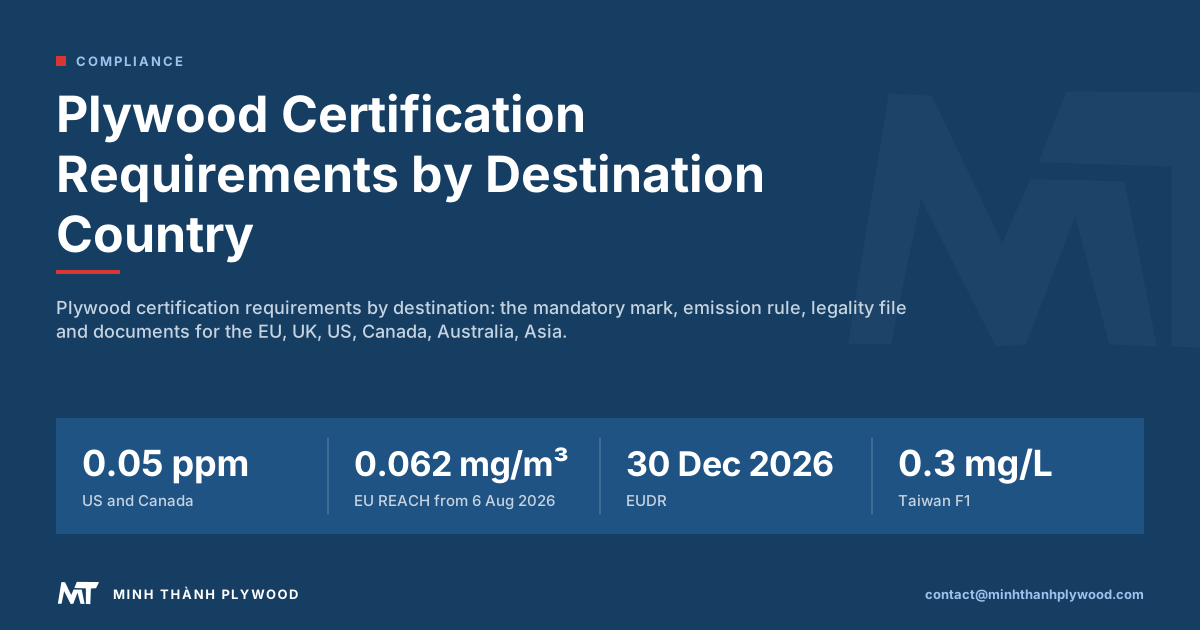
What certificates does plywood from Vietnam need in Australia, Canada, Mexico, Israel, Thailand and EU countries?
Plywood certification requirements by destination differ in what the border checks: a product mark (the Philippines, Taiwan, India), a formaldehyde label (the US, Canada), or a legality file (the EU, the UK, Australia, Korea). Read your country’s row, then the section below it. Every row was checked against an official or standards source on 20 October 2026.
| Destination | Mandatory product mark | Formaldehyde rule | Legality file | Filed or issued by |
|---|---|---|---|---|
| European Union | CE + DoP only for construction plywood (EN 13986) | REACH Annex XVII entry 77, from 6 August 2026 | EUTR now; EUDR statement from applicable date (30 Dec 2026 for plywood operators) | EU operator (importer) |
| United Kingdom | UKCA or CE for construction plywood | Buyer specification (E1 usual) | UK Timber Regulations due diligence | UK importer |
| United Kingdom, marine plywood | BS 1088 compliance, third-party Q-Mark recommended | Buyer specification | UK Timber Regulations due diligence | UK importer |
| United States | None for the product; TSCA Title VI label on the panel | TSCA Title VI, 0.05 ppm | Lacey Act declaration (PPQ 505) | US importer of record |
| Canada | CSA O121 / O151 only for structural use | SOR/2021-148: covered non-structural hardwood plywood, 0.05 ppm, label | None plywood-specific | Canadian importer |
| Australia | AS/NZS 2269 only for structural use | Buyer specification (E0 usual) | Illegal-logging due diligence | Australian importer |
| New Zealand | AS/NZS 2269 only for structural use | Buyer specification | Biosecurity import health standard | NZ importer |
| Japan | JAS for structural plywood | F☆☆☆☆ class for interior building use | Revised Clean Wood Act legality check | Japanese importer |
| South Korea | KS for plywood sold as KS product | Buyer specification | KFS import declaration + legality documents | Korean importer |
| India | ISI Standard Mark (IS 303, IS 710) | Within IS 303 | None plywood-specific | Foreign mill holds the licence from the Bureau of Indian Standards |
| Philippines | ICC sticker (PNS 196) | Within PNS 196 | None plywood-specific | DTI-BPS issues ICC to the importer |
| Taiwan | BSMI inspection mark (CNS 1349) | F1, F2 or F3 grade on the panel | None plywood-specific | BSMI, importer applies |
| Thailand | TIS 178 cited by buyers | Buyer specification | None plywood-specific | Importer |
| Indonesia | Check SNI registration with the importer | Buyer specification | Import documents per trade ministry rules | Indonesian importer |
| Israel | SII standard SI 37 (plain plywood) | SI 37 formaldehyde clause, ISO 12460-3 method | None plywood-specific | Israeli importer |
| Mexico | No plywood-specific NOM mark | Buyer specification | Phytosanitary rules per SENASICA | Mexican importer |
| GCC (Saudi Arabia, UAE) | Project specification; SASO or GSO where cited | Project specification | None plywood-specific | Importer and consultant |
The pattern is simple. Construction use triggers a structural mark (CE, UKCA, CSA, AS/NZS, JAS). Indoor use triggers a formaldehyde rule. Timber of any use triggers a legality file in the EU, the UK, Australia, Japan, Korea and the US. Three Asian markets add a national product mark at the border.
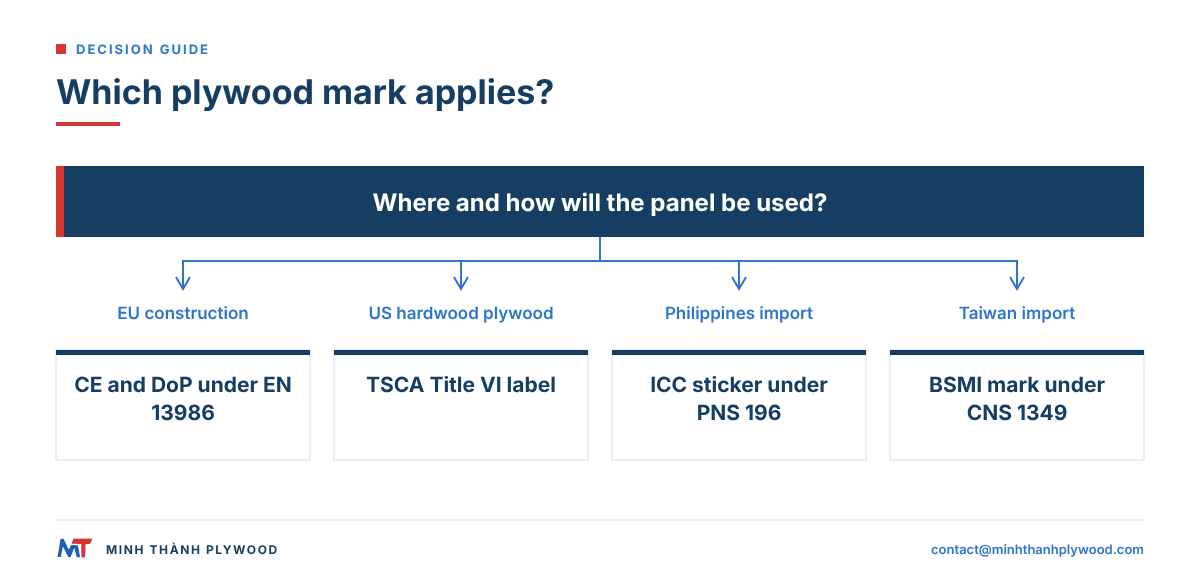
What the mill supplies and what the importer files
The importer, or its customs broker, files every destination declaration; the mill supplies the evidence those filings need. That split decides who does what before the container is loaded, and it prevents the most common delay: a filing that cannot be completed because a species or a test report is missing.
| Evidence | Supplied by the mill | Used by the importer for |
|---|---|---|
| Face and core species, scientific names | Yes, per order | Lacey Act, EUDR, Australian due diligence, Korean legality check |
| Country and plot of harvest | Yes, with geolocation files | EUDR statement from its application date |
| Formaldehyde certificate and test report | Yes (CARB P2 / TSCA Title VI, chamber tests) | US and Canada labels, REACH, buyer specification |
| Product label on the panel | Yes, printed before packing | TSCA Title VI, SOR/2021-148, BSMI, ICC |
| Commercial invoice, packing list, B/L | Yes | Customs entry everywhere |
| Certificate of origin (EUR.1 for the EU) | Yes | Preferential duty |
| Phytosanitary and fumigation certificates | Yes, where the destination asks | Biosecurity clearance |
| ISPM 15 marks on pallets and dunnage | Yes, on solid wood pallets, bearers and dunnage | Biosecurity clearance; plywood itself is generally exempt |
| Declaration of Performance | Only for CE-marked construction plywood | EU construction products |
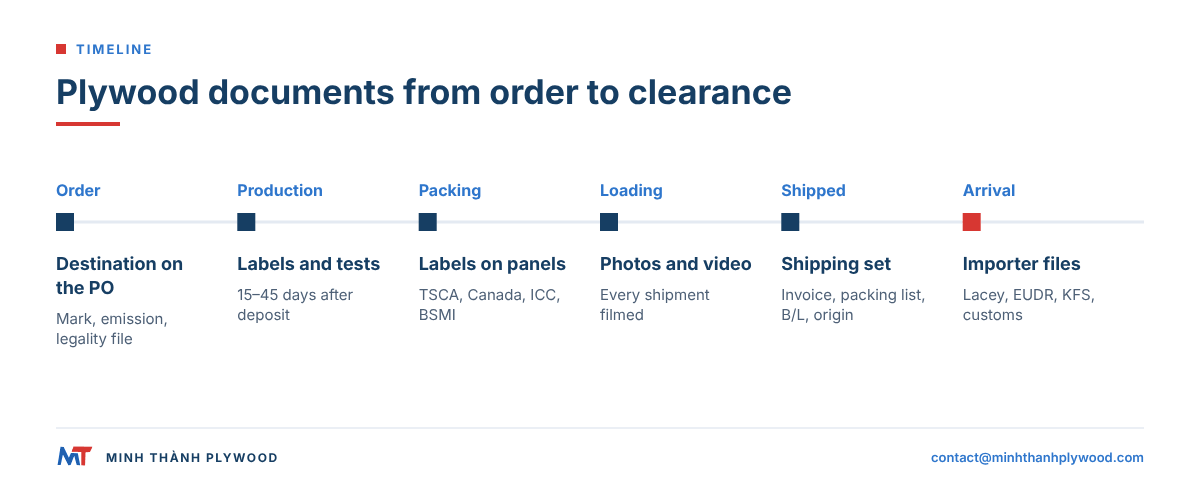
Agree the list with the purchase order. Labels are printed and test reports issued during production, which takes 15–45 days after the 30% deposit, so a document requested after loading is late.
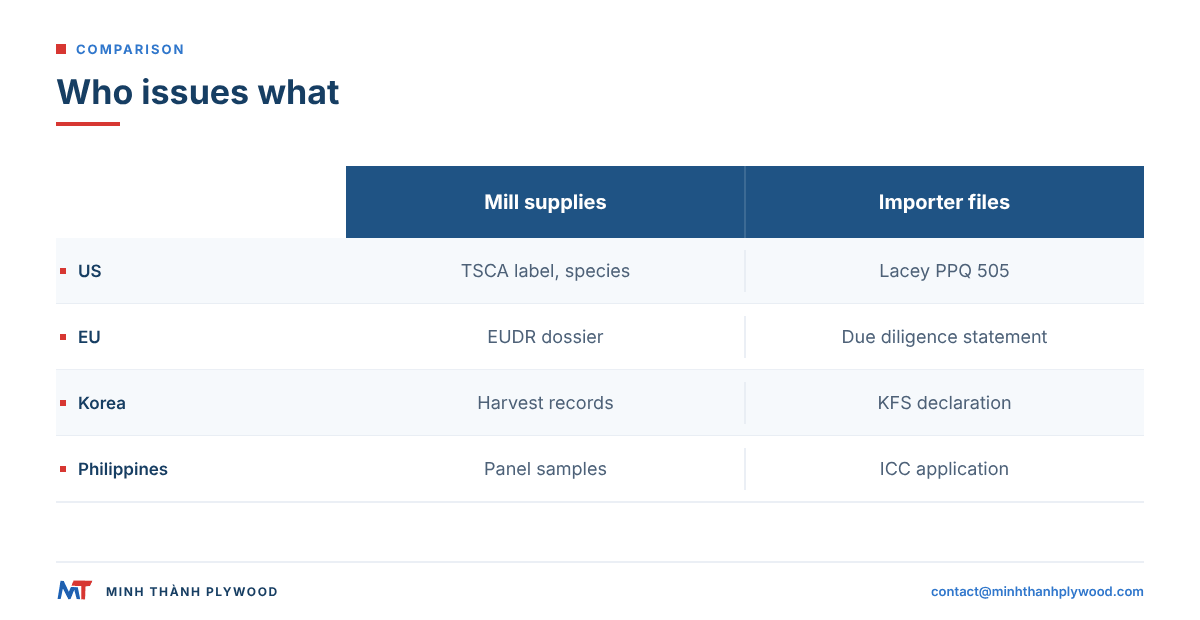
European Union: CE marking, EUDR and REACH formaldehyde
Until EUDR begins applying, importers placing plywood on the EU market must follow the EUTR timber-legality due diligence rules. The European Commission’s EUTR guidance confirms that EUTR continues until 30 December 2026.
From the applicable EUDR date, in-scope plywood importers must meet the new duties, including an upstream operator’s due diligence statement. For EUTR-covered plywood, the main start date is 30 December 2026, including micro and small operators dealing in those products; the later 30 June 2027 date is for other eligible micro and small operators. See the Commission’s application timetable.
For construction plywood, check the Declaration of Performance and CE marking under EN 13986. The EU’s REACH restriction on formaldehyde in wood-based articles has applied since 6 August 2026, including to relevant furniture panels.
- EUDR, from its application date. Regulation (EU) 2023/1115 establishes the due diligence statement duty for in-scope plywood once the relevant operator and product obligations start. The European Commission’s implementation update, checked 3 November 2026, gives 30 December 2026 for large/medium operators and for micro/small operators trading products already covered by EUTR, including plywood; 30 June 2027 applies to other eligible micro/small operators. Before that date, the current EUTR due diligence rules remain relevant. Our EUDR timeline tracks the dates.
- CE marking. The Construction Products Regulation makes a Declaration of Performance and CE marking mandatory for plywood placed on the market as a construction product. The assessment is against EN 13986. Furniture, packing and interior joinery plywood does not need one.
- REACH formaldehyde. Commission Regulation (EU) 2023/1464 sets 0.062 mg/m³ for formaldehyde released by wood-based articles from 6 August 2026, measured by the chamber method the regulation names.
- Customs. Commercial invoice, packing list, B/L and EUR.1 for the preferential rate under the EU–Vietnam agreement.
For Minh Thanh orders to Europe, we supply the EUDR compliance dossier (origin records and geolocation files) with orders. Panels meet the emission and quality requirements European furniture buyers ask for; CARB P2 / TSCA Title VI certification and six ASTM D6007 chamber tests averaging 0.014–0.032 ppm are the proof, and third-party testing to EN 717-1 is arranged through SGS on request. Our EUTR and EUDR comparison explains what changed.
United Kingdom: UKCA, timber due diligence and buyer emission specs
The UK requires timber due diligence from the importer under the UK Timber Regulations, and UKCA or CE marking only for plywood placed on the market as a construction product. There is no UK formaldehyde import limit for plywood; buyers write E1 or lower into the order.
The UK government guidance on timber and FLEGT licences, checked 20 October 2026, describes the due diligence system: information on species, country of harvest and supplier, a risk assessment, and mitigation. Northern Ireland follows EU rules for goods, so an order to Belfast follows the EU row.
Marine and specialist plywood in the UK. Marine plywood is bought to BS 1088. The BM TRADA Q-Mark scheme page, checked on 21 October 2026, states that the Timber Trade Federation requires all marine plywood sold by its members to comply with BS 1088 and recommends independent third-party quality assurance for any claim of compliance; BM TRADA operates the Q-Mark under Approved Body number 1224.
A UK marine buyer therefore asks for the BS 1088 claim and a third-party certificate, not a supplier statement. Minh Thanh supplies phenolic plywood to the EN 636-3 and EN 314-2 class 3 bond, and quotes a BS 1088 build only against a third-party test report for that build.
UK structural specifications also use bonding classes from EN 314-2. Our guide to class 2 and class 3 plywood shows which class a UK use calls for. For a furniture order, write the bond, the emission class and the face grade on the purchase order, and ask for the test report that backs the emission line.
United States: TSCA Title VI label and the Lacey Act declaration
Hardwood plywood imported into the US must come from a mill certified under TSCA Title VI, carry the TSCA Title VI label, and be declared under the Lacey Act by the importer. The emission limit for veneer-core hardwood plywood is 0.05 ppm.
- TSCA Title VI. The US EPA formaldehyde standards, checked 20 October 2026, require certification by an EPA-recognised third-party certifier, a label on each panel or bundle, and a compliance statement on the invoice. The California Air Resources Board runs the matching CARB Phase 2 programme.
- Lacey Act. The importer files the Plant and Plant Product Declaration (PPQ 505) with the genus, species and country of harvest of every wood in the panel.
- Importer Security Filing. The broker files cargo data at least 24 hours before loading in Vietnam.
Minh Thanh Plywood is CARB P2 / TSCA Title VI certified (ICTT mill no. 23024). US panels carry the TSCA Title VI label with producer, lot and certifier number TPC-43; the invoice and B/L state TSCA Title VI compliance; we supply face and core species with Vietnamese harvest origin for the Lacey declaration. Our import documents checklist lists the full US set.
Is CSA O121 plywood required in Canada?
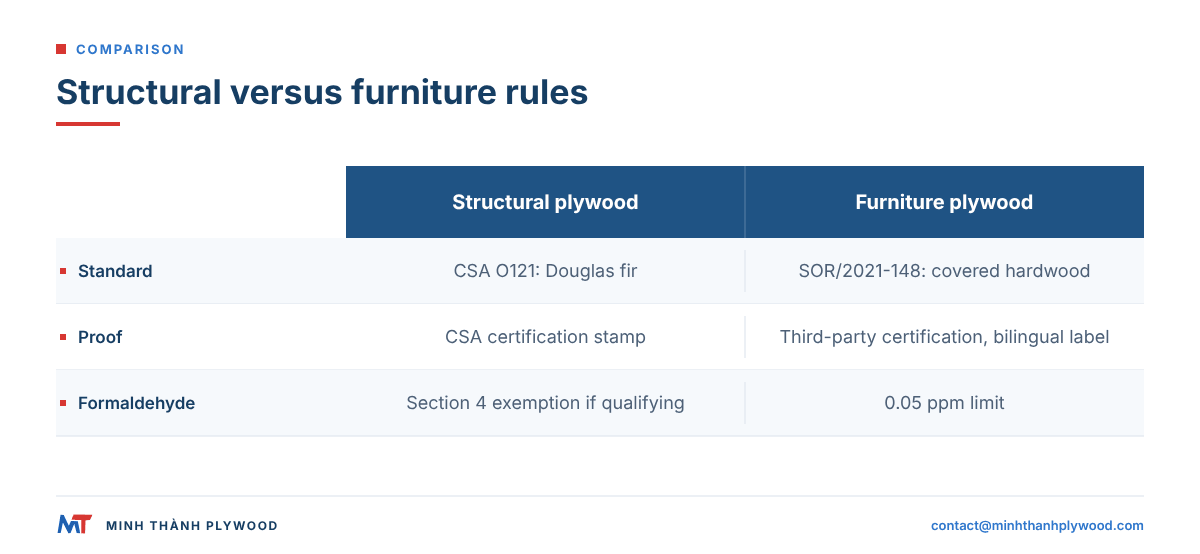
CSA O121 is required in Canada only for Douglas fir plywood sold for structural use. The formaldehyde rule covers non-structural hardwood plywood; qualifying structural plywood made with moisture-resistant adhesives is exempt under section 4. CSA O151 covers Canadian softwood plywood and CSA O153 poplar plywood, both structural.
The formaldehyde rule is the one that touches furniture and interior plywood. The Formaldehyde Emissions from Composite Wood Products Regulations (SOR/2021-148) set 0.05 ppm for hardwood plywood, the same limit as the US. Panels made in or imported into Canada from 7 January 2023 must comply, and laminated products have until 7 January 2028.
| Canada | Applies to | Proof |
|---|---|---|
| CSA O121 | Douglas fir structural plywood | CSA certification stamp |
| CSA O151 | Canadian softwood structural plywood | CSA certification stamp |
| SOR/2021-148 | Covered non-structural hardwood plywood, particleboard and MDF; structural exemption in section 4 | Third-party certification, bilingual label |
A furniture plant in Ontario that imports poplar-faced or birch-faced plywood therefore needs the formaldehyde label and certification, not a CSA O121 stamp. The CARB P2 / TSCA Title VI certificate and chamber reports are the evidence the Canadian certifier reviews.
What is the wood declaration for customs in Australia?
The wood declaration for customs in Australia is the importer’s illegal-logging due diligence for regulated timber products, plywood included. The old Community Protection Question at the border was removed on 3 March 2025, when the reformed Illegal Logging Prohibition Act and Rules 2024 took effect.
The Department of Agriculture, Fisheries and Forestry importer guidance, checked 20 October 2026, says importers must keep a written due diligence system, gather information, assess and mitigate risk, and keep records. A new notice, an e-declaration of species and harvest location, is written into the Act but will start only when the department’s system is ready.
Biosecurity is a separate file. The importer’s broker selects the plywood pathway in BICON, the import conditions database, and the department’s 2017 review placed plywood on the low-risk wooden article list. Solid timber packaging follows its own rules, so packs on plywood bearers or ISPM 15 pallets avoid questions.
For Australian orders we supply the species of every veneer and the Vietnamese harvest origin of the core. Structural uses in Australia need AS/NZS 2269 certified plywood; furniture, joinery and packing panels do not. The Australian import guide walks through clearance.
New Zealand: biosecurity and structural standards
New Zealand checks imported plywood through its biosecurity import health standard and asks for AS/NZS 2269 only when the panel is used structurally under the building code. There is no national formaldehyde import limit; buyers specify the emission class.
The Ministry for Primary Industries, checked 20 October 2026, sends plywood and veneer to the Import Health Standard for wooden panels; since its 2015 changes, products it rates low risk need no inspection or treatment on arrival. Packaging is checked separately, so ISPM 15 marks on any solid wood pallet matter. Structural bracing, flooring and roofing in New Zealand use AS/NZS 2269 plywood with a certified stamp; joinery, cabinetry and packing panels are bought on the buyer’s specification.
Japan: JAS and the F-star formaldehyde classes
Japan requires JAS certification for plywood sold as structural plywood and uses the F☆☆☆☆ class under the Building Standards Act to decide whether a panel can be used without area limits in interiors. F☆☆☆☆ has no indoor-use limit; F☆☆☆ is limited by area and ventilation.
JAS certification is issued by registered certification bodies after a factory audit, and the star class is printed on the panel stamp. Japan’s revised Clean Wood Act, in force from 1 April 2025, makes legality confirmation a duty for timber importers, so Japanese buyers ask for the species and origin of every veneer, imported faces included. Non-structural interior lots are often bought to a star class without a full JAS grade, so read the purchase order line.
South Korea: KFS import declaration and KS standards
South Korea requires the importer of plywood (HS 4412) to file an import declaration with the Korea Forest Service (KFS) and pass a legality document check before customs clearance, under Korea’s timber legality law. KS standards apply when the buyer orders a KS product.
The KFS detailed standards, as summarised by Forest Trends, accept FSC or PEFC certificates, FLEGT licences, or other legality documents such as harvest permits and origin records. A designated inspection agency reviews them per import, and unverified timber can be returned or destroyed.
For a Korean order, the Vietnamese harvest records and geolocation files we prepare for EUDR double as the legality document set. The certificate of origin form AK supports the preferential tariff under the ASEAN–Korea agreement.
India: the ISI Standard Mark for plywood
India requires the ISI Standard Mark of the Bureau of Indian Standards on general-purpose plywood (IS 303) and marine plywood (IS 710) under the Plywood and Wooden Flush Door Shutters (Quality Control) Order, 2024, which took effect from 28 February 2025 for large mills. A foreign mill needs its own licence through the Foreign Manufacturers Certification Scheme.
The licence belongs to the factory, not the trader, and it names the products and standards in scope. Check the licence number on the Bureau of Indian Standards portal and make sure the legal entity matches the invoice. Small and micro mills had later dates in 2025.
Philippines: PNS 196 and the ICC sticker
The Philippines lists plywood under mandatory product certification: imported plywood needs an Import Commodity Clearance (ICC) from the DTI Bureau of Philippine Standards, based on testing to PNS 196, and each panel carries the ICC sticker. Department Administrative Order 20-06, series of 2020, sets the current scheme.
The BPS product certification page, checked 20 October 2026, describes the ICC: the importer applies, samples are tested by a BPS or BPS-recognised laboratory, and the stickers are applied before the goods are sold. The Bureau of Customs releases the shipment against the clearance, and online marketplaces may not sell plywood without the mark.
Send the importer the panel build, glue type and thickness list early, because the ICC test samples come from the shipment or a pre-shipment lot.
Taiwan: BSMI inspection under CNS 1349
Taiwan’s Bureau of Standards, Metrology and Inspection (BSMI) has inspected imported plywood for formaldehyde and labelling since 1 July 2007, under CNS 1349 and related standards. Each panel shows the commodity inspection mark, the formaldehyde grade F1, F2 or F3, the manufacturer or importer, the batch and the place of origin.
The limits are set by desiccator test: F1 averages 0.3 mg/L and F3 averages 1.5 mg/L under the BSMI notices. Interior furniture buyers in Taiwan usually order F1. Agree with the importer who prints the inspection mark and the grade label before packing.
Thailand, Indonesia and Israel: national standards buyers cite
Thailand, Indonesia and Israel each have a national plywood standard that importers and projects cite, and the importer confirms with its own authority whether the standard is mandatory for the product code.
- Thailand. TIS 178-2549 is the Thai plywood standard. The Thai Industrial Standards Institute keeps the list of mandatory standards; a product under a mandatory standard needs a TISI licence and mark before sale.
- Indonesia. Indonesia’s national standard (SNI) system covers wood panels, and SVLK, the national timber legality system, applies to Indonesian production and exports. The importer checks the SNI registration and import rules for the HS code.
- Israel. The Standards Institution of Israel publishes SI 37 for plain plywood. A 2024 amendment notified to the WTO aligned its formaldehyde clause with the ISO 12460-3 gas analysis method.
For all three, a CARB P2 / TSCA Title VI certificate and a chamber test report are the emission proof buyers ask for first, and an SGS test to the buyer’s method closes any gap.
Mexico, the Gulf states, Singapore and Morocco
Mexico, the Gulf states, Singapore and Morocco set no plywood-specific product mark at the border; the importer’s broker sets the phytosanitary file and the project or buyer sets the specification. The documents that clear the goods are the customs set plus any plant-health certificate the importer’s authority names.
- Mexico. NOM-016-SEMARNAT-2013 regulates imported sawn wood; for plywood the broker checks SENASICA’s phytosanitary requirements module for the HS code.
- Saudi Arabia and the UAE. Tenders name the standard (SASO, GSO, EN or BS) and the fire or emission class; there is no Gulf-wide plywood certificate.
- Singapore. Green building projects ask for a Singapore Green Building Council label on some products; ordinary imports clear on the customs set.
- Morocco. Imports clear on the customs set, the certificate of origin and the phytosanitary certificate where the importer’s broker asks for it.
Ask the buyer for the tender clause or the broker’s document list, and quote against it.
How to verify a certificate before you order
Verify each certificate in the register of the body that issued it before the order is placed, because a copied PDF proves nothing. Four checks cover most markets:
- FSC chain of custody. Search the certificate code in the FSC certificate database, and confirm the mill, the product group and the claim on the invoice.
- CARB P2 and TSCA Title VI. Look up the mill’s third-party certifier listing and the mill number; ours is ICTT mill no. 23024.
- CE marking. Check that the declaration of performance names the product, the EN 13986 standard and the notified body number.
- Bureau of Indian Standards licence for India. Search the licence number on the Bureau of Indian Standards site against the IS 303 or IS 710 product named.
Ask the supplier to name which of the four apply to your destination before quoting; a mill that cannot name its certificate numbers is not ready for that market.
Why FSC, PEFC and ISO 9001 are buyer requirements, not border rules
FSC, PEFC and ISO 9001 are not mandatory for plywood imports in any of the sixteen markets; buyers, retailers and green building projects ask for them. Korea is the one market where FSC or PEFC certificates count as proof of legality at the border.
FSC chain of custody lets the buyer print an FSC claim on its own products. ISO 9001 shows a managed quality system. Minh Thanh holds ISO 9001:2015 for plywood manufacturing (KAC25/0185) and TCVN 11902:2017 for veneer-faced plywood (VietCert 141.1-VNC-HC); FSC and CE are available*. Our formaldehyde-free plywood guide explains the NAF and ULEF labels some US and Canadian projects add.
*Supplied directly or through qualified partner mills.
What Minh Thanh Plywood holds for each market
Minh Thanh Plywood, a manufacturer in Ha Hoa, Phu Tho, Vietnam, holds the emission certificate that opens North America and the evidence files that the EU, UK, Australia and Korea filings need.
| Market | What we supply |
|---|---|
| US | CARB P2 / TSCA Title VI certificate (ICTT mill no. 23024), TSCA Title VI label with certifier TPC-43, compliance statement on invoice and B/L, species and origin for Lacey |
| Canada | Same certificate and chamber reports for the SOR/2021-148 certifier |
| EU | EUDR compliance dossier (origin records and geolocation files), chamber reports, EUR.1, SGS test to EN 717-1 on request |
| UK and Australia | Species and harvest origin for due diligence, chamber reports |
| Korea | Harvest records and geolocation files for the KFS legality check, form AK |
| Philippines, Taiwan | Panel build and samples for ICC or BSMI testing; labels printed to the importer’s artwork |
| All markets | Commercial invoice, packing list, B/L, certificate of origin, phytosanitary and fumigation certificates, PPWR packaging test (SGS, September 2026) |
Six ASTM D6007 chamber tests between April 2025 and June 2026 on 9, 15 and 18 mm panels averaged 0.014–0.032 ppm against the 0.05 ppm limit: three by Shanghai Hongjun (HJ-QAT reports) and three by ICTT Vietnam (ICTTVN-QAT reports). Every shipment is photographed and filmed before loading, and buyers get the photos and video.
How to put plywood certification requirements by destination on the order
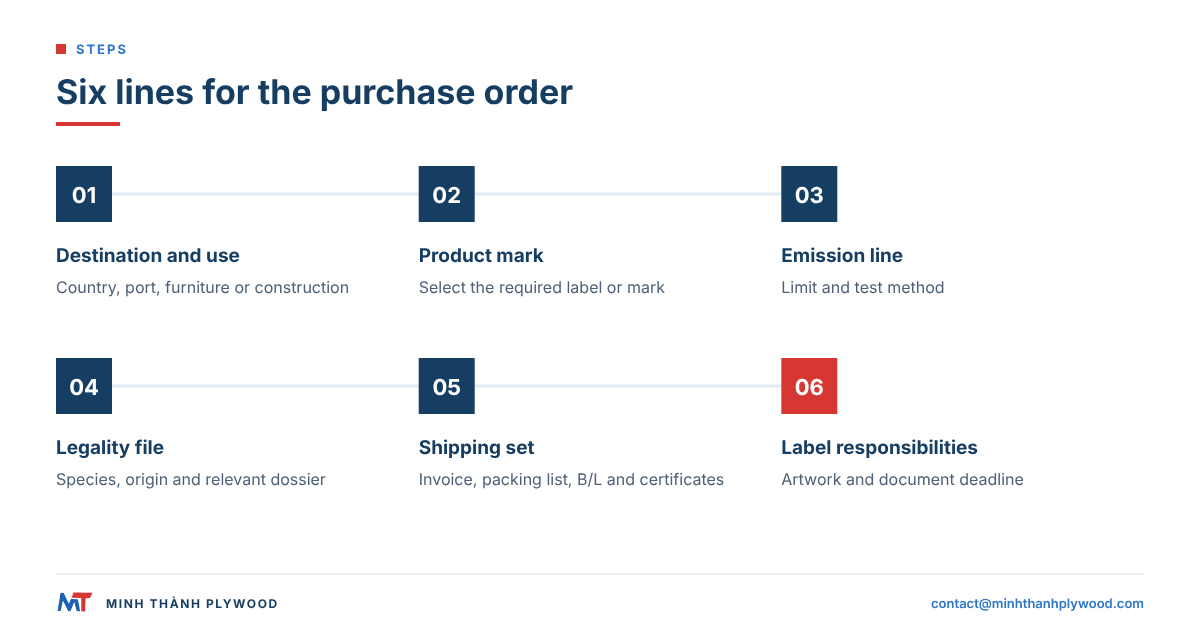
Write the destination market and the documents it needs on the purchase order, so the mill prints the right labels and issues the right files during production. Six lines are enough.
- Destination and use. Country, port and use: furniture, construction, packing.
- Product mark. TSCA Title VI label, SOR/2021-148 label, ICC sticker, BSMI mark, or none.
- Emission line. The limit and method: 0.05 ppm ASTM D6007, E1 by EN 717-1, F1 by CNS 1349.
- Legality file. EUDR dossier, Lacey species list, KFS legality documents.
- Shipping set. Invoice, packing list, B/L, origin certificate form, phytosanitary and fumigation.
- Who prints what. Label artwork and the date the importer needs it.
Send the six lines with the specification to contact@minhthanhplywood.com or WhatsApp +84 988 586 601 (Lisa). We reply within hours, Monday–Friday, 08:00–17:00 Vietnam time, and free samples go out for testing before the order.
Buyer questions, answered
What certificates does plywood from Vietnam need?
Each destination has its own rules. The US requires TSCA Title VI labelling and Lacey Act declarations; Canada regulates covered non-structural hardwood plywood emissions. For EU plywood in November 2026, EUTR timber-legality duties still apply; EUDR begins on 30 December 2026 for the relevant timber operators. CE/DoP applies only to construction plywood.
Is there one certificate that covers every country?
No. Each market has its own product mark, emission rule and legality file. CARB P2 / TSCA Title VI certification is the emission proof most buyers outside North America also accept, and a chamber test report backs it.
Who files the import declaration, the mill or the importer?
The importer or its authorised representative handles destination filings: the Lacey Act declaration in the US, applicable EUDR due diligence statements in the EU from their start date, and Korean timber-legality import filings. The mill supplies species, harvest-origin and test evidence.
Do I need CE marking for furniture plywood in the EU?
No. CE marking and a Declaration of Performance under EN 13986 apply to construction plywood, not furniture panels. Furniture plywood still needs the applicable timber-legality file (EUTR before EUDR begins) and must meet the REACH formaldehyde limit from 6 August 2026.
What is a wood declaration for customs in Australia?
Australian importers of regulated timber products such as plywood must run illegal-logging due diligence and keep records. The old Community Protection Question was removed on 3 March 2025; a new e-declaration of species and harvest location will follow when the department's system is ready.
Is CSA O121 required for plywood imported into Canada?
CSA O121 is required only when plywood is sold as Douglas fir structural plywood for construction. Covered non-structural hardwood plywood must meet the 0.05 ppm formaldehyde limit and labelling requirements under SOR/2021-148; qualifying structural plywood is exempt.
Does the Philippines require a certificate for imported plywood?
Yes. Plywood is on the Philippine mandatory certification list. The importer needs an Import Commodity Clearance from DTI-BPS, based on PNS 196 testing, and each panel carries the ICC sticker.
Which plywood mark does Taiwan require?
Taiwan's BSMI inspects imported plywood for formaldehyde and labelling under CNS 1349. Each panel shows the commodity inspection mark, its formaldehyde grade F1, F2 or F3, the importer and the batch.
Is FSC certification mandatory for plywood imports?
No country makes FSC mandatory for plywood imports. FSC is a buyer or project requirement, and in Korea it is one accepted proof of legality. Minh Thanh Plywood offers FSC-certified plywood as available*.
What does Minh Thanh Plywood hold?
CARB P2 / TSCA Title VI certification (ICTT mill no. 23024), ISO 9001:2015 (KAC25/0185) and TCVN 11902:2017 (VietCert 141.1-VNC-HC). We supply the EUDR compliance dossier with orders; FSC and CE are available*.
How long before shipment should I agree the documents?
Agree the document list with the purchase order, before production starts. Production takes 15–45 days after the deposit, and labels, test reports and origin files are prepared during that time.