
The EUTR, the EU Timber Regulation of 2010, bans illegally harvested timber and makes importers run due diligence on legality. The EUDR replaces it from 30 December 2026 and goes further: plywood must also be deforestation-free since 2020, traced to plot geolocation, and covered by a due diligence statement. Minh Thanh Plywood supplies the EUDR compliance dossier with orders.
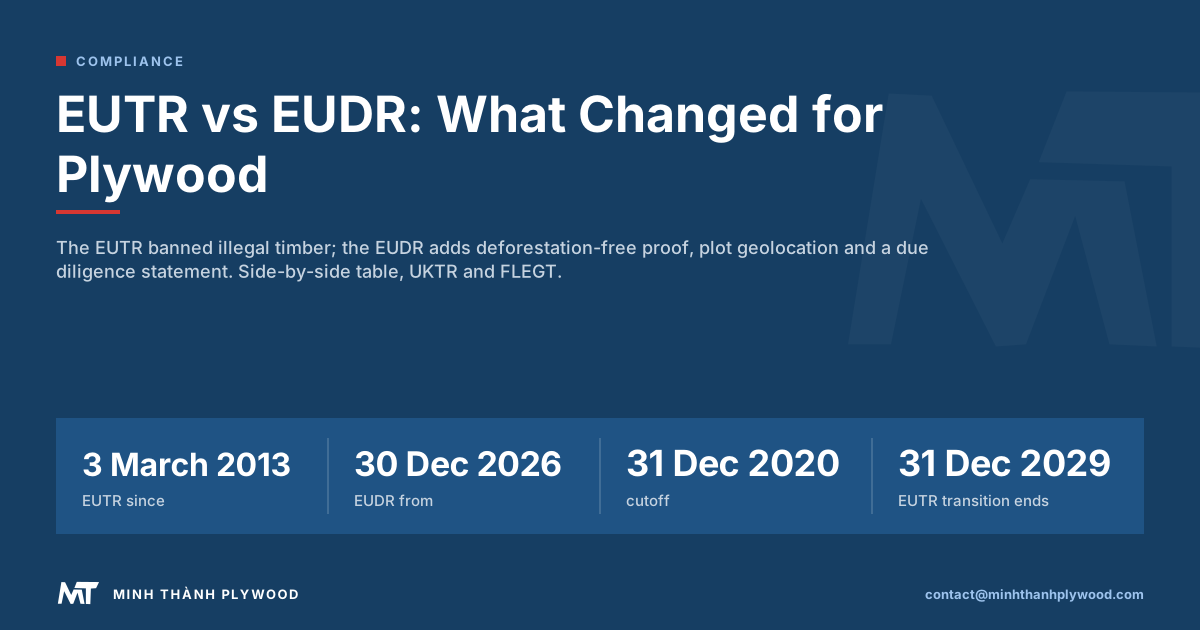
What is the difference between the EUTR and the EUDR?
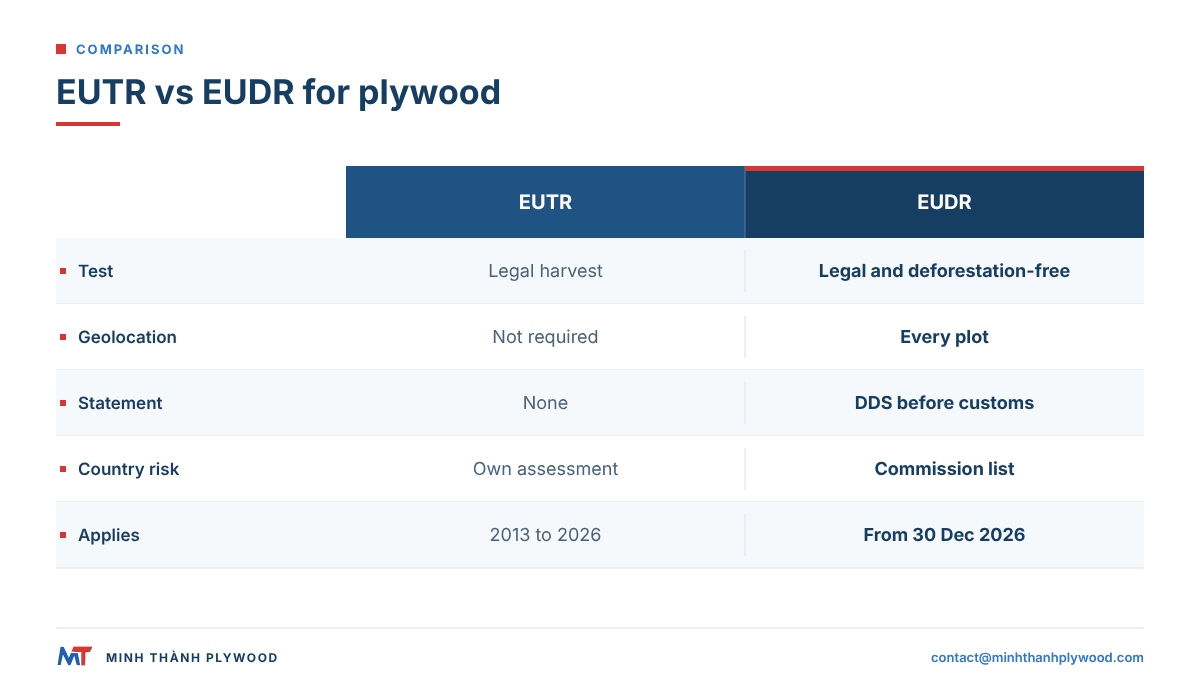
The EUTR checks that timber was harvested legally; the EUDR checks legality and that the wood did not come from land deforested or forest degraded after 31 December 2020. The EUDR also asks for something the EUTR never did: the geolocation of every plot the wood came from, and a due diligence statement filed before customs clearance.
| Metric | EUTR, Regulation (EU) No 995/2010 | EUDR, Regulation (EU) 2023/1115 |
|---|---|---|
| Applies | From 3 March 2013 until 30 December 2026 | From 30 December 2026 |
| Commodities | Timber only | Wood, cattle, cocoa, coffee, oil palm, rubber, soya |
| Plywood | Covered (4412 in the annex) | Covered (ex 4412 in Annex I) |
| Core test | Legally harvested | Legal and deforestation-free since 31 December 2020 |
| Forest degradation | Not tested | Tested for wood |
| Geolocation of plots | Not required | Required, at least six decimal digits; polygons over four hectares |
| Statement to authorities | None | Due diligence statement in the EU information system |
| Customs link | None | DDS reference number on the customs declaration |
| Country risk | Assessed by each operator | Commission list: low, standard, high |
| Downstream duties | Traders keep records one step up and down | Downstream operators and traders keep DDS reference numbers |
| FLEGT licence | Deemed legal | Deemed legal; deforestation still checked |
| Penalties | Set by member states | Minimums set: fines up to at least 4 % of EU turnover |
The question Italian buyers ask, “qual è la differenza tra EUDR e EUTR”, has the same answer in any language: the EUTR asked “is it legal?”, the EUDR asks “is it legal, deforestation-free and traceable to the plot?”
What was the EUTR, the EU timber regulation, and does it still apply?
The EUTR, Regulation (EU) No 995/2010, is the EU Timber Regulation that has banned illegally harvested timber and timber products from the EU market since 3 March 2013 (Regulation (EU) No 995/2010). It still applies until the EUDR takes over on 30 December 2026, and after that only to old timber during a transition (Regulation (EU) 2025/2650).
The EUTR placed three duties on the timber trade:
- Prohibition: operators may not place illegally harvested timber or products made from it on the EU market.
- Due diligence: operators, the first to place timber on the market, run a system of information, risk assessment and risk mitigation.
- Traceability: traders further down the chain keep records of who supplied them and whom they supplied.
Plywood has been in the EUTR annex from the start, so EU plywood importers have run legality due diligence for more than a decade. That experience carries over; the EUDR adds new data, a new test and a statement.
What is the EUDR, and how does it differ?
The EUDR, Regulation (EU) 2023/1115 on deforestation-free products, bans seven commodities and their products from the EU market unless they are deforestation-free, legally produced and covered by a due diligence statement. For plywood it builds on the EUTR in four ways.
- A new test. Wood must come from land that was not deforested, and from forest that was not degraded, after 31 December 2020.
- New data. The importer collects the geolocation of every plot and the harvest date or period (Article 9).
- A statement. A due diligence statement is filed in the EU information system before the customs declaration.
- A wider net. Six more commodities, a Commission country risk list and minimum penalties.
The legality test survives intact. Under the EUDR, “legally produced” covers land-use rights, environmental and forest rules, labour and human rights, tax and trade rules, and the rights of indigenous peoples in the country of production.
When does the EUDR replace the EUTR?
The EUDR replaces the EUTR on 30 December 2026, the date its operator duties apply, after two 12-month delays. Plywood importers of every size start on that date: the later 30 June 2027 date for micro and small operators excludes products listed in the EUTR annex, and plywood is one of them.
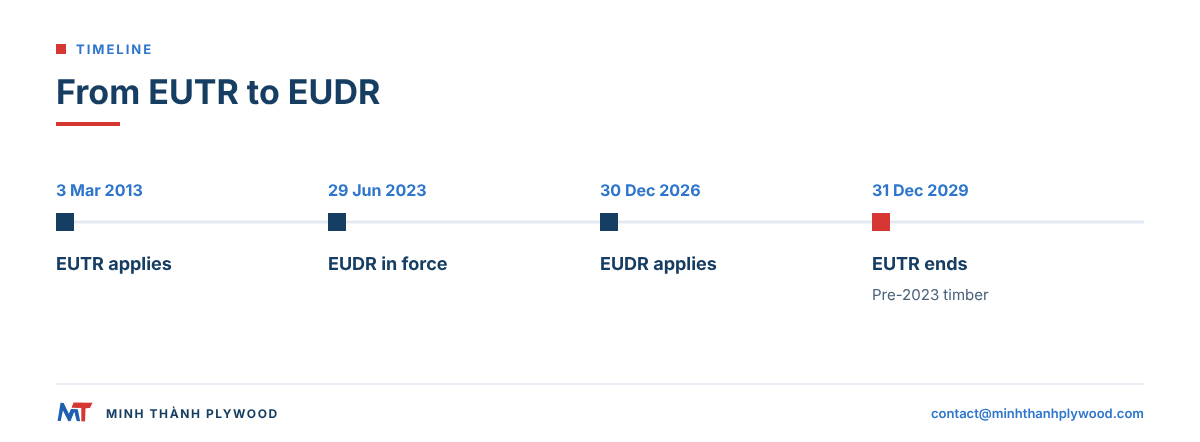
| Date | What happens |
|---|---|
| 3 March 2013 | EUTR applies |
| 29 June 2023 | EUDR enters into force; wood produced from this date falls under it |
| 30 December 2026 | EUDR applies; EUTR repealed for new timber |
| 31 December 2029 | EUTR ends for timber produced before 29 June 2023 and placed on the market from 30 December 2026 |
The transition rule in Article 37(2), as amended by Regulation (EU) 2025/2650, matters for stock. Plywood made from logs harvested before 29 June 2023 can still reach the market under EUTR rules until the end of 2029. Our EUDR delay guide explains every amendment and date.
EUTR due diligence, plywood import to the EU from Vietnam: what the EUDR adds
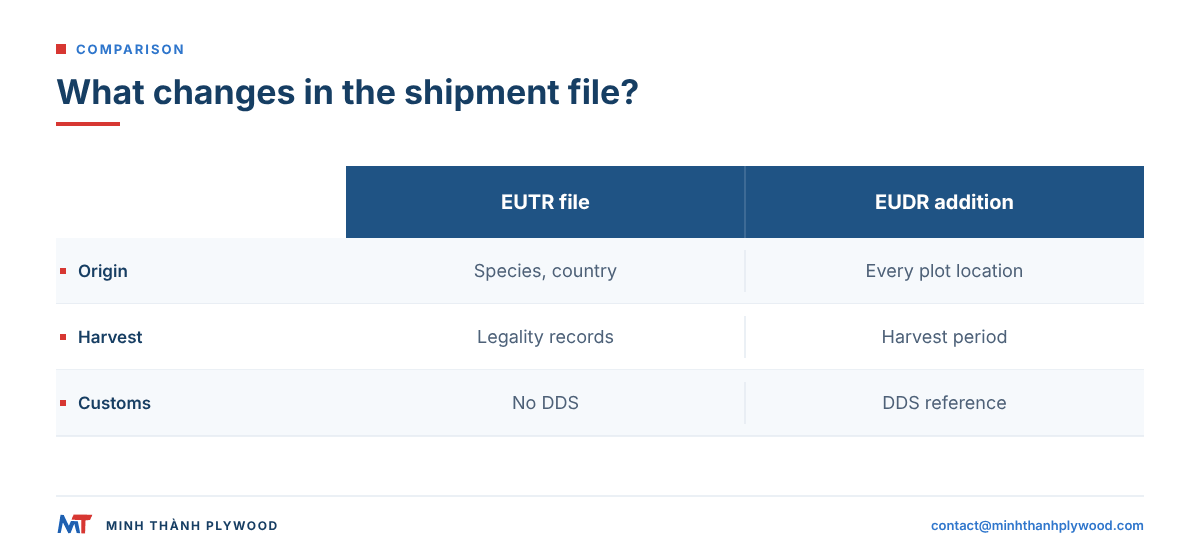
EUTR due diligence, plywood import to the EU from Vietnam: under the old rules the file rested on legality documents such as harvest permits, transport records and the species. The EUDR places its wider duties on the EU importer too, but the importer can only meet them with data from the Vietnamese supplier. A mill exporting plywood to the EU after 30 December 2026 must hand over, for every product line, the information in Article 9 of the regulation.
| Data the importer needs | What the supplier provides |
|---|---|
| Product description and trade name | Thickness, face, core and glue, as on the invoice |
| Species, common and scientific names | Every species in face, back and core |
| Quantity | Cubic metres and sheets per line |
| Country of production | Vietnam, and the country of any imported veneer |
| Geolocation of every plot | GeoJSON files: points or polygons, six decimal digits |
| Date or time range of harvest | Per plot or per purchase lot |
| Legality evidence | Harvest permits, land-use rights, transport records |
At Minh Thanh this is routine. We supply the EUDR compliance dossier, origin records and geolocation files, with orders. Our cores are plantation-grown Vietnamese wood: Styrax and Eucalyptus as standard, Acacia and Pine on order. See the EUDR traceability dossier for how it is built.
The biggest practical change is layer by layer. Under the EUTR a legality record for the panel was usually enough; under the EUDR the face veneer needs its own plot geolocation when it grew in a different forest from the core. We supply geolocation for both the imported face and the Vietnamese core (EUDR compliant plywood from Vietnam).
Vietnamese plywood and EUDR risk classification
Vietnam is classed as low risk under the EUDR by Commission Implementing Regulation (EU) 2025/1093 (Implementing Regulation (EU) 2025/1093). That lets an importer use simplified due diligence under Article 13 when every commodity in the plywood comes from low-risk countries.
Simplified due diligence keeps the information step and the statement. It drops the risk assessment and mitigation steps, unless the importer learns of a concern, and competent authorities check at least 1% of operators each year for low-risk origins, against 3% for standard and 9% for high risk.
The EUTR had no country list. Each importer judged Vietnam’s risk on its own, often with the help of a monitoring organisation. The EUDR list makes that judgement common to every importer and every member state.
EUTR vs EUDR in practice: a plywood import step by step
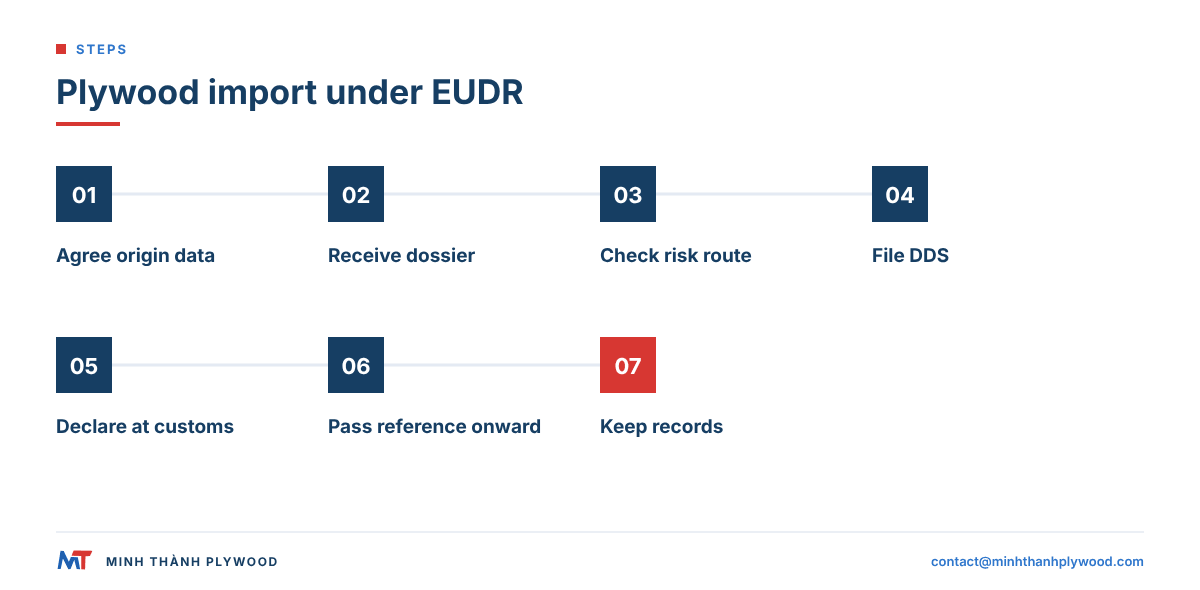
In practice the EUDR adds two steps to a plywood import and changes the timing of a third. The table follows one container of Vietnamese plywood under each regime.
| Step | Under the EUTR | Under the EUDR |
|---|---|---|
| Quotation | Species and country of harvest | Species, country, plot geolocation, harvest period agreed in the contract |
| Before loading | Legality documents collected | Origin dossier received and checked against Article 9 |
| Risk check | Importer’s own risk assessment | Simplified (low-risk Vietnam) or full due diligence |
| Before customs | Nothing filed | Due diligence statement filed; reference number obtained |
| Customs declaration | Normal | DDS reference number quoted |
| Sale in the EU | Trader records | Reference number passed on to customers |
| Records | Kept by the operator | Kept five years; system reviewed at least once a year |
The biggest practical change is timing. Under the EUTR an importer could finish the file after arrival; under the EUDR the statement must exist before the customs declaration. Late data now means a container waiting at the port.
How FLEGT licences fit under the EUTR and the EUDR
A FLEGT licence proves legal harvest under both regimes. Under the EUTR, timber with a valid FLEGT licence counted as legally harvested. Under the EUDR, wood products covered by a valid FLEGT licence from an operational licensing scheme are deemed to comply with the legality condition in Article 3(b) (Regulation (EU) 2023/1115, Article 10(3)).
A FLEGT licence does not prove deforestation-free origin. The importer still collects geolocation, still checks the land against the 31 December 2020 cutoff and still files the statement. FLEGT licences come only from countries whose Voluntary Partnership Agreement licensing system is operational; Indonesia has issued them since 15 November 2016.
Vietnam signed its Voluntary Partnership Agreement with the EU on 19 October 2018, in force from 1 June 2019. Its national timber legality assurance system (VNTLAS) sets the rules that Vietnamese mills follow for harvest and transport records. These records feed the legality part of an EUDR dossier.
How FSC certification fits into the EUDR
FSC certification supports an EUDR file but does not replace it. A certificate tells the importer the forest management and chain of custody were audited; it does not give the plot geolocation, the harvest dates or the deforestation check against the EUDR cutoff in the form the statement needs. The Commission has been clear that no certification scheme is a substitute.
Certified wood still helps. An importer running full due diligence can use certification as one input to the risk assessment, and a certified supply chain usually already holds the origin records an EUDR file needs. FSC is available* from Minh Thanh where buyers ask for it.
*Supplied directly or through qualified partner mills.
UKTR: what the UK kept
Great Britain did not adopt the EUDR. It kept the UK Timber Regulations 2013, a copy of the EUTR’s legality rules, so plywood entering Great Britain needs legality due diligence on the EUTR model. The UK’s separate forest risk commodities law in the Environment Act 2021 targets other commodities, not timber.
| Market | Rule for plywood | Core test | Geolocation |
|---|---|---|---|
| European Union | EUDR from 30 December 2026 | Legal and deforestation-free | Required |
| Great Britain | UK Timber Regulations 2013 | Legally harvested | Not required |
A mill supplying both markets prepares the EUDR dossier, which more than covers the UKTR file. Our planned guide on the UK Timber Regulation and plywood covers the British side.
Penalties under the EUTR and the EUDR
The EUTR left penalties to member states, and fines differed widely. In force since March 2013, it applied in the EU member states plus Iceland, Norway and Liechtenstein, and each of those jurisdictions wrote its own penalty regime, from administrative fines and seizure to criminal fines and suspension of trade. Fines could start from €50 with no upper limit, and the largest ran above €1,000,000. The cases below show what enforcement looked like for importers of wood products:
| Date | Authority | Fine | What the operator did wrong |
|---|---|---|---|
| November 2017 | United Kingdom (furniture retailer Lombok) | £5,000 | First UK business fined under the EUTR for non-compliance |
| January 2019 | Sweden | €62,800 | No proper due diligence on imported products such as gift bags and photo frames |
| March 2019 | Belgium | €12,000 | No due diligence on timber from high-risk countries |
| December 2019 | France | €5,000 | No risk assessment or mitigation for timber from high-risk countries including Bolivia, Brazil, Peru, Cameroon and Gabon |
| August 2020 | Denmark | €10,000 | Acted against an enforcement notice on teak imported from Myanmar |
The pattern is the same in every case: the fine fell on the importer, for a missing risk assessment or ignored notice, not for proof that the timber was illegal. The EUDR keeps that logic and raises the stakes. The EUDR sets minimum penalties in Article 25. For a company, the maximum fine must be at least 4 % of its total annual EU-wide turnover in the previous financial year, and it must rise for repeat breaches.
The EUDR adds confiscation of the products and of the revenue made from them, temporary exclusion from public procurement and public funding for up to 12 months, and a temporary ban on placing the commodity on the market. The Commission publishes a list of final judgments against companies (Article 25(3)).
EUTR, EUDR and EU duties on Chinese plywood: separate rules
Due diligence rules and trade duties are separate. The EUTR and the EUDR ask about legality and deforestation; anti-dumping duties ask about price and origin. Since 2025 the EU charges anti-dumping duties on hardwood plywood from China under Regulation (EU) 2025/2333; plywood of Vietnamese origin is outside that measure.
Origin matters for both. A Vietnamese certificate of origin settles the duty question, and the EUDR dossier settles the deforestation question for every species in the panel, including any imported face veneer.
EUDR checklist for European plywood buyers
Use this checklist to move a plywood supply chain from EUTR to EUDR before 30 December 2026. Each step builds on the EUTR system you already run.
- Keep your EUTR system running for every shipment placed on the market before 30 December 2026.
- List species per product, face, back and core, with scientific names.
- Ask each supplier for a sample dossier on a current shipment, with GeoJSON files.
- Check the files for six decimal digits and polygons over four hectares.
- Register in the EU information system and test a statement.
- Set simplified or full due diligence per product from the country risk of every species.
- Update contracts so the dossier arrives with the invoice for shipments landing after the date.
- Brief your customs broker to quote the DDS reference number.
- Tell your customers which reference numbers they will receive and keep.
- Keep records five years and review the system at least once a year.
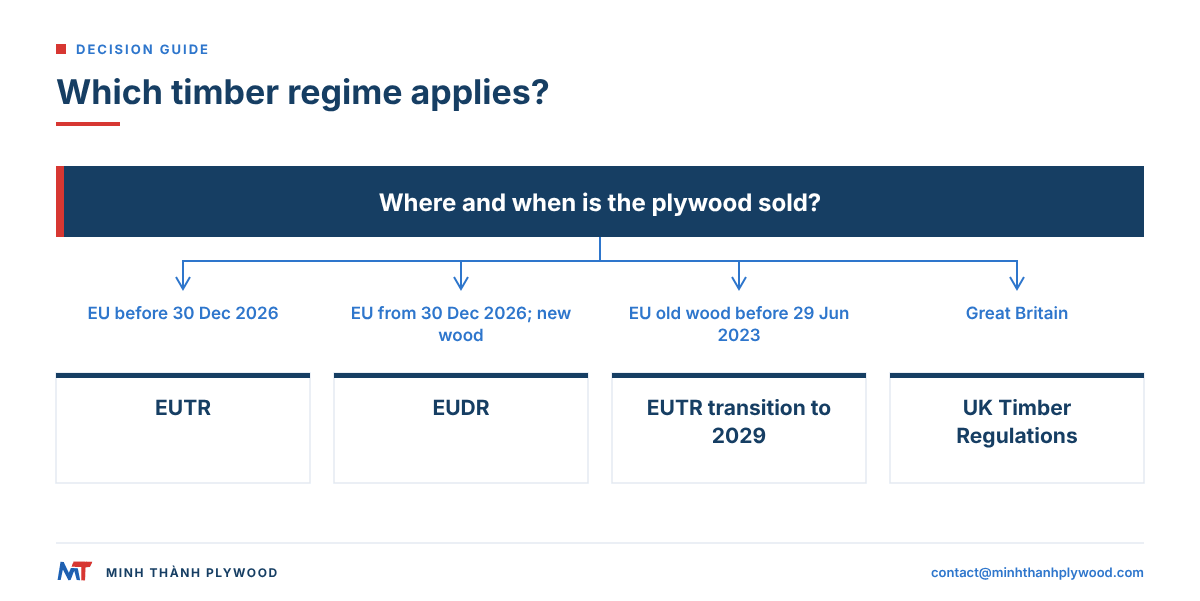
Which regime applies to your shipment? A verdict by case
The regime depends on when the plywood is placed on the market, when the wood was produced and where it is sold. Use the table for each shipment.
| Shipment | Regime | What you need |
|---|---|---|
| Placed on the EU market before 30 December 2026 | EUTR | Legality due diligence |
| Placed on the EU market from 30 December 2026, wood produced from 29 June 2023 | EUDR | Dossier, risk check, statement |
| Placed on the EU market from 30 December 2026, wood produced before 29 June 2023 | EUTR until 31 December 2029 | Legality due diligence and proof of the production date |
| Sold into Great Britain | UK Timber Regulations | Legality due diligence |
| Used or second-hand plywood | Outside the EUDR | Not in scope after the 2026 scope update |
For new production from Vietnam, the answer from 30 December 2026 is the EUDR. Plan every order arriving after that date on the EUDR basis.
What this means for your order
For plywood from Minh Thanh, the move from EUTR to EUDR does not change how you order, only what travels with the order. We supply the EUDR compliance dossier, origin records and geolocation files, with orders, and Vietnam’s low-risk status lets most of our panels use simplified due diligence.
Our standard terms: MOQ one 40HC with mixed specifications by agreement, production 15–45 days after the 30% deposit, balance 70% against the scanned B/L or irrevocable L/C at sight, FOB Hai Phong, CFR or CIF. Every shipment comes with the commercial invoice, packing list, B/L and certificate of origin (EUR.1 for the EU), and certificate files on order.
Ask for a sample dossier with your next quotation. See our furniture plywood range, the EUDR traceability dossier, the plywood import documents guide and more compliance guides.
Buyer questions, answered
What is the main difference between EUDR and EUTR?
The EUTR asks whether timber was harvested legally. The EUDR asks that and whether the land was deforested or the forest degraded after 31 December 2020, and it requires plot geolocation and a due diligence statement for each product placed on the market.
What was the EUTR and does it still apply?
The EUTR, Regulation (EU) No 995/2010, has banned illegal timber on the EU market since 3 March 2013. It applies until 30 December 2026, then only to timber produced before 29 June 2023, until 31 December 2029.
When does the EUDR replace the EUTR?
On 30 December 2026, when the EUDR's operator duties apply. Timber produced before 29 June 2023 and placed on the market from that date stays under the EUTR until 31 December 2029.
Does the EUDR apply to plywood imported from Vietnam?
Yes. Plywood is listed as ex 4412 in Annex I. From 30 December 2026 the EU importer must collect species, quantities and plot geolocation for every wood layer and file a due diligence statement before customs clearance.
Is FSC certification enough for EUDR compliance?
No. FSC can support the importer's risk assessment, but the EUDR still requires plot geolocation, harvest dates and a due diligence statement. No certificate replaces them.
What is Vietnam's risk classification under the EUDR?
Low risk, under Commission Implementing Regulation (EU) 2025/1093. Importers may use simplified due diligence when every commodity in the product comes from low-risk countries.
How do FLEGT licences fit under the EUDR?
A valid FLEGT licence from an operational licensing scheme counts as proof of legal production under the EUDR. It does not prove the wood is deforestation-free, so geolocation and the statement are still required.
Does the UK follow the EUDR?
No. Great Britain keeps the UK Timber Regulations, which mirror the EUTR's legality rules. Plywood shipped to Great Britain needs UKTR due diligence; plywood for the EU needs EUDR files.
What penalties apply under the EUDR compared with the EUTR?
The EUTR left penalties to member states. The EUDR sets minimums: fines with a maximum of at least 4 % of annual EU turnover, confiscation of goods and revenues, and exclusion from public procurement for up to 12 months.
Do EU furniture makers have duties under the EUDR?
Yes, lighter ones. A furniture maker using plywood already covered by a statement is a downstream operator: it files no statement, but the first downstream operator keeps the reference numbers, and non-SMEs register.