
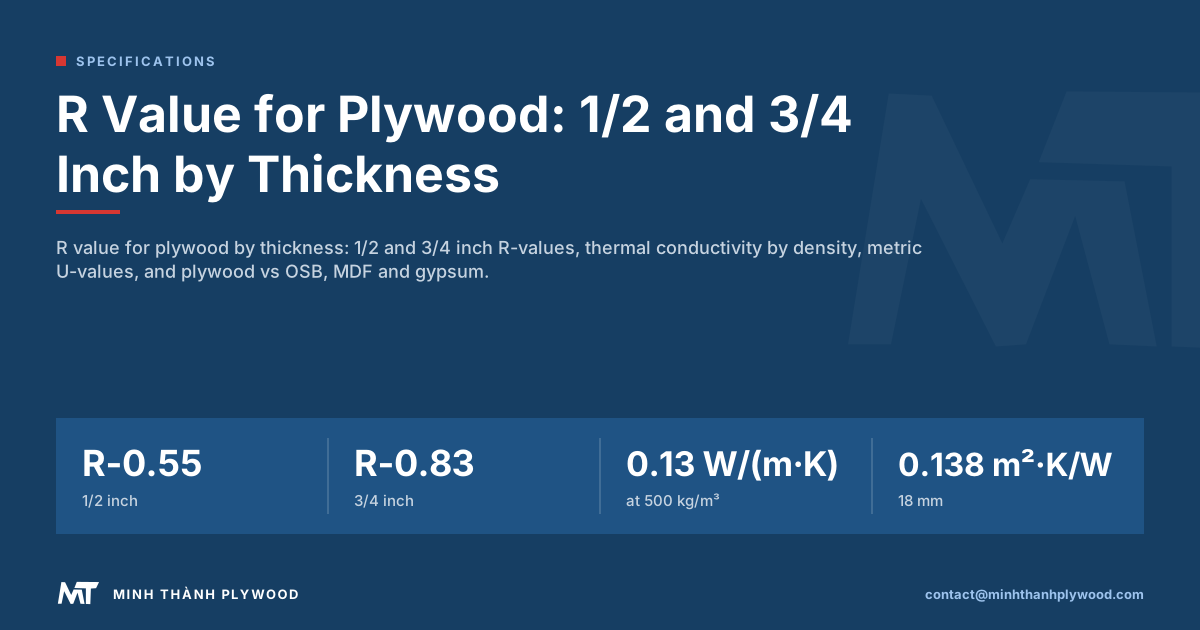
The R value for plywood is about R-1.1 to R-1.25 per inch: a 1/2 inch sheet adds roughly R-0.5 to R-0.6 and a 3/4 inch sheet roughly R-0.8 to R-0.9. In metric, plywood conducts 0.13 W/(m·K) at 500 kg/m³ and 0.17 W/(m·K) at 700 kg/m³ (EN ISO 10456). This guide gives both systems by thickness and density, compares OSB, MDF and gypsum, and works a wall example. Minh Thanh Plywood is a plywood manufacturer in Vietnam.
R value for plywood: the short answer
The R value for plywood is about R-1.1 to R-1.25 per inch of thickness in US units. In metric, plywood has a thermal conductivity of 0.13 W/(m·K) at a density of 500 kg/m³ and 0.17 W/(m·K) at 700 kg/m³, according to EN ISO 10456. Lighter panels insulate slightly better than dense ones.
Three numbers answer most questions:
- 1/2 inch plywood: about R-0.5 to R-0.6.
- 3/4 inch plywood: about R-0.8 to R-0.9.
- 18 mm plywood in metric: about 0.11 to 0.14 m²·K/W, depending on density.
R-value adds up layer by layer. Plywood adds its share to the cavity insulation, the lining and the air films; it does not replace insulation. The rest of this guide shows where these numbers come from, how density changes them and what they mean in a real wall, floor or roof.
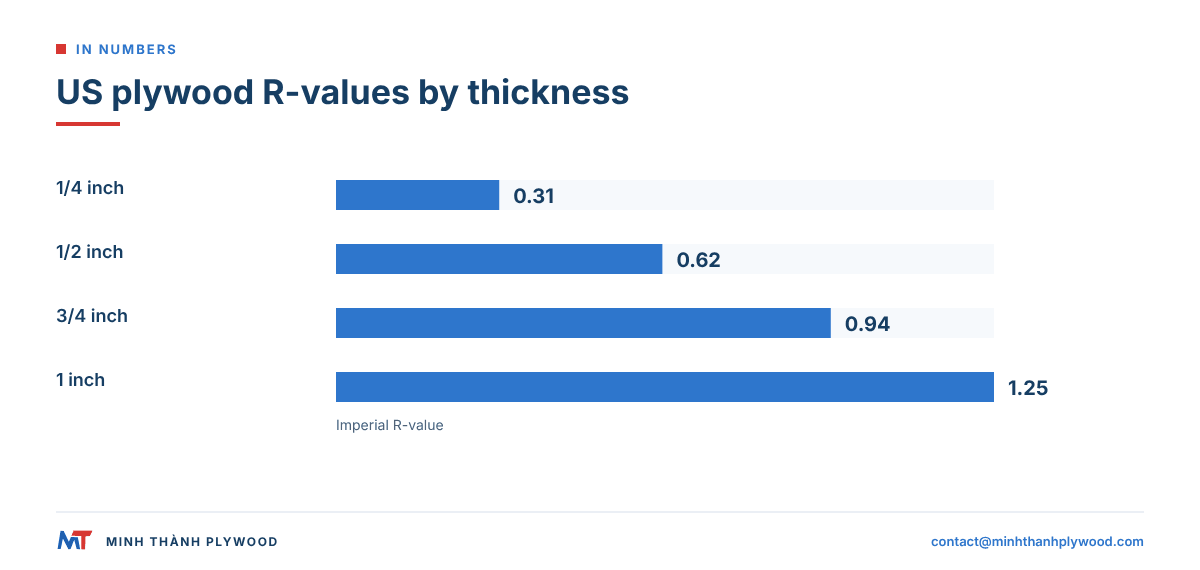
US R-values for plywood: the ASHRAE and NFPA table
US designers take plywood R-values from the ASHRAE Handbook of Fundamentals, and NFPA Global Solutions prints the same figures for wood structural panels (NFPA, wood structural panel R-values, accessed 21 October 2026). Use these when a plan reviewer or energy code asks for a US source.
| Plywood thickness | R-value (ft²·°F·h/BTU) |
|---|---|
| 1/4 inch | 0.31 |
| 3/8 inch | 0.47 |
| 15/32 inch | 0.59 |
| 1/2 inch | 0.62 |
| 19/32 inch | 0.74 |
| 5/8 inch | 0.78 |
| 23/32 inch | 0.90 |
| 3/4 inch | 0.94 |
| 1 inch | 1.25 |
For comparison, the same NFPA page lists 1/2 inch OSB at R-0.62, the same as 1/2 inch plywood, and 3/4 inch OSB at R-0.91 against R-0.94 for plywood. The two panels insulate alike, so choose between them on strength and moisture behaviour. The per-inch figure is R-1.25, which is the number behind the “R-1.25 per inch” column in the table further down. The metric columns in this guide use the EN ISO 10456 design conductivity instead, so they come out slightly lower.
A US wall: 2x4 and 2x6 with plywood sheathing
The layer values below are the ASHRAE figures reproduced by Archtoolbox (accessed 21 October 2026): interior air film 0.68, 1/2 inch gypsum wallboard 0.45, 1/2 inch plywood 0.62 and the winter exterior air film at 15 mph wind 0.17. Studs are ignored, as in the metric example further down.
| Layer | 2x4 wall at 16 inch o.c., R-13 batt | 2x6 wall at 16 inch o.c., R-21 batt |
|---|---|---|
| Interior air film | 0.68 | 0.68 |
| 1/2 inch gypsum wallboard | 0.45 | 0.45 |
| Fiberglass batt in the cavity | 13.00 | 21.00 |
| 1/2 inch plywood sheathing | 0.62 | 0.62 |
| Exterior air film, winter | 0.17 | 0.17 |
| Total through the cavity | 14.92 | 22.92 |
The plywood adds R-0.62 to a total of R-14.92 in the 2x4 wall, about 4 % of it, and the same R-0.62 to R-22.92 in the 2x6 wall, about 3 %. The U-factor is one divided by the total: 0.067 for the 2x4 wall and 0.044 for the 2x6 wall, in BTU/(h·ft²·°F). Take the plywood out and the 2x4 wall falls to R-14.30.
In IECC terms, the 2021 code asks for R-20, or R-13 plus R-5 of continuous insulation, in wood-frame walls in climate zone 3, and more in colder zones (ICC, 2021 IECC table R402.1.3). Sheathing helps with bracing and fixings but never closes that gap on its own; the insulation does.
What R-value and thermal conductivity mean
R-value is a material’s resistance to heat flow through a given thickness; thermal conductivity (lambda, λ, or k-value) is how readily the material itself conducts heat. A higher R-value insulates better; a lower conductivity insulates better. R equals thickness divided by conductivity.
| Term | Symbol | Unit | Better insulation when | Used in |
|---|---|---|---|---|
| Thermal conductivity | λ (lambda), k | W/(m·K) | Lower | EN ISO 10456, European data sheets |
| Thermal resistance, metric | R or RSI | m²·K/W | Higher | EU, UK, Australia, Canada |
| Thermal resistance, imperial | R-value | ft²·°F·h/BTU | Higher | United States |
| Thermal transmittance | U-value | W/(m²·K) | Lower | Whole walls, roofs and floors |
The conversion between the two R systems is fixed: one m²·K/W equals 5.678 imperial R units. A metric R of 0.138 m²·K/W is therefore R-0.79 in US units.
A U-value describes a whole assembly, not a sheet. It is one divided by the sum of every layer’s R-value plus the surface resistances. That is why a single sheet of plywood has an R-value but a wall has a U-value.
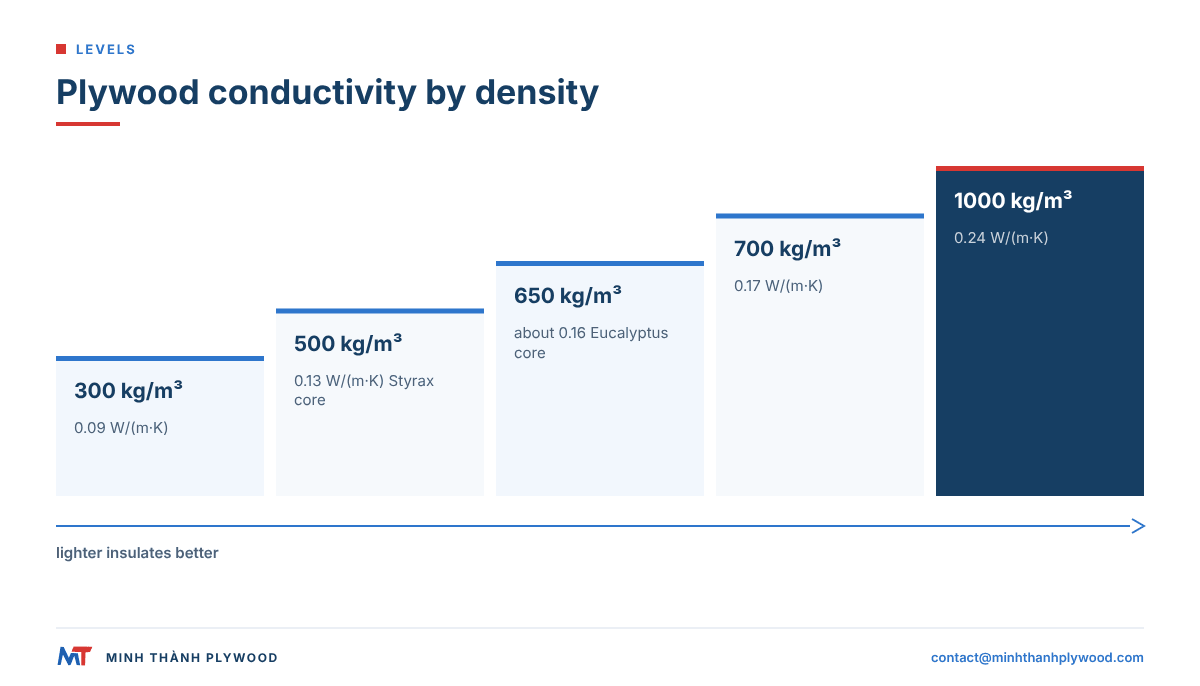
Thermal conductivity of plywood by density (EN ISO 10456)
EN ISO 10456 sets the design thermal conductivity of plywood by density: 0.09 W/(m·K) at 300 kg/m³, 0.13 at 500 kg/m³, 0.17 at 700 kg/m³ and 0.24 at 1000 kg/m³. Density decides the value because wood fibre conducts heat and the air in the cell walls does not.
| Plywood density | Thermal conductivity λ | Typical panel |
|---|---|---|
| 300 kg/m³ | 0.09 W/(m·K) | Very light core, for example balsa or paulownia |
| 500 kg/m³ | 0.13 W/(m·K) | Styrax or poplar core, many softwood panels |
| 580 kg/m³ | about 0.15 W/(m·K) (interpolated) | Acacia core |
| 650 kg/m³ | about 0.16 W/(m·K) (interpolated) | Eucalyptus core |
| 700 kg/m³ | 0.17 W/(m·K) | Dense hardwood and birch panels |
| 1000 kg/m³ | 0.24 W/(m·K) | Compressed, resin-loaded panels |
The table values for 300, 500, 700 and 1000 kg/m³ are the design values in ISO 10456, the standard for hygrothermal properties of building materials. The 580 and 650 kg/m³ rows are straight-line interpolations between the 500 and 700 kg/m³ values.
Which core gives which value
Our reference densities are 500 kg/m³ for white Styrax core, 580 kg/m³ for Acacia and 650 kg/m³ for Eucalyptus. A Styrax core panel sits on the 0.13 W/(m·K) line; a Eucalyptus core panel sits near 0.16 W/(m·K). A buyer who needs the best thermal figure from plywood picks the lighter core.
R-value of plywood by thickness: imperial and metric
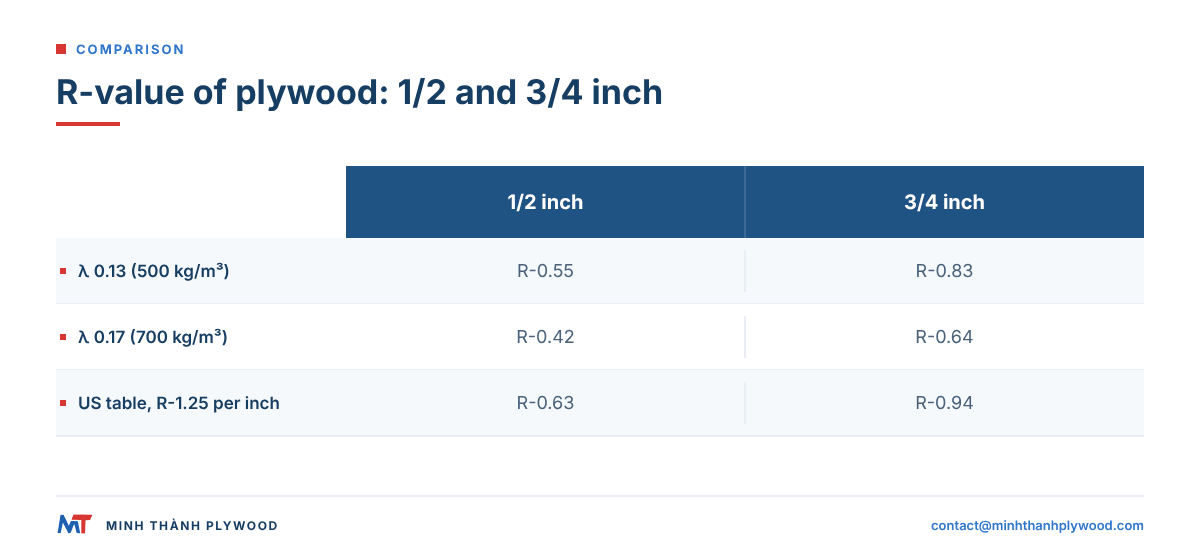
At 0.13 W/(m·K), plywood gives R-0.55 at 1/2 inch, R-0.83 at 3/4 inch and R-0.79 at 18 mm in US units. At the denser 0.17 W/(m·K), the same panels give R-0.42, R-0.64 and R-0.60. US tables that use R-1.25 per inch give R-0.63 at 1/2 inch and R-0.94 at 3/4 inch.
| Thickness | Metric R at λ 0.13 (m²·K/W) | Imperial R at λ 0.13 | Metric R at λ 0.17 (m²·K/W) | Imperial R at λ 0.17 | US table at R-1.25 per inch |
|---|---|---|---|---|---|
| 1/4 inch | 0.049 | R-0.28 | 0.037 | R-0.21 | R-0.31 |
| 3/8 inch | 0.073 | R-0.42 | 0.056 | R-0.32 | R-0.47 |
| 1/2 inch | 0.098 | R-0.55 | 0.075 | R-0.42 | R-0.63 |
| 5/8 inch | 0.122 | R-0.69 | 0.093 | R-0.53 | R-0.78 |
| 3/4 inch | 0.147 | R-0.83 | 0.112 | R-0.64 | R-0.94 |
| 1 inch | 0.195 | R-1.11 | 0.149 | R-0.85 | R-1.25 |
The US column follows the R-1.25 per inch figure printed in North American tables for softwood plywood, which corresponds to a conductivity of about 0.115 W/(m·K). Our columns use the EN ISO 10456 design values, which assume a slightly denser panel.
R-value of metric plywood thicknesses: 6 to 25 mm
An 18 mm sheet of plywood has a thermal resistance of 0.138 m²·K/W at 0.13 W/(m·K), which is R-0.79 in US units. A 12 mm sheet has 0.092 m²·K/W (R-0.52), and a 25 mm sheet 0.192 m²·K/W (R-1.09). Panels sold in metric thicknesses use this table.
| Thickness | Styrax core, λ 0.13: R (m²·K/W) | Imperial R | Eucalyptus core, λ 0.16: R (m²·K/W) | Imperial R |
|---|---|---|---|---|
| 6 mm | 0.046 | R-0.26 | 0.037 | R-0.21 |
| 9 mm | 0.069 | R-0.39 | 0.056 | R-0.32 |
| 12 mm | 0.092 | R-0.52 | 0.075 | R-0.43 |
| 15 mm | 0.115 | R-0.66 | 0.094 | R-0.53 |
| 18 mm | 0.138 | R-0.79 | 0.112 | R-0.64 |
| 25 mm | 0.192 | R-1.09 | 0.156 | R-0.89 |
Every value is thickness in metres divided by λ. For 18 mm Styrax core: 0.018 ÷ 0.13 = 0.138 m²·K/W, and 0.138 × 5.678 = R-0.79.
The U-value of a sheet on its own
A sheet’s own conductance, one divided by its R, is useful for checking a data sheet. An 18 mm Styrax core panel conducts about 7.2 W/(m²·K) through its thickness before any surface resistance is added. That number is not a wall U-value; it is the panel’s share before the rest of the build-up is counted.
What is the R-value of 1/2 plywood?
The R-value of 1/2 plywood is about R-0.5 to R-0.6. A 1/2 inch (12.7 mm) panel at 0.13 W/(m·K) gives 0.098 m²·K/W, which is R-0.55; US tables at R-1.25 per inch give R-0.63. A metric 12 mm sheet gives R-0.52.
1/2 inch plywood is a common wall sheathing and roof deck thickness on short spans. In a wall, its R-0.55 is a small addition to an R-13 to R-21 cavity: the sheathing is there to brace the frame and hold the cladding fixings.
For a 1/2 plywood R-value in a calculation, use the density of the panel you buy. A light softwood or Styrax core panel sits at the top of the range; a dense hardwood panel at the bottom.
What is the R-value of 3/4 plywood?
The R-value of 3/4 plywood is about R-0.8 to R-0.9. A 3/4 inch (19.05 mm) panel at 0.13 W/(m·K) gives 0.147 m²·K/W, which is R-0.83; US tables at R-1.25 per inch give R-0.94. An 18 mm metric sheet gives R-0.79.
The r-value of 3/4 plywood comes up most in subfloors and roof decks, where 3/4 inch is the usual thickness. In a suspended timber floor, the panel adds R-0.8 or so on top of the floor insulation between the joists. Over an unheated crawl space, that is a useful but small share of the floor’s total.
Is plywood a good insulator?
Plywood is a moderate insulator: far better than steel, concrete or gypsum per millimetre, but nearly four times worse than mineral wool and worse still than foam. It belongs in a wall as a structural layer, with the insulation in a separate layer.
| Material | Thermal conductivity λ, W/(m·K) | Thickness for the same R as 18 mm plywood at λ 0.13 |
|---|---|---|
| Mineral wool batt | 0.035 (typical declared value) | about 5 mm |
| Plywood, 500 kg/m³ | 0.13 | 18 mm |
| Gypsum plasterboard, 900 kg/m³ | 0.25 | about 35 mm |
| Dense concrete | about 2.0 | about 277 mm |
The plywood insulation value is real: an 18 mm sheet resists heat as well as roughly 35 mm of plasterboard. But a wall that needs R-3 to R-4 in metric (R-17 to R-23 in US units) will always get that from its insulation layer.
Plywood vs OSB, MDF, particleboard and gypsum
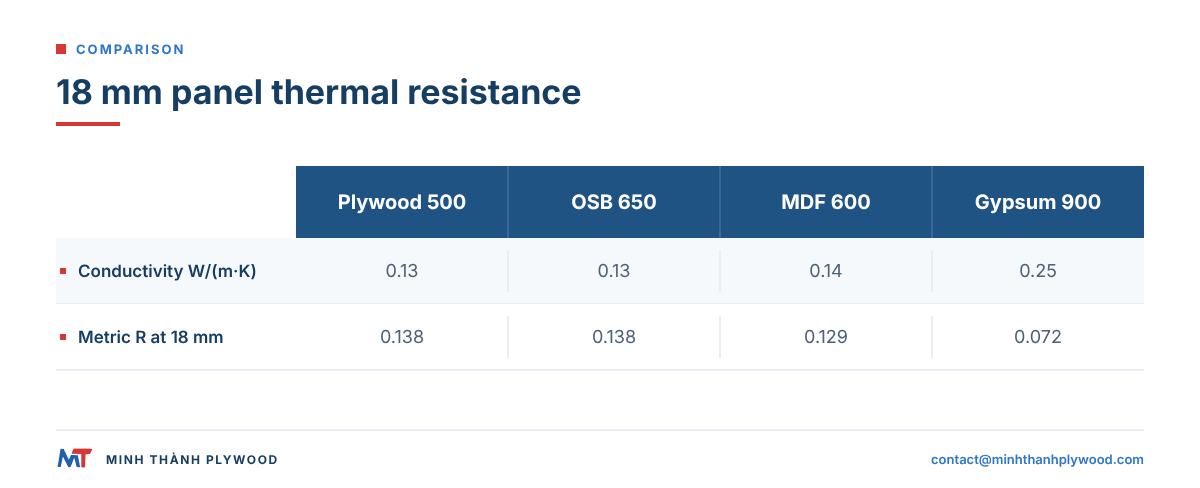
Plywood and OSB insulate almost equally: EN ISO 10456 gives OSB 0.13 W/(m·K) at 650 kg/m³, the same as plywood at 500 kg/m³. MDF and particleboard conduct 0.14 W/(m·K) at 600 kg/m³; gypsum plasterboard conducts 0.25 W/(m·K) at 900 kg/m³.
| Panel | Density | λ, W/(m·K) | R of 18 mm (m²·K/W) | Imperial R of 18 mm |
|---|---|---|---|---|
| Plywood | 500 kg/m³ | 0.13 | 0.138 | R-0.79 |
| Plywood | 700 kg/m³ | 0.17 | 0.106 | R-0.60 |
| OSB | 650 kg/m³ | 0.13 | 0.138 | R-0.79 |
| Particleboard | 600 kg/m³ | 0.14 | 0.129 | R-0.73 |
| Fibreboard including MDF | 600 kg/m³ | 0.14 | 0.129 | R-0.73 |
| Fibreboard including MDF | 800 kg/m³ | 0.18 | 0.100 | R-0.57 |
| Softwood timber | 500 kg/m³ | 0.13 | 0.138 | R-0.79 |
| Gypsum plasterboard | 900 kg/m³ | 0.25 | 0.072 | R-0.41 |
What this means when you choose a panel
Thermal resistance is not the reason to choose plywood over OSB or MDF. Choose on what the panel must do: plywood for screw holding at the edge, stiffness across the sheet, bond class for wet areas and a sanded face; OSB for low-cost sheathing; MDF for painted, routed interior parts. Their R-values sit within a few hundredths of a m²·K/W of each other at the same thickness.
A worked wall example: what does the plywood add?
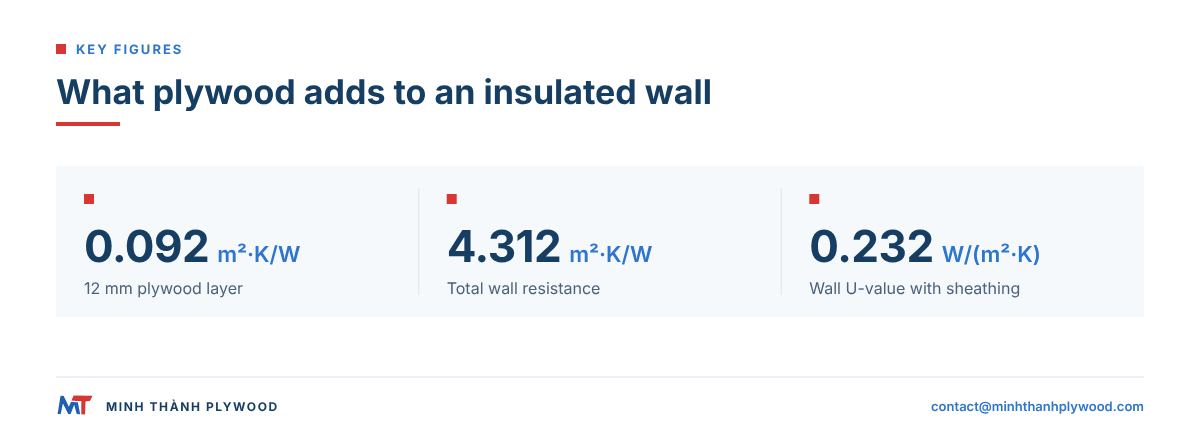
In a timber-frame wall with 140 mm of mineral wool, 12.5 mm plasterboard and 12 mm plywood sheathing, the plywood adds 0.092 m²·K/W to a total of 4.312 m²·K/W. The wall’s U-value moves from 0.237 W/(m²·K) without the sheathing to 0.232 with it.
The calculation, layer by layer, through the insulated part of the wall (studs ignored for clarity):
| Layer | Thickness | λ, W/(m·K) | R, m²·K/W |
|---|---|---|---|
| Inside surface resistance | — | — | 0.13 |
| Gypsum plasterboard | 12.5 mm | 0.25 | 0.050 |
| Mineral wool | 140 mm | 0.035 | 4.000 |
| Plywood sheathing, Styrax core | 12 mm | 0.13 | 0.092 |
| Outside surface resistance | — | — | 0.04 |
| Total | 4.312 |
U = 1 ÷ 4.312 = 0.232 W/(m²·K). Surface resistances of 0.13 and 0.04 m²·K/W are the standard values for walls with horizontal heat flow in ISO 6946.
Thicker sheathing changes little
With 18 mm plywood instead of 12 mm, the total becomes 4.358 m²·K/W and U drops to 0.229 W/(m²·K). Six extra millimetres of plywood buy three thousandths of a W/(m²·K). Adding 20 mm of insulation would do far more. Specify sheathing thickness for bracing, fixings and span, not for heat.
Where plywood’s R-value matters
Plywood’s R-value matters where the panel is the main layer between inside and outside: uninsulated sheds and farm buildings lined with plywood, vehicle and container bodies, cold-room doors and the floors of raised buildings without floor insulation. In a fully insulated wall it is a small share.
- Panelled rooms with no cavity insulation. An 18 mm lining is the only resistance, so a lighter core helps.
- Floors over open air. A 3/4 inch subfloor adds R-0.8 or so; the floor needs insulation underneath for real performance.
- Roof decks under membranes. The deck adds a little resistance and keeps the membrane off cold rafters.
- Packaging and transport. Insulated crates and truck bodies combine plywood skins with a foam core; the skins carry load, the foam carries the R-value.
For structural floors and subfloors, our plywood thickness guide sets thickness by span first.
Does moisture or density change plywood’s R-value?
Yes. Denser plywood conducts more heat: 0.17 W/(m·K) at 700 kg/m³ against 0.13 at 500 kg/m³. Wet plywood also conducts more, because water conducts heat far better than dry wood. Design values assume a dry, conditioned panel.
Three factors move a real panel away from the table:
- Density. Set by the core and face species and by how hard the panel is pressed. Our Styrax core panels sit at 500 kg/m³, Eucalyptus core at 650 kg/m³.
- Moisture content. A panel that stays wet in service loses some of its resistance. Our veneers and finished panels are dried to 8–12 % moisture content at dispatch, the normal range for furniture plywood.
- Glue lines. Each glue line is a thin, denser layer. The effect on the whole panel is small next to density and moisture.
A buyer who needs a declared λ for a project file can ask for a third-party test; we arrange testing to the buyer’s method through SGS on request.
How to specify plywood when thermal values matter
Write the panel’s density or core species on the order, so the designer can take λ from EN ISO 10456, and keep the insulation as its own layer. For a light, lower-conductivity panel, choose white Styrax core at 500 kg/m³; for hardness and screw holding, Eucalyptus core at 650 kg/m³.
A specification line that answers the designer’s questions:
- Thickness: for example 18 mm, with tolerance (our sanded panels hold ±0.2–0.3 mm).
- Core: Styrax (500 kg/m³) or Eucalyptus (650 kg/m³).
- Bond: UF glue at E0 emission for dry interiors; MR or WBP for humid or exterior use.
- Moisture at dispatch: 8–12 %.
- Sheet size: 1220 × 2440 mm or 1250 × 2500 mm.
The US limit for veneer-core hardwood plywood is 0.05 ppm under EPA’s formaldehyde emission limits. Our furniture and interior panels carry CARB P2 / TSCA Title VI certification as ICTT mill number 23024. Six ASTM D6007 chamber tests between April 2025 and June 2026 on 9, 15 and 18 mm panels averaged 0.014–0.032 ppm against the 0.05 ppm limit.
To price a panel for an insulated wall, a cold-room lining or a transport body, send the line above through our furniture plywood page, or email contact@minhthanhplywood.com. We reply within hours.
Buyer questions, answered
What is the R-value of 1/2 plywood?
1/2 inch plywood has an R-value of about 0.5 to 0.6 ft²·°F·h/BTU. At a thermal conductivity of 0.13 W/(m·K) it is R-0.55; US tables at R-1.25 per inch give R-0.63.
What is the R-value of 3/4 plywood?
3/4 inch plywood has an R-value of about 0.8 to 0.9. At 0.13 W/(m·K) it is R-0.83; US tables at R-1.25 per inch give R-0.94. Denser hardwood cores sit lower, around R-0.64 at 0.17 W/(m·K).
Is plywood a good insulator?
Plywood insulates far better than steel, concrete or gypsum per unit thickness, but it is not an insulation material. Mineral wool insulates about four times better per millimetre, so walls use plywood for stiffness and a separate layer for insulation.
What is the thermal conductivity of plywood?
EN ISO 10456 gives plywood a design thermal conductivity of 0.09 W/(m·K) at 300 kg/m³, 0.13 at 500 kg/m³, 0.17 at 700 kg/m³ and 0.24 at 1000 kg/m³. Lighter panels insulate better.
What has more R-value, plywood or OSB?
At similar thickness and density they are almost equal. EN ISO 10456 gives OSB 0.13 W/(m·K) at 650 kg/m³, the same as plywood at 500 kg/m³, so the choice between them is made on strength, moisture and fixing, not insulation.
Does plywood have more R-value than drywall?
Yes, about twice as much per thickness. Gypsum plasterboard conducts 0.25 W/(m·K) at 900 kg/m³, against 0.13 W/(m·K) for plywood at 500 kg/m³.
How do you convert plywood R-value between imperial and metric?
Divide the thickness in metres by the conductivity in W/(m·K) to get the metric R-value in m²·K/W, then multiply by 5.678 for the imperial R-value. 18 mm at 0.13 W/(m·K) is 0.138 m²·K/W, or R-0.79.
Does moisture change the R-value of plywood?
Yes. Water conducts heat far better than dry wood, so a damp panel insulates less than a dry one. Design values in EN ISO 10456 assume dry, conditioned panels; our panels leave the factory at 8–12 % moisture content.
Does thicker plywood make a wall warmer?
Only slightly. In a wall with 140 mm of mineral wool, going from 12 mm to 18 mm plywood sheathing moves the U-value from 0.232 to 0.229 W/(m²·K). Insulation thickness, not sheathing thickness, sets the wall's performance.