
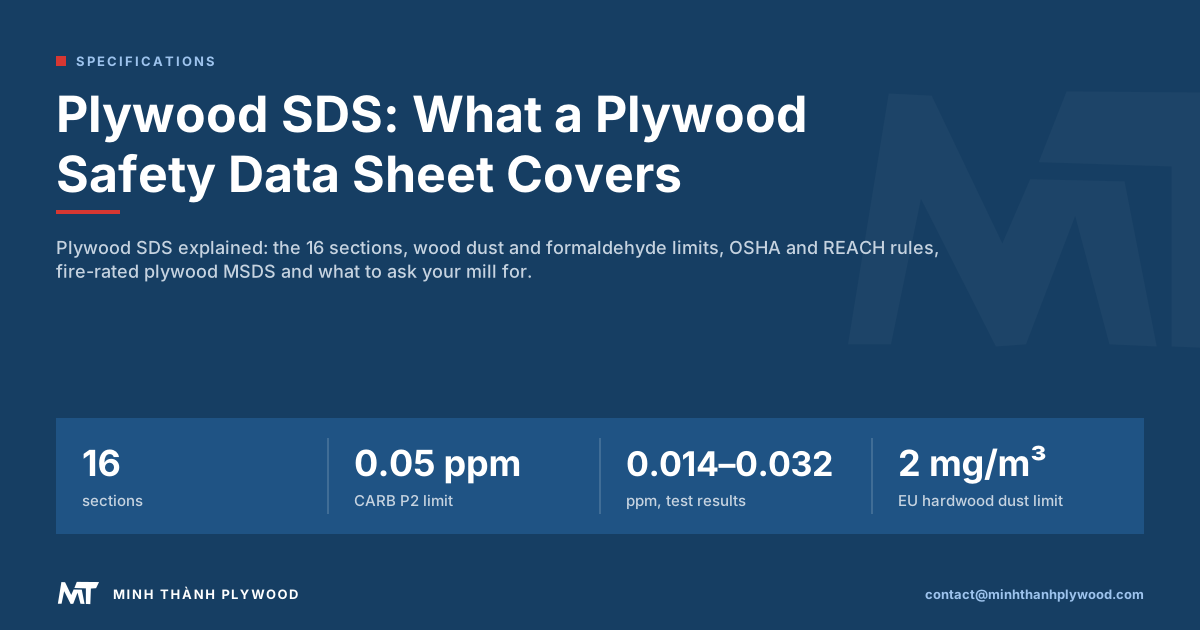
A plywood SDS is the 16-section safety data sheet that tells workers what can harm them when plywood is cut, sanded or burned: mainly wood dust and traces of formaldehyde from the glue. In the US, OSHA's Hazard Communication Standard requires one from the importer; in the EU, plywood is an article and needs safety information, not a REACH SDS. Minh Thanh Plywood supplies the panel data that fills it.
What is a plywood SDS?
A plywood SDS (safety data sheet) is a standard 16-section document that describes the hazards of plywood in the workplace, how to handle and store it, what protection workers need and what to do in a fire or an accident. It does not describe panel quality; it describes what can harm people who cut, sand, stack or burn the panels.
For plywood, almost every hazard on the sheet comes from two things:
- Wood dust, made when panels are sawn, routed, drilled or sanded.
- Formaldehyde, released in very small amounts from urea-formaldehyde (UF), melamine-fortified or phenolic glue lines.
A whole, uncut panel is stable and inert. The SDS therefore reads very differently from a chemical’s sheet: it is about processing, not about the sheet sitting in a warehouse. Importers also call it a plywood safety data sheet, a product safety sheet or, using the older name, a plywood MSDS. Our plywood quality and certificates page lists the documents that sit beside it.
Request the Minh Thanh plywood SDS
Importers searching “plywood SDS” want the sheet itself, so here is how to get ours. Send the panel type you buy (UF glue at E0 emission for furniture, MR or melamine-fortified, or phenolic film-faced) and we issue a 16-section SDS for that exact construction, with the revision date in section 16. The set that travels with it:
- SDS for the panel construction on your order, in the GHS 16-section order.
- TSCA Title VI / CARB P2 certificate and label details for US orders.
- Chamber test reports: the ASTM D6007 results quoted below.
- Species, glue and density lines so the sheet matches the packing list.
Ask for the SDS with your quotation; a sheet written for another mill’s panel does not describe yours.
Plywood MSDS vs SDS: is there a difference?
There is no difference in purpose: MSDS (material safety data sheet) is the old name, SDS is the current one. The change came when the US Occupational Safety and Health Administration (OSHA) aligned its Hazard Communication Standard with the United Nations Globally Harmonized System (GHS) in 2012.
| Point | MSDS (before 2012) | SDS (GHS format) |
|---|---|---|
| Layout | Free order, often 8–10 sections | Fixed order of 16 sections |
| Hazard labels | Words chosen by the writer | GHS classes, pictograms, signal words |
| Required by | OSHA, old format | OSHA standard 1910.1200 and Appendix D |
| Common names | MSDS, material safety data sheet | SDS, safety data sheet |
Search results and buyers’ checklists still say “plywood MSDS”. When an importer asks for one, they mean a current 16-section SDS.
When does an importer need a plywood safety data sheet?
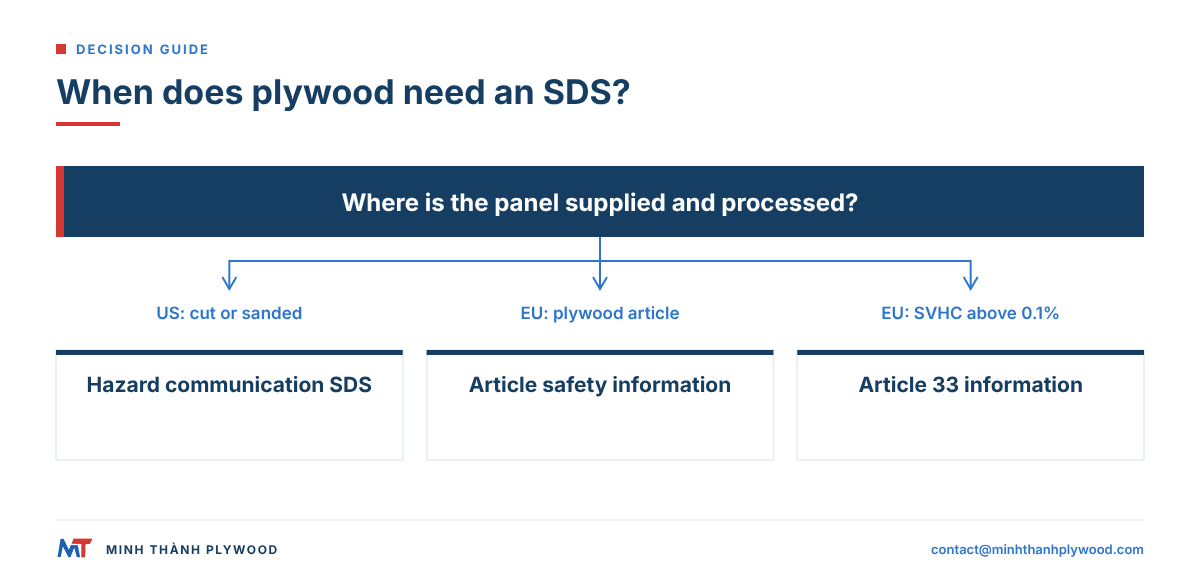
A US importer needs one whenever the plywood will be cut, sanded or otherwise processed at work, which is nearly every order. Under the OSHA Hazard Communication Standard, wood products are exempt only when the only hazard is flammability or combustibility; plywood that is sawn makes wood dust, so the exemption does not apply.
- United States: the manufacturer or importer prepares the SDS and supplies it to the first distributor or employer that receives the product (OSHA Hazard Communication Standard, 1910.1200, checked on 20 October 2026).
- European Union: REACH Article 31 requires an SDS for substances and mixtures. Plywood is an article, a shaped object, so a formal SDS is not required (Regulation (EC) No 1907/2006, checked on 20 October 2026). Article 33 applies instead: the supplier tells the buyer if the article contains a substance of very high concern above 0.1 % by weight.
- Workplace buyers in the EU: furniture plants still ask for a safety information sheet in the SDS layout, because their own risk assessment for wood dust and formaldehyde needs the data.
Does plywood need a safety data sheet? In the US, yes, as a document with the shipment. In the EU, the law asks for safety information, and buyers usually take it in the same 16-section form.
The 16 sections of a plywood SDS
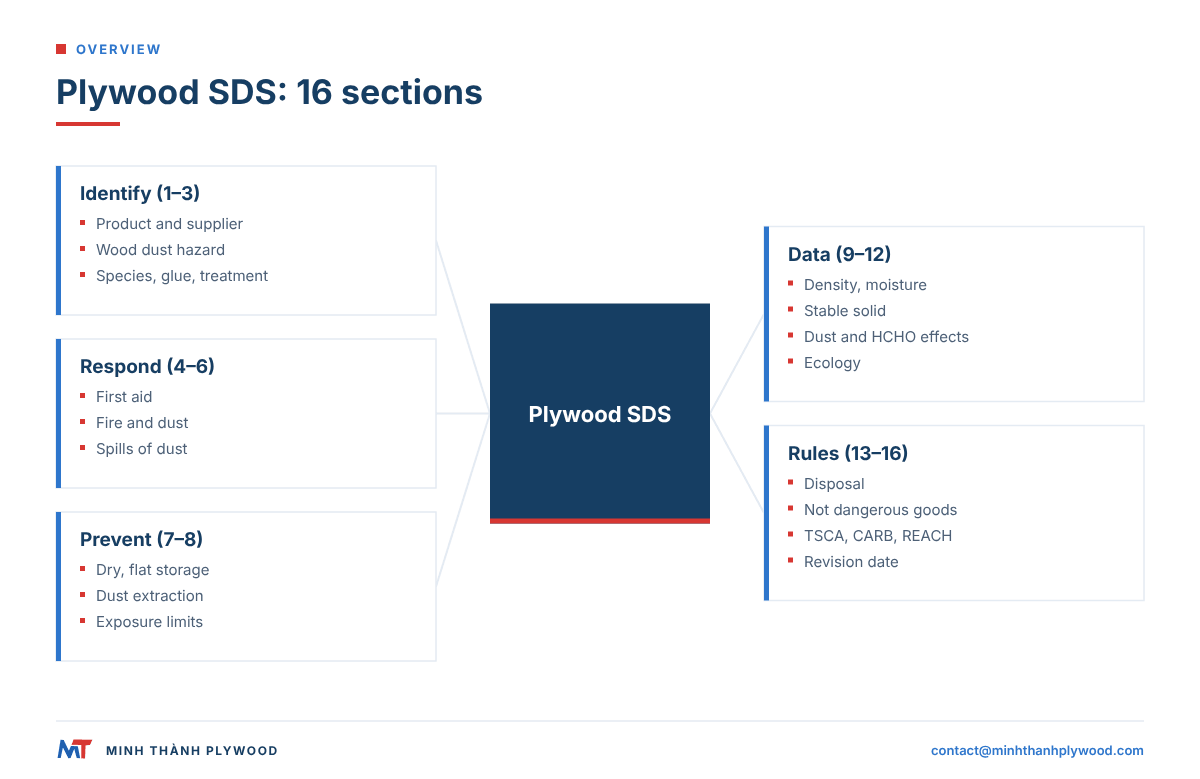
The 16 sections follow the same order for every product, so a buyer can find the same data on any sheet. For plywood, these are the points each section carries.
| No. | Section | What a plywood SDS says there |
|---|---|---|
| 1 | Identification | Product name, panel type, supplier, emergency phone |
| 2 | Hazard identification | Wood dust classes when processed; formaldehyde note |
| 3 | Composition | Wood species, resin type, any treatment, by percentage range |
| 4 | First aid | Dust in eyes, airways and on skin; splinters |
| 5 | Fire fighting | Water, foam or dry powder; dust explosion risk |
| 6 | Accidental release | Collect dust without blowing it into the air |
| 7 | Handling and storage | Dry, flat storage; dust control when cutting |
| 8 | Exposure controls | Dust and formaldehyde limits; extraction; masks |
| 9 | Physical properties | Solid panel, density, odour, moisture content |
| 10 | Stability and reactivity | Stable; avoid ignition sources and strong oxidisers |
| 11 | Toxicology | Dust effects; formaldehyde effects; carcinogen classes |
| 12 | Ecology | Wood is not classed as harmful to the environment |
| 13 | Disposal | Reuse, recycling or energy recovery under local rules |
| 14 | Transport | Not regulated as dangerous goods |
| 15 | Regulation | OSHA, TSCA Title VI, CARB, REACH notes |
| 16 | Other | Revision date, abbreviations, disclaimer |
Sections 12 to 15 are not enforced by OSHA, but a complete SDS fills them, and EU buyers read section 15 first.
Section 2: how wood dust and formaldehyde are classed
Section 2 classes uncut plywood as not hazardous and classes the dust from processing as the hazard. The usual GHS classes for wood dust are skin and eye irritation, respiratory sensitisation for some species, and carcinogenicity category 1A; combustible dust is added as a US hazard class.
- Wood dust: the International Agency for Research on Cancer (IARC) classed wood dust as carcinogenic to humans, Group 1, in 1995, mainly from hardwood dust exposure in furniture and joinery work.
- Formaldehyde: IARC classed formaldehyde as Group 1 in 2004. On a plywood SDS it appears because the glue can release traces of it; the amount is what emission tests measure.
- Combustible dust: fine dust collected in ducts, on beams or in filters can burn fast or explode when dispersed and ignited.
The signal word on a plywood SDS is usually “Danger” because of the carcinogen class of the dust, even though the panel itself carries no pictogram as shipped.
Section 3: what goes into the panel
Section 3 lists the panel’s components: wood veneers, the cured adhesive and any surface or treatment chemicals. Percentages are given as ranges, because the glue share changes with thickness and the number of plies.
For a Minh Thanh furniture panel, the components are:
- Face and back veneers: the species ordered, such as birch, poplar, okoume, pine, eucalyptus or engineered veneer (EV).
- Core veneers: white Styrax or Eucalyptus as standard; Acacia and Pine cores are made on order.
- Adhesive: UF glue at E0 emission as standard for furniture and interior panels; MR or melamine-fortified and phenolic (WBP) bonds to the buyer’s specification.
- Moisture: veneers and finished panels dried to 8–12 % moisture content at dispatch.
The CAS numbers buyers search for, as they appear in section 3 of a plywood SDS:
| Component | CAS number | Typical share by weight |
|---|---|---|
| Wood (veneers) | None; listed as wood dust when processed | 93–95 % in a published hardwood plywood SDS |
| Urea-formaldehyde (UF) resin, cured | 9011-05-6 | 3–7 % |
| Phenol-formaldehyde (PF) resin, cured | 9003-35-4 | Under 3 % in the same sheet; phenolic panels carry more |
| Melamine (melamine-fortified glue) | 108-78-1 | Small share of the resin |
| Formaldehyde (free, trace) | 50-00-0 | Under 0.01 % free formaldehyde on a published panel SDS |
The shares come from a published hardwood plywood SDS; our own sheet gives the range for your glue and ply count. In section 2 the processing dust is classed carcinogenicity category 1A (H350) under GHS.
Glue and emission class are two separate lines. E0 or E1 is an emission class measured on the panel, not a glue type, so section 3 names the resin and section 8 or 15 states the emission result.
Section 8: wood dust and formaldehyde exposure limits
Section 8 states the occupational exposure limits a plant must keep its air below, and the extraction and personal protection that keep it there. These are the main limits a plywood SDS quotes.
| Limit | Wood dust | Formaldehyde |
|---|---|---|
| EU binding limit | Hardwood dust 2 mg/m³ over 8 hours, from 17 January 2023 (Directive (EU) 2017/2398) | 0.3 ppm over 8 hours, 0.6 ppm short-term (Directive (EU) 2019/983) |
| US OSHA PEL | 15 mg/m³ total dust, 5 mg/m³ respirable (particulates not otherwise regulated) | 0.75 ppm over 8 hours, 2 ppm short-term, action level 0.5 ppm (29 CFR 1910.1048) |
| ACGIH TLV (US advisory) | 1 mg/m³ inhalable | See current ACGIH list |
The EU limits come from the Carcinogens, Mutagens and Reprotoxic Substances Directive (Directive 2004/37/EC, consolidated, checked on 20 October 2026). National limits in some EU countries are lower. For a buyer, section 8 is also where dust extraction at saws and sanders, and filter masks for open sanding, are written down.
How much formaldehyde does plywood release?
Modern furniture plywood releases far less formaldehyde than the workplace limits in section 8. The panel limit under CARB Phase 2 and TSCA Title VI is 0.05 ppm for veneer-core hardwood plywood, measured in a test chamber, and a good E0 panel tests well under it.
Our panels’ own results: six third-party ASTM D6007 chamber tests between April 2025 and June 2026, on 9, 15 and 18 mm panels, averaged 0.014–0.032 ppm. Three were run by Shanghai Hongjun (HJ-QAT-250597, HJ-QAT-251303, HJ-QAT-261036) and three by ICTT Vietnam (ICTTVN-QAT-250841, ICTTVN-QAT-251173, ICTTVN-QAT-260272).
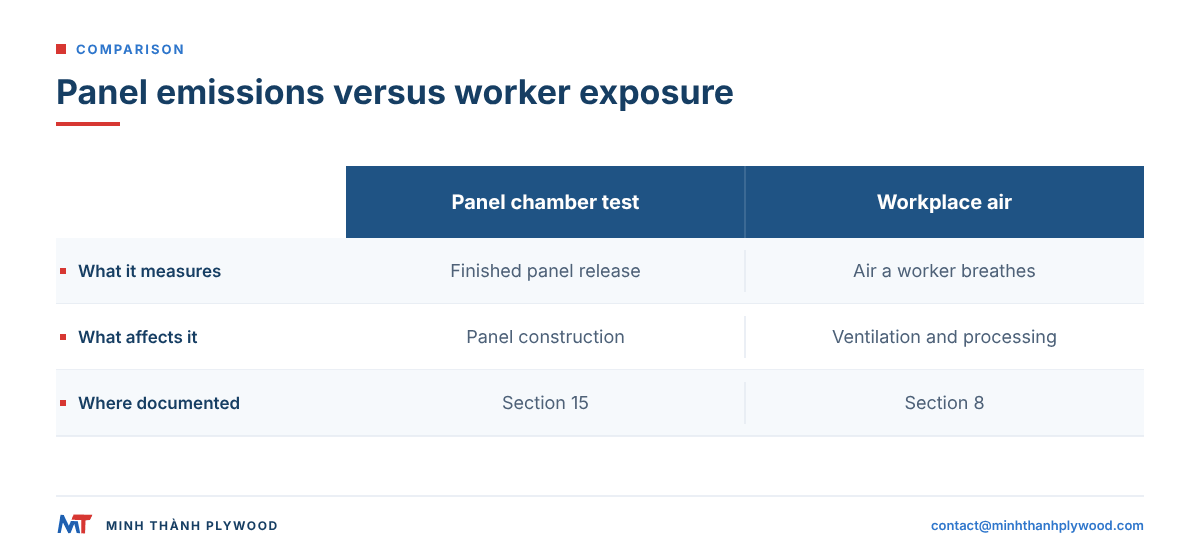
- Panel emission (ppm in a test chamber) proves how much a finished panel releases into a room.
- Workplace exposure (ppm in the air a worker breathes) depends on ventilation, stock volume and processing.
- Both belong on a good SDS: the emission result in section 15, the workplace limit in section 8.
Our guide to formaldehyde emission classes E0 and E1 explains how the test methods compare.
Fire rated plywood MSDS: what changes
A fire rated plywood MSDS, for fire-retardant-treated (FRT) panels, adds the treatment chemicals to section 3 and their effects to sections 5, 10 and 11. The wood and glue entries stay the same as for untreated plywood.
- Section 3: names the fire retardant, often phosphate- or boron-based salts, with a percentage range.
- Section 5: notes that the treatment slows flame spread but the panel still chars and burns in a sustained fire, and that smoke can carry treatment breakdown products.
- Section 7: storage away from rain, because some treatments leach when wet.
- Section 10: treated dust can react with strong acids or oxidisers.
- Section 13: treated offcuts may need disposal as treated wood under local rules, not as clean wood.
An FRT panel’s fire classification, for example a European reaction-to-fire class, is proved by its test report and declaration, not by the SDS. The SDS only says how to handle the treated product safely.
Fire, dust explosion and storage (sections 5 to 7)
Plywood is a combustible solid: it burns like any wood, and its fine dust can explode in a confined space. Sections 5 to 7 tell a plant how to prevent and fight both.
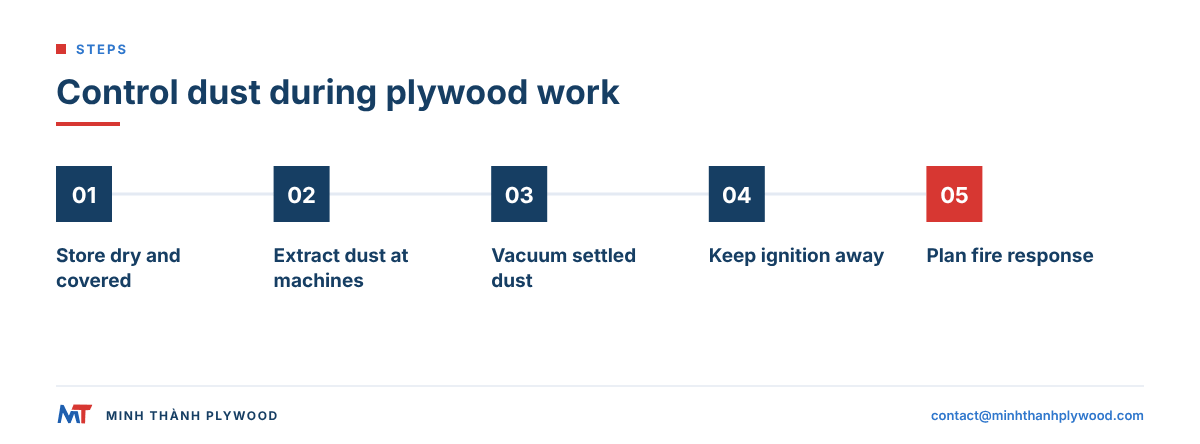
- Store panels flat, dry and under cover, away from heaters, welding and open flame.
- Extract dust at every saw, router and sander; do not let it settle on beams and ducts.
- Clean with vacuum systems rated for combustible dust, not with compressed air.
- Fight fire with water spray, foam or dry chemical; cool stacks to stop rekindling.
- Keep dust collectors outside the workshop or fitted with explosion venting.
In the US, combustible dust in wood shops is covered by NFPA 664; in the EU, by the ATEX workplace directive for explosive atmospheres. A plywood SDS names the hazard, and the plant’s own dust plan sets the controls.
Sections 9 to 14: properties, toxicology, disposal and transport
The later sections of a plywood SDS are short, because a wood panel has few chemical properties to report. They still need real numbers where they exist.
- Section 9, physical properties: solid panel, wood colour, faint wood odour; density by core, for example Styrax about 500 kg/m³, Acacia about 580 kg/m³ and Eucalyptus 650–750 kg/m³ at our mill.
- Section 10, stability: stable under normal conditions; burning gives carbon monoxide, carbon dioxide and smoke.
- Section 11, toxicology: dust can irritate eyes, nose and throat; some species can cause allergic reactions; carcinogen classes for wood dust and formaldehyde.
- Section 12, ecology: wood and cured resin are not classed as harmful to aquatic life.
- Section 13, disposal: reuse offcuts, recycle into particleboard or burn for energy where permitted.
- Section 14, transport: not dangerous goods under sea, road or air rules; no UN number.
Section 9 is where the buyer’s own density values matter. A sheet that copies another mill’s density gives the wrong weight for handling and storage.
Section 15: TSCA Title VI, CARB, REACH and EUDR notes
Section 15 lists the regulations that apply to the product and is where the panel’s compliance documents are named. For plywood sold to the US and the EU, these are the usual entries.
| Regulation | What section 15 states | Proof the mill supplies |
|---|---|---|
| TSCA Title VI (US EPA) | Panel complies with formaldehyde emission standards | Certificate, label, chamber test reports |
| CARB Phase 2 (California) | Panel complies with the Phase 2 limit | ICTT mill no. 23024 certification |
| OSHA HCS | SDS prepared under 29 CFR 1910.1200 | The SDS itself |
| REACH | Article, no SDS required; SVHC statement | Supplier’s Article 33 statement |
| EUDR | Wood product in scope of Regulation (EU) 2023/1115 | EUDR compliance dossier |
US orders from our mill carry the TSCA Title VI label (producer, lot, certifier number TPC-43), and the commercial invoice and bill of lading state TSCA Title VI compliance. The rule behind the label is described by the EPA formaldehyde emission standards for composite wood products (checked on 20 October 2026). For EU orders, we supply the EUDR compliance dossier (origin records and geolocation files) with the shipment. Our CARB P2 and TSCA Title VI page shows the certificate.
Who writes the SDS for imported plywood?
The importer that places plywood on the US market is responsible for the SDS under OSHA, and the mill provides the data that makes it accurate. A sheet built from the mill’s real construction data is shorter and more useful than a generic template.
| SDS section | Data from the mill | Data from the importer |
|---|---|---|
| 1 Identification | Product and construction name | Importer name, address, emergency phone |
| 3 Composition | Face, core, glue, any treatment | Format and CAS numbers |
| 8 Exposure | Resin type and emission results | Limits for the country of use |
| 9 Properties | Density, moisture content, thickness | — |
| 15 Regulation | TSCA Title VI, CARB, EUDR documents | Local regulation notes |
| 16 Other | Test dates | Revision date and signature |
We supply face and core species, Vietnamese harvest origin, glue type and the chamber test reports with the order documents. Test reports identify UF resin at E0 grade, which is the line section 3 needs.
How to check a plywood SDS before you accept it
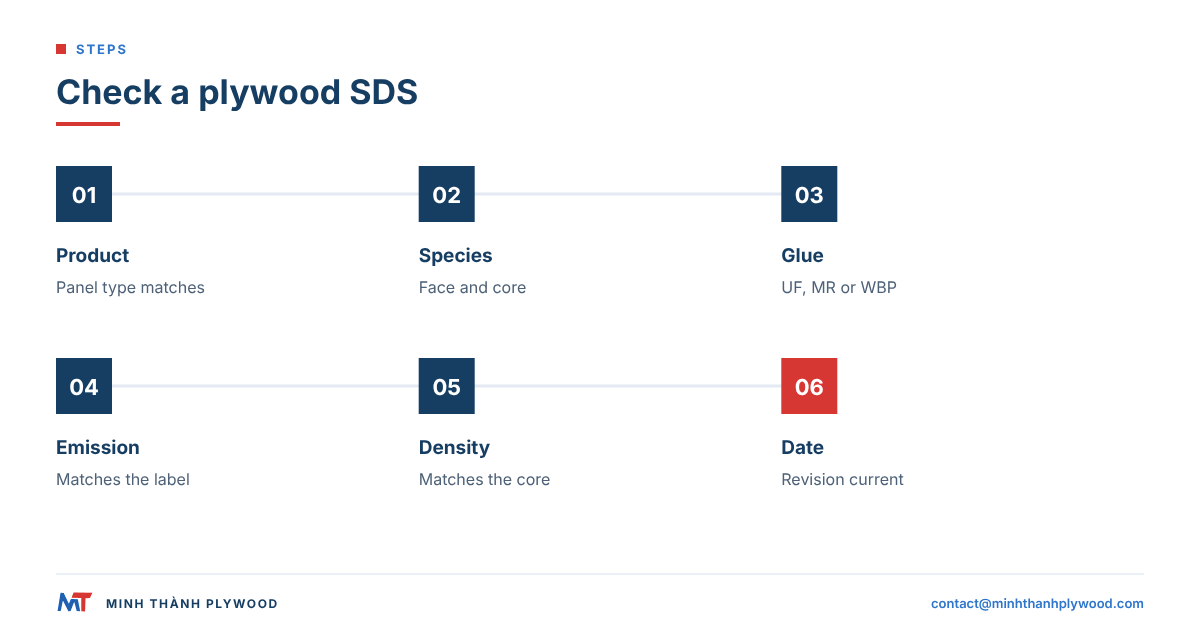
Check that the SDS describes your exact panel, not plywood in general, and that its numbers agree with the other order documents. A five-minute check prevents a sheet that misstates the glue or the species from going to your customers.
- Product: section 1 names the panel type you buy (furniture, packing, film-faced, LVL).
- Species: section 3 lists the face and core species on your order.
- Glue: section 3 names the resin (UF, MR or melamine-fortified, phenolic) of your order.
- Emission: section 15 matches the TSCA Title VI or CARB certification on the label.
- Density: section 9 matches the core: a Styrax panel and a Eucalyptus panel weigh differently.
- Treatment: a fire-retardant or preservative treatment is named if the panel has one.
- Date: section 16 carries a revision date after the latest change in glue or treatment.
If one line disagrees with the packing list or the certificate, fix the SDS before the goods arrive.
What this means for your plywood order
Ask for the panel construction data with your quotation, so the SDS, the label and the test reports describe the same product. For a furniture or interior panel from our mill, the order lines that feed the SDS are:
- Application: furniture, cabinets, interior joinery or packing.
- Face and back: species and grade pair, for example birch D+/D or poplar A/B.
- Core: white Styrax or Eucalyptus; Acacia or Pine on order.
- Glue and emission: UF glue at E0 emission, with CARB P2 / TSCA Title VI for US orders.
- Size and thickness: 1220 × 2440 or 1250 × 2500 mm, 3–40 mm, sanded to ±0.2–0.3 mm.
- Packing and quantity: from one 40HC, mixed specifications by agreement.
Production takes 15–45 days after the deposit, and free samples are available. Start from our furniture plywood from Vietnam page or see every certificate on Minh Thanh quality. Related reading: CARB Phase 2 vs TSCA Title VI, and EN 13986 and CE marking for plywood.
Buyer questions, answered
Does plywood need a safety data sheet?
In the US, yes in practice: OSHA treats plywood that will be sawn or sanded as a source of wood dust, so the manufacturer or importer must provide an SDS. In the EU, plywood is an article under REACH, so a formal SDS is not required, but buyers still ask for safety information.
Is an MSDS the same as an SDS for plywood?
Yes. MSDS (material safety data sheet) is the older name. Since OSHA aligned with the GHS in 2012, the document is called an SDS and follows a fixed 16-section order.
What are the main hazards listed on a plywood SDS?
Wood dust from cutting, sanding and machining, which can irritate the eyes and airways and is classed as a carcinogen by IARC, and formaldehyde released in small amounts from the glue. Dust clouds can also burn or explode in a confined space.
Who writes the SDS for imported plywood?
The party that places the product on the US market, usually the importer, is responsible under OSHA's Hazard Communication Standard. The mill supplies the construction data the importer needs: species, glue type, emission results and panel properties.
What is different about a fire rated plywood MSDS?
A fire-retardant-treated plywood SDS also names the treatment chemicals in section 3 and describes their behaviour in sections 5, 10 and 11. Untreated plywood SDS sheets list wood and resin only.
Does a CARB P2 certificate replace the SDS?
No. CARB P2 / TSCA Title VI certification proves the panel's formaldehyde emission limit; the SDS describes workplace hazards and handling. The SDS can quote the certification in section 15, and the two documents travel together.
What formaldehyde emission does Minh Thanh plywood have?
Six ASTM D6007 chamber tests between April 2025 and June 2026 on 9, 15 and 18 mm panels averaged 0.014–0.032 ppm, against the 0.05 ppm CARB Phase 2 / TSCA Title VI limit for veneer-core hardwood plywood.
How long is a plywood SDS valid?
An SDS has no fixed expiry date, but it must be updated when new hazard information becomes known. Most suppliers review their SDS every three to five years and print the revision date in section 16.
Can I use another mill's plywood SDS?
No. The SDS must describe the product you sell: its species, glue and treatment. A sheet written for softwood plywood with phenolic glue does not describe a hardwood panel with UF glue at E0 emission.