
A ply dining table needs a top of at least 18 mm, and 25–36 mm for long spans or a solid look; a doubled 18 mm sheet gives a 36 mm top with a striped plywood edge. Seal both faces and every edge with a hard finish such as polyurethane, hardwax oil or laminate. Plywood also makes good countertops with the right glue and a sealed sink cut-out. Minh Thanh Plywood makes furniture plywood in Vietnam.
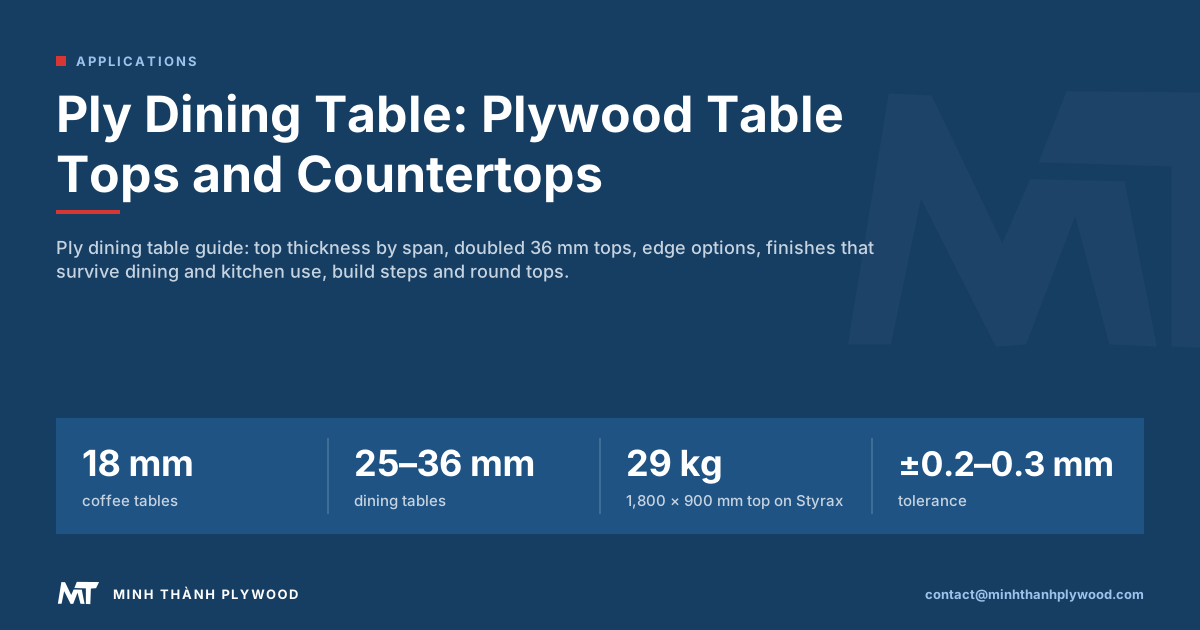
Is plywood good for a dining table?
Yes. A ply dining table is flat, strong and stable when it is built from good furniture plywood with a sanded hardwood face. Cross-laid veneers stop the top cupping or splitting like a wide solid board, and the striped plywood edge has become a design style of its own.
What makes plywood work for tables:
- Stability: cross-laid plies move very little with humidity, so the top stays flat through the seasons.
- Width in one piece: a 1220 × 2440 mm sheet gives a full six-seater top without glue joints across it.
- Strength: fixings for legs, brackets and frames hold in the face and the cross plies.
- Looks: birch faces with visible edge plies for a modern style, or oak, walnut and ash veneers for a solid-wood look.
- Cost: a plywood top costs much less than a solid hardwood top of the same size.
The weak points are the edges, which take up water fastest, and thin face veneers, which can be sanded through. A good finish and careful sanding deal with both.
What thickness plywood for a table top?
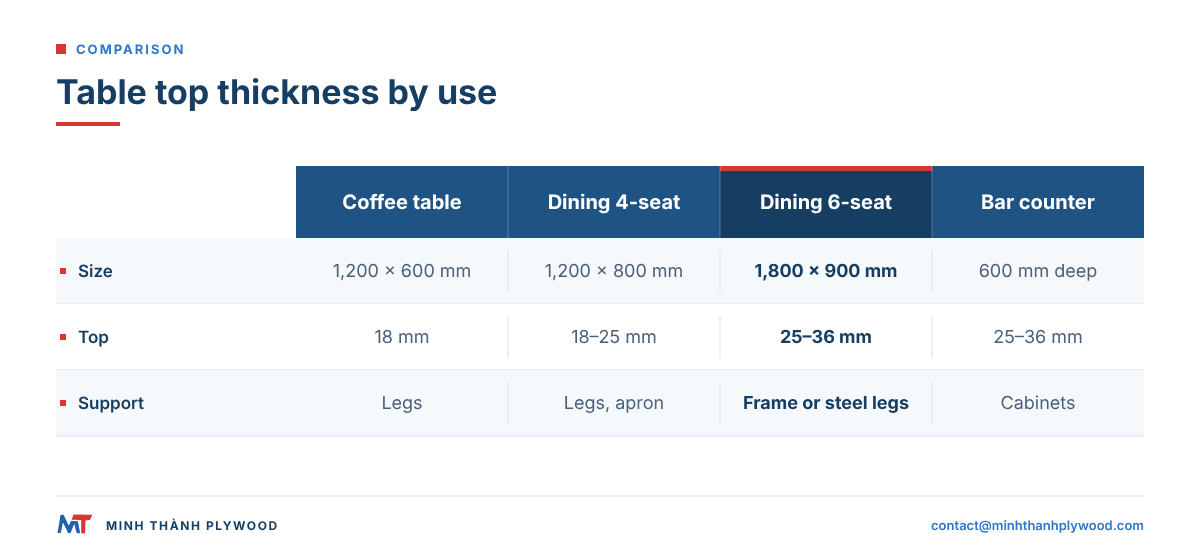
Use 18 mm plywood for small tables and coffee tables, 25 mm for dining tables, and 36 mm (two 18 mm sheets glued face to face) for long tables or a thick, solid look. Thickness depends on the span between supports and how the top is supported.
| Table | Typical size | Top thickness | Support |
|---|---|---|---|
| Side table | Up to about 600 mm | 12–18 mm | Four legs |
| Coffee table | About 1,200 × 600 mm | 18 mm | Legs or base frame |
| Four-seater dining table | About 1,200 × 800 mm | 18–25 mm | Legs with apron or frame |
| Six-seater dining table | About 1,800 × 900 mm | 25–36 mm | Frame or steel legs |
| Long table or desk | 2,000 mm and more | 36 mm, or 25 mm with a frame | Frame, middle support |
| Bar or kitchen counter | About 600 mm deep | 25–36 mm | Cabinets or brackets |
A frame or apron under the top lets you use a thinner top over a longer span; hairpin or corner legs with no apron need the thicker top. Our plywood thickness guide lists the full range in metric and imperial.
Plywood dining room table: doubled 36 mm tops
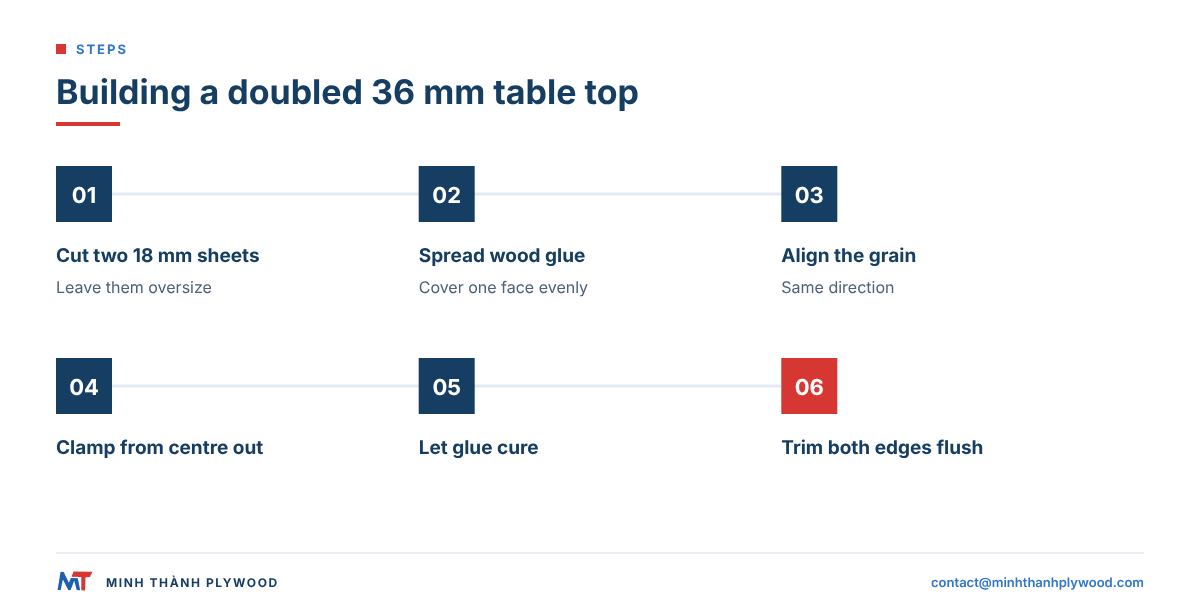
A plywood dining room table with a 36 mm top is usually two 18 mm sheets glued face to face. Doubling makes the top stiffer, gives a thick striped edge and hides the fixings for the legs in the lower layer.
- Cut both sheets a little oversize.
- Spread wood glue evenly over one face with a notched spreader or roller.
- Lay the second sheet with its grain in the same direction.
- Clamp or screw from the underside at close spacing, working from the centre out.
- Let the glue cure, then remove the screws if they are not wanted.
- Trim the edges together with a track saw or router for one clean, flush edge.
A doubled top is about twice as heavy as one sheet. A 1,800 × 900 mm top in 36 mm weighs about 29 kg on a Styrax core and about 38 kg on a Eucalyptus core, from the core densities of 500 and 650 kg/m³.
Which plywood is best for a dining table?
The best plywood for a dining table has a sanded hardwood face, a void-free core and a tight thickness tolerance. Voids show on the edge and soften under weight; an uneven sheet makes a bumpy doubled top.
| Face | Look | Notes |
|---|---|---|
| Birch | Pale, fine grain, neat light edge plies | The classic plywood-edge table |
| Poplar | Pale, plain | Good under paint, stain or laminate |
| Oak, walnut or ash veneer | Solid-wood look | Edge with a solid lip or veneer banding |
| EV (engineered veneer) | Even colour and grain | Consistent across many tables |
| Okoume | Pinkish brown | Light, easy to finish |
| Laminate (HPL) | Any colour or pattern | Hard-wearing surface for cafés and kitchens |
Our furniture panels use white Styrax or Eucalyptus cores as standard, with sanded and polished faces. Thickness tolerance on sanded furniture panels is ±0.2–0.3 mm, down to ±0.2 mm, so two sheets glue up flat. For the face choice in more depth, see our guide to the best plywood for furniture and the birch plywood page.
How to make a ply dining table
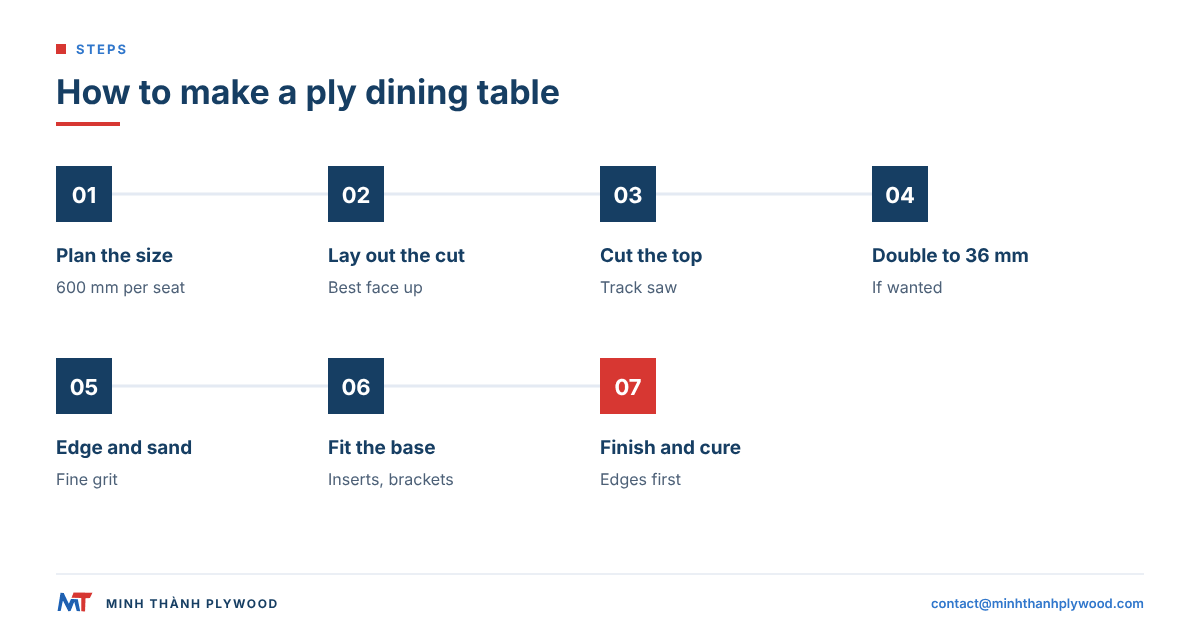
Make a dining table with plywood in eight steps: plan, cut, double if needed, edge, sand, fit legs, finish and cure.
- Plan the size: about 600 mm of table edge per seat; a six-seater is about 1,800 × 900 mm.
- Lay out the cut on the sheet so the best face area forms the top.
- Cut the top with a track saw or a circular saw on a guide, good face down for a circular saw.
- Double the top for 36 mm, if wanted, and trim the edges flush.
- Shape and edge: round the corners, ease the arrises, or glue on a solid lip.
- Sand the faces and edges in steps to a fine grit, without sanding through the face veneer.
- Fit the base: steel hairpin legs, a welded frame, a plywood trestle or a timber apron with corner brackets; use threaded inserts in the plywood for removable legs.
- Finish and cure: seal the edges first, coat both faces equally, and let it cure before use.
Screw legs into the plywood face with screws a few millimetres shorter than the top, or into threaded inserts. Never let a screw point break through the top face.
Plywood table edge options
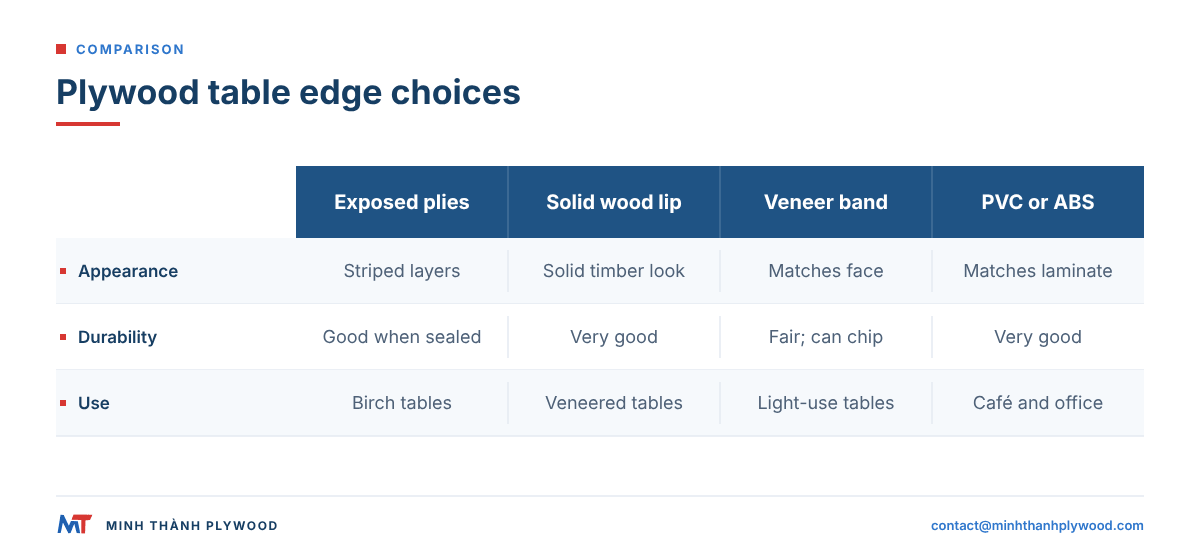
A plywood table edge can be left exposed and lacquered, edged with a solid wood lip, or covered with veneer or PVC banding. The edge style sets the table’s look more than any other detail.
| Edge | Look | Durability | Best for |
|---|---|---|---|
| Exposed, sanded and lacquered | Striped plywood layers | Good once sealed | Birch tables, modern styles |
| Chamfered or bevelled exposed | Thin top look, layers show at an angle | Good once sealed | Coffee tables, desks |
| Solid wood lip | Looks like solid timber | Very good; takes knocks | Oak and walnut veneer tables |
| Veneer edge banding | Matches the face | Fair; can chip | Light-use tables |
| PVC or ABS banding | Matches laminate | Very good | Café and office tables |
| Steel or aluminium edge | Industrial | Very good | Workbenches, bars |
A void-free core matters most for exposed edges: gaps in the inner plies show as dark holes. Fill any small void with tinted filler before the first coat.
How to finish a plywood dining table
Finish a plywood dining table with a hard, water-resistant coating on both faces and every edge: water-based polyurethane, a two-part lacquer, hardwax oil or epoxy. Edges first, faces equal, full cure before use.
| Finish | Look | Heat and water | Repair |
|---|---|---|---|
| Water-based polyurethane | Clear, low yellowing | Good | Sand and recoat the whole top |
| Two-part (2K) lacquer | Clear, hard | Very good | Workshop recoat |
| Hardwax oil | Natural, matt | Fair to good | Spot repair, re-oil |
| Epoxy | Thick, glossy | Very good on water, weaker on heat | Hard to repair |
| Laminate (HPL) | Any pattern | Very good | Replace the sheet |
| Paint with clear top coat | Colour | Good | Touch up |
The US Forest Products Laboratory’s Wood Handbook (FPL-GTR-282, 2021) explains why film finishes slow moisture exchange rather than stop it, which is why every face and edge needs the same coats.
Coat the underside as well as the top. A table finished on one face only takes up and loses moisture unevenly and can cup. Both faces of our furniture panels are UV-ready, made to the standard customers need to apply their own UV coating on a factory line.
Can you use plywood for a countertop?
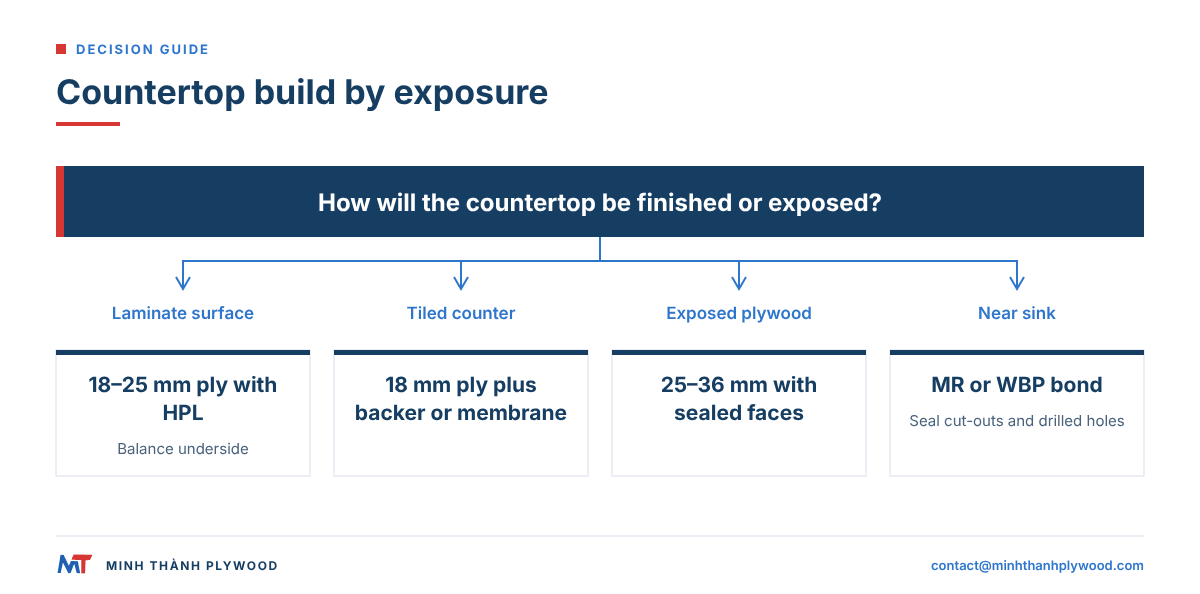
Yes. Plywood makes a stable countertop core under laminate, tile or stone, and an exposed plywood countertop is a popular look in kitchens and bars when it is sealed well. Choose the glue for the water it will see, and seal the sink cut-out and every edge.
- Under laminate: 18–25 mm plywood bonded with contact adhesive to high-pressure laminate (HPL), with a balancing laminate underneath.
- Under tile: 18 mm plywood over the cabinets with a cement backer board or a membrane, as the tile maker asks.
- Exposed plywood countertop: 25–36 mm birch or veneered plywood, sealed with polyurethane, two-part lacquer or epoxy.
- Near the sink: MR or melamine-fortified, or phenolic (WBP) bonded plywood, with the bond class chosen from the plywood specification in BS EN 636, which covers plywood for dry, humid or exterior conditions; seal the sink cut-out and every drilled hole before fitting.
- Food contact: use a finish rated food-safe once cured, and cutting boards on top.
Our furniture and interior panels use UF glue at E0 emission as standard; MR or melamine-fortified and phenolic (WBP) bonds are made to the buyer’s specification. For the US, TSCA Title VI sets 0.05 ppm formaldehyde for veneer-core hardwood plywood under 40 CFR 770.10. Our guide to whether plywood is waterproof explains what each glue survives.
Plywood coffee table ideas
A plywood coffee table is the easiest plywood table to build: an 18 mm top, a short span and simple legs. Coffee tables also show off plywood edges best because they are seen from above and the side.
- Box coffee table: four 18 mm panels mitred or butt-jointed, with a shelf inside.
- Hairpin-leg table: an 18–25 mm top on steel hairpin legs.
- Slotted flat-pack table: two or three CNC-cut panels that slot together without fixings.
- Layered or stacked table: offcut strips glued edge-up for a striped top.
- Wood coffee table tops on a steel base: a round or rounded-rectangle plywood top on a welded frame.
- Lift-top table: a hinged top on lift mechanisms, with storage inside.
A wooden coffee table top in plywood weighs much less than a solid-wood top of the same size, which matters for lift-top and flat-pack designs.
Plywood bar tops, desks and plyboard tables
A plywood bar top or desk follows the same rules as a dining table: 25–36 mm for long spans, a hard finish and sealed edges. A plyboard table, as plywood tables are often called in India and the UK, is the same build.
- Plywood bar counter: 36 mm doubled top with a solid wood or steel edge; 2K lacquer or epoxy against spills.
- Desks: 25 mm top with a steel frame, or 18 mm top with a plywood modesty panel that stiffens it.
- Café and restaurant tables: HPL-faced plywood with ABS edge banding, for daily cleaning.
- Outdoor tables: exterior plywood with phenolic glue, painted or varnished, edges sealed and renewed.
For heavy desks and long bars, check the shelf and span figures in our guide to how much weight plywood can hold.
Round tops and cut-to-size table parts
A round plywood table top is cut with a router on a trammel, a jigsaw and sander, or ordered cut to size. One 1220 × 2440 mm sheet gives a round top up to about 1,200 mm across, or two smaller round tops.
- Up to about 1,200 mm diameter: one top per sheet, from the full width.
- Smaller tops: two round tops per sheet for café tables.
- Larger round tables: two half-circles joined with a hidden spline, or a doubled top with staggered joints.
- Cut-to-size orders: for production runs, tops and parts can be cut to size at the factory; one panel is cut into 4, 6 or 8 pieces.
Our cut-to-size plywood page explains how cut sizes are ordered. Cut-to-size panels ship regularly to Italy and other European markets.
What size is a plywood dining table, and where do you buy one in the UK?
A standard dining table is 750 mm high and 900–1000 mm deep, with the length set by the seats. UK makers such as Made in Ply sell finished plywood tables in 4000 and 5600 mm lengths, 1000 mm deep and 750 mm high, with Formica, birch or oak tops, and 7magok builds birch ply tables to order in 5 to 9 working days. Rigg supplies plywood tables with a doubled top of two 18 mm sheets, 36 mm deep, plus about 1 mm of HPL.
| Dimension | Norm | Note |
|---|---|---|
| Table height | 750 mm | Dining and desk height |
| Table depth | 900–1000 mm | 1000 mm is the long-table norm |
| Length, 4 to 6 seats | 1200–1800 mm | Round to the sheet: 2440 mm is the full sheet |
| Length, 8 seats and up | 2000 mm to 4000 mm | Join sheets or add a mid-support |
| Chair seat height | 45 cm | Sets the clearance under the top |
| Leg clearance, A, X or V legs | Table length minus 29 cm | Measured at 45 cm seat height |
| Top build | 18 mm ply plus about 1 mm HPL, or two 18 mm sheets for 36 mm | HPL or Formica faces give a hard, wipe-clean top |
Ways to buy in the UK:
- UK makers: made-to-order plywood tables in a stated size, face and finish, with a lead time of 1 to 2 weeks being common.
- Design shops and online makers: ready-made birch plywood tables and desks.
- Your own build: a plywood top from a local panel dealer or a cut-to-size service, with legs bought separately.
Ask any maker for the top thickness, face species, core and finish. They decide how the table wears. UK furniture makers who build tables in quantity buy birch or poplar faced 18–25 mm panels by the container; Minh Thanh Plywood ships 1220 × 2440 mm furniture panels in these thicknesses.
What this means for your order
For table tops and countertops, order furniture plywood by the face you will show and the thickness you will build. Send these lines with your request:
- Application: dining tables, coffee tables, desks or countertops.
- Thickness: 18 or 25 mm, or 18 mm sheets for doubling to 36 mm.
- Face: birch (D+/D), poplar, EV, okoume, oak or walnut veneer, sanded.
- Core: white Styrax or Eucalyptus as standard.
- Glue and emission: UF glue at E0 emission for dry interiors; MR or phenolic (WBP) for kitchen and sink tops.
- Size: 1220 × 2440 mm or 1250 × 2500 mm; cut-to-size tops by agreement.
- Quantity: from one 40HC with mixed specifications by agreement.
Production takes 15–45 days after the deposit, and free samples are available. See furniture plywood from Vietnam for the build.
Buyer questions, answered
Is plywood good for a dining table?
Yes. Good furniture plywood is flat, strong across its width and stable through the seasons, and its layered edge has become a design feature. Use a sanded hardwood face, 18 mm or thicker, and seal it with a hard finish.
What thickness plywood for a table top?
18 mm for small and side tables, 25 mm for dining tables up to about 1,800 mm long, and 36 mm (two 18 mm sheets glued) for long or heavy-use tables or a solid look.
Which plywood is best for a dining table?
A furniture plywood with a sanded birch, poplar, oak or walnut veneer face, a void-free core and an even thickness. Birch shows the neatest striped edge; veneered faces give the look of solid wood.
Can you use plywood for a countertop?
Yes, as a core under laminate or tile, or as an exposed plywood top sealed with polyurethane or epoxy. Use moisture-resistant or phenolic-bonded plywood near the sink and seal the cut-out edges.
How do you finish a plywood dining table?
Sand to a fine grit, seal the edges first, then apply two or three coats of water-based polyurethane, hardwax oil or a two-part lacquer to both faces. Let it cure fully before use.
How do you make a dining table with plywood?
Cut the top from one sheet or glue two sheets for 36 mm, sand and edge it, fit a frame or legs with steel brackets or hairpin legs, and finish every face and edge.
How big is a six-seater plywood dining table?
About 1,800 × 900 mm, which fits inside one 1220 × 2440 mm sheet. A four-seater is about 1,200 mm long.
How heavy is a 36 mm plywood dining table top?
A 1,800 × 900 mm top in 36 mm weighs about 29 kg on Styrax core and about 38 kg on Eucalyptus core, from the panel densities.
Can you make a round plywood table top?
Yes. Cut it with a router on a trammel or order it cut to size. One 1220 × 2440 mm sheet gives a round top up to about 1,200 mm across, or two smaller tops.
Does a plywood table top need edging?
Not always: a sanded, lacquered plywood edge is a popular look. Add a solid wood lip or edge banding when you want the top to look like solid wood or need a harder edge.