
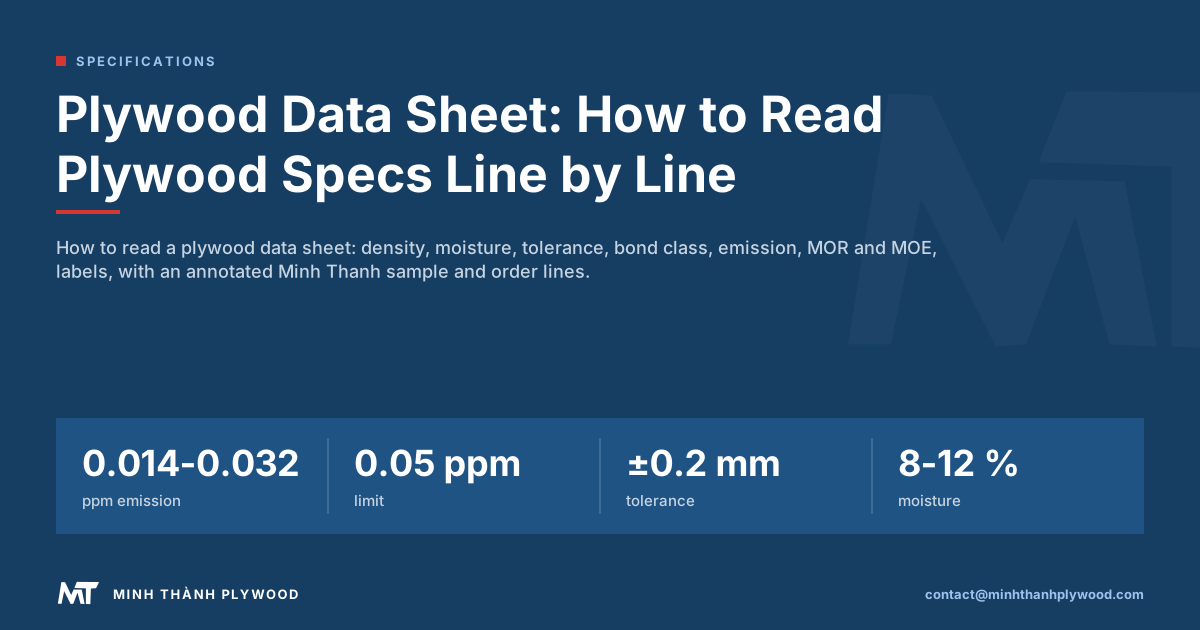
A plywood data sheet lists what the panel is (faces, core, glue, sizes) and what it measures (density, moisture, tolerance, bond, emission, strength), each with a test method. Read it as a set of claims, then match every line to a report or a check on arrival. Minh Thanh Plywood's sample sheet below shows each line with the document behind it.
What is a plywood data sheet?
A plywood data sheet is the mill’s short specification of one panel type: what it is built from, what sizes it comes in and what its measured properties are, each with the test method used. Buyers use it to compare offers, write purchase orders and check the panels that arrive.
The same document goes by several names:
- Technical data sheet (TDS): the most common name; lists build and measured properties.
- Product data sheet: often a shorter, sales-oriented version of the TDS.
- Specification sheet or spec sheet: the version a buyer or architect writes into a tender.
- Declaration of Performance (DoP): in the EU, the formal statement for CE-marked construction panels under EN 13986.
- Safety data sheet (SDS): a different document about handling hazards such as wood dust; it does not specify the panel.
A good plywood data sheet does three things: it names every build choice, it gives each measured value with its method and units, and it can be traced to reports the mill can send.
Plywood data sheet to download: what Minh Thanh sends, and typical values
UK buyers searching for a plywood data sheet usually want the sheet for one product: “18 mm 2440 × 1220 structural hardwood, Class 3”, with the spec table. Minh Thanh issues the data sheet as a PDF for the build you order, one per line below, with the certificates and reports attached. Ask for the line you buy and the sheet comes back with the quotation.
| Data sheet line | UK name the buyer uses | Glue and bond | EN 636 use class |
|---|---|---|---|
| Furniture and interior plywood | Non-structural hardwood plywood | UF glue at E0 emission | EN 636-1, dry |
| Humid-room plywood | Class 2 hardwood plywood | MR or melamine-fortified glue, EN 314-2 Class 2 | EN 636-2, humid |
| Exterior plywood | Class 3 exterior hardwood plywood | Phenolic (WBP), EN 314-2 Class 3 | EN 636-3, exterior |
| Film-faced plywood | Shuttering plywood | Melamine-fortified or phenolic (WBP) | EN 636-2 or 636-3 |
UK shelves also carry BS 1088 marine plywood and softwood shuttering C+/C; Minh Thanh makes neither as a marine product and quotes its phenolic exterior and film-faced panels for those jobs.
Typical values for a UK data sheet. These lines sit beside the build lines on a UK sheet:
| Line | Typical value | Method |
|---|---|---|
| Density | About 500 kg/m³ on a Styrax core, 650–750 kg/m³ on a Eucalyptus core | EN 323 |
| Bond class | Class 1, 2 or 3 by glue, as in the table above | EN 314-2 |
| Use class | EN 636-1, -2 or -3 by glue | EN 636 |
| Reaction to fire | Euroclass D-s2,d0 for plywood of at least 9 mm thickness and 400 kg/m³ density, classed without further testing | EN 13986, Table 8 |
| Bending strength (MOR) | 38–52 N/mm² for eucalyptus-core commercial plywood | EN 310 |
| Bending stiffness (MOE) | 6,900–9,000 N/mm² for eucalyptus-core commercial plywood | EN 310 |
| Formaldehyde | E0, CARB P2 chamber results 0.014–0.032 ppm | ASTM D6007 |
The MOR and MOE ranges are published typical values for eucalyptus-core commercial plywood, not a Minh Thanh test report: strength follows species, plies and thickness, so the figure on your sheet comes from the ordered build, tested along and across the face grain through SGS. Both Styrax and Eucalyptus cores meet the 400 kg/m³ density that Table 8 asks for.
What does a plywood technical data sheet contain?
A plywood technical data sheet contains two groups of lines: the build, which the mill chooses, and the properties, which a test measures. The table lists the lines buyers should expect and the method behind each.
| Line | What it tells you | Method or reference |
|---|---|---|
| Face and back | Species and grade pair | Grade rules (EN 635 in Europe) or the mill’s own ladder |
| Core | Species, construction | Mill description |
| Glue / bond | UF, MR, melamine-fortified, phenolic (WBP) | Bond class to EN 314-2 |
| Emission class | E0, E1, CARB P2 / TSCA Title VI | ASTM D6007, ASTM E1333, EN 717-1 |
| Thickness and plies | Nominal thickness, ply count | Mill build |
| Sizes | Length × width | Mill range |
| Tolerances | Thickness, length, width, squareness | EN 315 or the mill’s tighter band |
| Density | kg/m³ | EN 323 |
| Moisture content | % at dispatch | EN 322 |
| Bending strength and stiffness | MOR and MOE, N/mm² | EN 310 |
| Surface | Sanded, polished, UV-ready, coated | Mill description |
| Certificates | Emission, quality system, origin | Certificate numbers |
| Packing | Sheets per pack, packs per container | Mill plan |
A line without a method is a description, not a measured value. That is fine for build lines such as “white Styrax core”; for a property line, ask which method and which report.
How to read a plywood specification sheet, step by step
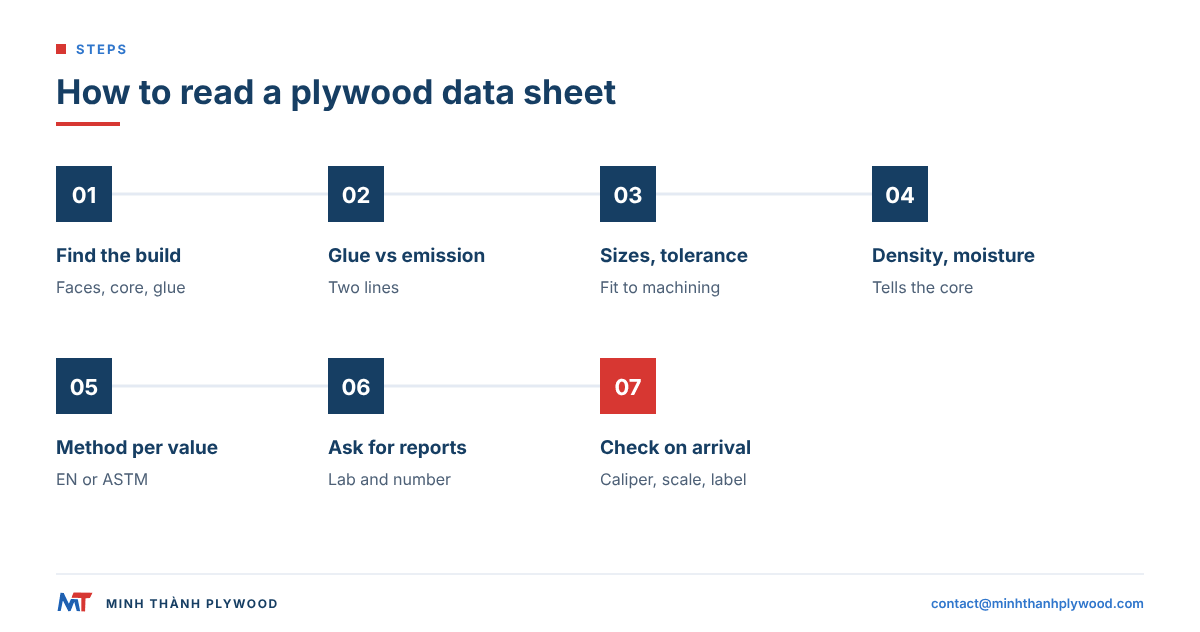
Read a plywood specification sheet in the order a buyer decides, from build to proof: faces, core and glue first, then emission, sizes and tolerance, density and moisture, and last the test method and report behind each number. Seven steps cover it:
- Find the build. Faces, core species and glue. These three lines decide most of the panel’s behaviour and price.
- Separate glue from emission. The glue line says what holds the panel together (UF, MR, phenolic); the emission line says how much formaldehyde it releases (E0, E1, CARB P2). They are two specifications.
- Check sizes and tolerance. Nominal thickness in millimetres, sheet size, and the tolerance band. Compare the band with what your machining needs.
- Read density and moisture together. Density tells you the core; moisture tells you how the sheet will move after delivery. A dense value on a declared light core is worth a question.
- Match each value to a method. MOR without EN 310, or emission without the chamber method, is not comparable with another mill’s sheet.
- Ask for the reports behind the numbers. Emission reports name the laboratory and the panel tested; certificates carry numbers you can look up.
- Turn it into checks on arrival. Thickness with a caliper, weight against density, labels against the certificate, edges against the build.
Step 7 is the one that makes the data sheet useful. A line you can check on arrival is a line you can hold the order to.
Annotated sample: Minh Thanh furniture plywood data sheet
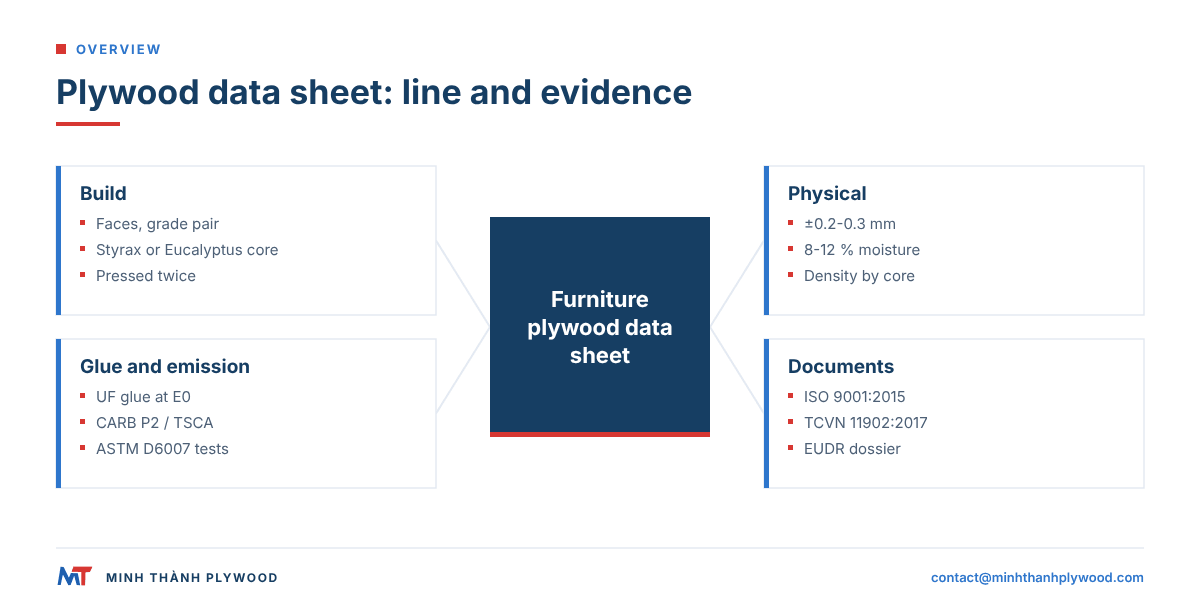
The sample below is Minh Thanh Plywood’s furniture plywood data sheet, with a note on the evidence behind each line. It covers the standard furniture and interior build; other builds change the glue, face or core lines.
| Line | Value | Evidence behind it |
|---|---|---|
| Faces | Birch (D+, D, E), poplar, EV, okoume, pine and others; quoted as face/back pairs | Approved sample per order |
| Core | White Styrax or Eucalyptus; Acacia and Pine on order | Stitched horizontally and vertically |
| Pressing | Twice: core board pressed and calibrated, then faces pressed on | Mill process |
| Glue | UF glue at E0 emission; MR, melamine-fortified or phenolic (WBP) to order | Glue line of the order |
| Emission | E0, tested every 3 months | Six ASTM D6007 chamber tests, 0.014–0.032 ppm |
| Certification | CARB P2 / TSCA Title VI | ICTT mill no. 23024 |
| Thickness | 3–40 mm | Mill range |
| Sizes | 1220 × 2440 and 1250 × 2500 mm; custom 1220 × 2500 and 1220 × 2280 mm | Mill range |
| Thickness tolerance | Sanded ±0.2–0.3 mm, down to ±0.2 mm | Caliper check, any sheet |
| Length and width tolerance | ±2 mm | Tape check, any sheet |
| Density (reference) | Styrax core about 500 kg/m³; Eucalyptus core 650 kg/m³ | Sheet weight: 26.8 kg (Styrax) or 34.8 kg (Eucalyptus) at 1220 × 2440 × 18 mm |
| Moisture content | 8–12 % at dispatch | Moisture meter on arrival |
| Surface | Sanded and polished; both faces UV-ready | Approved sample |
| Quality system | ISO 9001:2015 for plywood manufacturing | Certificate KAC25/0185 |
| National certificate | TCVN 11902:2017, veneer-faced plywood | VietCert 141.1-VNC-HC |
| Strength (MOR, MOE) | Tested to the buyer’s method on request | SGS report for the order |
Note what the sheet does not do: it does not print strength numbers that were not measured on this build. When a project needs MOR and MOE, we test the ordered build through SGS to the buyer’s method and the report goes with the order.
Density, moisture and tolerance: what the values mean
Density, moisture and tolerance are the three physical lines on every plywood data sheet, and all three can be checked on arrival with simple tools.
Density (EN 323) is mass per volume at a stated moisture. It tells you the core species: a white Styrax core sits around 500 kg/m³, a Eucalyptus core around 650 kg/m³, all-birch higher. It sets sheet weight and therefore the container load: a 1220 × 2440 × 18 mm sheet weighs about 26.8 kg on Styrax and 34.8 kg on Eucalyptus. Weigh five sheets on arrival and divide by their volume; the result should sit near the declared density.
Moisture content (EN 322) is water as a percentage of dry wood mass. Furniture plywood is dried to 8–12 % at dispatch. Panels much wetter than that can shrink and bow after they are cut; a pin meter reading on arrival tells you.
Tolerance (EN 315 or the mill’s own band) is how far the measured thickness, length and width may be from nominal. EN 315 gives a band that widens with thickness; furniture lines that cut grooves and hinge pockets ask for tighter. Minh Thanh’s sanded panels hold ±0.2–0.3 mm on thickness and ±2 mm on length and width.
Bond class and glue: reading the glue line
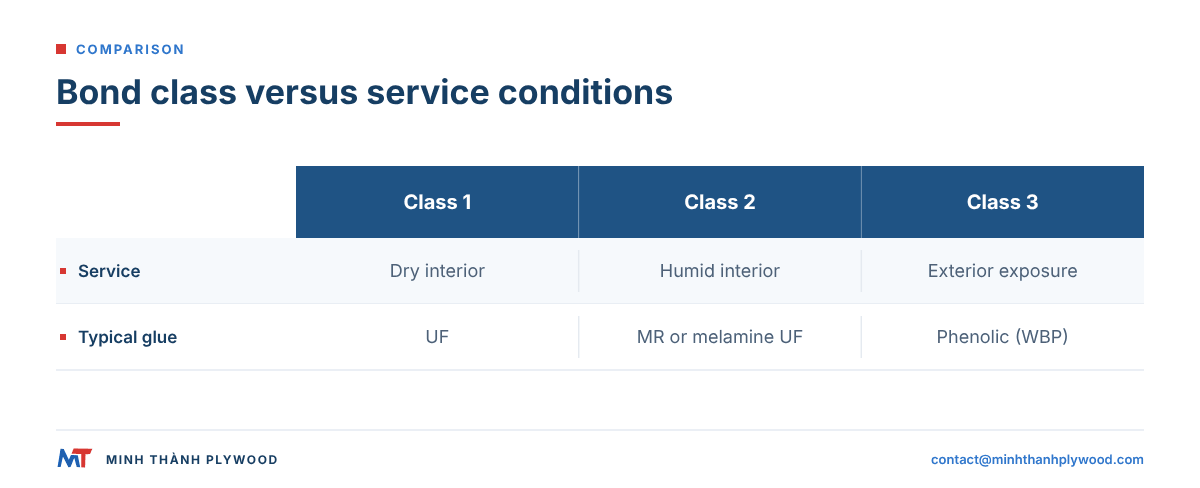
The glue line on a plywood data sheet names the adhesive and the conditions its bond survives. Europe grades bonds into three classes under EN 314-2:
| Bond class (EN 314-2) | Service conditions | Typical glue |
|---|---|---|
| Class 1 | Dry interior | UF (urea-formaldehyde) |
| Class 2 | Humid interior, protected exterior | MR or melamine-fortified UF |
| Class 3 | Exterior exposure | Phenolic (WBP) |
Bond class is tested by soaking or boiling specimens and then shearing the glue line. It is a different question from use class (EN 636-1, -2 and -3, dry, humid and exterior), which covers the whole panel, but the two usually move together.
For furniture and interior panels the standard choice is UF glue at E0 emission. Kitchen and bathroom parts may take MR or melamine-fortified glue; exterior and formwork work take phenolic (WBP). Minh Thanh makes MR, melamine-fortified and phenolic bonds to the customer’s specification, and the data sheet for that order names the bond.
Emission: E0, E1, CARB P2 and TSCA on a data sheet
The emission line says how much formaldehyde the panel releases, measured by a named method. It is separate from the glue line: “UF glue at E0 emission” is two facts, a resin and a class.
What the common emission entries mean:
- CARB P2 / TSCA Title VI: the US limit for hardwood plywood with a veneer core is 0.05 ppm, tested by ASTM E1333 or ASTM D6007 and certified by a third-party certifier. The EPA formaldehyde emission standards and the California Air Resources Board composite wood products programme set out the rules (consulted 20 October 2026).
- E1: the European class tested by EN 717-1 (chamber); E1 is an emission class, not a glue.
- E0: a lower class used in Asian and furniture trade, below E1.
Minh Thanh’s evidence for this line is CARB P2 / TSCA Title VI certification for hardwood plywood with a veneer core, 3–50 mm, under ICTT mill no. 23024. Six ASTM D6007 chamber tests between April 2025 and June 2026 on 9, 15 and 18 mm panels averaged 0.014–0.032 ppm against the 0.05 ppm limit.
Three reports are by Shanghai Hongjun (HJ-QAT-250597, HJ-QAT-251303, HJ-QAT-261036) and three by ICTT Vietnam (ICTTVN-QAT-250841, ICTTVN-QAT-251173, ICTTVN-QAT-260272). These are results on tested samples, with the method and laboratory on each report. For European buyers who want their own method, testing to EN 717-1 is arranged through SGS on request.
MOR, MOE and strength values: what to ask for
MOR and MOE are the bending strength and stiffness of the panel, tested to EN 310 on strips cut along and across the face grain. MOR (modulus of rupture) is the stress at which the strip breaks; MOE (modulus of elasticity) is how much it bends under load. Both are given in N/mm².
Read them with three questions:
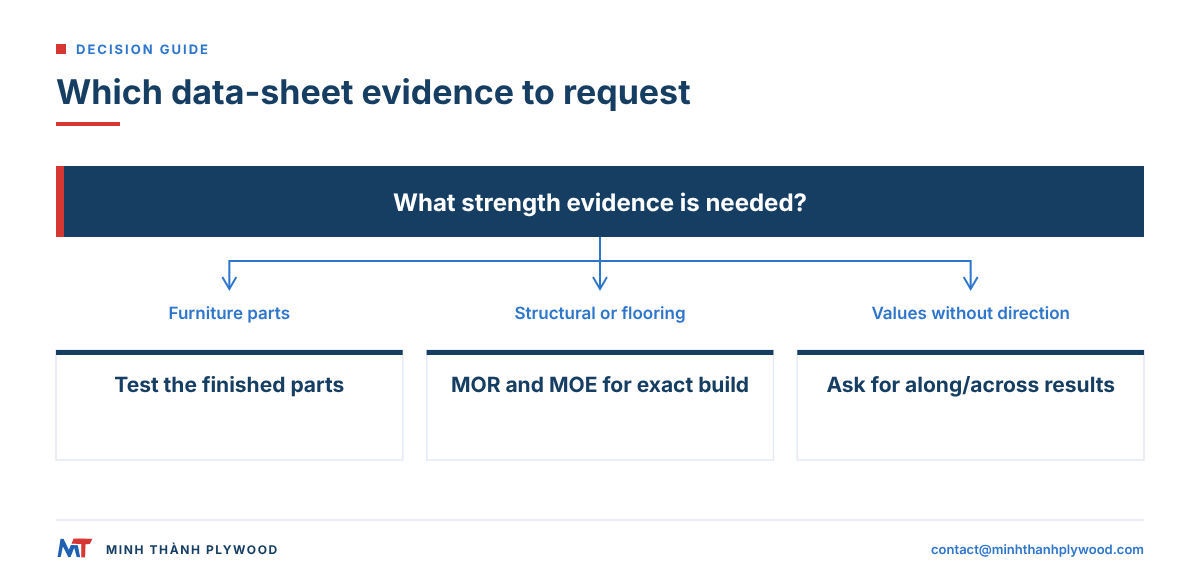
- Which direction? Plywood is stronger along the face grain than across it. A sheet that gives one figure without a direction is incomplete.
- Mean or characteristic? A mean is the average of the tests; a characteristic value is a lower figure used for structural design. Structural work uses characteristic values.
- Which build? Strength follows species, ply count and thickness. A value from a different core or thickness does not transfer.
Furniture buyers rarely design from MOR and MOE; they test parts. Structural, flooring and vehicle buyers do design from them, and then the values need a report on the exact build. Other mechanical lines, such as shear, screw withdrawal or Poisson’s ratio, belong to the same rule: one build, one method, one report. Through SGS we test the ordered build to the method in the buyer’s specification.
Plywood product data sheet vs marine plywood technical data sheet
A plywood product data sheet describes a general-purpose panel; a marine plywood technical data sheet adds the lines that prove the panel survives wet service. The difference is in the bond, the core and the standard.
| Line | General plywood product data sheet | Marine plywood technical data sheet |
|---|---|---|
| Standard | Mill specification, EN 636 use class | BS 1088 (or EN 636-3 with marine options) |
| Glue | UF, MR or phenolic | Phenolic (WBP) only |
| Bond test | EN 314-2 class named | Boil test to the standard, report attached |
| Core | Species and build | Durable species, strict core gap rules |
| Faces | Grade pair | Marine face grade, no open defects |
| Stamp | Mill mark | Standard and mill stamped on every sheet |
Minh Thanh does not sell its okoume or furniture panels as marine plywood and makes no BS 1088 claim. For exterior and humid uses we make panels with phenolic (WBP) or melamine-fortified bonds to the customer’s specification, and the data sheet for that order names the bond.
Stamps, labels and pack marks decoded
Stamps and labels are the part of the data sheet you can read on the panel itself. On arrival they connect the sheet in your hand with the documents in your file.
- TSCA Title VI label (US orders): producer, lot, certifier number TPC-43 and the words “TSCA Title VI compliant”. Panels for US orders carry it, and the commercial invoice and B/L state TSCA Title VI compliance.
- Pack label: product, thickness, size, grade pair, sheet count and pack number, matching the packing list line by line.
- Lacey Act data (US): face and core species and Vietnamese harvest origin, supplied for the importer’s declaration.
Read the label against the packing list first, then against the certificate number. A label that matches both is the quickest proof that the right panels arrived.
Which compliance documents go with the data sheet?
The data sheet describes the panel; compliance documents prove it to customs and to the buyer’s customers. For a Minh Thanh order the set is:
| Document | What it covers |
|---|---|
| CARB P2 / TSCA Title VI certificate | Emission certification, ICTT mill no. 23024 |
| Chamber test reports | ASTM D6007, Shanghai Hongjun and ICTT Vietnam |
| ISO 9001:2015 certificate | Quality system for plywood manufacturing, KAC25/0185 |
| TCVN 11902:2017 certificate | Veneer-faced plywood, VietCert 141.1-VNC-HC |
| EUDR compliance dossier | Origin records and geolocation files |
| PPWR packaging test | SGS, September 2026, Regulation (EU) 2025/40 |
| Shipping documents | Commercial invoice, packing list, B/L, certificate of origin (EUR.1 for the EU), phytosanitary and fumigation certificates |
EUDR data does not sit on a technical data sheet. Regulation (EU) 2023/1115, Article 9, asks the operator for information such as the product description, the species, the quantity, the country of production and the geolocation of all plots of land where the wood was produced (consulted 20 October 2026). We supply the EUDR compliance dossier with origin records and geolocation files with each order.
The PPWR report covers the packaging: SGS tested the cardboard, the plywood and pallet blocks, the strapping band and the wrapping film under Regulation (EU) 2025/40 and found lead, cadmium, mercury and hexavalent chromium not detected, a pass against the 100 mg/kg limit.
How to request a plywood data sheet and write it into your order
Ask for the data sheet of the build you will order, not a general brochure, and copy its lines into your purchase order. A complete request reads:
“Please send the technical data sheet for: furniture plywood, birch D+/D faces, white Styrax core stitched both ways, pressed twice, UF glue at E0 emission, 18 mm ±0.2 mm sanded, 1220 × 2440 mm, with the emission certificate, latest chamber report and EUDR dossier sample. Strength: MOR and MOE to EN 310 by SGS.”
Then on the purchase order, repeat the same lines and add packing and destination. What comes back from us: the data sheet for that build, the certificates and reports, free samples cut from the build, and a container plan with sheets per pack and per 40HC.
Send the request to contact@minhthanhplywood.com; Lisa replies within hours. For panel builds see furniture plywood from Vietnam, and for the certificates see quality. Further guides as they are published: plywood strength values, CARB Phase 2 vs TSCA Title VI and EN 13986 and CE marking for plywood.
Buyer questions, answered
What is a plywood data sheet?
A one- or two-page document from the mill that lists a plywood panel's build, sizes and measured properties, such as density, moisture, tolerance, bond class, emission and strength, with the test method for each.
What fire class does plywood have on a data sheet?
Plywood of at least 9 mm thickness and 400 kg/m³ density can be declared Euroclass D-s2,d0 without further testing under EN 13986 Table 8. The data sheet states the class together with the density and thickness.
What is the difference between a technical data sheet and a safety data sheet for plywood?
A technical data sheet describes the panel's specification and performance. A safety data sheet covers handling hazards such as wood dust. Buyers specify from the technical sheet.
How do I read a plywood specification sheet?
Read the build lines first (faces, core, glue), then sizes and tolerance, then measured values with their test methods. Check that each value has a method and a matching report.
What do MOR and MOE mean on a plywood data sheet?
MOR, modulus of rupture, is bending strength at failure in N/mm². MOE, modulus of elasticity, is bending stiffness. Both are tested to EN 310, along and across the face grain.
What is bond class on a plywood data sheet?
Bond class says where the glue line holds: EN 314-2 class 1 for dry interiors, class 2 for humid interiors and covered exteriors, class 3 for exterior exposure.
Is E0 a glue type?
No. E0 is an emission class. The glue is a separate line, for example UF glue at E0 emission, or a phenolic WBP bond.
What emission results does Minh Thanh's furniture plywood have?
Six ASTM D6007 chamber tests between April 2025 and June 2026 on 9, 15 and 18 mm panels averaged 0.014–0.032 ppm, against the 0.05 ppm CARB Phase 2 / TSCA Title VI limit.
What should a marine plywood data sheet show?
The standard (BS 1088), species and density, exterior phenolic bond with its test, core gap rules, face grades and the stamp. A data sheet without the bond test is not a marine data sheet.
Does a plywood data sheet include EUDR information?
Not usually. EUDR data, such as species, country of production and geolocation of the plots, comes in a separate dossier. Minh Thanh supplies the EUDR compliance dossier with orders.
Can I get third-party test results for my order?
Yes. Third-party testing to the buyer's method, for example EN 717-1 for emission or EN 310 for bending, is arranged through SGS on request.