
Poplar vs birch is a choice between a soft, light, pale face that paints well and costs less, and a harder, finer face that takes stain, wear and screws better. In most export plywood both are faces on the same hardwood core, so the face decides looks and price. Minh Thanh Plywood makes both in Vietnam; this guide compares them use by use.
Poplar vs birch plywood: the short answer
Choose birch-faced plywood when the face will be stained, clear-finished or knocked about, and poplar-faced plywood when it will be painted, laminated or hidden and price matters. That is the core of poplar vs birch plywood for most buyers.
The comparison changes with how the panel is built:
- All-poplar plywood: every ply is poplar. Light, soft, low cost, common in China.
- All-birch plywood (Baltic birch): every ply is birch. Heavy, hard, stiff, with a clean multi-ply edge.
- Poplar-faced or birch-faced plywood: a poplar or birch face and back pressed onto a hardwood core. This is how Vietnamese mills build both panels.
In faced panels the core sets weight, flatness and screw holding, and the face sets the look, the finish and the price. So compare faces first, then cores.
Poplar plywood vs birch plywood compared point by point
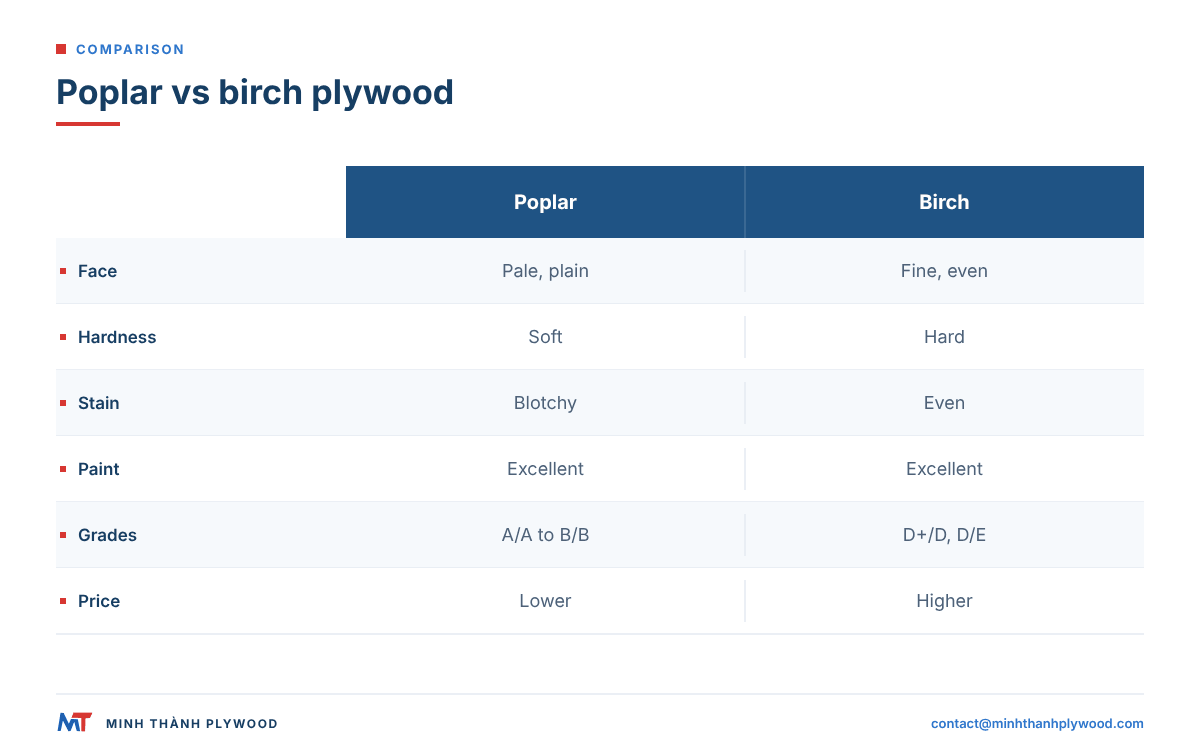
The table compares poplar plywood vs birch plywood on one property per row, for panels of the same build. Birch is harder and heavier, takes stain evenly and holds screws better; poplar is lighter, softer and cheaper, and paints well. Ratings are relative between the two.
| Property | Poplar | Birch |
|---|---|---|
| Face colour | Pale cream to white, may show green or grey streaks | Light cream to yellow-white, even |
| Grain | Straight, soft, little figure | Fine, tight, often with a light flame |
| Face hardness | Soft, dents more easily | Harder, resists dents and wear |
| Paint | Very good, smooth base | Very good |
| Stain | Uneven, may blotch | Even, takes stain well |
| Clear finish | Plain look | Bright, attractive look |
| Weight, all-ply panel | Light | Heavy |
| Screw holding, all-ply panel | Fair | Good |
| Laser cutting | Fast, light | Slower, crisp detail |
| Face grades | A/A, A/B, B/B (B/BB, BB/CC, CP) | D+, D, E (D+/D, D/E) |
| Price, same core | Lower | Higher |
Two rows matter most in practice: stain and hardness. If the finish is opaque and the part does not take wear, poplar saves money with no visible loss. If the finish shows the wood or the part is handled every day, birch earns its premium.
What is poplar plywood?
Poplar plywood is plywood with poplar veneer on the face and back, or on every ply. Poplar (Populus) is a fast-growing, light hardwood with a pale, plain face that sands smooth and paints well.
- All-poplar plywood is light and cost-effective, used for furniture backs, drawers, packaging, toys and hobby cutting.
- Poplar-faced plywood puts a poplar face and back on a harder core, which raises stiffness, screw holding and flatness while keeping poplar’s price and pale look.
- Bleached poplar plywood uses a poplar face lightened to an even white, for white furniture, shop fittings and painted or clear-coated parts.
Our poplar plywood is poplar-faced on a white Styrax or Eucalyptus core, quoted as face/back pairs A/A, A/B and B/B and matched to your approved sample. Buyers who order by the Chinese codes B/BB, BB/CC and CP get the same ladder under those names.
What is birch plywood?
Birch plywood is plywood with birch veneer on the face and back, or on every ply. Birch (Betula) is a dense, hard, fine-grained hardwood with an even light face that takes stain and clear finishes well.
- All-birch plywood, sold as Baltic birch or multiplex, is made in Northern and Eastern Europe with birch in every ply.
- Birch-faced plywood presses imported birch veneer onto a core of another hardwood. It gives the birch look and face hardness at a lower weight and price.
Our birch plywood is birch-faced on white Styrax or Eucalyptus core. Birch face grades are named D+, D and E in Vietnam and quoted as face/back pairs such as D+/D or D/E. The ladder is comparable to the European birch grades: D+ is close to B, D to BB, and E to CP/C, so D+/D is close to B/BB.
Poplar vs birch plywood strength
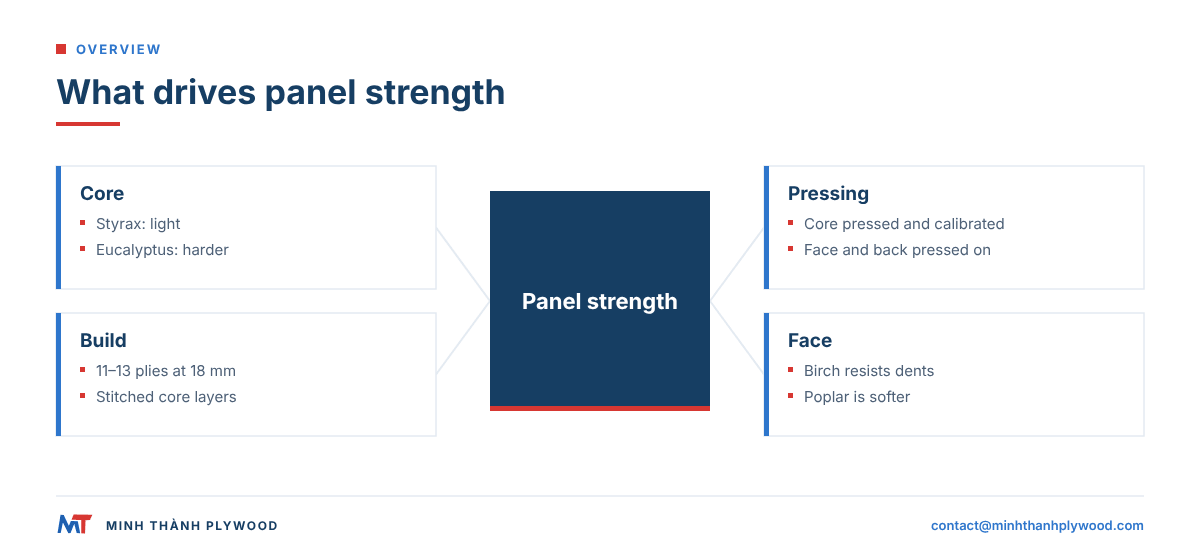
All-birch plywood is stronger, stiffer and harder than all-poplar plywood of the same thickness, because birch wood is denser. In faced panels the gap narrows: the core carries most of the bending load, and the faces mainly decide surface hardness.
What changes poplar vs birch plywood strength in a real panel:
- Core species and density. A white Styrax core gives a light, stable panel; a Eucalyptus core gives a heavier, harder one. Both are stronger than an all-poplar build.
- Ply count. An 18 mm panel is usually 11–13 plies. More, thinner plies spread defects and keep the panel flatter.
- Core assembly. Gaps and overlaps in the core weaken a panel more than the face species does. Our core layers are stitched both horizontally and vertically.
- Pressing. Our furniture-grade panels are pressed twice as standard: the core board is pressed and calibrated, then face and back are pressed on.
- Face hardness. Birch resists dents and point loads better than poplar, which matters on shelves, drawer fronts and table tops.
So a birch-faced panel and a poplar-faced panel on the same core carry almost the same load. The birch one keeps its face cleaner under knocks.
Weight and density: which is lighter?
All-poplar plywood is clearly lighter than all-birch plywood. Northern European birch plywood mills publish a density of about 680 kg/m³, while poplar is one of the lightest commercial hardwoods. In faced panels the core decides the weight, because face veneers are thin.
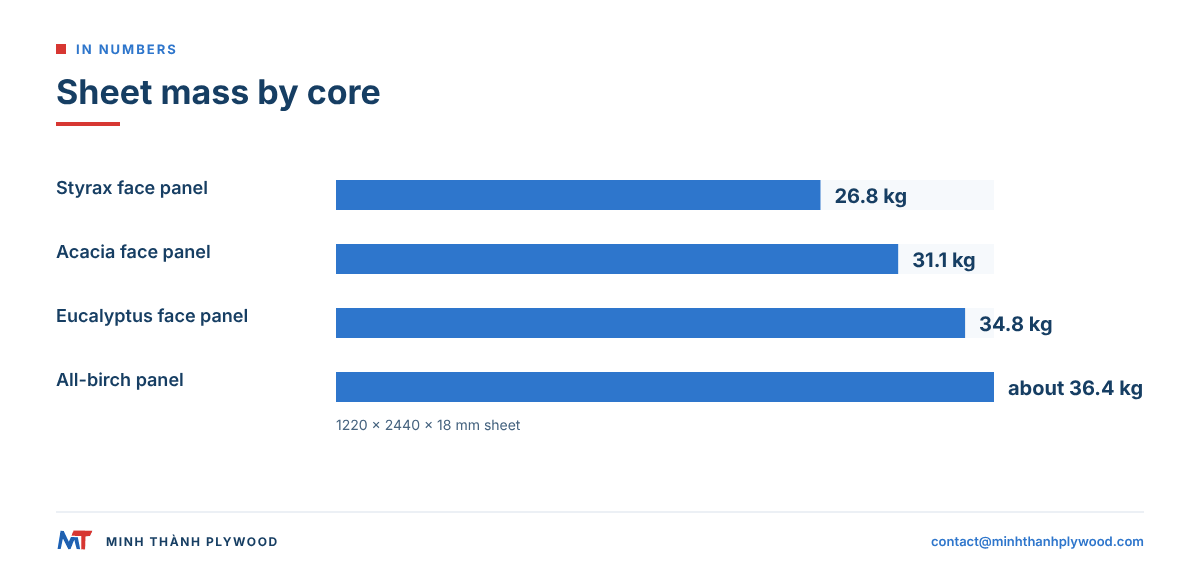
Weight is density times volume. A 1220 × 2440 × 18 mm sheet has a volume of 0.0535824 m³. Our reference sheet masses, the same for a poplar or a birch face:
| Build at 1220 × 2440 × 18 mm | Planning density | Sheet mass |
|---|---|---|
| Poplar or birch face, white Styrax core | 500 kg/m³ | 26.8 kg |
| Poplar or birch face, Acacia core | 580 kg/m³ | 31.1 kg |
| Poplar or birch face, Eucalyptus core | 650 kg/m³ | 34.8 kg |
| All-birch plywood, published density | 680 kg/m³ | about 36.4 kg |
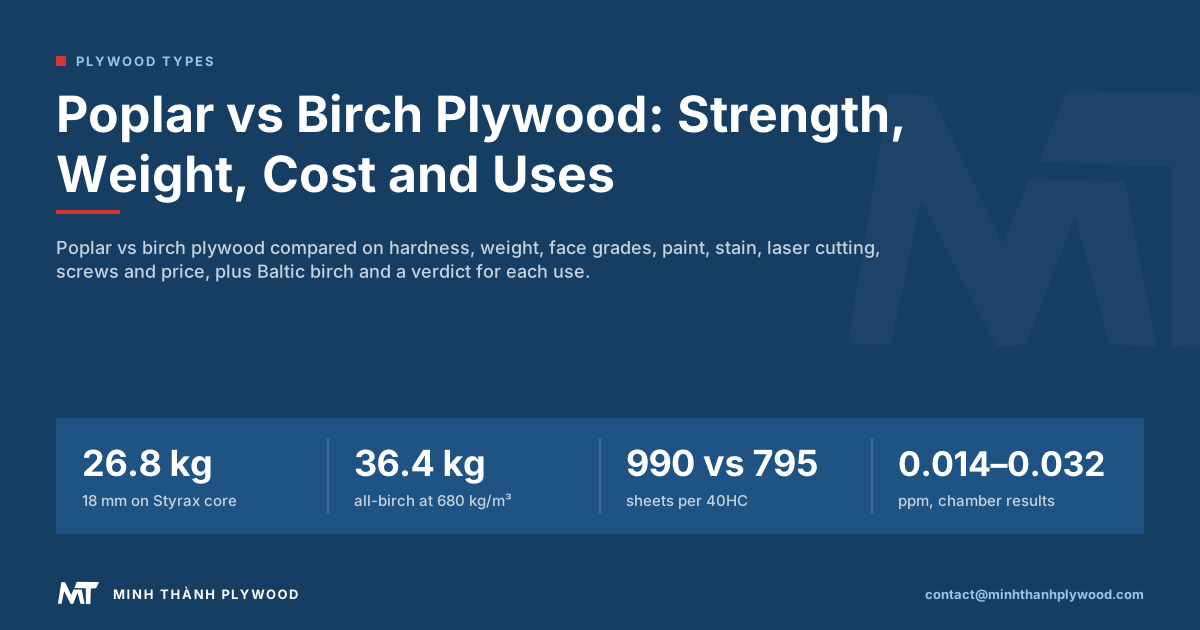
A birch-faced panel on Styrax core weighs about a quarter less than all-birch plywood of the same size. That matters for wall cabinets, caravan and van interiors, shop fittings that are moved, and freight: in a 40HC, the Styrax build loads 990 sheets of 18 mm against 795 on Eucalyptus core.
Screw holding and edges
Birch holds screws better than poplar in an all-ply panel, because the harder wood grips the thread. In faced panels, face screws hold according to the face, and edge screws hold according to the core.
- Face screws: birch faces resist pull-through and wobble better; on poplar, use washers or larger heads on loaded fixings.
- Edge screws: depend on the core. Eucalyptus and Acacia cores hold well; Styrax holds well with pilot holes and the right screw.
- Hinges and runners: fit to the core; for heavy doors use cup hinges with euro screws or inserts.
- Exposed edges: all-birch plywood shows even, void-free plies and is often left visible. Faced panels show the core species, so most buyers band them or paint them.
If your design shows the plywood edge as a feature, specify all-birch plywood. If the edges are banded, a faced panel does the job.
Face appearance, paint and stain
Poplar paints beautifully but stains poorly; birch does both well. That one fact decides many poplar vs birch choices in furniture.
| Finish | Poplar face | Birch face |
|---|---|---|
| Opaque paint | Excellent, smooth, low grain raise | Excellent |
| Lacquer or clear coat | Plain, pale look | Bright, even, with light figure |
| Wood stain | Blotchy without conditioner | Even, predictable |
| UV coating | Good base when sanded | Good base when sanded |
| Laminate or foil | Good, low cost base | Good, but the birch look is hidden |
Both faces of our furniture panels are sanded, polished and UV-ready, to the standard customers need to apply their own UV coating. Thickness is held to ±0.2–0.3 mm on sanded furniture panels, so faces stay flat under a lacquer or a laminate.
Bleached poplar plywood vs birch plywood
Bleached poplar plywood gives a whiter, more even face than birch at a lower price, but it is softer and shows its plain grain under a clear coat. Birch gives a warmer face with more figure and better wear.
Choose bleached poplar for white furniture, painted or clear-coated shop fittings, children’s furniture and display panels where an even white matters. Choose birch for stained work, high-wear surfaces and pieces sold on the look of the wood. Bleaching changes only the colour of the thin face veneer; it does not weaken the panel.
Bleached poplar vs birch for kitchen cabinets
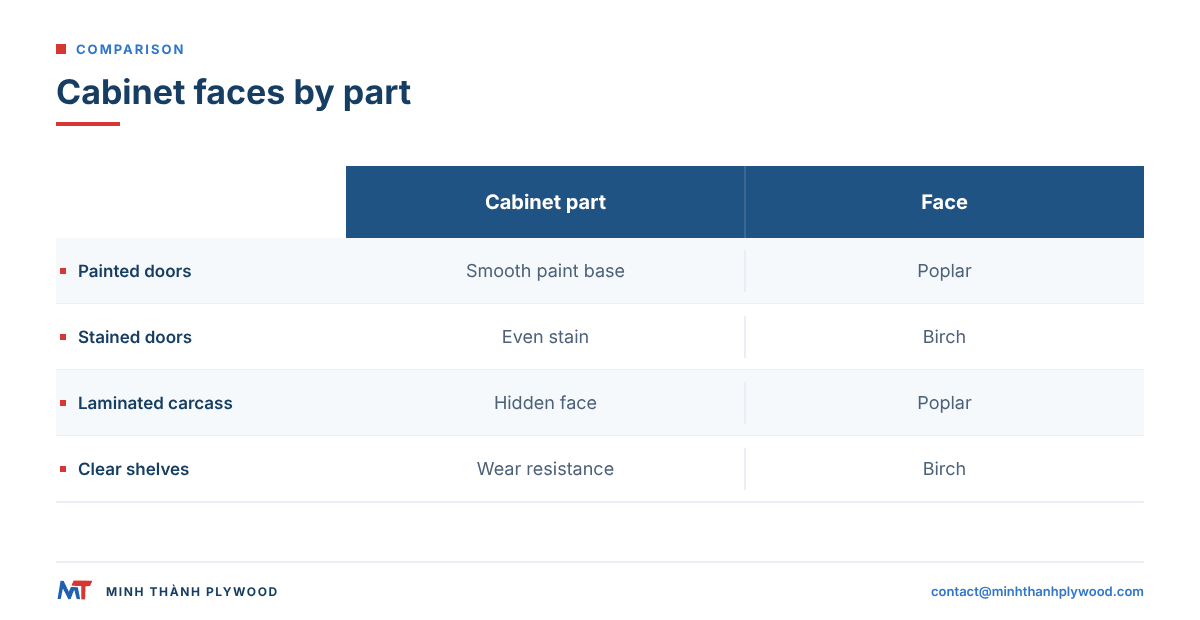
For kitchen cabinets, birch-faced plywood suits stained or clear-finished boxes and doors, and bleached or white poplar suits carcasses that are painted, laminated or hidden. Many cabinet makers mix them in one kitchen.
| Cabinet part | Better face | Why |
|---|---|---|
| Painted doors and panels | Poplar | Smooth paint base, lower cost |
| Stained or clear doors | Birch | Even stain, attractive grain |
| Carcass sides and backs, laminated | Poplar | Hidden face, lower cost |
| Open shelving, clear finish | Birch | Harder face, better look |
| Drawer boxes | Birch | Wear and screw holding |
| Wall cabinets | Either, on Styrax core | Lighter to hang |
Our guide to plywood for kitchen cabinets covers thickness, glue and edge choices for each cabinet part.
Laser cutting and CNC
Poplar plywood cuts faster and at lower power on a laser, which makes it popular for hobby work, models and displays. Birch plywood engraves with crisper detail and a harder edge, which suits signs, puzzles and products sold on finish.
- Thickness: laser work usually takes thin panels; our thin plywood of 3–5 mm is always 5-ply.
- Glue: the same glue through every ply gives an even cut; mixed glues char unevenly.
- Voids: a void inside the panel shows as a burnt gap; stitched, calibrated cores reduce them.
- CNC routing: birch faces chip less at the cut edge; poplar faces need sharp tools and down-cut bits.
See our thin plywood for 3–6 mm builds.
Poplar vs birch vs Baltic birch
Baltic birch is all-birch plywood with birch in every ply; poplar and birch plywood from Asian mills are usually faced panels on a hardwood core. At the reference densities below, both faced builds are lighter than all-birch plywood. Poplar-faced and birch-faced panels have the same planning weight on the same core; poplar faces cost less.
| Point | Poplar-faced | Birch-faced | Baltic birch |
|---|---|---|---|
| Plies | Poplar face, hardwood core | Birch face, hardwood core | Birch in every ply |
| Edge | Core species visible | Core species visible | Even birch plies, void-free |
| Weight, 18 mm | 26.8–34.8 kg by core | 26.8–34.8 kg by core | about 36.4 kg |
| Face hardness | Soft | Hard | Hard |
| Usual size | 1220 × 2440 mm | 1220 × 2440 mm | 1525 × 1525 mm, also 1220 × 2440 mm |
| Grades | A/A, A/B, B/B | D+/D, D/E | B/BB, BB/BB, BB/CP |
| Price | Lowest | Middle | Highest |
Our guides to Baltic birch plywood and birch plywood vs pine plywood go further into all-birch builds.
Which core is best under a poplar or birch face?
For furniture plywood, a white Styrax or Eucalyptus core is the usual choice under a poplar or birch face; Acacia and Pine cores are made on order. Vietnamese plywood is not made on poplar or birch cores: poplar and birch are faces.
| Core | Planning density | Best for |
|---|---|---|
| White Styrax | 500 kg/m³ | Light furniture, wall cabinets, a white edge; favoured by many European furniture buyers |
| Eucalyptus | 650 kg/m³ | Harder, heavier panels, table tops, high-wear parts |
| Acacia | 580 kg/m³ | Mid-weight panels, on order |
Our guide to the best plywood for furniture explains how core and face combine by furniture part. For a birch face, Styrax keeps the panel light; for a poplar face on table tops or shelving, Eucalyptus adds hardness.
Cost: is poplar plywood cheaper than birch?
Yes. On the same core, thickness and glue, poplar-faced plywood costs less than birch-faced plywood, because poplar veneer costs less than imported birch veneer. Baltic birch, with birch in every ply, costs the most.
What sets the price of either panel:
- Face species and grade: birch above poplar; A/A or D+/D above B/B or D/E.
- Core: Styrax, Eucalyptus or Acacia.
- Glue and emission: UF glue at E0 emission is our standard for furniture panels.
- Thickness, size and tolerance: sanded to ±0.2–0.3 mm costs more than unsanded.
- Quantity and term: from one 40HC, FOB Hai Phong, CFR or CIF.
As of October 2026, our furniture and interior plywood starts from US$350/m³. Compare cost per accepted part, not per sheet: a cheaper face that needs more filling or rejects parts at finishing can cost more in the end.
Which to choose by use
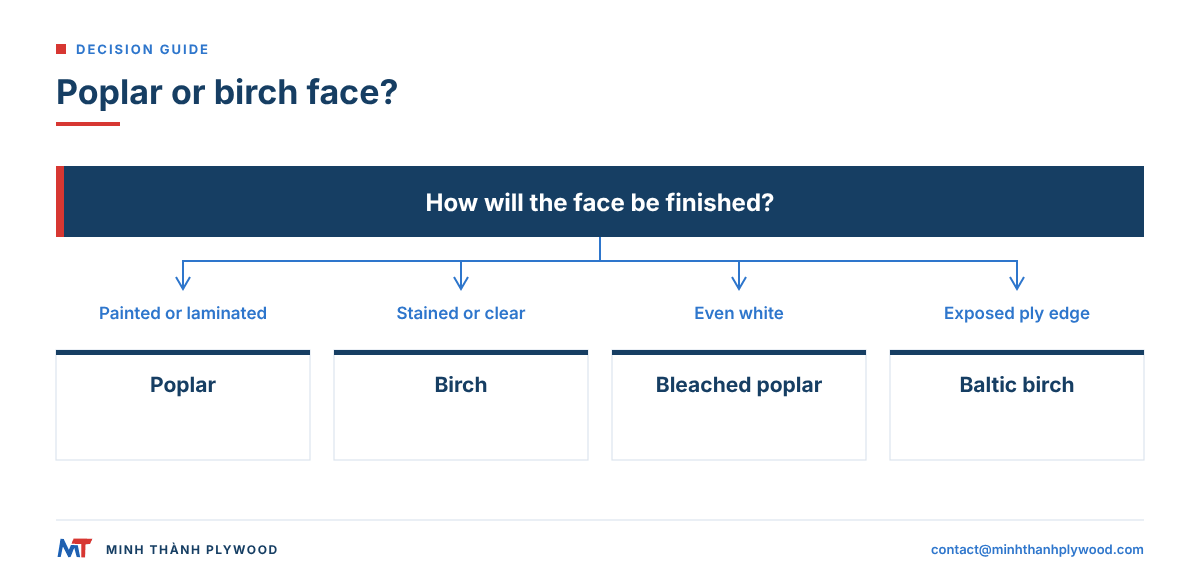
Choose by the finish and the wear the part will see. The matrix gives a verdict for common uses.
| Use | Choose | Why |
|---|---|---|
| Painted furniture and doors | Poplar | Smooth paint base, lower cost |
| Stained or clear furniture | Birch | Even stain, attractive face |
| White furniture, clear coat | Bleached poplar | Even white face |
| Kitchen carcasses, laminated | Poplar | Hidden face |
| Drawer boxes, shelves | Birch | Wear and screws |
| Interior doors, painted | Poplar | Cost and paint |
| Flooring underlay, hidden | Poplar or commercial | Face not seen |
| Exterior use | Neither as a furniture panel | Needs exterior glue; see exterior plywood |
| Laser hobby and displays | Poplar | Fast, light cuts |
| Laser products, fine engraving | Birch | Crisp detail |
| Exposed-edge designs | Baltic birch | Even multi-ply edge |
For outdoor jobs, the glue matters more than the face. Our exterior plywood uses water-resistant melamine-fortified or phenolic (WBP) glue.
Compliance and documents for either face
Poplar-faced and birch-faced panels carry the same compliance documents, because emission comes from the glue and the press, not the face species. Our furniture plywood uses UF glue at E0 emission.
Six ASTM D6007 chamber tests between April 2025 and June 2026, on 9, 15 and 18 mm panels, averaged 0.014–0.032 ppm against the 0.05 ppm CARB Phase 2 / TSCA Title VI limit for veneer-core hardwood plywood. That limit is set in EPA’s TSCA Title VI requirements. Three tests were run by Shanghai Hongjun and three by ICTT Vietnam. We hold CARB P2 / TSCA Title VI certification as ICTT mill no. 23024.
For Europe, we supply the EUDR compliance dossier (origin records and geolocation files) with orders, under Regulation (EU) 2023/1115. The application dates were amended by Regulation (EU) 2025/2650. Third-party testing to the buyer’s method, for example EN 717-1, is arranged through SGS on request.
What this means for your order
Decide the face by the finish, the core by the weight, and the grade by your approved sample. Send these lines with your request:
- Application: cabinets, doors, furniture parts, shop fittings or laser work.
- Face and grade: poplar A/A, A/B or B/B (or B/BB, BB/CC, CP), bleached if needed; or birch D+/D or D/E.
- Core: white Styrax or Eucalyptus as standard; Acacia on order.
- Glue and emission: UF glue at E0 emission; CARB P2 / TSCA Title VI labelling for US orders.
- Size and thickness: 1220 × 2440 or 1250 × 2500 mm, 3–40 mm, sanded to ±0.2–0.3 mm.
- Packing and quantity: from one 40HC, mixed specifications by agreement.
Production takes 15–45 days after the 30% deposit, and free samples are available, so you can compare a poplar and a birch face on the same core before you order. Read our guide to the types of plywood for the wider range.
Buyer questions, answered
Is poplar plywood as strong as birch plywood?
An all-poplar panel is weaker and softer than an all-birch panel. When poplar and birch are only the faces on the same hardwood core, the core carries most of the strength, and the difference is mainly face hardness and dent resistance.
Is poplar plywood cheaper than birch plywood?
Yes. With the same core, thickness and glue, a poplar-faced panel costs less than a birch-faced one, because poplar veneer is cheaper than imported birch veneer.
Is bleached poplar plywood strong enough for furniture?
Yes, when it is a bleached poplar face on a hardwood core with stitched, calibrated plies. Bleaching changes the colour of the thin face veneer only; it does not weaken the core.
Which is better for kitchen cabinets, poplar or birch plywood?
Birch-faced plywood is better for stained or clear-finished cabinet boxes and doors. Bleached or white poplar is the cost-effective choice for carcasses that are painted, laminated or hidden.
Can Vietnam birch plywood replace Baltic birch?
For cabinet and furniture parts with a birch look, yes: a birch face on a calibrated hardwood core gives the same appearance at a lower weight. For exposed multi-ply edges or all-birch technical uses, Baltic birch remains the panel to specify.
Which is better for laser cutting, poplar or birch plywood?
Poplar plywood cuts faster and lighter, which suits hobby and display work. Birch-faced plywood gives a harder face and crisper engraving detail. Ask for a thin panel with the same glue through every ply for clean cuts.
Does poplar plywood dent easily?
Yes, poplar is a soft hardwood, so a poplar face marks more easily than birch under knocks and point loads. Use birch faces on parts that take wear, such as drawer fronts and shelves in use every day.
Can you stain poplar plywood?
You can, but poplar takes stain unevenly and can blotch, and its grain may show green or grey streaks. Use a pre-stain conditioner or a gel stain, or choose birch for a stained finish.
Which is lighter, poplar or birch plywood?
All-poplar plywood is clearly lighter than all-birch plywood. Faced panels weigh what their core weighs: on a white Styrax core, an 18 mm sheet of 1220 × 2440 mm plans at about 26.8 kg whichever face it carries.
What grades do poplar and birch plywood come in?
Poplar faces are quoted as face/back pairs A/A, A/B and B/B, also ordered as B/BB, BB/CC and CP. Birch faces are quoted as D+, D and E, for example D+/D, comparable to European birch grades.