
Poplar wood is a light, soft, even hardwood, and the name covers two different trees: true poplars (Populus, including aspen and cottonwood) and tulip poplar, the yellow poplar of the eastern US. Both are prized for paint-grade furniture, interiors and plywood. Minh Thanh Plywood, a Vietnamese furniture plywood mill with poplar among its most produced faces, explains the types, the numbers and how to order.
What is poplar wood?
Poplar wood is a light, soft, pale hardwood, and in trade it means two different trees. True poplars are the genus Populus, which includes aspen and cottonwood; “poplar” in North American lumberyards usually means tulip poplar, Liriodendron tulipifera, a magnolia-family tree also called yellow poplar or tulipwood.
The two are not related, but their timber is used the same way: paint-grade furniture, mouldings, interior joinery, crates and plywood. Both are light, even-textured and easy to machine, and both are among the lowest-priced hardwoods in their markets.
This guide sorts out the names, gives the numbers, and explains where poplar works in furniture and panels, including how poplar plywood from Vietnam is built.
Poplar lumber in the US: board sizes, price per board foot and hardness
Poplar boards in the US cost about US$3.90 per board foot in 4/4, and range from US$3.20 to US$4.85 across dealers (indicative retail, 2026). The boards are sold surfaced on four sides (S4S), and the nominal size is bigger than the real one: a “1 x 6” is 0.75 x 5.5 in.
| Nominal board | Actual size (S4S) | Typical use |
|---|---|---|
| 1 x 2 | 0.75 × 1.5 in | Trim, frames, crafts |
| 1 x 3 | 0.75 × 2.5 in | Face frames, cleats |
| 1 x 4 | 0.75 × 3.5 in | Shelving, casing |
| 1 x 6 | 0.75 × 5.5 in | Shelves, cabinet parts |
| 1 x 8 | 0.75 × 7.25 in | Shelves, boxes |
| 1 x 12 | 0.75 × 11.25 in | Wide shelves, panels |
| 2 x 4 | 1.5 × 3.5 in | Legs, workbench, frames |
| 2 x 6 | 1.5 × 5.5 in | Thick tops, legs |
Boards are sold at 6 and 8 ft lengths in home centres, for example the Home Depot poplar board range, read 21 October 2026.
| Poplar lumber, US retail | 4/4 | 5/4 | 6/4 | 8/4 |
|---|---|---|---|---|
| Poplar, US$ per board foot | 3.90 | 4.80 | 4.90 | 5.20 |
Vermont Woods Studios gives US$3.20 to US$4.85 per board foot (checked on 21 October 2026). Source for the table: Forest Products Supply, domestic lumber price list, 9 July 2026.
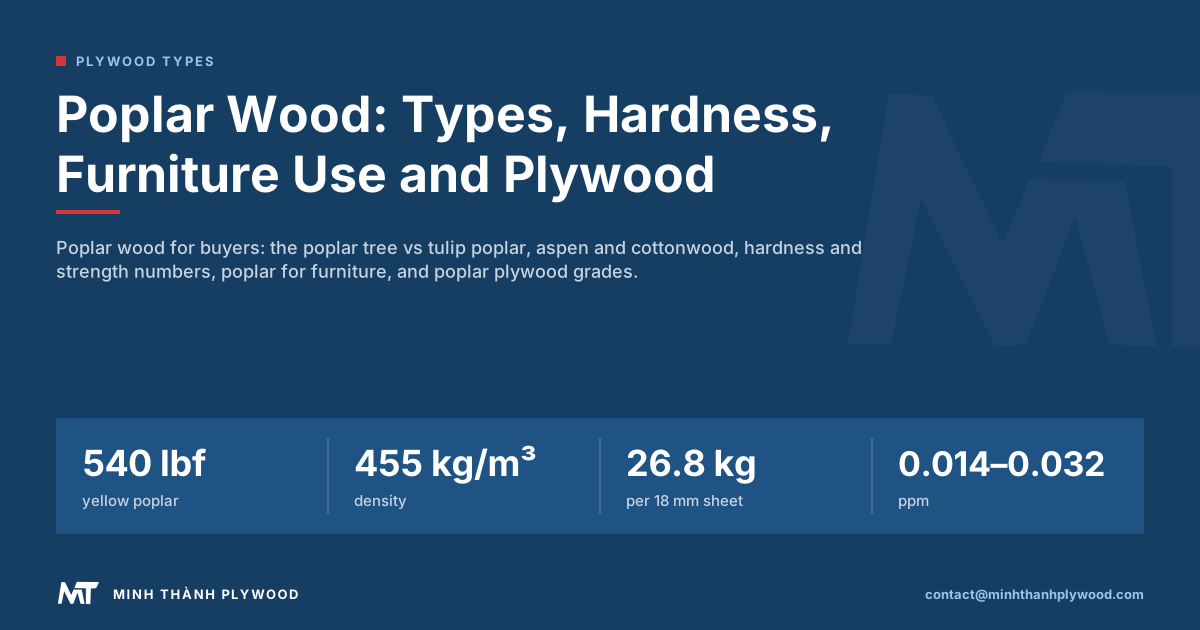
Hardness: yellow poplar scores 540 lbf (2,400 N) on the Janka scale, against 950 lbf for black cherry, so it dents more easily and is used for painted parts. A board foot weighs about 2.75 lb (Ocooch Hardwoods).
Buyers who need panels in volume, not boards, use poplar plywood, covered below. Minh Thanh Plywood quotes furniture and interior plywood from US$350/m³ FOB (October 2026).
Poplar wood tree: true poplars vs tulip poplar
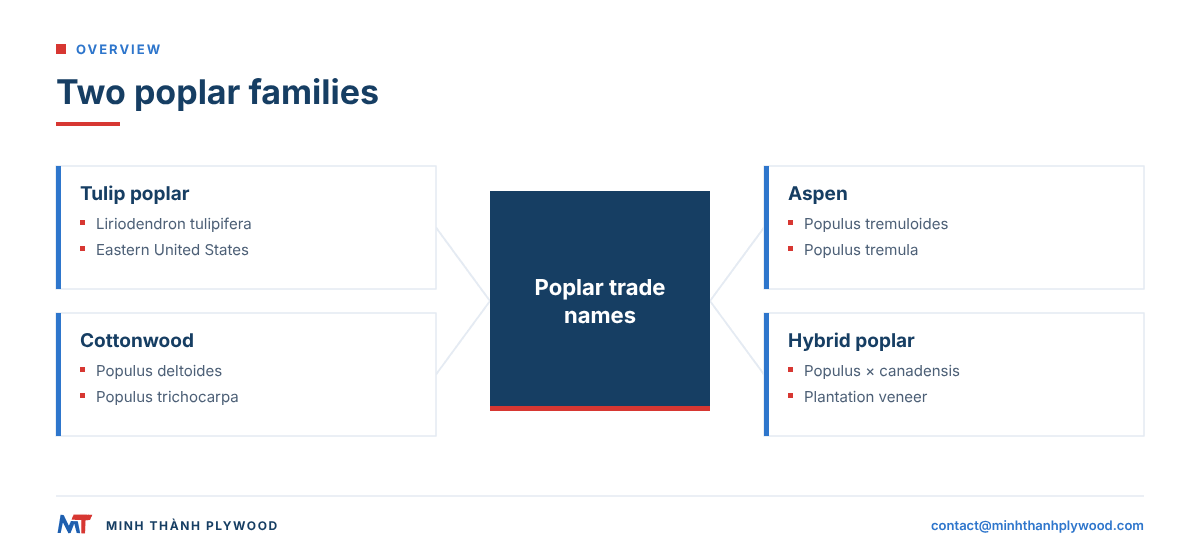
The poplar wood tree in Europe and Asia is almost always a true poplar (Populus); in North America, “poplar” lumber is usually tulip poplar. The table separates the trees a buyer meets under the poplar name.
| Trade name | Botanical name | Group | Where it grows | Typical timber use |
|---|---|---|---|---|
| Yellow poplar, tulip poplar, American tulipwood | Liriodendron tulipifera | Magnolia family, not a true poplar | Eastern United States | Painted furniture, mouldings, joinery |
| Eastern cottonwood | Populus deltoides | True poplar | Eastern and central US | Crates, pallets, veneer |
| Black cottonwood | Populus trichocarpa | True poplar | Pacific North America | Veneer, plywood, pulp |
| Quaking aspen | Populus tremuloides | True poplar (aspen) | Canada, northern US | Veneer, panels, saunas |
| European aspen | Populus tremula | True poplar (aspen) | Europe, Asia | Plywood, matches, saunas |
| Hybrid poplar, Euramerican poplar | Populus × canadensis and clones | True poplar | Plantations in Europe and China | Plywood and veneer, packaging |
True poplars grow very fast; in plantations in France, Italy and China, hybrid poplar clones reach harvest size in roughly 10 to 20 years. That fast growth is why poplar is a staple plywood and packaging species.
Is poplar a hardwood?
Yes, poplar is a hardwood. True poplars and tulip poplar both grow on broadleaf flowering trees, which is the botanical definition of hardwood. Poplar is a soft hardwood, though: yellow poplar scores 540 lbf (2,400 N) on the Janka hardness test, and quaking aspen and black cottonwood about 350 lbf (1,560 N).
For comparison, white oak scores about 1,350 lbf and hard maple 1,450 lbf. Pine species overlap with poplar: some softwoods are harder than poplar. For buyers, that means poplar dents more easily than oak or maple, which matters for tabletops and floors, not for carcasses, frames or painted panels.
Poplar wood properties: density, strength and stability
Poplar woods are light and moderately strong for their weight, with average stability. The table gives averages at about 12 % moisture content from The Wood Database (read 20 October 2026).
| Property (12 % MC) | Yellow poplar | Quaking aspen | Black cottonwood | Hard maple |
|---|---|---|---|---|
| Average dried density | 455 kg/m³ | 415 kg/m³ | 385 kg/m³ | 705 kg/m³ |
| Janka hardness | 540 lbf | 350 lbf | 350 lbf | 1,450 lbf |
| Modulus of rupture | 69.7 MPa | 57.9 MPa | 58.6 MPa | 109.0 MPa |
| Modulus of elasticity | 10.90 GPa | 8.14 GPa | 8.76 GPa | 12.62 GPa |
| Volumetric shrinkage | 12.7 % | 11.5 % | 12.4 % | 14.7 % |
| Decay resistance | Moderate to non-durable | Non-durable | Non-durable | Non-durable |
Sources: The Wood Database, Yellow Poplar, Quaking Aspen, Black Cottonwood, Hard Maple, read 20 October 2026.
- Light: yellow poplar at about 455 kg/m³ is close to a Styrax-core plywood panel at 500 kg/m³; cottonwood is lighter still.
- Stiff for its weight: yellow poplar’s modulus of elasticity of 10.90 GPa is high for a wood this light, which is why it works for frames and drawer parts.
- Even: a fine, uniform texture with small pores, so paint lies flat with little filling.
- Indoor wood: none of the poplars resist decay well outdoors.
Tulip wood (yellow poplar): colour and character
Tulip wood is the European trade name for yellow poplar, sold as American tulipwood. Its sapwood is creamy white, and its heartwood ranges from pale yellow-brown to olive green, sometimes with grey, purple or black streaks.
- Colour: the green heartwood turns brown with light exposure within months.
- Mineral streaks: dark streaks are sorted out of clear grades or used as a feature in “rainbow poplar”.
- Grain: straight, with a fine, even texture.
- Size: tulip trees grow tall and straight, giving long, wide, clear boards at a low price.
Because of its colour mix, tulipwood is mostly painted or stained. In Europe it is a standard joinery timber for painted doors, windows and mouldings, and in the US the default paint-grade furniture wood. Its veneer is also used as the hidden back of veneered panels to balance the pull of the face.
Cottonwood and aspen wood: the true poplars
Cottonwood and aspen wood are the lightest and softest of the poplars, and the true poplars that supply most poplar veneer and plywood worldwide. They are pale, almost white to light tan, with little contrast between sapwood and heartwood.
Cottonwood (eastern cottonwood and black cottonwood) is a big, fast-growing riverside tree. Its wood is soft, tends to have a woolly surface when sawn, and is used for crates, pallets, veneer and plywood cores. It shrinks and warps more than tulip poplar if dried carelessly.
Aspen wood (quaking aspen in North America, European aspen in Europe and Asia) is fine-textured, odourless and low in resin. That makes it the traditional wood for sauna benches and interiors, matchsticks, chopsticks and food crates. It peels into clean, light veneer for plywood and is the face species of many Nordic and Russian aspen panels.
Hybrid poplar plantations in Italy, France and China grow the clones used for most poplar plywood and veneer today.
Is poplar good for furniture? Poplar for furniture in practice
Yes, poplar is good for furniture that is painted, laminated or veneered, and for the parts you do not see. Poplar for furniture is chosen for its clean machining, light weight, stability and low price; it is not chosen for exposed natural-finish tops that take hard wear.
Where poplar works well
- Painted furniture: wardrobes, beds, dressers, children’s furniture.
- Frames and rails: upholstered sofa and chair frames, drawer sides and backs.
- Mouldings and trim: paint-grade skirting, architraves and panelled doors.
- Core and substrate: under veneer, laminate or lacquer, as solid wood or plywood.
Where to choose something else
- Dining tables and desks with a natural finish that take daily knocks: oak, ash, maple or walnut.
- Outdoor furniture: teak, acacia or treated wood.
- Floors and stair treads: harder hardwoods.
For panels, the furniture maker’s question is usually not solid poplar vs another solid wood, but poplar plywood vs birch plywood or MDF. That is covered next.
What is poplar plywood?
Poplar plywood is plywood with poplar face veneers, and sometimes poplar inner veneers too. There are two main builds on the market, and the difference matters for weight, strength and screw holding.
- Poplar-core plywood: poplar veneers all through; light and easy to machine, made mainly in China.
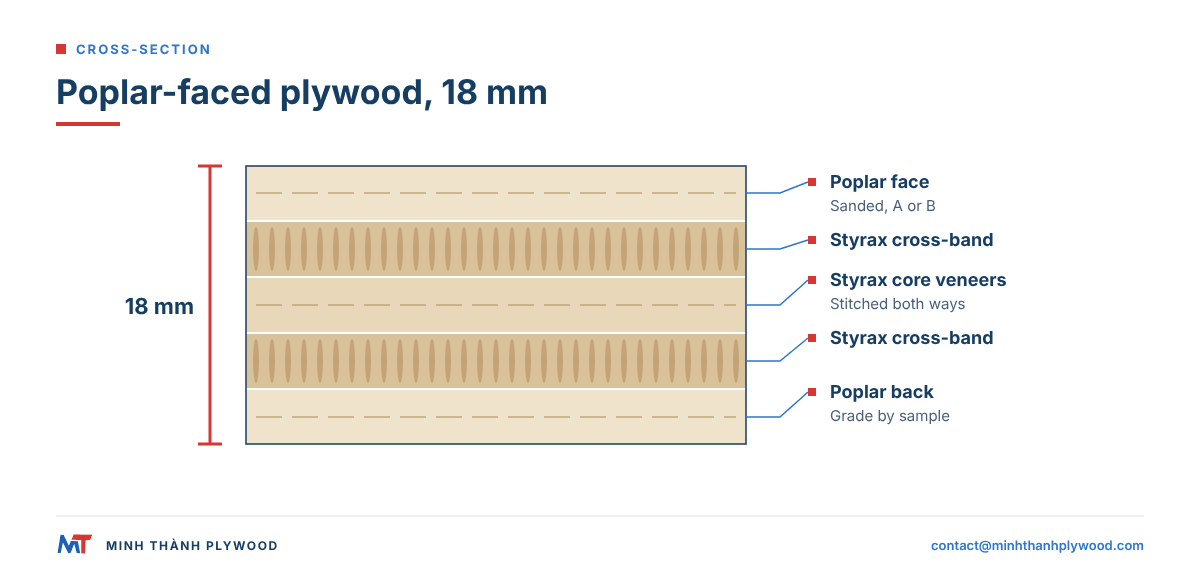
- Poplar-faced plywood on a hardwood core: a poplar face and back on a core of another species. Vietnamese mills use Styrax, Eucalyptus or Acacia cores, since Vietnam grows no poplar for cores.
Minh Thanh poplar plywood uses a poplar face on a white Styrax or Eucalyptus core as standard. The core is stitched in both directions and the panel is pressed twice: the core board first, calibrated, then the face and back. That keeps the poplar face flat and paint-ready across the full sheet. See poplar plywood for the full build.
Is poplar plywood good for cabinets and furniture?
Yes. Poplar plywood is good for cabinets when it is built as furniture plywood: sanded faces, a stitched, stable core, UF glue at E0 emission and a tight thickness tolerance. The poplar face paints, laminates and takes edge-banding cleanly.
| Point | Poplar-faced plywood (Styrax core) | Birch plywood | MDF |
|---|---|---|---|
| Density | About 500 kg/m³ | Higher, birch all through | Typically higher than plywood |
| Weight, 1220 × 2440 × 18 mm | About 26.8 kg | Heavier | Heavier |
| Screw holding in the face | Good | Very good | Fair, poor at edges |
| Face for paint or laminate | Smooth, light | Smooth, light | Smoothest |
| Exposed edge look | Plain plies | Even, decorative plies | No plies |
| Relative cost | Lower | Higher | Lowest |
| Best for | Painted and laminated cabinets, wardrobes, interiors | Exposed-edge furniture, high-load parts | Painted doors, routed fronts |
Poplar-faced plywood is the cost-effective birch alternative many European furniture makers use for painted and laminated parts. For high-load spans, read poplar plywood strength for furniture; for the birch side, see birch wood.
Poplar plywood grades: A/A, A/B, B/B and the Chinese codes
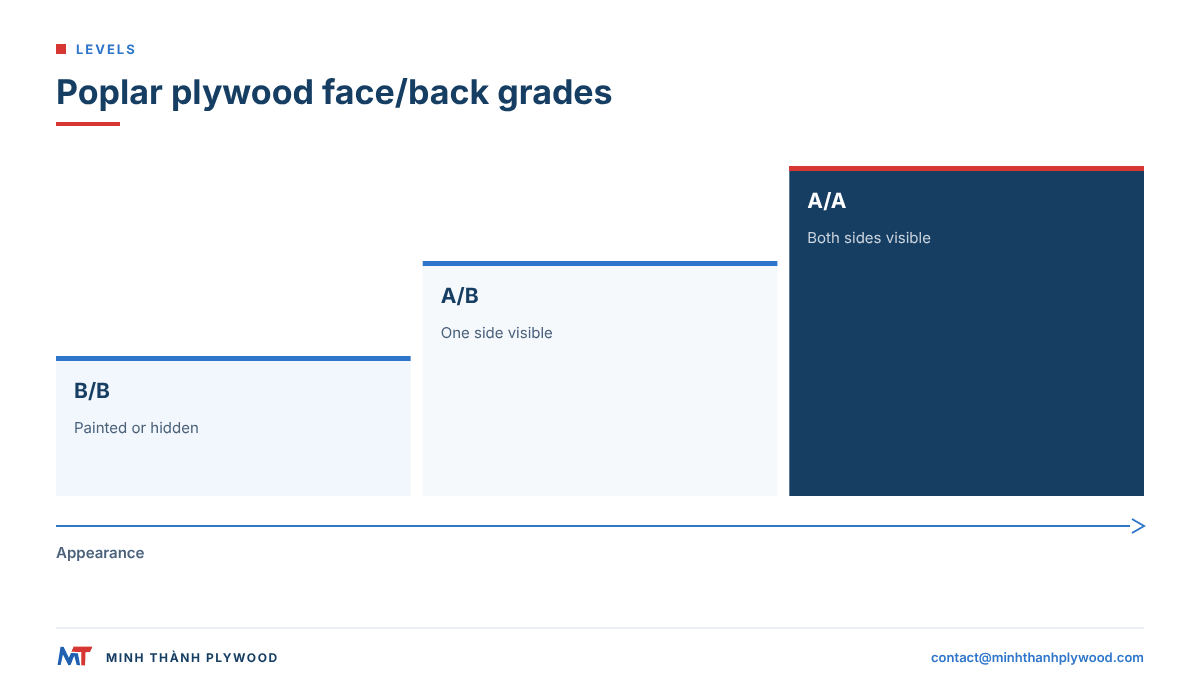
Poplar-faced panels are quoted as face/back grade pairs A/A, A/B and B/B, matched to the buyer’s approved sample. Buyers also order them by the Chinese codes B/BB, BB/CC and CP, which map onto the same ladder.
| Face/back pair | Face | Back | Typical use |
|---|---|---|---|
| A/A | Clean, even colour | Clean, even colour | Both sides visible: shelves, open units |
| A/B | Clean, even colour | Small sound defects allowed | One side visible: cabinet sides, doors |
| B/B | Small sound defects, patches | Small sound defects, patches | Painted, laminated or hidden parts |
The approved sample fixes what each letter means for your order: colour range, knot size, patches and splits. Ask for the sample in the grade pair you will buy, not only the top grade.
Poplar plywood sizes, thickness and weight
Poplar-faced plywood from Minh Thanh comes in 1220 × 2440 and 1250 × 2500 mm, plus custom sizes such as 1220 × 2500 and 1220 × 2280 mm, in thicknesses from 3 to 40 mm.
- Thin panels: 3–5 mm are always 5-ply: for drawer bottoms, backs and door skins.
- Furniture thicknesses: 12, 15 and 18 mm are the most ordered; 18 mm is usually 11–13 plies.
- Tolerance: sanded furniture panels to ±0.2–0.3 mm, down to ±0.2 mm.
- Moisture: 8–12 % at dispatch, the normal range for furniture plywood.
- Weight: an 18 mm sheet on Styrax core weighs about 26.8 kg; on Eucalyptus core, about 34.8 kg.
- Cut-to-size: one panel cut into 4, 6 or 8 pieces, shipped regularly to Italy and other European markets.
More on weights for each thickness in poplar plywood weight and density.
Emissions and compliance for poplar plywood
Poplar plywood for furniture in Europe and the US must meet formaldehyde rules, including EPA’s TSCA Title VI rule in the US, and the glue and core decide the result. Minh Thanh’s furniture panels use UF glue at E0 emission as standard and meet the emission and quality requirements European and US furniture buyers ask for.
- Certification: CARB P2 / TSCA Title VI (ICTT mill no. 23024, hardwood plywood veneer core, 3–50 mm).
- Test results: six ASTM D6007 chamber tests between April 2025 and June 2026 on 9, 15 and 18 mm panels averaged 0.014–0.032 ppm; three tests by Shanghai Hongjun, three by ICTT Vietnam. EPA lists the US limit for veneer-core hardwood plywood as 0.05 ppm.
- European methods: third-party testing to the buyer’s method, for example EN 717-1, is arranged through SGS on request.
- EUDR: we supply the EUDR compliance dossier (origin records and geolocation files) with orders under Regulation (EU) 2023/1115.
Working and finishing poplar
Poplar machines cleanly, glues well and takes paint better than almost any hardwood. Staining is its weak point: the soft wood blotches unless conditioned.
- Machine with sharp tools: soft true poplars can leave a fuzzy surface with dull cutters.
- Sand to 150–180 grit: enough for paint; finer grits burnish and reduce adhesion.
- Prime before painting: a sanding primer fills the fine pores and gives a smooth base.
- Condition before staining: a washcoat or gel stain prevents blotches.
- Use pilot holes: screws hold well in yellow poplar and in poplar plywood faces; pilot holes prevent splitting near edges.
On poplar plywood, sand the faces lightly; the factory face is already sanded flat, and heavy sanding can cut through the veneer.
How to find poplar plywood suppliers in Vietnam
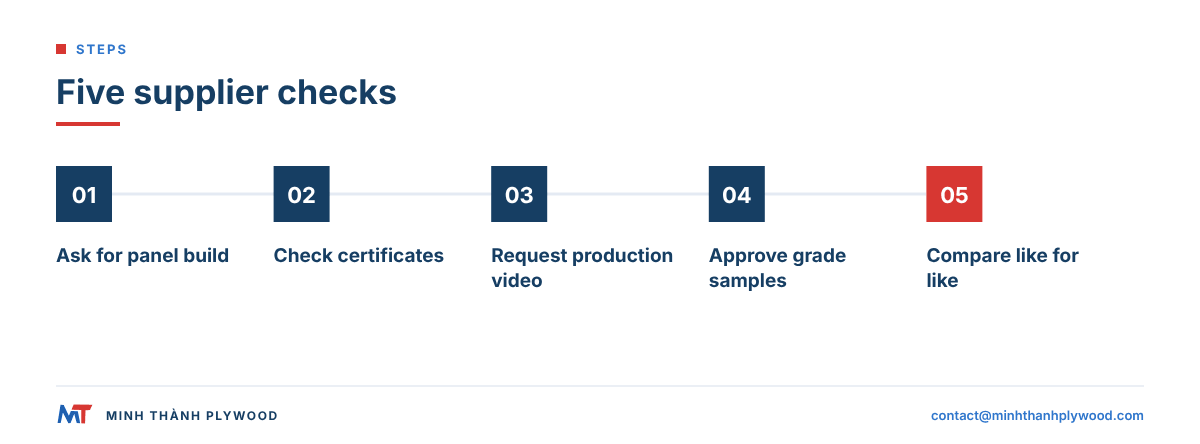
White Styrax, the light core of Vietnamese furniture plywood, is grown only in northern Vietnam, so mills that build on it work close to those plantations. To find a poplar plywood manufacturer rather than a trader, check that the company presses its own panels and holds its own certificates.
- Ask for the build: face species, core species, glue, ply count and tolerance. A manufacturer answers from the production line.
- Check certificates: CARB P2 / TSCA Title VI mill number, ISO 9001 and test reports in the company’s own name.
- Ask for a video walk: veneer drying, core building, pressing, sanding and packing.
- Request samples: in the grade pair you will buy.
- Compare like for like: same core, glue, grade, thickness and packing before price.
Minh Thanh Plywood is a manufacturer in Ha Hoa, Phu Tho, built for top-grade furniture and interior plywood with Europe as its main market, at 50,000+ m³ per year.
What this means for your poplar plywood order
Send these lines and a mill can quote one build, not a range:
- Application: cabinets, wardrobes, painted furniture, interiors or packaging.
- Face/back: poplar A/A, A/B or B/B (or B/BB, BB/CC, CP), matched to the approved sample.
- Core: Styrax for light weight, Eucalyptus for stiffness and screw holding.
- Glue and emission: UF glue at E0 emission; CARB P2 / TSCA Title VI documents for the US.
- Thickness and size: 3–40 mm; 1220 × 2440, 1250 × 2500 mm, custom or cut-to-size.
- Packing, quantity and port: export pallets; from one 40HC, mixed specifications by agreement; FOB Hai Phong, CFR or CIF.
Furniture and interior plywood starts from US$350/m³ (October 2026), production takes 15–45 days after the deposit, and free samples are available. Write to contact@minhthanhplywood.com, or compare poplar with other species in the pillar on types of wood.
Buyer questions, answered
Is poplar a hardwood?
Yes. Both true poplars (Populus) and tulip poplar (Liriodendron tulipifera) are broadleaf flowering trees, so their wood is hardwood. It is a soft hardwood: yellow poplar scores 540 lbf on the Janka test and aspen 350 lbf.
Is poplar good for furniture?
Yes, for painted furniture, frames, drawer sides and hidden parts. Poplar machines cleanly, holds paint well and is stable once dry; for exposed tops that take daily knocks, a harder wood or a sanded plywood panel lasts better.
Is tulip wood the same as poplar?
Tulipwood, tulip poplar and yellow poplar are the same tree, Liriodendron tulipifera, from the eastern United States. It is in the magnolia family and is not a true poplar, but it is sold as poplar in North America and as American tulipwood in Europe.
Is cottonwood a poplar?
Yes. Cottonwoods are true poplars of the genus Populus, named for the cotton-like fluff on their seeds. Eastern cottonwood and black cottonwood are the main timber species.
Is aspen wood the same as poplar?
Aspens are true poplars too: quaking aspen in North America and European aspen are Populus species. Aspen wood is light, pale and soft, used for veneer, plywood, matches, crates and sauna interiors.
Is poplar plywood good for cabinets?
Yes, when it is built for furniture: a sanded poplar face, a stable core, UF glue at E0 emission and tight thickness tolerance. Poplar faces paint and laminate well, which suits painted cabinet doors and carcasses.
Is poplar plywood strong?
Poplar plywood is strong enough for furniture carcasses, shelves of normal span and interior panels. Its strength depends mostly on the core species and the number of plies; a hardwood core such as Eucalyptus adds stiffness and screw holding.
What is poplar core plywood?
Poplar core plywood has its inner veneers made of poplar, which makes it light; it is made mainly in China. Vietnamese poplar plywood uses a poplar face on a Styrax or Eucalyptus core instead.
Why is poplar wood sometimes green?
Yellow poplar heartwood is often olive green, sometimes with purple, grey or black streaks from minerals in the soil. The colour darkens to brown with light, and paint hides it completely.
Can poplar plywood replace birch plywood?
For painted, laminated and veneered furniture parts, yes: a sanded poplar-faced panel on a stitched core gives a flat, paint-ready face at a lower price. For exposed natural edges and high-load parts, birch remains the stronger, harder choice.
What grades does poplar plywood come in?
Poplar-faced panels are quoted as face/back grade pairs A/A, A/B and B/B, matched to an approved sample. Buyers also order by the Chinese codes B/BB, BB/CC and CP, which map onto the same ladder.
Does poplar wood rot outdoors?
Yes. True poplars are non-durable, and yellow poplar is moderately durable to non-durable, so poplar is an indoor wood unless it is treated or thermally modified.