
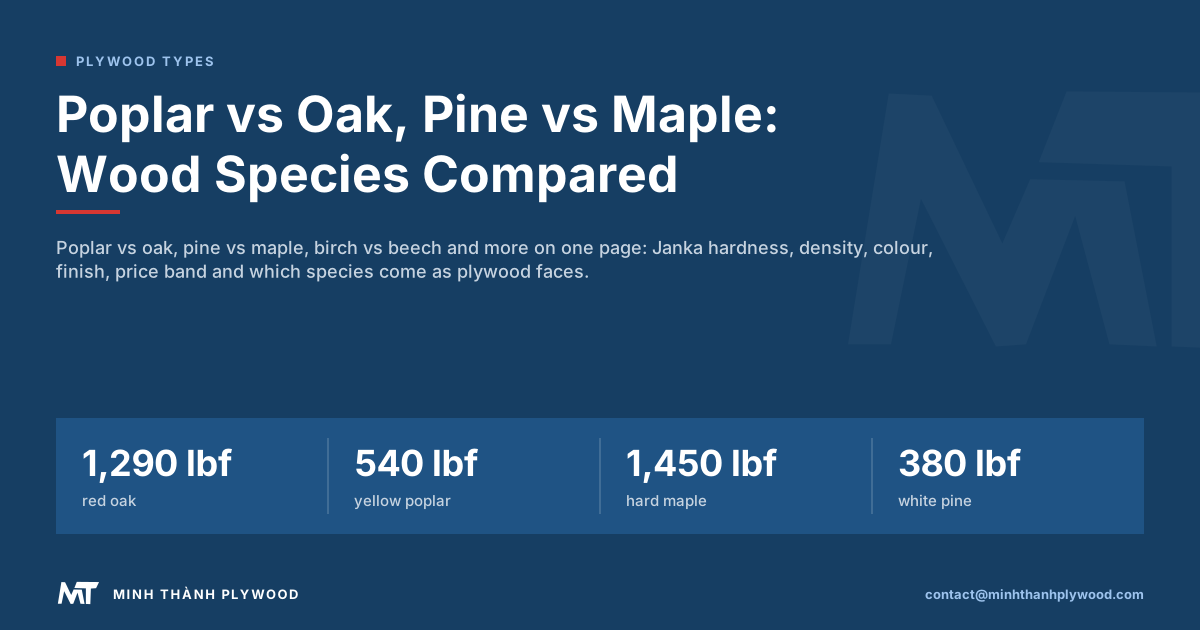
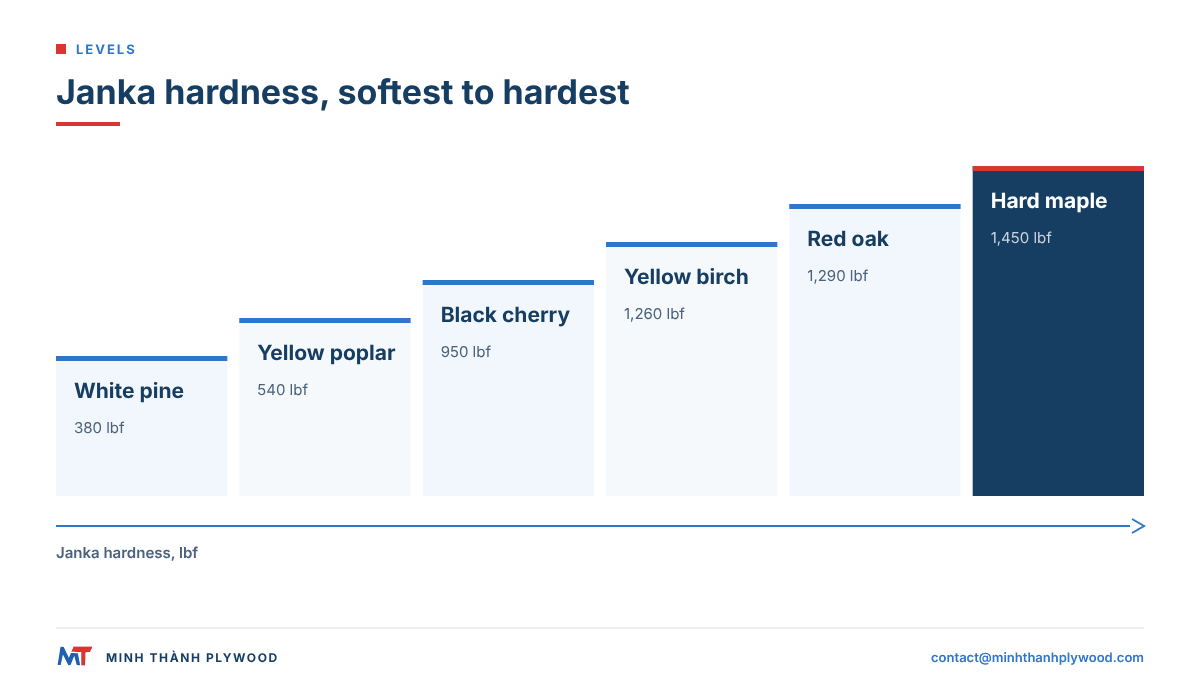
Oak is more than twice as hard as poplar: red oak scores 1,290 lbf on the Janka test, yellow poplar 540 lbf. Hard maple beats both at 1,450 lbf, and eastern white pine is the softest at 380 lbf. Minh Thanh Plywood puts thirteen furniture species in one matrix, with density, colour, finish, price band and which ones come as plywood faces.
Wood species compared: the matrix
The table below compares thirteen common furniture and panel woods on the numbers buyers ask about.
Janka hardness is the force needed to press a steel ball 11.28 millimetres across halfway into the wood; density is the average dried weight at 12 % moisture. Values are averages from the USDA Wood Handbook and The Wood Database (checked 20 October 2026); single boards vary around them. The Wood Handbook chapter on characteristics and availability of commercially important woods describes the species in more detail. Of these, Minh Thanh supplies poplar, birch and pine as plywood faces.
| Species | Janka hardness | Density | Colour | Stain or paint | Price band | As a plywood face |
|---|---|---|---|---|---|---|
| Quaking aspen | 350 lbf | 415 kg/m³ | Cream white | Paint | $ | Rare |
| Eastern white pine | 380 lbf | 400 kg/m³ | Pale yellow, knots | Stain or paint, seal knots | $ | Common |
| Yellow poplar | 540 lbf | 455 kg/m³ | Cream with green streaks | Paint first choice | $ | Common |
| Southern yellow pine | 690 lbf | 570 kg/m³ | Yellow-brown, strong figure | Stain | $ | Common in US sheathing |
| Soft maple | 950 lbf | 610 kg/m³ | Light brown-cream | Paint or clear | $$ | Specialist |
| Black cherry | 950 lbf | 560 kg/m³ | Pink-brown, darkens | Clear oil | $$$ | Specialist |
| Rubberwood | 980 lbf | 595 kg/m³ | Pale cream | Stain or paint | $ | Rare |
| Black walnut | 1,010 lbf | 610 kg/m³ | Chocolate brown | Clear oil | $$$$ | Specialist |
| Yellow birch | 1,260 lbf | 690 kg/m³ | Pale cream to red-brown | Paint or clear | $$ | Common |
| Red oak | 1,290 lbf | 700 kg/m³ | Light red-brown, open grain | Stain | $$ | Common in US cabinets |
| White oak | 1,360 lbf | 755 kg/m³ | Light to mid brown | Stain or fumed | $$$ | Specialist |
| Hard maple | 1,450 lbf | 705 kg/m³ | Near white | Clear | $$$ | Common in US cabinets |
| European beech | 1,450 lbf | 710 kg/m³ | Pale pink-brown | Stain or clear | $$ | Specialist |
Price bands are relative within each region’s trade: $ is the cheapest group, $$$$ the most expensive. Jump to a pair below: poplar vs oak, pine vs maple, maple vs oak, pine vs oak, walnut and cherry, birch vs beech, acacia and rubberwood, poplar vs pine.
Poplar vs oak: which is stronger?
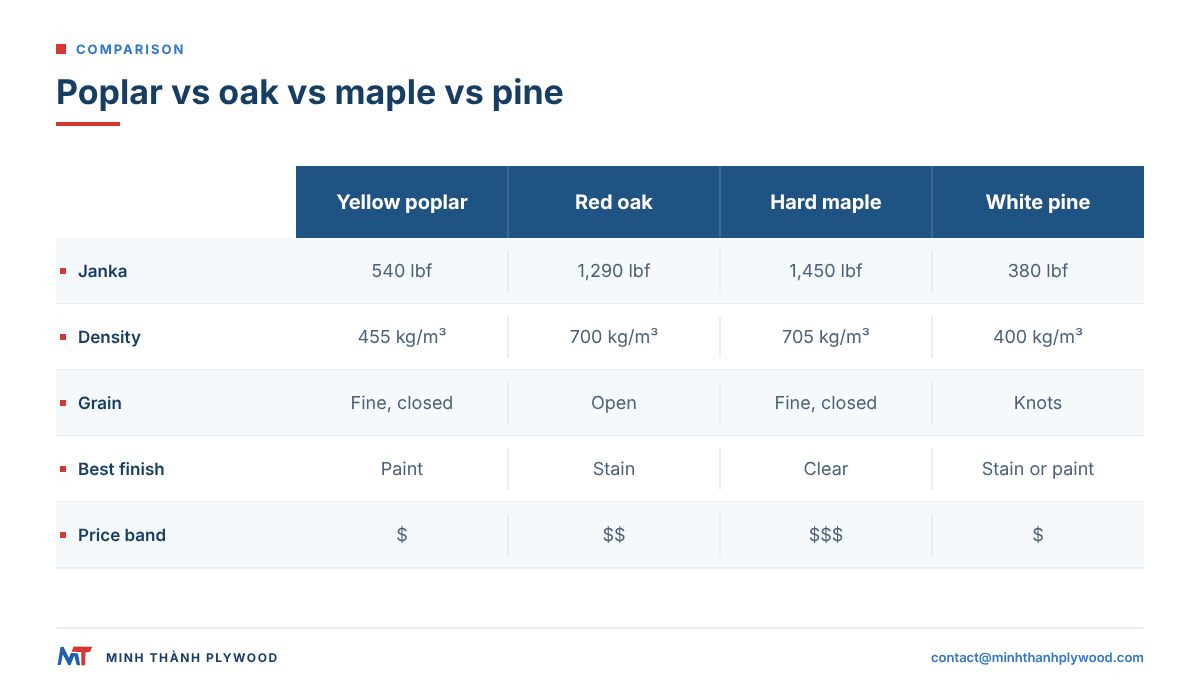
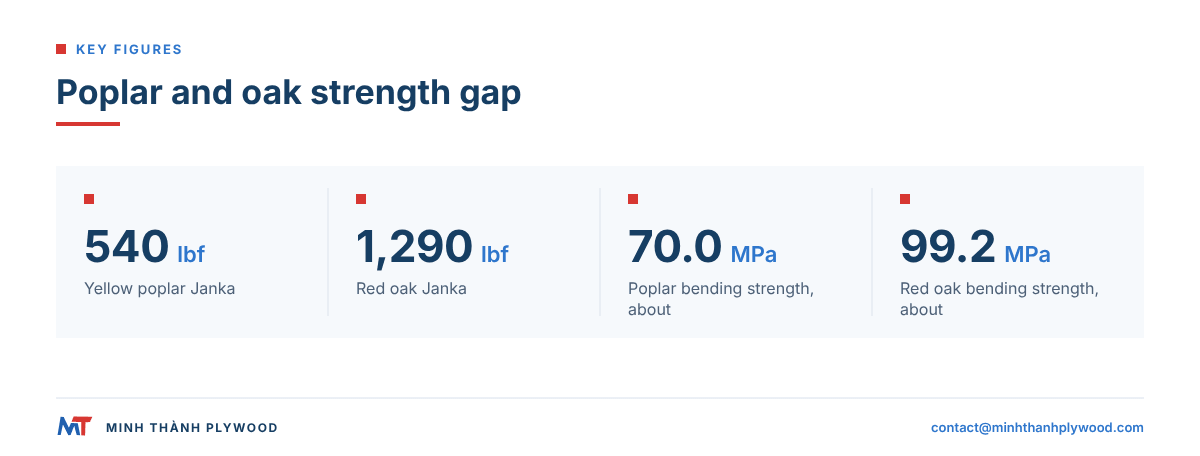
Oak is stronger than poplar on every measure that matters for furniture. Red oak has a bending strength, or modulus of rupture, of about 99.2 MPa against about 70.0 MPa for yellow poplar, and a Janka hardness of 1,290 lbf against 540 lbf. White oak is slightly higher again at about 102.3 MPa and 1,360 lbf.
Stiffness is closer. Red oak’s modulus of elasticity is about 12.5 GPa and poplar’s about 10.9 GPa, so a poplar shelf bends a little more under the same load but not by the margin the hardness gap suggests. The real difference shows at the surface: a dropped key dents poplar and barely marks oak.
That is why oak takes the visible, hard-wearing parts, such as table tops, stair treads and floor boards, and poplar takes the hidden or painted parts: drawer sides, frames, mouldings and carcass members. In plywood the comparison changes, because the face is thin veneer and the core carries the load; we come back to that below.
Poplar wood vs oak: weight, price and finish
Poplar wood vs oak comes down to three practical differences: poplar is about a third lighter, much cheaper and easier to paint; oak is heavier, costlier and better under stain.
- Weight. Yellow poplar averages 455 kg/m³ and red oak 700 kg/m³, so the same oak part weighs about 54 % more (700 ÷ 455).
- Price. Poplar is a fast-growing tree and sits in the lowest hardwood price band; red oak is mid-range and white oak upper-range.
- Finish. Poplar’s fine, closed grain paints smoothly, but its green and grey streaks blotch under stain. Oak’s open pores take stain deeply and show the grain; under paint they need filling first.
- Machining. Poplar cuts, routs and sands cleanly with little tear-out. Oak is harder on tools, and its tannins stain dark in contact with iron and water.
For plywood buyers poplar has a second life as a face veneer. Minh Thanh quotes poplar-faced panels as face/back pairs A/A, A/B and B/B, matched to the buyer’s approved sample; buyers also order them by the Chinese codes B/BB, BB/CC and CP, which map onto the same ladder. Our poplar plywood page shows the faces.
Pine vs maple: soft against hard
Pine vs maple is the widest gap in the common furniture woods: hard maple is almost four times as hard as eastern white pine, 1,450 lbf against 380 lbf. Southern yellow pine, at about 690 lbf, narrows the gap but stays at half of maple.
Maple vs pine wood also differs in look and finish:
- Grain. Pine has visible knots and a strong growth-ring figure; hard maple is near white with a tight, even grain.
- Finish. Pine takes stain unevenly and its knots bleed resin through paint unless sealed. Maple takes a clear finish beautifully but blotches under dark stain.
- Use. Pine is the rustic, country and budget wood, and the standard for shelving and framing. Maple is for butcher blocks, floors, worktops and drawer sides that must not dent.
- Weight. Eastern white pine averages 400 kg/m³; hard maple 705 kg/m³.
As plywood faces, pine is common and maple is a specialist veneer. Minh Thanh quotes pine-faced panels as A/A, A/B and B/B (B/C for utility parts), comparable to the European softwood face classes I to IV and the US A to D grades. See our pine plywood and the comparison of birch plywood vs pine plywood.
Maple vs oak plywood: which is better for cabinets?
Maple plywood is better for painted or clear, modern cabinets; oak plywood is better for stained, traditional ones. Neither is stronger as a panel, because a 0.6 mm face veneer adds hardness to the surface but almost nothing to the panel’s bending strength.
Maple plywood is plywood with a hard maple face, usually rotary-cut or plain-sliced, on a hardwood or poplar core. Oak plywood carries a red or white oak face, often plain-sliced for the cathedral figure or rift-cut for straight lines. The core and the glue decide how the panel behaves in a cabinet.
Which is harder, maple plywood or oak plywood? The maple face, 1,450 lbf against 1,290 lbf for red oak, so maple resists dents a little better on a door. Can you stain maple plywood to look like oak? In colour, yes, with a conditioner or gel stain; in texture, no, because maple has no open pores.
A third option is EV, engineered veneer: fast-grown veneer dyed and re-pressed into a block, then sliced into a repeatable figure. Oak-look and walnut-look patterns are common EV faces, and EV is the face Minh Thanh produces most. Our EV plywood page lists the build.
Maple wood vs oak: hardness, grain and price
Maple wood vs oak in solid timber follows the same pattern as the veneers: hard maple is harder, paler and closer-grained; oak is more open-grained, takes stain better and costs less for red oak.
| Hard maple | Red oak | White oak | |
|---|---|---|---|
| Janka hardness | 1,450 lbf | 1,290 lbf | 1,360 lbf |
| Density | 705 kg/m³ | 700 kg/m³ | 755 kg/m³ |
| Bending strength | about 109.0 MPa | about 99.2 MPa | about 102.3 MPa |
| Grain | Closed, fine | Open, coarse | Open, pores plugged with tyloses |
| Outdoor use | No | No | Yes, decay resistant |
| Price band | $$$ | $$ | $$$ |
White oak’s pores are blocked by tyloses, which is why it was the barrel and boat wood; red oak’s pores are open, so water passes along the grain. For an interior cabinet this matters little; for a bathroom vanity or a window board it does.
Pine vs oak wood: when to pay for oak
Pine vs oak wood is a choice between price and wear. Red oak is more than three times as hard as eastern white pine, 1,290 lbf against 380 lbf, and about 75 % heavier, 700 kg/m³ against 400 kg/m³ (700 ÷ 400).
Pay for oak where the surface takes daily wear: table tops, chair seats, floors and stair treads. Choose pine where the part is hidden, painted, or meant to look rustic: shelving, bed slats, wardrobe carcasses, cladding and children’s furniture that will be repainted. A pine table top shows dents and scratches within months; some buyers want exactly that worn look.
In panels the same logic runs through the face. A pine-faced plywood carcass is light and cheap; an oak-faced door is the visible upgrade. Mixing the two in one cabinet is common practice.
Maple vs walnut and walnut vs cherry wood
Walnut and cherry are the premium, clear-finished woods; maple is the pale, harder alternative. Maple vs walnut wood: hard maple is harder, 1,450 lbf against 1,010 lbf for black walnut, but walnut’s chocolate colour and figure put it in the highest price band.
Walnut vs cherry wood: walnut is slightly harder, 1,010 lbf against 950 lbf, and darker from the start. Cherry starts pink-brown and darkens to a deep red-brown under light within a year, so a cherry piece looks very different at delivery and at twelve months. Both are oiled or lacquered, rarely painted.
Cherry wood vs maple: soft maple and black cherry share the same hardness, 950 lbf, and similar weight. Cherry vs mahogany wood: Honduran mahogany is softer, about 800 lbf, very stable, and similar in reddish colour; it is the classic for carving and fine joinery.
In plywood, walnut and cherry faces are specialist veneers sold by decorative-panel makers. For volume furniture an EV walnut-look face gives a repeatable colour from sheet to sheet at a fraction of the cost.
Birch vs beech and birch vs aspen
Birch vs beech: European beech is harder, 1,450 lbf against 1,260 lbf for yellow birch, and slightly heavier, 710 kg/m³ against 690 kg/m³. Beech bends well under steam and is the classic wood for chairs, frames and tool handles; it moves more with humidity than birch.
Birch is the panel wood. Its logs peel into thin, even veneer on a rotary lathe, which is why birch plywood is a standard furniture and cabinet panel in Europe. Minh Thanh grades birch faces D+, D and E in Vietnamese practice, quoted as face/back pairs such as D+/D or D/E; individually D+ is about B, D about BB and E about CP/C on the European birch ladder, so D+/D is about B/BB. Faces include imported birch, chosen for the look the buyer orders.
Birch vs aspen: aspen is a soft, light poplar relative at 350 lbf and 415 kg/m³, used for sauna benches, crates and painted parts. Birch is almost four times as hard. Our birch plywood page shows the birch faces.
Acacia vs birch and rubberwood vs maple
Acacia and rubberwood are the Asian plantation woods in furniture; birch and maple are their temperate counterparts. Acacia vs birch: acacia is darker, golden to brown with strong figure, and is common in solid tables and outdoor furniture; birch is paler and is the plywood face.
As a plywood core, acacia is denser than the standard cores. Minh Thanh uses white Styrax or Eucalyptus cores as standard and makes Acacia cores on order; our reference panel densities are Styrax 500 kg/m³, Acacia 580 kg/m³ and Eucalyptus 650 kg/m³. An 18 mm sheet of 1220 × 2440 mm weighs about 26.8 kg on Styrax and 31.1 kg on Acacia.
Rubberwood vs maple: rubberwood scores about 980 lbf, close to soft maple’s 950 lbf and well below hard maple’s 1,450 lbf. It is a pale, stable, low-cost wood from rubber plantations at the end of their latex life, widely used for solid furniture, worktops and finger-jointed panels.
Poplar vs pine: the two budget woods
Poplar vs pine: poplar is the harder and smoother of the two, 540 lbf against 380 lbf for eastern white pine, with no knots or resin. Pine is lighter, cheaper in many markets and has the familiar knotty look.
For painted furniture poplar wins: it takes primer and paint evenly and does not bleed resin. For a natural, rustic finish pine wins. In joinery, poplar holds screws and edges better; pine is easier to nail and plane by hand.
As plywood faces both are economical. Poplar faces are smooth and suit paint, lamination and melamine overlay; pine faces show grain and knots and suit visible, natural interiors. Southern yellow pine is the exception in hardness at about 690 lbf, harder than poplar.
How hardness, density and stability decide the use
Hardness sets dent resistance, density sets weight and screw holding, and stability sets how much a part moves with humidity. A buyer reads the matrix in that order.
- Hardness for the surface. Floors, worktops and table tops need 1,000 lbf or more; carcass parts and painted panels work at 400–700 lbf.
- Density for weight and fixings. Denser woods hold screws better but make heavier furniture and freight. A flat-pack buyer counts kilograms per carton.
- Stability for the climate. Wide solid panels move across the grain. Beech and red oak move more than cherry and mahogany.
- Finish for the look. Open-grained woods (oak, ash) for stain; closed-grained woods (maple, birch, poplar) for paint or clear.
- Supply for volume. Poplar, pine, birch and plantation woods ship in volume; walnut and cherry are premium and slower.
Plywood changes step 3. Crossed layers cancel most of the movement, so a plywood panel stays flat where a solid board of the same species would cup. The US Forest Service’s Wood Handbook chapter on moisture relations covers why wood moves with humidity.
Solid wood or plywood face: what changes
With a plywood face, the species sets the look and the surface hardness; the core and the glue set strength, weight and flatness. The face veneer is thin, so a poplar-faced and an oak-faced panel on the same core behave almost the same in a cabinet.
What matters in the build:
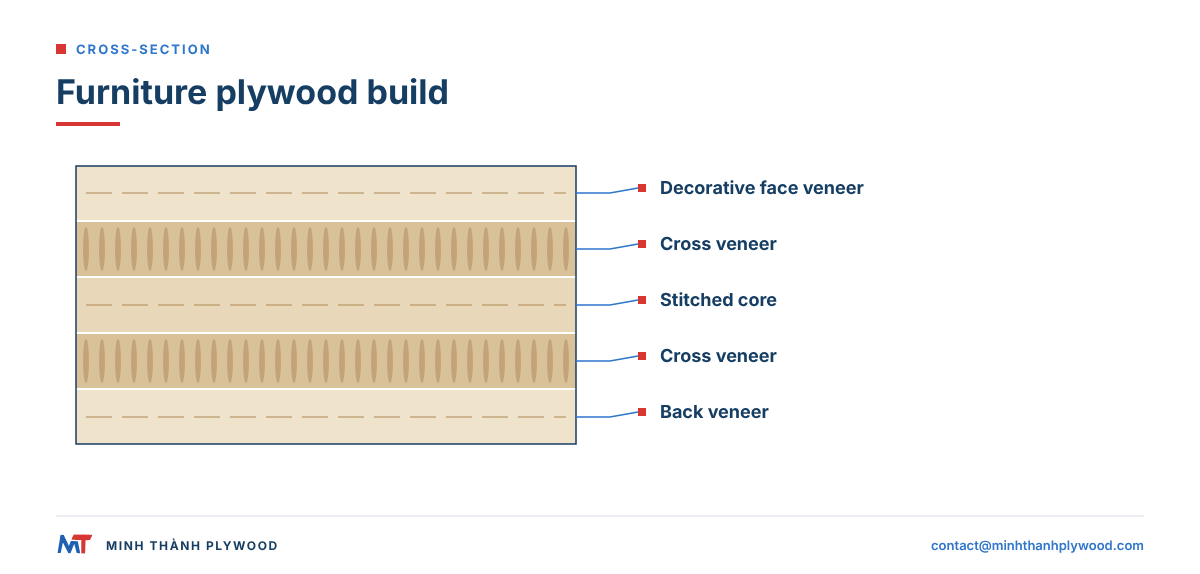
- Core species. Minh Thanh furniture panels use white Styrax or Eucalyptus cores as standard; Acacia and Pine cores are made on order.
- Pressing. Furniture-grade panels are pressed twice as standard: the core board is pressed and calibrated, then face and back are pressed on. The second pressing gives a flat, even face for thin decorative veneers.
- Core build. Core layers are stitched both horizontally and vertically, which keeps joints closed under the face.
- Thickness tolerance. Sanded furniture panels are held to ±0.2–0.3 mm, down to ±0.2 mm.
- Glue. UF glue at E0 emission is standard for furniture and interior panels.
- Moisture. Veneers and panels are dried to 8–12 % moisture content at dispatch.
Both faces are UV-ready, to the standard customers need to apply their own UV coating. Our furniture plywood guide covers the core choice in detail.
Which species are available as plywood faces?
The woods that peel or slice well and ship in volume are the plywood faces. Minh Thanh offers 10+ face veneers: mostly EV, poplar, birch, okoume and pine, and also bintangor, eucalyptus, gurjan, sapele and others on request.
| Face | Look | Grades quoted | Typical use |
|---|---|---|---|
| EV (engineered veneer) | Repeatable oak, walnut and other figures | By approved sample | Doors, visible furniture panels |
| Poplar | Smooth, cream | A/A, A/B, B/B; B/BB, BB/CC, CP | Painted, laminated, melamine-faced parts |
| Birch | Pale, fine grain | D+, D, E pairs | Cabinets, visible edges |
| Pine | Grain and knots | A/A, A/B, B/B, B/C | Natural interiors, shelving |
| Okoume | Pink-brown, even | By approved sample | Interior panels, light builds |
| Eucalyptus | Light brown | A/A, A/B, B/B | Furniture and interior panels |
A/A suits two visible faces, A/B one visible face and B/B paint or overlay. Panels come in 3–40 mm, in 1220 × 2440 and 1250 × 2500 mm, plus custom sizes such as 1220 × 2500 and 1220 × 2280 mm.
Which wood for which furniture part: verdict by use
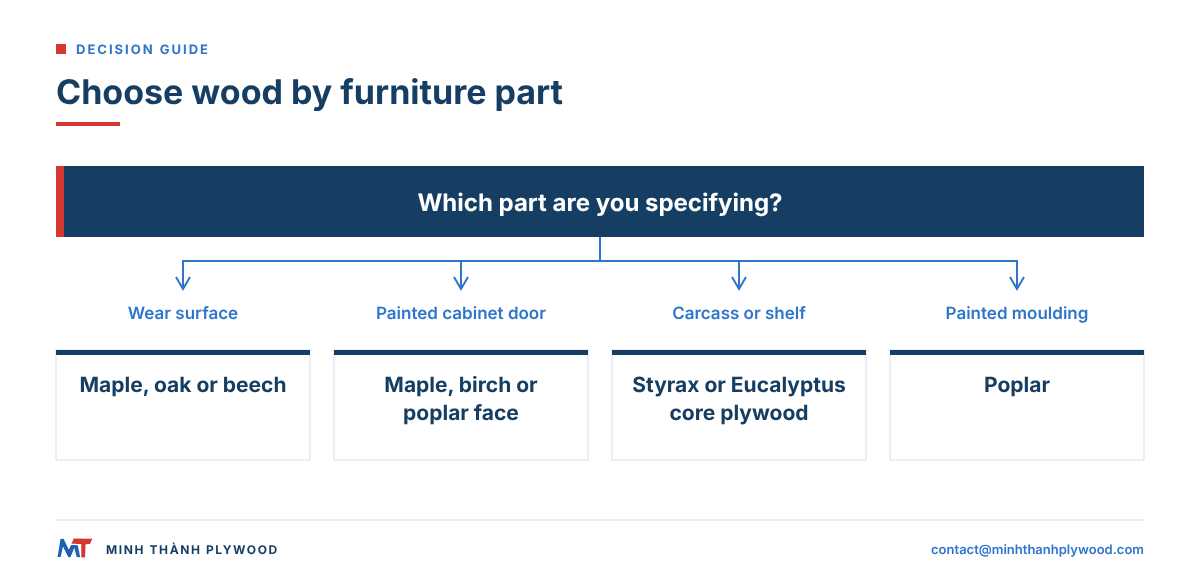
Pick the species by the part, not by the piece. The verdict for each common part:
- Table tops and worktops: hard maple, white oak or beech for wear; walnut or cherry for a premium clear finish.
- Cabinet doors: oak or EV oak-look for stained doors; maple, birch or poplar faces for paint.
- Carcasses and shelves: plywood on a Styrax or Eucalyptus core, poplar or birch faced; pine for budget lines.
- Drawer sides: birch plywood or hard maple for clean, hard edges.
- Chairs and frames: beech, oak or rubberwood.
- Painted mouldings and frames: poplar.
- Outdoor: white oak among these species; see our guide to the best wood for outdoor furniture.
For most cabinet and furniture plants the answer is a mix: a hard or premium species where hands touch, and plywood with an economical face everywhere else.
How to specify a face species in an RFQ
Write the face, its grade, the core and the glue into the RFQ, and send a sample of the look you need:
18 mm furniture plywood, 1220 × 2440 mm; face/back: poplar A/B; core: Styrax; UF glue at E0 emission; sanded, thickness ±0.3 mm; both faces UV-ready; 1×40HC CIF your port.
Swap the face line for birch D+/D, pine A/B or an EV pattern number. Minh Thanh sends free samples and replies within hours: contact@minhthanhplywood.com or WhatsApp +84 988 586 601. Prices for furniture and interior plywood start from US$350/m³ (October 2026), depending on face, core, glue, thickness, size, quantity and delivery term.
Buyer questions, answered
Is poplar stronger than oak?
No. Red oak has a bending strength of about 99.2 MPa and a Janka hardness of 1,290 lbf; yellow poplar has about 70.0 MPa and 540 lbf. Poplar is lighter and steadier to machine, which is why it is chosen for painted parts and plywood faces.
Is poplar cheaper than oak?
Yes. Poplar grows fast and is one of the cheapest hardwoods in North America and Europe, while white oak sits in the upper price band. As a plywood face, poplar is one of the most economical faces on the market.
Which is harder, maple or oak?
Hard maple, at 1,450 lbf on the Janka test, is harder than red oak at 1,290 lbf and white oak at 1,360 lbf. Soft maple, at 950 lbf, is softer than both oaks.
Is maple plywood better than oak plywood for cabinets?
Maple plywood suits painted or clear, modern cabinets with a smooth, closed grain; oak plywood suits stained, traditional doors where the open grain should show. Both carry the same panel strength because the core, not the face, does most of the work.
Can you stain maple plywood to look like oak?
Only in colour, not in texture. Maple has a closed, tight grain that takes stain unevenly and lacks oak's open pores; use a pre-stain conditioner or gel stain, or choose an oak-look EV face instead.
Is pine harder than maple?
No. Eastern white pine scores 380 lbf and southern yellow pine about 690 lbf, against 1,450 lbf for hard maple. Pine dents easily; maple is the floor, worktop and drawer-side wood.
Birch vs beech: which is better for furniture?
Beech is harder, 1,450 lbf for European beech against 1,260 lbf for yellow birch, and bends well under steam, so it is the chair and frame wood. Birch is the plywood wood: its veneer peels cleanly, which is why birch plywood is a standard furniture panel.
Is poplar or pine better for painted furniture?
Poplar. It has fewer knots, no resin pockets and a fine, even grain that paints smoothly. Pine is softer and needs knots sealed before painting.
Is oak plywood waterproof?
No plywood face is waterproof. The bond class of the glue and an edge seal decide moisture performance; interior furniture plywood uses UF glue, and exterior uses phenolic (WBP) or melamine-fortified bonds.
Which woods does Minh Thanh supply as plywood faces?
Mostly EV (engineered veneer), poplar, birch, okoume and pine, with bintangor, eucalyptus, gurjan, sapele and others on request, on white Styrax or Eucalyptus cores.