
Primed MDF is MDF board with a factory-applied, sanded coat of primer on its faces, ready for the final paint. White MDF usually means melamine-faced MDF, a resin-paper surface that needs no paint at all. Minh Thanh Plywood sets out every common MDF surface, how to paint it, and where a UV-ready or paint-grade plywood face does the same job lighter.
What is primed MDF?
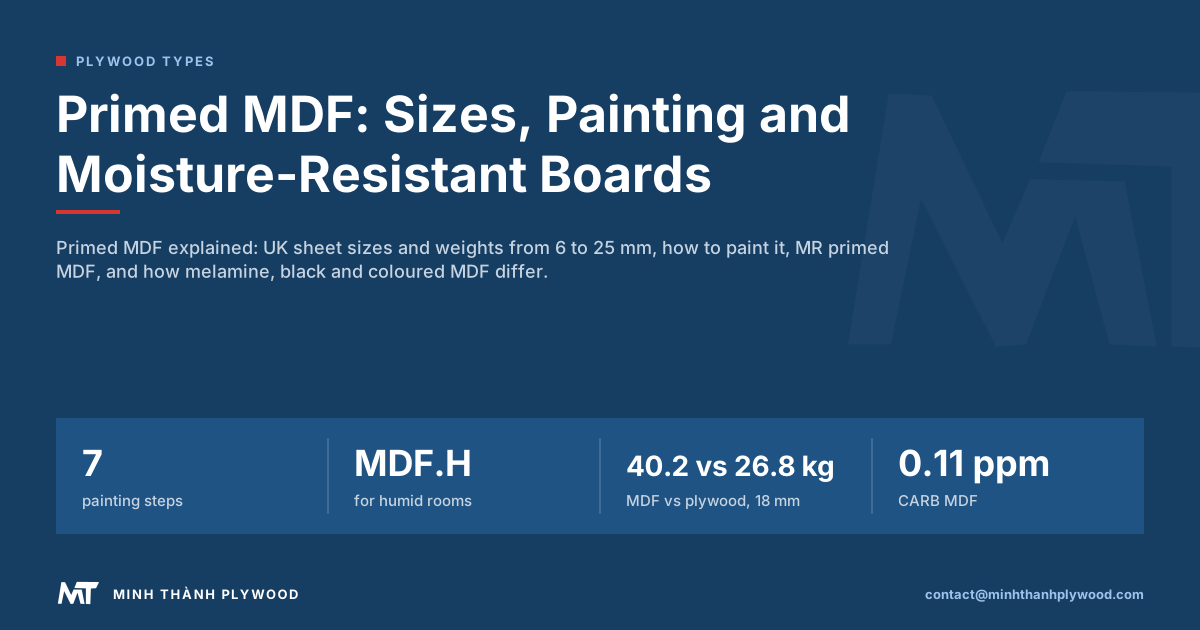
Primed MDF is medium-density fibreboard that leaves the factory with a sanded coat of primer on its faces, ready for the final colour. The primer seals the fibres, so the face does not soak up paint or raise fibres, and it gives a smooth, even base for two top coats.
Factory priming is done on a roller or spray line: one or two coats, often water-based acrylic, each cured and sanded. Boards are primed on one face or both. The same treatment is common on MDF mouldings, skirting boards, architraves and window boards, which are sold primed white for decorators.
What primed MDF does not cover: the edges. Every cut through a primed board exposes raw fibre, and those edges soak up paint and swell with water-based coatings unless they are sealed first. That is the single biggest cause of poor results with primed MDF.
Factory primed MDF vs ready-to-paint and raw MDF
Raw, primed and “ready-to-paint” MDF differ in how much of the painting work is already done. The three surfaces:
| Raw MDF | Factory primed MDF | Ready-to-paint MDF | |
|---|---|---|---|
| Surface | Bare fibre, sanded | Sanded primer coat | Sealed surface or paper for direct paint |
| Paint system needed | Sealer, primer, two top coats | Light sand, two top coats | Light sand, two top coats |
| Edge treatment | Seal and prime | Seal and prime | Seal and prime |
| Best for | Spray shops with their own primer | Doors, panels, fit-outs | Site and workshop painting |
| Price | Lowest | Higher | Higher |
A furniture plant with its own spray line often buys raw MDF and primes in-house, because its primer and top coat come as one system. A joinery workshop or site painter saves a full day on a kitchen by buying factory primed MDF.
How to paint primed MDF
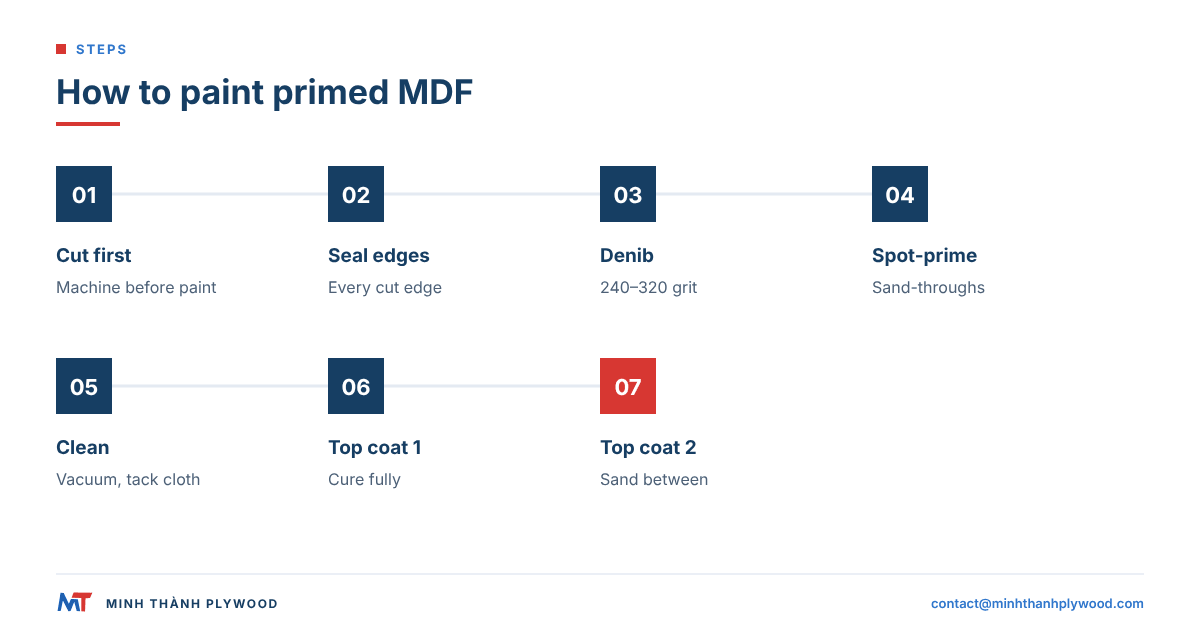
Primed MDF needs a light sand, sealed edges and two top coats. The steps:
- Cut and machine first. Do all cutting, routing and drilling before painting.
- Seal every cut edge. Apply an edge sealer, diluted PVA or a solvent-based primer to raw edges, let it dry, and sand smooth. Repeat on routed profiles.
- Denib the face. Sand the factory primer lightly with 240–320 grit; do not sand through it.
- Spot-prime damage. Touch up any area sanded through to the fibre.
- Clean the dust. Vacuum, then wipe with a tack cloth.
- First top coat. Water-based or solvent-based to suit your system; let it cure fully.
- Sand and second coat. Light sand between coats, then the final coat.
Water-based paints on unsealed edges raise the fibres and leave a rough, swollen line. Sealing edges first is what separates a smooth door from a rejected one.
Moisture-resistant primed MDF for kitchens and bathrooms
For kitchens, bathrooms and window boards, order primed MDF on a moisture-resistant core: class MDF.H under EN 622-5, sold as MR MDF and usually dyed green. The primer and paint protect the face; the MR core protects against the swelling that starts at edges and screw holes when water gets in.
Moisture-resistant is not waterproof. An MR primed MDF board still swells if it stands in water, so kitchen plinths and bath panels need sealed edges and a gap above the floor. Exterior-grade MDF exists for outdoor signs and cladding, but painted exterior joinery is usually made in timber or exterior plywood.
When MDF is used in construction, the EN board classes sit under the EU Construction Products Regulation, Regulation (EU) No 305/2011 (checked 20 October 2026). Plywood’s moisture performance comes from its glue: interior furniture plywood uses UF glue, and melamine-fortified (MR) or phenolic (WBP) bonds are made to order for humid and exterior uses.
White MDF board: melamine-faced, primed or painted?
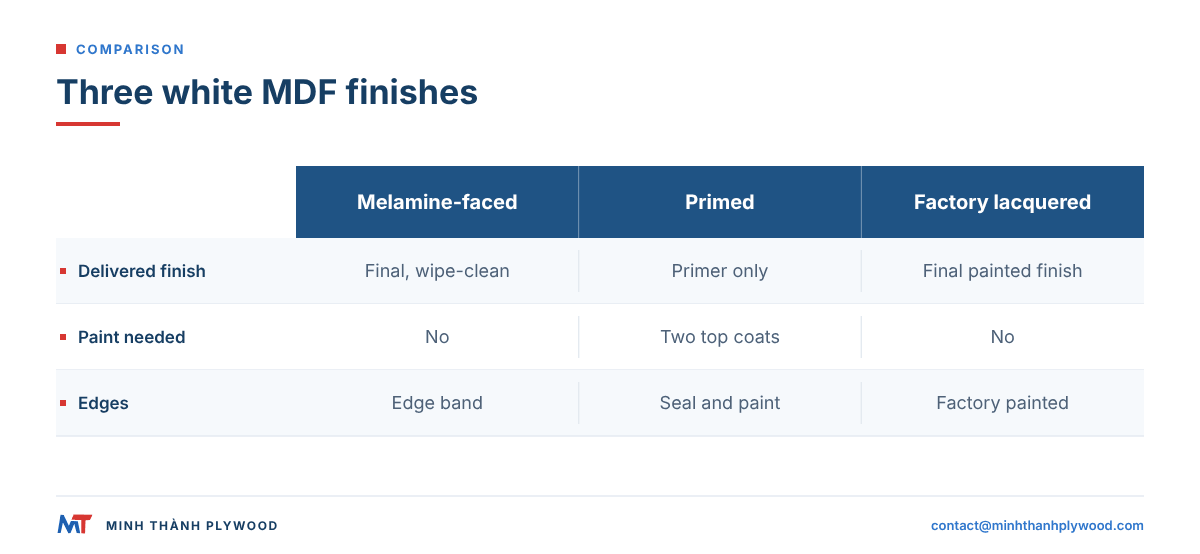
White MDF board in trade lists usually means melamine-faced MDF, MDF with white melamine paper pressed onto both faces. It is wipe-clean, needs no paint, and comes in matt, satin, gloss and textured finishes. White MDF can also mean primed white MDF, which still needs top coats, or MDF lacquered white at the factory.
| White MDF option | Finish on delivery | Paint needed | Edges | Typical use |
|---|---|---|---|---|
| White melamine-faced MDF | Final, wipe-clean | No | Edge banding | Wardrobes, shelving, office |
| Primed white MDF | Primer only | Two top coats | Seal and paint | Painted doors, panelling |
| Factory lacquered white MDF | Final, high build | No | Factory painted | Kitchen and bedroom doors |
| White high-gloss laminated MDF | Final, gloss | No | Edge banding | Modern doors |
Ask which one a quote means. A white melamine board priced against a primed white board is not a like-for-like comparison: one is finished, the other is half-way.
Is melamine the same as MDF?
No, melamine is not the same as MDF. MDF is the board, made from wood fibres bonded with resin. Melamine is the surface: a decorative paper impregnated with melamine resin and pressed onto the board under heat, where the resin melts and cures into a hard, closed surface.
So “melamine board” names the surface and leaves the core open. The core can be:
- MDF: melamine-faced MDF, MFMDF or MDF melamine board.
- Particle board: melamine-faced chipboard, MFC, the most common melamine board in Europe.
- Plywood: melamine plywood, lighter and stronger, often for transport, display and furniture that must hold screws.
The paper, colour and texture can be identical on all three; only the core changes weight, edges and price. Our guide to melamine board lists the sizes and grades.
Melamine MDF vs melamine particle board
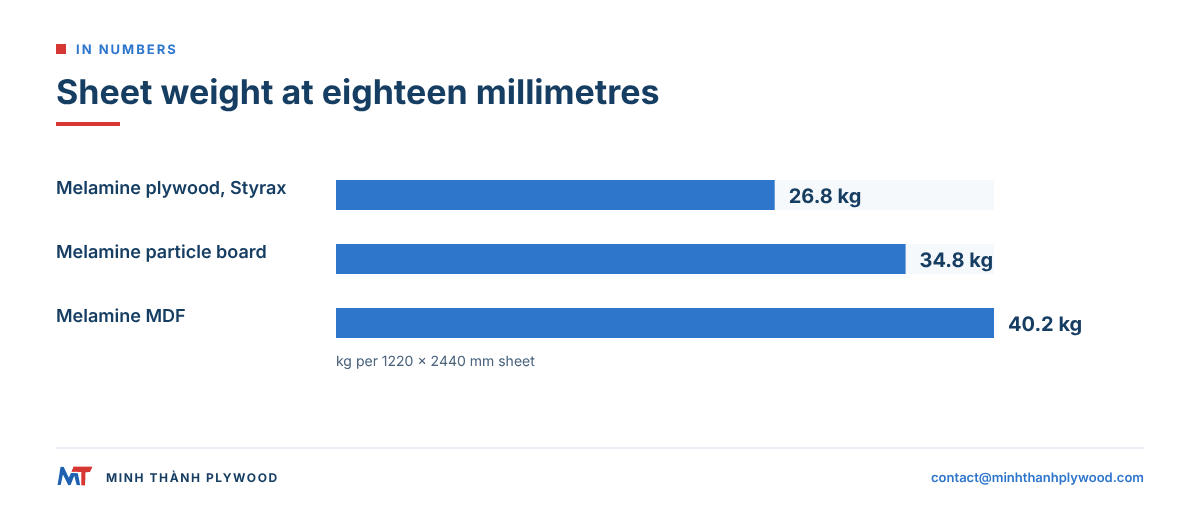
Melamine MDF gives a smoother, flatter surface and an edge that can be profiled; melamine particle board is lighter and cheaper and is the standard for flat carcasses. The comparison at 18 mm:
| Melamine MDF | Melamine particle board | Melamine plywood | |
|---|---|---|---|
| Core density | about 750 kg/m³ | about 650 kg/m³ | 500–650 kg/m³ by core |
| Sheet weight, 1220 × 2440 mm | about 40.2 kg | about 34.8 kg | 26.8 kg on Styrax core |
| Surface smoothness | Smoothest | Fine; chip texture can show on gloss | Smooth on a sanded face |
| Edge profiling | Yes, routed and painted | No, edge band only | Edge band or show the layers |
| Screw holding | Good in face | Fair | Very good |
| Price | Middle | Lowest | Highest |
Weights are sheet volume, about 0.0536 m³, times density. The plywood figure is Minh Thanh’s reference value for 18 mm on a Styrax core. For high-gloss or dark plain colours, MDF hides the core texture best; for long white carcass runs, particle board is the cost choice.
Black MDF and coloured MDF
Black MDF is through-coloured: the wood fibres are dyed before the board is pressed, so it is black all the way through. Cut, routed or engraved edges stay black and need no edge banding or paint, which is why designers use it for shop fittings, displays, exhibition stands, signage and CNC-cut panels.
Coloured MDF works the same way in other colours: red, blue, green, grey and more, as through-dyed boards sold under several brand names. Points to know:
- Price. Black and coloured MDF cost more than standard MDF because of the dyes, the line cleaning between colours and the smaller runs.
- Finish. The board is sanded but not sealed; a clear lacquer, oil or wax brings out the colour and protects it.
- Sizes. Usually 2440 × 1220 mm (4 × 8 ft) in a smaller thickness range than standard MDF.
- Cabinets. Black MDF suits cabinet doors and panels in dry interiors; ask for a moisture-resistant grade for kitchens.
Black MDF is also made by painting or by black melamine. Those boards show a brown core when cut; through-coloured boards do not.
Laminated MDF: HPL, PET, acrylic and foil
Laminated MDF covers every surface bonded to MDF other than melamine paper and veneer. The common types:
- HPL (high-pressure laminate). A thick, tough laminate glued on; for worktops, desks and contract furniture.
- PET film. A polyester film in matt or gloss, scratch resistant, common on modern kitchen doors.
- Acrylic. A high-gloss acrylic sheet, deep shine, for premium doors.
- PVC foil. Vacuum-pressed over routed MDF doors, so the profile is covered in one piece.
- Paper foil. Thin, low-cost, for back panels and drawer bottoms.
The MDF lamination sheet is chosen by wear and look; the core is chosen by edge and weight. Prelaminated MDF means the surface is pressed on by the board maker; post-laminated means a furniture plant presses it on. On plywood the same laminates bond well to a sanded, flat face, which is why the face grade and the calibration matter more than the species.
MDF colours and finishes: how buyers choose
MDF colours come from four routes, and each has its own price and edge behaviour:
| Route | Colour range | Edge | Price |
|---|---|---|---|
| Melamine paper | Hundreds of plain, wood and stone decors | Edge band | Low |
| Paint on primed MDF | Any colour | Painted | Medium, labour heavy |
| Laminate, PET or acrylic | Wide, gloss and matt | Edge band | Medium to high |
| Through-coloured MDF | Black and a short palette | Same colour | High |
Choose by volume and repair. Melamine decors are cheapest in volume and cannot be touched up; paint on primed MDF can be repaired on site; through-coloured MDF hides chips because the colour runs through. A furniture plant with mixed orders often stocks primed MDF for custom colours and melamine boards for standard ones.
Primed MDF sizes and thicknesses
Primed MDF is sold mainly in 2440 × 1220 mm sheets, in thicknesses from 6 mm to 25 mm in most trade ranges, with 18 mm the most common for doors and furniture panels. Some suppliers cut primed MDF to size, and MR primed MDF comes in a narrower thickness range.
In the UK the full board is the 8 × 4 ft sheet of 1220 × 2440 mm. Wickes lists its general purpose MDF in 6, 9, 12 and 18 mm, and part sheets of 606 or 607 × 1220 mm and 606 or 607 × 1829 mm, while MDF Direct sells ready-to-paint full boards in 9, 12, 18 and 25 mm. Weights below are the sheet volume times about 750 kg/m³:
| Thickness | Full sheet 1220 × 2440 mm, weight | Part sheets in the UK ranges |
|---|---|---|
| 6 mm | 13.4 kg | 607 × 1220 mm, 607 × 1829 mm |
| 9 mm | 20.1 kg | 606 × 1220 mm, 606 × 1829 mm |
| 12 mm | 26.8 kg | 607 × 1220 mm, 607 × 1829 mm |
| 18 mm | 40.2 kg | 606 × 1220 mm, 606 × 1829 mm |
| 25 mm | 55.8 kg | Full sheets and cut-to-size only |
Standard primed MDF suits dry interiors: use class 1 under EN 335 (service class 1 in Eurocode 5 terms). Kitchens and bathrooms need MR primed MDF (MDF.H); UK merchants name Neatmatch MR for humid rooms and Medite Exterior or Tricoya where exterior exposure is expected. UK stockists price by the sheet and cut boards to size, and add delivery: MDF Direct, for example, charges £10 to £60 plus VAT depending on zone and order value, and delivers in 3 to 4 working days across England and Wales (read October 2026).
Primed MDF profiles are a separate product family: skirting, architrave, window boards and mouldings, primed on the show faces.
For plywood alternatives Minh Thanh supplies 1220 × 2440 and 1250 × 2500 mm sheets, custom sizes such as 1220 × 2500 and 1220 × 2280 mm, thicknesses from 3 to 40 mm, and cut-to-size panels where one sheet is cut into 4, 6 or 8 pieces. Sanded furniture panels are held to ±0.2–0.3 mm thickness tolerance.
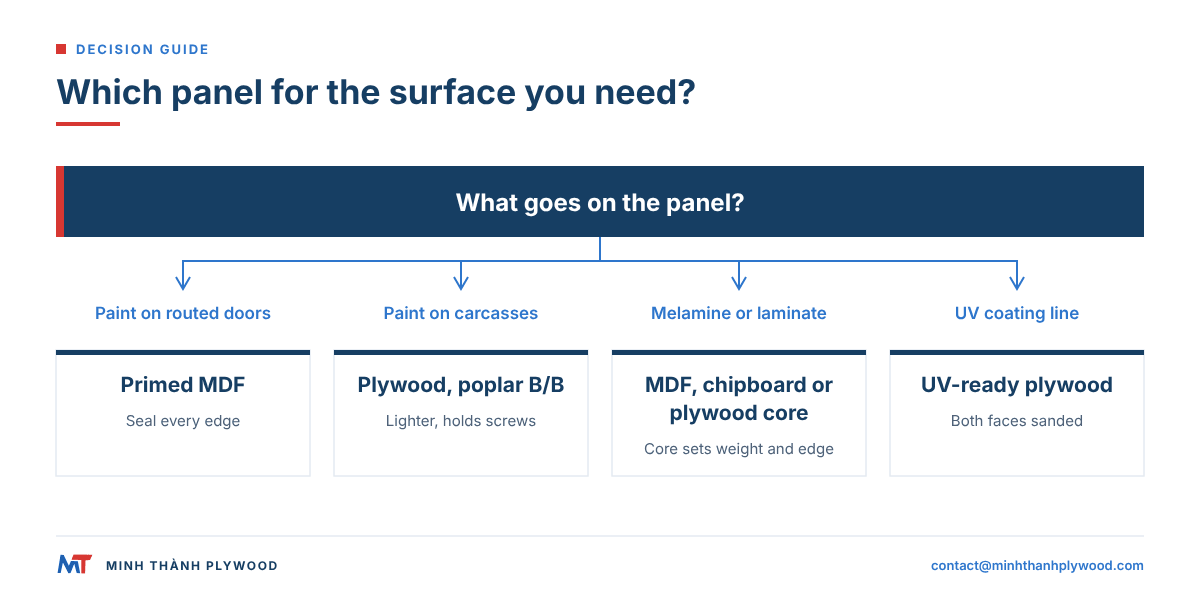
Surface options on plywood: UV-ready, overlay and paint-grade faces
Plywood does the same surface jobs as MDF, at about two-thirds of the weight. The options a furniture plant orders:
- UV-ready faces. Minh Thanh sands and polishes both faces to the standard customers need to apply their own UV coating, so the panel goes straight onto a UV roller line.
- Overlay-grade faces. For melamine paper, HPL or PET, the face must be flat and closed. Poplar-faced panels in B/B, and eucalyptus-faced B/B, suit paint or overlay.
- Paint-grade faces. Poplar is the plywood paint face: fine, closed grain, no resin. A/B gives one clean show face.
- Calibrated thickness. Furniture-grade panels are pressed twice as standard: the core board is pressed and calibrated, then face and back are pressed on. A flat core keeps the overlay or gloss paint free of ripples.
Melamine plywood is pressed by board makers or furniture plants on such panels. Our poplar plywood and eucalyptus plywood pages show the faces.
Primed MDF or paint-grade plywood: which for painted furniture?
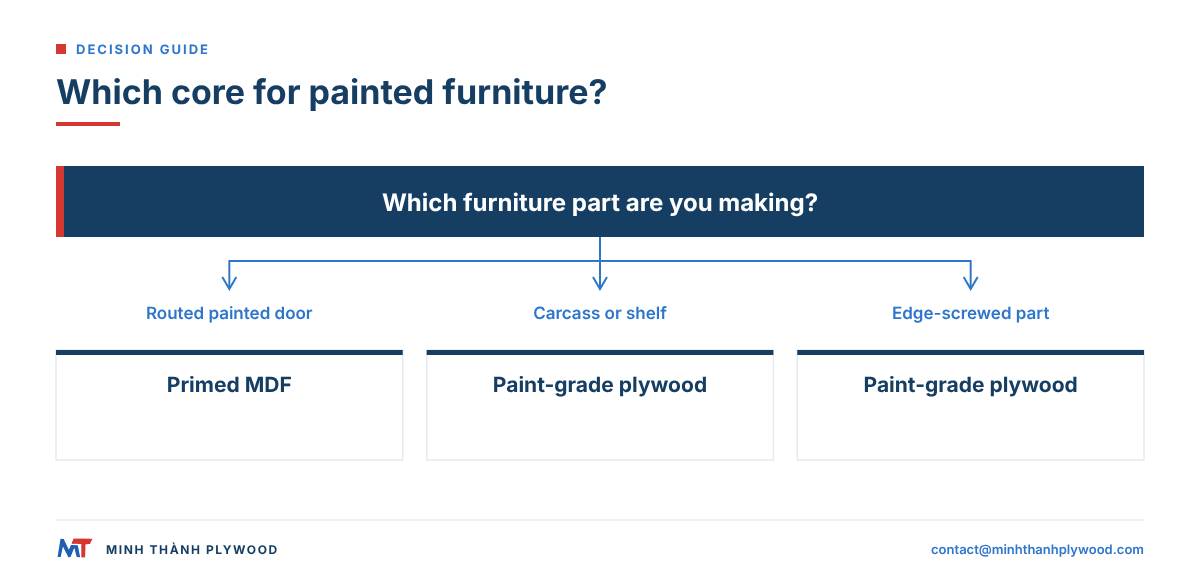
Use primed MDF for painted doors with routed profiles and for the smoothest gloss face; use paint-grade plywood for carcasses, shelves and anything screwed into an edge or carried by hand. Many painted kitchens combine them.
Why plywood for the body:
- Weight. 26.8 kg for an 18 mm Styrax-core sheet against about 40.2 kg for MDF.
- Screws and hinges. Crossed veneers hold fixings in the face and the edge.
- Spans. Shelves sag less.
- Water. A splash on a plywood edge does not swell the way MDF does.
Why primed MDF for the doors: it routes cleanly into shaker and bevel profiles, and its painted edge has no layers to fill. Plywood edges need filling or edge banding before paint. Our guide to plywood for kitchen cabinets shows how plants split the parts.
Emissions, primers and coatings
The board, not the primer, sets most of a painted panel’s formaldehyde emission, so the core’s class goes on the order. In the US, CARB Phase 2 and TSCA Title VI limit MDF to 0.11 ppm, thin MDF to 0.13 ppm, particleboard to 0.09 ppm and veneer-core hardwood plywood to 0.05 ppm; see 40 CFR 770.10 (checked on 20 October 2026).
In the EU, Commission Regulation (EU) 2023/1464 (checked 20 October 2026) limits formaldehyde from furniture and wood-based articles to 0.062 mg/m³ from 6 August 2026. Coatings and laminates reduce emissions from the face, but cut edges and drilled holes still release from the core.
Minh Thanh furniture plywood uses UF glue at E0 emission, certified CARB P2 / TSCA Title VI (ICTT mill no. 23024); six ASTM D6007 chamber tests between April 2025 and June 2026 averaged 0.014–0.032 ppm against the 0.05 ppm limit. Our E0 and E1 emission page explains the classes.
What to write in your RFQ for a painted or overlaid panel
State the surface, the face grade, the core, the thickness tolerance and the emission class, and say what will go on top:
18 mm furniture plywood for UV coating and paint, 1220 × 2440 mm; face/back: poplar B/B; core: Styrax, double pressed; UF glue at E0 emission, CARB P2 / TSCA Title VI; sanded, thickness ±0.3 mm; 1×40HC CIF your port.
For MDF, add primed one or two sides, MDF or MDF.H, and the emission limit. Minh Thanh makes plywood, not MDF; send the RFQ to contact@minhthanhplywood.com or WhatsApp +84 988 586 601 for free samples and a reply within hours. Furniture and interior plywood starts from US$350/m³ (October 2026).
Buyer questions, answered
What is primed MDF?
Primed MDF is MDF with one or more coats of primer applied and sanded at the factory, on one or both faces. It saves the first two steps of painting: sealing the fibres and building a smooth base.
Do you need to prime primed MDF again?
Not the face, if the factory primer is clean and undamaged; give it a light sand and apply two top coats. Every cut edge is raw MDF and must be sealed and primed before painting.
Is melamine the same as MDF?
No. MDF is the board, made of wood fibres and resin; melamine is a resin-impregnated decorative paper pressed onto a board's surface. Melamine-faced MDF is MDF with that surface.
Is melamine MDF better than melamine particle board?
Melamine MDF has a smoother, flatter surface and an edge that can be profiled and painted; melamine particle board is lighter and cheaper and is the standard for flat cabinet carcasses with edge banding.
What is white MDF board?
In most trade lists, white MDF board is MDF faced with white melamine paper on both sides. Primed white MDF also exists and is meant to be painted.
What is black MDF?
Black MDF is through-coloured MDF: the fibres are dyed black before pressing, so the board is black throughout and cut edges need no edge banding or paint.
Is black MDF more expensive than regular MDF?
Yes. The dyes, the cleaning of the line between colours and smaller production runs put through-coloured MDF in a higher price band than standard MDF.
Can black MDF be used for cabinets?
Yes, for doors, panels and display units in dry interiors, sealed with a clear lacquer or oil. Specify a moisture-resistant grade for kitchens.
Can you paint melamine-faced MDF?
Only after sanding the glossy surface and applying a bonding primer made for melamine; ordinary primers peel. It is usually better to order primed MDF or the melamine colour you want.
Is plywood better than primed MDF for painted furniture?
Plywood is lighter, holds screws better and suits carcasses and shelves; primed MDF gives the smoothest painted face and profiled edges for doors. A smooth poplar or eucalyptus B/B face makes plywood a good paint base.