
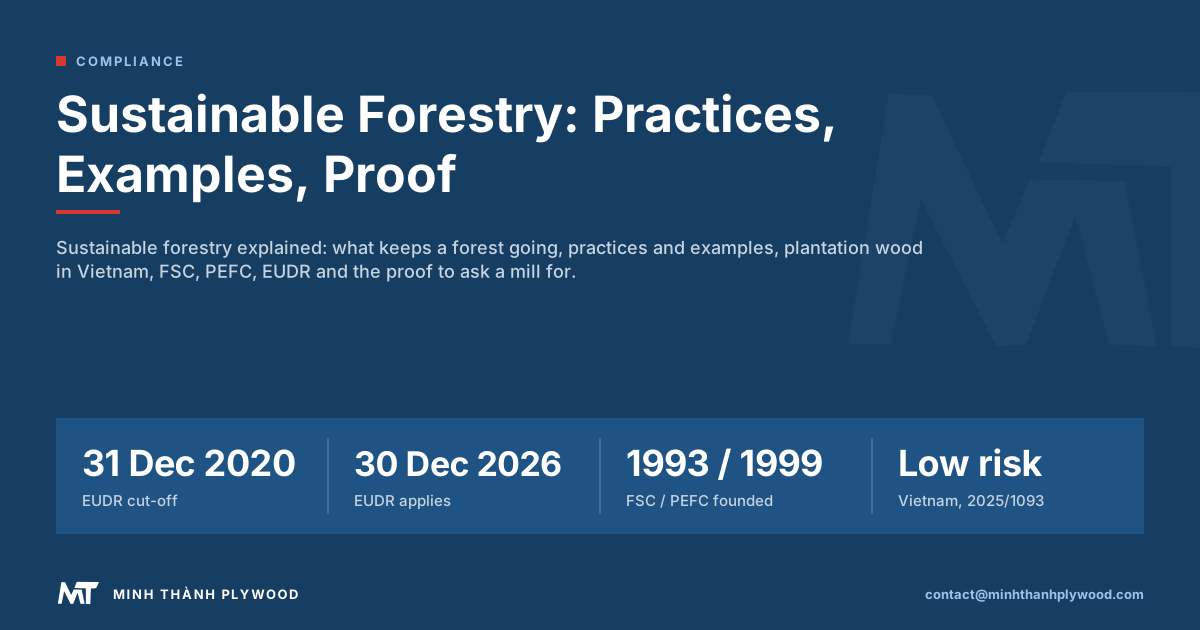
Sustainable forestry is managing forests so they keep their area, growth, soil, water and wildlife while still giving wood, year after year. For plywood, most of that work now happens in planted forests. Minh Thanh Plywood makes plywood in Vietnam from locally grown plantation timber; this guide covers the practices, real examples and the records that prove them.
What is sustainable forestry?
In practice, sustainable forestry is managing a forest so that it keeps its area, its growth, its soil and water and its wildlife over the long term while it supplies wood. The rule at its centre is simple: take no more than the forest regrows, and regenerate what you cut.
The idea is old. Central European foresters wrote it into timber law in the eighteenth century, when mines and towns had stripped the hills of wood. Today the Food and Agriculture Organization of the United Nations (FAO) states the same goal for forest management, extended to soil, water, biodiversity and the people who live from forests.
For a plywood buyer, the question is practical. A panel is made of veneers peeled from logs; the forest those logs came from either grows back or it does not. The rest of this guide shows how to tell which, and what records a mill can hand over.
What makes a forest well managed?
A well-managed forest is one where the harvest stays below growth, cut land is replanted or regrows, soil and water are protected, habitat is kept, and the land is managed legally, with the rights of workers and local people respected. Miss one of these and the forest slowly loses value.
- Growth and harvest: the volume cut over a rotation is no more than the volume grown.
- Regeneration: every cut area is replanted or left to regrow, and checked until it does.
- Soil and water: no harvest on steep, erodible slopes; buffer strips kept along streams.
- Habitat: old trees, wetlands and wildlife corridors left in place.
- Legality and rights: clear land title, harvest permits, safe work and fair dealing with neighbours.
- Records: maps, inventories and harvest logs that show all of this happened.
These six points are the backbone of the standards that certify forests, such as FSC and PEFC, and of the laws that now ask importers where their wood came from.
Sustainable forestry practices: what do foresters actually do?
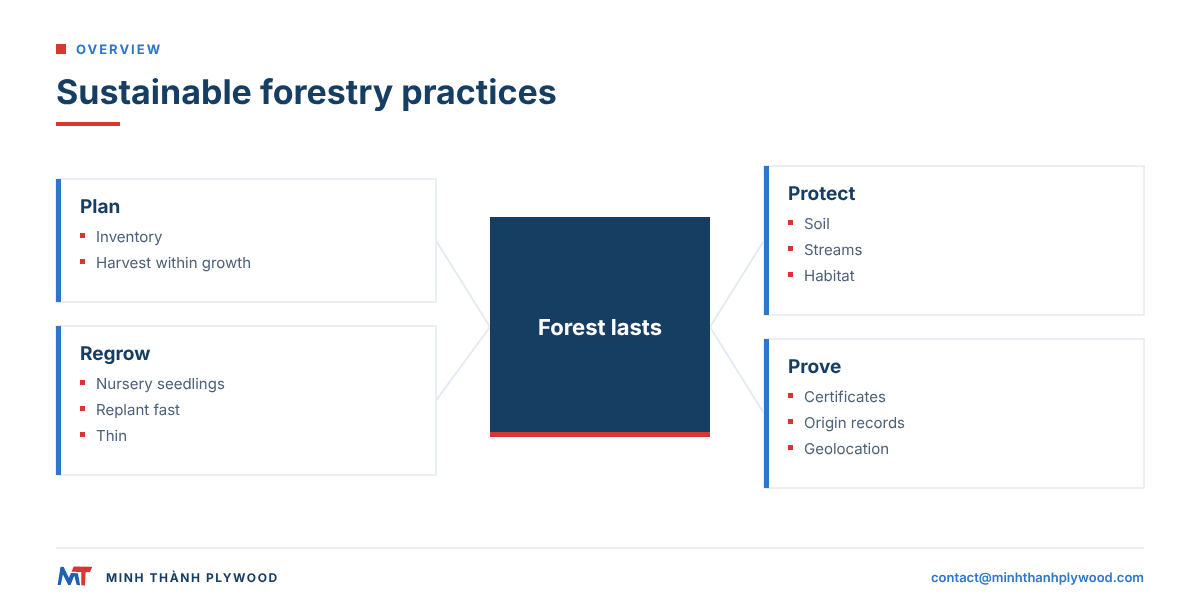
Sustainable forestry practices are the field methods that keep a forest productive: planning harvests from inventory, replanting with good seedlings, thinning, protecting soil and water, keeping habitat, controlling fire and pests, and recording every step. Each practice leaves evidence that a buyer can ask to see.
- Inventory and planning: measure what grows, then set the harvest from that number.
- Nursery and replanting: raise seedlings from selected seed and plant them soon after harvest.
- Thinning: remove weaker stems so the rest grow into larger, straighter logs.
- Reduced-impact harvest: plan skid trails, fell trees away from streams, keep machines off wet soil.
- Soil and water protection: buffer strips, no burning of slash on steep ground.
- Habitat retention: leave patches of native forest and old trees standing.
- Fire and pest control: firebreaks, patrols and early treatment of outbreaks.
- Records and audit: maps, harvest logs and, where certified, yearly audits.
The social side counts as much as the silviculture, and it is the part the Forest Stewardship Council lists in its own ten practices:
- Tenure and use rights: who owns, leases or may use the land is defined and documented.
- Indigenous Peoples’ rights: land and resource rights are recognised, with free, prior and informed consent where they apply.
- Workers and community relations: safe work, fair pay and a way for neighbours to raise complaints.
- High conservation value forests: areas with rare species, large intact forest or sites of cultural value are identified and kept, not harvested.
- Plantations managed with precaution: planted forests do not replace natural forest and are monitored for effects on soil, water and biodiversity.
Ecologically sustainable forestry adds weight to points 5 and 6: it treats the forest as an ecosystem first and a wood supply second, with mixed species and longer rotations where the site allows.
Natural forests vs plantations: where does plywood wood come from?
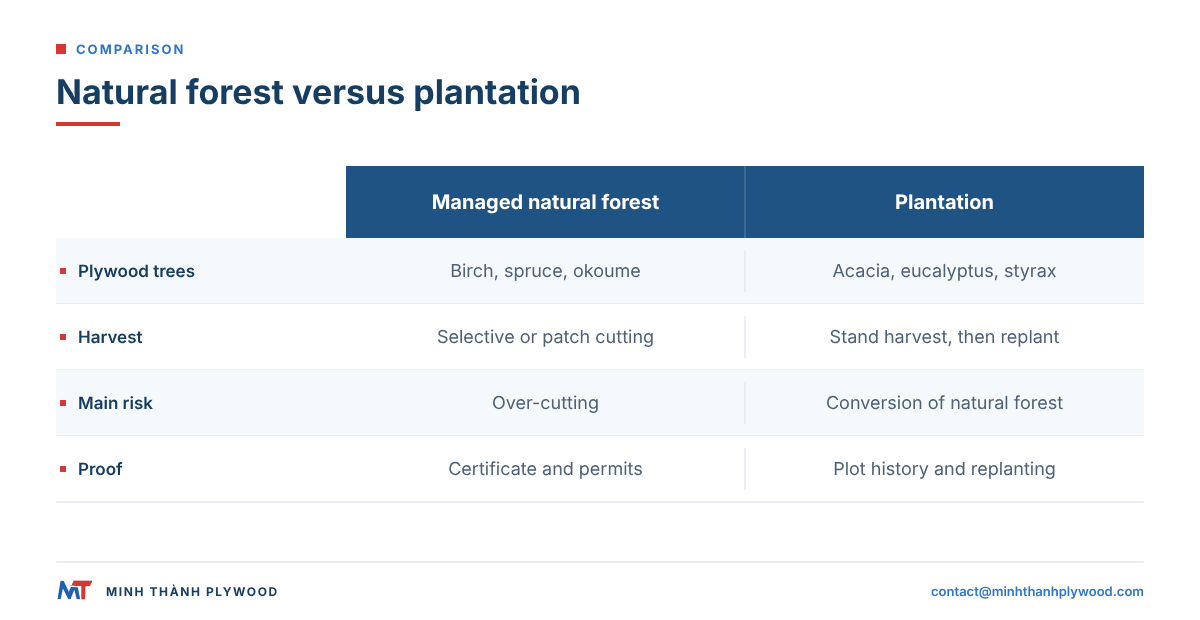
Most plywood wood now comes from two sources: natural or semi-natural forests managed for long rotations, such as Nordic and Baltic birch, and planted forests grown on short rotations, such as acacia and eucalyptus in Vietnam. Both can be managed well; they need different proof.
| Point | Managed natural forest | Plantation |
|---|---|---|
| Typical plywood species | Birch, spruce, okoume | Acacia, eucalyptus, styrax, poplar |
| Rotation | Many decades | A few years to a decade or more |
| Harvest method | Selective or patch cutting, natural regrowth | Clear-felling of the stand, then replanting |
| Main risk | Over-cutting, degradation of old forest | Plantations on land cleared from natural forest |
| Proof to ask for | Forest certificate, harvest permits | Land history, plot maps, replanting records |
The main risk with plantations is how the land became a plantation. A stand planted on degraded farmland is a different story from one planted where natural forest was cleared. That is why the EU now asks for plot geolocation and a cut-off date.
Examples of sustainable forestry
Examples of sustainable forestry include smallholder acacia plantations in northern Vietnam replanted after each harvest, nursery programmes that grow birch seedlings for Nordic and Baltic forests, mixed-species planting that makes stands resist pests, and reduced-impact selective logging in tropical natural forest. Each one keeps the land producing wood.
- Smallholder acacia in Vietnam: farm families plant acacia on hill land, harvest it after several years, sell the logs to local peeling and plywood mills, and replant the same plot. The cycle turns hill land into a steady income and keeps it under tree cover.
- Birch nurseries in the Baltics: forest owners raise birch seedlings from selected seed in nurseries and plant them on cut areas, so the next rotation starts with stronger trees.
- Mixed stands in the Nordics: foresters keep birch among spruce and pine because mixed stands suffer less from storms, pests and fungal disease than single-species stands.
- Reduced-impact logging in the tropics: crews map every tree, cut only the marked ones, fell them away from streams and plan skid trails to limit damage to the trees left standing.
These sustainable forestry examples share one habit: they plan the next harvest before the current one ends.
Why is sustainable forestry important?
Sustainable forestry is important because it keeps wood supply going for the next harvest, protects soil, water and wildlife, keeps carbon in growing forests, and lets buyers meet the laws that now cover timber imports. A forest that is cut without regrowth stops supplying anything.
The scale of the loss is why buyers ask. The FAO estimated global deforestation at about 10 million hectares a year between 2015 and 2020, much of it forest that cannot be replaced within a human lifetime.
For a mill, it is a supply question. A plywood factory that peels local logs depends on the plantations around it being replanted every rotation. When they are, log supply stays steady and close, and so do prices.
For an importer, it is also a legal question. The EU, the US and the UK all require proof that timber was harvested legally, and the EU now requires proof that it did not come from land deforested after 2020. Good forestry is the cheapest way to have that proof ready.
Sustainability of forests in Vietnam: what changed?
The sustainability of forests in Vietnam rests on two changes: large areas of degraded hill land were planted with fast-growing trees, mostly acacia and eucalyptus, and timber legality became law through the Vietnam Timber Legality Assurance System. Plantation wood now feeds most of the country’s plywood mills.
Northern provinces such as Phu Tho grow acacia, eucalyptus and styrax on hill farms and forestry land. Many plots belong to households who plant, tend and sell a stand, then replant. Peeling mills nearby turn the logs into core veneer, and plywood mills press it into panels.
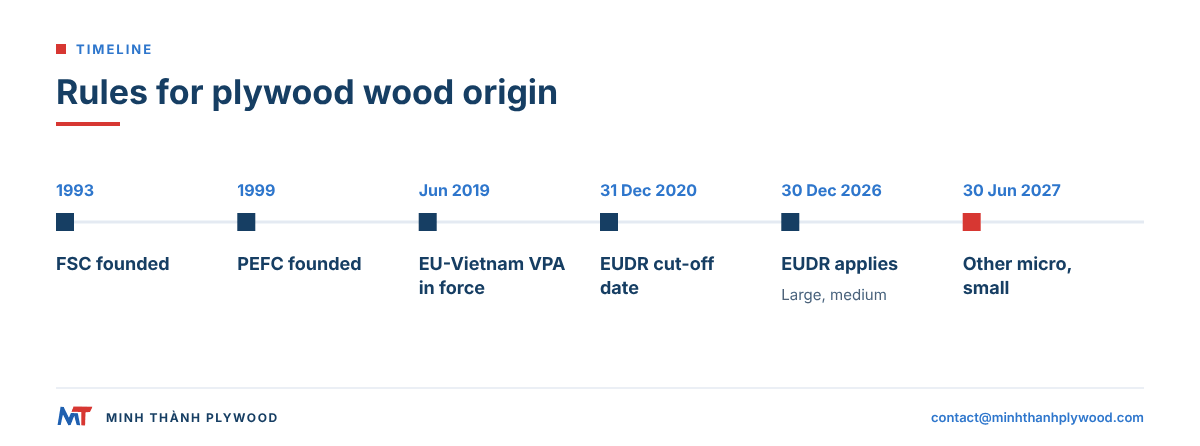
Vietnam and the EU signed a Voluntary Partnership Agreement on timber legality, in force since June 2019. Under it, Vietnam’s Decree 102/2020/ND-CP set up the national timber legality system that classifies organisations and checks the origin of timber they trade. On the import side, the EU Deforestation Regulation, (EU) 2023/1115, sets what an EU buyer must prove.
What does plantation wood mean for plywood?
Plantation wood gives plywood mills a steady, local supply of core logs on short rotations, so the core of most Vietnamese plywood is acacia, eucalyptus or styrax grown within reach of the factory. The face veneer can come from elsewhere; the core is local.
Minh Thanh Plywood is in Ha Hoa, Phu Tho, where locally grown plantation timber supplies our cores. Our furniture panels use white Styrax or Eucalyptus cores as standard, with Acacia and Pine cores made on order. Faces, such as birch, poplar, okoume or EV, are chosen for the look the buyer orders.
Short haul from plantation to mill means fresher logs, less transport and a clear origin record for each delivery. That record is what a buyer needs later, when a forest certificate or the EU’s geolocation rule asks where the wood grew.
What is responsible logging?
Responsible logging is harvesting that the forest can replace: in natural forests, selective and reduced-impact cutting within the annual growth; in plantations, felling a stand at the end of its rotation and replanting it promptly, with soil and streams protected. Both depend on planning and records.
In a plantation, clear-felling is normal. The stand was planted as one crop and is harvested as one. What makes it responsible is what happens next: replanting with good seedlings, keeping buffer strips along streams, and not extending the plantation into natural forest.
In natural forest, clear-felling large areas is the opposite of good practice. There, responsible logging means taking a few marked trees per hectare and leaving the forest structure intact.
How do FSC and PEFC certify responsible forest management?
FSC and PEFC certify responsible forest management in two steps: a forest management certificate shows a forest is run to the standard, and a chain-of-custody certificate tracks certified wood through every company that handles it. A product claim is valid only when both links hold.
The Forest Stewardship Council (FSC) was founded in 1993 and sets one set of global principles adapted by country. The Programme for the Endorsement of Forest Certification (PEFC) was founded in 1999 and endorses national systems. Both audit forests, both run chain of custody, and both put a claim on the sales invoice, such as “FSC Mix” or “FSC 100%”.
In the United States and Canada, two more schemes matter, because the country’s own landowners and mills use them. The Sustainable Forestry Initiative (SFI) is endorsed by PEFC and has run for about 30 years, and the American Tree Farm System (ATFS) certifies family forests. A buyer in any of these markets meets one of four names:
| Scheme | Region | What is audited | How a buyer checks it |
|---|---|---|---|
| FSC | Worldwide | Forest management and chain of custody against global principles adapted by country | FSC public certificate database, certificate code on the invoice |
| PEFC | Worldwide, endorses national systems | Forest management and chain of custody against national standards | PEFC database, certificate number and claim on the invoice |
| SFI | United States and Canada, PEFC-endorsed, about 30 years old | Forest management, fibre sourcing and chain of custody; about 363 million acres (147 million hectares) of forest in 2025 | SFI public certificate search, label and claim on the invoice |
| ATFS | United States, family forests | Forest management on private woodlands, with sourcing recognised under PEFC and SFI chain of custody | ATFS landowner certificate, passed on through the supplier’s chain of custody |
Plywood made in Vietnam for the US market is normally sold on FSC or PEFC chain of custody, or on legality documents, because SFI and ATFS cover North American forests. For plywood from us, FSC is available*, with the claim on the sales documents. Our guide to PEFC vs FSC compares the two systems, and what FSC wood means explains the labels.
*Supplied directly or through qualified partner mills.
What does the EUDR require for plywood?
The EU Deforestation Regulation (EUDR), Regulation (EU) 2023/1115, requires that wood in plywood placed on the EU market comes from land not deforested or degraded after 31 December 2020, was harvested legally, and is backed by a due diligence statement with the geolocation of every production plot.
The regulation applies from 30 December 2026 to large and medium operators, and to micro and small operators already covered by the earlier timber regulation; other micro and small operators follow on 30 June 2027, under Regulation (EU) 2025/2650. Vietnam is classed as low risk under Implementing Regulation (EU) 2025/1093, which allows simplified due diligence.
We supply the EUDR compliance dossier (origin records and geolocation files) with orders. The EUDR traceability page shows what the dossier holds.
Sustainable forestry practices and the proof a buyer can ask for
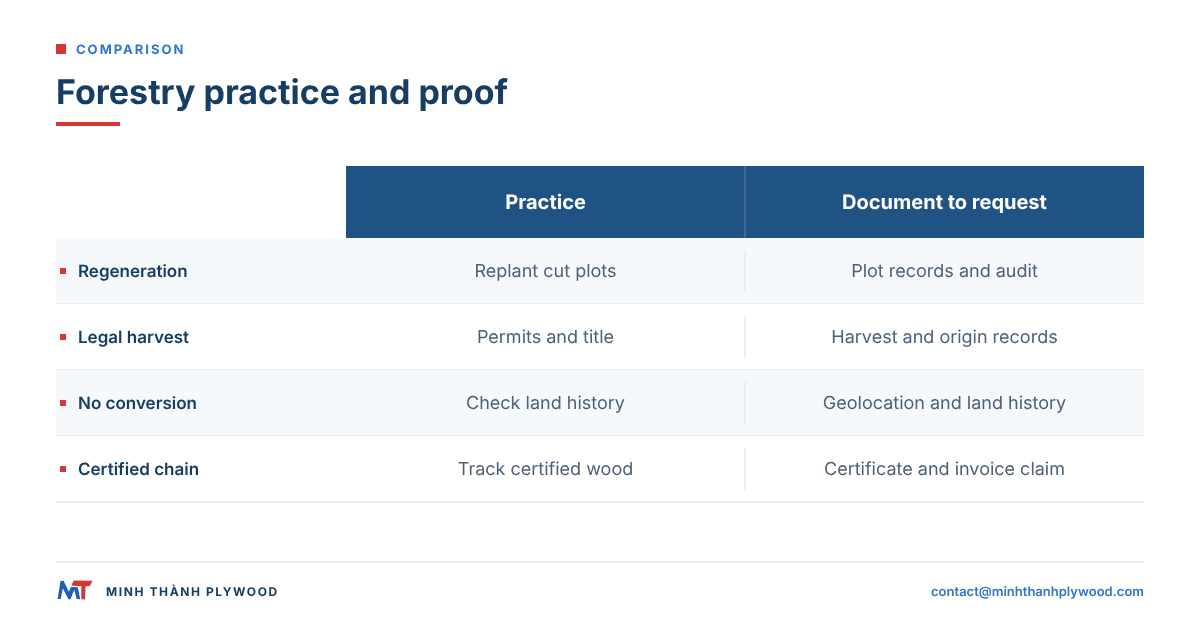
Each sustainable forestry practice leaves a record, and a buyer can ask a mill for the record rather than for a promise. The table pairs the practice with the document that proves it.
| Practice | What it means in the forest | Proof a buyer can ask for |
|---|---|---|
| Harvest within growth | Cut no more than the stand grows | Forest management certificate (FSC or PEFC) |
| Replanting after harvest | Every plot replanted or regrowing | Plot records and certificate audit reports |
| No conversion of natural forest | Plantations on land that was not natural forest after 2020 | EUDR geolocation files and land history |
| Legal harvest | Permits, land title, taxes paid | Harvest permits and origin records |
| Traceable chain | Certified wood kept apart through every mill | Chain-of-custody certificate and claim on invoice |
| Local supply | Logs grown near the mill | Origin records by plot and delivery |
Ask for the documents before the first order. A mill that can send them quickly has a working traceability system; a mill that needs weeks probably does not.
How should a buyer check a plywood mill’s forestry claims?
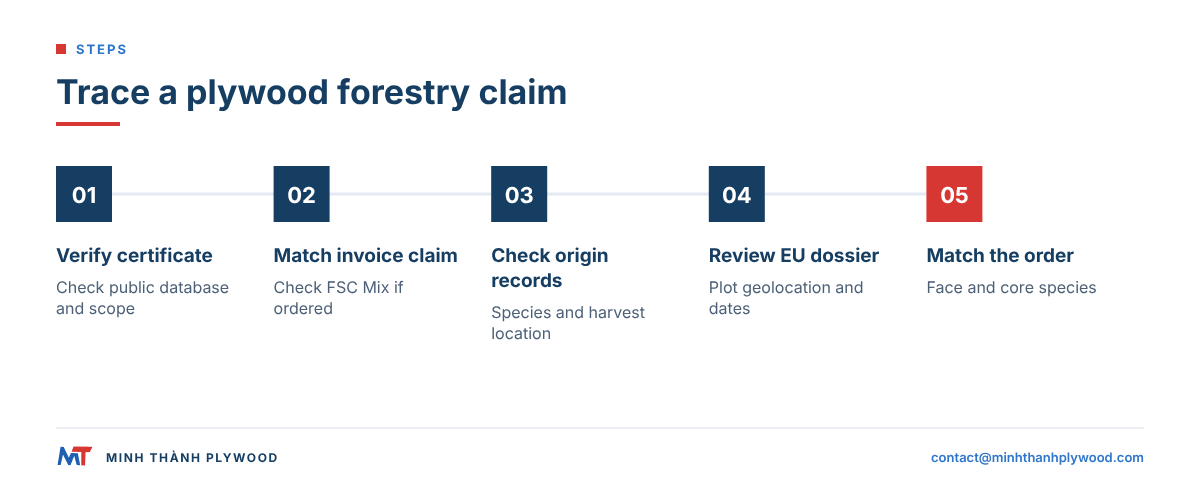
Check a plywood mill’s forestry claims against documents: a valid certificate number you can look up, the claim printed on the invoice, origin records for the logs, and plot geolocation for EU shipments. A green word on a brochure proves nothing; a record does.
- Look up the certificate in the FSC or PEFC public database, and check the product scope covers plywood.
- Check the claim on the proforma and invoice, such as “FSC Mix”.
- Ask for origin records naming the species and where the logs grew.
- For the EU, ask for the EUDR dossier with geolocation files and production dates.
- Match species on the dossier to the faces and core on the order.
Write the claim you need on the order, so the documents are prepared with the shipment rather than after it.
What should you write on a plywood order for forestry proof?
Write the product, the species of faces and core, the forest claim, the origin records and the market on the order. A furniture order from Minh Thanh Plywood for the EU reads like this:
Furniture plywood, 18 mm, 1220 × 2440 mm, poplar faces A/B, Styrax core from Vietnamese plantation wood, UF glue at E0 emission, EUDR compliance dossier with origin records and geolocation files, FSC Mix claim on the invoice if required, one 40HC, CIF destination port.
MOQ is one 40HC, with mixed specifications by agreement. Production takes 15–45 days after the 30% deposit, with the balance against the scanned B/L or by irrevocable L/C at sight.
Our quality and compliance page lists the certificates we hold. Send your specification through the furniture plywood page and we reply within hours.
Buyer questions, answered
What is sustainable forestry?
In practice, sustainable forestry is managing a forest so it keeps its area, growth, soil, water and wildlife over time while it supplies wood. The harvest stays within what the forest regrows, and cut areas are regenerated.
What makes a forest well managed?
A forest lasts when harvest stays below growth, cut land is replanted or regrows, soil and water are protected, wildlife habitat is kept, and the land is managed legally with the rights of local people respected.
What are examples of sustainable forestry?
Examples include smallholder acacia plantations replanted after each harvest, nursery-grown seedlings for Nordic and Baltic birch stands, reduced-impact selective logging in natural forest, and buffer strips left along streams.
Why is sustainable forestry important?
It keeps wood supply going for the next harvest, protects soil, water and wildlife, holds carbon in growing forests, and lets buyers meet laws such as the EU deforestation regulation.
Is plantation wood the same as responsibly grown wood?
Not automatically. Plantation wood comes from planted forests on a rotation; it counts as well managed when the land was not cleared from natural forest and the plantation is run, harvested and replanted to a standard.
What is responsible logging?
Responsible logging is harvesting that the forest can replace: selective, reduced-impact cutting in natural forests, or clear-felling and replanting on a rotation in plantations, with soil and streams protected.
How can a buyer prove plywood comes from well-managed forests?
Ask for an FSC or PEFC claim on the invoice backed by a chain-of-custody certificate, and for origin records with plot geolocation. For the EU, the EUDR dossier carries those records.
What is the EUDR deforestation cut-off date?
The EU deforestation regulation uses 31 December 2020: wood in plywood placed on the EU market must come from land not deforested or degraded after that date.
Does Minh Thanh Plywood supply FSC plywood?
FSC is available, supplied directly or through qualified partner mills. We supply the EUDR compliance dossier, with origin records and geolocation files, with orders.