
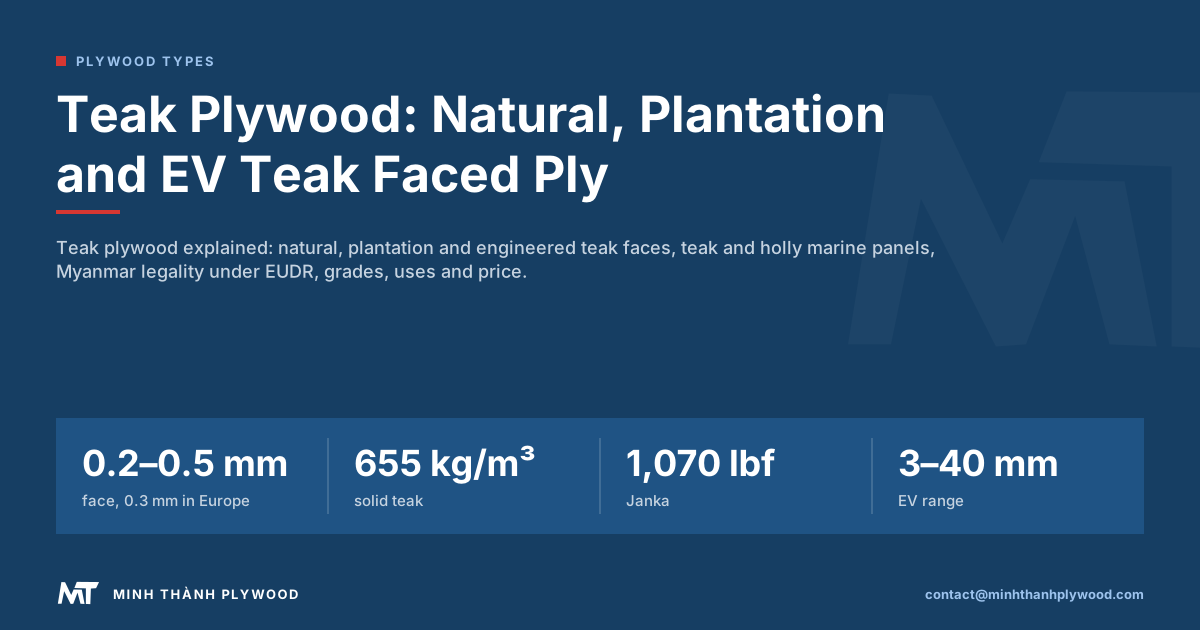
Plywood teak, usually sold as teak plywood or teak ply, is a plywood panel with a thin teak veneer on the face over a core of another species. The face can be natural, plantation or engineered teak, and that choice sets the look, the legality checks and the price. Minh Thanh Plywood makes the engineered teak look in its EV range; this guide explains all three.
What is teak plywood?
Teak plywood is plywood with a thin teak veneer on its face, and often its back, pressed over a core of another species. The core gives the panel its strength, flatness and price; the teak face gives the golden-brown colour and straight grain buyers want.
Three faces are sold as “teak plywood”, and they are very different products:
- Natural teak face: veneer sliced from natural or old-plantation teak logs, Tectona grandis.
- Plantation teak face: veneer from young plantation teak, lighter in colour and more variable.
- Engineered teak face (EV teak): reconstituted veneer made from fast-grown wood, dyed and re-sliced to show a teak pattern.
A specification that says only “teak plywood” leaves the most important choice open. Always name the face type.
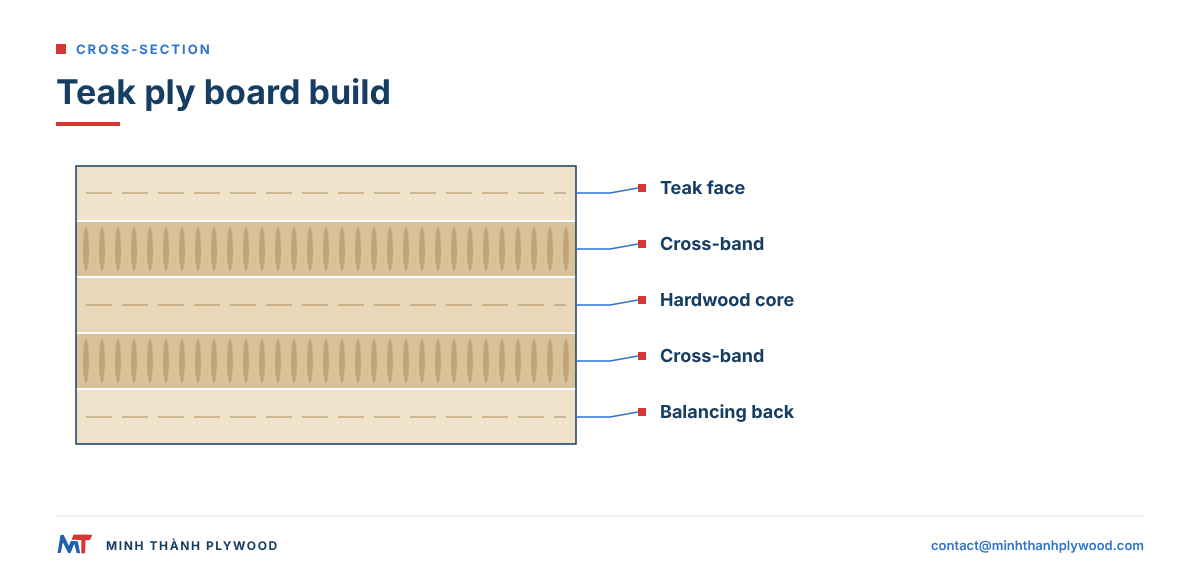
Teak ply board: how the panel is built
A teak ply board is built like any decorative plywood: a cross-laminated core, a teak face and a balancing back. The thin face does not change the panel’s strength much; the core and the glue do.
| Layer | What it is | What it decides |
|---|---|---|
| Face | Teak veneer, natural, plantation or engineered | Look, colour, grade, price |
| Cross-band | Veneer laid across the face grain | Flatness, stops the face telegraphing |
| Core | Hardwood veneers, crossed ply to ply | Strength, weight, screw holding |
| Back | Teak or a cheaper balancing veneer | Keeps the panel flat |
| Glue | UF, melamine-fortified or phenolic | Water resistance and emission |
On a furniture panel, the core is white Styrax or Eucalyptus as standard, with Acacia and Pine cores made on order. An 18 mm panel is usually 11–13 plies.
Teak plywood sizes and thicknesses for Nordic boat and interior use
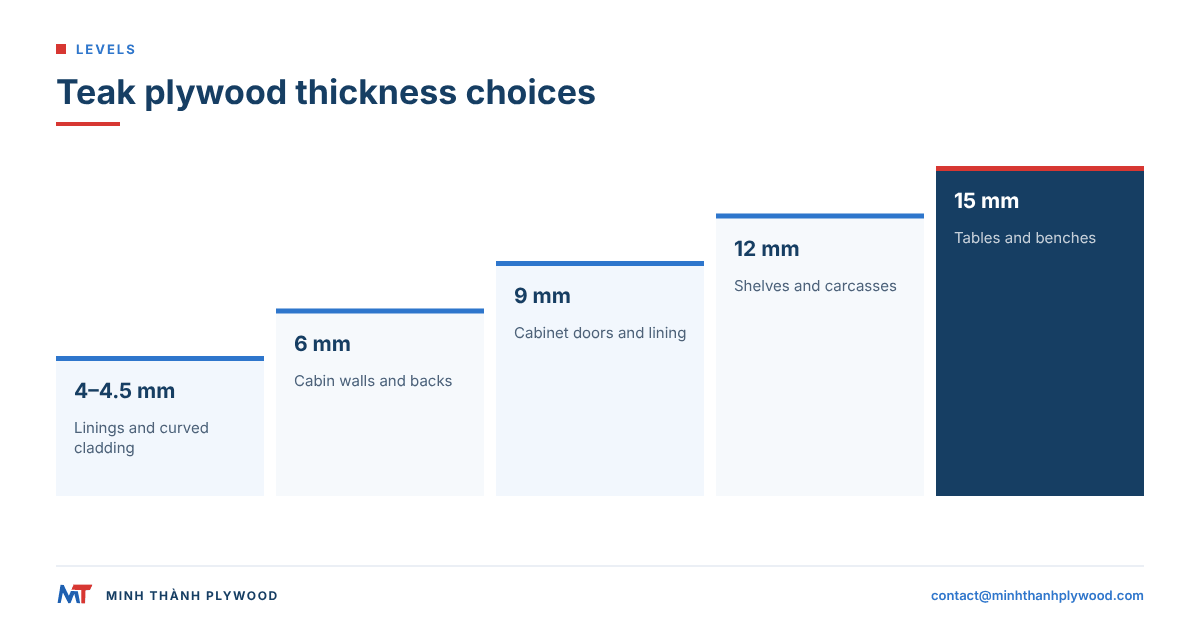
Swedish chandlers and timber merchants sell teak plywood as a stock item in a short list of thicknesses and two sheet formats, and a buyer asking for “plywood teak” in Sweden is usually looking for exactly this list. Isaksadeltra, Hjertmans and Calexico Wood publish it in October 2026:
| Thickness | Faces | Full sheet | Half sheet | Typical use |
|---|---|---|---|---|
| 4 or 4.5 mm | 1-sided teak (4.5 mm) or both faces (4 mm) | 2440 × 1220 mm | 1210 × 605 mm | Linings, drawer bottoms, curved cladding |
| 6 mm | 2-sided | 2440 × 1220 mm | 1210 × 605 mm | Cabin walls, cupboard backs |
| 9 mm | 2-sided | 2440 × 1220 mm | 1210 × 605 mm | Cabinet doors, bulkhead lining |
| 12 mm | 2-sided | 2440 × 1220 mm | 1210 × 605 mm | Shelves, carcasses |
| 15 mm | 2-sided | 2440 × 1220 mm | 1210 × 605 mm | Tables, benches, structural joinery |
Two build details separate the marine-interior panel from a furniture panel. Hjertmans describes its teak plywood as a birch core with a 0.6 mm teak veneer on front and back. A furniture panel from our line carries a thinner face, 0.2–0.5 mm, so the Nordic boat panel has more wood to sand before the core shows. Calexico Wood also sells teak-and-holly sole (durk) plywood in 7.5, 13.5, 16.5 and 19.5 mm at 1220 × 2440 mm, with 45 mm teak strips and 5 mm white or black lines between them.
What a Swedish buyer should know before ordering from a Vietnamese mill:
- Prices at the chandler are quoted per sheet including 25% moms (Swedish VAT), and most sellers cut to size for a start fee. An importer buys by the m³ or the container, ex VAT, and cuts the sheets itself.
- Papers: the timber documents that Swedish buyers ask for are FSC certificates and the EU deforestation file. We supply the EUDR dossier (origin records and geolocation files) with orders.
- Where we fit: interior fit-out, yacht cabinetry above the waterline, wardrobes and wall panels, in container volumes, with an engineered or plantation teak face matched to your approved sample. For hull, deck and wet-area work, order a marine-rated panel (see the marine section below).
Teak ply veneer: how thick is the face?
The teak ply veneer on a plywood face is very thin: decorative face veneers are generally 0.2–0.5 mm, and European furniture buyers usually ask for about 0.3 mm. A thicker face allows more sanding before the core shows; a thinner face is cheaper.
- Sanding: light sanding only; heavy sanding through a thin face exposes the cross-band.
- Finishing: a thin face takes oil, lacquer and UV coatings well when the panel is calibrated.
- Repairs: deep scratches cannot be sanded out as on solid teak.
Thickness tolerance matters as much as face thickness. Our sanded furniture panels are held to ±0.2–0.3 mm, so a finishing line does not sand through the thin teak face at the high spots.
Natural vs plantation vs engineered teak faces
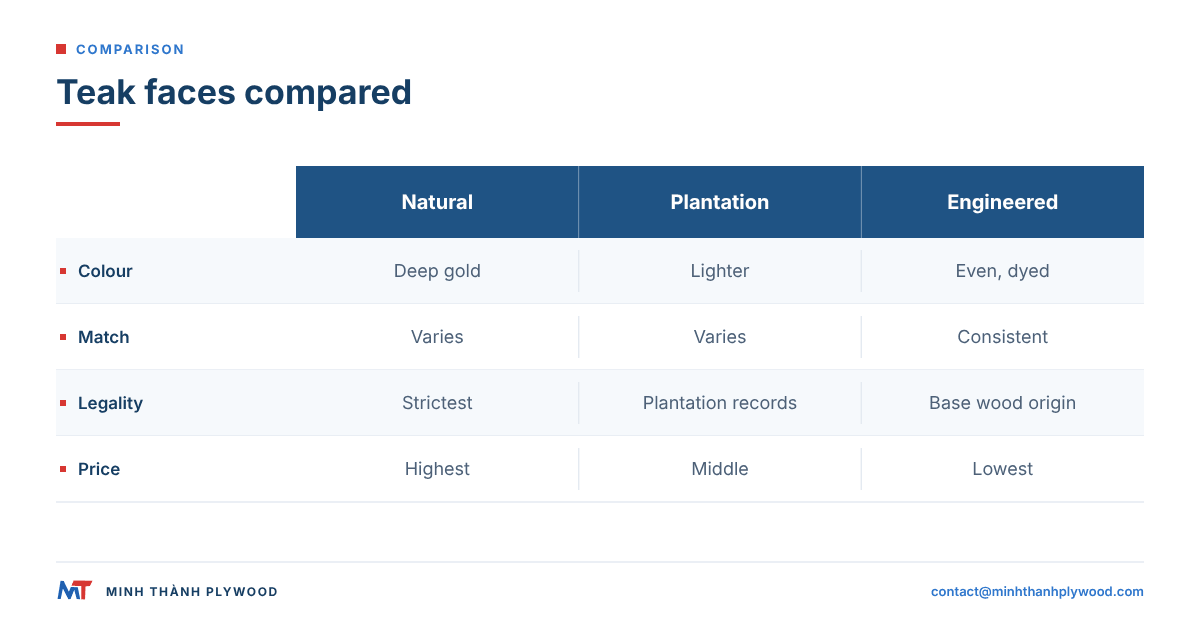
Natural teak gives the richest colour and figure at the highest price and the most sourcing risk; plantation teak is lighter and more variable at a middle price; engineered teak gives a uniform teak look at the lowest price with no teak-origin questions.
| Point | Natural teak face | Plantation teak face | Engineered teak (EV) face |
|---|---|---|---|
| Source | Natural or old-plantation teak logs | Young plantation teak | Fast-grown plantation wood, re-made |
| Colour | Deep golden brown | Lighter, more contrast and sapwood | Set by the dye, even |
| Grain | Natural figure, varies by log | Straighter, wider variation | Repeating teak pattern |
| Sheet-to-sheet match | Varies | Varies | Very consistent |
| Natural oil | Yes | Less | No |
| Legality checks | Strictest | Plantation records | Origin of the base wood |
| Price | Highest | Middle | Lowest |
For flat furniture, wall panels and fit-outs where colour must match across many sheets, engineered teak is the practical choice. For a piece sold on the character of real teak, choose a natural or plantation face and approve a sample.
Teak faced ply from Vietnam: the EV teak look
Our teak faced ply is made in the EV range: engineered veneer with a teak look, pressed on Vietnamese plantation cores. EV (engineered veneer) is one of the faces we produce most, so the teak look is a regular production face, not a special run.
What an EV teak panel from Minh Thanh Plywood gives you:
- Even colour across the order, because the veneer pattern is engineered.
- A sanded, UV-ready face on both sides, to the standard customers need to apply their own UV coating.
- Double pressing as standard on furniture grades: the core board is pressed and calibrated, then face and back are pressed on.
- UF glue at E0 emission for furniture and interior panels.
- Sizes of 1220 × 2440 and 1250 × 2500 mm, and custom sizes such as 1220 × 2500 and 1220 × 2280 mm.
Our EV plywood page lists the build. EV faces are matched to your approved sample, so ask for a teak sample before you fix colour.
Teak wood plywood properties: durability and stability
Teak wood itself is very durable, stable and oily, which is why it is prized for boats and outdoor furniture. In teak wood plywood, those properties belong to the thin face only: the panel’s durability comes from its core and glue.
Figures for solid teak from The Wood Database: average dried density about 655 kg/m³ and Janka hardness 1,070 lbf (4,740 N). The heartwood is rated very durable against decay.
What carries over to plywood:
- Face colour and grain: yes.
- Face resistance to water staining: partly, on a natural teak face with its own oil.
- Rot resistance of the whole panel: no, this comes from the core species and glue.
- Dimensional stability: from cross-lamination, which plywood gives with any face.
So treat teak plywood as a decorative panel. For outdoor and wet uses, the glue line decides survival.
Teak marine plywood and teak and holly panels
Teak marine plywood combines a teak face with a marine-rated build: phenolic (WBP) glue, a durable core and a face that tolerates water. Teak and holly plywood is a decorative version for boat cabin soles, with teak strips divided by thin pale lines.
- Glue: phenolic (WBP), so plies stay bonded in wet conditions.
- Core: a durable, void-free core, often okoume or meranti in marine builds.
- Standard: marine panels are usually specified to BS 1088, the British Standard for marine plywood.
- Teak and holly: the pale lines were holly; modern panels often use other pale woods or synthetic strips.
Minh Thanh Plywood does not sell furniture panels as marine plywood. For boat interiors, specify a marine-rated panel from a marine supplier; our marine plywood buying guide explains what to check.
Myanmar teak, EUDR and legal sourcing
Myanmar is the historic source of natural teak, and under the EU deforestation regulation it is a high-risk country. Commission Implementing Regulation (EU) 2025/1093 lists “Belarus, Democratic People’s Republic of Korea, Myanmar, Russian Federation” as high risk, while Vietnam is listed as low risk (EUR-Lex, Regulation (EU) 2025/1093, read 20 October 2026).
What that means for buyers of teak plywood:
- EUDR scope: Regulation (EU) 2023/1115 covers wood products, plywood included, and requires origin records and plot geolocation (EUR-Lex, Regulation (EU) 2023/1115).
- High-risk origin: teak of Myanmar origin gets no simplified due diligence: full due diligence must show negligible risk, and authorities check 9 % of operators each year.
- US imports: the Lacey Act requires a declaration of species and country of harvest for plywood imports.
- Practical choice: many importers choose plantation teak with plantation records, or engineered teak, to remove the risk.
For our panels, we supply the EUDR compliance dossier (origin records and geolocation files) with orders, and for US orders the face and core species and Vietnamese harvest origin for the Lacey Act declaration.
Fixing, edges, fire and care of teak plywood
A teak-faced panel is fixed, edged and finished like any decorative plywood, with a few teak-specific rules. Calexico Wood covers the same points on its Swedish page (edges, fastening, fire, surface treatment and maintenance), so a buyer comparing offers will look for them.
- Edges: the cut edge shows the cross-laminated core. Cover it with a teak edge strip, a solid teak lipping or iron-on veneer tape, and seal any edge that meets water.
- Fastening: pre-drill for screws, most of all near an edge; the thin face splits if a screw is driven blind. On natural teak, wipe the surface with solvent before gluing, because its natural oil weakens the bond.
- Fire: wood-based panels of 9 mm and more, at 400 kg/m³ density or above, fall in Euroclass D-s2,d0 without testing under Commission Decision 2007/348/EC. Teak veneer does not change the class, but a fire-retardant core does.
- Surface treatment: oil gives the natural teak colour and needs more care; lacquer or UV varnish gives a closed face and less upkeep.
- Maintenance: inspect the finish on exposed or boat-interior panels and re-coat when it dulls, before water reaches the veneer.
Teak ply grades and what to inspect
Teak plywood is graded on the face: colour evenness, grain match, knots, splits, patches and joints. Grade names differ by mill, so fix the grade with an approved sample rather than a letter alone.
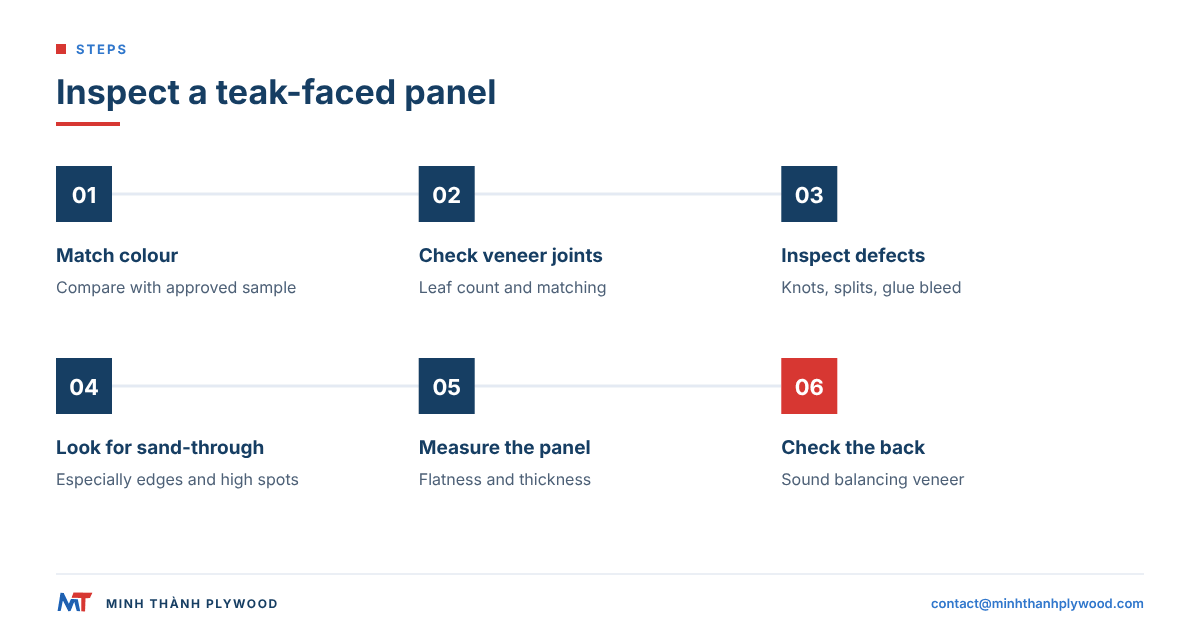
Check these points on a teak ply delivery:
- Colour match across sheets in a pack and against the approved sample.
- Face joints: number of leaves and how they are matched.
- Defects: open knots, splits, glue bleed, sanding marks.
- Sand-through at edges or high spots.
- Flatness and thickness against the tolerance on the order.
- Back quality: balancing veneer sound and flat.
Our EV faces are matched to the buyer’s approved sample, and every shipment is photographed and filmed before loading, with the photos and video sent to the buyer.
Teak plywood vs solid teak and teak veneer
Teak plywood gives the teak look on a large, flat, stable panel at a fraction of the weight and cost of solid teak. Solid teak gives full-thickness wood that can be planed, carved and used outdoors. Teak veneer on its own is the thin face sheet a workshop presses onto its own board.
| Point | Teak plywood | Solid teak | Teak veneer sheet |
|---|---|---|---|
| Form | Finished panel, 1220 × 2440 mm | Boards and beams | Thin leaves to press yourself |
| Teak content | Face only | All | All, but only a fraction of a millimetre |
| Flatness over large areas | Stable, cross-laminated | Moves with humidity | Depends on the board it is pressed onto |
| Outdoor use | Only with marine glue and build | Yes, very durable | No, until pressed and sealed |
| Repairs | Light sanding only | Plane and re-finish | Not applicable |
| Weight per area | Set by the core | Heavy | Negligible |
| Cost | Low to medium | High | Low, plus pressing cost |
So the difference between teak plywood and teak veneer is the step of pressing: veneer is the raw face, plywood is the finished panel. Most furniture and fit-out makers buy teak plywood ready-pressed, because a calibrated, double-pressed panel gives a flatter face than pressing veneer in a small workshop press.
Teak ply vs veneer ply: what the names mean
Teak ply is one kind of veneer ply: plywood whose decorative face is teak. Veneer ply is the general name, used especially in India and the Middle East, for any plywood with a decorative hardwood face, such as oak, ash, walnut, sapele or teak.
- Commercial ply: plain face, for painting, laminating or hidden use.
- Veneer ply: decorative face veneer, finished with polish or lacquer.
- Teak ply: veneer ply with a teak face, natural, plantation or engineered.
- Laminate-faced board: printed paper or HPL face; not a wood veneer.
When a quotation says “veneer ply” without a species, ask which face is meant. Our guide to the best plywood for furniture shows which faces suit each furniture part.
Teak plywood uses
Teak plywood is used where the teak look is wanted on large, flat, stable areas at a fraction of the cost and weight of solid teak. Typical uses:
| Use | Usual face | Note |
|---|---|---|
| Wardrobes and cabinets | EV or plantation teak | Colour match across doors |
| Wall panels and ceilings | EV teak, 3–9 mm | Light, even colour |
| Doors and door skins | EV or natural teak | Thin faced panels |
| Hotel and office fit-outs | EV teak | Repeat orders match |
| Yacht and boat interiors | Natural teak, marine build | Phenolic glue, marine rating |
| Furniture and tables | Natural or plantation teak | Approve a sample |
For thin wall panels and door skins, our thin plywood is made in 3–6 mm; 3–5 mm is always 5-ply.
Teakwood plywood price: what drives it
Teakwood plywood price is driven mainly by the face: natural teak costs most, plantation teak less, engineered teak least. Core, glue, thickness, sanding and quantity make up the rest.
- Face type and grade: natural, plantation or EV; leaf match and colour selection.
- Face thickness: about 0.3 mm is the European norm.
- Core species: white Styrax, Eucalyptus or Acacia.
- Glue: UF glue at E0 emission for interiors; phenolic for wet use.
- Thickness and size: 3–40 mm, 1220 × 2440 or 1250 × 2500 mm.
- Order size: from one 40HC, with mixed specifications by agreement.
As of October 2026, our furniture and interior plywood starts from US$350/m³; the final price depends on face, core, glue, thickness, size, quantity and delivery term.
When EV teak is the honest substitute
EV teak is the honest substitute when the buyer needs the teak look, colour consistency and a clean legal file, not the natural oils and figure of real teak. Say so on your own product labels: call it teak-look or engineered teak veneer, not solid teak.
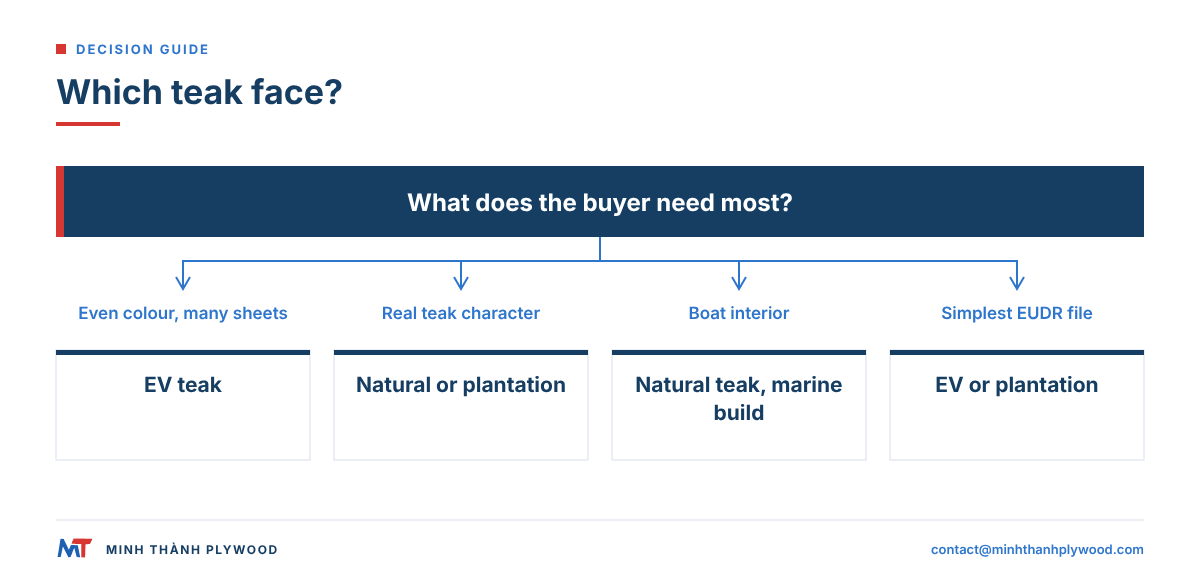
| Need | Best face |
|---|---|
| Even teak colour across hundreds of sheets | EV teak |
| Lowest cost with a teak look | EV teak |
| Character grain sold as real teak | Natural or plantation teak |
| Water-exposed boat interior | Natural teak, marine build |
| Simplest EUDR file | EV teak or plantation teak with records |
Our guide to the types of plywood places EV-faced panels in the wider range of faces.
What this means for your order
Name the teak face type first, then the core, glue and finish. Send these lines with your request:
- Application: cabinets, wall panels, doors, fit-out or furniture.
- Face: EV teak look, matched to your approved sample; back face to suit.
- Core: white Styrax or Eucalyptus as standard; Acacia or Pine on order.
- Glue and emission: UF glue at E0 emission; CARB P2 / TSCA Title VI labels for US orders.
- Size and thickness: 1220 × 2440 or 1250 × 2500 mm, 3–40 mm, sanded to ±0.2–0.3 mm.
- Packing and quantity: from one 40HC, mixed specifications by agreement.
Production takes 15–45 days after the 30% deposit, and free samples are available. For a plain commercial build under a painted or laminated finish, see our commercial plywood.
Buyer questions, answered
What is teak plywood?
Teak plywood is plywood with a thin teak veneer glued to the face, and often the back, over a core of another wood. The core gives strength and flatness; the teak face gives the colour and grain.
What is the difference between teak ply and veneer ply?
Teak ply is one kind of veneer ply: plywood whose decorative face is teak. Veneer ply is the wider family of plywood with any decorative veneer face, such as oak, walnut, ash or teak.
What is the difference between teak plywood and teak veneer?
Teak veneer is a thin sheet of teak, a fraction of a millimetre thick, sold on its own for pressing onto a board. Teak plywood is a finished panel that already has teak veneer pressed onto a plywood core.
Is teak plywood waterproof?
The teak face resists water well, but the panel is only as water-resistant as its glue and core. For boats and wet areas, specify phenolic (WBP) glue and a marine-rated build; a furniture teak panel with interior glue is for indoor use.
Is teak plywood good for furniture?
Yes. Teak-faced plywood gives the warm teak look on flat, stable panels for cabinets, wall panels, doors and furniture, at far less cost and weight than solid teak.
What is engineered teak veneer?
Engineered teak, sold as EV or recon teak, is veneer made from fast-grown plantation wood that is peeled, dyed, glued into a block and sliced again to reproduce teak grain. It looks consistent from sheet to sheet and avoids the sourcing issues of natural teak.
What is teak and holly plywood?
Teak and holly plywood is a marine-style panel with teak strips separated by thin pale lines, traditionally holly, used for boat cabin soles and yacht interiors. It is a decorative marine panel, not a general furniture board.
Can I import Myanmar teak plywood into the EU?
Myanmar is listed as a high-risk country under the EU deforestation regulation's country benchmarking, so teak of Myanmar origin gets no simplified due diligence: full due diligence must show negligible risk, and authorities check 9 % of operators each year. Many buyers choose plantation or engineered teak to avoid the risk.
Why is natural teak plywood expensive?
Natural teak is a slow-growing, high-demand timber with limited legal supply, and its best logs come from old trees. Plantation teak costs less, and engineered teak costs least while giving an even teak look.
What thickness does teak plywood come in?
Teak-faced plywood is made in the same thicknesses as other furniture plywood, commonly from 3 mm for wall lining to 18 mm and more for carcasses and doors. Our EV-faced panels run from 3 to 40 mm.