
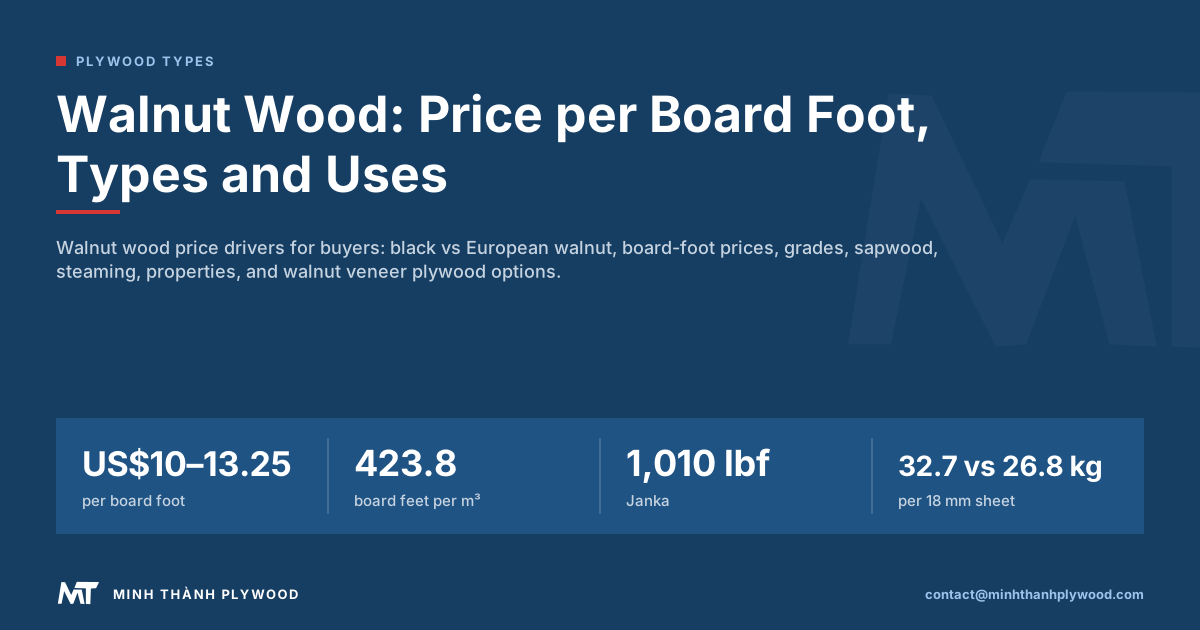
Walnut wood is a dark, fine-grained hardwood, mostly American black walnut, and one of the most expensive furniture woods: 4/4 FAS black walnut traded at about US$10–13.25 per board foot in early 2026. Width, grade, sapwood and thickness move that price. Minh Thanh Plywood, a Vietnamese furniture plywood mill, explains each driver and the cheaper walnut-faced panel options.
What is walnut wood?
Walnut wood is the timber of trees in the genus Juglans, the same trees that give walnuts. Two species dominate furniture: American black walnut (Juglans nigra) and European walnut (Juglans regia), also sold as English, French or Circassian walnut.
Walnut is prized for its deep brown heartwood, fine texture and easy working. It is a premium species: in most markets it costs more per cubic metre than oak, maple or cherry. That is why buyers who want the walnut look on large surfaces usually choose walnut veneer on a stable core, not solid boards.
This guide covers walnut wood types, walnut wood properties, what drives the price per board foot, and the panel options for a walnut look.
How much does walnut cost per board foot?
In early 2026, 4/4 FAS black walnut lumber traded at about US$10–13.25 per board foot in the US trade, and suppliers described the price as very steady (Woodshop News, “Black walnut sales stay steady”, February 2026, read 20 October 2026). Retail yards add their margin, and wide, thick or figured boards sell well above that band.
A board foot is a volume: 12 × 12 inches by one inch thick, or 144 cubic inches. One cubic metre equals about 423.8 board feet, so walnut at US$10–13.25 per board foot is roughly US$4,240–5,620 per cubic metre of rough lumber before waste. That is more than ten times the starting price of a furniture plywood panel.
Walnut board foot price is quoted on rough, kiln-dried lumber by grade and thickness. Planing, straight-line ripping and sapwood removal all reduce the usable volume, so the cost of the finished part is higher than the board-foot figure suggests.
Buying walnut timber in the UK: formats, sizes and price per m³
UK merchants sell American black walnut sawn at about £5,500 per m³ (ex-VAT, 76.2 mm random-width boards), which is roughly £156 per cubic foot, and home-grown walnut from around £4,000 per m³ (indicative, 2026). The US lumber price above, US$4,240–5,620 per m³ rough, is the same trade seen from the mill; UK planed and cut-to-size boards cost more because the merchant carries freight, drying and cutting waste.
| UK walnut format | Typical size | Use |
|---|---|---|
| Sawn American black walnut, random width | 76.2 mm thick (3 in) stock; £5,500 per m³ ex-VAT | Joinery, furniture makers |
| Planed all round (PAR) American black walnut, cut to size | Cut to length and width from planed boards | Shelves, worktops, small parts |
| American black walnut, cut-to-order merchant | Stocks up to 3,600 mm long; internal use only | Furniture, sanded to a fine finish |
| English walnut, kiln-dried, London-grown | £4,000 per m³ ex-VAT | Furniture, limited urban supply |
| English walnut waney-edge boards | 20 to 80 mm thick, up to 940 mm wide, up to 4.3 m long | Tables, benches, slabs |
Sources: Direct Line Timber, American black walnut 76.2 mm random, Fallen & Felled, walnut wood, Wood Cut To Order, walnut, English Woodlands Timber, walnut, Planed Oak, planed American black walnut, checked on 21 October 2026.
Conversion: £5,500 ÷ 35.3 cubic feet per m³ = £156.
English walnut vs American black walnut. English walnut is European walnut (Juglans regia) grown in Britain: lighter, greyer brown, more figured and sold in short supply as waney-edge boards and slabs. American black walnut is darker, more uniform and sold in long straight boards. Both are for internal use only; neither lasts outdoors.
For UK buyers who want the walnut look in volume, a walnut-veneer panel on a light core is the alternative to paying per cubic metre of solid timber. Our walnut veneer plywood pitch is below.
What drives the price of walnut timber?
Grade, thickness, width, length, sapwood, steaming, figure and origin move walnut timber prices. The table gives the direction of each driver for the same species.
| Price driver | Lower price | Higher price | Why |
|---|---|---|---|
| Grade | #1 Common, #2 Common | FAS, FAS one face (F1F) | Clear yield per board |
| Thickness | 4/4 (about one inch) | 8/4 and thicker | Fewer thick logs, longer drying |
| Width | Narrow, random widths | Wide boards, 8 inches and up | Walnut logs are often small |
| Length | Short lengths | Long, clear lengths | Walnut trees branch low |
| Sapwood | Steamed or sapwood allowed | Unsteamed heartwood, sap-free | Waste when sapwood is cut away |
| Figure | Plain, straight grain | Curl, crotch, burl, claro | Rarity and veneer demand |
| Species | Black walnut | European walnut | Scarcity, mostly sold as veneer |
| Form | Rough lumber | Surfaced, slabs, live edge | Labour and selection |
Woodshop News also reported a Midwest mill pricing premium walnut at about US$14 per board foot against a standard FAS grade around US$8.50 (Woodshop News, “Buyers, sellers put a premium on walnut”, read 20 October 2026). The spread between grades is often larger than the year-to-year change.
Black walnut wood vs European walnut
Black walnut wood is darker, more uniform and far more available; European walnut is lighter, more figured, harder and scarcer. Most walnut lumber traded worldwide is American black walnut.
| Property | Black walnut (Juglans nigra) | European walnut (Juglans regia) |
|---|---|---|
| Native range | Eastern United States | South-east Europe to Asia, planted across Europe |
| Heartwood colour | Chocolate brown, sometimes purplish | Lighter grey-brown, darker streaks |
| Average dried density | 610 kg/m³ | 640 kg/m³ |
| Janka hardness | 1,010 lbf | 1,220 lbf |
| Modulus of rupture | 100.7 MPa | 111.5 MPa |
| Availability | Widely available as lumber | Scarce, often only as veneer |
Sources: The Wood Database, Black Walnut and English Walnut, read 20 October 2026.
Claro walnut (Juglans hindsii and its hybrids) from California is a third option, known for strong figure and used mainly for veneer, slabs and gunstocks.
Walnut wood properties: hardness, density and stability
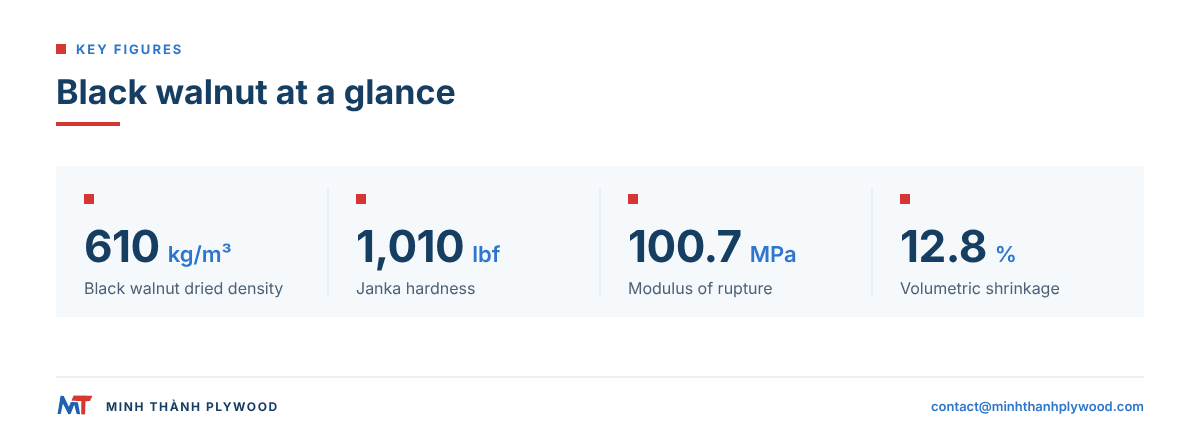
Walnut wood properties sit in the middle of the furniture hardwoods: medium density, medium hardness, good strength and good stability once dry. Black walnut at about 12 % moisture content averages:
- Density: 610 kg/m³ dried.
- Janka hardness: 1,010 lbf (4,490 N), harder than cherry at 950 lbf, softer than red oak.
- Modulus of rupture: 100.7 MPa; modulus of elasticity 11.59 GPa.
- Crushing strength: 52.3 MPa.
- Shrinkage: 5.5 % radial, 7.8 % tangential, 12.8 % volumetric, a low ratio that keeps boards fairly stable.
- Decay resistance: heartwood rated very durable; the sapwood is not.
Source: The Wood Database, Black Walnut, read 20 October 2026.
Walnut steam-bends well, glues well and finishes to a deep lustre. Its semi-ring-porous structure, with pores getting smaller through each growth ring, is what separates real black walnut from imported lookalikes under a hand lens.
Walnut sapwood, steaming and colour
Walnut sapwood is the pale, almost white outer band of the log, and it is the main source of waste and price difference in walnut lumber. A walnut log can carry a wide band of it, and US grading rules count sapwood as sound wood, so even FAS boards may show it.
There are three ways to deal with it:
- Cut it away: keeps the colour pure but raises the cost of every finished part.
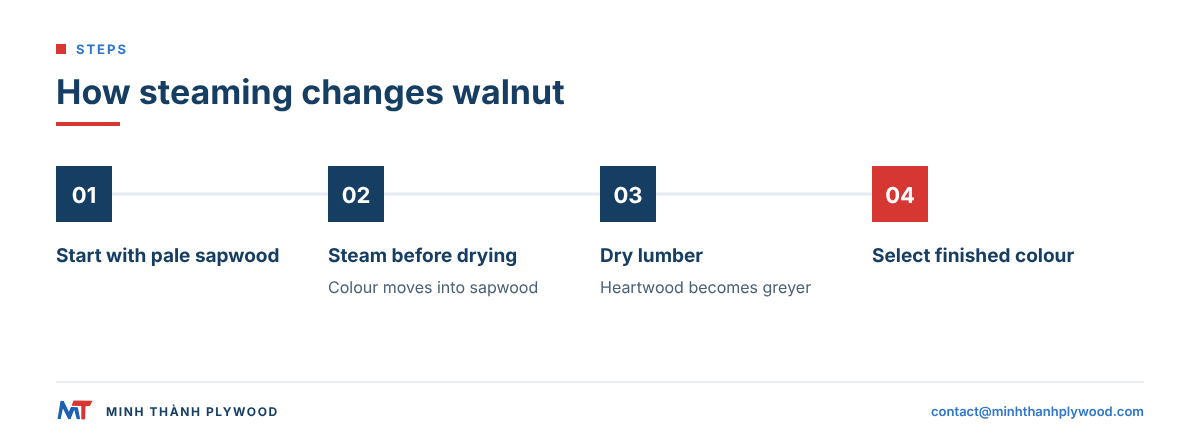
- Steam the lumber: steaming before drying moves colour from the heartwood into the sapwood, giving a more even board; the heartwood turns slightly greyer.
- Use it: sapwood streaks are a design feature in live-edge tables and rustic furniture.
Unsteamed, sap-free walnut costs the most. For panels, the question disappears: a walnut veneer face is selected leaf by leaf for colour, and an engineered walnut face has no sapwood at all.
Walnut timber grades and sizes
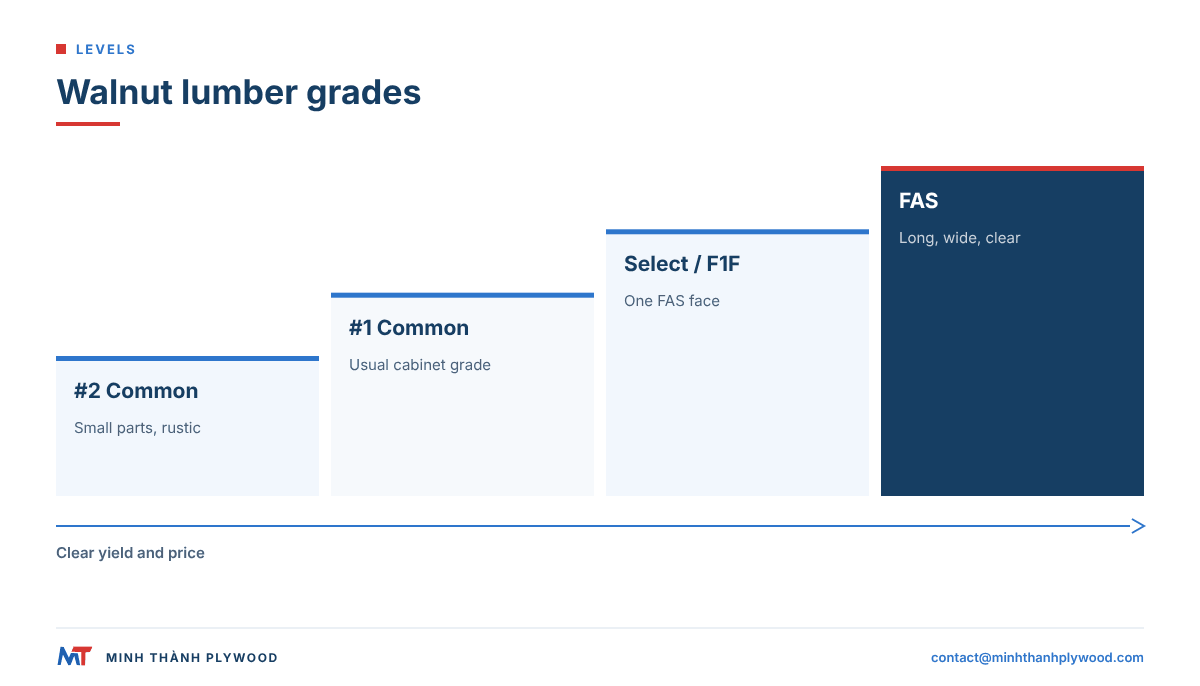
Walnut timber is graded under the NHLA rules in North America, with a few walnut-specific allowances. The main grades are FAS, FAS one face (F1F), Select, #1 Common and #2 Common.
- FAS: the best grade, long and wide boards with a high clear yield.
- F1F and Select: one face at FAS quality, the other at #1 Common.
- #1 Common: shorter clear cuttings, the usual cabinet grade.
- #2 Common: more defects and sapwood, used for small parts and rustic work.
Walnut thicknesses run 4/4, 5/4, 6/4, 8/4 and up; 4/4 dominates the trade. Widths are random and often narrower than oak, because walnut trees are smaller. European walnut is sold by the sawmill’s own grades, often as whole logs sawn through and stacked in sequence (boules), so the figure can be matched.
Walnut veneer plywood: the walnut look at panel prices
Walnut veneer plywood is a plywood panel faced with a thin walnut veneer, typically 0.2–0.5 mm thick. One cubic metre of walnut log sliced into veneer covers far more furniture surface than the same log sawn into boards, so a walnut-faced panel costs a fraction of solid walnut per square metre.
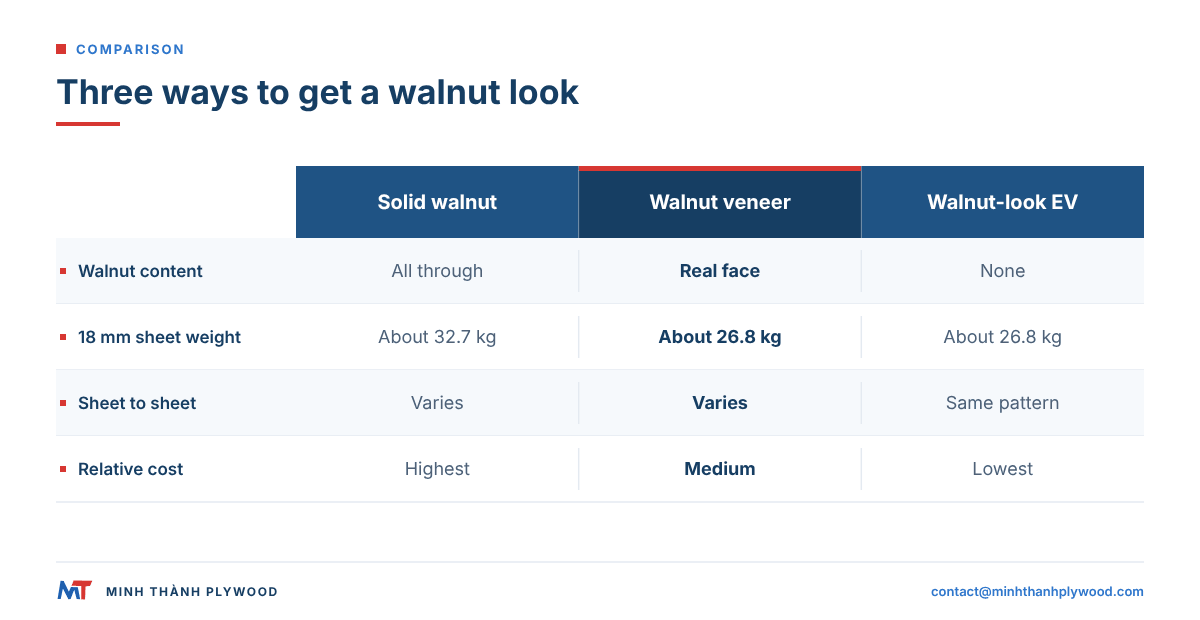
| Point | Solid black walnut | Walnut veneer plywood | Walnut-look EV plywood |
|---|---|---|---|
| Walnut content | All through | Real walnut face | No walnut: dyed, recomposed veneer |
| Look | Varies board to board | Natural, varies leaf to leaf | Same pattern sheet to sheet |
| Width | Glued-up boards | Full 1220 × 2440 mm sheet | Full 1220 × 2440 mm sheet |
| Weight, 1220 × 2440 × 18 mm | About 32.7 kg at 610 kg/m³ | About 26.8 kg on Styrax core | About 26.8 kg on Styrax core |
| Movement | 12.8 % volumetric shrinkage | Low, cross-laminated | Low, cross-laminated |
| Relative cost | Highest | Medium | Lowest of the three |
Weights are calculated: 1.22 m × 2.44 m × 0.018 m = 0.0535824 m³, times the density.
How much is a sheet of walnut plywood? It depends on the face grade, the core, the thickness and the order size, which is why mills quote it per build. Minh Thanh’s indicative starting price for furniture and interior plywood is from US$350/m³ (October 2026); natural walnut faces are quoted on top of the build. More detail is in our guide to walnut plywood price.
Engineered walnut veneer (EV): when it beats natural walnut
Engineered veneer (EV) is made from plantation veneers that are dyed, glued into a block and sliced again to reproduce a walnut grain. It gives the walnut look at the lowest price and with the best sheet-to-sheet match.
Choose EV walnut for long runs of matching parts: hotel rooms, office furniture, retail fit-outs and flat-pack lines, where every door must look alike. Choose natural walnut for high-end pieces where the variation is the point. EV is the face Minh Thanh produces most, on stitched Styrax or Eucalyptus cores; see EV plywood for the builds. Compare with birch-faced panels in walnut plywood vs birch.
What is walnut wood used for?
Walnut wood is used for fine furniture, cabinets, interior panelling, gunstocks, musical instruments, turned bowls and veneer. Its dark colour makes it the reference species for high-end interiors.
- Furniture: dining tables, chairs, sideboards, beds, desks.
- Cabinetry and kitchens: doors and panels, often walnut veneer on plywood.
- Interiors: wall panels, ceilings, doors, hotel and office fit-out.
- Gunstocks: the classic stock wood, for its strength and shock absorption.
- Instruments: guitar backs and sides, piano cases.
- Turnery and small items: bowls, boxes, handles.
- Veneer: the highest-value logs are sliced for face veneer.
Walnut nut-shells are a separate product, used as blasting media, and not timber.
How to finish walnut and walnut plywood
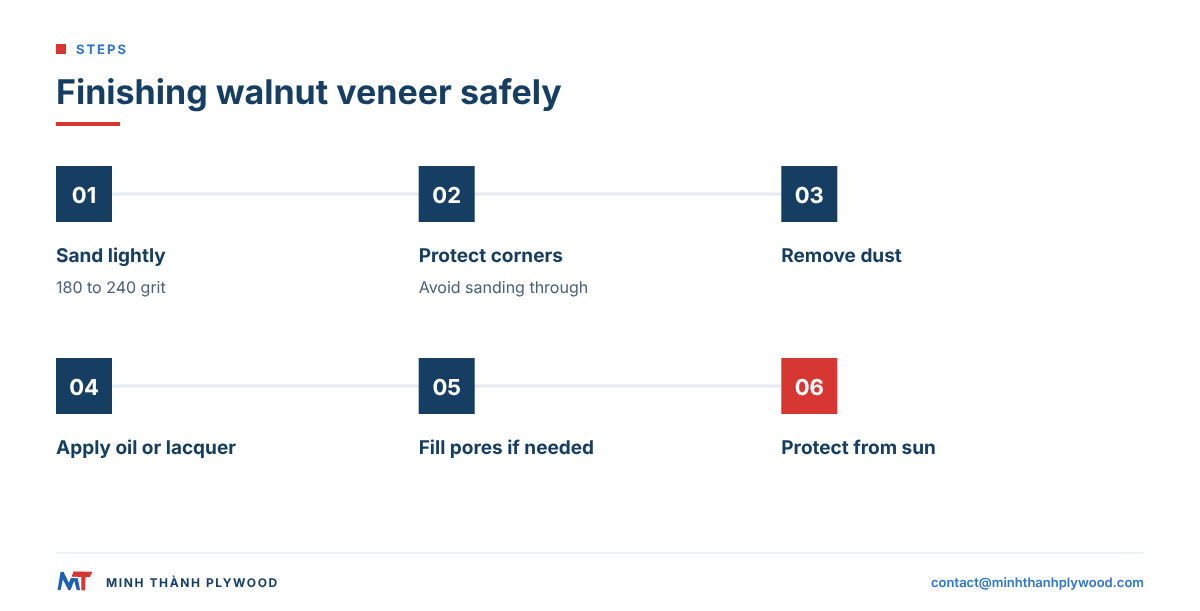
Walnut finishes beautifully with oil, hardwax oil or clear lacquer, and needs no stain. On walnut plywood, the rule is to sand lightly, because the face is thin.
- Sand lightly: 180 to 240 grit by hand or orbital sander; never use coarse grit on a veneer face.
- Watch the edges: sand-through shows first at panel edges and corners.
- Remove dust: vacuum and tack-cloth, since walnut dust settles in pores.
- Oil or lacquer: oil deepens the colour; water-based lacquer keeps it lighter.
- Fill pores if needed: for a mirror finish, use a dark pore filler.
- Protect from sun: walnut lightens toward a warm honey tone in strong light over time.
A double-pressed panel with a sanded, flat face takes finish evenly. Minh Thanh sands furniture panels to ±0.2–0.3 mm thickness tolerance, which keeps the thin face flat across the sheet.
Walnut vs oak vs cherry: which furniture wood?
Walnut is the darkest and most expensive of the three, oak the hardest and most versatile, cherry the softest in tone and quickest to change colour. Choose by colour first, then by budget.
- Walnut: dark brown, refined grain; premium price; very stable.
- Oak: light to medium brown, strong grain; mid price; hardest of the three.
- Cherry: reddish-brown that darkens with age; mid-to-high price; fine texture.
For more species side by side, see wood species compared, and the guide to oak wood.
Supply, CITES and paperwork for walnut
Black walnut is not listed in the CITES appendices, and the IUCN classifies it as of least concern, so it can be traded without CITES permits (The Wood Database, Black Walnut, read 20 October 2026). Normal timber paperwork applies: origin, species and phytosanitary documents.
For panels sold in the EU, the EU Deforestation Regulation covers plywood and veneer (Regulation (EU) 2023/1115). Its obligations start on 30 December 2026 for large and medium operators and on 30 June 2027 for other micro and small operators (European Commission, EUDR implementation update). We supply the EUDR compliance dossier (origin records and geolocation files) with our orders, and for the US we supply the face and core species and Vietnamese harvest origin for the importer’s Lacey Act declaration.
What this means for your walnut panel order
If you want the walnut look on furniture panels, send the face choice, the core, the glue and the size. A mill can then quote one panel, not a range.
- Face: natural black walnut (crown or quarter cut), European walnut, or walnut-look EV; face/back grades for one or two visible sides.
- Core: Styrax for light weight (about 500 kg/m³) or Eucalyptus (650–750 kg/m³) for harder screw-holding.
- Glue and emission: UF glue at E0 emission. Our panels carry CARB P2 / TSCA Title VI certification (ICTT mill no. 23024); six chamber tests between April 2025 and June 2026 averaged 0.014–0.032 ppm. The limit for veneer-core hardwood plywood is 0.05 ppm under 40 CFR 770.10.
- Thickness and size: 3–40 mm; 1220 × 2440 or 1250 × 2500 mm, or cut-to-size.
- Quantity: from one 40HC; production 15–45 days after the deposit; FOB Hai Phong, CFR or CIF.
Free samples are available. Send the lines to contact@minhthanhplywood.com, read the walnut plywood guide, or compare species in the pillar on types of wood.
Buyer questions, answered
How much does walnut cost per board foot?
In early 2026, 4/4 FAS black walnut lumber traded at about US$10–13.25 per board foot in the US trade, as reported by Woodshop News in February 2026. Retail yards, wide boards, thick stock and figured wood cost more.
Why is walnut wood so expensive?
Black walnut grows slowly, much of each tree is pale sapwood, logs are often short and narrow, and furniture demand is high. Much of the best log volume also goes to veneer and export, which keeps lumber prices up.
What is the difference between black walnut and European walnut?
Black walnut (Juglans nigra) from the eastern US is darker, chocolate brown, and widely traded as lumber. European walnut (Juglans regia) is lighter, greyer brown with more figure, harder, scarcer and often sold only as veneer.
Is walnut a hardwood?
Yes. Walnut comes from broadleaf trees of the genus Juglans. Black walnut scores 1,010 lbf on the Janka test, between cherry and oak.
What is walnut sapwood?
Sapwood is the pale, nearly white outer wood of the walnut log. Lower grades allow a lot of it; buyers either cut it away, steam the lumber to darken it, or use it as a design feature.
How much is a sheet of walnut plywood?
A walnut veneer plywood sheet costs much less than the same area of solid walnut because the walnut face is only 0.2–0.5 mm thick. The price depends on the face grade, core, thickness and quantity, so ask for a quote on your build.
Where can I buy walnut plywood?
From panel distributors and timber merchants, or factory-direct by the container from plywood mills. Minh Thanh Plywood quotes natural walnut faces on request and makes walnut-look engineered veneer (EV) faces in furniture grade.
How do you finish walnut plywood?
Sand lightly with fine grit only, since the face is thin, then use an oil, hardwax oil or clear lacquer to bring out the dark colour. Avoid heavy sanding at the edges, where sand-through shows first.
Is walnut good for furniture?
Yes. Walnut is strong, stable once dry, easy to work and finishes beautifully, which is why it is a top choice for tables, cabinets, chairs and high-end interiors.
Is walnut wood durable outdoors?
Black walnut heartwood is rated very durable against decay, but it is costly and the sapwood is not durable, so it is rarely used outdoors. It is mainly an indoor furniture wood.
What is steamed walnut?
Steamed walnut is lumber that was steamed in a kiln before drying, which darkens the pale sapwood toward the heartwood colour. It gives a more even board at the cost of a slightly duller heartwood tone.