
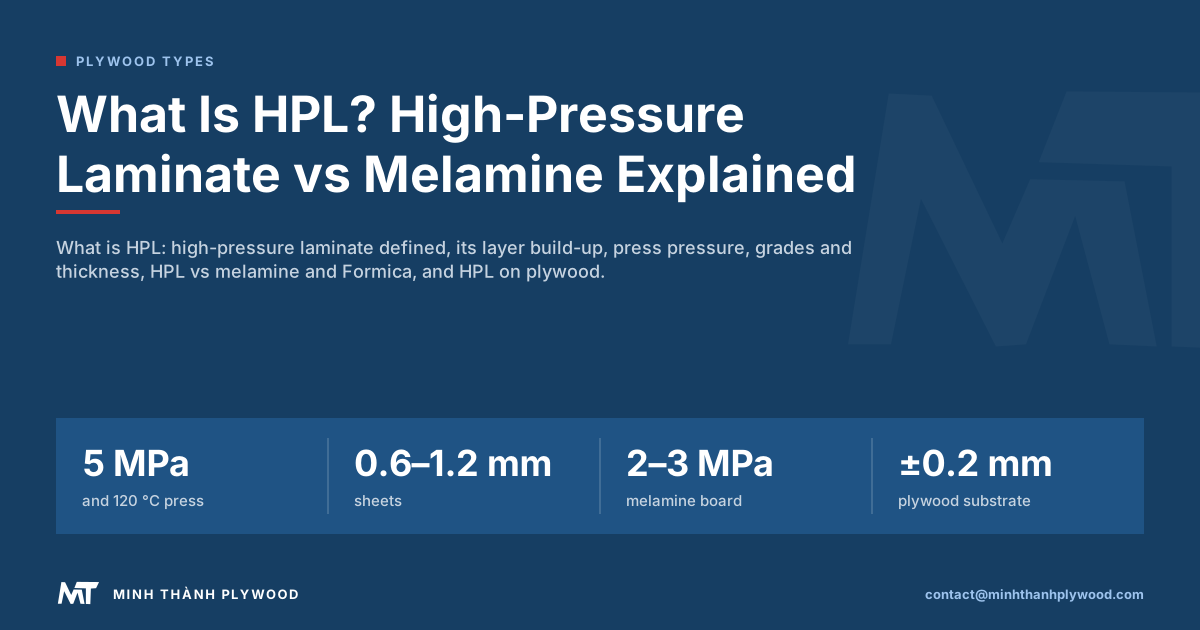
HPL is high-pressure laminate: layers of kraft paper and a printed décor paper, soaked in phenolic and melamine resins and pressed together at about 5 MPa or more and 120 °C or more into a hard sheet, usually 0.6–1.2 mm thick, that is glued onto a board. Minh Thanh Plywood supplies the plywood substrate that HPL is bonded to.
What is HPL? The short answer
HPL, high-pressure laminate, is a hard decorative sheet made by curing layers of resin-soaked paper under heat and high pressure. A typical sheet has a printed décor paper soaked in melamine resin on top of several kraft papers soaked in phenolic resin, pressed at about 5 MPa or more and 120 °C or more until the resins set into one solid layer.
- What it is: a surface sheet, usually 0.6–1.2 mm thick, not a board.
- What it does: gives a board a décor and a wear, scratch and heat-resistant face.
- What it goes on: plywood, particleboard or MDF, bonded with glue in a press.
- What it is called: HPL, HPDL, laminate, Formica, sunmica or mica, by market.
Minh Thanh Plywood makes the plywood substrate under the laminate: sanded, calibrated furniture plywood for workshops that press HPL themselves.
What does HPL stand for, and where does the name come from?
HPL stands for high-pressure laminate; the decorative grade is also written HPDL, high-pressure decorative laminate. The “high pressure” is the press. European standard EN 438 gives typical process values of at least 5 MPa and at least 120 °C (EN 438-1 listing, DIN Media, read 20 October 2026).
Two other names come up in buying:
- Formica: a brand of HPL, invented in 1912–1913 in the United States as an electrical insulator “for mica”; the name became the everyday word for laminate in many countries (Formica history, read 20 October 2026).
- Sunmica and mica: in India and much of the Middle East, laminate sheets are called sunmica or mica, after an early brand and the same mica idea.
Whatever the name on the price list, the buyer is ordering the same product: a thin, pressed resin-paper sheet.
How is high-pressure laminate made? The layer build-up
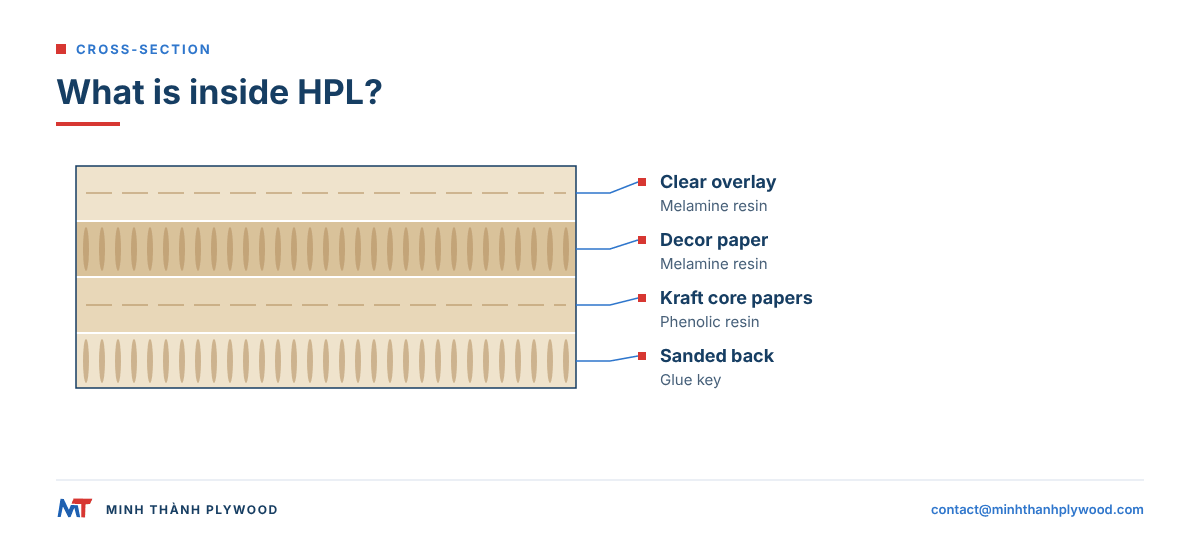
High-pressure laminate is built from three kinds of paper, stacked and cured in one press cycle. Each layer has a job, and the stack decides the thickness and the grade.
| Layer | Material | Job |
|---|---|---|
| Overlay (top) | Clear paper soaked in melamine resin | Wear and scratch resistance over the décor |
| Décor paper | Printed or solid-colour paper in melamine resin | The colour, wood grain or stone pattern |
| Core papers | Several kraft papers soaked in phenolic resin | Body, impact strength and thickness |
| Back | Sanded reverse side | Gives the glue a key on the board |
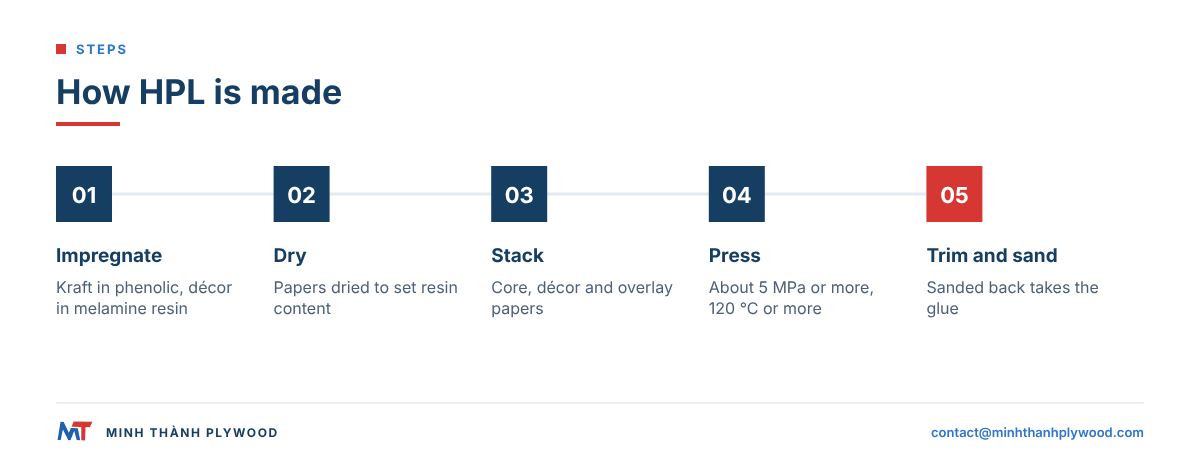
The making follows five steps:
- Impregnate the kraft papers in phenolic resin and the décor and overlay papers in melamine resin.
- Dry the papers to a set resin content.
- Stack the core, décor and overlay papers between press plates; the plate texture gives the finish.
- Press at high pressure and heat until both resins cure into one sheet.
- Trim and sand the back so glue grips it when the sheet is laminated to a board.
More core papers make a thicker sheet; a sheet of 2 mm and over is compact laminate, which stands without a board.
HPL vs LPL and melamine board: press pressure and build
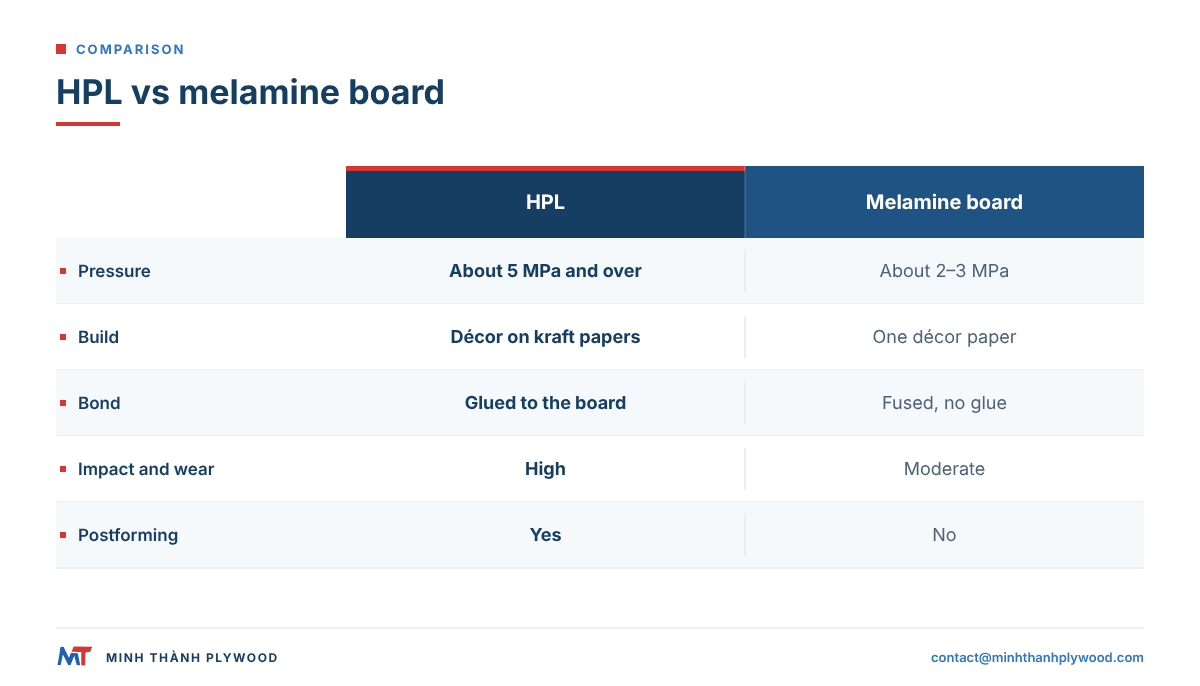
HPL and melamine board (also called low-pressure laminate, LPL, or melamine-faced chipboard) both have a melamine-resin décor face, but they are made differently. HPL is a separate sheet pressed at 5 MPa or more and glued to a board later; melamine board is a décor paper fused straight onto particleboard or MDF in a short press at about 2–3 MPa and 170–190 °C, with no glue line.
| Point | HPL | Melamine board (LPL) |
|---|---|---|
| Press pressure | About 5 MPa and over | About 2–3 MPa |
| Press temperature | 120 °C and over | About 170–190 °C, short cycle |
| Build | Décor paper on several phenolic kraft papers | One décor paper on the board |
| How it reaches the board | Glued on in a second step | Fused on, no glue |
| Face thickness | 0.6–1.2 mm | A single paper layer |
| Impact and wear | High | Moderate |
| Postforming round edges | Yes, with postforming grade | No |
| Cost per m² | Higher | Lower |
Melamine figures: decorative surfaces guide, Polytec, read 20 October 2026. The practical rule: HPL for worktops, desks, doors and anything handled hard; melamine board for carcasses, shelves and backs.
Types of HPL laminates: grades and finishes
HPL laminates are sold in grades by use, then by finish and décor. The grade sets the thickness and the test values; the finish sets the look.
- General-purpose grade: the most widely used HPL, 0.71–1.22 mm (0.028 to 0.048 in), for horizontal and vertical surfaces; the US NEMA grade HGS is a nominal 0.048 in.
- Vertical grade: a thinner sheet for doors, wall panels and cabinet sides; NEMA VGS is a nominal 0.028 in.
- Postforming grade: a sheet that bends around a heated rounded edge, for worktop fronts and tabletops; it is a nominal 1.0 mm (0.039 in, NEMA HGP) sheet and, depending on the maker, forms to a radius as small as about 9.5 mm (3/8 in).
- Fire-retardant grade: for public interiors where a fire class is specified.
- Compact HPL: 2 mm and thicker, self-supporting, for toilet cubicles, lockers and laboratory tops.
- TFL (thermally fused laminate): melamine paper fused to particleboard or MDF in one press, the low-pressure cousin; cheaper than HPL, with less impact and wear resistance.
- Exterior HPL: UV-stable décor and weather-resistant core for façade cladding.
Finishes include matt, gloss, suede, wood-grain embossed and synchronised “in-register” textures, where the texture follows the printed grain. EN 438 and the US standard NEMA LD 3 test wear, impact, scratch, heat and stain resistance by grade; the laminate maker’s data sheet gives the class of each line.
HPL laminate sheets: sizes and thicknesses
HPL laminate sheets for furniture are usually 0.6–1.2 mm thick, and the common format is 1220 × 2440 mm (4 × 8 ft), matching standard plywood. Larger jumbo sheets are made for long worktops.
| Thickness | Typical use |
|---|---|
| 0.6–0.7 mm | Vertical surfaces, doors, wall panels, postforming |
| 0.8 mm | General furniture faces and cabinet doors |
| 1.0 mm | Desks, tables, shop fittings |
| 1.2 mm | Worktops and counters with heavy wear |
| 2 mm and over | Compact laminate, no board needed |
A 1220 × 2440 mm HPL sheet laid on a 1220 × 2440 mm plywood panel is trimmed after pressing, so buyers order the laminate and the board in the same format and the workshop trims the overhang. On 18 mm plywood, two 0.8 mm sheets add about 1.6 mm to the finished part, which the drawing has to allow for.
What is HPL plywood, and when should you laminate HPL on plywood?
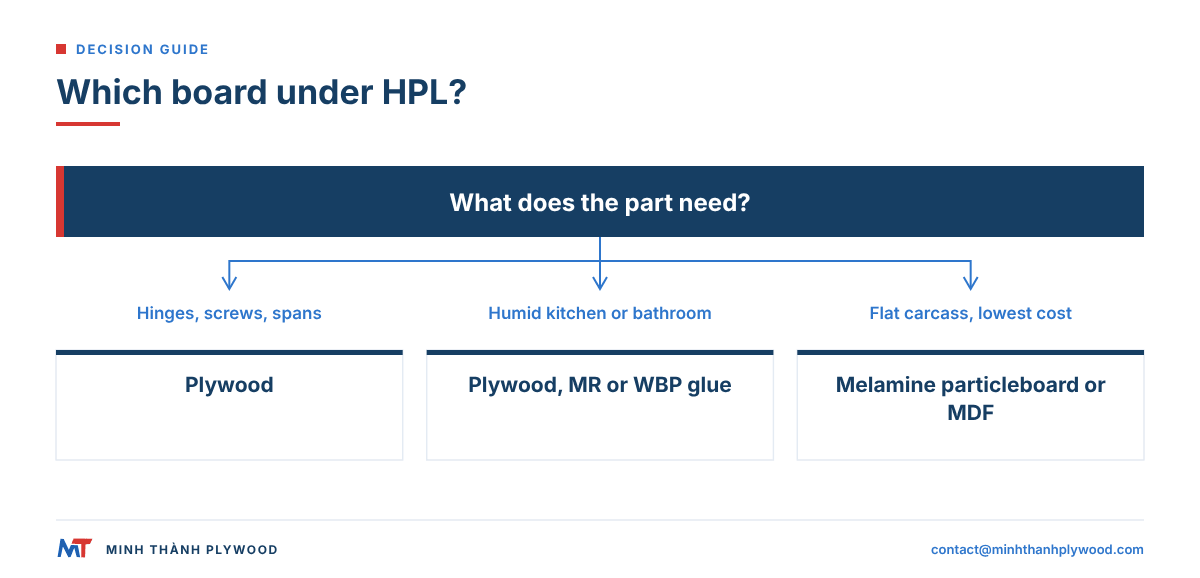
HPL plywood is a plywood panel with HPL glued to one or both faces, pressed in a workshop or a laminating line. Choose plywood under HPL when the part must hold screws and hinges, carry load across a span, stay light, or face humidity; choose particleboard or MDF under melamine when the part is a plain carcass at the lowest cost.
| Need | Board under the laminate |
|---|---|
| Hinge and screw holding near edges | Plywood |
| Long shelves, desks and spans | Plywood |
| Lighter doors and mobile furniture | Plywood on a light core |
| Kitchens and bathrooms with humidity | Plywood with MR or WBP glue |
| Flat carcass sides at lowest cost | Melamine particleboard or MDF |
A white Styrax core plywood is planned at about 500 kg/m³, so an 18 mm sheet of 1220 × 2440 mm weighs about 26.8 kg before laminating; compare it with the actual sheet weight of the MDF or particleboard you would use. For screw holding and spans, our plywood vs MDF guide and particle board vs plywood guide set out the numbers.
What makes a good plywood substrate for HPL?
A good HPL substrate is flat, even in thickness, smooth and free of core gaps, because every flaw in the board shows through a 0.8 mm laminate as a dent, a ridge or a bubble. Four points decide it.
- Thickness tolerance: sanded furniture panels at ±0.2–0.3 mm, down to ±0.2 mm, so the press closes evenly.
- Flat, gap-free core: core layers stitched both horizontally and vertically, so no overlap or gap telegraphs through the face.
- Double pressing: the core board is pressed and calibrated first, then the face and back are pressed on, for a flat panel.
- Moisture: 8–12 % at dispatch, so the board does not shrink under the laminate after pressing.
Minh Thanh furniture panels are made this way as standard, with sanded faces that are UV-ready on both sides, the same smooth face a laminating line needs.
Balanced construction: why HPL needs a backer
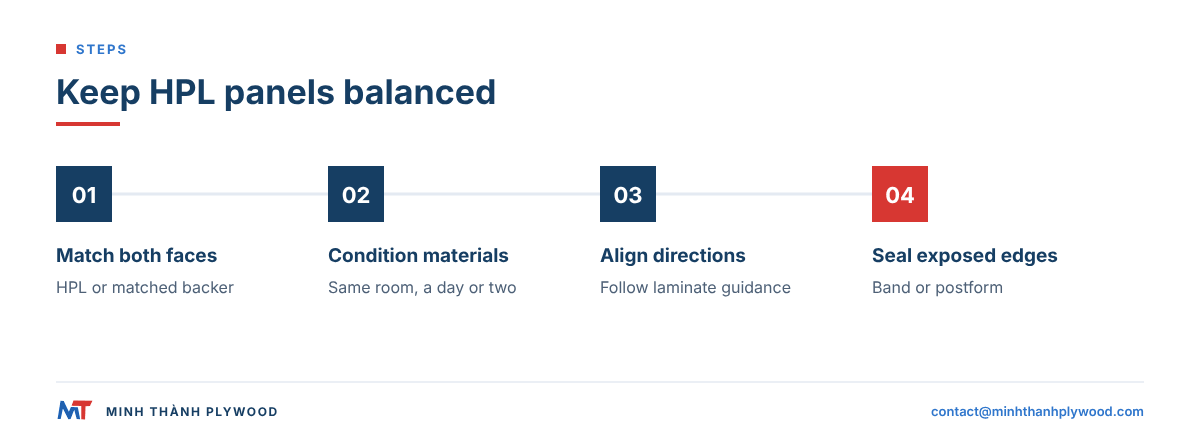
An HPL part needs a laminate or backer sheet on the opposite face, because a laminate on one side moves differently from the wood when humidity changes, and the panel bows toward one face. A backer sheet of similar thickness balances the pull and keeps the part flat.
- Laminate both faces with the same or a matched backer grade.
- Condition the laminate and the plywood in the same room for a day or two before pressing.
- Run grain directions the same way across the décor and the plywood face where the laminate maker advises it.
- Seal exposed edges with edge banding or a postformed edge.
A plywood substrate on a balanced cross-laminated build is itself less prone to bowing than a single board, which is one reason plywood is chosen under HPL for doors.
Is HPL waterproof?
The HPL surface is water-resistant: the cured melamine face does not take up water, and spills wipe off. The part as a whole is only as water-resistant as its board, its edges and its glue line, so wet-area furniture needs a water-resistant core glue and sealed edges.
- Kitchens and bathrooms: HPL on plywood with MR (melamine-fortified) or phenolic WBP glue, all edges banded.
- Dry interiors: HPL on plywood with UF glue at E0 emission.
- Outdoors: exterior-grade HPL or compact HPL only.
Standing water at a cut-out, such as a sink hole, enters the board through the raw edge; seal every cut before fitting.
HPL and formaldehyde: what the plywood under it must meet
The cured HPL sheet is an inert surface, but the laminated part is a composite-wood product, so the board under it carries the emission requirement. In the United States, the hardwood plywood core must meet the CARB Phase 2 / TSCA Title VI limit of 0.05 ppm under 40 CFR 770.10. The EPA’s regulated-stakeholder guidance describes the 0.05 ppm requirement and the treatment of non-exempt laminated products (checked on 8 October 2026). Workshops that cut and fit laminated panels also work to the workplace limit: OSHA standard 1910.1048 sets the permissible exposure limits for formaldehyde in the workplace.
Minh Thanh holds CARB P2 / TSCA Title VI certification (ICTT mill no. 23024), and six ASTM D6007 chamber tests on 9, 15 and 18 mm panels between April 2025 and June 2026 averaged 0.014–0.032 ppm. Third-party testing to the buyer’s method, for example EN 717-1, is arranged through SGS on request.
Where HPL laminates are used
HPL laminates are used wherever a surface takes hands, impact, heat and cleaning every day. The main uses by sector:
- Kitchens: worktops, cabinet doors and splashbacks.
- Offices: desks, meeting tables, storage fronts.
- Retail and hospitality: shop fittings, counters, hotel furniture.
- Healthcare and schools: wall cladding, doors, laboratory tops in compact HPL.
- Transport and marine interiors: panels where weight and wear both count.
- Public buildings: toilet cubicles and lockers in compact HPL.
In furniture made for export, HPL on plywood is common in contract furniture for hotels and offices, where buyers want screw holding and a hard face in one part.
Environmental impact and certifications
HPL is about 60–70 % paper by weight, saturated with phenolic and melamine resins, so its footprint follows the paper, the resin and the board under it. Specifiers in North America look for four things on a data sheet: recycled content, FSC Controlled Wood, an indoor-air label such as UL GREENGUARD Gold, and a Declare label. Wilsonart, a leading US maker, quotes an average of 26 % post-consumer recycled content and lists all of these; Formica and other makers publish their own sheets, so compare the data sheets line by line. Major HPL brands in the United States are Wilsonart and Formica, with Pionite, Panolam and others behind them.
For LEED v4.1, the low-emitting credit looks at the composite wood under the HPL: the panel must be made with ULEF or NAF resins under CARB/TSCA Title VI, so a laminated part is only as clean as its board. CARB P2 / TSCA Title VI compliance alone is the legal minimum for sale in the US, not the LEED criterion; a plywood core with CARB P2 / TSCA Title VI proof, as in the section above, is the compliance base, and the laminate maker’s sheet answers recycled content and FSC.
HPL laminates, plywood and container planning
Buyers who laminate in their own plant usually ship the plywood substrate in full containers and buy HPL locally or from the laminate maker. A 40HC of 1220 × 2440 × 18 mm plywood on a Styrax core is planned at 18 packs and 990 sheets, about 53 m³ and 26.8 kg per sheet, within a 28,000 kg planning payload.
| Core, 18 mm | Sheets per 40HC | Approx. volume | Weight per sheet |
|---|---|---|---|
| Styrax | 990 | 53 m³ | 26.8 kg |
| Acacia | 880 | 47 m³ | 31.1 kg |
| Eucalyptus | 795 | 43 m³ | 34.8 kg |
The lighter Styrax core gives the most sheets per container and the lightest laminated door. Mixed thicknesses in one container are possible by agreement.
How to specify plywood for HPL lamination
A plywood order for HPL lamination names the board the press needs, not only a thickness. Send these lines and we quote from them:
- Application: doors, worktops, desks or wall panels; wet or dry rooms.
- Core: white Styrax for light parts, Eucalyptus for harder screw holding.
- Glue and emission: UF glue at E0 emission for dry rooms; MR or phenolic WBP for kitchens and bathrooms.
- Face: sanded, calibrated face for laminating, such as EV or Poplar.
- Size and tolerance: 1220 × 2440 or 1250 × 2500 mm, ±0.2–0.3 mm.
- Packing and quantity: from one 40HC, mixed specifications by agreement, and the destination port.
Production is 15–45 days after the 30% deposit, FOB Hai Phong, CFR or CIF, with free samples. For the laminate itself, see our laminate sheets buyer guide and the HPL thickness and tolerances guide; for the board, our furniture plywood page.
Buyer questions, answered
What does HPL stand for?
HPL stands for high-pressure laminate, also written HPDL for high-pressure decorative laminate. The name comes from the press: the resin-soaked papers are cured under a pressure of about 5 MPa or more.
Is HPL waterproof?
The HPL face is water-resistant: water does not soak through the cured melamine surface. The board under it is not, so edges, cut-outs and the substrate decide how a laminated part survives wet areas.
HPL vs melamine: which is better?
HPL is tougher: it resists impact, wear and heat better and can be postformed around edges. Melamine board costs less and suits carcasses, shelves and low-wear vertical parts.
What is HPL plywood?
HPL plywood is a plywood panel with a high-pressure laminate sheet glued to one or both faces. The laminate gives the décor and wear surface; the plywood gives screw holding, stiffness and lower weight than particleboard.
Is Formica the same as HPL?
Formica is a brand of high-pressure laminate, first made in the United States in 1913. People use the name for any HPL sheet, the way sunmica or mica is used in India.
How thick is HPL?
Decorative HPL for furniture is usually 0.6–1.2 mm thick; 0.8 mm and 1 mm are the common sheets. Compact HPL, used without a substrate, starts at 2 mm.
Can HPL be used outdoors?
Only exterior-grade HPL, made with UV-stable décor and a weather-resistant build, is meant for outdoor cladding. Standard interior HPL fades and its bond to the board fails outside.
What glue is used to bond HPL to plywood?
Workshops use PVA or urea glue in a press for flat panels and contact adhesive for site work. The plywood face must be sanded, clean and dry for an even bond.
Why does HPL need a backer sheet?
A laminate on one face pulls the panel as it moves with humidity, so the panel bows. A backer laminate on the other face balances the pull and keeps the part flat.
What is the difference between HPL and plywood?
HPL is a thin resin-and-paper surface sheet; plywood is the structural wood panel under it. One is the finish, the other is the board.