
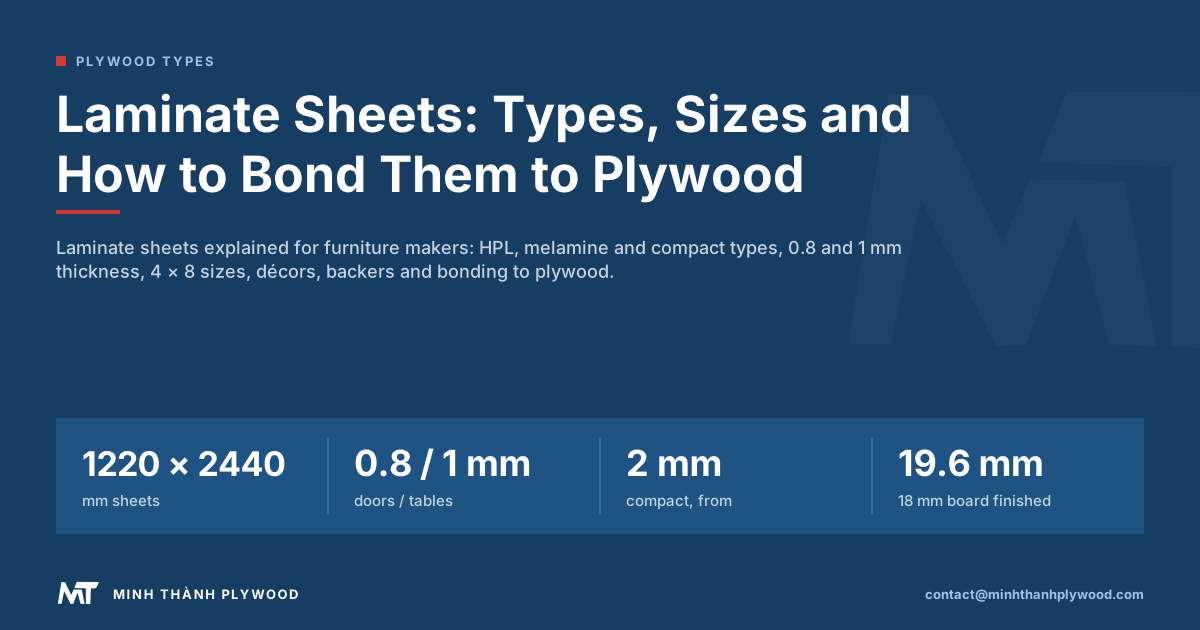
Laminate sheets are thin decorative sheets of resin-cured paper, mostly 0.8 or 1 mm high-pressure laminate in 1220 × 2440 mm (4 × 8 ft), glued onto plywood, particleboard or MDF to give furniture its colour, grain and wear surface. This guide, from plywood maker Minh Thanh Plywood, covers types, sizes, décors, backers and bonding.
Laminate sheets: what they are and how furniture makers buy them
Laminate sheets are thin, hard decorative sheets made of resin-cured paper, glued onto a board to give it a colour, a wood grain or a stone pattern and a surface that resists wear. Furniture makers buy them by type, thickness, size, décor code and finish, and buy the board under them separately.
- Types: high-pressure laminate (HPL) for most furniture; low-pressure melamine on board for carcasses; compact laminate for self-supporting parts.
- Thickness: mostly 0.8 mm and 1 mm.
- Size: 1220 × 2440 mm, 4 × 8 ft, the same as standard plywood.
- Décor: a code from the laminate maker’s book, solid colour or wood grain.
- Board: plywood for strength and screw holding, particleboard or MDF for low-cost carcasses.
Minh Thanh Plywood makes the furniture plywood that laminate sheets are pressed onto.
Laminate sheet sizes and grades in Canada and North America
In Canada and the US, laminate sheets are sold in feet and inches, in three sheet sizes and three NEMA LD 3 grades. A Canadian shopper at Home Depot sees 4 × 8 ft and 5 × 12 ft sheets from Formica and Wilsonart, each with a décor code. The table puts the metric sizes beside them.
| North American size | Metric | Note |
|---|---|---|
| 4 × 8 ft | 1220 × 2440 mm | The standard sheet; same format as standard plywood |
| 4 × 10 ft | 1220 × 3050 mm | Longer worktops with fewer joints |
| 5 × 12 ft | 1525 × 3660 mm | Wide and long counters; Formica and Wilsonart list it |
| NEMA LD 3 grade | Nominal thickness | Use |
|---|---|---|
| HGS, horizontal general purpose | 0.048 in (1.2 mm) | Countertops and desktops |
| HGP, horizontal postforming | 0.039 in (1.0 mm) | Rolled edges and backsplashes |
| VGS, vertical general purpose | 0.028 in (0.7 mm) | Cabinet doors and wall panels |
Canadian stores stock Formica and Wilsonart. Formica 909-58 Black in matte finish, 4 × 8 ft, was C$155 at Home Depot Canada in October 2026, and the same shop lists Formica Ice Onyx 7408-43 in 4 × 8 ft and 5 × 12 ft. A decor code names the colour and the finish, so two shops quoting 909-58 are quoting the same sheet.
A laminate sheet is only the face. Pre-laminated panels in birch plywood, 1/4 to 3/4 in thick, are sold by retailers such as TCH in black, and furniture makers who laminate their own panels buy the plywood core from a factory. Our furniture plywood is the board under the laminate: UF glue at E0 emission, with CARB P2 / TSCA Title VI proof for North American buyers. The US formaldehyde limit for veneer-core hardwood plywood is 0.05 ppm under 40 CFR 770.10.
Types of laminate sheets
There are four main types of laminate sheet, and the type decides how the sheet reaches the board. The table sets them side by side.
| Type | What it is | Typical thickness | How it is bonded |
|---|---|---|---|
| High-pressure laminate (HPL) | Décor paper on phenolic kraft papers, pressed hard | 0.6–1.2 mm | Glued to the board |
| Postforming HPL | Thinner HPL that bends round a heated edge | 0.6–0.7 mm | Glued, then formed |
| Low-pressure melamine | One décor paper fused to the board | Single paper layer | Fused on, no glue |
| Compact laminate | Thick HPL, no board needed | 2 mm and over | Used on its own |
Our guide what is HPL explains the press and layer build-up behind high-pressure laminate; for most furniture faces sold as “laminate sheets”, HPL is what the buyer gets.
Laminate sheets for wood: which boards they bond to
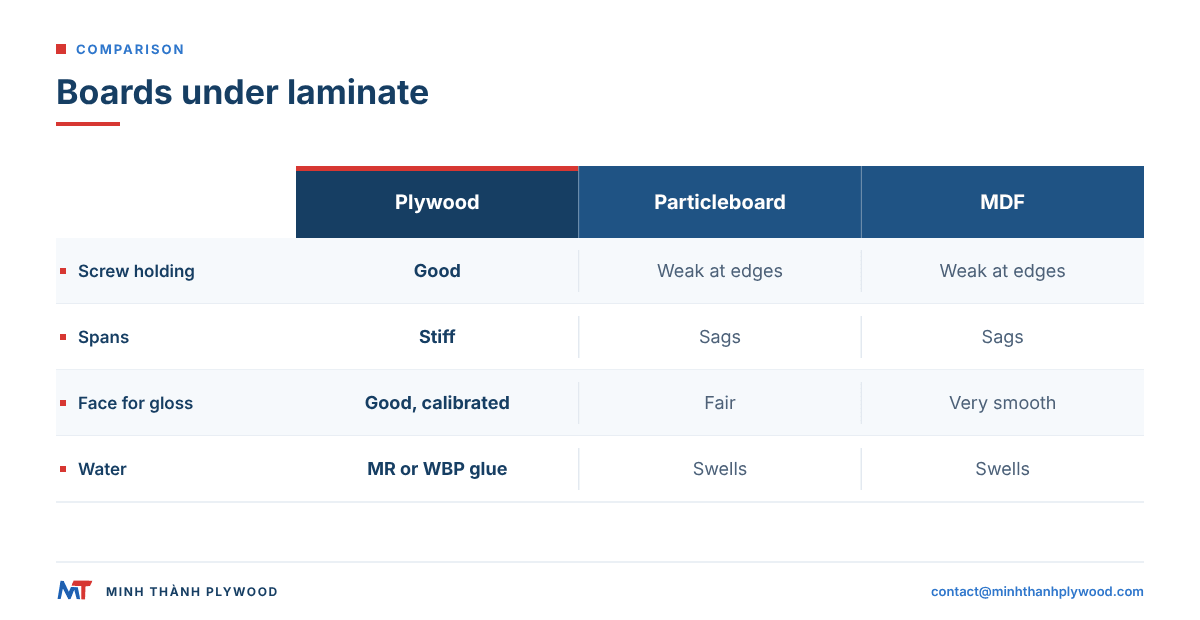
Laminate sheets for wood bond to plywood, particleboard and MDF, but each board behaves differently under the laminate. Plywood holds screws and hinges best and spans furthest; particleboard is the cheapest flat carcass board; MDF gives the smoothest face for thin, glossy laminates.
| Board | Strengths under laminate | Watch-outs |
|---|---|---|
| Plywood | Screw and hinge holding, stiffness over spans, lighter cores | Needs a calibrated, gap-free core for a flat face |
| Particleboard | Low cost, flat for carcass sides | Weak screw holding at edges, swells when wet |
| MDF | Very smooth face for gloss | Heavy, weak edge screw holding, swells when wet |
Furniture buyers choose plywood under laminate for kitchen shutters, wardrobe doors, desks and hotel furniture where hinges and fixings are close to the edge. Our particle board vs plywood guide gives the full comparison.
What is the difference between plywood and laminate?
Plywood is a board and laminate is a surface: plywood is made of wood veneers glued in cross layers to give strength, while laminate is a thin resin-paper sheet that gives the board its look and wear resistance. A laminated plywood panel uses both, and each is specified on its own line.
- Plywood decides: strength, weight, screw holding, flatness, glue class and emission.
- Laminate decides: colour, pattern, texture, scratch, wear and heat resistance.
Laminate flooring is a third product: a click plank on an HDF core, laid over a subfloor, which may itself be plywood.
Laminate sheet thickness: 0.8 mm, 1 mm and the rest
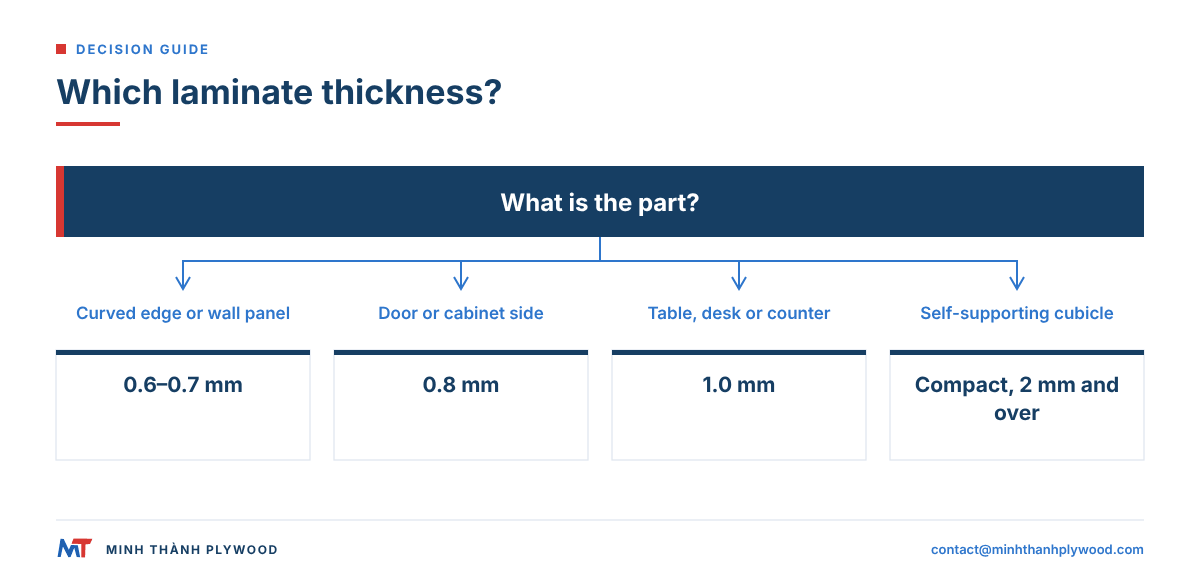
Most furniture laminate sheets are 0.8 mm or 1 mm thick; 0.8 mm is the general face for doors and carcasses, and 1 mm is used for tables, desks and shop counters that take more wear. Thinner sheets bend; thicker sheets take impact.
| Thickness | Use |
|---|---|
| 0.6–0.7 mm | Postforming edges, vertical panels, wall cladding |
| 0.8 mm | Wardrobe and kitchen doors, cabinet sides |
| 1.0 mm | Tables, desks, counters |
| 1.2 mm | Worktops with heavy wear |
| 2 mm and over | Compact laminate for cubicles and lockers |
Plan the finished part: a 18 mm plywood board with a 0.8 mm laminate on each face finishes at about 19.6 mm before edging, which matters for hinges and drawer runners.
Laminate sheet sizes and how they match plywood
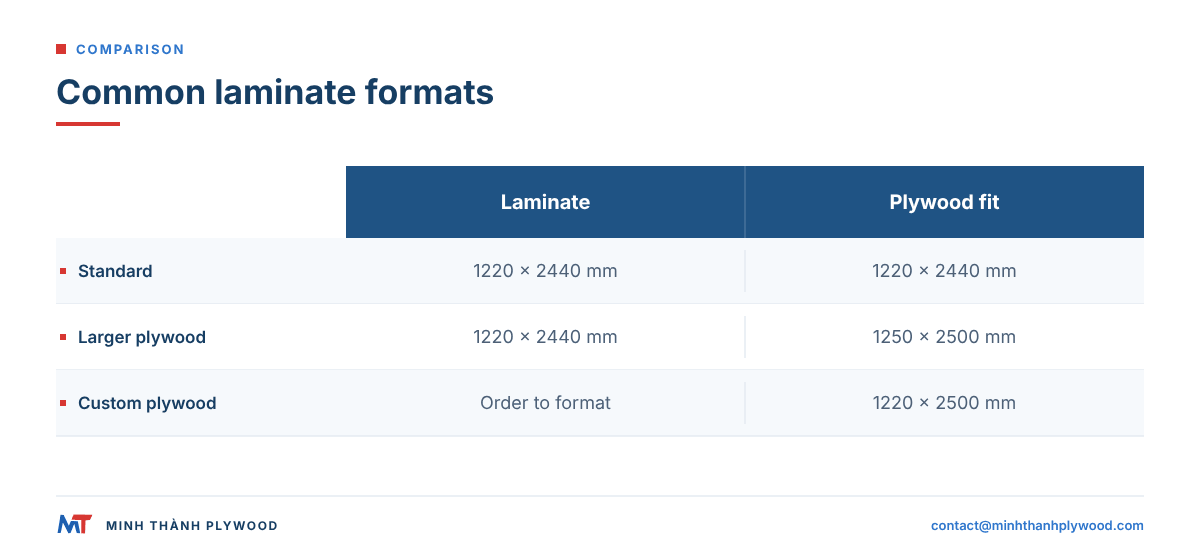
The standard laminate sheet size is 1220 × 2440 mm (4 × 8 ft), the same as standard plywood, so one sheet faces one board with a small trim. Minh Thanh plywood comes in 1220 × 2440 and 1250 × 2500 mm, with custom sizes such as 1220 × 2500 and 1220 × 2280 mm.
- Match the formats: order laminate and plywood in the same nominal size, or laminate slightly larger for trimming.
- Cut after pressing: press full sheets, then cut parts, so edges are clean.
- Plan the grain: for wood-grain décors, cut all doors of a cabinet in the same direction.
- Use cut-to-size boards when the plant presses parts, not full sheets.
For part-sized boards, our cut-to-size plywood is one panel cut into 4, 6 or 8 pieces.
Wooden laminate sheet décors vs solid colours
A wooden laminate sheet is a laminate printed with a wood grain (oak, walnut, teak or ash) and often embossed with a matching texture; a solid-colour laminate is one flat colour such as white, grey or black. Both are the same product underneath; the choice is about look, repeat orders and how defects show.
| Point | Wood-grain décor | Solid colour |
|---|---|---|
| Hides small scratches and dust | Well | Poorly, especially dark gloss |
| Grain direction on cut parts | Must be planned | No direction |
| Matching edge band | Printed grain band | Plain band |
| Texture options | Embossed, in-register grain | Matt, gloss, suede |
| Repeat-order match | By décor code and batch | By colour code |
The laminate maker’s décor code, finish code and thickness are the three lines that make a repeat order match the first.
Finishes and textures
Laminate finish is the surface texture pressed into the sheet: matt, suede, gloss, high gloss, woodgrain emboss and in-register texture, where the emboss follows the printed grain. The finish changes how the face looks under light and how it wears.
- Matt and suede: the most forgiving for fingerprints and small scratches; the usual choice for kitchen and wardrobe doors.
- Gloss and high gloss: strong colour, but shows every scratch and every flaw in the board beneath.
- Woodgrain emboss: gives a touch of real timber at a low cost.
- In-register texture: the closest to real veneer; costs more.
High-gloss laminate needs the flattest board: on plywood, that means a calibrated, sanded face with tight thickness tolerance.
Backer sheets and balanced panels
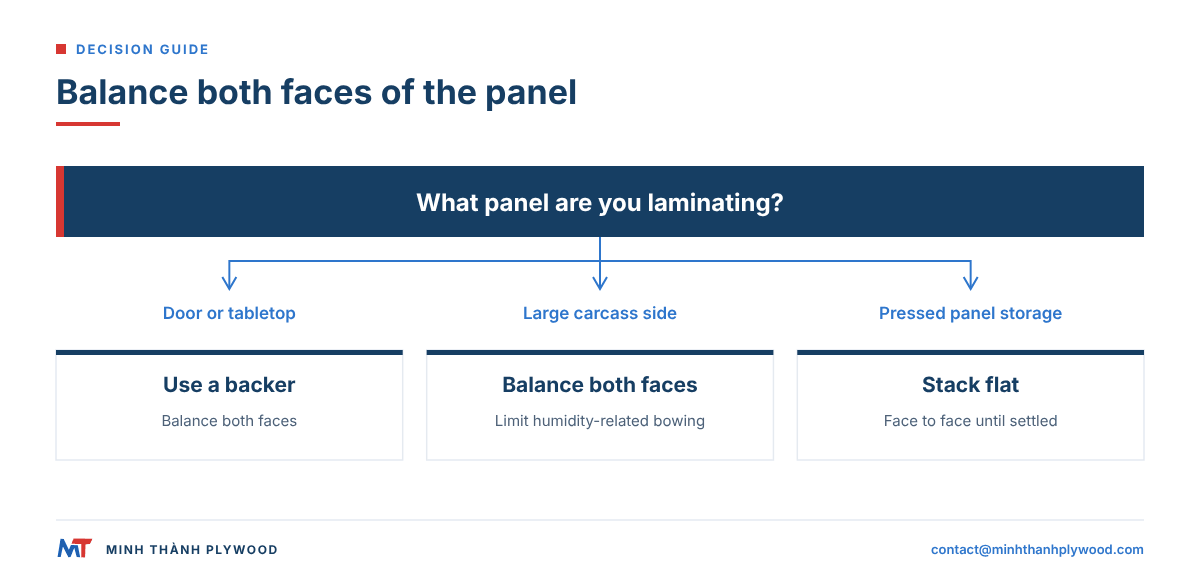
A backer sheet is a plain laminate glued to the hidden face of a laminated panel, so both faces move the same way as humidity changes. Without it, a door or tabletop faced on one side only bows toward the laminate.
- Use a backer on every door, tabletop and free-standing panel.
- Match thickness roughly to the face sheet; the laminate maker gives the backer grade.
- Keep fixed carcass sides balanced too when they are large.
- Store pressed panels flat, stacked face to face, until they settle.
Plywood itself is a balanced cross-laminated panel, so a balanced plywood under a balanced laminate pair gives the flattest doors.
How to apply laminate to plywood
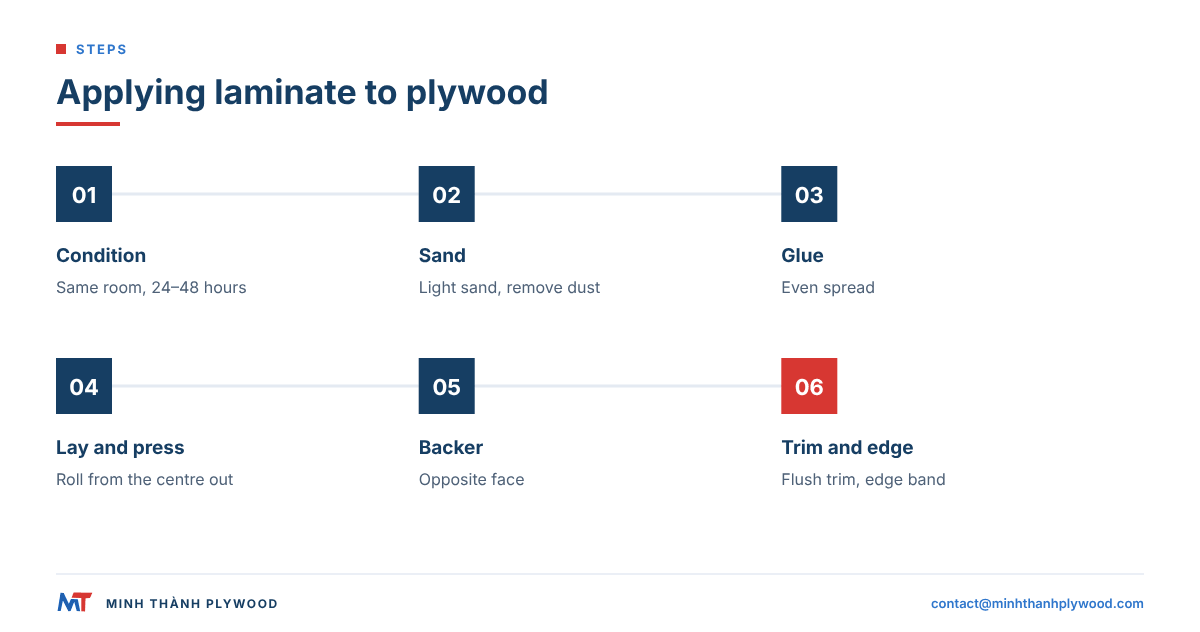
Laminate is applied to plywood by gluing the sheet to a clean, sanded board and pressing it flat; plants use a press with PVA or urea glue, and site carpenters use contact adhesive and a roller. The steps are the same either way.
- Condition the laminate and the plywood in the same room for 24–48 hours.
- Sand the plywood face lightly and remove dust.
- Spread glue evenly: on the board for press glue, on both board and laminate back for contact adhesive.
- Lay the sheet and press it, or roll it from the centre out to push out air.
- Lay the backer on the opposite face the same way.
- Trim and edge with a flush router bit, then apply edge banding.
How to put laminate on plywood at home and in a factory differs only in the press: a factory press gives the more even bond.
How to remove laminate from plywood
Laminate glued with contact adhesive is removed by heating it with a heat gun or iron to soften the glue, then lifting it slowly with a putty knife from one edge. Laminate pressed with PVA or urea glue is bonded into the wood fibres and seldom comes off cleanly.
- Contact adhesive: heat, lift, scrape off the remaining glue, sand.
- Press-glued laminate: sand or plane off, or replace the part.
- Solvent: a contact-adhesive solvent helps release old glue; use with ventilation.
After removal, the plywood face needs sanding flat before a new sheet goes on.
Laminate flooring on plywood: a different product
Laminate flooring is installed on plywood by floating the click planks on an underlay over a flat, dry plywood subfloor; the plywood is screwed to the joists, level within the flooring maker’s limit and free of squeaks. Flooring laminate is a plank with an HDF core, not a furniture laminate sheet.
- Check the subfloor is dry, flat and screwed down.
- Lay the underlay the flooring maker specifies.
- Click the planks together, leaving the expansion gap at the walls.
- Do not glue or nail floating planks to the plywood.
For subfloor sheathing, our plywood vs OSB guide covers the board under the floor.
What is a sunmica or mica sheet used for?
In India and the Gulf, laminate sheets are called sunmica, mica or simply laminate; in the United States and Europe, many people say Formica. All mean the same thing: a decorative HPL sheet glued onto plywood for doors, wardrobes and desks, made to the standard EN 438 or NEMA LD 3 (EN 438-1 listing, DIN Media, read 20 October 2026).
| Market | Common name | Usual meaning |
|---|---|---|
| India | Sunmica, mica, laminate | 0.8–1 mm HPL sheet |
| UAE and Gulf | Laminate, HPL, Formica | HPL or laminated board |
| United States | Formica, plastic laminate | HPL sheet |
| Europe | HPL, laminate | HPL sheet |
Buyers in the UAE and Dubai looking for laminated plywood often buy plywood from Asia and laminate it locally, or buy finished laminated boards; sea time from Hai Phong to the Middle East is typically 15–25 days, by carrier and route.
The plywood under the laminate: what to order from us
The plywood under a laminate sheet should be flat, calibrated and free of core gaps, because the laminate shows every flaw. Minh Thanh furniture panels are pressed twice as standard, have core layers stitched both horizontally and vertically, sanded faces and a thickness tolerance down to ±0.2 mm.
- Application: doors, wardrobes, desks, kitchen shutters; wet or dry rooms.
- Core: white Styrax for light parts or Eucalyptus for harder screw holding.
- Glue and emission: UF glue at E0 emission; MR or phenolic WBP for kitchens and bathrooms.
- Face: sanded EV, Poplar or similar, ready for laminating.
- Size: 1220 × 2440 or 1250 × 2500 mm, or cut-to-size.
- Packing and quantity: from one 40HC, mixed specifications by agreement; the destination port.
Production is 15–45 days after the 30% deposit, with free samples. See our furniture plywood page and the plywood vs MDF guide for the board choice.
Buyer questions, answered
What are laminate sheets made of?
Most laminate sheets are layers of kraft paper soaked in phenolic resin under a printed décor paper soaked in melamine resin, pressed into one hard sheet. Thinner low-pressure sheets are a single resin-soaked décor paper.
What is a mica sheet used for?
In India and the Middle East, mica or sunmica means a decorative laminate sheet. It is glued onto plywood or particleboard for wardrobes, kitchen shutters, tables and wall panels.
What is the difference between plywood and laminate?
Plywood is the structural board, made of cross-laminated wood veneers; laminate is a thin decorative sheet glued onto it. Furniture uses both: plywood for strength, laminate for the surface.
What thickness of laminate sheet should I buy?
Buy 0.8 mm for most furniture faces and cabinet doors, 1 mm for tables and desks, and a thinner 0.6–0.7 mm postforming or vertical grade for curved edges and wall panels.
How do you apply laminate to plywood?
Sand and clean the plywood, apply glue to the board (PVA or urea glue in a press, or contact adhesive on both faces for hand work), lay the sheet, press or roll it flat, then trim the edges.
How do you remove laminate from plywood?
Warm the laminate with a heat gun to soften contact adhesive, lift an edge with a putty knife and work it off slowly. Pressed PVA or urea bonds rarely release cleanly, so the face is usually sanded or the panel replaced.
Can you install laminate flooring on plywood?
Yes. Laminate flooring floats over a flat, dry plywood subfloor on an underlay; the plywood must be screwed down, level and free of squeaks. Flooring laminate is a click plank, not the same product as furniture laminate sheets.
Do laminate sheets need a backer?
Yes, for doors, tables and any panel free to bow. A backer sheet on the hidden face balances the pull of the decorative laminate as humidity changes.
What size are laminate sheets?
The standard furniture size is 1220 × 2440 mm, 4 × 8 ft, to match plywood. Larger sheets are made for worktops and wall cladding.
Can laminated plywood be bought ready-made?
Yes, laminating plants sell HPL- or melamine-faced plywood ready to cut. Many furniture makers buy the plywood and laminate it themselves to choose the décor and backer.