
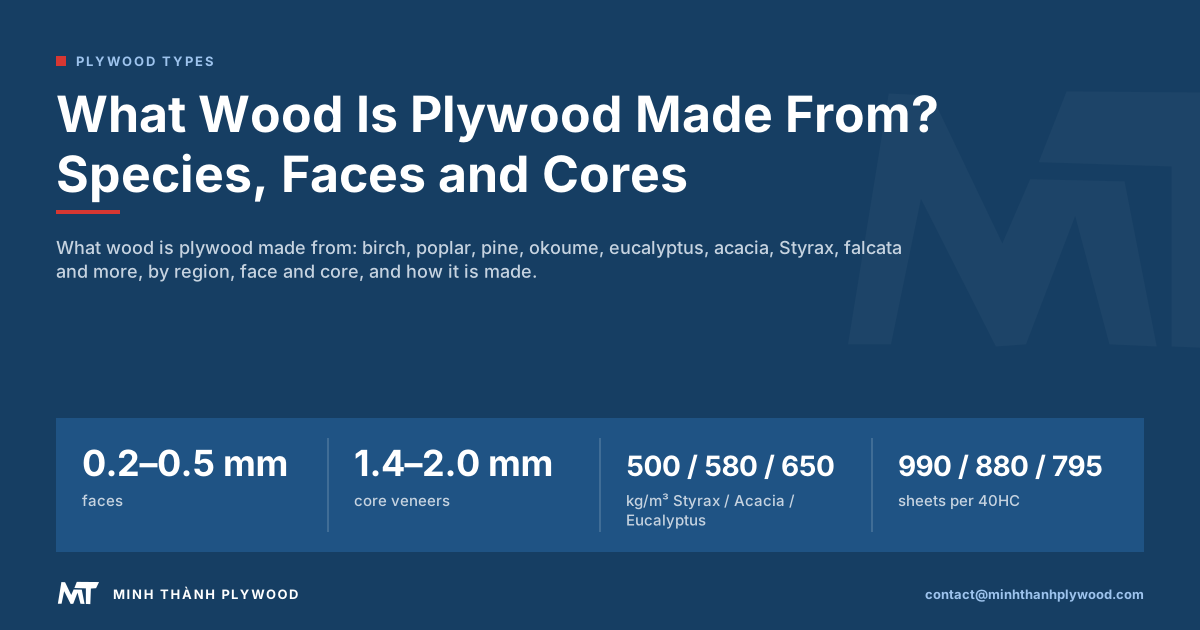
Plywood is made from thin wood veneers peeled from logs, most often birch, poplar, pine, fir, eucalyptus, acacia, okoume or tropical hardwoods, glued in crossed layers. The face species gives the look; the core species gives weight, strength and price, and they are often different trees. Minh Thanh Plywood, a Vietnamese furniture plywood maker, lists the species by region and shows how they become a panel.
What wood is plywood made from?
Plywood is made from thin sheets of wood, called veneers, peeled from logs of fast-growing or plantation trees and glued in crossed layers. The most common species are birch, poplar, pine, spruce and fir in the northern hemisphere, and eucalyptus, acacia, Styrax, falcata, meranti and okoume in tropical regions.
Two facts explain most of the answer:
- Face and core can be different trees. The face veneer is chosen for looks; the core veneers are chosen for strength, weight and cost.
- Each region uses its own trees. Plywood is made close to its timber, so a panel’s species usually tells you where it was made.
So “what wood is plywood made from” has two answers for every panel: the face species and the core species. A buyer should ask for both.
Tree plywood species: which tree is used for plywood?
No single tree makes plywood; each producing region uses the trees it grows, such as birch, poplar, pine, okoume, eucalyptus and acacia. The table lists the main species, where they come from and whether they are used as a face, a core or both.
| Species | Main sources | Face | Core | Typical plywood |
|---|---|---|---|---|
| Birch | Finland, Baltic states, Russia | Yes | Yes, in all-birch panels | Baltic birch, birch-faced plywood |
| Poplar | China, Italy, France, India | Yes | Yes, in China and India | Poplar plywood, light furniture panels |
| Pine and fir | North America, Chile, New Zealand, Europe | Yes | Yes | Structural softwood plywood, CDX, pine-faced |
| Spruce | Nordic countries | Yes | Yes | Construction plywood |
| Okoume | Gabon and Central Africa | Yes | Yes, in marine panels | Okoume-faced and marine plywood |
| Eucalyptus | Vietnam, China, Brazil, India | Yes | Yes | Furniture, commercial and film-faced plywood |
| Acacia | Vietnam, Indonesia, Malaysia | Rarely | Yes | Commercial and film-faced plywood |
| Styrax | Northern Vietnam | No | Yes | Light furniture plywood cores |
| Falcata (sengon) | Indonesia | Rarely | Yes | Light core plywood |
| Meranti and lauan | Indonesia, Malaysia, Philippines | Yes | Yes | Tropical hardwood plywood |
| Gurjan | South and Southeast Asia | Yes | Yes, in Indian marine grades | Gurjan-faced and Indian marine plywood |
| Bintangor | Southeast Asia | Yes | Rarely | Bintangor-faced commercial plywood |
Falcata and sengon are the same tree, Falcataria moluccana, sold under its Philippine and Indonesian names. Our guide to the types of plywood groups these species into product families.
Wood used for plywood faces: the visible veneer
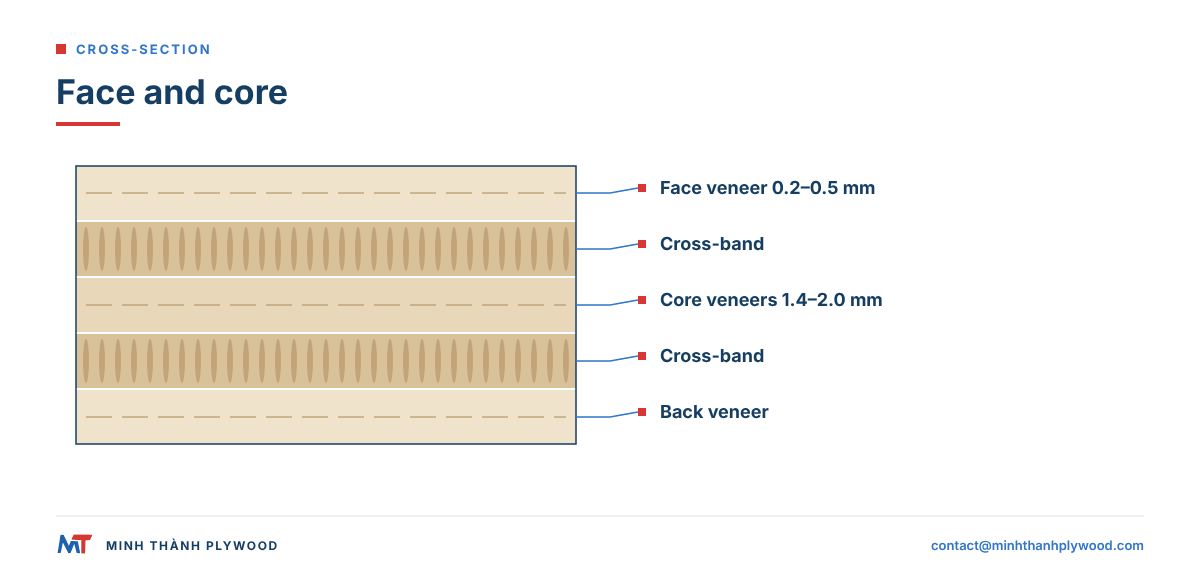
The wood used for plywood faces is chosen for colour, grain and how well it takes a finish. The face veneer is very thin, generally 0.2–0.5 mm, and European furniture buyers usually ask for about 0.3 mm.
Common face species and what each gives:
- Birch: fine, even, light face that stains and lacquers well.
- Poplar: pale, plain face that paints very well and costs less.
- Okoume: pinkish-brown, smooth face, light weight.
- Pine: knotty or clear softwood face, rustic or painted.
- Eucalyptus: hard, light brown face for commercial and furniture use.
- Bintangor and gurjan: reddish-brown tropical faces for commercial plywood.
- EV (engineered veneer): re-made veneer in a chosen colour and grain, such as oak or teak looks.
- Decorative hardwoods: oak, walnut, ash, teak and others on fine furniture panels.
At Minh Thanh Plywood we press more than ten face veneers, most often EV, poplar, birch, okoume and pine, and also bintangor, eucalyptus, gurjan, sapele and others on request. Birch and okoume faces are imported veneers pressed onto our Vietnamese cores.
Plywood core species: the hidden layers
The core species sets a panel’s weight, stiffness, screw holding and much of its price, even though it is hidden. Core veneers are thicker than faces, usually 1.4–2.0 mm, and laid with their grain crossing from ply to ply.
In Vietnam, plywood cores are made from plantation acacia, eucalyptus and Styrax, or a mix; rubberwood is a niche, higher-cost core in the south. Poplar and birch are faces in Vietnam, not cores, and gurjan, okoume and bintangor are used only as faces.
Our furniture panels use white Styrax or Eucalyptus cores as standard; Acacia and Pine cores are made on order. The reference densities we use for planning loads:
| Core | Planning density | 18 mm sheet, 1220 × 2440 mm | What buyers choose it for |
|---|---|---|---|
| White Styrax | 500 kg/m³ | 26.8 kg | Light weight, pale edge, flat furniture panels |
| Acacia | 580 kg/m³ | 31.1 kg | Mid weight, commercial and film-faced panels |
| Eucalyptus | 650 kg/m³ | 34.8 kg | Hardness, screw holding, heavier furniture parts |
Many European furniture buyers choose white Styrax because it is light and gives a clean, pale edge.
Softwood vs hardwood species in plywood
Softwood plywood is made from conifers such as pine, fir and spruce, and is used mostly for construction; hardwood plywood is made from broad-leaved trees such as birch, poplar, eucalyptus and acacia, and is used mostly for furniture and interiors.
| Point | Softwood plywood | Hardwood plywood |
|---|---|---|
| Species | Pine, Douglas fir, spruce, radiata | Birch, poplar, eucalyptus, acacia, Styrax, meranti |
| Main regions | North America, Nordic countries, Chile, New Zealand | Asia, Northern Europe (birch), Africa (okoume) |
| Faces | Knots and patches common | Smooth, sanded, graded faces |
| Main uses | Sheathing, roofing, subfloors, forms | Furniture, cabinets, interiors, packaging |
| Grading | Structural and appearance grades | Face/back appearance grades |
Botanical “hardwood” does not always mean hard: poplar and Styrax are hardwoods but light and soft. Our guide to birch plywood vs pine plywood compares the two families in one pair.
What wood is used in plywood in India?
Plywood in India is commonly made with gurjan and other hardwood faces over poplar and eucalyptus cores from farm plantations. Premium marine grades use gurjan through more of the panel, while commercial grades use mixed hardwood cores.
- Faces: gurjan, other tropical hardwoods and decorative veneers.
- Cores: poplar from northern India, eucalyptus from many states, and mixed hardwoods.
- Grades: commercial (MR), boiling-water-resistant (BWR/BWP) and marine.
Indian buyers who import plywood often ask for gurjan faces; we press gurjan-faced panels on our Vietnamese cores, listed on our gurjan plywood page.
Is plywood made from teak only?
No, plywood is not made from teak only, and very little plywood contains teak at all. Teak appears as a thin decorative face veneer on “teak plywood”, over a core of a faster-growing species. Solid teak is too slow-growing and costly to peel for cores.
Where the idea comes from: in some markets, especially India, “teak ply” is a well-known decorative panel, and teak is famous as a furniture wood. But the teak is only the face. Most teak-look panels today use an engineered teak veneer, which gives an even teak colour from plantation wood. Our guide to EV plywood shows how engineered faces are made.
How is plywood made? Step by step
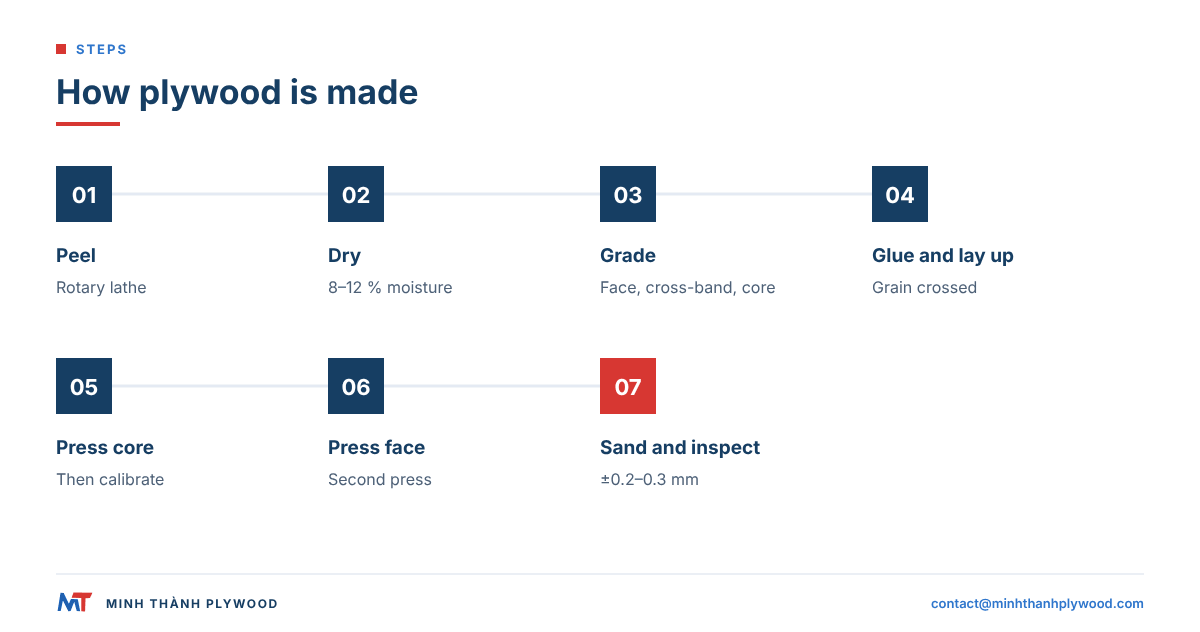
Plywood is made by peeling logs into veneers, drying and grading them, gluing them in crossed layers and hot-pressing the stack into a panel. The steps below are how a furniture plywood mill in Vietnam makes a panel.
- Select and cut logs. Plantation logs are cut to length, matching the panel size, such as 1220 × 2440 mm with trimming allowance.
- Peel veneers. Logs are turned on a rotary lathe that peels a continuous sheet of veneer, like unrolling paper.
- Clip and dry. Veneer is clipped into sheets and dried; finished panels leave at 8–12 % moisture content.
- Grade veneers. Each veneer is sorted for faces, cross-bands or core by its defects and colour.
- Joint and stitch the core. Core veneers are edge-jointed; our core layers are stitched both horizontally and vertically.
- Spread glue and lay up. Glue is spread on the veneers, which are laid with the grain of each layer crossing the next.
- Pre-press and hot-press the core. The stack is cold-pressed, then hot-pressed: about 110–120 °C for MR glue and 130–145 °C for phenolic (WBP) glue.
- Calibrate the core board. The pressed core is sanded to an exact thickness.
- Press face and back. On furniture grades the face and back are pressed on in a second press.
- Trim, sand and inspect. Panels are trimmed to size, sanded and polished, measured and graded.
- Pack and document. Panels are packed on pallets, labelled and recorded for the shipment’s documents.
An 18 mm furniture panel is usually 11–13 plies. Our guide to plywood thickness shows how ply count changes with thickness.
Why furniture panels are pressed twice
Furniture panels are pressed twice so the face goes onto a flat, calibrated core, which gives a flatter panel and a more even face than a single pressing. Our furniture-grade panels are pressed twice as standard: the core board is pressed and calibrated, then face and back are pressed on.
What double pressing changes for the buyer:
- Flatness: high spots in the core are sanded off before the face goes on.
- Thickness tolerance: sanded furniture panels are held to ±0.2–0.3 mm, down to ±0.2 mm.
- Face quality: fewer telegraphed core joints and gaps under lacquer.
- Finishing: both faces are UV-ready, to the standard customers need to apply their own UV coating.
Single pressing is normal for commercial and packing grades, where the face is painted, covered or hidden.
What glue holds the wood together?
Plywood veneers are held together by a thermosetting glue, and the glue, not the wood, decides water resistance and most of the formaldehyde emission. Glue type and emission class are two separate specifications.
| Glue | Water resistance | Typical use |
|---|---|---|
| UF glue at E0 emission | Interior | Furniture and interior panels |
| MR / melamine-fortified | Humid interiors, some exterior | Commercial, film-faced, CDX-type panels |
| Phenolic (WBP) | Exterior and wet use | Film-faced, exterior and marine-type panels |
Our furniture plywood uses UF glue at E0 emission; MR, melamine-fortified and phenolic (WBP) bonds are made to the customer’s specification. Our guide is plywood waterproof? explains what each glue survives.
Does the species affect formaldehyde emission?
The species affects formaldehyde emission very little; the glue and the pressing decide it. That is why the US rule sets one limit for all veneer-core hardwood plywood, whatever the species: 0.05 ppm under TSCA Title VI (40 CFR 770.10, checked on 20 October 2026).
Six ASTM D6007 chamber tests on our panels between April 2025 and June 2026, on 9, 15 and 18 mm thicknesses, averaged 0.014–0.032 ppm against that 0.05 ppm limit. Three were run by Shanghai Hongjun and three by ICTT Vietnam. We hold CARB P2 / TSCA Title VI certification as ICTT mill no. 23024. Third-party testing to the buyer’s method, for example EN 717-1, is arranged through SGS on request.
Which plywood species is strongest?
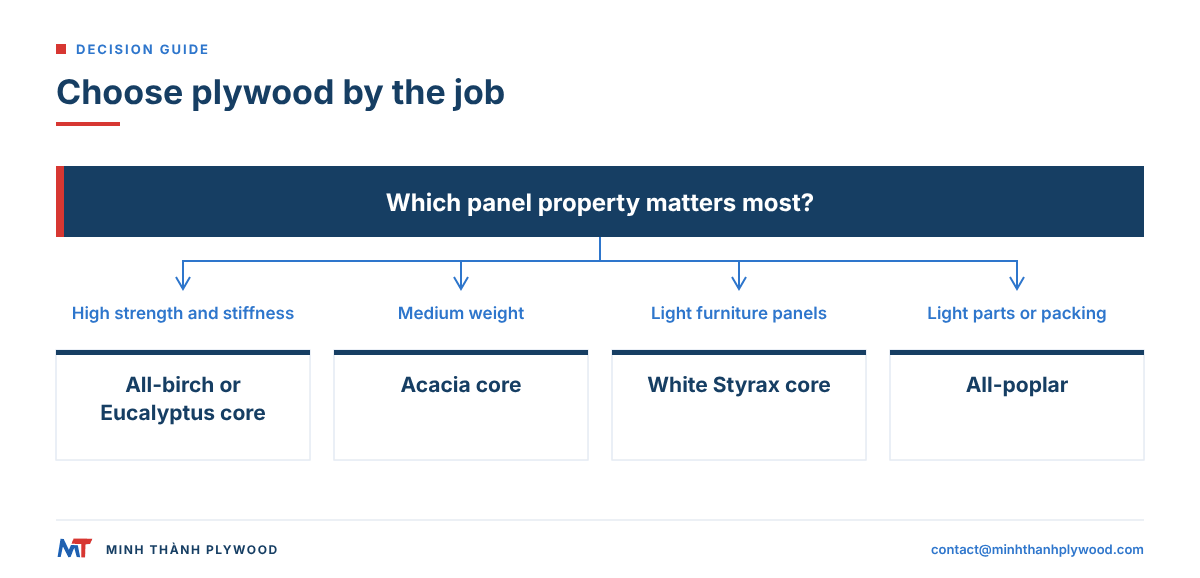
All-birch plywood is one of the strongest and stiffest common builds, because birch is a dense, hard wood used in every ply. Among faced panels, strength follows the core: a dense core such as eucalyptus makes a harder, stiffer panel than a light core such as Styrax.
| Build | Relative strength | Relative weight | Best use |
|---|---|---|---|
| All-birch | High | High | Shelving, jigs, exposed-edge furniture |
| Eucalyptus core, hardwood face | High | High | Table tops, heavy-use furniture, forms |
| Acacia core | Medium to high | Medium | Commercial and film-faced panels |
| White Styrax core | Medium | Low | Light furniture, wall cabinets |
| All-poplar | Low to medium | Low | Light furniture parts, packaging |
For structural uses, strength is set by a grade and a design standard, not by species alone. Our guide to how much weight plywood can hold works through shelf loads.
Can you tell the species by looking?
You can usually identify the face species by its grain and colour, and often the core species by the colour of the plies at the edge. For a certain answer, the species should be written on the specification, the invoice and the EUDR file.
Quick visual clues at the edge of a panel:
- White Styrax core: pale, almost white plies.
- Eucalyptus core: reddish-brown to light brown plies, dense.
- Acacia core: yellowish to medium-brown plies.
- All-birch: even, light, thin plies with no voids.
- Poplar core: very pale, soft plies.
Mixed cores can combine species in one panel, so ask for the core species in writing when it matters to your product.
Does the core species affect landed cost?
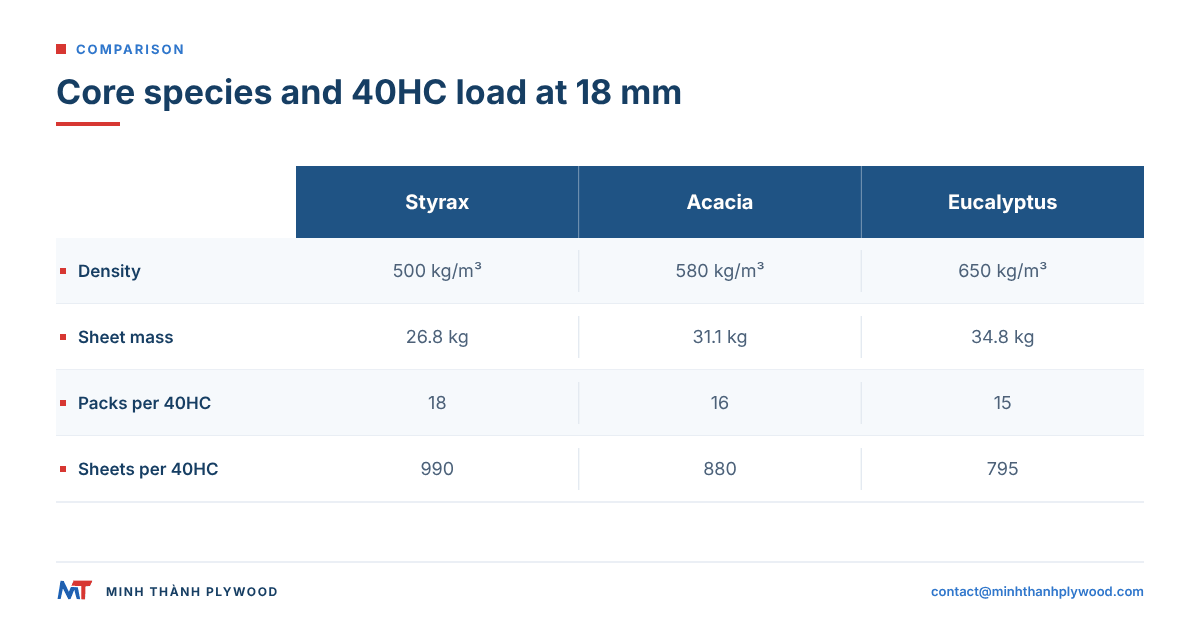
Yes, the core species changes landed cost beyond the FOB price, because a lighter core puts more sheets in a container before the payload limit. Freight is paid per container, so sheets per container sets freight per sheet.
Our 40HC loading plan at 1220 × 2440 × 18 mm, with a planning payload of 28,000 kg unless the booking is lower:
| Core | Packs | Sheets | Volume | Sheet mass |
|---|---|---|---|---|
| White Styrax | 18 (16 lying + 2 upright) | 990 | about 53 m³ | 26.8 kg |
| Acacia | 16 | 880 | about 47 m³ | 31.1 kg |
| Eucalyptus | 15 | 795 | about 43 m³ | 34.8 kg |
Styrax loads 195 more 18 mm sheets than Eucalyptus in the same container, so its freight per sheet is lower. Packs are about one metre high, and sheets per pack are capped by weight as well as height.
Pros and cons of plywood made in Vietnam
Plywood made in Vietnam combines plantation hardwood cores, furniture-grade faces, competitive prices and full export documents. Its limits are that some faces are imported veneer and that quality differs between mills, so samples and a first-shipment inspection matter.
| Strength | Watch-out |
|---|---|
| Plantation acacia, eucalyptus and Styrax cores | Birch and okoume faces are imported veneer |
| Furniture-grade sanding and double pressing at good mills | Quality differs from mill to mill |
| CARB P2 / TSCA Title VI and EUDR files from certified mills | Ask for certificates and test reports by name |
| Mixed specifications in one container by agreement | Agree specs and grades with an approved sample |
Our mill is in Ha Hoa, Phu Tho, where locally grown plantation timber supplies the cores. Every shipment is photographed and filmed before loading, and the buyer gets the photos and video.
Plantation timber: where the logs come from
Most plywood made in Asia today comes from plantation trees grown for the purpose, not from natural forest. Acacia, eucalyptus, Styrax, falcata and poplar grow quickly enough to be harvested on short rotations and replanted, which is why they dominate Asian cores.
In Vietnam, plantation acacia and eucalyptus are grown widely, and Styrax is grown only in the north. Our mill in Ha Hoa sits among these plantations, so cores are locally grown and travel a short distance to the peeling line. That keeps cost down and lets the mill buy logs of the size and freshness its lathes need.
Plantation origin also matters for compliance. The EU deforestation regulation asks for the plot of land where the wood was produced, and plantation plots can be mapped and recorded. The EU’s country benchmarking in Implementing Regulation (EU) 2025/1093 lists Vietnam as a low-risk country.
Is Vietnamese plywood really made in Vietnam?
Plywood made in Vietnam is built on Vietnamese plantation cores, mainly acacia, eucalyptus and Styrax, with local or imported face veneers. Buyers confirm origin with documents and a mill visit rather than by trusting a label.
How to check origin:
- Visit or video-audit the mill, including log yard, peeling and pressing.
- Ask for the EUDR dossier: origin records and geolocation files for the timber.
- Check the certificate of origin issued for the shipment, such as EUR.1 for the EU.
- Match species on the invoice to the core you see at the panel edge.
- Ask for certificates by number, such as a CARB P2 / TSCA Title VI mill number.
We supply the EUDR compliance dossier (origin records and geolocation files) with orders under Regulation (EU) 2023/1115, and for US orders the face and core species and Vietnamese harvest origin for the importer’s Lacey Act declaration.
How to read the species on a plywood specification
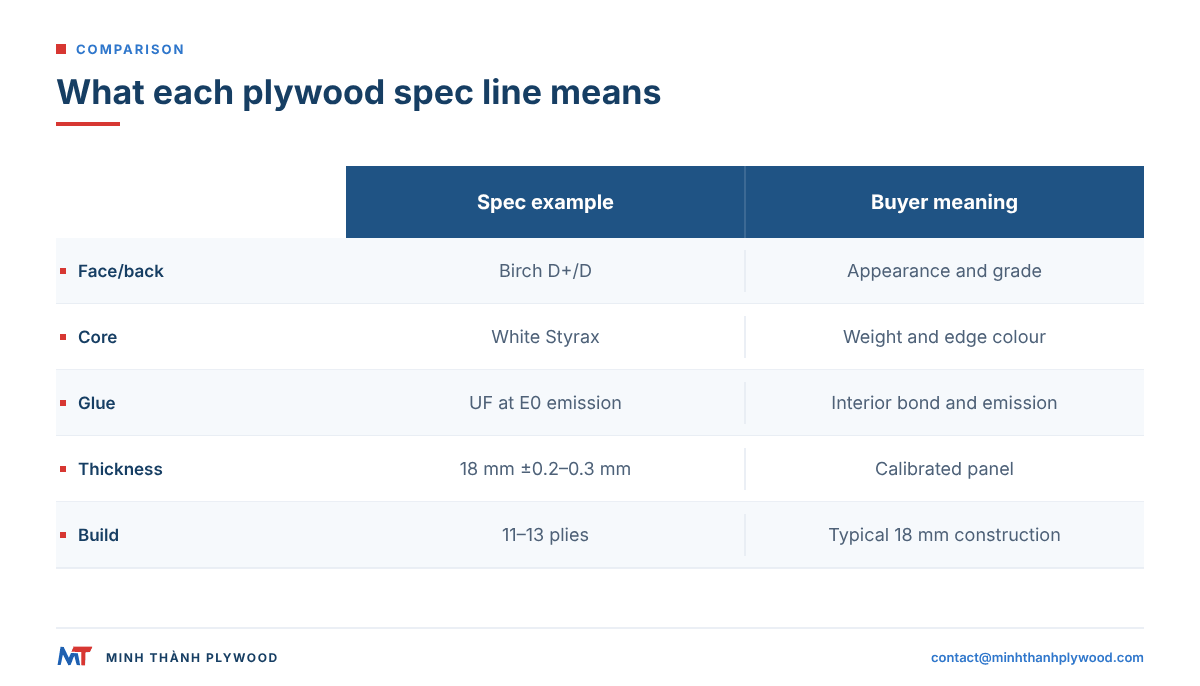
A complete plywood specification names the face species and grade, the back, the core species, the glue and emission class, the thickness and its tolerance, and the size. If any line is missing, two quotes for “the same plywood” can be very different panels.
| Spec line | Example | What it tells you |
|---|---|---|
| Face / back | Birch D+/D | Face species and grade pair |
| Core | White Styrax | Weight, edge colour, price |
| Glue / emission | UF glue at E0 emission | Interior use; emission class |
| Thickness | 18 mm, ±0.2–0.3 mm | Calibrated, sanded panel |
| Size | 1220 × 2440 mm | Standard sheet |
| Plies | 11–13 | Build quality at 18 mm |
Our guide to the best plywood for furniture shows which combinations suit each furniture part.
What this means for your order
Specify the face for the look, the core for the weight and price, and the glue for the use. Send these lines with your request:
- Application: furniture, cabinets, interiors, packing or construction.
- Face and grade: birch D+/D, poplar A/B, EV, okoume, pine or eucalyptus, matched to your approved sample.
- Core: white Styrax or Eucalyptus as standard; Acacia or Pine on order.
- Glue and emission: UF glue at E0 emission; MR, melamine-fortified or phenolic (WBP) to your specification.
- Size and thickness: 1220 × 2440 or 1250 × 2500 mm, 3–40 mm.
- Packing and quantity: from one 40HC, mixed specifications by agreement.
As of October 2026, our furniture and interior plywood starts from US$350/m³ and commercial plywood from US$250/m³. Production takes 15–45 days after the deposit, and free samples are available. See our furniture plywood from Vietnam for the full build.
Buyer questions, answered
What wood is plywood made from?
Plywood is made from veneers of fast-growing or plantation trees: birch, poplar, pine, spruce and fir in the north; eucalyptus, acacia, Styrax, falcata, meranti and other hardwoods in Asia; okoume in Africa. Face and core are often different species.
Which tree is used for plywood?
No single tree. Birch dominates Northern European plywood, pine and fir North American structural plywood, poplar Chinese plywood, and acacia, eucalyptus and Styrax Vietnamese plywood. Decorative faces add oak, walnut, teak and many others.
Is plywood hardwood or softwood?
Both exist. Softwood plywood uses pine, fir or spruce and is used mostly in construction. Hardwood plywood uses birch, poplar, eucalyptus, acacia and other broad-leaved trees and is used mostly in furniture and interiors.
What wood is used in plywood in India?
Indian plywood commonly uses gurjan and other hardwood faces, with poplar and eucalyptus cores from farm plantations. Premium marine grades use gurjan through more of the panel.
Is plywood made from teak only?
No. Teak is used only as a decorative face veneer on some panels, called teak plywood. The core of almost all plywood is a faster-growing species such as poplar, eucalyptus, acacia or pine.
What is the strongest plywood by species?
All-birch plywood is one of the strongest and stiffest common builds, because birch is dense and hard. Among Vietnamese cores, Eucalyptus gives the hardest, heaviest panel and white Styrax the lightest.
Can I tell what species a plywood is by looking at it?
You can identify the face by its grain and colour, and often the core by the colour of the plies at the edge: white Styrax is pale, Eucalyptus reddish brown. For a certain answer, ask for the species on the specification and invoice.
Does the wood species affect formaldehyde emission?
Very little. Emission comes mainly from the glue and how it is pressed. Our furniture plywood uses UF glue at E0 emission, and chamber tests averaged 0.014–0.032 ppm against the 0.05 ppm CARB Phase 2 limit.
Does the core species affect landed cost?
Yes. A lighter core puts more sheets in a container before the payload limit: at 18 mm a 40HC takes about 990 sheets on Styrax core, 880 on Acacia and 795 on Eucalyptus, so freight per sheet changes.
How is plywood made?
Logs are peeled into thin veneers, which are dried, graded, glued and laid with the grain of each layer crossing the next. The stack is hot-pressed, trimmed, sanded and inspected. Furniture panels are often pressed twice for flatness.
Is Vietnamese plywood really made in Vietnam?
Plywood made in Vietnam uses Vietnamese plantation cores, mainly acacia, eucalyptus and Styrax, with local or imported faces. Buyers confirm origin with a mill visit, the certificate of origin and the EUDR geolocation files for the timber.
What are the pros and cons of plywood made in Vietnam?
Strengths are plantation hardwood cores, furniture-grade faces, competitive prices and full export documents. The limits are that birch and okoume faces are imported veneer and that quality differs between mills, so approve samples and inspect the first shipment.