
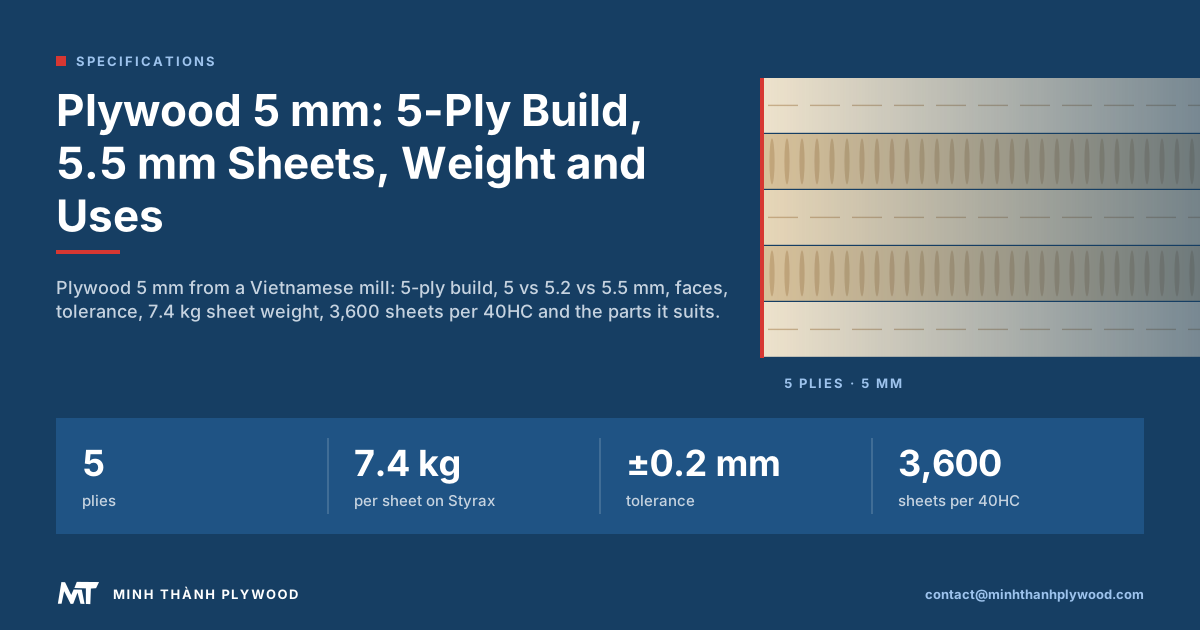
Plywood 5 mm is a thin 5-ply panel for cabinet and wardrobe backs, drawer bottoms, door inserts and linings: stiff enough to close a carcass, light enough to carry one-handed. Minh Thanh Plywood builds it from three core veneers and two faces, sands it to ±0.2–0.3 mm and loads 3,600 sheets of 1220 × 2440 mm into one 40HC on a Styrax core.
What is plywood 5 mm?
Plywood 5 mm is a panel five millimetres thick made from five thin veneers glued with their grain alternating, and it is the thickness furniture plants use to close the back of a cabinet or the bottom of a drawer. It sits between 4 mm plywood, used for light linings, and 6 mm plywood, the stiffer back for large wardrobes.
The same panel appears under several names. A quotation may call it 5mm ply board, ply 5mm or plywood sheet 5mm, and all of these mean one thing: a thin, sanded sheet that holds a staple or a short screw along a frame and stays flat across a whole carcass back.
Minh Thanh makes 5 mm as part of its thin plywood 3–6 mm range, with the same faces, glue and checks as its 18 mm furniture panels. The plywood thickness guide shows where 5 mm sits in the full 3–40 mm range.
How is a 5 mm plywood panel built?
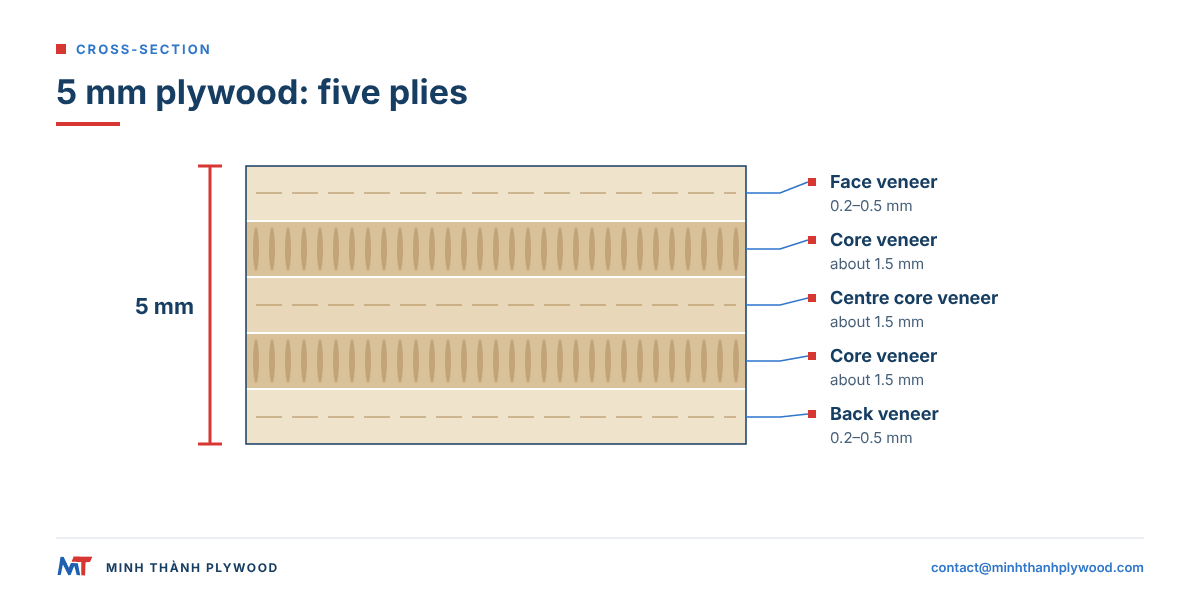
A 5 mm panel from Minh Thanh is always 5-ply: three core veneers in the middle and a face and a back veneer outside, with the grain of each layer at right angles to the next. The core veneers are cut to suit the panel, so all five layers fit inside five millimetres after pressing and sanding.
| Layer | Grain direction | Typical thickness before pressing |
|---|---|---|
| Face veneer | Along the sheet | 0.2–0.5 mm (0.3 mm on most European orders) |
| Core veneer 1 | Across | about 1.5 mm |
| Core veneer 2 (centre) | Along | about 1.5 mm |
| Core veneer 3 | Across | about 1.5 mm |
| Back veneer | Along | 0.2–0.5 mm |
The core figure follows from the build: five millimetres, less two faces of about 0.3 mm, leaves 4.4 mm for three core veneers, close to 1.5 mm each before the press takes up its share. A thin sheet has no spare layers to hide a gap, so the core veneers are sorted and laid close before the glue goes on.
Two thin panels in the same range are built differently. At 3 mm the build is one core veneer, two cross-band veneers and two faces. At 4 and 5 mm it is three core veneers and two faces, with the core veneer thickness changed to suit the panel. A 4 mm furniture panel, for example, uses three 1.3 mm Styrax core veneers.
Why is 5 mm plywood five plies and not three?
Five plies keep a thin sheet flat. A 3-ply panel of the same thickness has one thick core and two faces, and any difference in moisture between the face and the core pulls the sheet into a bow. With five layers balanced around a centre veneer, the forces on each side of the middle cancel out.
The extra plies help in daily use too:
- Screws and staples hold better, because a fixing passes through more glue lines.
- Edges split less when a back panel is pinned close to its edge.
- Cuts stay straight, because the sheet does not spring when it is released from the stack.
This is the reason Minh Thanh does not sell a 3-ply 5 mm panel. Every thin sheet from the mill, 3 to 5 mm, is five plies.
5 mm, 5.2 mm or 5.5 mm: which one should you order?
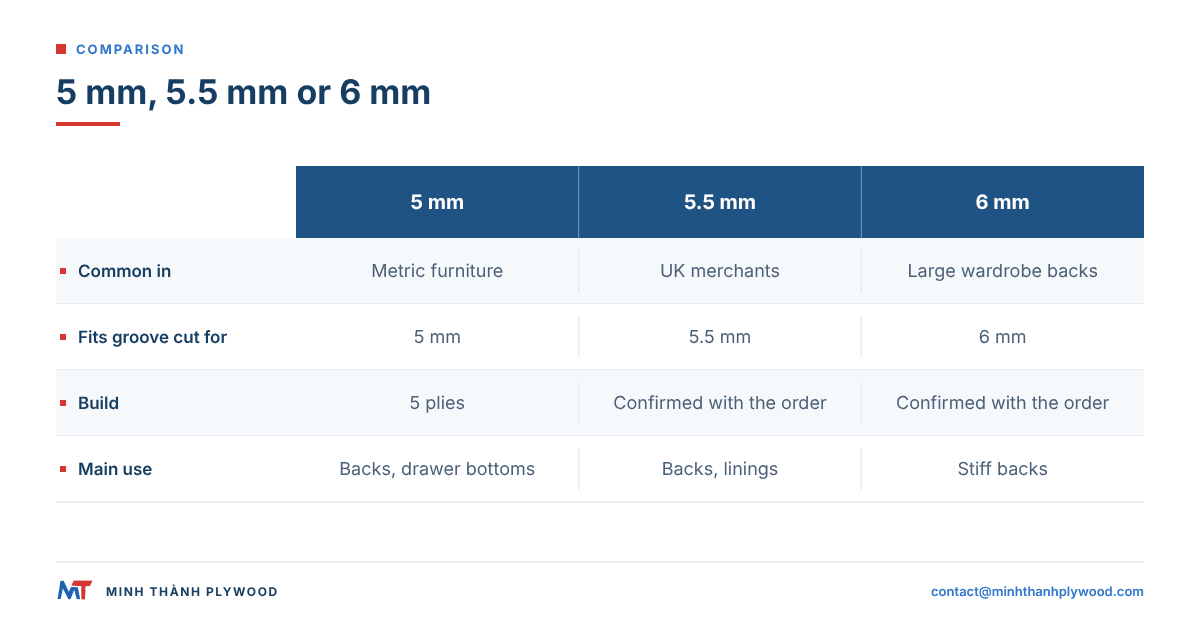
Order 5 mm for furniture drawn in metric sizes and 5.5 mm when the design or the grooves were set for the UK thin sheet. A 5.2 mm panel is the size North American buyers meet as nominal 1/4 inch. The three do the same jobs; the difference is only what fits the groove, rebate or drawing you have.
| Name on the order | Where it is common | What to check |
|---|---|---|
| 5 mm | Furniture plants in Europe and Asia, flat-pack ranges | Back grooves cut at 5 mm plus clearance |
| 5.2 mm | North America, sold as nominal 1/4 inch underlay and backs | Fits a 5 mm groove only with a loose tolerance |
| 5.5 mm | UK merchants’ standard thin sheet, also written 5.5mm plywood or 5.5 mm ply wood | Grooves cut for 5.5 mm will rattle with 5 mm |
| 6 mm | Large wardrobe backs, stiffer linings | About a fifth heavier than 5 mm |
Two figures settle most questions. A sanded 5 mm furniture panel is held to ±0.2–0.3 mm, so it measures between 4.7 mm and 5.3 mm at the outside of that band; a 5.2 mm sheet sits inside it. A 5.5 mm sheet does not, so a back groove cut for 5.5 mm needs 5.5 mm panels.
Minh Thanh quotes any thickness from 3 to 40 mm, so 5.5 mm plywood sheets are a line on the order like 5 mm; the ply count of a 5.5 mm panel is confirmed with the order, while 5 mm is always five-ply.
Is 5 mm plywood the same as 1/4 inch?
No. One quarter of an inch is 6.35 mm, so a full 1/4 inch panel is closer to 6 mm plywood than to 5 mm. The confusion comes from US practice: panels sold under the nominal name 1/4 inch are often thinner than a quarter inch, and 5.2 mm sheets are sold under that name for underlay and cabinet backs.
| Name | Actual thickness | Nearest metric panel |
|---|---|---|
| 1/4 inch, true | 6.35 mm | 6 mm |
| 7/32 inch | 5.6 mm | 5.5 mm |
| Nominal 1/4 inch underlay | often 5.2 mm | 5 mm |
| 3/16 inch | 4.8 mm | 5 mm |
US structural panels use nominal names defined in Voluntary Product Standard PS 1-22 (NIST, October 2023). Inch sizes use the exact NIST definition of 1 inch = 25.4 mm. Furniture backs are not structural panels, so the safe route when converting a US drawing is to measure the groove and order the metric panel that fits it. The 1/4 inch plywood and 1/8 inch plywood articles cover the inch sizes on either side.
Which faces and grades does 5mm ply board come in?
Any of Minh Thanh’s 10+ face veneers can go on a 5 mm panel, with the grade quoted as a face/back pair and matched to the approved sample. On thin panels the faces made most are poplar, birch, engineered veneer (EV), okoume and pine.
| Face | Grades quoted | Where 5 mm with this face goes |
|---|---|---|
| Poplar | A/A, A/B, B/B | Painted backs, drawer bottoms, laminated linings |
| Birch | D+/D, D/E (D+ is close to European B, D to BB) | Visible backs in open shelving, display units |
| Engineered veneer (EV) | Matched to the colour reference | Backs that match an oak, walnut or white-oak front |
| Okoume | Matched to the sample | Warm-toned interior panels, not a marine build |
| Pine | A/A, A/B, B/B | Pine-look furniture backs |
A back panel is seen from one side in most cabinets, so A/B is the usual pair: the A face toward the open front or the glass door, the B face against the wall. Choose A/A for open shelving seen from both sides, and B/B when the back will be painted or covered with paper or foil.
Poplar plywood is the most common choice for 5 mm backs: pale, even and light. Birch plywood faces suit backs that stay visible behind glass.
What is 5 mm plywood used for?
5 mm plywood is used where a part must close, line or separate rather than carry a load. Furniture and interior plants order it for:
- Cabinet and wardrobe backs: slid into a groove or pinned into a rebate; the main use.
- Drawer bottoms: on drawers of normal width, held in grooves on four sides.
- Door panel inserts: the thin centre panel of a frame-and-panel door.
- Furniture linings: the inside of chests, cupboards and built-ins.
- Display and shop-fitting backs: painted or laminated over a poplar face.
- Packaging inserts and dividers: where a sanded face and clean edge matter.
Move up to 6 mm for wide wardrobe backs that must stiffen the carcass, and to 9 mm for drawer sides or panels that take screws into their edge. The guide to back panels for cabinets and wardrobes compares 5 mm plywood with hardboard and MDF for the same job.
How much does a 5 mm plywood sheet weigh?
A 1220 × 2440 × 5 mm sheet weighs about 7.4 kg on a white Styrax core, 8.6 kg on Acacia and 9.7 kg on Eucalyptus. The weight is the sheet volume, 0.0149 cubic metres, times the core’s planning density.
| Core | Planning density | Weight per 1220 × 2440 × 5 mm sheet | Sheets in one cubic metre |
|---|---|---|---|
| White Styrax | 500 kg/m³ | 7.4 kg | about 67 |
| Acacia (on order) | 580 kg/m³ | 8.6 kg | about 67 |
| Eucalyptus | 650 kg/m³ | 9.7 kg | about 67 |
For a flat-pack range the core choice shows up in the carton. A wardrobe with two 5 mm backs carries over two kilograms less on Styrax than on Eucalyptus, and that difference repeats across every carton in the container. The plywood weight calculator runs the same sum for other sizes and thicknesses.
What tolerance should you ask for on 5 mm?
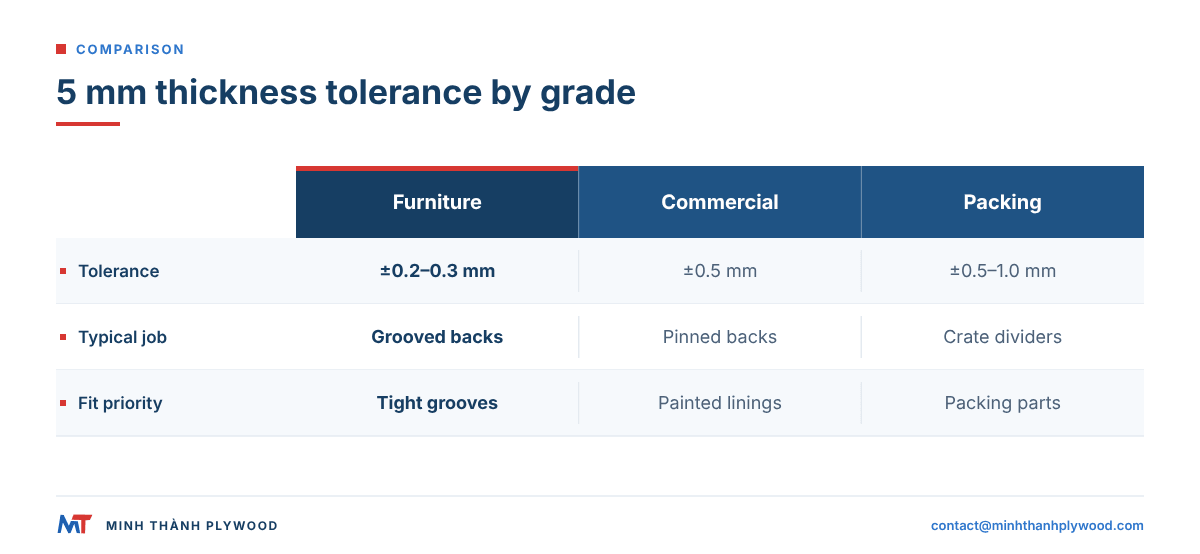
Ask for ±0.2–0.3 mm on sanded 5 mm furniture panels, and ±0.2 mm when the backs slide into grooves cut by CNC or a fixed router set-up. Length and width are held to ±2 mm.
| Product line at 5 mm | Thickness tolerance | Typical use |
|---|---|---|
| Sanded furniture plywood | ±0.2–0.3 mm, down to ±0.2 mm | Backs in grooves, drawer bottoms |
| Commercial plywood | ±0.5 mm | Pinned backs, linings, painted parts |
| Packing plywood | ±0.5–1.0 mm | Crate panels and dividers |
At 5 mm a tolerance band is a large share of the panel. Half a millimetre is a tenth of the sheet, which is why a back panel that fits one carcass can rattle or jam in the next. Minh Thanh sands both faces of furniture-grade thin panels and holds them down to ±0.2 mm when the order asks for it, so a back cut from one pack fits the same groove as a back from the next.
How do you cut, fix and bend 5 mm plywood?
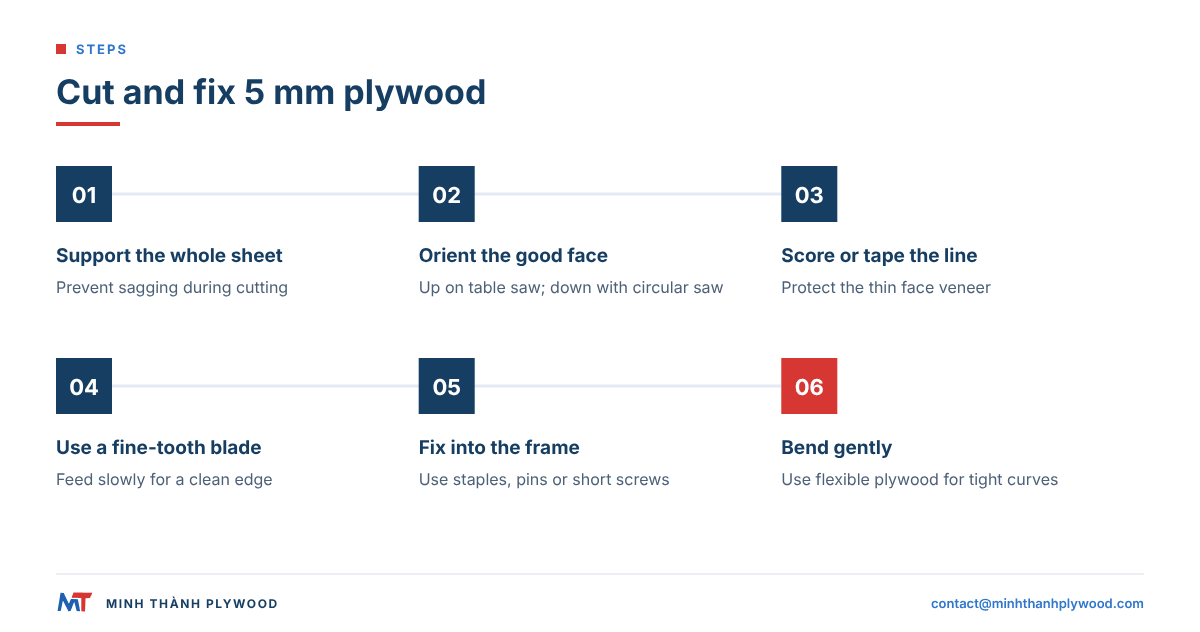
Cut 5 mm plywood with the whole sheet supported and a fine-tooth blade, fix it with staples, pins or short screws into a frame, and bend it only into gentle curves. Thin sheets fail when they flex or split at an edge, not because the wood is weak.
- Support the sheet: lay it on a full table or on sacrificial boards so it cannot sag at the cut.
- Mark the good face: face up on a table saw, face down under a circular saw or plunge saw.
- Score or tape the line: a knife cut or masking tape on the face stops the top veneer from lifting.
- Use a fine-tooth blade: many teeth and a slow feed leave a clean edge on a 0.3 mm face veneer.
- Fix away from the edge: staples or pins into a rebate, or short screws through a pre-drilled hole into the frame, not into the 5 mm edge itself.
- Bend gently: the sheet bends most easily across the grain of the face; for tight curves use a flexible plywood built for bending.
A furniture plant that runs thousands of backs a week avoids most cutting by ordering the parts cut at the mill. Cut-to-size plywood is cut from the full panel into 4, 6 or 8 pieces before packing.
Which glue and emission class does 5 mm plywood come with?
5 mm furniture plywood comes with UF glue at E0 emission as standard, and MR, melamine-fortified or phenolic (WBP) bonds on order. The glue and the emission class are two separate lines of the specification.
The emission evidence covers the thin range. Minh Thanh’s CARB P2 / TSCA Title VI certification (ICTT mill no. 23024) is for hardwood plywood with a veneer core from 3–50 mm, so 5 mm panels for the US carry the TSCA Title VI label. Six ASTM D6007 chamber tests between April 2025 and June 2026, on 9, 15 and 18 mm panels, averaged 0.014–0.032 ppm against the 0.05 ppm limit. That limit for hardwood plywood with a veneer core is set in 40 CFR 770.10. Three tests were by Shanghai Hongjun and three by ICTT Vietnam; see CARB P2 and TSCA Title VI certification.
For European buyers the panels meet the emission requirements furniture plants there ask for, and third-party testing to the buyer’s method, for example EN 717-1, is arranged through SGS on request.
How many 5 mm sheets fit in a 40HC?
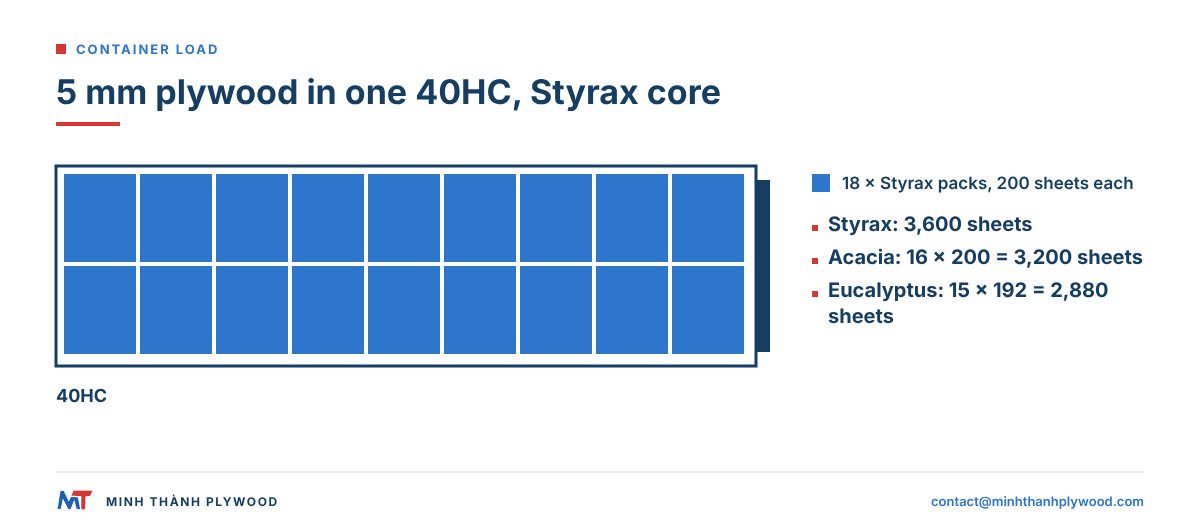
One 40HC takes 3,600 sheets of 1220 × 2440 × 5 mm on a Styrax core, 3,200 on Acacia and 2,880 on Eucalyptus. Each pack is about one metre high, so it holds 200 sheets at 5 mm, and the heaviest core stops earlier because of weight.
| Core | Packs × sheets | Sheets per 40HC | Volume | Net weight |
|---|---|---|---|---|
| White Styrax | 18 × 200 | 3,600 | 53.58 m³ | 26,791 kg |
| Acacia | 16 × 200 | 3,200 | 47.63 m³ | 27,625 kg |
| Eucalyptus | 15 × 192 | 2,880 | 42.87 m³ | 27,863 kg |
The plan uses a 28,000 kg planning payload. On Eucalyptus a full 200-sheet pack would take the load past that figure, so each pack is cut to 192 sheets. If your booking allows less, for example 26,000 kg, the count drops to match. The 18 Styrax packs go in as 16 lying flat and 2 standing upright at the door end; container loading shows the order of work.
Thin backs rarely fill a container alone. The minimum order is one 40HC with mixed specifications by agreement, so a furniture plant can load 5 mm backs with 15 or 18 mm carcass panels of the same face.
What does 5 mm plywood cost, and what moves the price?
In October 2026 furniture and interior plywood from Minh Thanh started from US$350/m³, and commercial plywood from US$250/m³, FOB Hai Phong. One cubic metre holds about 67 sheets of 1220 × 2440 × 5 mm, which turns the cubic-metre price into a sheet price on the quotation.
The lines that move the price of a thin panel:
- Face and grade: birch and A/A faces cost more than B/B poplar; a thin sheet has two faces for very little core, so the face is a large share of the cost.
- Core: Styrax, Eucalyptus, or Acacia on order.
- Glue: UF at E0 against melamine-fortified or phenolic.
- Tolerance and sanding: ±0.2 mm and sanded, UV-ready faces.
- Size and cutting: custom lengths and cut-to-size parts.
- Delivery term: FOB Hai Phong, CFR or CIF.
Thin panels are where a mill’s veneer sorting shows. A 5 mm sheet uses the thinnest core veneers the mill peels, and good thin veneer is scarce, so an order with a tight face grade is planned with the veneer stock rather than rushed.
Price and spec per sheet: 5 mm and 5.5 mm compared with UK retail
A 5 mm sheet of 1220 × 2440 mm costs from about US$3.7 at the commercial rate and from about US$5.2 at the furniture rate, raw FOB Hai Phong, against about £21 to £22 ex VAT for a UK retail flexible 5 mm sheet. The FOB figures are the cubic-metre price divided by the sheet count, before the face, core, glue and quantity set the final price; they are raw FOB examples, not a retail price.
| Sheet, 1220 × 2440 mm | Sheets per m³ | From US$250/m³ (commercial) | From US$350/m³ (furniture) |
|---|---|---|---|
| 5 mm | about 67 | about US$3.7 | about US$5.2 |
| 5.5 mm | about 61 | about US$4.1 | about US$5.7 |
UK buyers see the other end of the chain. Sheet Materials Wholesale lists 5 mm flexible plywood at £22.28 (cross grain) and £22.06 (long grain) ex VAT per sheet, and says its 5 mm range starts from about £21. A UK importer adds sea freight, duty, VAT, port charges and the merchant’s margin to the FOB figure. Compare the landed cost, not the FOB figure, with the shelf price.
The bond decides where a 5 mm sheet can be used. EN 636 sets the use class and EN 314-2 sets the bond class that backs it:
| Glue | Use class it is built for | Bond class | Where it fits |
|---|---|---|---|
| UF at E0 emission (standard) | EN 636-1, Class 1 | EN 314-2 Class 1 | Dry interiors: wardrobe and cabinet backs, drawer bottoms, linings |
| MR or melamine-fortified | EN 636-2, Class 2 | EN 314-2 Class 2 | Humid interiors such as kitchens and bathrooms, and sheltered exteriors |
| Phenolic (WBP) | EN 636-3, Class 3 | EN 314-2 Class 3 | Exterior use with sealed edges |
UK retailers state the same classes: DIY Building Supplies sells a 5.5 mm sheet to EN 636-2 with an EN 314-2 Class 2 bond for humid interiors, and Sheet Materials Wholesale sells a Class 1 sheet for dry interior work only. Ask for the bond when your sheet goes in a kitchen or bathroom, and seal the cut edges.
Plydirect also sells a nominal 5 mm sheet as 5.5 mm actual, cut to size. We cut 5 mm panels from the full sheet at the mill: see cut-to-size plywood. Bending ply is a separate build; for tight radii use flexible plywood.
How do you check a 5 mm delivery when it arrives?
Check a 5 mm delivery in four steps against the order and the approved sample.
- Count: packs and sheets per pack against the packing list.
- Thickness: a caliper at the four corners and the centre of sheets from several packs, against ±0.2–0.3 mm or the figure on the order.
- Flatness and moisture: sheets lie flat on the pack; moisture readings across the packs sit within 8–12 %.
- Faces and edges: face grade against the sample, five closed plies at the edge with no gaps.
Minh Thanh photographs and films every container before loading and sends the photos and video to the buyer, so the arrival check starts from a record of how the packs left the mill.
How do you write plywood 5 mm on a quotation request?
Write plywood 5 mm on a quotation request as one line in the order a mill quotes it: application, core, glue and emission, face and grade, size, tolerance, packing and quantity.
5 mm furniture plywood for wardrobe backs · 5-ply, white Styrax core · UF glue at E0 emission · poplar face A/B, sanded · 1220 × 2440 mm · ±0.2 mm · export packs · 3,600 sheets, 1 × 40HC, FOB Hai Phong.
Add a line for each other thickness in the same container, and say if the backs slide into grooves, because that decides the tolerance. Send the line to [email protected]; replies come within hours, with the sheet weight and load plan for that build, and free samples before the order.
Buyer questions, answered
How many plies does 5 mm plywood have?
Five. Minh Thanh builds every thin panel from 3 to 5 mm with five plies; at 5 mm that is three core veneers and two face veneers, laid with the grain alternating so the sheet stays flat.
Is 5.5 mm plywood the same as 5 mm?
No, but they do the same jobs. 5.5 mm is the thin sheet UK merchants stock, 5 mm is the metric size most furniture plants draw. The half millimetre matters only where a groove or rebate was cut for one of them.
Is 5 mm plywood the same as 1/4 inch?
Not quite: 1/4 inch is 6.35 mm, so a true 1/4 inch panel is closer to 6 mm. US panels sold as nominal 1/4 inch are often thinner, which is why 5.2 mm sheets are sold under that name.
How much does a 5 mm plywood sheet weigh?
A 1220 × 2440 × 5 mm sheet weighs about 7.4 kg on a white Styrax core, 8.6 kg on Acacia and 9.7 kg on Eucalyptus, at planning densities of 500, 580 and 650 kg/m³.
What is 5 mm plywood used for?
Cabinet and wardrobe backs, drawer bottoms, door panel inserts, furniture linings, display backs and packaging inserts. It closes or lines a part; it is not a shelf or a load-bearing board.
How do you cut 5.5 mm or 5 mm plywood without splintering?
Support the whole sheet, score or tape the cut line, and use a fine-tooth blade with the good face up on a table saw or down under a circular saw. Thin sheets splinter when they flex, so support matters more than the saw.
Can you bend 5 mm plywood?
Into gentle curves, yes. A 5-ply sheet bends most easily across the grain of its face veneer. For tight radii use a flexible plywood made for bending rather than a standard 5 mm panel.
How many sheets of 5 mm plywood fit in a 40HC?
On 1220 × 2440 mm sheets: 3,600 on Styrax core (18 packs of 200), 3,200 on Acacia (16 × 200) and 2,880 on Eucalyptus (15 × 192, capped by the 28,000 kg payload).
What tolerance does 5 mm plywood have?
Sanded 5 mm furniture panels are held to ±0.2–0.3 mm, and to ±0.2 mm when the order asks. Commercial 5 mm is held to ±0.5 mm and packing grade to ±0.5–1.0 mm.
How much is 5 mm plywood from Vietnam?
In October 2026, furniture plywood from Minh Thanh started from US$350/m³ and commercial plywood from US$250/m³, FOB Hai Phong. One cubic metre holds about 67 sheets of 1220 × 2440 × 5 mm.
Where can I buy 5 mm plywood in container quantities?
From a mill that makes thin panels on its own lines. Minh Thanh sells 5 mm by the 40HC, with mixed thicknesses in one container by agreement and free samples before the order.