
Yes, in two markets. The United States has final anti-dumping and countervailing findings on hardwood and decorative plywood from Vietnam (2026), and South Korea has charged anti-dumping duty on Vietnamese plywood since November 2020. The EU and the UK have no measure on Vietnamese plywood. Minh Thanh Plywood checked each case on 20 October 2026.
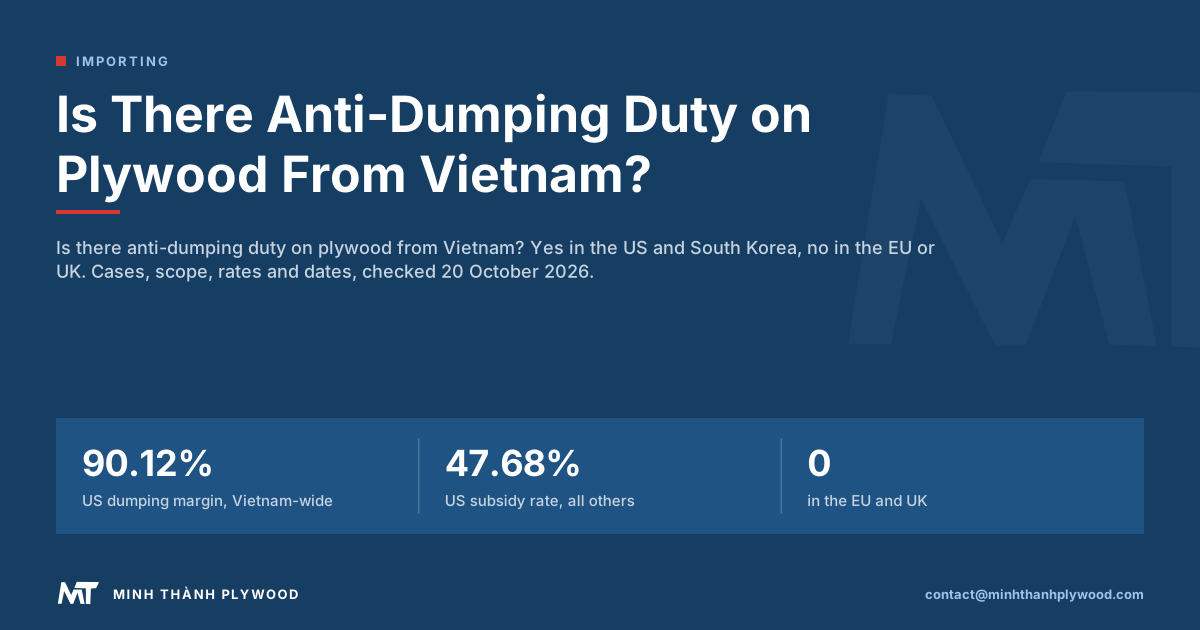
Is there anti-dumping duty on plywood from Vietnam?
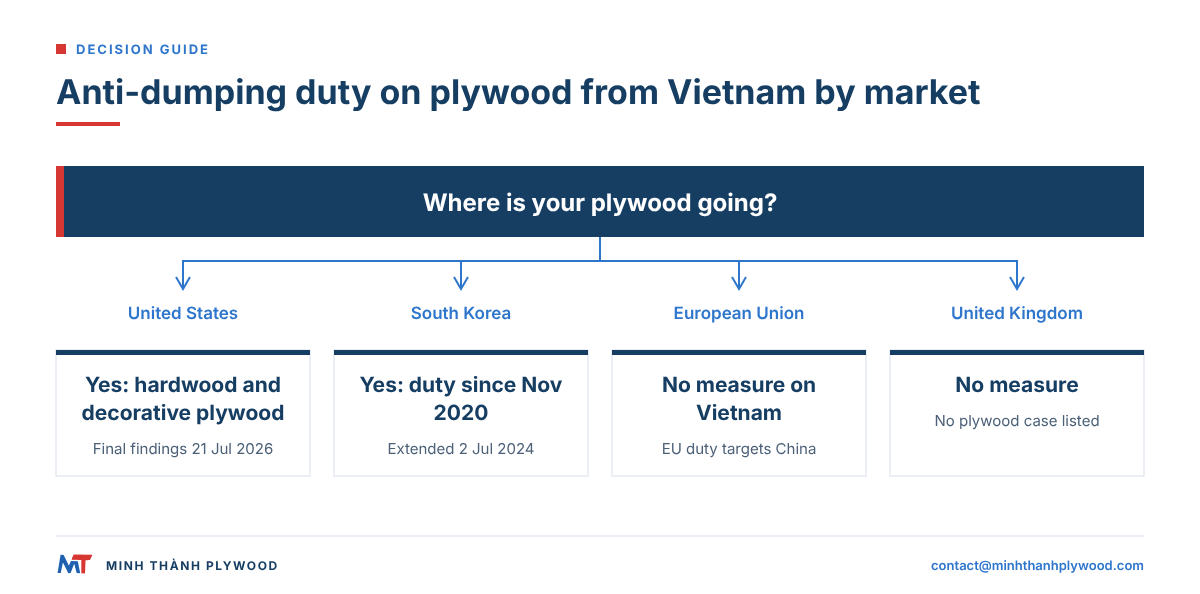
Yes, in two markets, and no in the others buyers ask about. On 20 October 2026, plywood from Vietnam faced trade-defence measures in the United States (final anti-dumping and countervailing findings on hardwood and decorative plywood, 2026) and in South Korea (anti-dumping duty since November 2020). The European Union and the United Kingdom have no anti-dumping measure on Vietnamese plywood.
Anti-dumping duty is never charged on “plywood” in general. Each measure names a product, a country of origin and, often, the producers. That is why the same panel can pay a large extra duty in one market and only the normal tariff in the next. The table below answers the question market by market, with the legal act and the date we checked it.
| Market | Measure on plywood from Vietnam? | Case or act | Product scope | Rate | Checked |
|---|---|---|---|---|---|
| United States | Yes: final findings 21 July 2026; injury found | A-552-851 (dumping), C-552-852 (subsidy) | Hardwood and decorative plywood; softwood structural plywood excluded | Dumping margin 90.12% Vietnam-wide; subsidy 47.68% all others | 20 Oct 2026 |
| United States (China orders) | Yes, for panels made with Chinese core material | A-570-051, C-570-052 (2023 circumvention ruling) | Hardwood plywood finished in Vietnam from Chinese inputs | China-wide 183.36% dumping, 22.98% subsidy | 20 Oct 2026 |
| South Korea | Yes, since 6 November 2020; extended 2 July 2024 | Ministry of Economy and Finance decree | Plywood under HS 4412.31, 4412.33, 4412.34, 4412.39, 4412.91, 4412.92, 4412.99 | Set per exporter in the decree | 20 Oct 2026 |
| European Union | No | Regulation (EU) 2025/2333 targets China only | Chinese hardwood plywood | 43.3% or 86.8% on Chinese plywood; 0 on Vietnamese | 20 Oct 2026 |
| United Kingdom | No | No plywood case on the Trade Remedies Authority list | — | 0 | 20 Oct 2026 |
For the EU, the full story of the China duty and the 2026 anti-circumvention probe sits in our article on the EU anti-dumping duty on Chinese hardwood plywood. The normal tariff, which every shipment pays, is covered in import duty on plywood from Vietnam.
Is there an anti-dumping duty on Vietnamese plywood in the US?
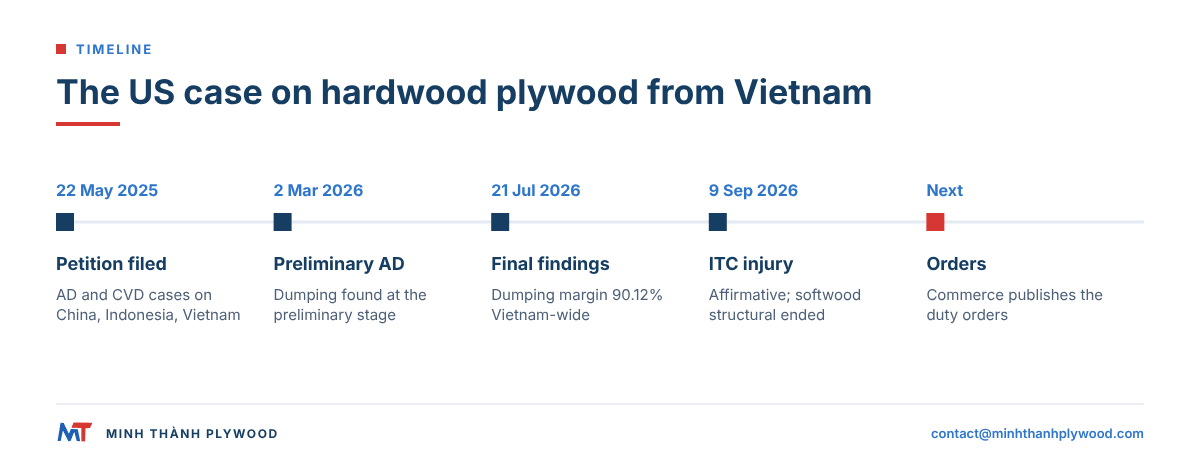
Yes. The US Department of Commerce published final affirmative findings of dumping and of subsidies on hardwood and decorative plywood from Vietnam on 21 July 2026, and the US International Trade Commission found that these imports injure the US industry. The Commission’s determination was published in the Federal Register on 9 September 2026.
The case started with a petition filed on 22 May 2025 by the Coalition for Fair Trade in Hardwood Plywood. It runs in parallel against China and Indonesia. The key numbers from the final dumping determination (FR 2026-14614) are:
- Dumping margin, Vietnam-wide entity: 90.12%.
- Cash deposit, Vietnam-wide entity: 84.95%, after the adjustment for export subsidies that are offset against the dumping deposit.
- Subsidy rate, all others: 47.68%, from the final countervailing duty determination (FR 2026-14613). Commerce lists the rates in its announcement of the final determinations.
- Period of investigation for dumping: 1 October 2024 to 31 March 2025.
Two Vietnamese producers were examined individually as mandatory respondents: Junma Phu Tho Co., Ltd. and the combined Nhat Duy Production and Trading Co., Ltd. / Trieu Thai Son Co., Ltd. The dumping margin calculated for Trieu Thai Son was given to the separate-rate companies, which is why the named producers and the Vietnam-wide entity all carry 90.12%. On subsidies, Trieu Thai Son / Nhat Duy and all other producers carry 47.68%, while Junma Phu Tho carries 165.39%. The preliminary dumping margin, published on 2 March 2026, was 196.14%; the final rate is less than half of it.
How do the rates compare with China and Indonesia?
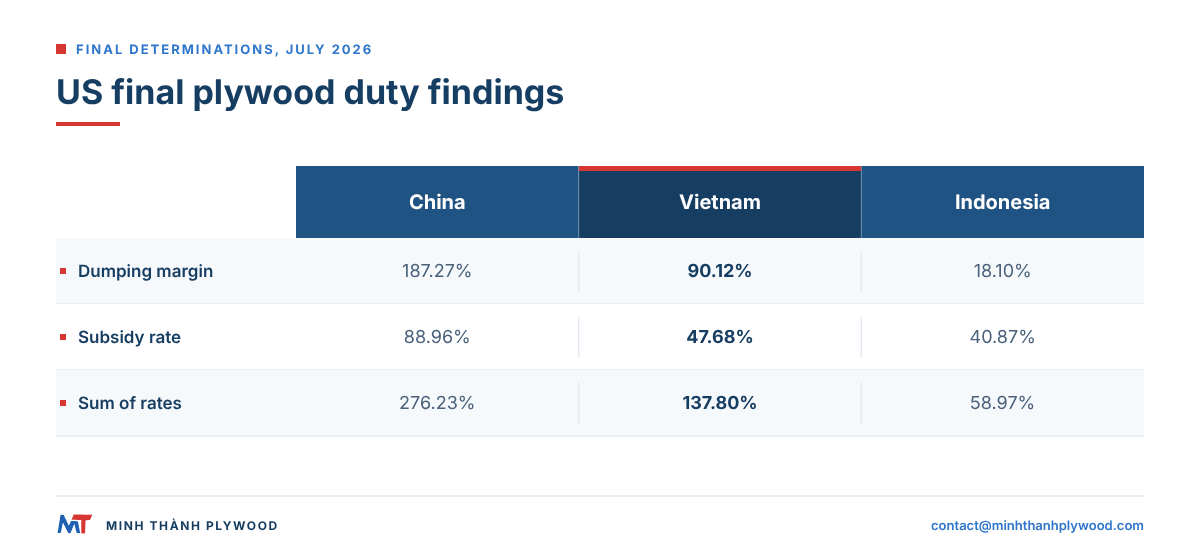
The same investigation ran against three countries, and Vietnam’s combined rate sits between Indonesia’s and China’s. Rates are from the Commerce final determinations announcement:
| Origin | Dumping margin | Subsidy rate | Combined (dumping + subsidy) |
|---|---|---|---|
| China | 187.27% | 88.96% | 276.23% |
| Vietnam (most producers) | 90.12% | 47.68% | 137.80% |
| Indonesia (all others) | 18.10% | 40.87% | 58.97% |
The combined figures are the sum of the two published rates. The cash deposit at entry is set in the order notice, which adjusts the dumping deposit for export-subsidy offsets (84.95% for Vietnam instead of 90.12%).
What does the US duty cost on a container?
Duty is a percentage of the entered customs value. On a US$100,000 entry at the Vietnam-wide dumping margin of 90.12%, the dumping deposit is US$90,120; the 47.68% subsidy rate adds US$47,680, so the two together come to US$137,800 on top of the normal tariff (rates before any offset adjustment). At the preliminary margin of 196.14% the same entry would have carried a US$196,140 dumping deposit, which shows how much the final ruling changed the picture for Vietnamese suppliers.
How big is the US market for Vietnamese plywood, and how did the case run?
US imports from Vietnam under the headings in the case, per the Commerce case summary:
| Year | Volume | Value |
|---|---|---|
| 2022 | 797,871 m3 | US$413 million |
| 2023 | 436,183 m3 | US$192 million |
| 2024 | 828,767 m3 | US$252 million |
The petitioners alleged dumping margins of 138.04-152.41% for Vietnam. The key dates:
| Date | Step |
|---|---|
| 22 May 2025 | Petition filed by the Coalition for Fair Trade in Hardwood Plywood |
| June 2025 | Commerce opens the investigations on China, Indonesia and Vietnam |
| 2 March 2026 | Preliminary dumping determination published |
| 15 July 2026 | Final determinations signed; published 21 July 2026 |
| 19 August 2026 | US International Trade Commission votes affirmative on injury |
| 9 September 2026 | Commission determination published in the Federal Register |
On 20 October 2026, the Federal Register showed no antidumping duty order for case A-552-851 yet. Commerce issues the orders after the Commission’s affirmative vote, and the order notice sets the cash deposit instructions that US Customs and Border Protection applies at entry. A US importer should read that notice, and the rate for the named exporter, before the vessel arrives.
What does the US case cover, and what is excluded?
The US case covers hardwood and decorative plywood, a wide family that includes most furniture and interior panels: plywood with a hardwood or decorative face, veneer-core or composite-core, coated or not. The Commission’s determination (FR 2026-18367) lists the HTSUS subheadings under heading 4412, from 4412.10.05 to 4412.92.42.
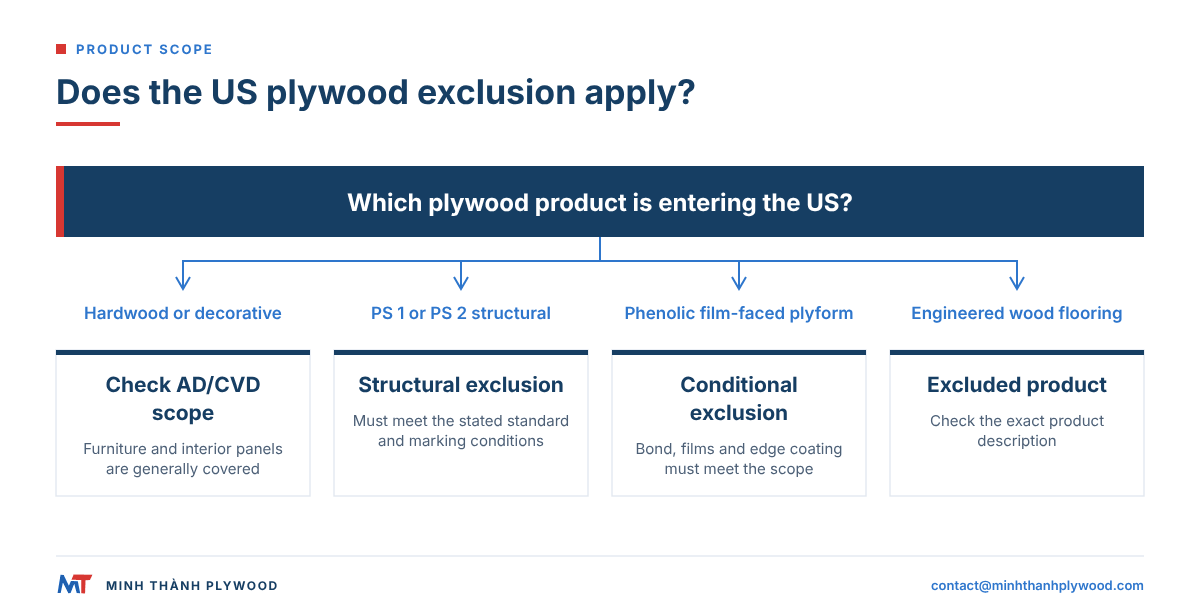
Several products are outside the scope:
- Softwood structural plywood. The Commission terminated the investigations on softwood structural plywood as negligible, and the scope excludes all softwood structural plywood.
- Structural panels to PS 1 or PS 2. Panels made and stamped to the US structural standards fall outside.
- Phenolic film-faced plyform. Excluded when the panel has an Exterior or Exposure 1 bond, an opaque phenolic film on both face and back and a moisture-resistant edge coating.
- Flooring. Engineered wood flooring is outside.
- Ready-to-assemble furniture. Furniture kits are not plywood under the scope.
Each exclusion has conditions written into the scope language. A product that meets only part of a condition is inside the case. A US buyer of decorative film or overlaid panels should have the customs broker read the scope against the exact build.
How does the 2023 circumvention ruling affect plywood from Vietnam?
The 2023 ruling applies the US duties on Chinese hardwood plywood to panels finished in Vietnam with Chinese-made core material. Commerce published it in FR 2023-15431 on July 20, 2023, under the China orders A-570-051 and C-570-052.
The ruling lists five production scenarios. All of them put Chinese core material inside a panel completed in Vietnam: assembled core platforms, glued multi-ply core sheets or individual core veneers made in China, with faces from China, Vietnam or a third country. Panels in those scenarios pay the China duties.
Panels made in Vietnam outside the five scenarios pay no China cash deposit, on one condition: the exporter signs an exporter certification and keeps the records that support it, and the importer signs an importer certification and keeps its own records. Exporters named as non-cooperating in the ruling cannot use the certification and pay the China-wide rates of 183.36% (dumping) and 22.98% (subsidy).
For a buyer, the practical question is simple: where was the core made? At Minh Thanh, furniture panels use white Styrax or Eucalyptus cores, peeled from plantation timber grown around Ha Hoa, Phu Tho. The core veneers, the stitching of the core layers and both pressings happen in our factory.
Is there anti-dumping duty on Vietnamese plywood in the EU?
No. No EU anti-dumping or anti-subsidy measure targets plywood from Vietnam. The EU’s plywood duties name other origins:
- Hardwood plywood from China: definitive duty under Implementing Regulation (EU) 2025/2333 of 19 November 2025.
- Rate: 43.3% for one named exporter and 86.8% for all other Chinese companies.
- Slightly modified hardwood plywood from China: an anti-circumvention investigation opened by Implementing Regulation (EU) 2026/1840 of 23 July 2026, on panels with thin softwood or bamboo outer plies; imports from China are registered while it runs.
- Softwood plywood from Brazil: definitive duty under Implementing Regulation (EU) 2026/822 of 14 April 2026.
- Rate: 5.4%.
A Vietnamese panel pays the normal EU customs duty, or the preferential rate under the EU-Vietnam Free Trade Agreement when the shipment carries valid origin proof. Our article on the EU import duty on Vietnamese plywood under EVFTA sets out the 4412 tariff lines and the origin rules.
The one EU point that touches Vietnam is origin. Customs can question a Vietnamese certificate of origin when the panel was only finished in Vietnam from Chinese plywood, because the duty follows the true origin of the goods.
Does the UK charge anti-dumping duty on Vietnamese plywood?
No. The UK Trade Remedies Authority’s public list of cases held no plywood case on 20 October 2026, so the UK applies no anti-dumping duty to plywood from Vietnam or China.
Since 2021 the UK runs its own trade-remedy cases. EU measures adopted after the UK left the EU, including the 2025 EU duty on Chinese hardwood plywood, do not apply in Great Britain. Plywood from Vietnam pays the UK Global Tariff rate or the preferential rate under the UK-Vietnam Free Trade Agreement with origin proof.
South Korea’s anti-dumping duty on Vietnamese plywood
South Korea is the one Asian market with a standing anti-dumping duty on plywood from Vietnam. Korea opened the investigation in December 2019, applied a provisional duty from May 2020 and imposed the definitive duty by decree No. 815 of the Ministry of Economy and Finance on 6 November 2020, later amended by decree No. 882 of 31 December 2021.
The petitioner for the sunset review was the Korea Wood Panel Association. The review opened in July 2023, and Korea extended the duty on 2 July 2024, as recorded by Global Trade Alert and the Vietnam trade remedies portal.
The measure covers plywood under HS 4412.31, 4412.33, 4412.34, 4412.39, 4412.91, 4412.92 and 4412.99. Rates are set exporter by exporter in the decree, so a Korean importer asks the supplier for its rate in the current decree before signing. Typical sea time from Hai Phong to Korea is about 2–3 weeks.
Which other markets should a plywood importer check?
Every market that runs its own trade-defence system can open a case, so an importer checks its own list even where no case is known. These are the official places to look:
| Market | Where measures are listed | What to search |
|---|---|---|
| European Union | TARIC consultation | Full 10-digit code, origin VN; additional codes show any duty |
| United Kingdom | UK Trade Tariff and the Trade Remedies Authority case list | Commodity code with origin Vietnam |
| United States | Commerce AD/CVD case pages and the Federal Register | Case numbers A-552-851, C-552-852, A-570-051, C-570-052 |
| Canada | Canada Border Services Agency, measures in force under SIMA | Plywood, by product and origin |
| Australia | Anti-Dumping Commission, Dumping Commodity Register | Plywood, by product and origin |
| South Korea | Korea Trade Commission and the Ministry of Economy and Finance decree | Plywood, exporter name |
| India | Directorate General of Trade Remedies, final findings | Plywood, by product and origin |
A search by product name alone is not enough: some measures cover one face species or one construction. Search with the full tariff code your broker uses, and read the product description in the act against your specification.
How do you check whether a duty applies to your plywood, step by step?
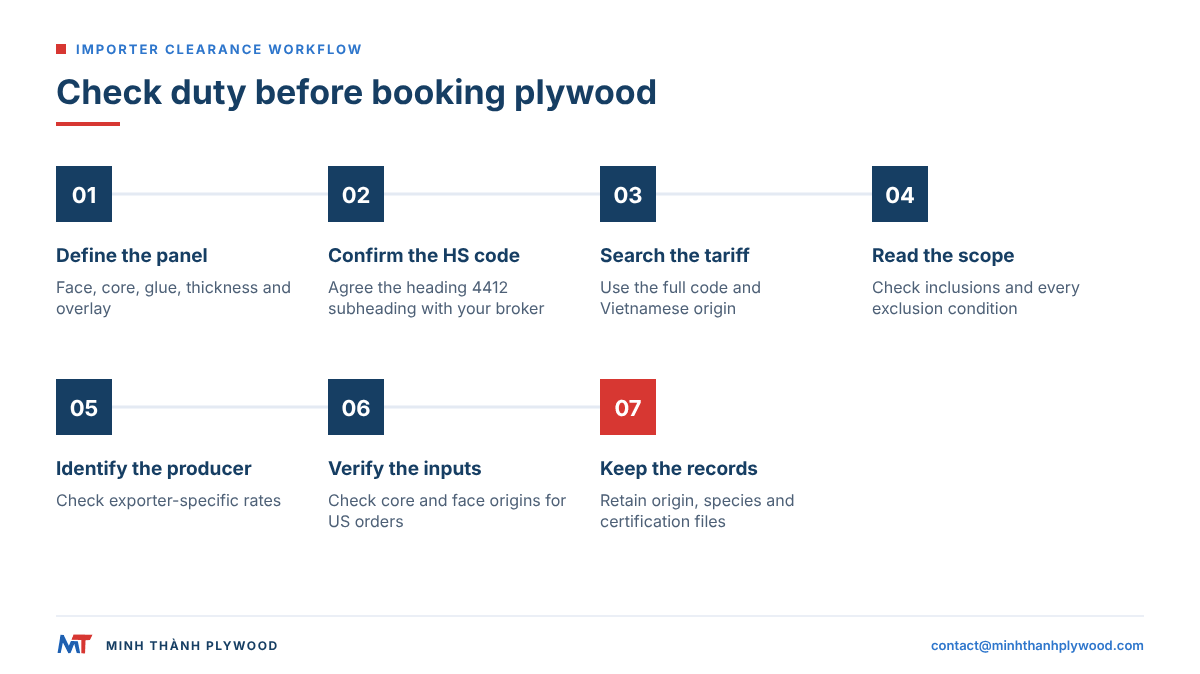
You check a plywood duty from the product outwards: the build decides the code, the code and the origin decide the measure. In practice:
- Fix the build. Face species, core species, glue, thickness and any overlay, as in the order specification.
- Agree the HS code with your customs broker. Plywood is heading 4412; the subheading depends on the outer plies and the ply thickness. Our article on the plywood HS code 4412 explains the lines.
- Look up the code with origin Vietnam in your tariff database. Read every additional code or measure shown.
- Read the scope of any measure against your build, including the exclusions.
- Check the producer. Some measures have one rate per exporter; the commercial invoice must name the producer the rate belongs to.
- Check the inputs. For the US, confirm where core and faces were made, because of the 2023 circumvention ruling.
- Keep the file. Store the certificate of origin, the species data and the certifications with the entry.
Anti-dumping duty vs import duty: what is the difference?
Import duty is the normal tariff that every shipment of a product pays; anti-dumping duty is an extra charge on one product from a named country, set after an investigation. The two are added together.
| Import duty | Anti-dumping duty | |
|---|---|---|
| Applies to | Every origin, at the normal or preferential rate | One product from one named country |
| Set by | The tariff schedule and trade agreements | An investigation into dumping and injury |
| Rate | Per tariff line | Per country, often per producer |
| Changed by | Tariff changes, trade agreement staging | Reviews, expiry after five years unless renewed |
| Lowered by origin proof? | Yes, under a trade agreement | No; the right origin only shows whether the measure applies |
| Example | EU duty on Vietnamese plywood under EVFTA | EU duty on Chinese hardwood plywood, 86.8% |
Countervailing duty works like anti-dumping duty, but it answers subsidies instead of low export prices. The US case on Vietnamese plywood has both.
How is anti-dumping duty calculated on a plywood shipment?
Anti-dumping duty is a percentage of the customs value of the goods, charged on top of the normal duty. The EU, for example, applies its rate to the net, free-at-Union-frontier price before duty, which is close to the CIF value.
A worked example, with the EU rate for Chinese hardwood plywood: a container with a CIF value of US$20,000 at an EU port would pay US$17,360 in anti-dumping duty at 86.8%, before normal duty and VAT. The same container from Vietnam pays no anti-dumping duty in the EU.
In the US, the importer pays a cash deposit at entry, at the rate in the order or the latest review. The final amount is fixed later, in an administrative review of the entries, so the deposit can be refunded in part or raised.
Why the origin of the veneer matters for duty
The origin of a panel’s core and faces decides which duties apply, because both the US circumvention ruling and EU origin rules look inside the panel. A certificate of origin from Vietnam is the start of the file, not the whole of it.
These are the records that answer an origin question for a Minh Thanh panel:
- Core: white Styrax or Eucalyptus core veneers from plantation timber grown in the Ha Hoa area, peeled, dried to 8–12 % and pressed in our factory.
- Faces: chosen for the look the buyer orders, including imported birch and okoume; the face species and its country of harvest go on the order documents.
- Production record: the core is pressed and calibrated, then face and back are pressed on, so the panel is made from veneer in Vietnam, not finished from imported plywood.
- Origin files: the EUDR compliance dossier (origin records and geolocation files) for EU orders, and the face and core species with their harvest origin for a US Lacey Act declaration.
Origin documents and their legalisation are covered in our guide to origin marking and document legalisation.
What does this mean for your order?
For most markets, nothing changes in the order itself: plywood from Vietnam enters the EU, the UK and most of Asia, the Middle East and Africa at the normal or preferential tariff. Three cases need a step at the order stage.
- US orders of hardwood or decorative plywood: read the order notice and the exporter’s rate before you book; agree the scope analysis with your broker; keep the circumvention certifications.
- Korean orders: ask for the supplier’s rate in the current Korean decree.
- EU and UK orders: ask for valid origin proof for the preferential rate; keep the build data that shows the panel was made in Vietnam.
Minh Thanh ships furniture and interior plywood from 3 mm to 40 mm, with Europe as our main market. The minimum order is one 40HC with mixed specifications by agreement; production takes 15–45 days after the 30% deposit, FOB Hai Phong, CFR or CIF.
What to send with your request for quotation
A request that names the destination and the documents lets us prepare the right origin file from day one. With your specification, send:
- Application: furniture, cabinets, interior, packing or other.
- Core: Styrax or Eucalyptus.
- Glue and emission: UF glue at E0 emission, MR or phenolic (WBP).
- Face and grade: for example poplar A/B, birch D+/D, EV.
- Size and thickness: 1220 × 2440 mm, 1250 × 2500 mm or a custom size.
- Packing and quantity: packs per container, labels, mixed loads.
- Destination port and HS code your broker uses, and the origin proof your customs asks for.
Send it to contact@minhthanhplywood.com or through the quote form; we reply within hours, and free samples go out on request.
Buyer questions, answered
Is there anti-dumping duty on plywood from Vietnam?
Yes in the United States and South Korea. The US made final dumping and subsidy findings on Vietnamese hardwood and decorative plywood in July 2026, and Korea has charged anti-dumping duty since November 2020. The EU and the UK have no measure on plywood from Vietnam.
Is there an anti-dumping duty on Vietnamese plywood in the US?
Yes. Commerce found dumping and subsidies on hardwood and decorative plywood from Vietnam on 21 July 2026, and the US International Trade Commission found injury, published 9 September 2026. Softwood structural plywood is outside the case.
Is there anti-dumping duty on Vietnamese plywood in the EU?
No. The EU's hardwood plywood duty of 43.3% to 86.8% applies to plywood originating in China, and its 2026 anti-circumvention probe also concerns imports from China. Vietnamese plywood pays only the normal customs duty, or the EVFTA rate with valid origin proof.
Does the UK have anti-dumping duty on Vietnamese plywood?
No. The UK Trade Remedies Authority's public case list showed no plywood case on 20 October 2026, so plywood from Vietnam pays the normal UK tariff or the UK-Vietnam agreement rate.
What is South Korea's anti-dumping duty on Vietnamese plywood?
Korea imposed a definitive anti-dumping duty on plywood from Vietnam by decree of 6 November 2020 and extended it on 2 July 2024 after a sunset review. Rates are set per exporter, so a Korean importer checks the supplier's rate in the current decree.
Can Vietnamese plywood with Chinese veneer be charged Chinese duty?
Yes, in the US. A 2023 circumvention ruling applies the China plywood orders to panels finished in Vietnam with Chinese-made core material. Panels outside those five scenarios need exporter and importer certifications.
Is film-faced plywood from Vietnam covered by the US duty?
Phenolic film-faced plyform that meets the exclusion's conditions is outside the US case: an Exterior or Exposure 1 bond, an opaque phenolic film on both faces and sealed edges. Other decorative or overlaid panels may be inside the scope.
How do I check whether a duty applies to my plywood?
Search the tariff database of your country with the full HS code and Vietnam as origin: TARIC for the EU, the UK Trade Tariff, the US ACE and AD/CVD case lists. Any anti-dumping duty appears as an additional code against that line.
Is anti-dumping duty the same as import duty?
No. Import duty is the normal tariff on every shipment of a product. Anti-dumping duty is an extra charge on one product from a named country, set after an investigation, and it is added on top of the normal duty.
Does Minh Thanh supply origin documents for duty checks?
Yes. Every shipment comes with a certificate of origin, and US orders carry the face and core species with their Vietnamese harvest origin. EU orders come with the EUDR compliance dossier, which holds the origin records and geolocation files.