
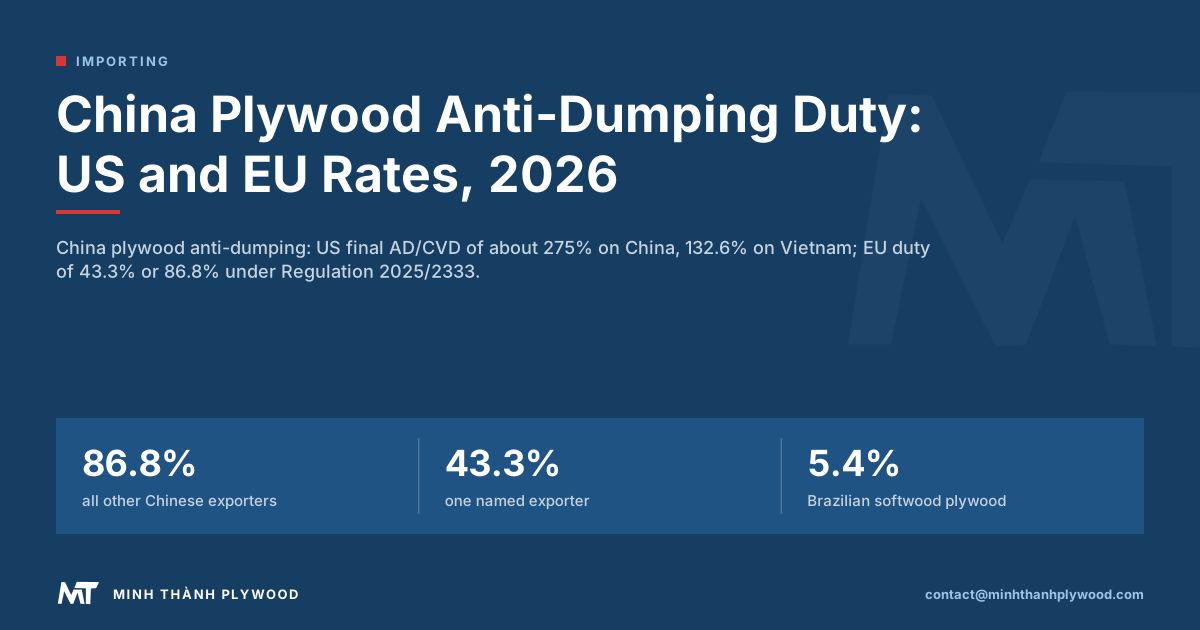
In the US, hardwood and decorative plywood from China pays a final anti-dumping margin of 187.27% plus 88.96% countervailing duty (Commerce, 21 July 2026), and plywood from Vietnam pays 84.95% plus 47.68%. The EU charges 86.8%, or 43.3% for one named exporter, under Implementing Regulation (EU) 2025/2333, with no measure on Vietnam. Minh Thanh Plywood sets out both cases, their scope and the origin points below.
What is the EU anti-dumping duty on Chinese plywood?
The EU anti-dumping duty on Chinese plywood is a definitive duty of 86.8% on hardwood plywood from China, or 43.3% for one cooperating exporter. It covers hardwood plywood with an outer ply of non-coniferous wood, and the rate that applies depends on the exporter named on the invoice.
Commission Implementing Regulation (EU) 2025/2333 of 19 November 2025 imposed the duty. It was published in the Official Journal on 20 November 2025 and also collected the provisional duty earlier secured.
The measure answers a finding that hardwood plywood from China was sold in the EU below its normal value and injured EU producers. It applies on top of the normal customs duty, at the EU border, whoever the importer is.
Three points decide whether a shipment pays it: the panel’s build (an outer ply of tropical or non-coniferous wood), its origin (China) and its producer (one named exporter or all others). The US runs a separate and harsher case, set out first below because it also reaches Vietnam; the EU rates, scope, the 2026 anti-circumvention probe and the position of plywood from Vietnam follow.
US anti-dumping and countervailing duty on Chinese plywood
In the US, Chinese hardwood and decorative plywood pays a dumping margin of 187.27% (cash deposit 185.96%) plus a countervailing duty of 88.96%, about 275% combined. The same case covers Indonesia and Vietnam, which matters more for US buyers: in 2024 the US imported 154,516 m³ of these panels from China, against 787,821 m³ from Indonesia and 828,767 m³ from Vietnam, by Commerce’s import table.
These are the final determinations that the Department of Commerce announced.
Commerce announced them on 16 July 2026 and published them in the Federal Register on 21 July 2026.
The case began with petitions filed in May 2025 by the Coalition for Fair Trade in Hardwood Plywood (Columbia Forest Products, Commonwealth Plywood, Manthei Wood Products, States Industries and Timber Products). Its milestones in the Federal Register:
| Date | Step | Source |
|---|---|---|
| 16 June 2025 | Countervailing duty investigations opened on China, Indonesia and Vietnam | 90 FR, 2025-11075 |
| 22 January 2026 | Preliminary countervailing duties: China 81.34%, Vietnam 4.37–26.75%, Indonesia 2.40–128.66% | 91 FR, 2026-01187 (Vietnam), 2026-01185 (China), 2026-01186 (Indonesia) |
| 2 March 2026 | Preliminary anti-dumping duties: China 187.27%, Vietnam 196.14%, Indonesia 3.94–84.94% | trade.gov |
| 21 July 2026 | Final anti-dumping and countervailing determinations for all three countries | 91 FR 45782–45787, Vietnam notice |
| 19 August 2026 | ITC final vote: US industry materially injured; softwood structural plywood dropped as negligible | 91 FR 57383 |
The final rates, by country, as Commerce published them:
| Country | Producer | Anti-dumping margin | AD cash deposit | Countervailing duty |
|---|---|---|---|---|
| China | China-wide entity (all exporters) | 187.27% | 185.96% | 88.96% |
| Indonesia | PT Wijaya Cahaya Timber / PT Wijaya Triutama Plywood Industri | 15.40% | 15.39% | 58.39% |
| Indonesia | PT Sengon Indah Mas / PT Java Wood Industri | 23.88% | 23.78% | 4.22% |
| Indonesia | PT Mustika Buana Sejahtera | 84.94% | 84.94% | 128.66% |
| Indonesia | All others | 18.10% | 18.06% | 40.87% |
| Vietnam | Junma Phu Tho Co., Ltd. | 90.12% | 84.95% | 165.39% |
| Vietnam | Trieu Thai Son / Nhat Duy Production and Trading | 90.12% | 84.95% | 47.68% |
| Vietnam | All other producers, including the Vietnam-wide entity | 90.12% | 84.95% | 47.68% |
Case numbers for the Commerce record (ACCESS) are A-570-211 and C-570-212 for China, A-560-844 and C-560-845 for Indonesia, and A-552-851 for Vietnam. Orders that follow an affirmative ITC vote run for at least five years and can be reviewed each year.
The older US orders on certain hardwood plywood from China, from January 2018 (A-570-051 and C-570-052), still stand: Commerce continued them after the sunset review. The continuation applies from 25 May 2023. Panels covered by those orders are excluded from the 2026 China case, so they keep paying the 2018 rates instead.
Which plywood does the US duty cover?
The US scope is wider than the EU’s. It covers any flat panel of two or more wood veneers, with or without a core, where the face or the back veneer is hardwood, softwood or bamboo, whatever the surface coating (paint, paper, HPL, MDO, phenolic film) and whatever the dimension. The core can be veneer, particleboard or MDF, so veneered MDF and particleboard panels are in. Panels made to ANSI/HPVA HP-1-2024 are typical subject goods.
The scope also follows the panel through minor processing: plywood trimmed, cut to size, drilled or notched in a third country stays subject to the duty of the country where it was made.
The main exclusions, from Appendix I of the final notice for Vietnam:
- Structural plywood stamped to PS 1 or PS 2 with a core made entirely of the listed North American softwood species (Douglas fir, southern pine, spruces, firs and others).
- Phenolic film faced plyform, with Exterior or Exposure 1 bond and at least 90 g/m² of opaque phenolic film on both faces (the notice prints “90g/m3”) and a moisture-resistant coating on the edges.
- Assembled and ready-to-assemble furniture, kitchen cabinets, RTA bathroom vanities, finished table tops and finished countertops.
- Panels with cork faces, solid bamboo products, non-flat shaped plywood and multilayered wood flooring.
- Certain LVL door and window components and LVL door stiles and rails within set dimensions.
Goods are mainly declared under HTSUS 4412.10, 4412.31 to 4412.34, 4412.39, 4412.41, 4412.42, 4412.51, 4412.52 and 4412.91 to 4412.99, but the written description decides, not the code.
Does the US anti-dumping duty apply to plywood from Vietnam?
Yes. Since the final determinations, hardwood and decorative plywood made in Vietnam pays an anti-dumping cash deposit of 84.95% and a countervailing duty of 47.68% for almost every producer, 132.63% in all, on top of normal US duty. Commerce gave the same 90.12% margin to all 52 Vietnamese companies with a separate rate and to the Vietnam-wide entity; only Junma Phu Tho has a higher countervailing rate, 165.39%.
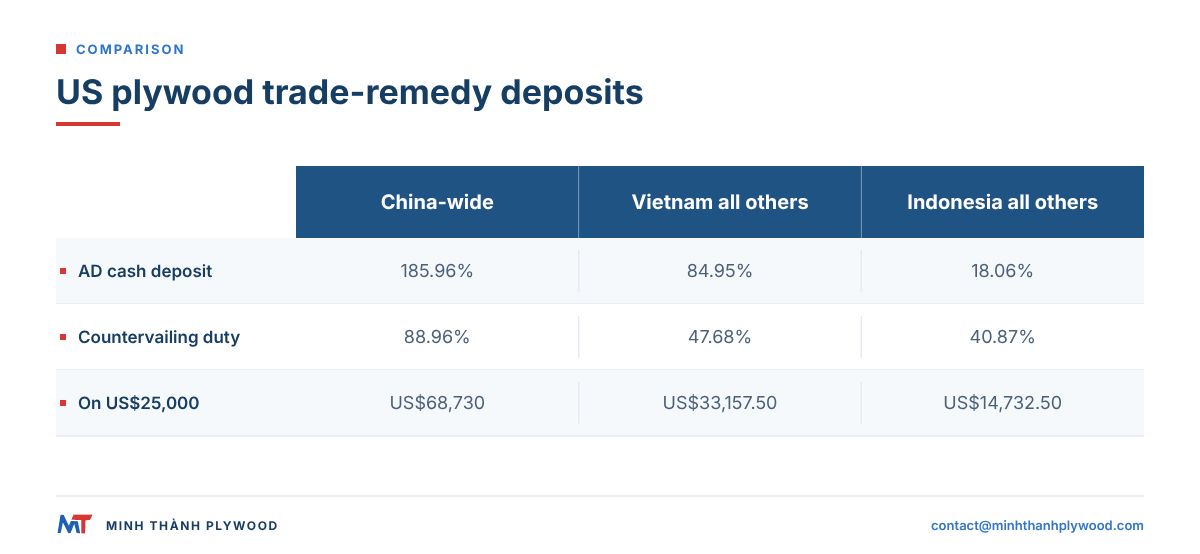
| US entry, value US$25,000 | AD cash deposit | CVD | Trade-remedy deposits |
|---|---|---|---|
| Chinese hardwood plywood (China-wide) | 185.96% = US$46,490 | 88.96% = US$22,240 | US$68,730 |
| Vietnamese hardwood plywood (all others) | 84.95% = US$21,237.50 | 47.68% = US$11,920 | US$33,157.50 |
| Indonesian hardwood plywood (all others) | 18.06% = US$4,515 | 40.87% = US$10,217.50 | US$14,732.50 |
The importer of record pays these deposits to CBP at entry. For a US buyer, Vietnamese furniture plywood has stopped being the duty-free alternative to China it was in 2024. Before a US order, check the panel against the scope exclusions with your customs broker; for the EU, the UK and other markets the US deposits do not apply.
For Europe the position is the reverse: no EU measure applies to Vietnamese plywood, which is why Europe stays our main market. The rest of this page covers the EU duty on Chinese plywood in detail.
EU anti-dumping duty on Chinese plywood: rates by exporter
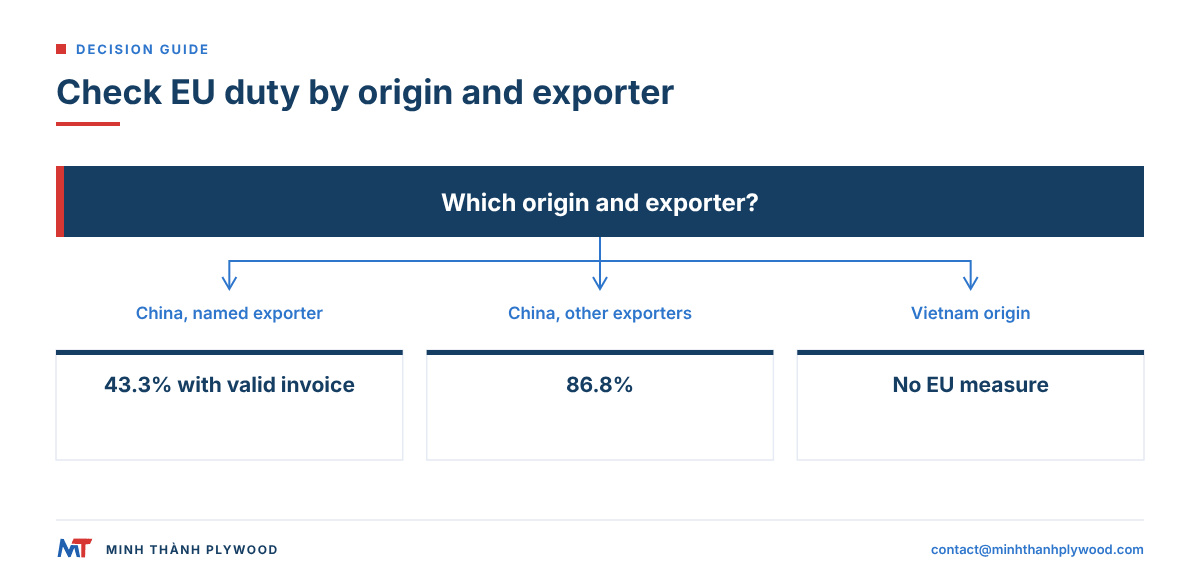
The regulation sets two rates, both on the net, free-at-Union-frontier price before duty:
| Exporter group | Definitive duty | TARIC additional code | Condition |
|---|---|---|---|
| One named cooperating exporter | 43.3% | 89MK | A valid commercial invoice carrying the declaration set out in Article 1(3) |
| All other companies in China | 86.8% | 8999 | — |
The individual rate is not automatic. Customs applies it only when the importer presents a commercial invoice with a dated, signed declaration by an official of the issuing company, worded as the regulation prescribes. Until that invoice is presented, the 86.8% rate applies.
Some summaries quote 43.2% for the cooperating exporter. The rate in the table of Article 1(2) is 43.3%.
Which plywood does the EU duty cover?
The duty covers plywood made only of wood sheets other than bamboo and okoumé, each ply up to 6 mm thick, with at least one outer ply of tropical or non-coniferous wood of the species listed in subheadings 4412 31, 4412 33 and 4412 34, whether or not coated or surface-covered, and originating in China.
In customs terms, that is nine TARIC codes: 4412 31 10 80, 4412 31 90 00, 4412 33 10 12, 4412 33 10 22, 4412 33 10 82, 4412 33 20 10, 4412 33 30 10, 4412 33 90 10 and 4412 34 00 10. These are the codes for plywood with a tropical outer ply (4412 31), with an outer ply of birch, poplar, maple, cherry and the other temperate hardwoods listed in 4412 33, or with another non-coniferous outer ply (4412 34).
In everyday trade names, the measure reaches most Chinese furniture and decorative plywood: poplar-faced, birch-faced, bintangor- or other tropical-faced, and engineered-veneer panels classed under those lines. Our article on the plywood HS code 4412 explains how the outer ply decides the subheading.
Which plywood falls outside the EU duty?
Panels outside the product definition pay no duty under 2025/2333, even from China:
- Plywood with bamboo plies, which the definition excludes.
- Plywood with okoumé plies, also excluded by name.
- Softwood plywood, with both outer plies of coniferous wood (4412 39), unless the 2026 anti-circumvention probe extends the measure to slightly modified panels.
- LVL, blockboard and other panels classed under subheadings outside 4412 31, 4412 33 and 4412 34.
- Plywood with a ply over 6 mm, which is outside the definition.
An importer should still read the regulation’s text against the exact build. The probe opened in 2026 exists because some panels were built to sit just outside the lines above.
Chinese plywood anti-dumping: the 2026 anti-circumvention investigation
On 23 July 2026, the Commission opened an investigation into possible circumvention of the Chinese plywood duty, by Implementing Regulation (EU) 2026/1840, published on 24 July 2026. The request came on 9 June 2026 from the Greenwood Consortium.
The product under investigation is “slightly modified hardwood plywood from the People’s Republic of China”:
- Plywood with both outer plies of coniferous wood or bamboo, each outer ply less than 2.5 mm thick, with a core of tropical or non-coniferous plies.
- Plywood with both outer plies of engineered veneer made of mixed wood with at least 50 % coniferous or bamboo veneer, each outer ply less than 2.5 mm thick, on the same kind of core.
- Declared under CN codes ex 4412 10 00 and ex 4412 39 00.
The request argues that, after the 2025 duty, exports of the duty-paying panels were replaced by these modified panels. During the investigation, customs in every member state registers the imports, so that the duty can be collected back to the date of registration if circumvention is found. Registration ends nine months after the regulation entered into force.
The investigation names only imports from China. It does not concern plywood from Vietnam.
How is China plywood anti-dumping duty calculated?
The duty is a percentage of the net, free-at-Union-frontier price before duty, which is close to the CIF value of the goods at the EU port. It is added to the normal customs duty, and import VAT is charged on the total.
| Shipment | Value at EU frontier | Rate | Anti-dumping duty |
|---|---|---|---|
| Chinese hardwood plywood, all other exporters | US$25,000 | 86.8% | US$21,700 |
| Chinese hardwood plywood, named exporter with valid invoice | US$25,000 | 43.3% | US$10,825 |
| Plywood made in Vietnam | US$25,000 | No measure | 0 |
The example leaves out normal duty, VAT, freight inside the EU and broker fees. A duty of that size changes the landed cost of a panel by more than any freight or exchange-rate move, which is why customs checks origin closely on these lines.
Is there anti-dumping duty on Vietnamese plywood in the EU?
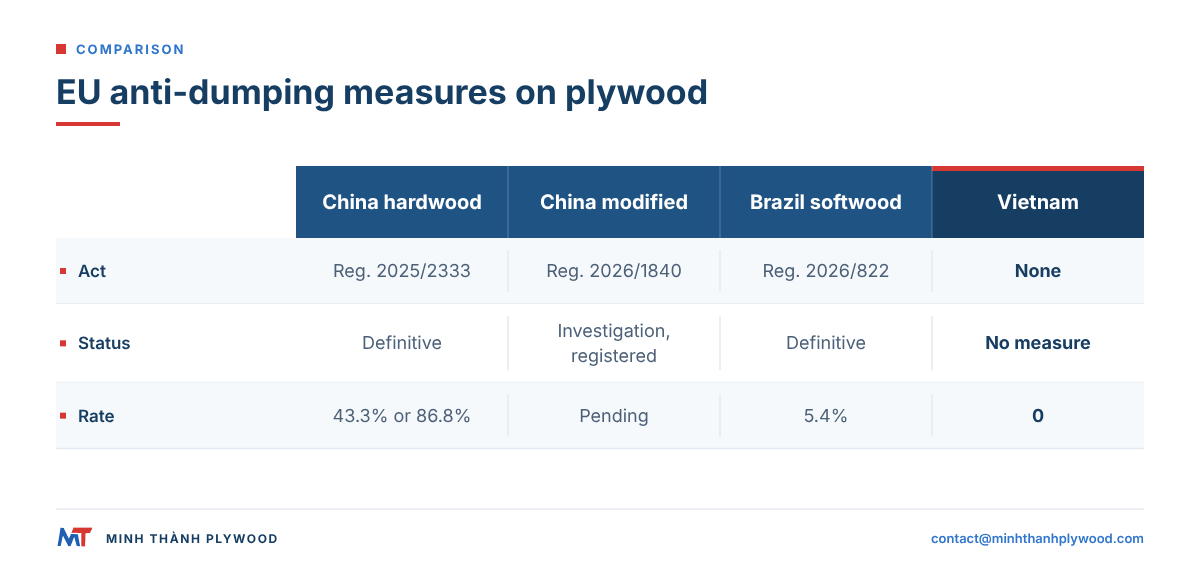
No. No EU anti-dumping or anti-subsidy measure applies to plywood from Vietnam, and the 2026 anti-circumvention probe concerns imports from China. On 20 October 2026, the EU’s measures on plywood named China (hardwood plywood) and Brazil (softwood plywood), and none named Vietnam.
Plywood made in Vietnam pays the normal EU duty for its tariff line, or the preferential rate under the EU-Vietnam Free Trade Agreement when the shipment carries valid origin proof. That rate and the origin rules are covered in EU import duty on Vietnamese plywood under EVFTA.
The status in other markets differs: the US charges 84.95% anti-dumping and 47.68% countervailing duty on Vietnamese hardwood plywood (see the US section above), and South Korea also has a measure. Our country-by-country table is in anti-dumping duty on plywood from Vietnam.
What does origin mean for plywood made in Vietnam?
For duty, origin is the country where the panel was made, not the country it was shipped from. A panel peeled, dried, glued and pressed from veneer in Vietnam is Vietnamese. Chinese plywood that is only sanded, cut, faced or repacked in Vietnam stays Chinese, and the EU duty follows it.
That line is where the circumvention risk sits for EU importers. When a Vietnamese certificate of origin covers a panel that was really made in China, the importer owes the duty, often years later, once customs establishes the true origin.
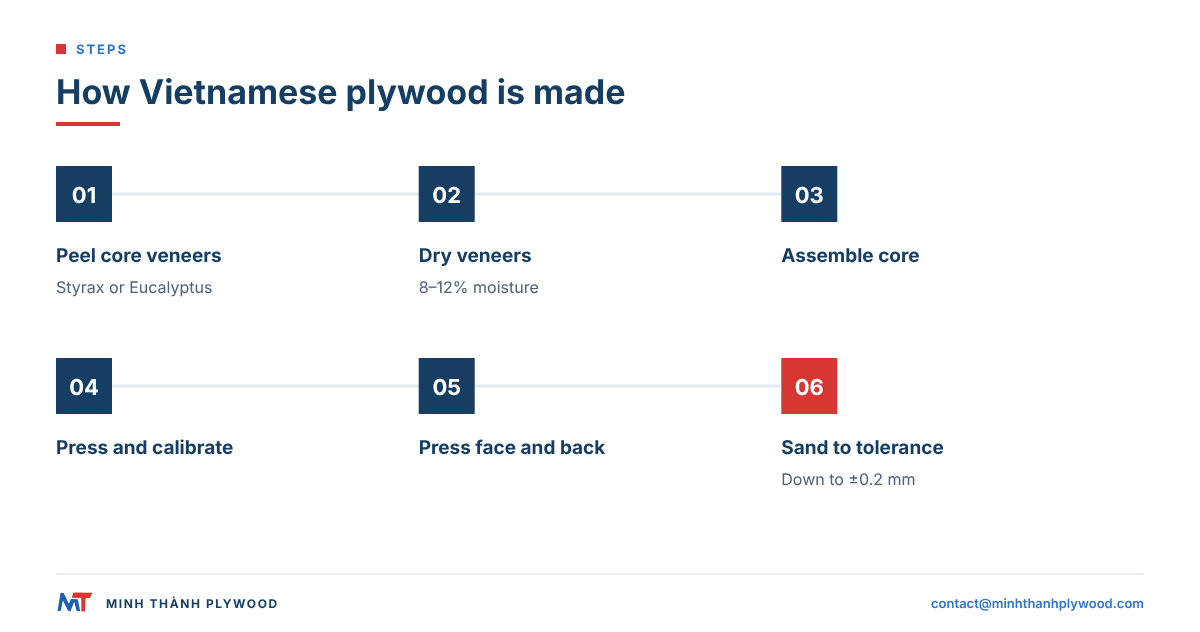
At Minh Thanh the whole build happens in our factory in Ha Hoa, Phu Tho:
- Core veneers are peeled from Styrax or Eucalyptus plantation timber grown in the area.
- Drying brings veneers to 8–12 % moisture.
- Core assembly with the core layers stitched both horizontally and vertically.
- First pressing of the core board, then calibration.
- Second pressing of the face and back, chosen for the look the buyer orders, including imported birch and okoume.
- Sanding to the thickness tolerance, down to ±0.2 mm.
What should EU importers ask a Vietnamese plywood mill?
An EU importer should ask a Vietnamese mill for proof that the panel is made in Vietnam from veneer, before the first order and with every shipment. Seven questions cover it:
- Where are the core veneers peeled? Ask for the species and the region.
- Where are the faces from? Face species and country of harvest, per specification.
- Is the core pressed in your factory? Ask for production photos or a video of the press line.
- Which certificate of origin will you issue? EUR.1 for the EU, or the form your broker asks for.
- Can you supply the EUDR file? Minh Thanh supplies the EUDR compliance dossier (origin records and geolocation files) with orders.
- Do you buy finished plywood from other countries? The answer should match what you see on the floor.
- Will you photograph the loading? Every Minh Thanh shipment is photographed and filmed before loading, and the buyer gets the files.
A mill that makes its own panels answers these in a day. The same file also serves EUDR due diligence, because Vietnam is classed as low risk under Implementing Regulation (EU) 2025/1093 and the origin records are the same.
The EU duty on Brazilian softwood plywood
The EU also charges anti-dumping duty on softwood plywood from Brazil: a definitive 5.4% rate.
The duty comes from Implementing Regulation (EU) 2026/822 of 14 April 2026. It covers plywood made only of wood sheets other than bamboo, each ply up to 6 mm, with both outer plies of coniferous wood, under CN 4412 39 00 and originating in Brazil.
The case opened on 6 March 2025 on a complaint by the Softwood Plywood Consortium; a provisional duty followed on 4 November 2025 under Implementing Regulation (EU) 2025/2219. The definitive rate is the same 5.4% for the sampled exporters, the other cooperating companies and all other Brazilian imports; one Brazilian producer has no duty.
The Brazil case matters for construction and packing buyers more than for furniture buyers: it concerns pine-faced structural and utility panels. Together with the China measure and the 2026 probe, it shows the EU now watches both hardwood and softwood plywood lines.
Which other EU rules affect plywood imports?
Two older EU measures restrict plywood supply for reasons other than dumping:
- Russia: Regulation (EU) 2022/576 added wood products of CN chapter 44, including plywood, to the import ban in Regulation 833/2014, effective 9 April 2022.
- Belarus: Regulation (EU) 2022/355 did the same for Belarus and entered into force on the day after its publication.
Every plywood shipment into the EU also falls under the deforestation regulation (EUDR) from 30 December 2026 for most operators, and under the REACH formaldehyde limit for wood-based articles from 6 August 2026. These apply whatever the origin, so they belong in the order file alongside the origin proof.
A timeline of EU trade defence on plywood
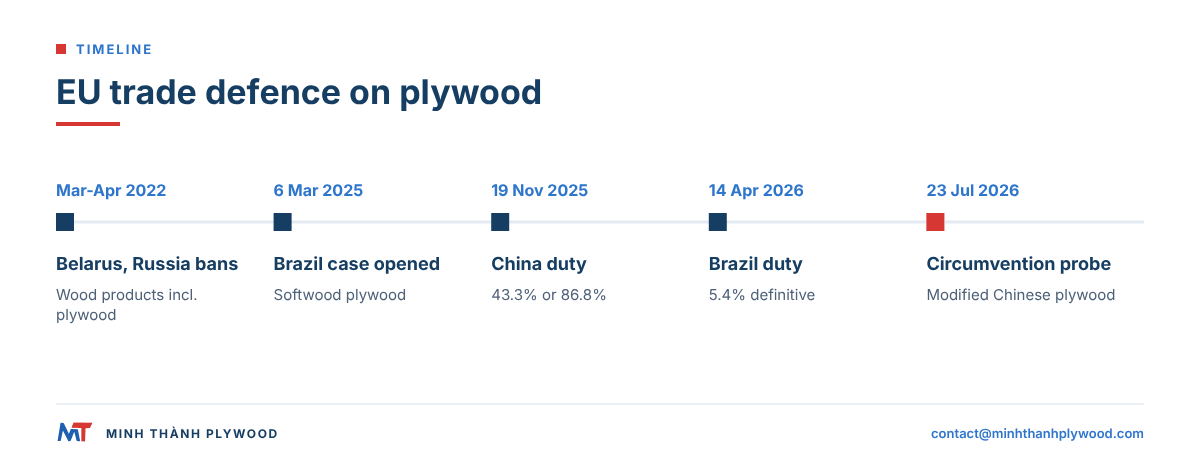
EU trade defence on plywood moved fast between 2022 and 2026:
| Date | Act | What happened |
|---|---|---|
| 3 March 2022 | Regulation (EU) 2022/355 | Import ban on Belarusian wood products, including plywood |
| 9 April 2022 | Regulation (EU) 2022/576 | Import ban on Russian wood products, including plywood |
| 6 March 2025 | Notice C/2025/1490 | Anti-dumping case opened on Brazilian softwood plywood |
| 4 November 2025 | Regulation (EU) 2025/2219 | Provisional duty on Brazilian softwood plywood |
| 19 November 2025 | Regulation (EU) 2025/2333 | Definitive duty on Chinese hardwood plywood: 43.3% or 86.8% |
| 14 April 2026 | Regulation (EU) 2026/822 | Definitive duty on Brazilian softwood plywood: 5.4% |
| 23 July 2026 | Regulation (EU) 2026/1840 | Anti-circumvention probe on slightly modified Chinese plywood, imports registered |
The next date to watch is the end of the anti-circumvention investigation, due within nine months of the regulation’s entry into force on 25 July 2026.
What this means for your order
For an EU order of plywood from Vietnam, the China duty changes the paperwork, not the tariff. Plan three things:
- Origin proof: a certificate of origin from Vietnam, and EUR.1 or the form your broker asks for when you claim the EVFTA rate.
- Build records: core and face species, where they were peeled, and production photos, kept with the entry.
- Specification on the invoice: a plain description, for example “18 mm furniture plywood, poplar face A/B, Styrax core, UF glue at E0”, so the tariff line and origin read the same on every document.
Minh Thanh makes furniture and interior plywood for Europe as its main market, with repeat orders into Italy. The minimum order is one 40HC, mixed specifications by agreement; production takes 15–45 days after the 30% deposit, FOB Hai Phong, CFR or CIF, with 30–40 days at sea to Northern Europe and 25–35 days to the Mediterranean.
What to send with your request
Send the specification lines below, and the origin file comes prepared with the order:
- Application: furniture, cabinets, interior, packing.
- Core: Styrax or Eucalyptus.
- Glue and emission: UF glue at E0 emission, MR or phenolic (WBP).
- Face and grade: poplar A/B, birch D+/D, EV, okoume or pine.
- Thickness and size: 3–40 mm; 1220 × 2440 mm, 1250 × 2500 mm or custom.
- Packing and quantity: packs, labels, mixed loads.
- EU port, HS code and origin form your broker uses.
Write to contact@minhthanhplywood.com or use the quote form; we reply within hours, and free samples are sent on request.
Buyer questions, answered
What is the US anti-dumping duty on Chinese plywood?
A final dumping margin of 187.27% (cash deposit 185.96%) for all Chinese exporters, plus a countervailing duty of 88.96%, about 275% combined, under Commerce's final determinations published on 21 July 2026 (case A-570-211 and C-570-212). Panels under the 2018 orders on certain hardwood plywood from China keep the 2018 rates.
Is there US anti-dumping duty on plywood from Vietnam?
Yes. Hardwood and decorative plywood from Vietnam pays an anti-dumping cash deposit of 84.95% (margin 90.12%) and a countervailing duty of 47.68% for almost every producer, 132.63% in all; Junma Phu Tho has a 165.39% countervailing rate. The ITC confirmed injury on 19 August 2026.
Which plywood is excluded from the US hardwood plywood duty?
PS 1 or PS 2 structural plywood with an all-softwood core of the listed species, phenolic film faced plyform, assembled and ready-to-assemble furniture and kitchen cabinets, finished table tops and countertops, cork-faced panels, solid bamboo, shaped plywood, wood flooring and certain LVL door parts.
What is the EU anti-dumping duty on Chinese plywood?
86.8% for all Chinese exporters except one, which pays 43.3%, under Implementing Regulation (EU) 2025/2333 of 19 November 2025. The duty covers hardwood plywood with a tropical or non-coniferous outer ply and is charged on the net, free-at-Union-frontier price.
Is there anti-dumping duty on Vietnamese plywood in the EU?
No. The EU duty applies to hardwood plywood originating in China, and the 2026 anti-circumvention probe concerns imports from China. Plywood made in Vietnam pays the normal customs duty, or the EVFTA preferential rate with valid origin proof.
Which plywood is covered by the EU duty on Chinese plywood?
Plywood of wood sheets, each ply up to 6 mm, with at least one outer ply of tropical or non-coniferous wood, coated or not, under nine TARIC codes in 4412 31, 4412 33 and 4412 34. Plywood with bamboo or okoumé plies is outside.
What is the EU anti-circumvention investigation on Chinese plywood?
An investigation opened by Implementing Regulation (EU) 2026/1840 of 23 July 2026 into Chinese hardwood plywood given thin softwood, bamboo or engineered veneer outer plies under 2.5 mm, declared under other codes. Imports from China are registered so duty can be collected back if circumvention is found.
Does the EU duty on Chinese plywood apply to Vietnamese panels with Chinese veneer?
The duty follows the origin of the goods. A panel made in Vietnam from veneer is Vietnamese, while Chinese plywood that is only finished in Vietnam keeps its Chinese origin. Customs can ask for production and origin records.
How is the EU anti-dumping duty on plywood calculated?
As a percentage of the net, free-at-Union-frontier price before duty, close to the CIF value. It is added to the normal customs duty, and VAT is charged on the total.
Is there an EU anti-dumping duty on softwood plywood?
Yes, on softwood plywood from Brazil: a definitive 5.4% under Implementing Regulation (EU) 2026/822 of 14 April 2026, for plywood with both outer plies of coniferous wood under CN 4412 39 00.
How long does the EU duty on Chinese plywood last?
EU anti-dumping measures run for five years from their imposition unless an expiry review extends them. The Chinese hardwood plywood measure dates from November 2025.
How do I prove my plywood is not Chinese?
With a certificate of origin from the country of production and the mill's build records: where the core veneers were peeled and pressed, the face species and its harvest country, and production photos. Minh Thanh adds the EUDR compliance dossier with origin records and geolocation files.
Does the UK apply the EU duty on Chinese plywood?
No. The EU duty dates from 2025, after the UK left the EU, and applies only in the EU customs territory. The UK runs its own trade-remedy cases.