
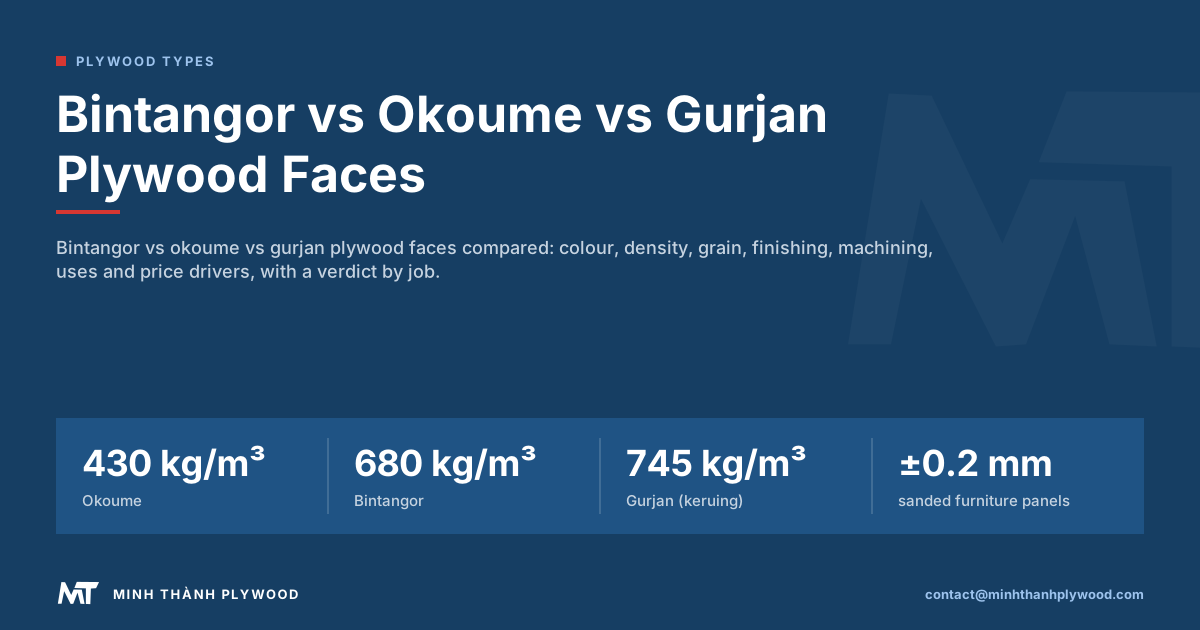
In the bintangor vs okoume choice, okoume gives a pale, even face for clear and stained furniture, bintangor gives a deeper reddish face that hides wear on carcasses and shop fittings, and gurjan gives the darkest red-brown for a rich natural look. All three are face veneers over a separate core. Minh Thanh Plywood presses each of them on white Styrax or Eucalyptus cores in Vietnam.
Bintangor vs okoume: which face wins for which job?
Okoume wins for pale, clean furniture faces under clear or stained finishes; bintangor wins for warm reddish carcasses, shop fittings and painted or laminated parts that take knocks; gurjan wins when the buyer wants the deepest red-brown natural look. The three are face choices: the core under them does most of the structural work.
Each of the three is a tropical hardwood veneer, peeled and laid on the outside of a plywood panel. In Vietnam none of them is used as a core. Our panels put the chosen face and back over white Styrax or Eucalyptus plantation veneers, stitched horizontally and vertically and pressed twice.
That makes the decision simpler than it looks. You choose the face for colour, texture, finish and wear; you choose the core for weight, screw holding and flatness; you choose the glue for the room. Swapping okoume for bintangor on the same core changes the look and the surface hardness, not the panel’s weight class.
Bintangor vs okoume plywood vs gurjan: how do the three faces compare?
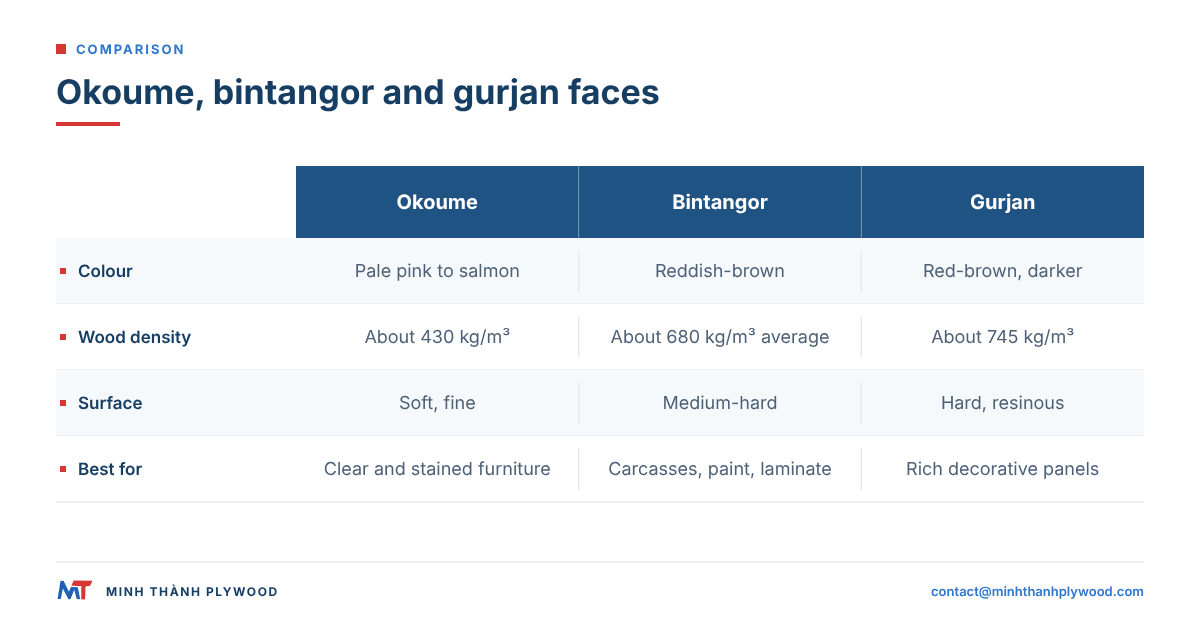
The table compares the three faces one property per row, plus the eucalyptus face we also make. Wood densities are for the solid timber, not the panel; a faced panel takes most of its weight from the core, so compare the faces on colour and hardness first.
| Property | Okoume face | Bintangor face | Gurjan face | Eucalyptus face |
|---|---|---|---|---|
| Botanical name | Aucoumea klaineana | Calophyllum species | Dipterocarpus species | Eucalyptus species |
| Origin of the timber | Central Africa, mainly Gabon | South-East Asia | South and South-East Asia | Vietnamese plantations |
| Colour | Pale pink to salmon | Reddish-brown, sometimes pinkish | Red-brown, darker | Light brown to reddish |
| Texture and grain | Fine, soft, mild figure | Medium, interlocked grain | Coarser, straight to interlocked | Medium, straight |
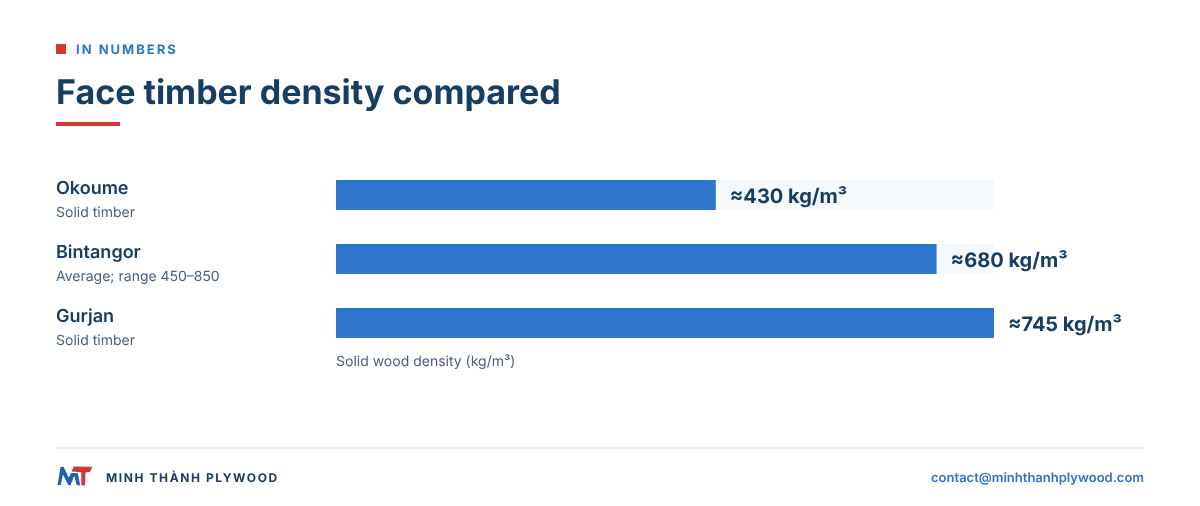
| Solid wood density | About 430 kg/m³ | 450–850 kg/m³, average about 680 kg/m³ | About 745 kg/m³ | 650–750 kg/m³ |
| Surface hardness | Soft; dents more easily | Medium-hard | Hard | Medium-hard |
| Clear and stain finish | Even, light | Warm, deeper | Rich; seal against resin first | Natural, varied |
| Paint and laminate | Good | Very good | Good after sealing | Very good |
| Relative face price | Highest | Mid | Mid to high | Lowest |
| Typical uses | Cabinets, doors, wall panels, van interiors | Carcasses, shop fitting, door skins, painted panels | Wardrobes, counters, decorative panels | Painted or overlaid furniture, carcasses |
| Grades | Graded to the approved sample | Graded to the approved sample | Graded to the approved sample | A/A, A/B, B/B to the approved sample |
| Minh Thanh cores | White Styrax or Eucalyptus | White Styrax or Eucalyptus | White Styrax or Eucalyptus | White Styrax or Eucalyptus |
Sources for the densities: the Wood Database okoume entry and keruing entry, and the PROSEA bintangor profile, all checked on 20 October 2026. Eucalyptus is our own core planning range.
What is bintangor plywood?
Bintangor plywood is plywood faced with bintangor veneer, a reddish-brown tropical hardwood of the Calophyllum genus from South-East Asia. In Vietnam it is pressed over a local core and sold for commercial and furniture plywood, door skins and shop fitting.
Bintangor is a trade group, not a single species. The PROSEA profile gives a density range of about 450–850 kg/m³ across the group, with an average about 680 kg/m³. That spread shows up in the veneer: some sheets are pinker, some deeper red, and the grain is often interlocked, which gives a ribbon-like figure.
For a buyer, the practical points are three. The face is harder than okoume, so it takes knocks on carcasses and counters better. The colour hides small marks and repairs. And the interlocked grain can tear out when machined across, so sharp tools and a fine finish cut give the cleanest edges.
Our bintangor-faced plywood is pressed twice with both faces sanded, and thickness is held to ±0.2 mm on furniture panels.
What is okoume plywood?
Okoume plywood is plywood faced with okoume (Aucoumea klaineana), a light hardwood from Central Africa, mainly Gabon, also sold as gaboon. Its face is pale pink to salmon, fine in texture, with a soft, wavy figure that takes clear finishes and stains evenly.
Okoume is one of the lightest plywood timbers: the Wood Database lists about 430 kg/m³. Its long, straight logs peel into large, clean veneer sheets, which is why it is a classic face for doors, cabinets and boat interiors. The wood is soft, so the face dents more easily than bintangor or gurjan.
Okoume’s other name in plywood is marine: all-okoume panels built to BS 1088 are a standard boat material. An okoume face on a furniture core is a different product. Our guide to marine okoume plywood vs okoume-faced plywood explains the line between them.
We import okoume face veneer and press it over white Styrax or Eucalyptus cores; the full specification is on our okoume plywood page.
What is gurjan plywood?
Gurjan plywood is plywood faced with gurjan, the trade name used in India for Dipterocarpus timbers, which South-East Asia sells as keruing and the Philippines as apitong. The face is red-brown and darker than bintangor, with a coarser texture and natural resin in the wood.
The Wood Database keruing entry gives a density of about 745 kg/m³, the highest of the three. The wood is hard and stiff, which gives a durable face for wardrobes, counters and display furniture. Its resin can build up on tools and bleed through some finishes, so a sealer coat before the topcoat is the usual practice.
In India, “gurjan plywood” is often understood as gurjan through the whole panel. Our gurjan panels are gurjan-faced: gurjan face and back veneers over a Styrax or Eucalyptus core, and both species are named on the quotation. Our gurjan plywood guide covers face versus core, grades and price drivers.
Which face looks best under clear, stain or paint?
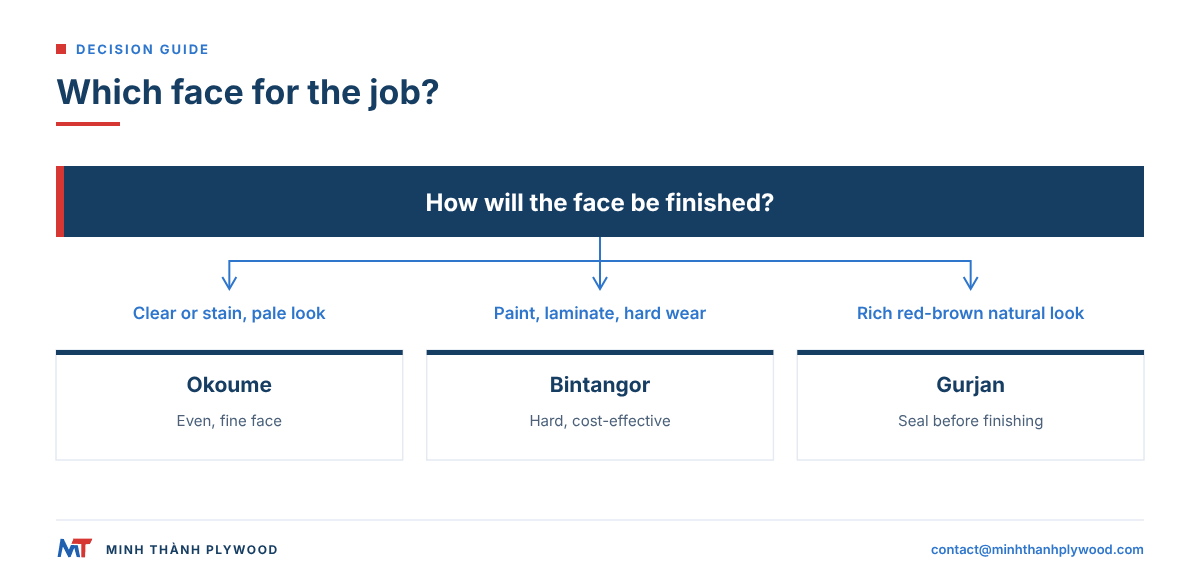
Under a clear or stained finish, okoume gives the palest and most even face, bintangor gives a warmer, deeper red, and gurjan gives the richest red-brown. Under paint or laminate, bintangor is the usual cost-effective choice, because the colour no longer matters and its hardness does.
| Finish | Okoume | Bintangor | Gurjan |
|---|---|---|---|
| Clear lacquer | Pale, even, fine | Warm red, ribbon figure | Deep red-brown |
| Stain | Takes stain evenly | Takes stain; deepens red | Limited range; already dark |
| Paint | Smooth base, soft face | Hard, smooth base | Seal first against resin |
| Laminate or veneer overlay | Good | Very good | Good |
| UV coating line | UV-ready faces | UV-ready faces | UV-ready faces, sealed |
Our faces are sanded and polished, and both faces are UV-ready to the standard customers need to apply their own UV coating. Finish a sample of each face with your own coating before choosing: the same lacquer looks different on all three.
Which face is stronger, and which is lighter?
Gurjan is the densest and hardest of the three faces, bintangor sits in the middle, and okoume is the lightest and softest. But a faced panel takes its strength and weight mainly from the core and glue, so on the same core the three faces give panels of almost the same weight and strength.
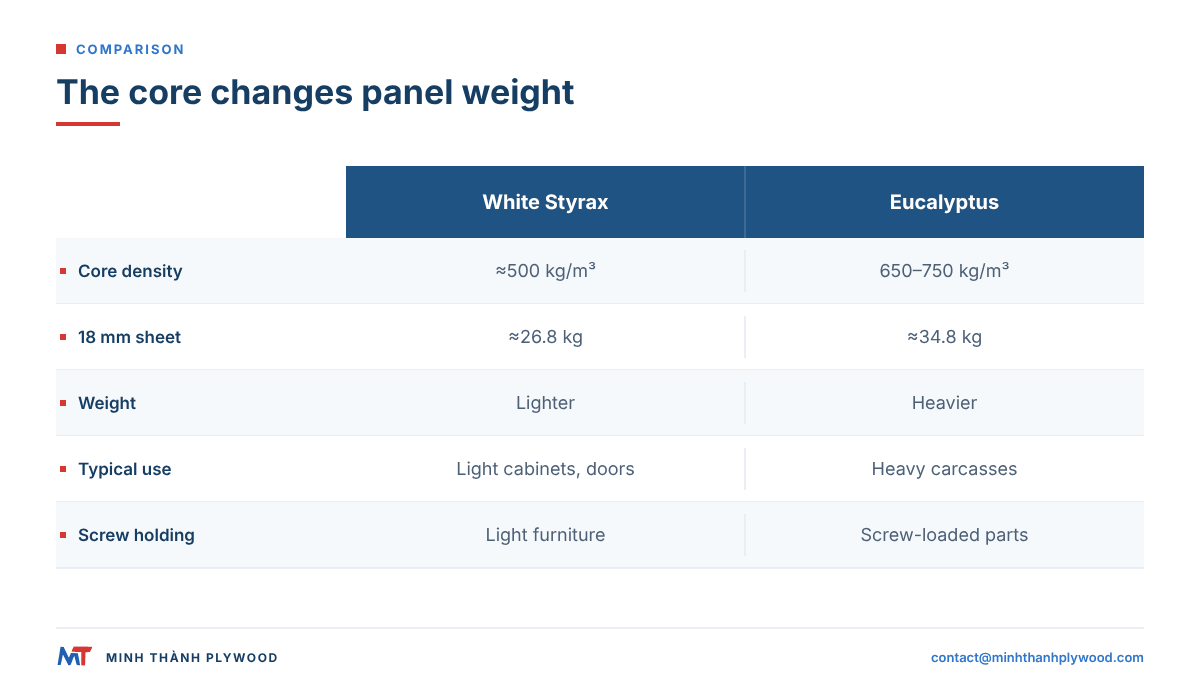
The face veneers are thin compared with the core. An 18 mm sheet of 1220 × 2440 mm on white Styrax weighs about 26.8 kg, and on Eucalyptus about 34.8 kg, whichever of the three faces it carries. The face choice changes surface hardness: how well the panel resists dents, scratches and wear on edges.
| Panel, 18 mm, 1220 × 2440 mm | Styrax core | Eucalyptus core |
|---|---|---|
| Weight per sheet, any of the three faces | About 26.8 kg | About 34.8 kg |
| Core density used | 500 kg/m³ | 650 kg/m³ |
| Typical choice | Light cabinets, doors, vehicle interiors | Heavy carcasses, screw-loaded parts |
If you need a light panel, choose the Styrax core; if you need screw holding and stiffness, choose Eucalyptus. Then choose the face for its look and wear.
Which face is easier to machine and finish?
Okoume is the easiest of the three to cut and sand, bintangor needs sharp tools across its interlocked grain, and gurjan’s resin and silica dull cutters fastest. All three machine well on CNC lines once tools and feed are set for them.
- Okoume: soft and even; cuts and sands quickly. Silica in the wood dulls blades over long runs, and soft fibres can fuzz, so a sharp blade and a fine final sanding give the best surface.
- Bintangor: the interlocked grain can tear out when routed or planed across, so use sharp carbide tools and a light finishing pass on visible edges.
- Gurjan: hard and resinous; resin builds up on tools and can gum sanding belts, so clean tools often and seal the face before finishing.
Because our panels are calibrated, thickness is held down to ±0.2 mm on sanded furniture panels, whichever face is on top. That matters more for CNC nesting and edge banding than the face species does.
Does okoume or bintangor make plywood marine grade?
No face species makes a panel marine grade. A marine panel is built through every ply to a marine standard such as BS 1088, with a boil-proof bond and a mark on each sheet. Okoume is a common marine timber, but an okoume face on a furniture core is furniture plywood.
The same applies to bintangor and gurjan. All three are poorly to moderately durable woods that need a coating outdoors. Water resistance in a faced panel comes from the glue: UF glue at E0 emission for dry interiors, melamine-fortified for humid rooms, phenolic WBP for parts that see water.
Our bintangor, okoume and gurjan panels are furniture and interior plywood, and we do not sell them as marine plywood. For boat interiors above the waterline, an okoume-faced panel with a melamine-fortified or phenolic WBP bond and a full coating often fits; for hulls and decks, buy a marine-standard panel.
Where does a eucalyptus face fit in the choice?
A eucalyptus face fits where the buyer wants a cost-effective natural face from Vietnamese plantation timber, or a hard base for paint and overlays. It is lighter in colour than bintangor and gurjan and more varied than okoume. We grade eucalyptus faces A/A, A/B and B/B to the approved sample.
A/A suits furniture with both faces on show, A/B suits parts with one visible face, and B/B suits panels that will be painted or overlaid. Because the face, the core and the timber all come from Vietnamese plantations, it is the most local of the four options and needs no imported veneer.
If the face will be fully hidden under paint or a laminate, a eucalyptus face, a poplar face or bintangor can all do the job; choose by price and hardness. Our eucalyptus-faced plywood page lists the grades and cores.
What does the core under the face change?
The core changes the panel’s weight, stiffness, screw holding and flatness; the face changes its look and surface hardness. Our standard furniture cores are white Styrax, about 500 kg/m³, and Eucalyptus, about 650–750 kg/m³, with Acacia and Pine made on order.
- White Styrax core: light and pale; keeps sheets easy to handle and works well under light okoume faces, so dark core lines do not show at the edge.
- Eucalyptus core: denser and harder; better screw holding for carcasses and heavier parts, at a higher sheet weight.
Every furniture panel is built the same way. Core veneers are stitched horizontally and vertically so the layers stay closed. The core board is pressed and calibrated, then face and back are pressed on. Veneers and panels leave the factory at 8–12 % moisture, the normal range for furniture plywood.
Which face is easier to source legally and sustainably?
Eucalyptus is the easiest face to document, because it comes from Vietnamese plantations; okoume is a Central African timber with a tight legal framework and many certified concessions; bintangor and gurjan come from natural forests in South and South-East Asia, where the paperwork carries more weight. Every one of them can be sold into the UK and EU with the right papers.
| Face | Where the timber grows | What a UK or EU importer should hold |
|---|---|---|
| Okoume | Gabon and Central Africa; logs may not be exported, so veneer is peeled in the country | Origin and legality papers; FSC chain of custody where the buyer asks for certified veneer |
| Bintangor | Natural forests in South-East Asia | Species, country of harvest and legality evidence for due diligence |
| Gurjan | Natural forests in South and South-East Asia | Species, country of harvest and legality evidence for due diligence |
| Eucalyptus | Vietnamese plantations | Plantation origin records and geolocation |
Three rules decide the paperwork:
- UK buyers import under the UK Timber Regulation, which requires due diligence on species, country of harvest and legality before the timber is placed on the market. The less documented the forest, the more evidence you need.
- EU buyers fall under the EU Deforestation Regulation (EUDR), Regulation (EU) 2023/1115, whose application date for large and medium operators is 30 December 2026 on the Commission’s EUDR page. Plywood is among the wood products on its list, and geolocation of the harvest plot is part of the dossier.
- Gabon has banned raw log exports since 2010 and requires processing in the country, so okoume veneer and plywood leave Gabon already processed. FSC-certified concessions cover over 2.4 million hectares there (FSC, end of 2024), so FSC okoume is available, at a price.
Minh Thanh supplies the EUDR compliance dossier with orders, with origin records and geolocation files, and holds CARB P2 / TSCA Title VI certification for US buyers. Name the face species on the order and ask for the paperwork you need at the quotation stage, not at the port.
How do the prices of the three faces compare?
The face is one of several price lines, so compare quotes on the same core, glue, thickness, size and grade before judging the face. Okoume veneer is shipped from Central Africa and graded for pale, clean faces, which adds to its cost; bintangor and gurjan veneers come from Asian forests. In the table above the order is okoume highest, gurjan mid to high, bintangor mid and eucalyptus lowest.
The other lines usually move the price more than the face. Phenolic WBP glue costs more than UF, a two-sided A/A face pair costs more than A/B, and thickness, size and quantity all move the cubic-metre price. Our furniture and interior plywood starts from US$350/m³ (October 2026); the final price follows face, core, glue, thickness, size, quantity and delivery term.
To compare faces fairly, ask for one quote with three face options on the same specification. The difference between the lines is then the true face difference.
How do you check bintangor, okoume and gurjan faces on arrival?
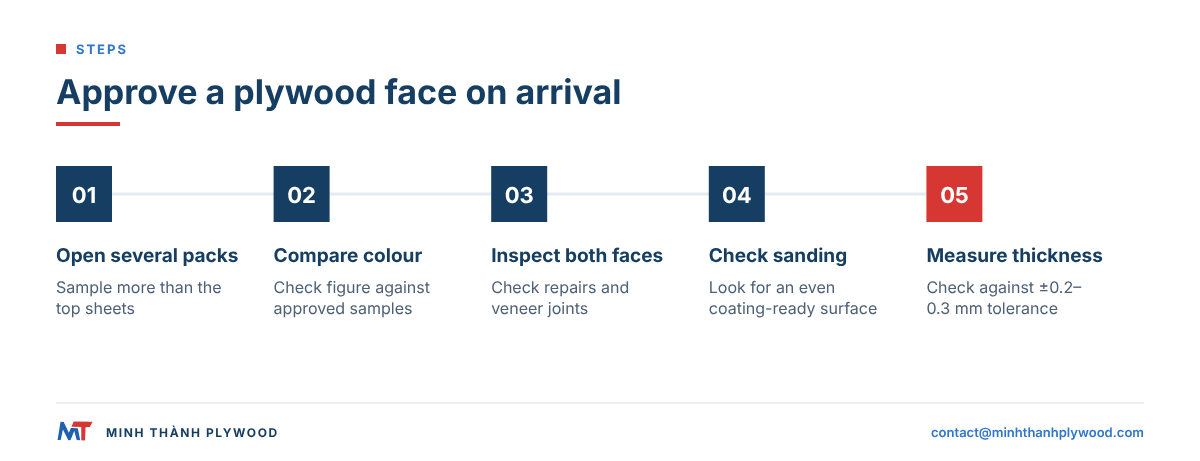
Check each face against the approved sample: colour range, figure, repairs, joints and sanding, sheet by sheet from several packs. Natural veneers vary, so the sample, not a photo or a grade word, sets what is accepted. Measure thickness at the same time against the written tolerance.
A quick arrival check takes five steps:
- Open several packs, not only the top one, and lay sheets from each side by side with the approved sample.
- Compare colour and figure in daylight: okoume should sit in the pale pink range of the sample, bintangor and gurjan in their red-brown ranges.
- Look at repairs and joints on the face and the back, against the face/back pair you ordered.
- Check the sanding: an even surface without sander marks, ready for your coating.
- Measure thickness at several points with a caliper; sanded furniture panels are made to ±0.2–0.3 mm, down to ±0.2 mm.
Keep in mind how each face changes in light. All three darken with exposure, and fresh okoume deepens from pink towards a warmer salmon; a sample stored for weeks will look darker than new production. Compare new sheets with a freshly cut edge of the sample, or with a sample kept wrapped.
Every shipment we send is photographed and filmed before loading, and buyers get the photos and video. That record, the approved sample and the specification on the proforma together settle any question about a face. Our veneer grading guide explains how faces and backs are graded before pressing.
Which face should you choose for your job?
Choose okoume for pale, light furniture and doors under clear or stain; bintangor for hard-wearing carcasses, shop fittings and painted or laminated panels; gurjan for rich red-brown decorative furniture; eucalyptus for a cost-effective local face or a hidden base. This table gives the verdict by job.
| Job | First choice | Why |
|---|---|---|
| Clear-lacquered cabinet doors | Okoume | Pale, even, fine face |
| Stained furniture | Okoume | Takes stain evenly |
| Kitchen and wardrobe carcasses | Bintangor | Hard, warm face that hides marks |
| Shop fitting and counters | Bintangor or gurjan | Hard-wearing, warm colour |
| Decorative wall panels, rich colour | Gurjan | Deepest red-brown |
| Painted or laminated parts | Bintangor or eucalyptus | Hard, cost-effective base |
| Van and caravan interiors | Okoume on Styrax core | Lightest combination |
| Door skins | Bintangor or okoume | Smooth, thin, even faces |
For mixed projects, one container can carry more than one face: mixed specifications are possible by agreement, usually one or two per container.
How do you sample and specify the face you choose?
Order a free sample of each face you are considering, finish it with your own coating, and approve one as the reference for production. Then write the face, back, core, glue, thickness, size and quantity as separate lines, so the quote shows exactly what you will receive.
A complete order line for a bintangor-faced carcass panel reads like this:
Bintangor-faced plywood, 18 mm, 1220 × 2440 mm, Eucalyptus core, UF glue at E0 emission, bintangor face and back graded to approved sample, sanded both sides, thickness ±0.2 mm, for kitchen carcasses, one 40HC, CIF destination port.
For okoume or gurjan, change the face line and keep the rest. Production takes 15–45 days after the 30% deposit, with the 70% balance against the scanned B/L or by irrevocable L/C at sight, on FOB Hai Phong, CFR or CIF terms. For US buyers, the limit for veneer-core hardwood plywood is 0.05 ppm under 40 CFR 770.10. We hold CARB P2 / TSCA Title VI certification as ICTT mill no. 23024.
Send your specification through the okoume plywood page, the bintangor plywood page or the gurjan plywood page; we reply within hours.
Buyer questions, answered
What is the difference between bintangor and okoume plywood?
Bintangor plywood has a reddish-brown Calophyllum face from South-East Asia; okoume plywood has a pale pink to salmon Aucoumea klaineana face from Central Africa. Okoume is lighter, finer and paler; bintangor is denser, deeper in colour and harder-wearing.
Which is lighter, okoume or bintangor?
Okoume wood is lighter, about 430 kg/m³ against an average near 680 kg/m³ for bintangor. In a faced panel the core sets most of the weight, so an okoume face and a bintangor face on the same Styrax core weigh almost the same.
Is bintangor stronger than okoume?
Bintangor wood is denser and harder than okoume, so its face resists dents better. The strength of a faced panel comes mainly from its core and glue, so compare panels on the same core and thickness.
What is gurjan wood?
Gurjan is the trade name used in India for Dipterocarpus timbers, sold in South-East Asia as keruing and in the Philippines as apitong. It is a dense, red-brown hardwood with natural resin.
Which face is best for a clear or stained finish?
Okoume, for a pale, even, fine face that takes stain evenly. Bintangor and gurjan give deeper colours under clear coats; seal gurjan before finishing, because its natural resin can bleed.
Which face is best for painted or laminated furniture?
Bintangor is a common choice for painted and laminated panels because it is cost-effective and hard-wearing. If the face will be fully covered, a poplar or eucalyptus face can do the same job.
Is okoume or bintangor plywood marine grade?
Neither face makes a panel marine grade. A marine panel is built and marked to a marine standard such as BS 1088 through every ply. Our bintangor, okoume and gurjan panels are furniture and interior plywood.
Which cores does Minh Thanh use under these faces?
White Styrax or Eucalyptus plantation cores, with core veneers stitched horizontally and vertically. Furniture panels are pressed twice: the core is pressed and calibrated, then face and back are pressed on.
Which is cheaper, bintangor or okoume?
Okoume veneer is shipped from Central Africa and is graded for pale, clean faces, which adds to its cost; bintangor and gurjan come from Asian forests. Compare quotes on the same core, glue, thickness and grade to see the real face difference.
Can I get samples of all three faces?
Yes. Free samples of bintangor, okoume and gurjan faces are available, and we recommend finishing them with your own coating before you choose.