
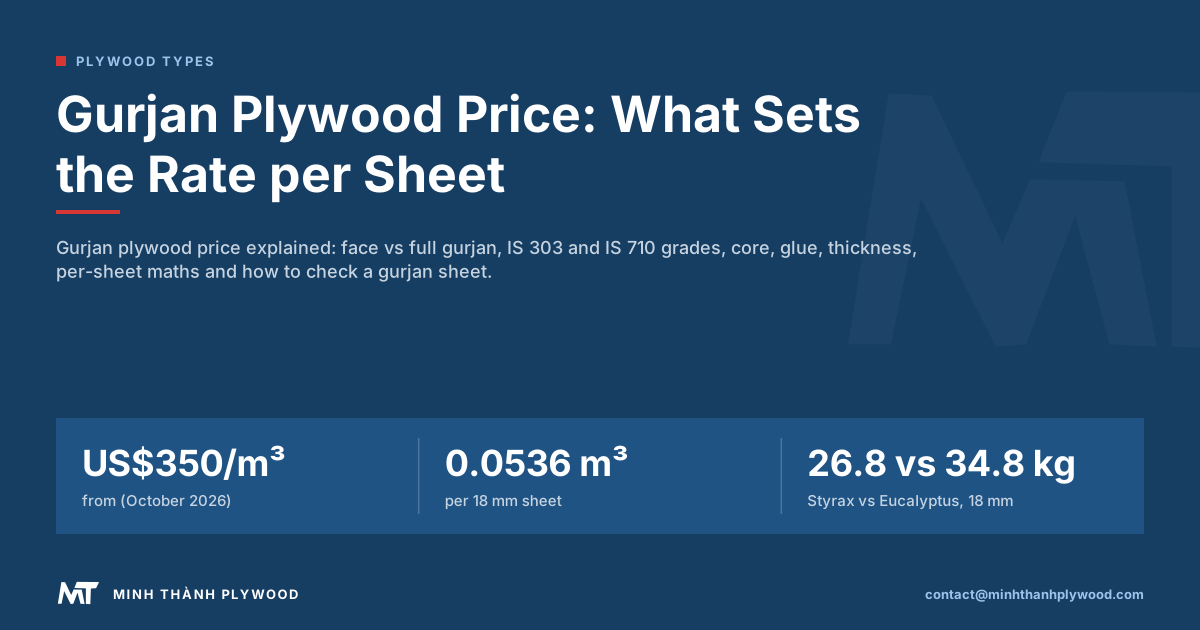
The gurjan plywood price depends first on how much gurjan is in the panel: a thin gurjan face on a plantation core costs far less than full gurjan, then on the bond grade (MR, BWR or 710 marine), thickness, size and quantity. Minh Thanh Plywood quotes gurjan-faced furniture panels from US$350/m³ (October 2026), FOB Hai Phong.
What is the gurjan plywood price in India in 2026?
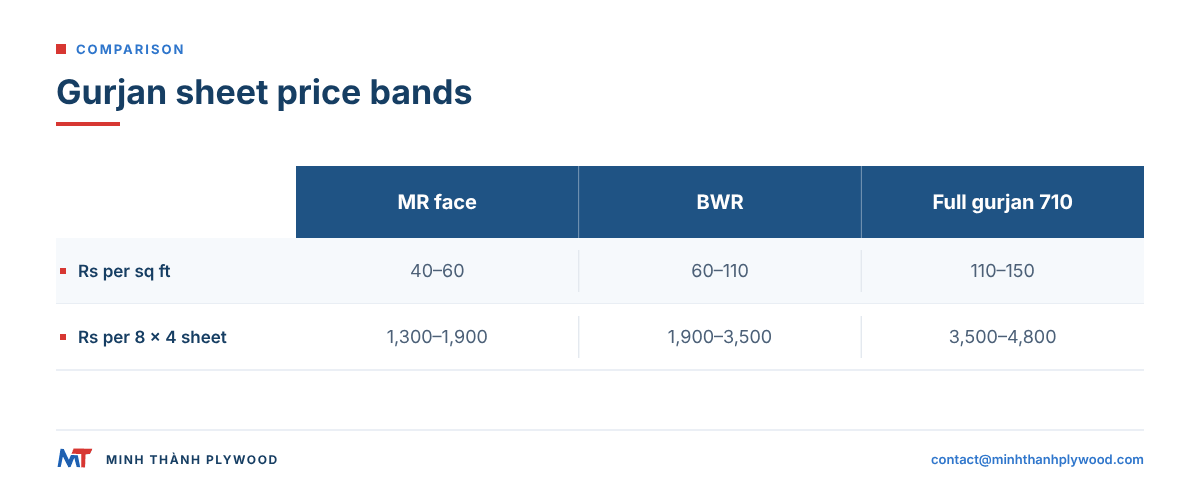
Indian dealers quote gurjan plywood per square foot, and a standard 8 × 4 ft sheet is 32 sq ft. Indicative 2026 retail rates run from about Rs 40-60 per sq ft for gurjan-faced commercial (MR) plywood to Rs 110-150 per sq ft for 100% gurjan, which puts the sheet between about Rs 1,300 and Rs 4,800.
| Gurjan plywood type (8 × 4 ft) | Thickness | Rs per sq ft | Rs per sheet (32 sq ft) |
|---|---|---|---|
| Gurjan-face commercial / MR | 16-19 mm | about 40-60 | about 1,300-1,900 |
| Same, live retail example | 18 mm | about 57 | Rs 1,824 listed at BuildingSteps (ex tax, ex shipping) |
| BWR (boiling water resistant) | 16-19 mm | about 60-110 | about 1,900-3,500 |
| 100% gurjan, IS 710 marine | 12, 16 and 18 mm | about 110-150 | about 3,500-4,800 |
The 12 mm sheet is priced below the 16 mm rate because it holds about three-quarters of the wood, and Plyneer lists IS 710 gurjan in 12 mm, 16 mm and 18 mm. Treat every figure as a range: city, brand, tax and delivery move it by 10 to 20%.
Export comparison. At US$350/m³ FOB, an 18 mm 1220 × 2440 mm sheet is about US$18.8, or about Rs 1,600 at an assumed Rs 85 to the US dollar, before freight, duty and the importer’s margin. That sits in the same band as the Rs 1,824 retail sheet above, which is why Indian converters and traders ask for gurjan-faced panels from Vietnam.
Brands buyers compare. Indian buyers choose between branded, ISI-marked plywood with a printed grade and a warranty, and local unbranded sheets that cost less but carry no mark. Whichever they pick, the price gap between quotes comes from the face-versus-full-gurjan test below, so ask each dealer to state face, core and bond in writing.
What decides the gurjan plywood price?
The gurjan plywood price is set mostly by how much gurjan the panel contains, then by its bond grade, thickness, size, quantity and delivery term. A sheet with gurjan only on the face and back can cost a fraction of a full gurjan sheet of the same thickness, and a 710 marine grade costs more than an MR grade of the same build.
| Price driver | Lower cost | Higher cost | Why it matters |
|---|---|---|---|
| Gurjan content | Gurjan face and back on a plantation core | Full gurjan, every ply | Gurjan logs are scarce tropical hardwood |
| Core species | Styrax or poplar | Gurjan or other dense tropical hardwood | The core is most of the panel volume |
| Bond grade | MR (moisture resistant, UF or melamine-fortified) | BWR, then BWP phenolic (710 marine) | Phenolic glue and longer press cycles cost more |
| Standard and testing | Unmarked commercial | IS 303 or IS 710 marked, tested | Testing and rejects add cost |
| Thickness | Thicker panels, per m³ | Thin panels, per m³ | Thin panels use more glue lines per m³ |
| Face grade | Utility, repaired face | Clean, matched face | Clean faces need more selection |
| Calibration and sanding | Commercial ±0.5 mm | Calibrated, down to ±0.2 mm | Second press and sanding passes |
| Emission | Unspecified | E0 emission, CARB P2 / TSCA Title VI | Low-emission glue and chamber tests |
| Quantity and term | Full 40HC, FOB | Small lots, CIF to an inland city | Fixed costs spread over fewer m³ |
Each row moves the price independently, which is why gurjan plywood rates spread so widely and two “gurjan plywood” quotes can differ widely and both be fair. Compare quotes only after each one names face, core, bond, thickness and grade.
What does “gurjan” mean on a face and in a core?
Gurjan is the trade name in India for timber of the genus Dipterocarpus, sold as keruing in Malaysia and Indonesia, apitong in the Philippines and yang in Thailand. It is a reddish-brown tropical hardwood with a coarse texture and natural resin, which gives it good water resistance once bonded with phenolic glue.
On a plywood quote, the word can mean three different builds:
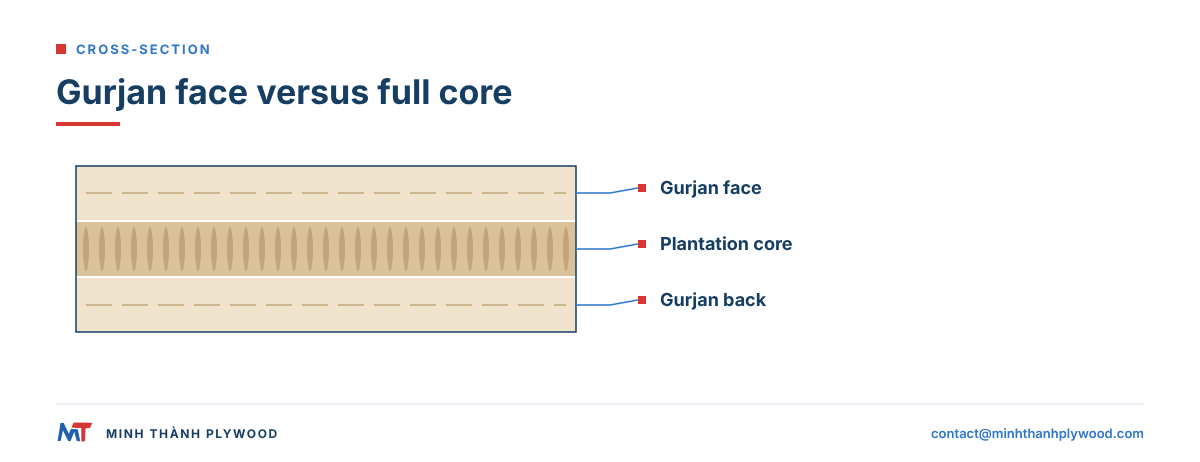
- Gurjan face: a thin gurjan veneer on the face, and often the back, over a core of another species. This is the most common build for furniture and interiors.
- Gurjan core or “full gurjan”: gurjan veneers in every ply. Heavier, more water resistant, and the most expensive.
- Mixed hardwood with gurjan: gurjan in some plies and other hardwoods in the rest.
The difference matters for price and weight. Ask the supplier to name the species of the face, the back and the core on the quotation, not just “gurjan plywood”.
What do the grade names mean: MR, BWR, BWP, IS 303 and IS 710?
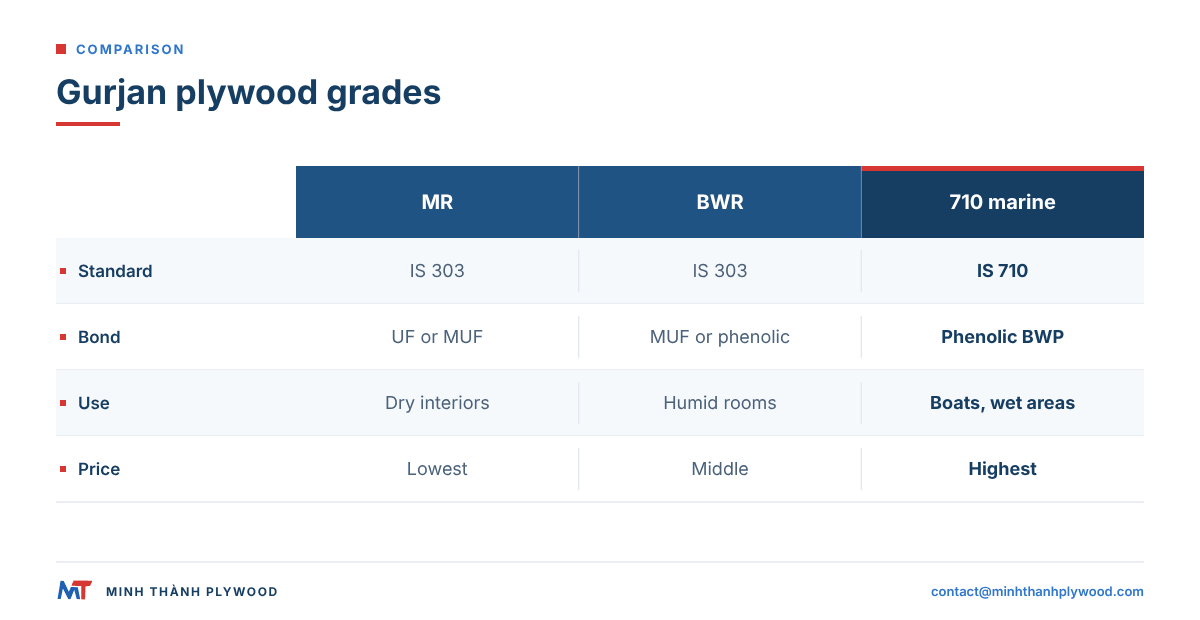
In the Indian market, gurjan plywood grades combine an Indian Standard number with a bond name. IS 303 is the standard for general-purpose plywood; IS 710 is the standard for marine plywood.
| Grade name | Standard | Bond | Typical use |
|---|---|---|---|
| MR (moisture resistant) | IS 303 | Urea-formaldehyde, often melamine-fortified | Dry interior furniture, wardrobes, wall panels |
| BWR (boiling water resistant) | IS 303 | Melamine-fortified or phenolic | Kitchens, bathroom vanities, humid rooms |
| BWP (boiling water proof) | IS 303 or IS 710 | Phenolic | Exterior use, wet areas |
| 710 marine | IS 710 | Phenolic BWP, with the standard’s species and preservative rules | Boats, docks, kitchens with heavy wetting |
“Gurjan 710” therefore means a gurjan panel sold to the marine standard, and a “gurjan 710 plywood price list” is a list of marine-grade rates. The marine grade costs more than MR or BWR because of the phenolic glue, the stricter veneer rules and the testing.
Outside India, the same bonds have other names: MR and melamine-fortified (MUF), WBP phenolic, and EN 314-2 bond classes 1, 2 and 3. The BSI record identifies BS EN 314-2:1993 as the plywood bonding-quality requirements standard. Our marine plywood buying guide explains how marine grades compare across markets.
How do you work out a price per sheet from a price per m³?
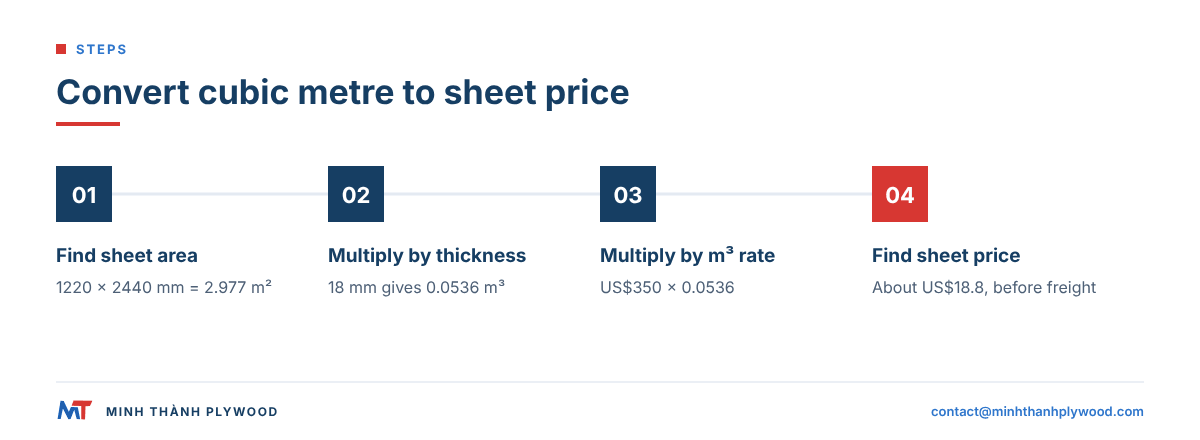
Multiply the price per cubic metre by the volume of one sheet. A 1220 × 2440 mm sheet (8 × 4 ft) holds 2.977 m² of face, so its volume is 2.977 × thickness in metres.
| Thickness | Volume of one 1220 × 2440 mm sheet | Sheets per m³ |
|---|---|---|
| 6 mm | 0.0179 m³ | 56.0 |
| 9 mm | 0.0268 m³ | 37.3 |
| 12 mm | 0.0357 m³ | 28.0 |
| 15 mm | 0.0447 m³ | 22.4 |
| 18 mm | 0.0536 m³ | 18.7 |
| 19 mm | 0.0566 m³ | 17.7 |
| 25 mm | 0.0744 m³ | 13.4 |
A worked example: at US$350/m³, an 18 mm sheet works out to 350 × 0.0536 = about US$18.8 before freight, and a 12 mm sheet to about US$12.5. In India, dealers quote per square foot; an 8 × 4 sheet is 32 sq ft, so the sheet price is 32 times the rate per square foot.
Two cautions: thin panels carry more glue lines per m³ and cost a little more per m³, and some quotes use nominal thickness while the sheet measures less. State the measured thickness and tolerance on the order.
What is the price of 12 mm, 19 mm and 8 × 4 gurjan plywood?
The price of a 12 mm, 19 mm or 8 × 4 gurjan sheet is the grade’s rate times the sheet’s size, so the useful comparison is between grades at the same thickness.
- 12 mm gurjan plywood: about two-thirds of the wood in an 18 mm sheet. Used for drawer sides, backs and wall panelling.
- 19 mm gurjan plywood: the Indian furniture thickness, about 6% more wood than 18 mm. Used for carcasses, shelves and doors.
- 8 × 4 sheets: the standard size, 1220 × 2440 mm; 1250 × 2500 mm panels hold 5% more face area.
For a fair comparison, collect three quotes at the same thickness and ask each to state face, core and bond. A low price on “gurjan” usually means a gurjan face over a lighter core, which is a good panel for dry furniture but not a 710 marine panel.
Why do gurjan plywood rates differ between quotes?
Two gurjan plywood quotes differ because the panels are not the same, even when the name is. The usual hidden differences:
- Core species: a light poplar or Styrax core against a gurjan or dense hardwood core.
- Ply count: fewer, thicker core veneers cost less to lay up than more, thinner ones.
- Core gaps and overlaps: a carefully laid core costs more than one with open joints.
- Glue spread and type: less glue, or UF sold as BWR, cuts cost.
- Measured thickness: an “18 mm” sheet that measures 16.5 mm uses about 8% less wood.
- Face veneer thickness: a thin face sands through easily.
- Testing: a tested, marked grade carries the cost of tests and rejects.
The cheapest quote is rarely the lowest cost of gurjan plywood per usable sheet. Ask for a sample, cut it, weigh it and boil a strip if the grade claims BWR or BWP.
What is red core plywood?
Red core plywood is a trade name for plywood whose inner plies are a reddish hardwood, such as gurjan, keruing or red meranti, or are dyed or glued to look red. Buyers pay more for it because a red hardwood core suggests a dense, water-resistant panel.
The name alone proves nothing. Check three things:
- The species, by cutting a sample and looking at the core veneers: real hardwood shows grain and pores, a dyed core shows uniform colour.
- The weight, against the stated density: a dense red hardwood core weighs more than a poplar or Styrax core.
- The bond, by a boil test on a strip: a BWP panel holds after boiling, a UF panel opens.
A light, pale plantation core is not worse for dry furniture; it is lighter to handle and cheaper. It is only wrong when the quote promised a red hardwood core.
How do you check a gurjan sheet before you buy?
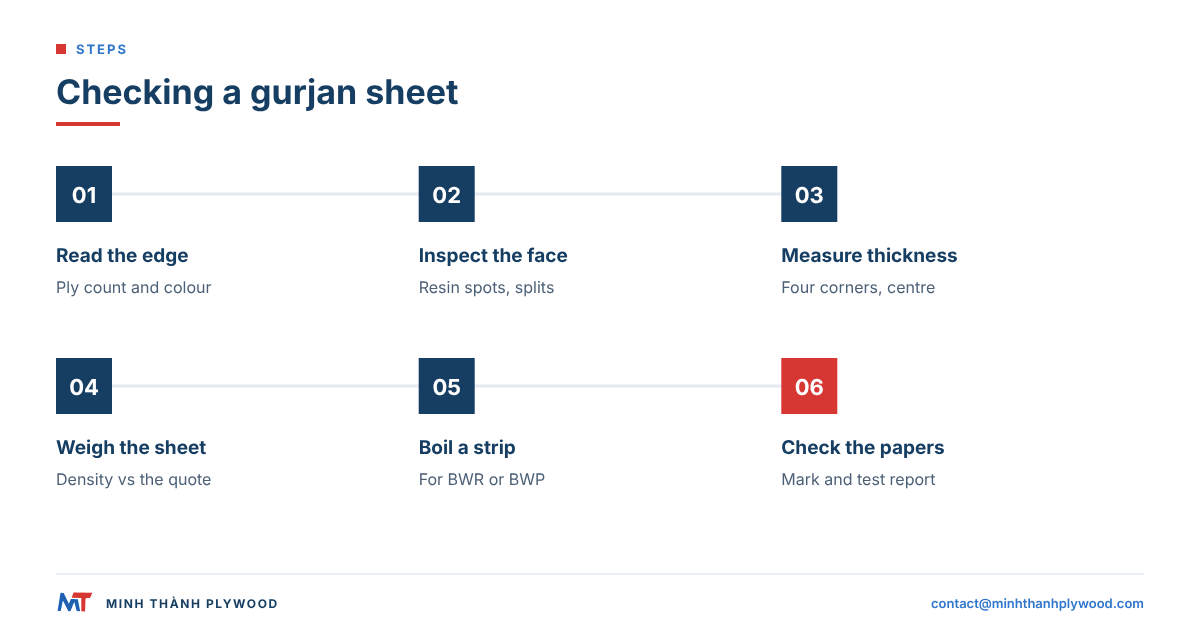
Check a gurjan sheet in six steps, on a sample or on the first pack of a delivery:
- Read the edge. Count the plies and look at the colour of each: gurjan is reddish-brown with a coarse texture.
- Look at the face under a raking lamp for resin spots, splits, overlaps and sand-through.
- Measure thickness at four corners and the centre with a calliper; compare with the quoted tolerance.
- Weigh the sheet and divide by its volume to get its density; compare with the species on the quote.
- Test the bond by boiling a strip for the time the grade requires, then try to separate the plies with a chisel.
- Check the mark and papers: the standard number and grade on the sheet, and the test report on the invoice.
| Measurement on an 18 mm 1220 × 2440 mm sheet | Styrax core | Eucalyptus core |
|---|---|---|
| Reference core density | 500 kg/m³ | 650 kg/m³ |
| Sheet weight, at that density | 26.8 kg | 34.8 kg |
A gurjan-faced sheet on a Styrax core sits close to the first column. A much heavier sheet points to a dense hardwood core, and a much lighter one to a thinner sheet than quoted. Our plywood weight calculator does the same arithmetic for other sizes.
Is gurjan better than eucalyptus, okoume or bintangor?
Gurjan is the best of these four for a red-brown face with natural resin and marine-type use; Eucalyptus is the best-value dense core; okoume is the lightest decorative face; bintangor is a cost-effective reddish face for furniture.
| Face species | Colour | Main strength | Typical use |
|---|---|---|---|
| Gurjan | Red-brown, coarse, resinous | Water resistance with phenolic glue | Marine, kitchens, red-brown furniture faces |
| Bintangor | Pinkish-red to red-brown | Smooth face at a lower price | Furniture, door skins, commercial faces |
| Okoume | Salmon-pink, even | Light weight | Furniture, boat interiors, decorative work |
| Eucalyptus | Pale pink to light brown | Dense, plantation-grown | Faces for painted work, cores |
For a side-by-side guide on faces, see bintangor vs okoume vs gurjan.
Where does gurjan plywood come from?
Gurjan timber grows in the tropical forests of South and South-East Asia, from India and Myanmar to Malaysia, Indonesia and the Philippines. Gurjan plywood is made mainly in India, which is the largest market for the name, and in South-East Asia, where the same timber is sold as keruing or apitong.
Vietnam supplies gurjan-faced plywood: gurjan face veneers pressed onto Vietnamese plantation cores. That build keeps the gurjan look on the outside while the core comes from locally grown plantation timber, which lowers the weight and the price per m³.
Prices in each origin move with log supply, freight and the exchange rate. The sibling plywood price guide covers how those factors move plywood prices in general.
What is the cost of gurjan plywood from Minh Thanh, and what is in it?
Minh Thanh Plywood quotes furniture and interior plywood, gurjan-faced panels included, from US$350/m³ (October 2026), FOB Hai Phong; the final price depends on face, core, glue, thickness, size, quantity and delivery term.
| Field | Minh Thanh gurjan-faced plywood |
|---|---|
| Face and back | Gurjan veneer, appearance matched to your approved sample |
| Core | White Styrax or Eucalyptus plantation timber, stitched horizontally and vertically |
| Pressing | Pressed twice: core board pressed and calibrated, then face and back |
| Thickness | 3–40 mm; tolerance down to ±0.2 mm on furniture panels |
| Sizes | 1220 × 2440 and 1250 × 2500 mm; custom sizes such as 1220 × 2500 mm |
| Glue and emission | UF glue at E0 emission standard; MR / melamine-fortified or phenolic WBP to your specification |
| Certificates | CARB P2 / TSCA Title VI (ICTT mill no. 23024), ISO 9001:2015 |
| Moisture | 8–12% at dispatch |
Our six ASTM D6007 chamber tests between April 2025 and June 2026 on 9, 15 and 18 mm panels averaged 0.014–0.032 ppm, against the 0.05 ppm CARB Phase 2 limit, which TSCA Title VI matches in the US. The full product specification is on our gurjan plywood page.
How do you get an accurate gurjan plywood quote?
Send one specification line per panel type, and every quote you collect becomes comparable:
- Use: furniture, kitchen, wall panelling or marine.
- Face and back: gurjan, with a photo or sample of the look.
- Core: Styrax for a lighter panel, Eucalyptus for a denser one, or full gurjan.
- Bond and emission: UF at E0 emission, melamine-fortified MR, or phenolic WBP.
- Thickness, tolerance and size: for example 18 mm ±0.2 mm, 1220 × 2440 mm.
- Quantity, packing and port: one 40HC is the minimum, with mixed specifications by agreement.
Production takes 15–45 days after the 30% deposit, with the 70% balance against the scanned B/L or an irrevocable L/C at sight. Free samples are available; write to [email protected], and we reply within hours.
Buyer questions, answered
What is the price of gurjan plywood?
There is no single price: it moves with the share of gurjan in the panel, the bond grade, thickness and quantity. For export, Minh Thanh's gurjan-faced furniture panels start from US$350/m³ (October 2026), FOB Hai Phong; in India, retail rates are quoted per square foot by grade.
What is the price of 12mm gurjan plywood?
A 12 mm 1220 × 2440 mm sheet holds 0.0357 m³, so its price is the per-m³ rate times 0.0357. That is about two-thirds of the price of an 18 mm sheet of the same grade, plus a small premium because thin panels need more veneer layers per m³.
What is the price of 19mm gurjan plywood?
A 19 mm 8 × 4 sheet holds 0.0566 m³, about 6% more wood than an 18 mm sheet, so it costs roughly 6% more at the same grade. Check whether the quote is for nominal 19 mm or measured thickness.
What does 710 mean in gurjan plywood?
710 refers to IS 710, the Indian standard for marine plywood. A 710 panel uses boiling-water-proof (BWP) phenolic glue and veneers from the species the standard lists, and costs more than IS 303 MR or BWR grades.
Why is gurjan plywood expensive?
Gurjan is a tropical hardwood (Dipterocarpus) from South and South-East Asia with limited log supply, and full gurjan panels use it in every ply. Gurjan-faced panels on plantation cores cost less because only the outer veneers are gurjan.
What is red core plywood?
Red core plywood is a trade name for plywood whose inner plies are reddish hardwood, such as gurjan or red meranti, or are made to look red. Cut a sample and check the core veneers, the weight and the bond before paying a red-core premium.
How do I check if plywood is real gurjan?
Look at the edge: gurjan veneers are reddish-brown with a coarse texture and visible resin streaks. Weigh the sheet against its stated density, check the face under a lamp for resin spots, and ask the mill to name the species of face, back and core on the quotation.
Is gurjan plywood better than eucalyptus plywood?
For a red-brown face and marine use, gurjan has the edge. For furniture cores, Eucalyptus is dense, plantation-grown and lower in price, which is why gurjan-faced panels on Eucalyptus or Styrax cores are common.
Is gurjan plywood priced per sheet or per square foot?
In India, dealers quote per square foot by thickness and grade; an 8 × 4 sheet is 32 square feet. Export mills quote per cubic metre, which converts to per sheet by multiplying by the sheet volume.
Does Minh Thanh make full gurjan plywood?
We make gurjan-faced plywood: gurjan face and back veneers over a stitched white Styrax or Eucalyptus core, both species named on the quotation. It gives the gurjan look at a lighter weight and lower price than full gurjan.