
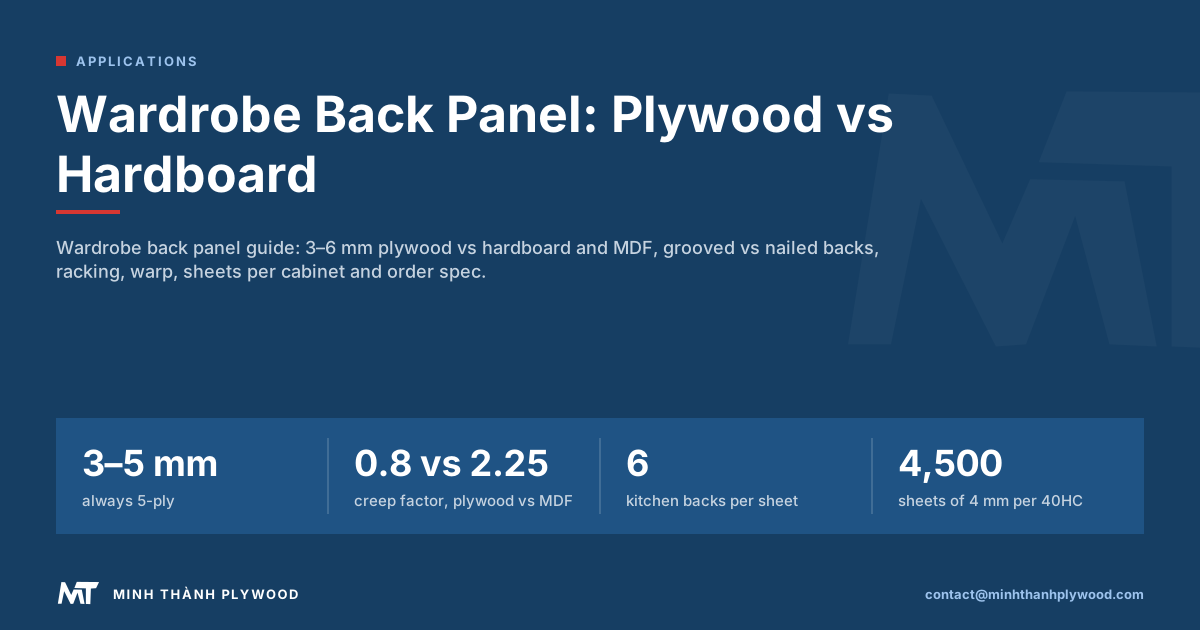
A wardrobe back panel is the thin sheet, usually 3–5 mm, that closes the back of a wardrobe or cupboard and holds the carcass square. Thin plywood makes the strongest backing board: it holds staples and nails near the edge, resists racking and stays flat in humid rooms where hardboard and MDF soften. Minh Thanh Plywood makes 3–5 mm 5-ply panels for furniture factories.
What is a wardrobe back panel?
A wardrobe back panel is the thin sheet fixed to the back of a wardrobe, cupboard or cabinet that closes it and holds the carcass square. It is also called a wardrobe back board, wardrobe backing board or cupboard backing board, and it is usually 3–6 mm thick.
The back does three jobs:
- It closes the cabinet against dust and the wall behind.
- It braces the carcass. Without a back, a box of four panels can rack into a parallelogram; a back fixed all round turns it into a stiff box.
- It finishes the inside, with a wood, white or coloured face behind the shelves and hanging rail.
Because of the second job, a back panel is a structural part of the wardrobe, not just a cover. A thin, well-fixed back is what stops a tall wardrobe from wobbling when a door is opened.
Wardrobe back board materials: plywood, hardboard and MDF compared
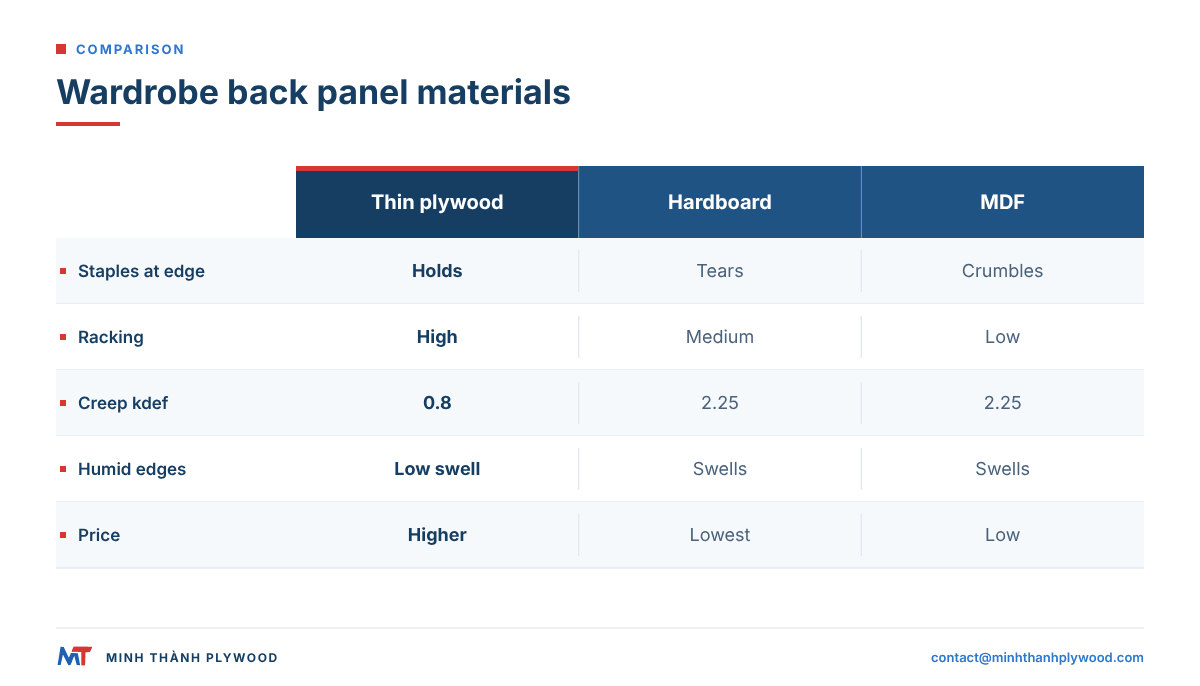
Thin plywood is the strongest wardrobe back panel; hardboard and thin MDF are cheaper and smoother but tear at fixings and soften in humid rooms. The table compares the three backing boards on what a furniture maker checks.
| Metric | Thin plywood, 3–6 mm | Hardboard, 3 mm | MDF back board, 3–6 mm |
|---|---|---|---|
| Build | Cross-laminated veneers, 5-ply | Wet-process fibreboard | Dry-process fibreboard |
| Holding staples and nails near the edge | Good: veneers resist tear-out | Tears under load | Tears and crumbles |
| Racking stiffness when fixed all round | High | Medium | Low to medium |
| Long-term creep (kdef indoors, Eurocode 5) | 0.8 | 2.25 | 2.25 |
| Edge swelling in humidity | Low | High at edges | High at edges |
| Stays flat on tall wardrobes | Yes, balanced 5-ply build | Can bow | Can sag |
| Weight per sheet | Low on Styrax core | Medium | Medium |
| Face options | Poplar, birch, EV; paint or laminate | Brown or white-coated | Raw, white or laminated |
| Price per sheet | Higher | Lowest | Low |
Verdict by use. Thin plywood for wardrobes, tall cupboards, kitchen cabinets and any furniture shipped flat-pack across climates. Hardboard for low-cost backs on small, low units in dry rooms. MDF back board for painted backs on short, stable cabinets. The long-term creep factors come from Eurocode 5 (EN 1995-1-1), which uses the same 2.25 for hardboard and MDF in dry indoor use against 0.8 for plywood.
Why thin plywood beats hardboard for racking strength
Thin plywood braces a wardrobe better than hardboard because the back only works through its fixings, and plywood holds a staple, pin or screw close to its edge without tearing. When a door swings or the wardrobe is pushed, each fixing along the edge carries a shear load; in hardboard and MDF the fibres around the fixing crush and the back starts to slip.
How racking resistance builds up:
- The carcass tries to rack into a parallelogram when pushed at the top corner.
- The back panel resists by shear across its whole area, as long as it cannot slide.
- The fixings transfer the load from the sides, top and bottom into the back.
- The weakest link decides. If the material tears around the fixings, the back slips and the wardrobe wobbles.
Plywood’s cross-laminated veneers spread the load from each fixing into fibres running in two directions, so the edge holds. Hardboard and MDF have no long fibres to spread it. The same mechanism explains why a wardrobe with a hardboard back often wobbles after a house move, when the fixings have been loaded and the fibres around them have crushed.
What thickness should a wardrobe back panel be?
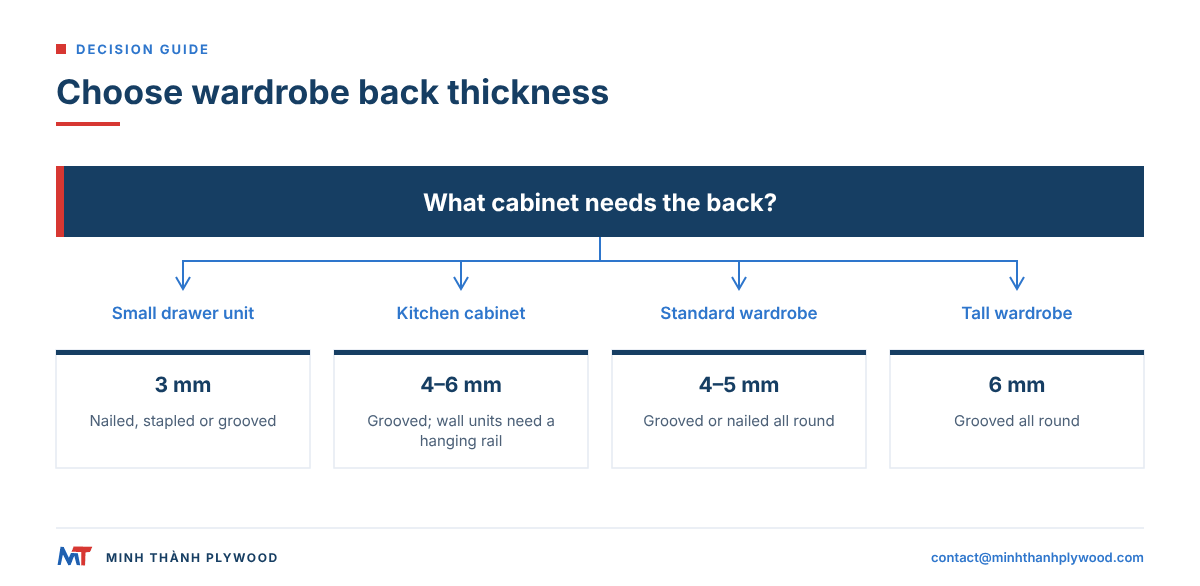
Use 3–4 mm back panels for small cupboards and drawer units, 4–6 mm for wardrobes and kitchen cabinets, and 6 mm where the back is grooved into a tall carcass or carries fixings into the wall.
| Furniture | Back panel thickness | Fixing |
|---|---|---|
| Drawer units and bedside cabinets | 3 mm | Nailed or stapled on, or grooved |
| Kitchen base and wall cabinets | 4–6 mm | Grooved, with a hanging rail for wall units |
| Wardrobes up to standard height | 4–5 mm | Grooved or nailed all round |
| Tall wardrobes and fitted cupboards | 6 mm | Grooved all round |
| Bookcases with visible backs | 4–6 mm, wood-faced | Grooved |
| Full-height wardrobe where a UK shop sells 9 mm MDF | 6 mm plywood holds its fixings and stays flat better, at about half the weight | Grooved or nailed all round |
| Cabinets screwed to the wall through the back | 9 mm and up, or a separate rail | Screws through rail or back |
6 mm plywood or 9 mm MDF on a full-height wardrobe? UK board suppliers such as MDF Direct call 9 mm MDF the sweet spot for full-height wardrobes, because it resists racking and a 12 mm back adds weight at the rear of the carcass. 6 mm plywood holds its fixings and stays flat better than 9 mm MDF at about half the weight; choose 9 mm (plywood or MDF) where the back must stiffen a tall carcass or carry wall fixings. A 1220 × 2440 mm sheet of 6 mm Styrax-core plywood weighs about 8.9 kg (0.0179 m³ at 500 kg/m³); a 9 mm MDF sheet of the same size weighs about 19 kg (0.0268 m³ at 700 kg/m³).
Tall backs are lighter to carry, to groove in and to fix to a wall that is not flat. Choose 9 mm when the back itself carries wall fixings; otherwise 6 mm plywood does the job at half the weight, and MDF’s creep factor is nearly three times that of plywood (2.25 against 0.8).
Do not hang a cabinet on its back panel alone: a 3–6 mm back holds the carcass square but is not a hanging rail. Wall cabinets hang from a rail or from brackets fixed into the carcass sides.
Is my wardrobe back panel failing? Repair or replace
A back panel is failing when the doors will not stay in line, the carcass leans or the back bows, and the repair is cheap until the board itself is damaged. Check the back before blaming hinges: a loose back lets the whole box rack, and the doors follow.
| Sign | Likely cause | Fix |
|---|---|---|
| Doors out of line, gaps uneven top to bottom | Carcass racked; back loose or fixings pulled | Measure both diagonals, push the box square, then refix the back all round |
| Back bows outward or sags in the middle | Thin hardboard or MDF has softened, or damp | Add a horizontal rail behind it, or replace the back |
| Nails or staples pulled through | Board tears at its fixings | Refix with screws and glue 10 mm in from the edge, or replace with plywood |
| Damp marks, swollen edges, soft board | Wall moisture or condensation | Cure the damp first; replace a swollen board with plywood |
| Wardrobe wobbles but the back looks flat | Too few fixings or back missing at the corners | Add fixings at close, even spacing all round |
Repair when the board is flat, dry and sound and only the fixings have moved: re-square the box and refix the back. Replace when it is swollen, crumbling at the edges or bowed. A replacement is a thin plywood panel, 4–6 mm, cut to the inside size at ±1–2 mm (the tolerance UK cut-to-size shops such as Artisaw quote), fixed all round after the diagonals are equal.
Grooved vs nailed-on back panels
A grooved back panel sits in a groove cut into the sides, top and bottom of the carcass; a nailed-on back is fixed over the back edges. Grooved backs look better, hide the panel edge and square the carcass; nailed-on backs are faster and common in flat-pack furniture.
| Point | Grooved (rebated or dadoed) back | Nailed-on (surface-fixed) back |
|---|---|---|
| Look | Edge hidden, clean back | Edge visible on the sides |
| Squareness | Groove holds the carcass square | Squared when nailing |
| Assembly | Slide in before the last panel | Nail or staple after assembly |
| Thickness | 4–6 mm, sized to the groove | 3–4 mm usual |
| Tolerance needed | Tight: panel must slide without play | Looser |
| Best for | Quality and fitted furniture | Flat-pack, low-cost units |
A groove 8–10 mm from the back edge leaves room for a wall batten or skirting behind the cabinet. The panel thickness must match the groove: on the line, a back a fraction of a millimetre too thick jams, and one too thin rattles. That is why furniture plants order back panels with a tight thickness tolerance; Minh Thanh holds sanded furniture panels to ±0.2–0.3 mm, and length and width to ±2 mm.
How do you stop a back panel warping, and keep the carcass square?
A thin back panel stays flat when it is balanced, dry and fixed all round; the carcass stays square when the back goes on after the diagonals have been measured equal. Most warped backs come from an unbalanced build or from panels assembled wet and dried in the room.
What keeps a back panel flat:
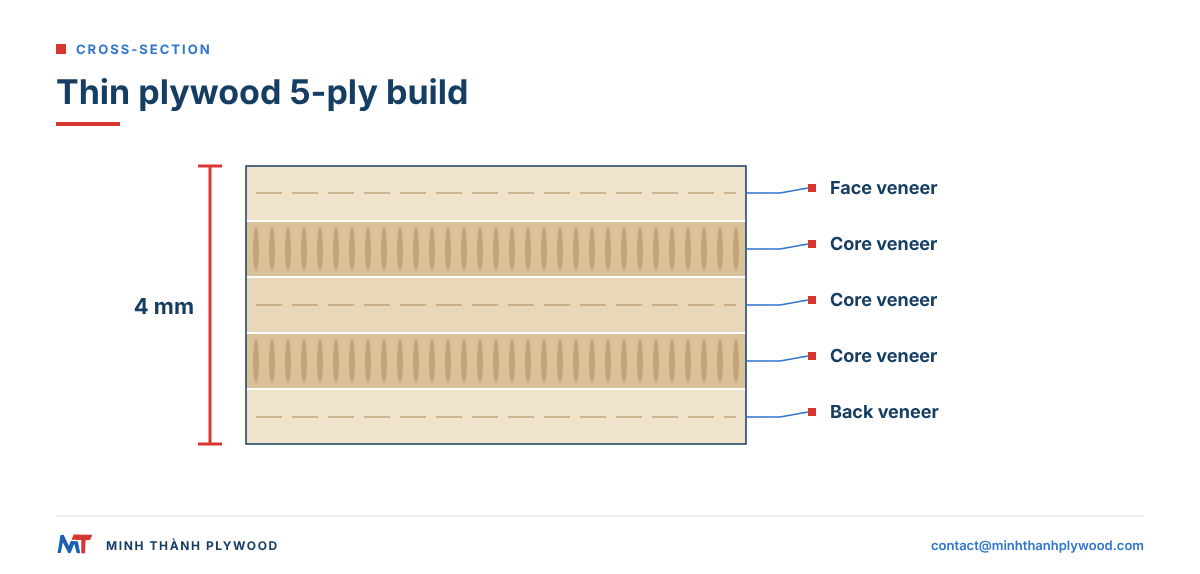
- A balanced build. Minh Thanh thin plywood is always 5-ply: 3 mm is one core veneer, two cross-band veneers and two faces; 4 and 5 mm have three core veneers and two faces. Equal layers on both sides of the centre keep the panel flat.
- Core veneer matched to the panel. A 4 mm furniture panel uses three 1.3 mm Styrax core veneers.
- Dry panels. Veneers and finished panels are dried to 8–12% moisture at dispatch, the normal range for furniture plywood.
- Two-step pressing. Furniture-grade panels are pressed twice: the core is pressed and calibrated, then the faces go on.
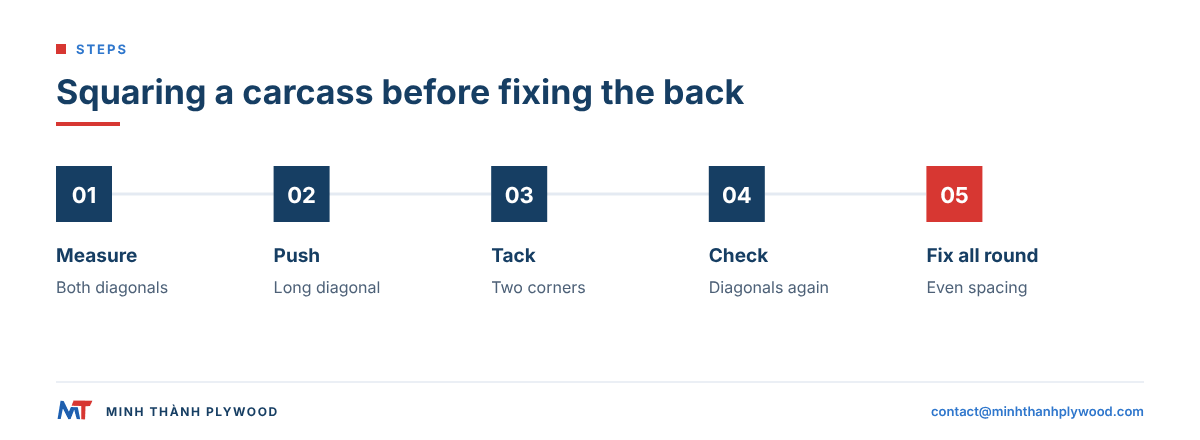
How to keep the carcass square during assembly:
- Assemble the carcass and measure both diagonals.
- Push the long diagonal until the two readings are equal.
- Fix the back at two opposite corners, then measure again.
- Fix all round at even spacing.
Wardrobe backing board faces: white, prefinished or wood
Wardrobe back panels come wood-faced, white or prefinished in a colour; the face is chosen to match the inside of the carcass. Most white backs are thin plywood or fibreboard with a white paper, melamine or paint layer.
| Back face | Built from | Use |
|---|---|---|
| Poplar, sanded | Thin plywood | Painted or laminated by the furniture maker |
| Birch or EV | Thin plywood | Visible wood interiors, open shelving |
| White paper or melamine | Thin plywood or fibreboard | White carcasses, flat-pack wardrobes |
| Painted white | Thin plywood | Fitted wardrobes, kitchens |
| Raw brown | Hardboard | Hidden backs on low-cost units |
Minh Thanh thin plywood leaves the factory with sanded, UV-ready faces, so a furniture plant can paint, laminate or UV-coat its backs on its own line. Poplar faces are quoted as A/A, A/B or B/B; a back only shows one face, so A/B or B/B keeps cost down. Thin premium face veneer is scarce, so 4 mm panels with top faces can take longer; we do not lower the standard to go faster.
How much does cabinet back plywood cost per sheet?
Cabinet back plywood is priced per cubic metre at the mill, so the price per sheet follows its thickness: a 1220 × 2440 × 4 mm sheet is 0.0119 m³, about 84 sheets per cubic metre. Minh Thanh’s indicative starting price for furniture and interior plywood is from US$350/m³ (October 2026).
Against that mill price, UK shelf prices in October 2026 run from about £16 to £20 for a 9 mm MDF sheet of 1220 × 2440 mm (inc VAT, The Good Sheet, Wickes) and from about £68 (Premier Timber) for a 6 mm birch plywood sheet of the same size, with Howarth Timber and SL Hardwoods listing the same sheet up to £84. Retail birch is a premium face; a furniture plant buying poplar-faced, Styrax-core backs by the container pays the mill price instead, and cut-to-size backs save the offcut waste a retail sheet carries.
What moves the price of a back panel:
- Thickness. A 3 mm sheet uses less wood than a 6 mm one, but thin veneers cost more to peel and handle per cubic metre.
- Face grade. A/A faces cost more than A/B or B/B; a back usually needs only one good face.
- Core. Light Styrax cores cut freight weight; Eucalyptus is stiffer and heavier.
- Glue and emission. UF glue at E0 emission is the standard for furniture interiors.
- Size and cutting. Cut-to-size backs save cutting and freight on offcuts.
- Quantity. Prices are quoted per container, and mixed thicknesses can share a 40HC.
For US buyers, the TSCA Title VI limit is 0.05 ppm for veneer-core hardwood plywood under 40 CFR 770.10.
The final price depends on face, core, glue, thickness, size, quantity and delivery term, so send your cutting list for a quotation.
How much back panel plywood does a cabinet project need?
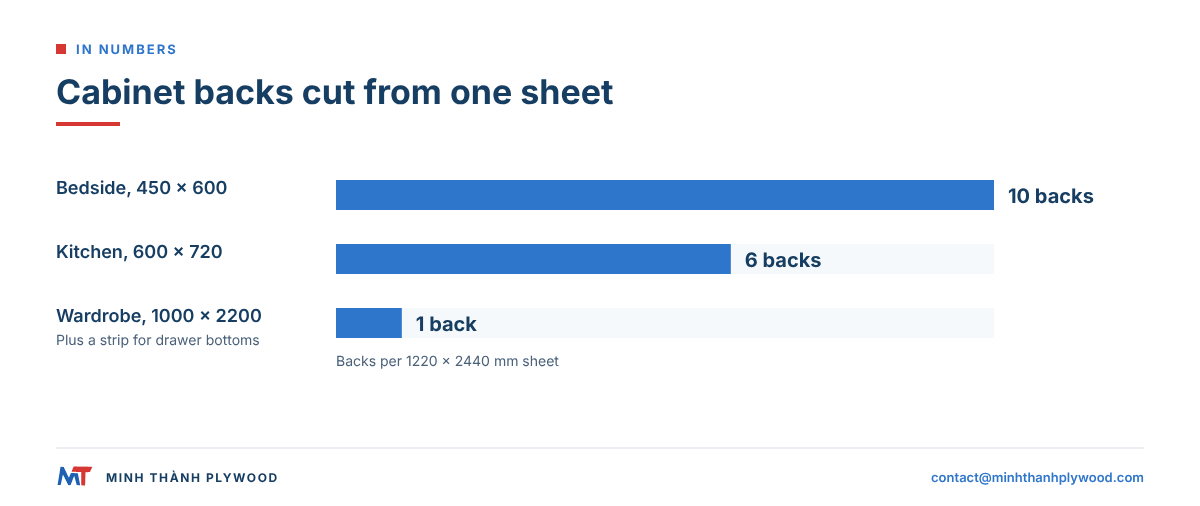
One 1220 × 2440 mm sheet gives six kitchen base-unit backs of 600 × 720 mm, or one wardrobe back of 1000 × 2200 mm with a long strip left for drawer bottoms. Count backs per sheet from the cutting plan, not by area, because offcuts are rarely usable as backs.
| Cabinet | Back size | Backs per 1220 × 2440 mm sheet |
|---|---|---|
| Kitchen base unit | 600 × 720 mm | 6 |
| Kitchen wall unit | 600 × 720 mm | 6 |
| Bedside cabinet | 450 × 600 mm | 10 |
| Wardrobe module | 1000 × 2200 mm | 1, plus a strip for drawer bottoms |
For a fitted kitchen of twelve 600 mm units, two sheets of 4–6 mm plywood cover all the backs. Furniture factories cutting thousands of identical backs order cut-to-size panels: one 1220 × 2440 mm panel cut into 4, 6 or 8 pieces, which arrive ready for the groove.
What to write on a back panel plywood order
A back panel order states thickness and tolerance, ply count, core, glue and emission, face and back grade, size or cutting plan, moisture and packing. Ordering the back by its groove size, not just “3 mm”, avoids panels that jam or rattle on the line. Plywood is processed wood and sits outside the scope of ISPM 15, so only solid-wood bearers under the packs need the ISPM 15 mark.
Thin plywood for wardrobe backs: 4 mm ±0.2 mm, 5-ply, Styrax core, UF glue at E0 emission, poplar B/B faces sanded and UV-ready, cut to size 1220 × 2440 mm into 6 pieces, 8–12% moisture, export packing.
For container planning on a Styrax core in 1220 × 2440 mm, one 40HC carries about 5,994 sheets of 3 mm, 4,500 sheets of 4 mm, 3,600 sheets of 5 mm or 2,988 sheets of 6 mm, all within the 28,000 kg planning payload. Most wardrobe makers mix thin back panels with 18 mm carcass panels in the same container, by agreement.
Minh Thanh’s minimum order is one 40HC; production takes 15–45 days after the deposit, with a 30% deposit and the 70% balance against the scanned bill of lading, and free samples are available. Send your back panel sizes to contact@minhthanhplywood.com.
Buyer questions, answered
What thickness should a wardrobe back panel be?
3–4 mm for small cupboards and drawer units, 4–6 mm for wardrobes and kitchen cabinets, and 6 mm or more where the back is grooved into a tall carcass that must stay square.
What is the best backing board for cupboards?
Thin plywood. It holds staples and nails near the edge, braces the carcass against racking and stays flat in humidity. Hardboard and thin MDF are cheaper but tear at fixings and soften when damp.
Is hardboard or plywood better for a wardrobe back?
Plywood. Its cross-laminated veneers resist tearing at staples and splitting at the edges, and it does not swell at the edges in humid rooms. Hardboard is only cheaper.
Should a wardrobe back panel be grooved in or nailed on?
Grooved in for quality furniture: the back sits in a groove in the sides, top and bottom, hides its edges and squares the carcass. Nailed-on backs are faster and common in flat-pack furniture.
Why does a wardrobe wobble?
Usually because the back panel is loose, too thin, or fixed at too few points. A back fixed all round, at close spacing, stops the carcass racking.
Is 9 mm MDF or 6 mm plywood better for a full-height wardrobe back?
6 mm plywood holds its fixings and stays flat better than 9 mm MDF at about half the weight: a 1220 × 2440 mm sheet weighs about 8.9 kg in Styrax-core plywood against about 19 kg in MDF. Use 9 mm (plywood or MDF) where the back must stiffen a tall carcass or carry wall fixings.
How do I know my wardrobe back panel is failing?
Doors out of line, a back that bows or sags, nails pulled through the board, damp marks or a wobbling carcass. Re-square and refix a sound board; replace one that is swollen, crumbling or bowed.
How much does a wardrobe back panel cost in the UK?
In October 2026 a 9 mm MDF sheet of 1220 × 2440 mm retails at about £16 to £20 inc VAT and a 6 mm birch plywood sheet at about £68 to £84. Mill-direct furniture plywood is priced per cubic metre, from US$350/m³.
Can I replace a wardrobe back panel?
Yes. Cut a new thin plywood panel to the inside size of the old one, square the carcass by measuring its diagonals, then fix the new back all round with pins or screws.
Is MDF back board good for a wardrobe?
It works in dry rooms for nailed-on backs on low cabinets. In humid rooms or tall wardrobes, MDF back board sags and tears at fixings; thin plywood holds better.
How much does cabinet back plywood cost per sheet?
Price follows volume: a 1220 × 2440 × 4 mm sheet is 0.0119 m³, about 84 sheets per cubic metre. Factory prices for furniture plywood start from US$350/m³ (October 2026), depending on face, core, glue and quantity.
How many cabinet backs can I cut from one sheet?
A 1220 × 2440 mm sheet gives six backs of 600 × 720 mm for kitchen base units, or one 1000 × 2200 mm wardrobe back with a long offcut strip for drawer bottoms.
Do wardrobe back panels need to be white?
No, but many are: a white melamine, paper or painted face matches white carcasses. Wood-faced plywood backs suit open shelving and visible interiors.
How many plies does 3 mm plywood have?
Minh Thanh's 3 mm plywood is 5-ply: one core veneer, two cross-band veneers and two face veneers. The 4 and 5 mm panels are also 5-ply, with three core veneers and two faces.
How many thin plywood sheets fit in a container?
On a Styrax core in 1220 × 2440 mm, one 40HC carries about 5,994 sheets of 3 mm, 4,500 of 4 mm, 3,600 of 5 mm or 2,988 of 6 mm, within the planning payload.