
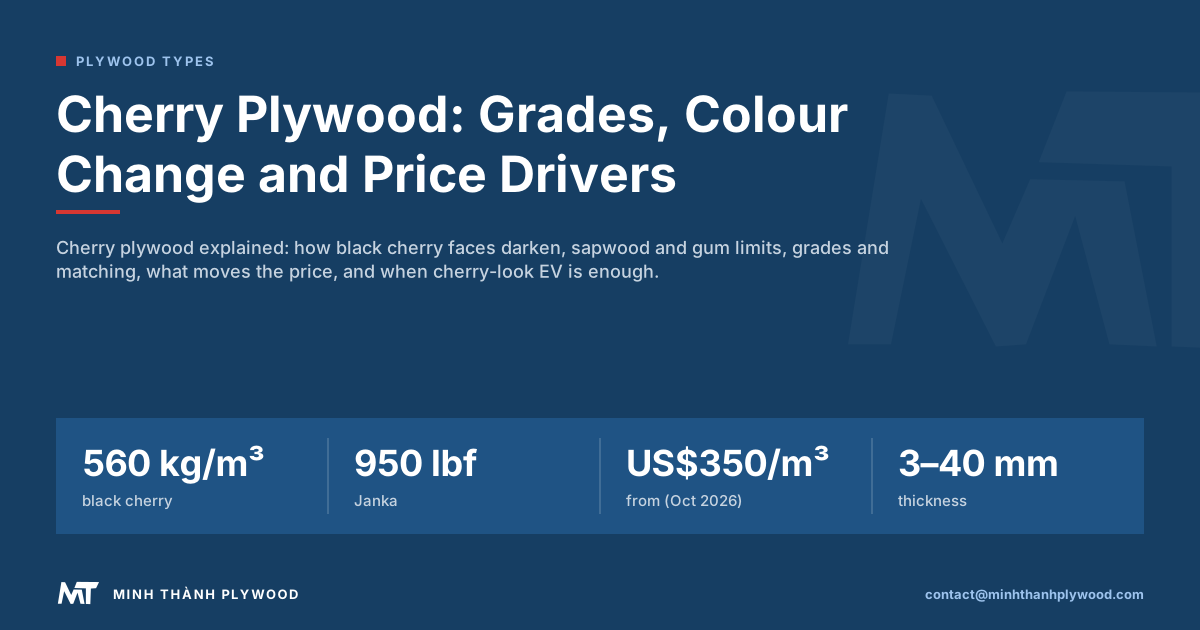
Cherry plywood is a panel faced with black cherry veneer, prized because its pinkish face darkens to a deep reddish brown within months. Its price is set mostly by the face: natural cherry, sap-free selection and matching cost more than the core underneath. Minh Thanh Plywood makes cherry faces on request and offers cherry-look engineered veneer when the budget is tighter.
Cherry plywood: the short answer
Cherry plywood is plywood faced with black cherry veneer over a core of another species, bought for a warm face that darkens with age. Three choices decide what you get and what you pay: the face selection, the grade and matching, and whether the veneer is natural or engineered.
- Face selection: natural cherry (sapwood allowed) or select, sap-free heartwood.
- Grade and matching: how many flecks, gum spots and colour streaks are allowed, and how the leaves are laid.
- Natural or engineered: real cherry veneer, or cherry-look engineered veneer (EV) when an even colour at a lower cost matters more.
The core under the face sets flatness, weight and screw holding. Each of these choices has a section below, with a price-driver table and the lines to put on an order.
What is cherry veneer plywood?
Cherry veneer plywood is a hardwood plywood panel whose face, and often back, is a thin sheet of black cherry (Prunus serotina) glued over a cross-laminated core. The cherry is only the outer skin; the plies underneath are a different, lower-cost wood chosen for flatness and strength.
Black cherry is a North American hardwood with fine, even grain and a satin lustre. In solid form it averages about 560 kg/m³ dried, with a Janka hardness of about 950 lbf (4,230 N), softer than maple or oak (The Wood Database, black cherry, read 20 October 2026). On a panel, that softness matters less than you might think: the face is thin, and the core and finish carry most of the wear.
- Face: black cherry veneer, plain-sliced, quarter-sliced or rotary-cut.
- Back: cherry of a lower grade, or a different species when the back is hidden.
- Core: hardwood veneer core; on our panels, white Styrax or Eucalyptus as standard.
- Uses: cabinets, doors, furniture, wall panelling and shop fittings.
How does cherry colour change after the panel is made?
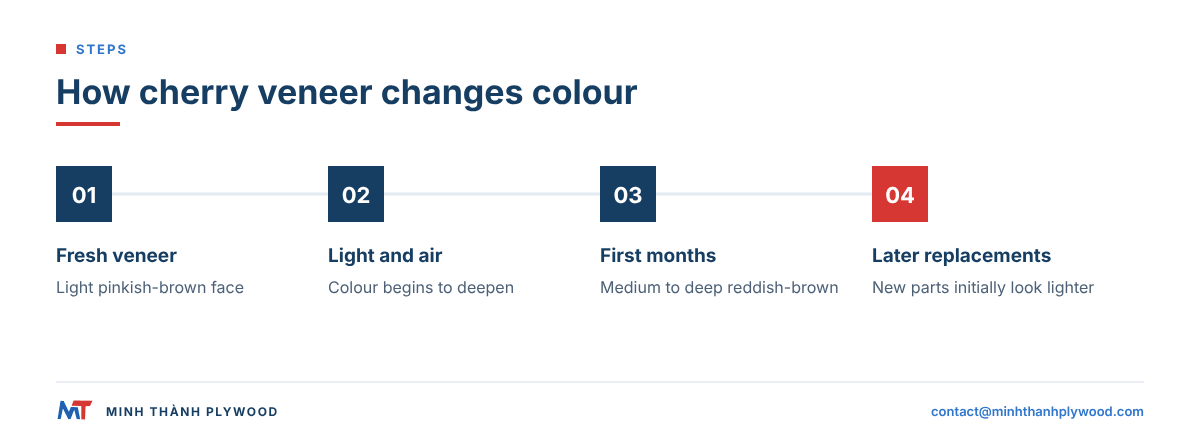
Cherry darkens. A fresh cherry face is light pinkish brown and, with light and air, turns medium to deep reddish brown, most of it in the first months after it is cut and finished. This change is the reason many buyers choose cherry, and the reason they get complaints when they do not plan for it.
What the change means for a project:
- Panels from one order age together when they are finished and installed together; a replacement door cut a year later will look lighter for a while.
- Objects left on a fresh surface leave shadows: a vase or a book blocks the light and leaves a lighter patch, which fades as the area catches up.
- Sun speeds the change: some makers leave cut parts in daylight for a few days before assembly so the colour evens out.
- Clear finishes do not stop it: a finish with UV absorbers slows the change, but the wood still darkens.
The sample you approve should show both a fresh face and one that has been in light, so the client agrees to the colour they will live with.
Sapwood, pith flecks and gum pockets: what can a cherry face show?
Natural cherry faces can show pale sapwood streaks, small dark pith flecks and gum pockets, and the face grade sets how many of each are allowed. None of these are defects in the wood; they are what cherry looks like, and the order decides how much of that character is wanted.
| Feature | What it looks like | How the order controls it |
|---|---|---|
| Sapwood | Pale cream streak beside the pink-brown heartwood | Order “natural” (sapwood allowed) or “select / sap-free” (heartwood only) |
| Pith flecks | Small dark brown marks along the grain | Higher face grades allow fewer and smaller flecks |
| Gum pockets | Dark resin streaks or spots | Limited by grade; agree a limit on the approved sample |
| Mineral streaks | Greenish or dark streaks | Limited by grade |
| Colour variation | Leaves of different shade side by side | Set by matching and by the leaves taken from one log |
Sapwood is the main price lever. A sap-free face uses only the heartwood of each log, so more veneer is rejected and the face costs more.
Cherry plywood grades and veneer matching
Cherry plywood is graded by its face, usually on the North American hardwood plywood scale where AA is the top face grade, then A, B and lower, with a numbered grade for the back. A panel described as A-1 cherry, for example, has an A face and a sound back of grade 1.
- AA and A faces: for cabinet doors, furniture fronts and panelling seen up close.
- B faces: for cabinet boxes, interiors and parts that will be partly hidden.
- Lower faces: for paint-grade or hidden work, where cherry is rarely chosen.
Matching describes how the veneer leaves sit on the face:
- Book match: every second leaf flipped like the pages of a book, giving a mirrored pattern.
- Slip match: leaves laid side by side in the same direction, giving a repeating pattern.
- Random match: leaves of mixed width and pattern, the lowest cost of the three.
- Whole-piece rotary: one continuous rotary-cut sheet, with a broad, wild grain.
For a buyer who also buys birch, our birch faces use the Vietnamese grade names D+, D and E, quoted as face/back pairs such as D+/D. Cherry is ordered by its own face grade and an approved sample, not by the birch ladder. Our guide to birch plywood grades explains that scale.
US grade codes on cherry plywood: A1, A2, BC and PC2
US cherry plywood is ordered by a face letter, a back number and sometimes a core code, so a listing such as 1/8 A1, 1/4 A2, 1/2 BC or 3/4 A1 PC2 reads as thickness, face and back, and core. Here is how those codes map onto the face pairs we quote.
| US code | Meaning | Closest face on our quote |
|---|---|---|
| A (or AA) face | Clear, matched face for visible surfaces | AA or A face |
| B face | Sound face, small patches allowed | B face |
| Back 1 | Sound tight knots to 3/8 in, no repaired knots | Matching sound back grade |
| Back 2 | Sound knots to 3/4 in, repaired knots and mineral streak allowed | Lower back grade |
| Back 3 and 4 | Reject back, for concealed sides | Concealed back |
| PC | Pro Core: veneer inner plies with thin MDF crossbands under the face and back, for an MDF-smooth surface at lower weight | Ask for an MDF-crossbanded core; our standard is an all-veneer stitched hardwood core |
The back-grade definitions are those printed by Cherokee Wood Products. When you compare quotes, ask each supplier to state face, back and core separately. The face and back pair we quote, such as A/B, is matched to the sample you approve.
Plain-sliced, quarter-sliced and rotary cherry faces
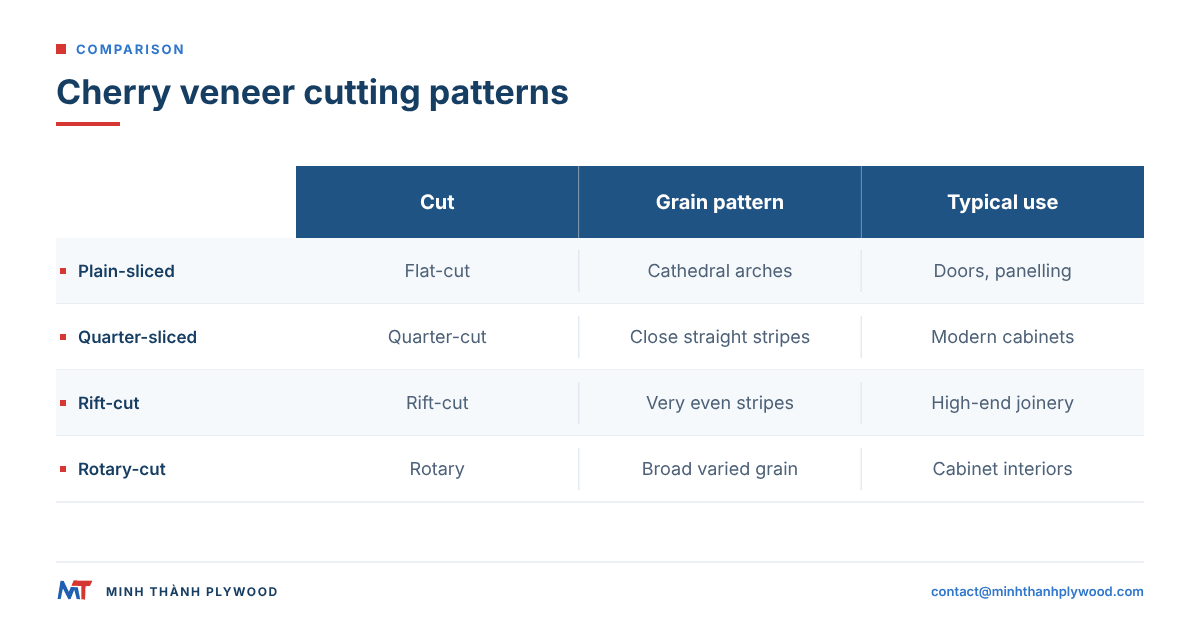
The way the cherry log is cut into veneer sets the grain pattern on the face, and with it the look and the price. Plain-sliced cherry is the most common face; quarter-sliced and rift faces are straighter and cost more; rotary-cut faces cost the least.
| Cut | Grain on the face | Typical use |
|---|---|---|
| Plain-sliced (flat-cut) | Cathedral arches down the leaf | Doors, furniture tops, panelling |
| Quarter-sliced | Straight, close stripes | Modern cabinets, matched walls |
| Rift-cut | Very straight, even stripes | High-end joinery, few figure marks |
| Rotary-cut | Broad, varied pattern | Cabinet interiors, lower-cost faces |
Plain-sliced cherry, book-matched, is what most buyers picture when they ask for cherry plywood. Quarter-sliced cherry shows less figure, which suits a quiet, modern design.
What sets the cherry plywood price?
The cherry plywood price is set mostly by the face: species selection, grade, matching and the share of sap-free heartwood, then by core, glue, thickness, size and quantity. As a reference, furniture and interior plywood from our factory starts from US$350/m³ (October 2026); a natural cherry face sits well above that start, and cherry-look engineered veneer sits between the two.
| Price driver | Lower cost | Higher cost |
|---|---|---|
| Face material | Cherry-look engineered veneer | Natural black cherry veneer |
| Sapwood | Natural (sapwood allowed) | Select, sap-free heartwood |
| Face grade | B face | AA or A face |
| Matching | Random or rotary | Book-matched, sequenced leaves |
| Back | Lower-grade back or other species | Cherry back of matching grade |
| Glue and emission | UF glue at E0 emission (standard) | MR or phenolic bond by order |
| Thickness and size | Standard 1220 × 2440 mm | Custom sizes and thin sheets |
| Quantity | Full container of one specification | Small mixed lots |
| Delivery term | FOB Hai Phong | CFR or CIF to your port |
Retail gives a floor to compare against. Cherokee Wood Products lists natural cherry plywood in 4 × 8 ft sheets from US$111 to US$175 per sheet, by thickness: 1/8, 1/4, 1/2 and 3/4 in, unfinished, ordered by codes such as 1/8 A1, 1/4 A2, 1/2 BC and 3/4 A1 PC2.
| Price reference | What it is | Price |
|---|---|---|
| US retail, natural cherry 4 × 8 ft | One unfinished sheet, 1/8 to 3/4 in | US$111 to US$175 per sheet |
| Minh Thanh Plywood FOB | Furniture and interior plywood, per m³, by the container | From US$350/m³ |
| Cherry-look engineered veneer | Same cores, lower face cost | Between the two |
The two rows are not the same unit: a retail sheet price includes the distributor’s stock, handling and margin, while FOB per m³ is a container price for a full specification. An importer who prices a full container of one specification against US shelf prices sees the margin; cherry faces are quoted from the specification, so send the lines below.
We do not publish a price list: the quote is built from your specification. The quickest way to compare offers is to send every supplier the same lines from the order section below.
Cherry plywood for laser cutting and small projects
Hobby laser cutters use thin cherry plywood: sheets of 1/8 in (about 3 mm) cut to fit the bed of the machine, with a veneer face on an MDF or hardwood core. A US seller such as Laser Wood Supplies cuts 1/8 in cherry ply on an MDF core to 11 3/4 × 19 in for Glowforge machines, notes that natural thickness varies between 3.4 and 4 mm, and sells it in boxes of US$18 for 1 to 12 sheets, US$24 for 13 to 25 and US$32 for 26 to 50.
- Veneer core or MDF core: MDF cuts evenly and burns darker at the edge; a hardwood veneer core is lighter and shows a light striped edge.
- Thickness: ask for the real measured thickness, since a 1/8 in label can arrive near 5/32 in and not fit a 3 mm setting.
- Pre-cut sizes: bed-size blanks sell by the box; full sheets are cut by the user.
- Sealing: a thin coat of clear finish after cutting keeps the cherry colour even.
We make thin furniture-grade panels from 3 mm and can cut sheets to a stated size by the container, so a laser-supply reseller can order cherry-faced blanks by specification. For a one-off project, the retail box is the quicker route.
Natural cherry or cherry-look engineered veneer?
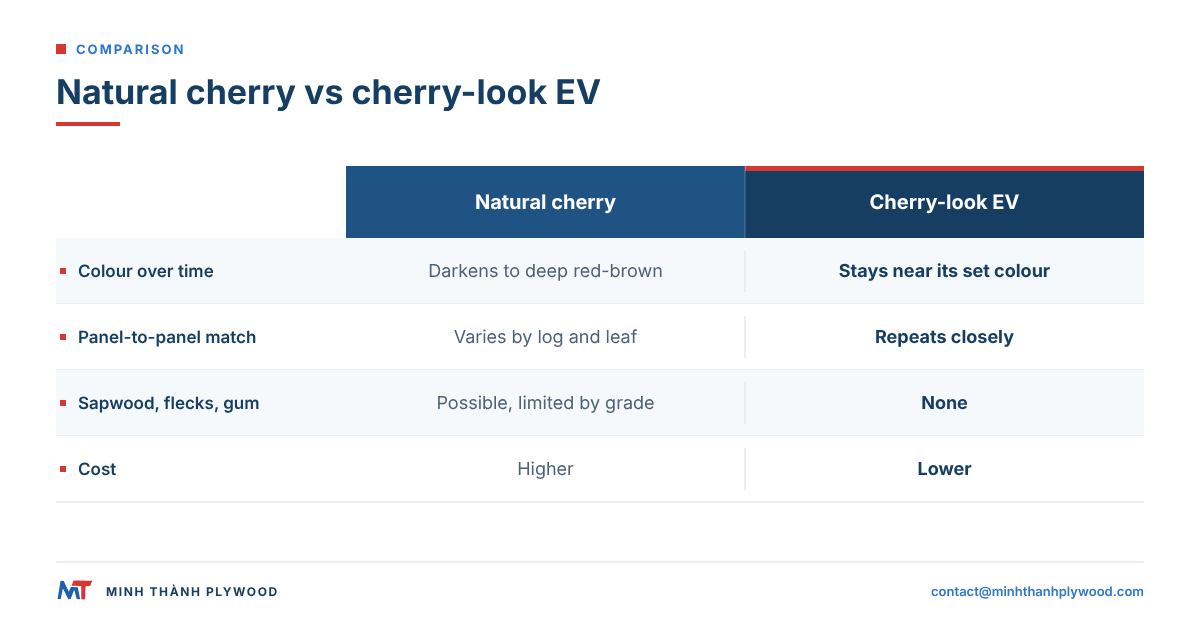
Natural cherry gives the real wood’s colour change and figure; cherry-look engineered veneer (EV) gives an even, repeatable colour at a lower cost. Engineered veneer is real wood veneer, usually from fast-growing species, dyed, stacked and resliced so that every leaf repeats the chosen colour and grain. EV is the face we produce most.
| Point | Natural cherry face | Cherry-look EV face |
|---|---|---|
| Wood | Black cherry veneer | Dyed and reconstituted wood veneer |
| Colour over time | Darkens to deep reddish brown | Stays close to its set colour |
| Panel-to-panel match | Varies by log and leaf | Repeats closely between orders |
| Sapwood, flecks, gum | Possible, limited by grade | None |
| Figure | Natural, unique | Printed into the block, repeating |
| Cost | Higher | Lower |
| Best for | Furniture and doors where real cherry is specified | Large runs, shop fitting, repeat orders |
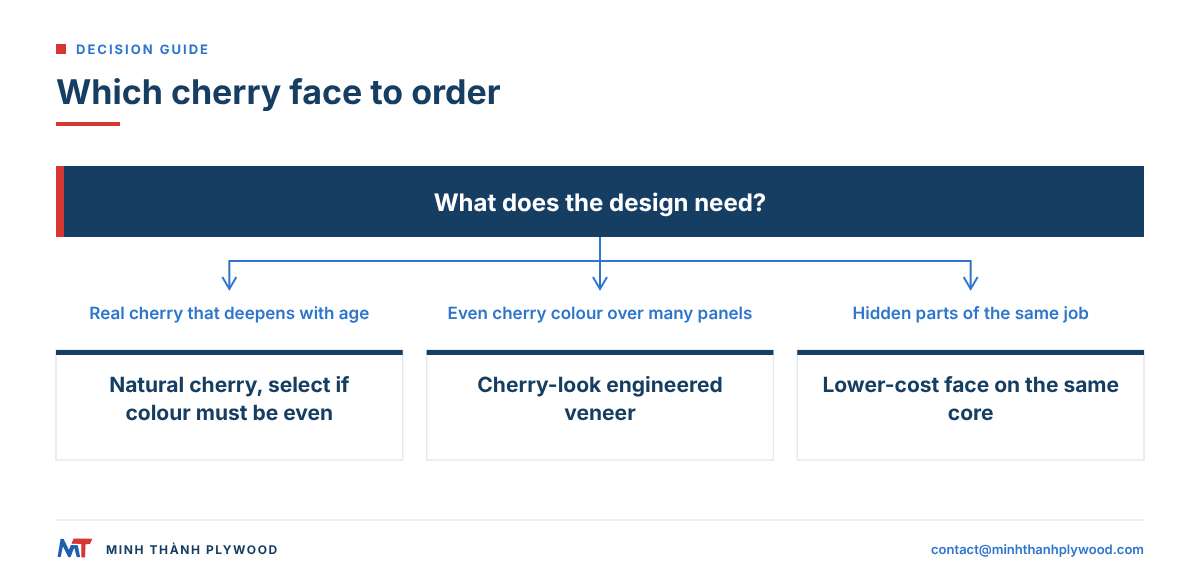
EV is the cheaper match when the design calls for a cherry colour across many panels or repeat orders and does not require the species. Natural cherry stays the choice when the client specifies the species or wants the colour to deepen with age. See our EV plywood page for the engineered faces.
Core, glue and thickness options for cherry-faced panels
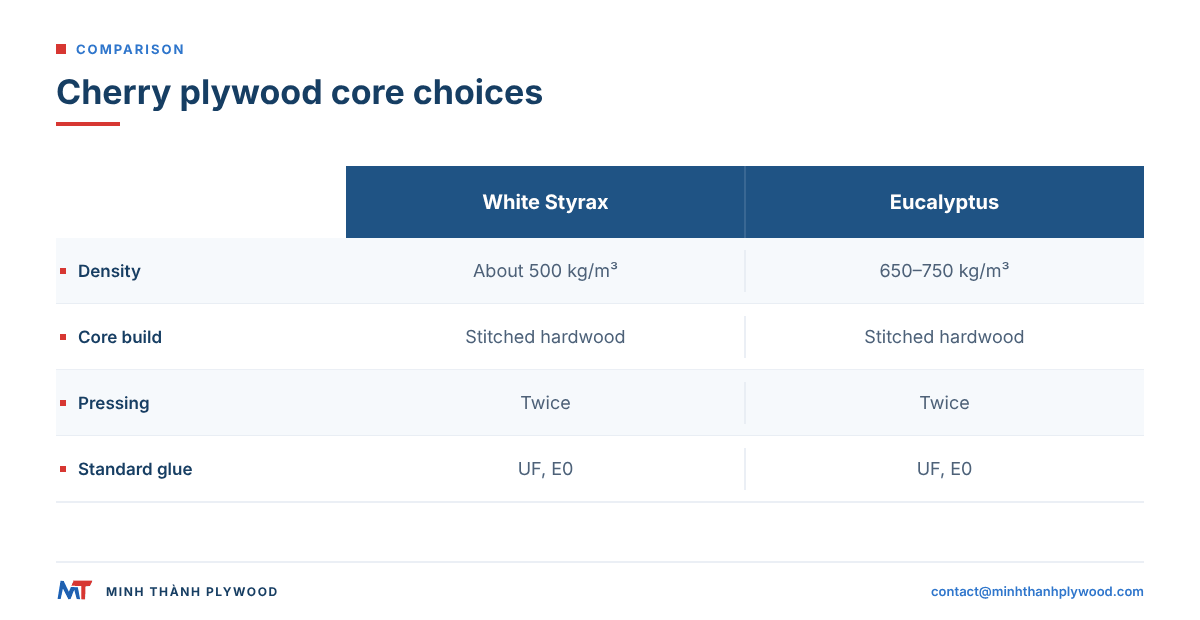
Under the cherry face we use the same core and glue choices as our other furniture panels: white Styrax or Eucalyptus core, UF glue at E0 emission as standard, and thickness from 3 to 40 mm. Furniture-grade panels are pressed twice: the core board is pressed and calibrated first, then the face and back are pressed on, which keeps the cherry face flat and the thickness tight.
| Specification | Our standard |
|---|---|
| Core | White Styrax (about 500 kg/m³) or Eucalyptus (650–750 kg/m³) |
| Core build | Core layers stitched horizontally and vertically |
| Pressing | Twice: calibrated core board, then face and back |
| Glue | UF glue at E0 emission; MR or phenolic (WBP) bonds by order |
| Thickness | 3–40 mm; thin 3–5 mm panels are always 5-ply |
| Thickness tolerance | Sanded furniture panels ±0.2–0.3 mm |
| Sizes | 1220 × 2440 and 1250 × 2500 mm; custom sizes such as 1220 × 2500 mm |
| Moisture | 8–12 % at dispatch |
Our panels hold CARB P2 / TSCA Title VI certification (ICTT mill no. 23024). Six chamber tests between April 2025 and June 2026 on 9, 15 and 18 mm panels averaged 0.014–0.032 ppm against the 0.05 ppm limit.
The US limit for veneer-core hardwood plywood is 0.05 ppm under 40 CFR 770.10. The chamber test method for that limit is described in ASTM D6007, and the rule as a whole is in 40 CFR Part 770.
Finishing cherry plywood: stain, oil and lacquer
Cherry plywood looks best under a clear finish that lets it darken naturally; stain is possible but needs care because cherry blotches. The face arrives sanded and polished, and both faces are UV-ready for buyers who apply their own UV coating.
- Sand lightly with fine paper only to remove handling marks; the face veneer is thin.
- Test on an offcut from the same panel before finishing the job.
- For a clear look, use oil, lacquer or a water-based clear coat; the colour will still deepen.
- For a darker start, apply a washcoat (thin sealer) first, then a gel stain, which sits on the surface and blotches less.
- For UV lines, apply the UV coating to the sanded face; ask for UV-ready faces on the order.
- Seal edges and backs with the same number of coats as the face to keep the panel balanced.
Many makers skip stain on cherry altogether. Six months of daylight does what a stain would do, and it does it evenly.
Where is cherry plywood used?
Cherry plywood is used where a warm, fine-grained face is seen up close: kitchen and bathroom cabinets, furniture, doors, wall panelling and shop fittings. Hidden parts of the same job often use a lower-cost face on the same core.
- Kitchen cabinets: doors, end panels and open shelving in cherry; boxes in a lower face grade or EV.
- Furniture: desks, sideboards, bookcases and bed panels.
- Wall panelling: book-matched or sequenced cherry for offices, hotels and boardrooms.
- Doors: veneered door skins and flush doors.
- Shop fitting: counters and displays, often in cherry-look EV for colour consistency across stores.
For a whole cabinet line, ask for two specifications: cherry for what is seen, and a lower-cost face for what is not. One container can carry both, by agreement.
Buying cherry veneer plywood from suppliers in Asia
Buyers in Asia source cherry veneer plywood from mills in Taiwan, mainland China and Vietnam, and the questions that separate offers are the same everywhere: is the face natural cherry or engineered veneer, which grade and matching, which core and glue, and which emission proof. A low price per sheet often hides a lower face grade or a lighter core.
- Ask what the face is: natural black cherry, another cherry species, or cherry-look EV.
- Ask for the grade and matching in writing, with a sample from production.
- Ask for the core species and build: stitched hardwood core or a lighter filler.
- Ask for the emission proof: certification number and chamber-test reports with method and date.
- Compare the same specification across suppliers, at the same delivery term.
We are a Vietnamese manufacturer of furniture and interior plywood with a capacity of 50,000+ m³ per year, and Europe is our main market. Sea transit from Hai Phong to South-East Asia is typically 5–12 days, and about 2–3 weeks to Japan or Korea, by carrier and route.
What to write on a cherry plywood order
A cherry plywood order that can be quoted the same day names the face, grade, core, glue, size and quantity. Send these lines with your request:
- Application: cabinet doors, carcasses, furniture, panelling or doors.
- Face: natural cherry, select sap-free cherry, or cherry-look EV; cut and matching.
- Face and back grade: for example an A face with a grade 1 back, matched to an approved sample.
- Core: white Styrax or Eucalyptus.
- Glue and emission: UF glue at E0 emission; CARB P2 / TSCA Title VI documents for US orders.
- Size and thickness: for example 1220 × 2440 × 18 mm.
- Finish: sanded, or UV-ready faces.
- Packing and quantity: from one 40HC, mixed specifications by agreement; destination port.
Production is 15–45 days after the 30% deposit, with the balance against the scanned B/L, FOB Hai Phong, CFR or CIF. Free samples are sent on request. Read our guides to Baltic birch plywood and birch vs maple plywood for other face choices, and the hardwood veneered plywood guide for the full species range.
Buyer questions, answered
What is cherry plywood?
Cherry plywood is plywood with a face veneer of black cherry (Prunus serotina) glued over a core of other wood. The face gives the cherry look; the core gives flatness, strength and screw holding.
Does cherry plywood darken over time?
Yes. A fresh cherry face is light pinkish brown and darkens to a medium or deep reddish brown with light and air, with most of the change in the first months. Clear finishes do not stop it.
Is cherry plywood expensive?
Cherry-faced plywood costs more than birch, maple or poplar faces on the same core, because good cherry logs are scarce and sap-free faces waste more veneer. The face grade, matching and quantity move the price more than the core does.
What is the difference between natural and select cherry faces?
A natural cherry face may mix pale sapwood with the darker heartwood. A select or sap-free face is heartwood only, so it is more even in colour and costs more.
Can you stain cherry plywood?
You can, but cherry tends to blotch with thin pigment stains. A washcoat or gel stain gives a more even colour, and many buyers simply use a clear finish and let the wood darken.
Is cherry veneer plywood good for kitchen cabinets?
Yes. Cherry veneer plywood is a classic choice for cabinet doors, end panels and visible boxes, where its colour and fine grain show. Hidden parts can use a lower-cost face on the same core.
What thickness does cherry plywood come in?
Cherry-faced panels are made from thin 3 mm sheets for backs and curved work up to 18 mm and thicker for carcasses and shelves. We make cherry-faced and cherry-look panels across our 3–40 mm range.
What is cherry-look engineered veneer?
Engineered veneer (EV) is real wood veneer that is dyed, layered and resliced to repeat a chosen colour and grain, such as cherry. It gives an even, repeatable cherry look at a lower cost than natural cherry.
Does cherry plywood have pith flecks and gum pockets?
Natural cherry often shows small dark pith flecks and gum pockets. Higher face grades limit their size and number, so state the grade and approve a sample.
How do I get a quote for cherry plywood?
Send the face (natural or select cherry, or cherry-look EV), grade and matching, core, glue and emission class, thickness, sheet size and quantity. We reply within hours and send free samples.
How much does cherry plywood cost per sheet?
US retail prices for natural cherry plywood, 4 × 8 ft, run from about US$111 to US$175 per sheet in 2026, depending on thickness (1/8 to 3/4 in) and grade. Container FOB prices are quoted per m³ from the specification.
Can cherry plywood be used on a laser cutter?
Yes. Thin cherry plywood, usually 1/8 in on an MDF or veneer core, cuts and engraves well on hobby lasers such as the Glowforge. Check the real thickness, which can vary from 3.4 to 4 mm.