
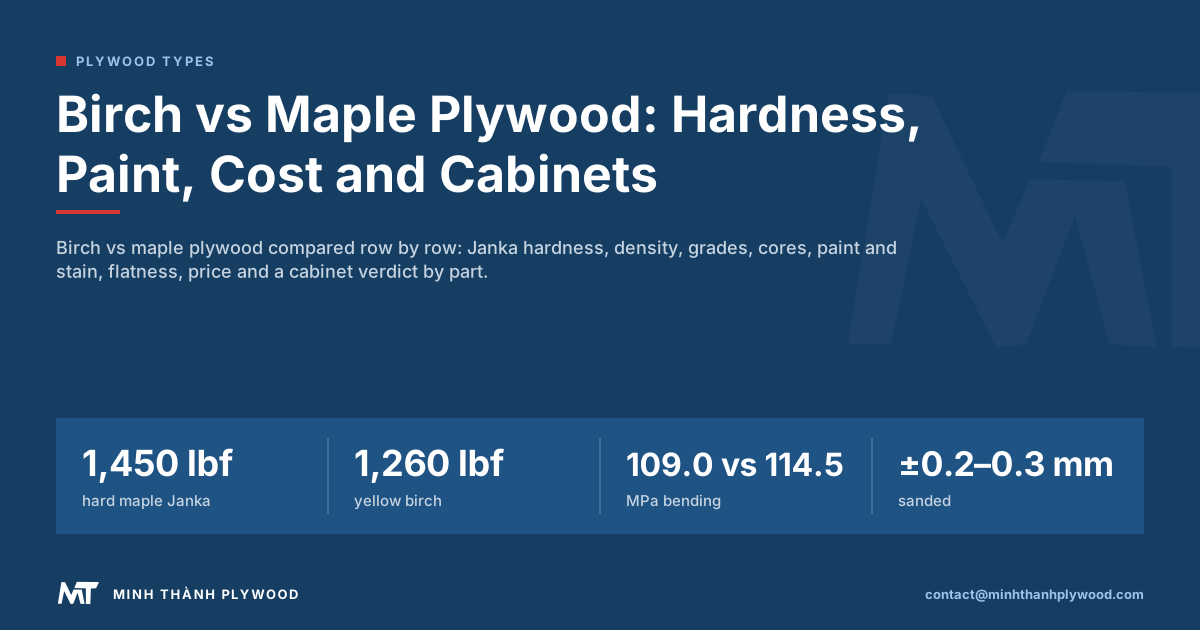
Birch vs maple plywood comes down to the face and the part: hard maple is slightly harder and paler, birch is a little softer, stronger in bending and usually lower in cost. On a veneered panel the core, grade and finish matter more than the species. Minh Thanh Plywood makes birch-faced panels as a standard line and maple faces on request.
Birch vs maple plywood: the short answer
Birch vs maple plywood is a choice of face, and the right answer depends on the part. Hard maple is a little harder and paler, with the most even face; birch is slightly softer, a little stronger in bending, takes paint as well and usually costs less.
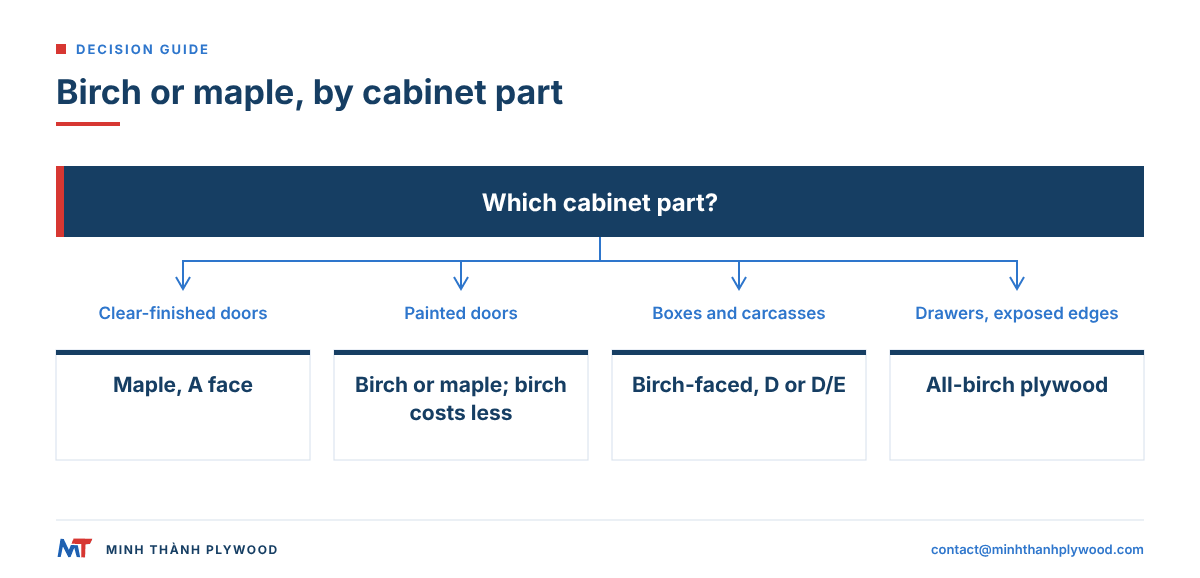
- Clear-finished doors and visible boxes: maple, for its pale, even face.
- Painted doors and fronts: birch or maple; both paint well, birch costs less.
- Cabinet boxes and carcasses: birch-faced panels on a stitched hardwood core.
- Drawer boxes with exposed edges: all-birch (Baltic-type) plywood, for the clean edge.
- Dent-prone tops and shelves: hard maple face, or a harder finish over birch.
The sections below give the numbers behind each verdict, a full comparison table, and the lines to write on an order.
What is birch plywood?
Birch plywood is plywood with a birch face veneer, either over a core of other hardwood or, in Baltic-type panels, with birch in every ply. In the trade the word covers two products with very different edges and weights, so the first question on any order is which one you mean.
- Birch-faced plywood: a birch face and back over a hardwood core. Our panels use white Styrax or Eucalyptus cores as standard.
- All-birch plywood: birch in every layer, known as Baltic birch or multiplex; dense, stiff, with a clean striped edge.
The birch species also differ. European silver birch, the species in Baltic-type panels, averages about 640 kg/m³ dried with a Janka hardness of about 1,210 lbf. North American yellow birch averages about 690 kg/m³ and 1,260 lbf (The Wood Database, checked on 20 October 2026). Paper birch is lighter, at about 610 kg/m³ and 910 lbf (The Wood Database, checked on 20 October 2026). Our birch faces are graded with the Vietnamese names D+, D and E. See our birch plywood page for sizes and grades.
What is maple plywood?
Maple plywood is plywood faced with maple veneer, almost always hard maple (sugar maple), over a hardwood or composite core. It is the standard pale face of North American cabinet work: creamy white, fine-grained, with very few marks in the top grades.
- Hard maple (Acer saccharum): about 705 kg/m³ dried and 1,450 lbf Janka; the face most cabinet specifications mean.
- Soft maple (red and silver maple): about 485 to 610 kg/m³ and 700 to 950 lbf Janka, slightly darker and lower in cost.
- White maple: a sapwood-only selection of hard maple, the palest and most even face.
- Cuts: rotary-cut for boxes and interiors; plain-sliced for doors and panels.
Maple plywood is usually maple only on the face and back. An all-maple panel, like all-birch, is rare and costly, so the core under a maple face is the line to check on a quote.
Maple plywood vs birch plywood: the comparison table
This table compares maple plywood vs birch plywood one metric per row, for solid-wood properties and for the panels as they are bought. Wood values are averages for dried wood at 12 % moisture from The Wood Database; panel values are those of our birch-faced line and of maple faces made on the same cores.
| Metric | Hard maple | Yellow birch | Silver birch (Baltic) |
|---|---|---|---|
| Janka hardness | 1,450 lbf (6,450 N) | 1,260 lbf (5,610 N) | 1,210 lbf (5,360 N) |
| Average dried density | 705 kg/m³ | 690 kg/m³ | 640 kg/m³ |
| Bending strength (MOR) | 109.0 MPa | 114.5 MPa | 114.3 MPa |
| Stiffness (MOE) | 12.62 GPa | 13.86 GPa | 13.96 GPa |
| Face colour | Creamy white, very even | Pale cream to light brown | Pale cream, light |
| Grain | Fine, straight, closed | Fine, slightly wavy, closed | Fine, closed, mild figure |
| Paint | Excellent, very smooth | Excellent | Excellent |
| Stain | Blotches; use washcoat or gel | Blotches less than maple; still test | Blotches; test |
| Common panel build | Maple face on another core | Birch face on hardwood core | All-birch core, or birch face |
| Face grades | AA, A, B (North American) | D+, D, E on our panels | B, BB, CP, C (European) |
| Price, same core and grade | Higher | Lower | All-birch costs more than faced |
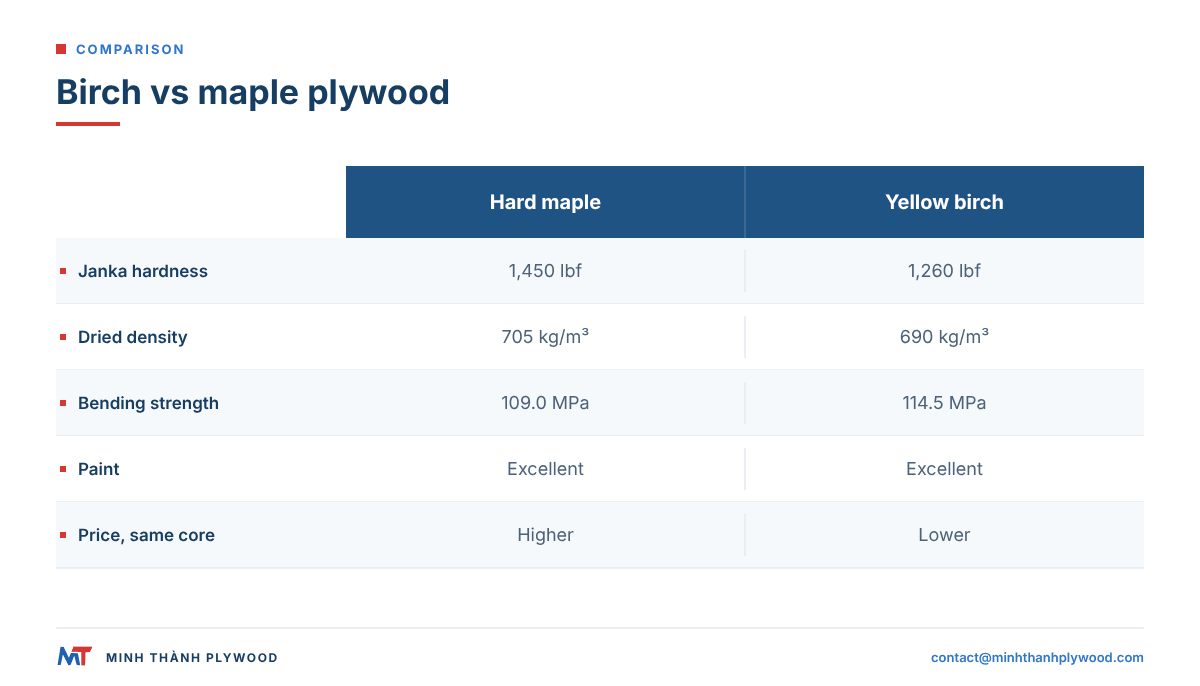
The pattern is clear: maple wins on hardness and the most even pale face; birch wins on bending strength, stiffness and cost. Both are closed-grain faces that paint very well. The comparison that matters for an order is panel against panel at the same core and grade.
Is birch or maple harder?
Hard maple is harder than birch: about 1,450 lbf on the Janka scale against 1,260 lbf for yellow birch and 1,210 lbf for silver birch. Soft maple, at 700 to 950 lbf, is softer than both birches, so “maple” on a quote should always say which maple.
On a plywood panel, though, the Janka number of the face species is only part of the story. The Janka test presses a steel ball into solid wood; on plywood, the ball meets a thin face veneer backed by a core of another density. A dent in a veneered panel depends on:
- The face species: hard maple resists a little better than birch.
- The core density under it: our white Styrax core is about 500 kg/m³ and our Eucalyptus core 650–750 kg/m³; a denser core supports the face better.
- The finish: a hard lacquer or UV coat adds surface resistance to either face.
- The thickness of the face veneer: thicker faces resist dents longer and can be sanded more.
For a worktop or a shelf that takes knocks, a hard maple face on a dense Eucalyptus core under a hard finish is the strongest pairing. For cabinet sides and boxes, birch is hard enough.
Strength and stiffness: is maple plywood as strong as birch?
In solid wood, birch is slightly stronger and stiffer than hard maple: yellow birch has a bending strength (modulus of rupture) of about 114.5 MPa and a stiffness (modulus of elasticity) of about 13.86 GPa, against 109.0 MPa and 12.62 GPa for hard maple. In a veneered panel, those differences are small next to the effect of the core.
A face veneer is a small fraction of the panel’s thickness. The plies underneath carry the load, so a maple-faced and a birch-faced panel on the same core and thickness behave almost the same in a shelf or a cabinet side. Where strength really changes is between builds:
- All-birch plywood is stiffer and heavier than a birch-faced panel on a lighter core.
- A stitched core (core layers joined horizontally and vertically, as on our panels) avoids gaps and overlaps that weaken a panel.
- Thickness matters most: stiffness rises with the cube of thickness, so going from 15 to 18 mm adds far more than any change of face.
If a shelf sags, change the thickness, the span or the core before changing the face species.
Appearance and grain: how do birch and maple look side by side?
Maple is the paler and more even of the two: creamy white with a fine, straight grain and few marks in the top grades. Birch is pale cream to light brown, with a slightly wavier grain, more variation between leaves and, in rotary-cut faces, a soft wavy figure.
| Look | Maple face | Birch face |
|---|---|---|
| Base colour | Creamy white | Pale cream to light brown |
| Colour between leaves | Very even in white maple | More variation |
| Grain | Fine and straight | Fine, slightly wavy |
| Figure | Occasional curl or bird’s-eye | Occasional flame, wavy rotary pattern |
| Typical marks | Mineral streaks in lower grades | Pin knots, colour streaks in lower grades |
| Ageing | Yellows slightly with light | Yellows slightly with light |
Both faces turn slightly yellow or amber under oil-based finishes and with light. A water-based clear finish keeps both closer to their fresh colour. Approve the sample under the finish you will actually use, because the raw face and the finished face can look like two different woods.
Staining and finishing: which blotches less?
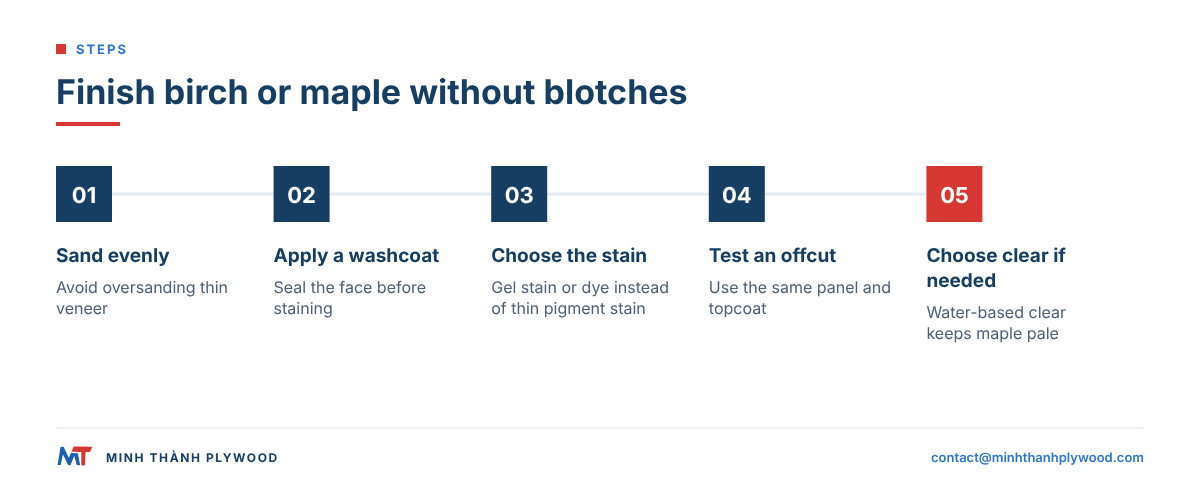
Both maple and birch can blotch under thin pigment stains, maple usually more than birch, because both are fine-grained woods whose density varies across the face. Neither should be stained without a test on an offcut from the same panel.
- Sand evenly with fine paper; do not oversand a thin face.
- Apply a washcoat (a thin sealer or diluted finish) so the stain takes evenly.
- Use a gel stain or dye rather than a thin pigment stain.
- Test on the same panel, under the topcoat you will use.
- For a clear look, skip stain: a water-based clear coat keeps maple pale; oil warms both faces.
- For UV lines, apply the UV coat to the sanded face; our faces are delivered UV-ready on both sides.
If the design calls for a dark colour, neither birch nor maple is the natural choice; a darker face species or an engineered veneer in the target colour gives an even result with less work.
Which takes paint better, maple plywood or birch plywood?
For paint, maple plywood vs birch plywood is close to a tie: both are smooth, closed-grain faces that hold primer and paint without grain filling. Flatness is what shows under a raking light, and it comes from the core and the pressing rather than from the face species.
Maple plywood vs birch plywood paintability flatness
What makes a painted panel look right:
- A flat panel: our furniture-grade panels are pressed twice as standard: the core board is pressed and calibrated, then face and back are pressed on. This keeps core gaps and overlaps from showing through the paint.
- Tight thickness: sanded furniture panels are held to ±0.2–0.3 mm, so doors and panels line up.
- A sanded, polished face: fewer fibres raised by water-based primer.
- A sound face grade: patches and splits can show through paint; a D face on our birch line, or a B maple face, paints cleanly.
- Balanced finishing: prime and paint the back as well as the face to keep the panel flat.
Maple has a slight edge for high-gloss paint because its face is a touch smoother. Birch is the more economical paint-grade face. If budget allows only one upgrade, put it into the core and the pressing, not the species.
Moisture and movement: which face is more stable?
As solid wood, hard maple moves a little less than yellow birch: its volumetric shrinkage from green to oven-dry is about 14.7 %, against about 16.8 % for yellow birch (The Wood Database). In plywood, cross-laminated plies hold each other, so both faces stay far more stable than solid boards of either species.
What keeps a birch- or maple-faced panel stable in use:
- Balanced build: face and back of similar thickness and grade, so the panel does not cup.
- Dry veneer and panels: ours are dried to 8–12 % moisture content at dispatch, the normal range for furniture plywood.
- Acclimatisation: stack panels flat in the workshop for a few days before machining.
- Equal finishing: seal faces, backs and edges with the same number of coats.
- Indoor use: both are interior faces; for damp areas, order an MR or phenolic bond and seal the edges.
A movement problem on a cabinet door is far more often a moisture or finishing issue than a face-species issue. Store, acclimatise and finish both faces the same way and either species stays flat.
Workability and machining
Birch and maple both machine cleanly with sharp tooling; maple, being harder, dulls blades a little faster and burns more easily at slow feed. On plywood, the core decides most of what you see at the cut edge and how screws hold.
- Sawing: use a fine-tooth blade and a scoring blade on both faces to avoid tear-out on cross-grain cuts.
- Routing: maple burns more easily at low feed; keep the cutter moving.
- Edges: faced panels show the core at the edge and take edge banding; all-birch panels show an even striped edge that many designers leave exposed.
- Screws and hinges: hold depends on core density; Eucalyptus cores hold better than lighter cores.
- CNC nesting: flat, calibrated panels cut more accurately; thickness tolerance matters as much as species.
Machine a test part from the panel you will buy, with the tooling you will use, before fixing a production setting.
Grades: D+, D and E birch vs North American and European grades
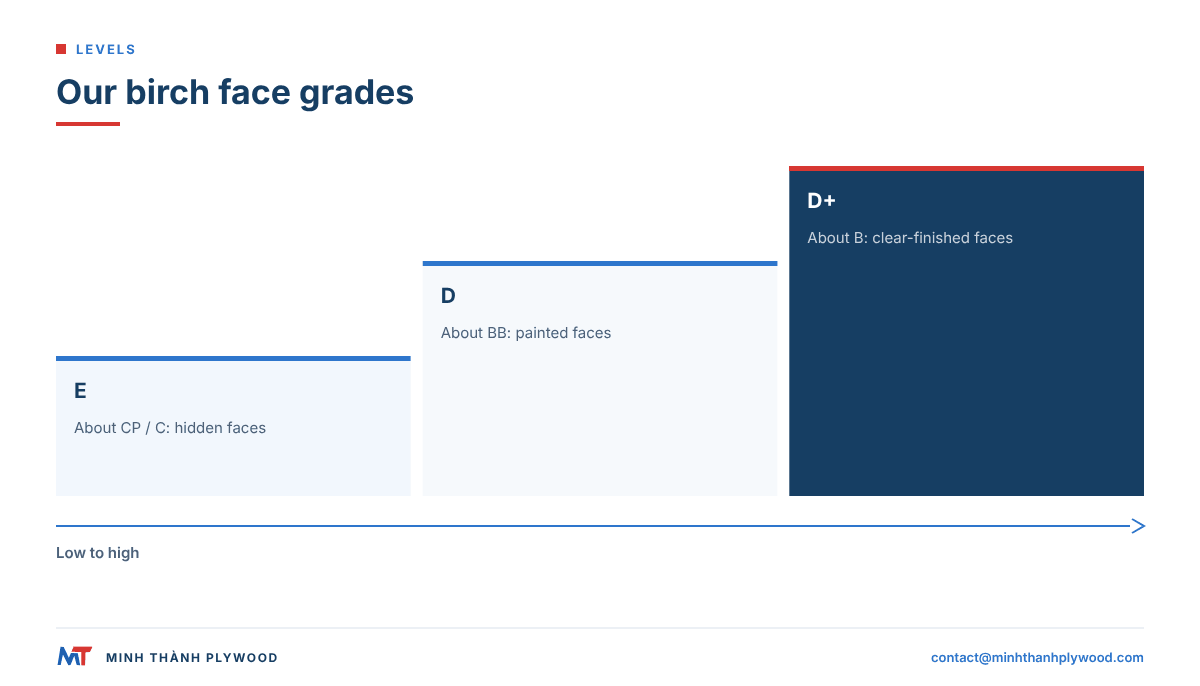
Birch and maple are graded on different scales, so a fair comparison needs a cross-reference. Our birch faces use the Vietnamese grade names D+, D and E (from low to high: E, D, D+), quoted as face/back pairs such as D+/D or D/E, and matched to the sample the buyer approves.
| Our birch face | Comparable European birch grade | Typical use |
|---|---|---|
| D+ | B | Clear-finished and high-visibility faces |
| D | BB | Painted or partly visible faces |
| E | CP / C | Hidden or covered faces |
Pairs follow the same pattern: D+/D is comparable to B/BB, and D/D to BB/BB. Maple in North America is graded mostly AA, A and B for the face with a numbered back grade, such as A-1. When comparing quotes, line up the face you need (clear-finished, painted or hidden) rather than the letters. Our guide to birch plywood grades shows each grade in detail.
Cost comparison: is birch or maple more expensive?
Maple-faced plywood usually costs more than birch-faced plywood of the same grade, core and thickness. Selected white maple faces need sapwood-only veneer, and good maple logs are in demand for solid furniture as well as veneer. Even so, the core, the grade and the thickness move the price more than the species does.
| Price driver | Effect on the quote |
|---|---|
| Face species | Maple-faced above birch-faced at the same grade |
| Face grade | Higher grades cost more for either species |
| Core | All-birch costs more than a birch face on a hardwood core |
| Thickness | More veneer, more cost per sheet |
| Glue and emission | MR or phenolic bonds by order are priced above standard UF glue at E0 emission |
| Quantity and mix | Full container of one specification costs less per m³ |
| Delivery term | FOB Hai Phong, CFR or CIF |
As a reference, furniture and interior plywood from our factory starts from US$350/m³ (October 2026). The final price depends on face, core, glue, thickness, size, quantity and delivery term, so we quote each specification rather than publish a list.
Maple vs birch cabinets: verdict by part
For maple vs birch cabinets, the best answer is usually both: maple where a pale clear-finished face is seen, birch where paint covers it or nobody sees it, and all-birch where an exposed edge or heavy load needs it. Choosing face, carcass and drawer parts separately saves money without lowering quality.
| Cabinet part | Recommended face | Why |
|---|---|---|
| Clear-finished doors and fronts | Maple (A face) | Palest, most even face |
| Painted doors and fronts | Birch or maple | Both paint well; birch costs less |
| Visible end panels | Same face as the doors | Colour match across the run |
| Cabinet boxes and carcasses | Birch-faced, D or D/E | Sound face at lower cost |
| Shelves | Birch or maple, 18 mm and up | Thickness beats species for sag |
| Drawer boxes, exposed edges | All-birch plywood | Clean edge, strong joints |
| Drawer bottoms and backs | Thin birch-faced plywood | Thin 3–5 mm panels are always 5-ply |
One container can carry several specifications by agreement, so a cabinet maker can order maple fronts and birch carcasses together. Our guide to birch plywood for kitchen cabinets covers the carcass side in more detail.
Prefinished maple or Baltic birch for cabinet boxes?
For cabinet boxes a shop can buy prefinished maple plywood (a UV or lacquer coat already on the faces) or raw Baltic birch and finish it in the flat. Prefinished maple saves the spraying step and gives a pale, even interior; Baltic birch costs more per sheet but shows a clean striped edge that needs no banding.
| Point | Prefinished maple plywood | Baltic birch plywood |
|---|---|---|
| Finishing | Done at the factory, so no shop finishing | Sand and finish in the flat, 2 to 3 coats |
| Edges | Solid banding, 1/8 to 1/4 in, or veneer tape | No banding; the striped edge is left exposed |
| Wear edges | Solid banding is preferred over veneer tape | Edge is all birch and wears evenly |
| Typical sheet | 4 × 8 ft prefinished cabinet grade | BB/BB or B/BB 4 × 8 ft sheets |
Cabinet makers on the Sawmill Creek forum (checked on 21 October 2026) describe the same split: prefinished maple with 1/4 in solid banding, or Baltic birch with the edge left bare and the sheet finished flat with three coats in one day. A US distributor such as Berta Store (checked on 21 October 2026) sells both: prefinished 4 × 8 ft cabinet-grade sheets and BB/BB Baltic birch.
Our factory takes the same route from the other side: birch or maple faces on a calibrated core, sanded and UV-ready on both sides, so a cabinet maker can have the faces coated to the finish the job needs. Ask for the face, the edge treatment and the finish on the same quote line.
Baltic birch vs maple plywood
Baltic birch and maple plywood answer different needs: Baltic birch is chosen for its all-birch core and clean edge, maple plywood for its pale face. If the edge will be seen or the joints carry load, Baltic birch is the better panel; if only the face matters, maple on a good core costs less than an all-birch panel of the same face grade.
| Point | Baltic birch | Maple plywood |
|---|---|---|
| Core | Birch in every ply | Usually another hardwood core |
| Edge | Even, void-free stripes | Shows the core; usually edge-banded |
| Weight | Heavy | Depends on core |
| Face | Pale birch, B/BB style grades | Creamy maple, AA to B grades |
| Typical use | Drawers, jigs, exposed-edge furniture | Doors, cabinet faces, panelling |
Our birch line is birch-faced on white Styrax or Eucalyptus cores; we do not sell it as full birch. Read our Baltic birch plywood guide for the all-birch panel.
Sourcing and sustainability: Lacey Act, EUDR and certified faces
Maple and birch veneer both come from managed temperate forests, so the paperwork is a matter of declaring species and origin. Hard maple is a North American hardwood, and birch faces come from northern temperate forests; the plantation Styrax and Eucalyptus cores under a Vietnamese panel are grown fibre.
- United States: the Lacey Act requires an import declaration naming the plant species, its country of harvest, the quantity and the value for plywood and veneer entering the US (USDA APHIS, read 21 October 2026).
- European Union: the EU Deforestation Regulation asks operators for origin records and geolocation data; we supply the EUDR compliance dossier with orders.
- Certified faces: FSC or PEFC chain-of-custody faces are a separate request that must be named on the quote, since the certificate has to cover the veneer lot.
- Emission: CARB P2 / TSCA Title VI covers the formaldehyde side of the same US file.
Send the species, origin and certificate you need with the enquiry, so the documents match the order from the first quote.
Where Vietnamese birch-faced plywood fits
Vietnamese birch-faced plywood fits the large middle of furniture and cabinet work: carcasses, painted fronts, shelving and furniture parts, where a sound birch face, a flat stitched core and tight thickness matter more than an all-birch edge. It is built for the demands of European furniture buyers, our main market.
| Specification | Our birch-faced line |
|---|---|
| Face grades | D+, D and E, quoted as face/back pairs such as D+/D or D/E |
| Core | White Styrax or Eucalyptus; Acacia and Pine on order |
| Core build | Stitched horizontally and vertically |
| Pressing | Twice: calibrated core board, then face and back |
| Glue and emission | UF glue at E0 emission; MR or phenolic (WBP) by order |
| Thickness | 3–40 mm; sanded tolerance down to ±0.2 mm |
| Sizes | 1220 × 2440 and 1250 × 2500 mm, custom sizes on order |
| Moisture | 8–12 % at dispatch |
| Faces | Sanded and polished; UV-ready on both sides |
Our panels hold CARB P2 / TSCA Title VI certification (ICTT mill no. 23024). Six ASTM D6007 chamber tests between April 2025 and June 2026 on 9, 15 and 18 mm panels averaged 0.014–0.032 ppm. The limit for veneer-core hardwood plywood is 0.05 ppm under 40 CFR 770.10, part of the US EPA’s formaldehyde standards for composite wood products. Maple faces are made on request on the same cores.
How to specify birch or maple plywood
A birch or maple plywood specification that can be quoted and checked names the face species and grade, the core, the glue, the size and the finish. Hard and soft maple, or birch-faced and all-birch, must be stated, because each pair differs in price and behaviour.
- Name the species exactly: hard maple, soft maple or white maple; birch-faced or all-birch.
- Name the face and back grade: for example D+/D birch, or an A face maple with a grade 1 back.
- Name the core: white Styrax or Eucalyptus on our panels.
- Name the glue and emission: UF glue at E0 emission, or an MR or phenolic bond.
- Name the finish: sanded, or UV-ready faces.
- Approve a sample: under your planned finish, then hold production to it.
Send these lines with the application, size and quantity, and we reply within hours.
Other species comparisons in this guide series
Birch and maple are two of many face and core choices for furniture plywood. These guides compare the others:
- Birch versus oak plywood: grain, stain and cost against red and white oak.
- Hardwood plywood guide: every hardwood face and core in one place.
- Hardwood vs softwood plywood: core, strength, weight and cost.
- Walnut plywood vs birch: dark face against pale face.
- White oak plywood buying guide: rift, quarter and plain-sliced oak.
- Rubberwood plywood and what is rubberwood: the plantation hardwood behind many cores.
- Rubberwood vs acacia: two plantation species compared.
- Lauan plywood, meranti plywood and cedar plywood: other face species.
- How to bend plywood, flexible plywood and moulded plywood: curved work.
- Types of plywood: the full range at a glance.
What to write on a birch or maple plywood order
An order for birch or maple plywood that can be quoted the same day lists the application, the face and grade, the core, the glue, the size and the quantity. Send these lines:
- Application: cabinet doors, carcasses, drawers, shelving or furniture parts.
- Face: birch (D+/D, D/E) or maple (hard, soft or white; face and back grade).
- Core: white Styrax or Eucalyptus.
- Glue and emission: UF glue at E0 emission; CARB P2 / TSCA Title VI documents for US orders.
- Size and thickness: for example 1220 × 2440 × 18 mm, or cut-to-size.
- Finish: sanded, or UV-ready faces.
- Packing and quantity: from one 40HC, mixed specifications by agreement; destination port.
Production is 15–45 days after the 30% deposit, FOB Hai Phong, CFR or CIF, and samples are free. See our birch plywood page for the full specification, or contact us with your drawing.
Buyer questions, answered
Is birch or maple harder?
Hard maple is harder: about 1,450 lbf on the Janka scale against about 1,260 lbf for yellow birch and 1,210 lbf for European silver birch. Soft maple, at 700 to 950 lbf, is softer than either birch.
Is birch or maple plywood better for kitchen cabinets?
Both make good cabinets. Maple suits clear-finished doors and boxes where a pale, even face is wanted; birch suits painted doors, boxes and drawers at a lower cost. Many shops use maple for what is seen and birch for the rest.
Is birch or maple more expensive?
Maple-faced plywood usually costs more than birch-faced plywood of the same grade and core. The core, face grade and thickness move the price more than the species does.
Which takes paint better, birch or maple plywood?
Both paint very well because both are closed-grain hardwoods with smooth faces. Maple is slightly smoother; birch shows a little more grain under thin paint. A sanded, flat face and a primer matter more than the species.
Does birch or maple plywood blotch when stained?
Both can blotch with thin pigment stains because both are fine-grained with uneven density. Use a washcoat or gel stain, and test on an offcut from the same panel.
Is maple plywood as strong as birch?
In solid wood, yellow birch is slightly stronger in bending than hard maple, about 114.5 MPa against 109.0 MPa. In a veneered panel the core sets strength, so compare panels of the same core and thickness.
What is the difference between Baltic birch and maple plywood?
Baltic birch has birch in every ply, so the edge is clean and the panel is dense and stiff. Maple plywood is usually a maple face over another core, chosen for its pale face rather than its edge.
What is hard maple vs soft maple plywood?
Hard maple (sugar maple) is the dense, pale species most cabinet faces use. Soft maple comes from red and silver maple, is softer and slightly darker, and costs less.
Can I see the difference between birch and maple plywood?
Yes. Maple is creamy white with a fine, even grain and few marks; birch is pale cream to light brown with a slightly wavier grain and more colour variation between leaves.
Which is flatter, birch or maple plywood?
Flatness comes from the core build and pressing, not the face species. A calibrated core pressed twice gives a flat panel with either face.
Can I order maple-faced plywood from Minh Thanh Plywood?
Yes. Birch-faced panels are a standard line, and maple faces are made on request on the same white Styrax or Eucalyptus cores, in sizes such as 1220 × 2440 mm.
Is prefinished maple plywood better than Baltic birch for cabinet boxes?
Prefinished maple saves the finishing step and gives a pale interior but needs edge banding, usually 1/8 to 1/4 in solid wood. Baltic birch costs more per sheet and needs finishing, but its striped edge can be left bare.
What paperwork does imported maple or birch plywood need?
US imports need a Lacey Act declaration with species and country of harvest. EU buyers need EUDR origin records and geolocation files, which we supply with orders, and FSC or PEFC faces must be named on the quote.