
Yes, most plywood has formaldehyde: it comes from the urea, melamine or phenol formaldehyde glue, not the wood. What matters is how much the panel releases into the air. Low-emission plywood made to CARB Phase 2 or TSCA Title VI is safe for indoor furniture. Minh Thanh Plywood's six chamber tests averaged 0.014–0.032 ppm against the 0.05 ppm limit.
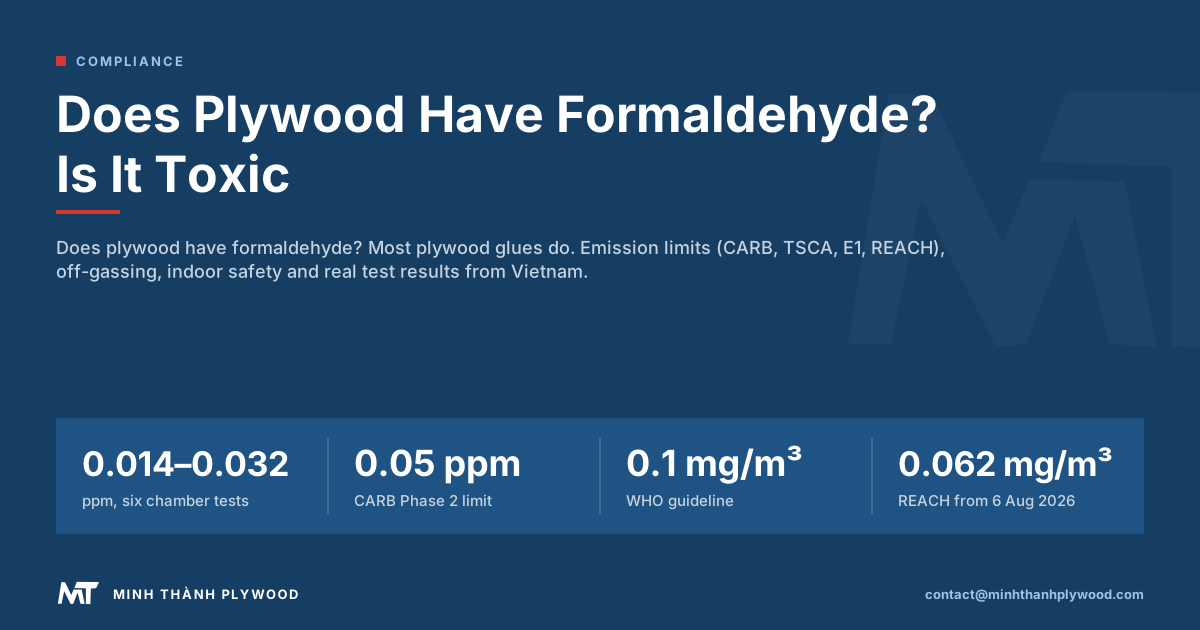
Does plywood have formaldehyde?
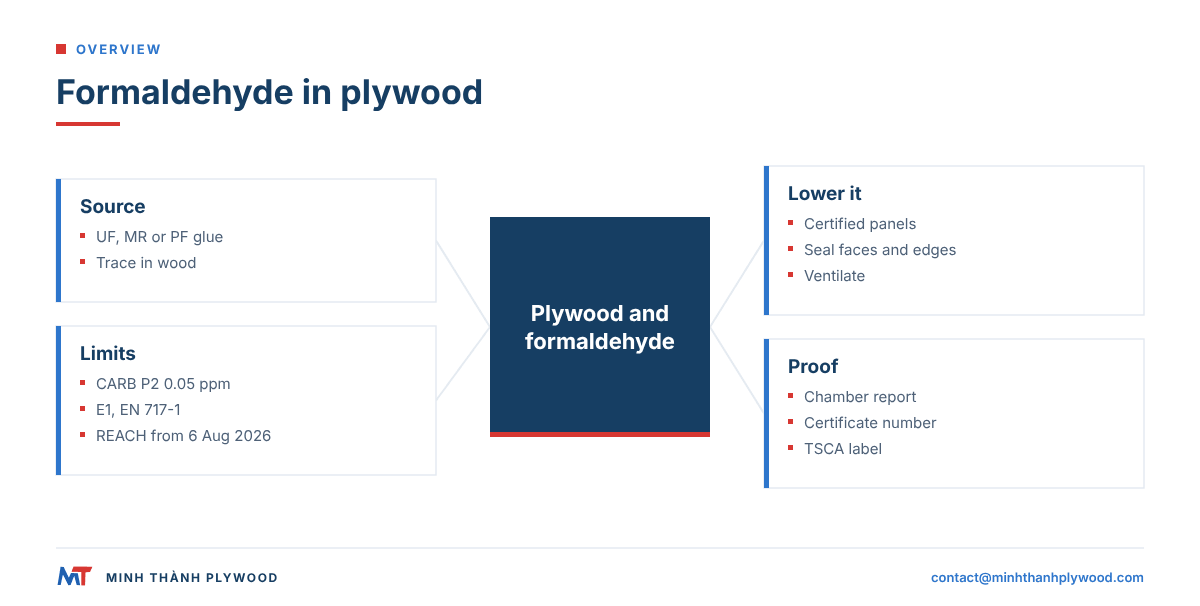
Yes, most plywood has formaldehyde because the glue that holds the veneers together is a formaldehyde-based resin. Urea formaldehyde (UF), melamine-fortified UF and phenol formaldehyde (PF) are the three resins behind most panels sold today. Wood itself also contains a trace of natural formaldehyde.
The useful question is not whether formaldehyde is present, but how much the finished panel releases into room air. That number is what the laws limit and what laboratories measure. Two panels with the same glue type can differ widely, depending on the resin recipe, the press and how long the panel cured.
| Glue | Formaldehyde in the resin | Release from the finished panel | Typical use |
|---|---|---|---|
| UF glue at E0 emission | Yes, low-emission recipe | Very low | Furniture, cabinets, interiors |
| Standard UF | Yes | Low to moderate | Packing, low-cost commercial panels |
| Melamine-fortified UF (MR) | Yes | Low to moderate | Humid rooms, covered exterior |
| Phenol formaldehyde (WBP) | Yes, bound tightly once cured | Very low once cured | Exterior, formwork, marine |
| NAF resins (soy, PMDI) | No added formaldehyde | Natural wood level only | Specialist interior panels |
Does all plywood have formaldehyde?
Not all plywood has added formaldehyde. Panels glued with no-added-formaldehyde (NAF) resins, such as soy-based or PMDI glues, carry only the small natural amount found in wood. US rules recognise these as NAF panels and give them their own certification route (40 CFR Part 770).
NAF plywood costs more, presses differently and is offered by fewer mills. For most furniture buyers, a low-emission UF panel tested to CARB Phase 2 does the same job in the room at a lower price. Our sibling guide on formaldehyde-free plywood compares the options.
Is plywood toxic? What the health limits say
Plywood is not toxic in normal indoor use when it meets a modern emission limit. Formaldehyde irritates eyes, nose and throat at high indoor levels, and the International Agency for Research on Cancer classes it as carcinogenic to humans (IARC Monographs volume 100F). The risk depends on the concentration in the air you breathe.
The World Health Organization’s indoor air guidelines cover formaldehyde among other indoor pollutants (WHO guidelines for indoor air quality). Their formaldehyde value is 0.1 mg/m³ as a 30-minute average, set to protect against irritation and long-term effects. Panel limits are set so a furnished room stays well below it.
| Limit | Value and method | Where it applies |
|---|---|---|
| WHO indoor air guideline | 0.1 mg/m³, 30-minute average in room air | Health benchmark, worldwide |
| CARB Phase 2 / TSCA Title VI, hardwood plywood veneer core | 0.05 ppm, ASTM E1333 or ASTM D6007 chamber (40 CFR 770.10) | United States |
| E1, EN 13986 | 0.124 mg/m³, EN 717-1 chamber | EU and UK construction panels |
| REACH entry 77, furniture and wood-based articles | 0.062 mg/m³, Appendix 14 chamber, from 6 August 2026 (Regulation (EU) 2023/1464) | European Union |
US and EU results use different units and chambers, so a ppm result is not converted into mg/m³ on paper. A buyer who needs the EU figure asks for the EU test.
To put these numbers in context, here is where each level sits on one scale, in ppm (WHO’s 0.1 mg/m³ is about 0.08 ppm):
| Level | Value | What it means |
|---|---|---|
| Outdoor air, rural and suburban | 0.0002–0.006 ppm | Typical background (ATSDR) |
| Outdoor air, urban | 0.0015–0.047 ppm | Typical background in towns, where traffic adds formaldehyde (ATSDR) |
| Minh Thanh panels, six ASTM D6007 chamber tests | 0.014–0.032 ppm | Inside the range of city air, in a sealed test chamber |
| WHO indoor guideline | about 0.08 ppm (0.1 mg/m³) | Health benchmark for room air |
| US panel limit, CARB Phase 2 / TSCA Title VI | 0.05 ppm | Chamber limit for hardwood plywood |
| Mild eye, nose and throat irritation in volunteers | 0.25–3 ppm, short exposures | No precise threshold; reported in clinical studies |
| Moderate to severe irritation | above 2–3 ppm | Most people (US EPA-hosted review) |
The human body also makes formaldehyde in small amounts as part of its normal metabolism, which is why very low levels are not a health event in themselves. A chamber figure is a panel test, not the air in your room: a furnished, ventilated room dilutes the panel’s release further.
Is plywood safe for indoor use?
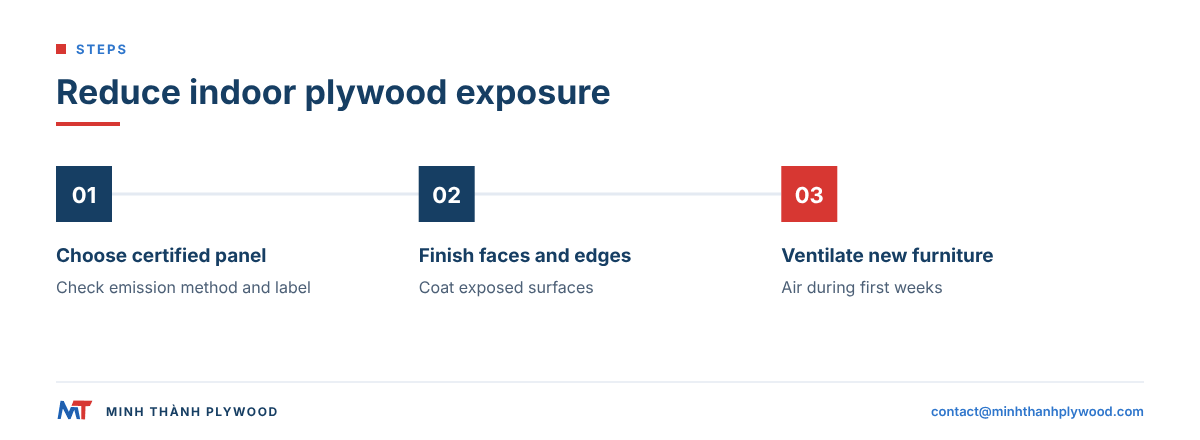
Plywood is safe for indoor use when it carries a recognised low-emission certification and the room is ventilated normally. Kitchen cabinets, wardrobes, beds and shelving from certified panels add very little formaldehyde to room air after the first weeks.
Three things make indoor plywood safer in practice:
- Buy certified panels. CARB Phase 2 or TSCA Title VI labels in the US; E1 or the REACH-compliant level in Europe.
- Cover the faces and edges. Lacquer, paint, laminate or veneer slow the release from the panel.
- Ventilate at first. Air new furniture for its first weeks and avoid heating a closed room hard.
Children’s rooms and small, tight rooms deserve the lowest-emission panels you can buy. For these, a specification that names “UF glue at E0 emission” plus a chamber test is a sensible standard.
How long does plywood off-gas formaldehyde?
Plywood off-gasses most in its first weeks and months, then at a slowly falling rate for years. The resin keeps curing after pressing, and free formaldehyde near the surface leaves first. Mills therefore cool and stack panels before packing, and a panel that has spent weeks at sea has already passed its first peak.
Heat and humidity raise emission: the same panel releases more in a hot, damp, closed room than in a cool, dry one. Ventilation brings the room level down quickly. Sealing faces and edges with a coating slows the release from the start.
Published figures give a range: a building-biologist guide reports that urea-formaldehyde (UF) panels release about 15–60 % of their emission in the first 30 days, depending on the resin formula, and cites a study where freshly made panels started below 0.1 ppm and fell towards zero as they aged. The starting level still decides the outcome. A panel that tests at a fraction of the limit is low from the day it arrives; a high-emission panel can stay above guideline levels for months.
A sensitive buyer can test three times: when the panels are new, after a few weeks of airing, and after 2–3 months. Ordering E0-level panels with a chamber report makes the first reading the low one.
Is formaldehyde in plywood dangerous to workers?
Formaldehyde is a workplace concern mainly at the glue kitchen and the hot press, where resin is mixed and heated. Mills control it with extraction, enclosed mixing and low-emission resins. Cutting and sanding finished low-emission panels mainly raises a dust hazard, which dust extraction and masks handle.
For a buyer’s workshop, the practical rules are dust extraction on saws and sanders, ventilation in finishing rooms and storage of panels in a dry, aired space. These cover both wood dust and the small formaldehyde release from fresh stock.
Does Vietnamese plywood contain formaldehyde? Real test levels
Vietnamese plywood uses formaldehyde-based glues like plywood from every other origin; the emission level depends on the mill. Minh Thanh’s furniture and interior panels use UF glue at E0 emission as standard. Six third-party chamber tests prove the result, run by two laboratories between April 2025 and June 2026.
| Item | Result |
|---|---|
| Method | ASTM D6007 small-chamber test |
| Panels tested | 9, 15 and 18 mm |
| Average results | 0.014–0.032 ppm |
| Limit compared | 0.05 ppm, CARB Phase 2 / TSCA Title VI, hardwood plywood veneer core |
| Laboratories | Shanghai Hongjun (HJ-QAT-250597, HJ-QAT-251303, HJ-QAT-261036); ICTT Vietnam (ICTTVN-QAT-250841, ICTTVN-QAT-251173, ICTTVN-QAT-260272) |
| Certification | CARB P2 / TSCA Title VI, ICTT mill no. 23024 |
These are results of the panels tested, under the method named. E0 emission is tested periodically, every 3 months, and third-party testing to the buyer’s own method, for example EN 717-1, is arranged through SGS on request.
The answer to “does Vietnamese plywood contain formaldehyde” is therefore the same as for any plywood: yes, in the glue, and the release from a certified low-emission panel is a fraction of the US limit.
Plywood and formaldehyde: glue, emission class and certificate
Glue type, emission class and certificate are three separate lines of a plywood specification, and plywood and formaldehyde questions get easier once they are kept apart. Mixing them up causes most quoting errors. “E0 glue” is a common phrase, but E0 is an emission level, not a resin.
- Glue (resin): UF, melamine-fortified UF, phenolic or NAF. It decides the bond class and part of the emission.
- Emission class: E0, E1, CARB P2, F★★★★ and others. It is a measured release, by a named method.
- Certificate: a third-party programme that tests the mill and its panels on a schedule, such as CARB Phase 2 / TSCA Title VI through an approved certifier.
Write all three on your order: “UF glue at E0 emission, CARB P2 / TSCA Title VI certified, ASTM D6007 report”. Each answers a different question your own customer may ask.
How the main emission classes compare
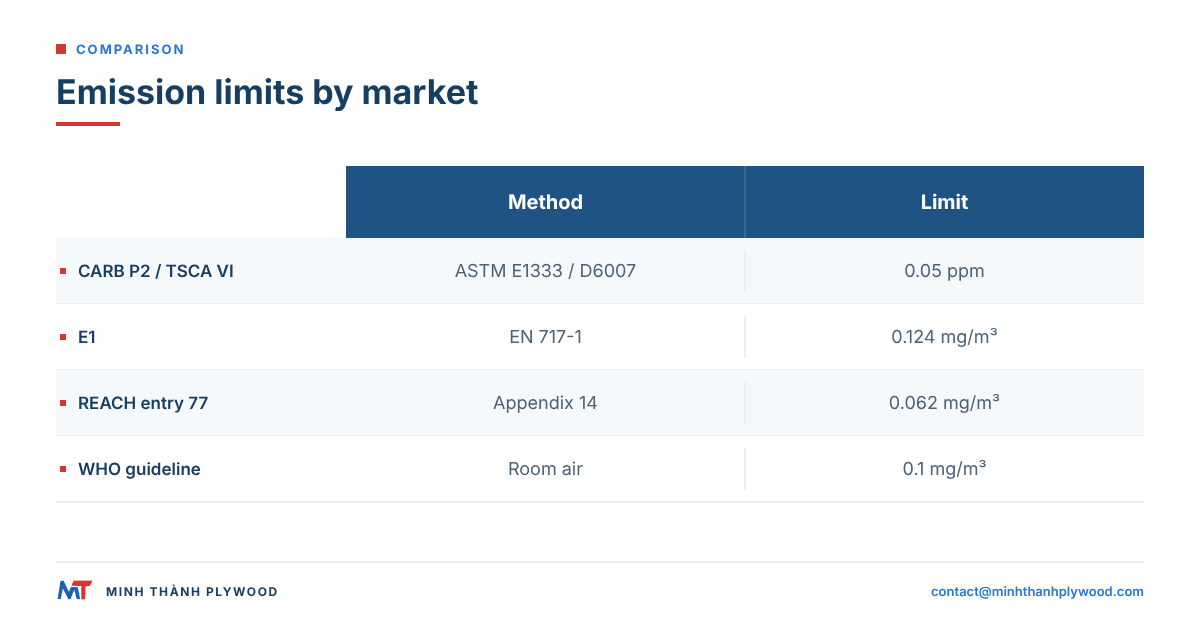
The main plywood emission classes measure formaldehyde release with different methods, so they rank panels but do not convert exactly. The table places them side by side for a buyer choosing what to ask for.
| Class | Method | Limit | Who asks for it |
|---|---|---|---|
| CARB Phase 2 / TSCA Title VI (hardwood plywood) | ASTM E1333 or ASTM D6007 chamber | 0.05 ppm | US importers and retailers |
| E1 | EN 717-1 chamber | 0.124 mg/m³ | EU and UK construction panels |
| REACH entry 77 | Appendix 14 chamber | 0.062 mg/m³ | EU furniture and wood-based articles, from 6 August 2026 |
| E0 | Not one global method | Below E1, by the buyer’s method | European and Asian furniture buyers |
Because E0 has no single global definition, the emission number should always travel with its method. A European furniture buyer who accepts CARB P2 / TSCA Title VI as proof avoids a second test; one who needs an EN 717-1 or REACH figure orders that test.
Does OSB have more formaldehyde than plywood?
OSB usually releases less formaldehyde than interior UF-bonded plywood, because most OSB is bonded with PMDI or phenolic resin. US rules exempt oriented strand board, together with structural plywood made to PS 1, from the TSCA Title VI emission limits (40 CFR 770.3).
That does not make OSB the better interior panel. It has a rough face, swells at the edges and is rarely used for visible furniture. For cabinets and furniture, certified low-emission plywood gives a smooth, stable face. See our guide to OSB grades for its uses.
Does birch plywood have formaldehyde?
Birch plywood has formaldehyde when its glue does, which is almost always. The species does not decide the emission; the resin, the press and the curing do. A birch-faced panel with UF glue at E0 emission and a phenolic birch panel are both low-emission, by different routes.
Our birch-faced panels use the same UF glue at E0 emission as the rest of our furniture range, with D+, D and E face grades quoted as face/back pairs. The certificate and chamber tests cover hardwood plywood veneer core, the class birch-faced furniture panels belong to.
Can you seal plywood to reduce formaldehyde?
Yes. A coating on all faces and edges slows the release from plywood. Water-based lacquers, paints and laminates are common choices; edges matter most, because cut edges expose every glue line. Sealing does not make a high-emission panel low; it lowers what a good panel already releases.
For furniture makers, the order of choices is clear: start with a certified low-emission panel, then finish all surfaces, including the back of carcasses and the inside of drawers.
Is it safe to burn plywood?
Burning plywood indoors, in a wood stove or on an open fire is not safe. The glue, coatings and any treatment release formaldehyde, carbon monoxide and other combustion products, and the ash can carry residues. Offcuts belong in a waste wood or energy-recovery route that burns at controlled temperatures with flue cleaning.
Untreated, uncoated offcuts from low-emission panels are still glued wood, so the same rule applies. Keep the stove for clean, dry firewood.
Plywood SDS or MSDS: what to request
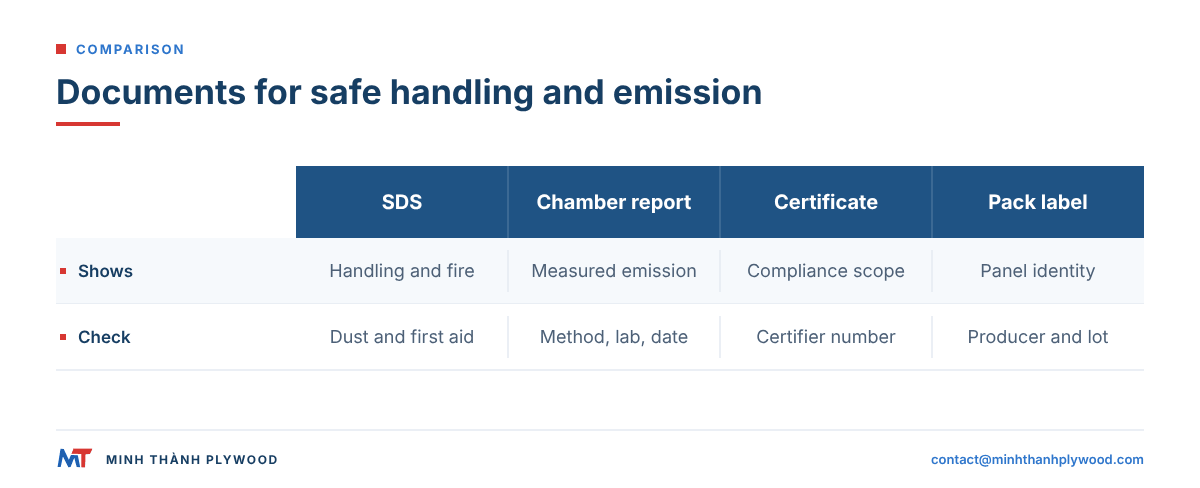
Request a safety data sheet (SDS, formerly MSDS) for safe handling, and an emission test report for formaldehyde level. They answer different questions. The SDS covers dust, fire and first aid; the test report gives the measured emission by method.
A complete document set for an indoor plywood order includes:
- The emission certificate (CARB P2 / TSCA Title VI number for US goods).
- The chamber test report: method, lab, date, panel thickness.
- The SDS for handling and storage.
- Panel labels for the US: producer, lot and certifier, with “TSCA Title VI compliant”.
What this means for your order
For furniture and interior plywood from Minh Thanh, the formaldehyde specification is fixed in the quote: UF glue at E0 emission, CARB P2 / TSCA Title VI certification (ICTT mill no. 23024) and chamber test reports from two named laboratories. Panels for US orders carry the TSCA Title VI label, and the invoice and B/L state compliance.
Production is 15–45 days after the 30% deposit, MOQ one 40HC with mixed specifications by agreement. Furniture/interior plywood starts from US$350/m³ (October 2026), with free samples. Tell us the market, the emission method your customers ask for, and the panel build; see our furniture plywood range and the CARB P2 / TSCA Title VI certificate, or more compliance guides.
Buyer questions, answered
Does plywood have formaldehyde?
Most plywood does, because the glue that bonds the veneers is a urea, melamine or phenol formaldehyde resin. Wood itself also holds a trace. Only panels made with no-added-formaldehyde (NAF) glue avoid added formaldehyde.
Does all plywood have formaldehyde?
No. Plywood glued with soy-based, PMDI or other no-added-formaldehyde resins has no added formaldehyde, only the small natural amount in wood. Most furniture and construction plywood still uses formaldehyde-based resins.
Is plywood safe for indoor use?
Yes, when it meets a recognised emission limit such as CARB Phase 2 or TSCA Title VI in the US, or E1 and the REACH limit in the EU. Ventilate new furniture for the first weeks and keep the room at normal temperature and humidity.
Is formaldehyde in plywood dangerous?
Formaldehyde is an irritant at high indoor levels and IARC classes it as carcinogenic to humans. The risk comes from the concentration in room air, so low-emission panels keep it far below the WHO guideline of 0.1 mg/m³.
How long does plywood off-gas?
Emission is highest when the panel is new and falls fastest in the first weeks and months, then slowly for years. Heat and humidity raise it; ventilation lowers the level in the room.
Does Vietnamese plywood contain formaldehyde?
Vietnamese furniture plywood uses formaldehyde-based glue like most plywood. Minh Thanh's panels use UF glue at E0 emission and six third-party ASTM D6007 tests averaged 0.014–0.032 ppm against the 0.05 ppm CARB Phase 2 limit.
Does birch plywood have formaldehyde?
Birch plywood has formaldehyde when its glue does, which is the usual case. Birch faces with UF glue at E0 emission or a phenolic glue are low-emission; the species does not decide it, the glue and the press do.
Does OSB have more formaldehyde than plywood?
Usually not. Most OSB is bonded with PMDI or phenolic resin, which emit very little, and US rules exempt OSB from the TSCA Title VI limits. Interior UF-bonded plywood needs certification instead.
Is it safe to burn plywood?
Not indoors or in a stove. Burning glued wood releases formaldehyde, carbon monoxide and other combustion gases; treated or coated plywood adds more. Send offcuts to a waste or energy-recovery route.
What document proves a plywood's formaldehyde level?
A chamber test report naming the method (ASTM E1333, ASTM D6007 or EN 717-1), the lab, the date and the panel tested, plus the CARB or TSCA certificate number for US goods. A safety data sheet describes hazards, not the emission.