
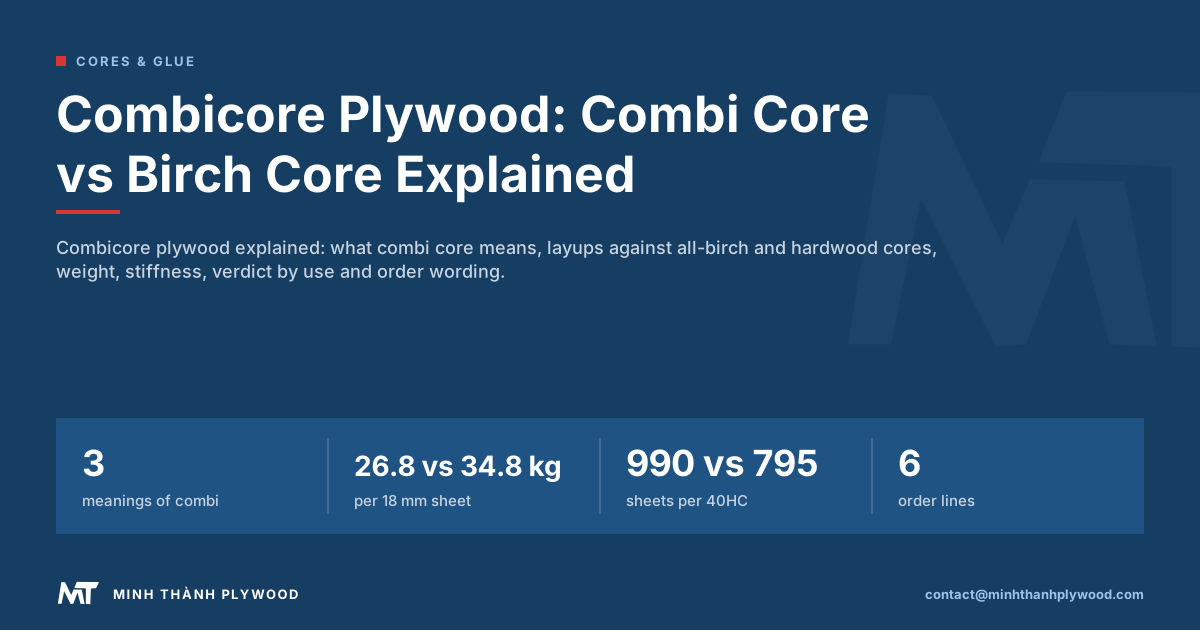
Combicore, or combi core plywood, mixes species in one panel: hard outer plies such as birch or Eucalyptus over lighter inner plies such as poplar. It costs less and weighs less than an all-birch core, and it shows two kinds of plies at the edge. Here is how Minh Thanh Plywood reads a combi quotation, when to accept it and how to write the order.
What is combi core plywood (combicore)?
Combi core plywood, sold as combicore, is plywood whose core combines two species or materials in one layup. The most common build has hard, dense outer plies such as birch or Eucalyptus over a lighter inner core such as poplar, so the panel looks and machines like hardwood plywood at a lower weight and price.
The word appears on merchant listings as combi, combicore, combi core, combination core and combined core. They all mean the same thing: the core is not one species from face to back. What the word does not tell you is which species, how many plies of each, how the core is closed and which glue holds it. Those four lines decide whether a combi panel is a good buy.
What are the different kinds of combi plywood?
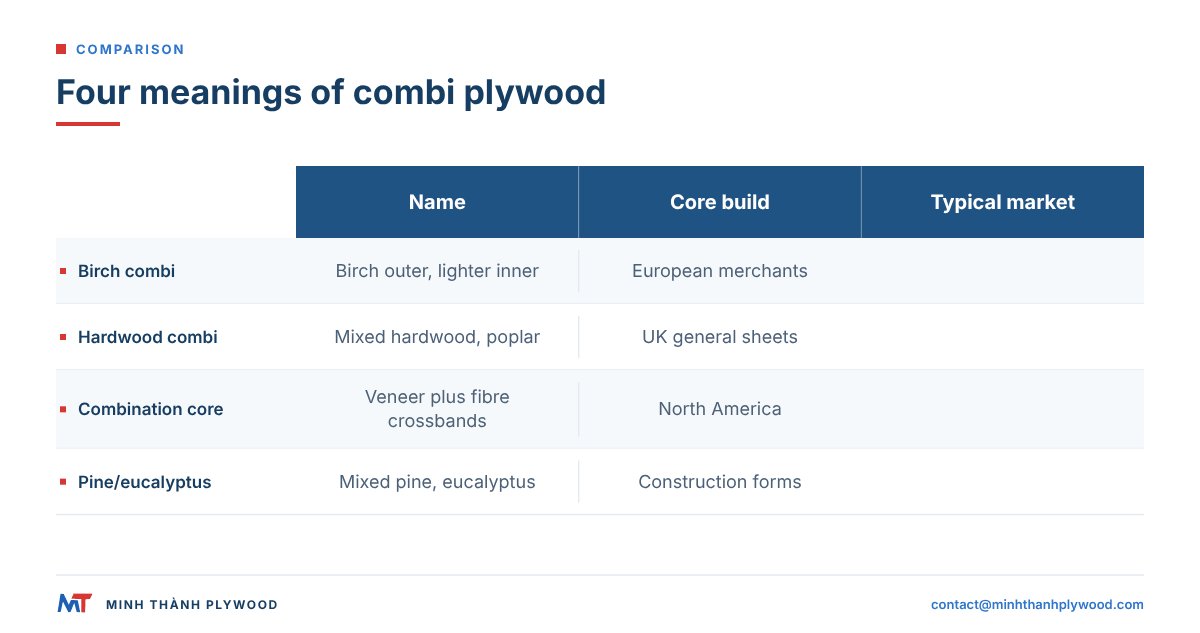
Combi plywood has four common meanings, and a quotation can use any of them. Read the build behind the name before comparing prices.
| Name on the quote | Usual build | Where it is common |
|---|---|---|
| Birch combi, birch combicore | Birch face and back, birch outer core plies, poplar or other hardwood inner plies | European merchants, Chinese-made panels |
| Hardwood combi | Hardwood face such as okoume, bintangor or eucalyptus, mixed hardwood and poplar core | External and general-purpose sheets in the UK |
| Combination core | Veneer core centre with MDF, particleboard or hardboard crossbands under the faces | North American hardwood plywood |
| Pine or eucalyptus combi | Pine and eucalyptus plies in one core | Construction and formwork plywood |
Three of these are veneer-only builds and differ only by species; the fourth (combination core) adds a fibre layer to flatten the face. All four aim at the same compromise: put the expensive or flat material where it shows, and keep the centre light and cost-effective.
Combi core vs birch core: the comparison
An all-birch core is heavier, stiffer, flatter and better at the edge; a combi core is lighter, cheaper and good enough wherever edges are banded or hidden. Both carry the same birch face, so the choice is about weight, edge and price. The table compares the two on one metric per row.
| Metric | Combi core (birch outer, lighter inner) | All-birch core |
|---|---|---|
| Face and back | Birch | Birch |
| Core species | Two or more | Birch only |
| Weight | Lower | Higher |
| Bending stiffness | Good | Very good |
| Face flatness | Good; depends on the inner plies | Very good |
| Screw holding near the face | Very good | Very good |
| Screw holding in the edge | Good | Very good |
| Edge appearance | Two colours or textures | Even, one colour |
| Price | Lower | Higher |
| Verdict | Banded furniture, cabinets, covered work, flooring bases | Exposed edges, jigs, heavy shelving, top flatness |
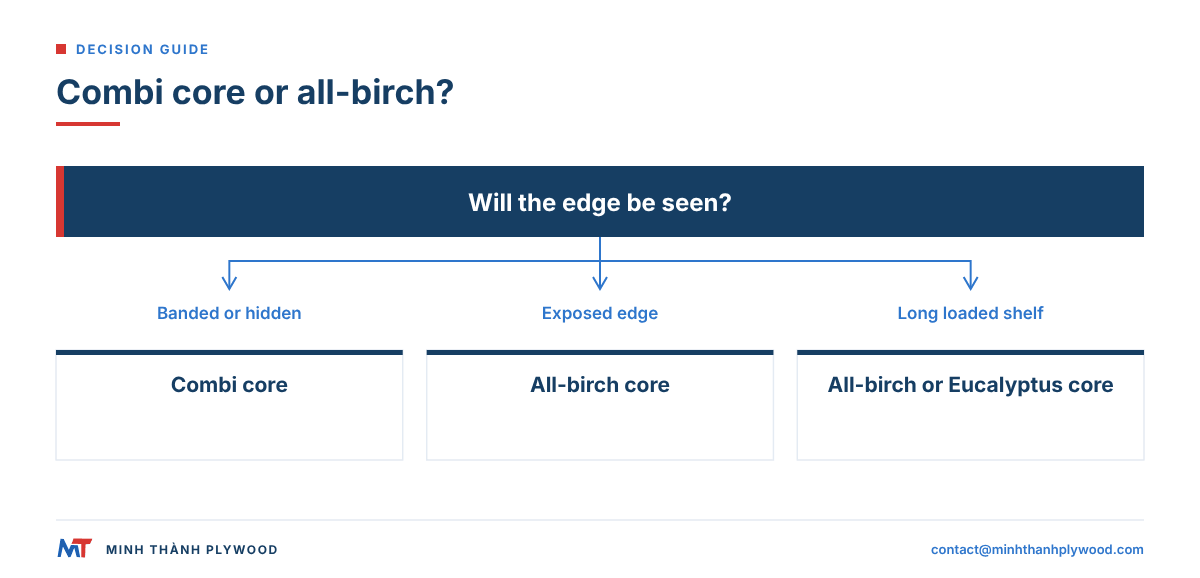
The verdict by use is short. If the edge is banded, laminated or hidden, combi core does the job at a lower cost. If the edge is part of the design, or the panel spans a long shelf under load, pay for the all-birch core.
How are combi, all-birch and plantation hardwood cores laid up?
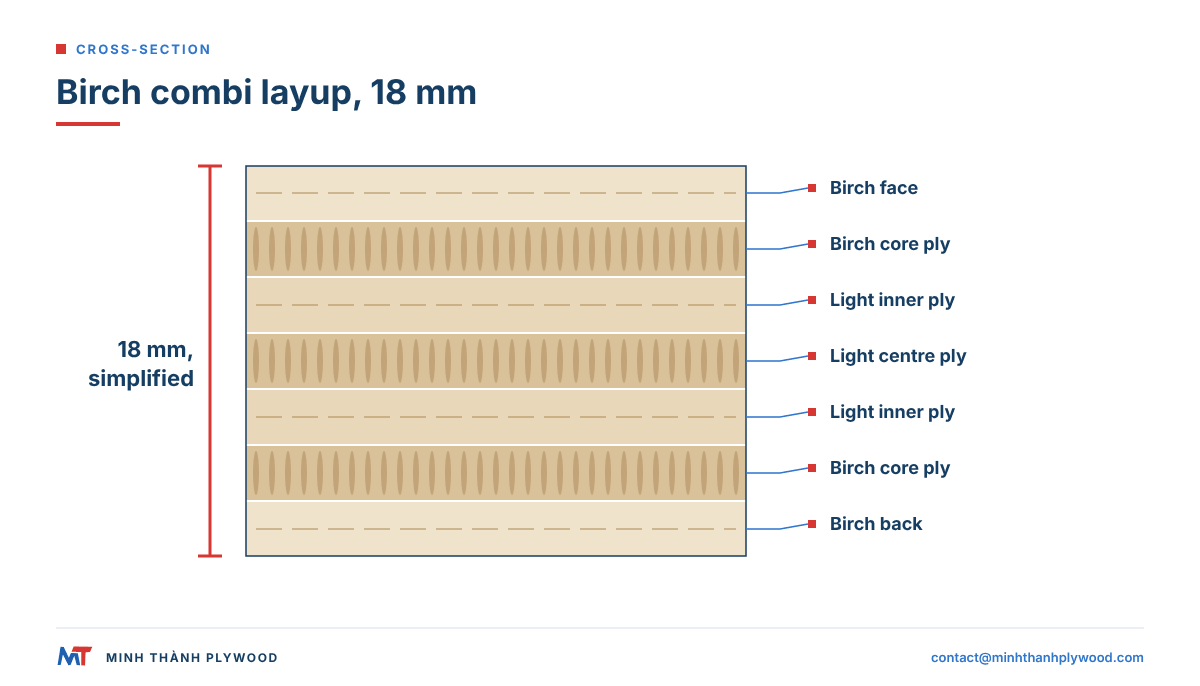
All four builds use the same cross-laid principle: an odd number of veneers, each at right angles to the next, balanced around the centre ply. They differ in which species sits in which position.
- All-birch core: every ply is birch, from face to back, with many thin plies. The edge shows even, pale lines.
- Birch combi: birch face and back, birch in the plies next to them, a lighter species in the centre plies. The edge shows a pale band at each side and a different centre.
- Plantation hardwood core with a birch face: birch face and back over a core of one plantation hardwood such as white Styrax or Eucalyptus. The edge shows a thin birch line at each side over an even core.
An 18 mm panel of any of these builds typically has 11–13 plies. What changes the behaviour is the density of the centre and how well it is closed. A stitched Styrax or Eucalyptus core behaves evenly across the sheet; a loose-laid poplar centre can leave gaps that show as dents under a thin birch face.
Stiffness, weight and flatness: the trade-offs in numbers
Weight follows the core species, and stiffness follows weight closely. A lighter core saves freight and handling; a denser core resists sag and holds edge screws harder.
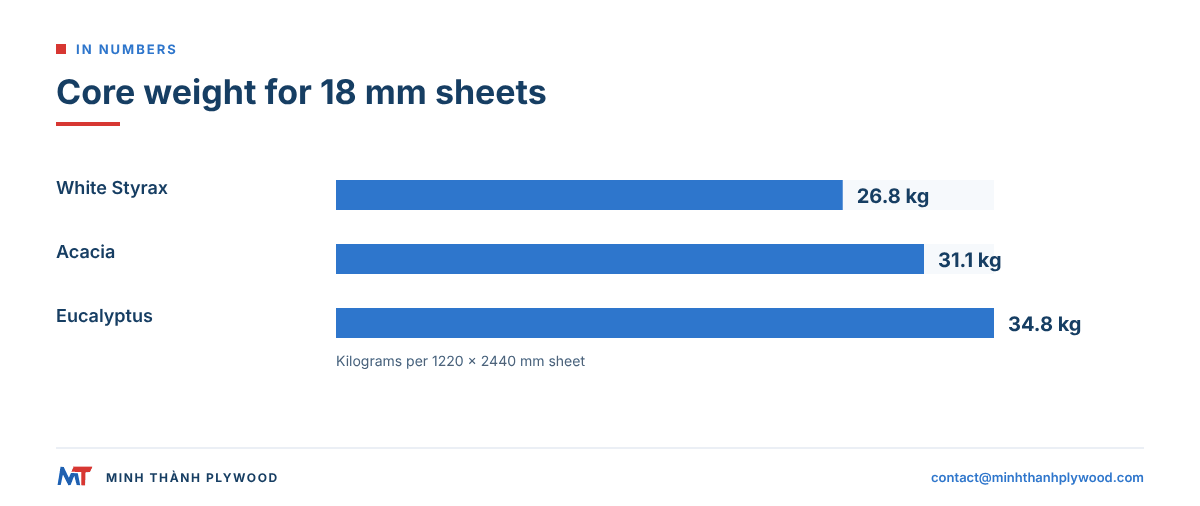
Minh Thanh’s reference core densities and 18 mm sheet weights for 1220 × 2440 mm sheets:
| Core | Reference density | Sheet weight, 18 mm | Sheets per 40HC |
|---|---|---|---|
| White Styrax | 500 kg/m³ | 26.8 kg | 990 sheets |
| Acacia | 580 kg/m³ | 31.1 kg | 880 sheets |
| Eucalyptus | 650 kg/m³ | 34.8 kg | 795 sheets |
Birch is denser than all three, so an all-birch sheet is the heaviest of the group, and a combi sheet sits between an all-birch sheet and a Styrax-core sheet. Three trade-offs follow:
- Weight: a Styrax-core 40HC carries about a quarter more 18 mm sheets than a Eucalyptus-core load, because the payload limit of 28,000 kg is reached later.
- Stiffness: Eucalyptus and birch resist sag in shelves and tops; Styrax is the light choice for carcasses and doors.
- Flatness: flatness comes from closure and pressing more than from species. A stitched core pressed and calibrated before the faces go on gives a flat face on any of these species.
Combi core vs birch core for cabinets
For cabinet carcasses with banded edges, combi core and plantation hardwood cores are the efficient choice; for cabinets with exposed plywood edges, all-birch is the better core. The face is birch in both cases, so the room sees the same panel.
| Cabinet part | Combi or plantation core | All-birch core |
|---|---|---|
| Carcass sides, tops and bottoms (banded) | Recommended | Works, at a higher cost |
| Shelves over long spans | Choose a Eucalyptus core | Recommended |
| Doors with exposed edges | Not recommended | Recommended |
| Drawer boxes | Recommended with a stitched core | Recommended |
| Painted or UV-coated fronts | Recommended with a calibrated core | Recommended |
Cabinet makers judge a carcass panel on three things: it stays flat after cutting, it holds hinge and runner screws, and it bands cleanly. A stitched Styrax core pressed twice meets all three, at a lower weight than birch, which is why European furniture plants order it.
Is combi core plywood suitable for exterior use?
Combi core plywood is suitable for exterior use only when it is bonded with an exterior glue, usually phenolic (WBP), and its edges are sealed. The glue decides the bond class; the word combi describes the species, not the glue.
What to check on an external-grade combi offer:
- Glue: phenolic (WBP) for exterior and wet use; melamine-fortified bonds for humid and covered use.
- Core closure: core gaps let water in and weaken the panel; ask for a closed core.
- Face grade: exterior sheets often use utility C/D faces, which is normal.
- Edges: seal cut edges on site, whichever glue is used.
Bond quality for plywood is classed in EN 314-2: Class 1 for dry use, Class 2 for humid and covered exterior use, Class 3 for exterior use. The APA plywood guide explains exterior and Exposure 1 bond classifications for North American panels. Plywood for dry, humid or exterior conditions is specified in BS EN 636. For US sales, the TSCA Title VI limit for veneer-core hardwood plywood is 0.05 ppm under 40 CFR 770.10.
Minh Thanh’s exterior and CDX-type plywood uses utility C/D faces with melamine-fortified or phenolic (WBP) glue, for stair treads, wall sheathing and other outdoor uses. See exterior plywood and the planned guide to WBP plywood.
Combi core for flooring, walls and siding
Combi core works for flooring bases, wall linings and siding backers where the edges are hidden, the panel is fixed to a frame and the glue matches the moisture. It is a weak choice where edges stay exposed to water or wear.
- Flooring base and subfloor: works when fixed to joists; choose a denser core such as Eucalyptus for heavy loads, and hold the thickness tolerance so the floor stays level.
- Wall linings: works well; the face shows and the edges are covered by trims or joints.
- Siding and cladding backers: use exterior glue and seal the edges.
- Stair treads: use a dense core with exterior glue; exposed nosings need a hardwood edge or a solid nosing.
For floors under tiles or vinyl, flatness and tolerance matter more than species. Commercial and film-faced builds are held to ±0.5 mm and sanded furniture builds to ±0.2–0.3 mm at Minh Thanh.
Combi core plywood: pros and cons
Combi core plywood saves weight and cost against all-birch, and gives a birch face for furniture and interiors. Its costs are a mixed edge, more variation between suppliers and a risk that the centre species changes between orders.
Pros
- Lower weight than all-birch, so lower freight per sheet and easier handling.
- Lower price for the same birch face.
- Good screw holding near the surface, from the hard outer plies.
- Wide choice of inner species to tune weight and stiffness.
Cons
- The edge shows two species, so edges need banding.
- Stiffness and flatness depend on the inner species and its closure.
- The word combi covers many builds, so offers are hard to compare.
- Without written core lines, a cheaper inner species can replace the sampled one.
Where Vietnamese birch-faced plywood fits
Vietnamese birch plywood from Minh Thanh is a birch-faced build: imported birch face and back veneers on a white Styrax or Eucalyptus core. In the language of this guide it is a combi-type panel with one plantation hardwood in the core, closed and calibrated.
The build that ships to European furniture plants:
- Core: white Styrax as standard, Eucalyptus where stiffness matters, stitched horizontally and vertically.
- Pressing: twice; the core board is pressed and calibrated, then face and back are pressed on.
- Glue and emission: UF glue at E0 emission as standard; melamine-fortified and phenolic bonds on order.
- Faces: birch graded D+, D and E in Vietnam and quoted as pairs such as D+/D; as a buying comparison, D+ is close to European B and D close to BB.
- Tolerance and moisture: down to ±0.2 mm on sanded panels; 8–12 % moisture at dispatch.
Use it for banded furniture, cabinets and shop fittings. See birch plywood and Eucalyptus plywood.
How to stop a cheaper core being substituted
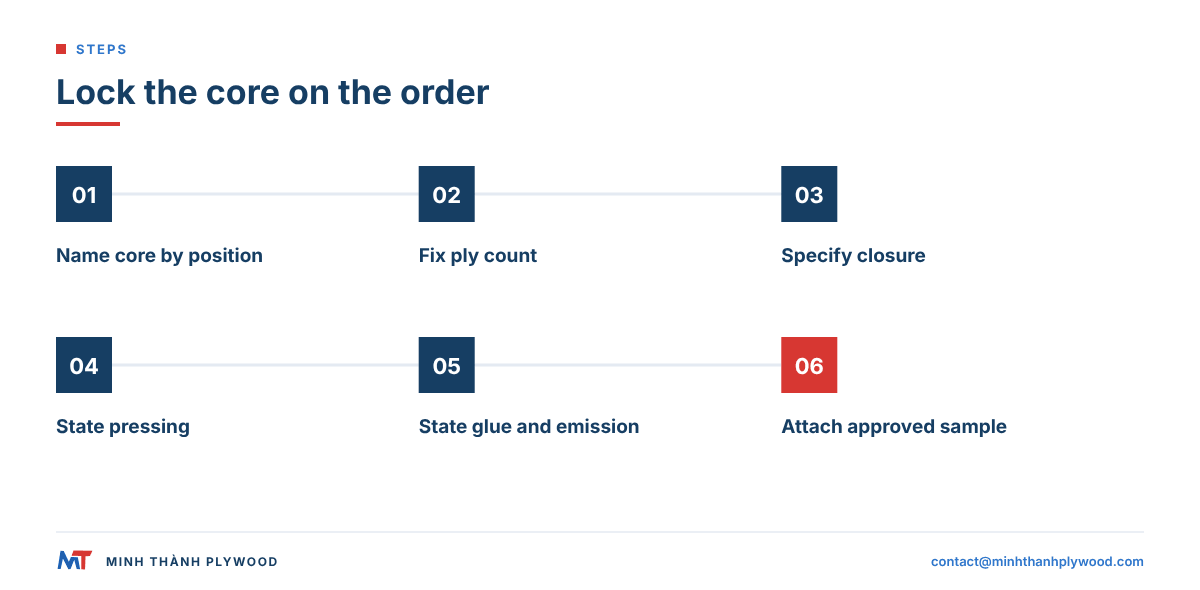
Write the core in the purchase order line by line, and attach an approved sample of exactly that build. A face species and a thickness alone leave the core to the supplier.
Purchase-order wording that closes the gap:
- Core species by position: “Face and back birch; core white Styrax throughout” or “birch outer core plies, poplar centre plies”.
- Ply count: “18 mm, 13 plies” or the count on the approved sample.
- Core grade and closure: “core grade A, stitched, no overlaps”.
- Pressing: “core board pressed and calibrated before face and back”.
- Glue and emission: “UF glue at E0 emission”, or “phenolic (WBP) glue”, as two separate lines.
- Reference: “built as approved sample no. … dated …; any change of core species needs written approval”.
With these lines, a lighter or cheaper centre is a visible breach of the order, not a matter of interpretation.
How to check the core when the panels arrive
Check the core at the edge, on the scale and with one cut. Three quick checks show whether the delivered core matches the sample.
- Edge: count the plies and look at their colours against the sample.
- Weight: weigh a few sheets; at 18 mm, a Styrax-core sheet weighs about 26.8 kg and a Eucalyptus-core sheet about 34.8 kg, so a species change shows on the scale.
- Cut: cut one sheet across and look for gaps, overlaps and a mixed centre.
Minh Thanh photographs and films every container before loading and sends the photos and video to the buyer, so the edges and pack labels can be checked before the ship leaves.
What this means for your order
Accept combi core where edges are banded and weight and cost matter; pay for an all-birch core where edges are exposed or spans are long. In both cases, write the core species, plies, closure and glue on the order.
Minh Thanh quotes birch-faced plywood on Styrax or Eucalyptus cores from one 40HC, with mixed specifications by agreement. Production takes 15–45 days after the 30% deposit, the balance is 70% against the scanned B/L, and free samples come with the quotation. Send your core line to [email protected], and compare the other cores in the plywood core types guide and the cores and glue guides.
Buyer questions, answered
What is combi core plywood?
Combi core plywood has a core of two species or materials: usually hardwood outer plies, such as birch or Eucalyptus, over lighter inner plies such as poplar. In North America the term can also mean a veneer core with MDF crossbands.
What does combicore mean?
Combicore is a trade spelling of combi core: a plywood core that combines species. It is common on British and European merchant listings, for example birch combi or hardwood combi.
Is combi core plywood as good as birch core?
For banded furniture, cabinets and covered work it does the same job at a lower weight and cost. For exposed edges, heavy loads over long spans and the highest flatness, an all-birch core is better.
Is combi core plywood good for cabinets?
Yes, for carcasses with banded or covered edges. Specify the core species and closure, because a combi panel with a loose poplar centre can show dents under thin faces.
Can combi core plywood be used outside?
Only when it is bonded with exterior glue, usually phenolic (WBP), and the edges are sealed. The glue decides exterior use; the word combi says nothing about it.
Is combi core plywood good for flooring?
It works as a flooring base and subfloor where the edges are hidden and the panel is fixed to joists. For heavily loaded floors, ask for a denser core such as Eucalyptus and check the thickness tolerance.
Why is combi plywood cheaper than birch?
Birch veneer is the costly part of the panel. A combi build uses birch only where it is seen or where it adds most stiffness, and a lighter, lower-cost species in the centre.
How can I tell combi core from birch core?
Look at the edge: an all-birch core shows even, pale plies of one colour; a combi core shows two colours or textures. A sheet weight check also helps, because lighter cores make lighter sheets.
Is Vietnamese birch plywood combi core?
Vietnamese birch plywood from Minh Thanh has birch face and back veneers on a white Styrax or Eucalyptus core, which is a combi-type build. Order it for banded edges and covered work.
Do I need to write the core on the purchase order?
Yes. Write the core species, the share of birch plies if any, the closure and the glue. Without it, a supplier may quote a cheaper core under the same face.