
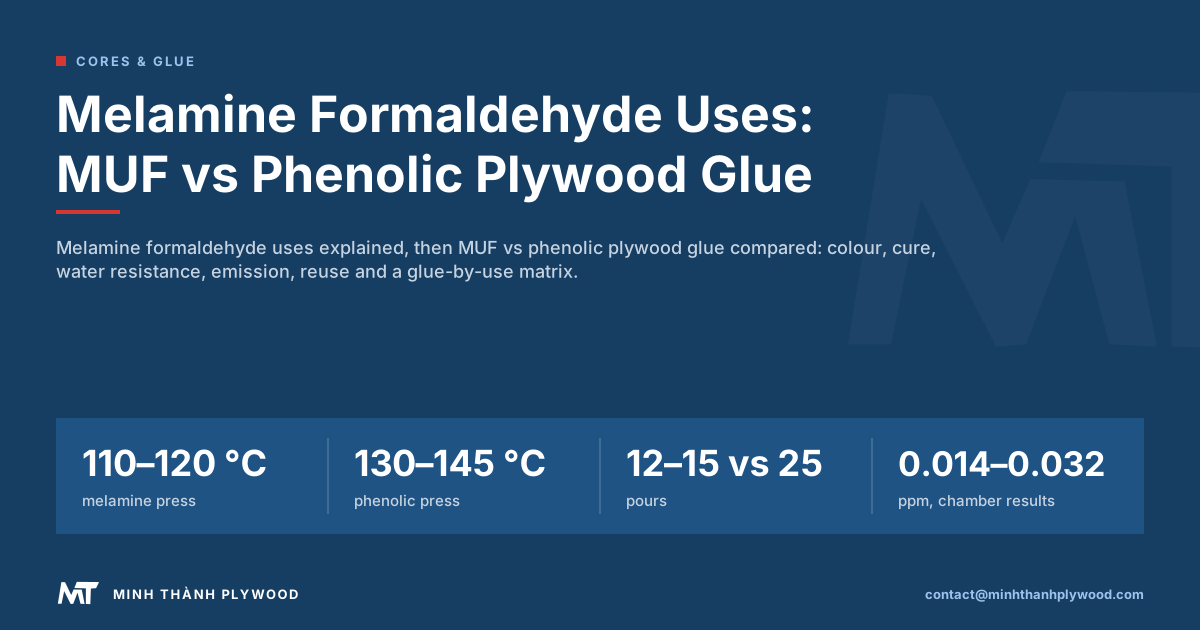
Melamine formaldehyde resin is used for laminates, decor papers, tableware, coatings and wood glues. In plywood it appears as MUF glue, melamine-urea-formaldehyde, the main rival to phenolic (PF) glue. MUF suits interior, furniture and economy formwork panels; phenolic suits exterior use and formwork reused many times. Minh Thanh Plywood makes both bonds to order.
Melamine formaldehyde uses: what melamine and formaldehyde resin is used for
Melamine formaldehyde is a hard, heat-curing resin made by reacting melamine with formaldehyde. Once cured it is hard, scratch resistant, heat resistant and resistant to water, which explains its main uses: surfaces that take wear and glues that must withstand moisture.
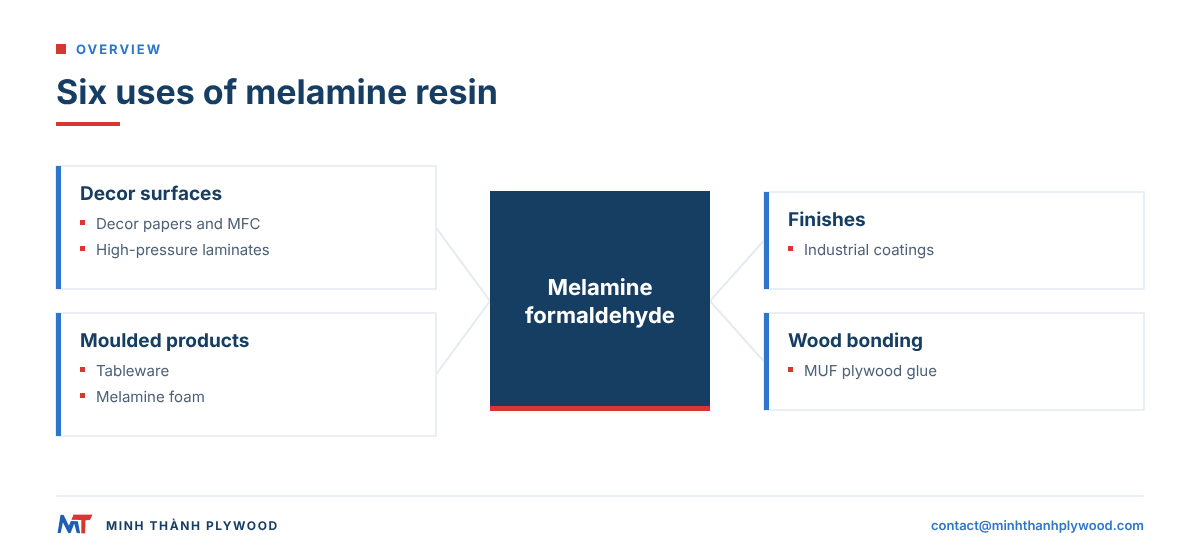
Melamine formaldehyde (MF) resin has six main uses. The table gives each one with its form and the property that makes it work.
| Use | Form | Key property | Number to know |
|---|---|---|---|
| Decor papers and melamine-faced boards (MFC) | Printed paper soaked in resin, pressed on particleboard or MDF | Hard, scratch-resistant surface | Cures in the hot press |
| High-pressure laminate (HPL) and electrical laminates | Kraft or glass-cloth layers bonded with resin | Wear and arc resistance | NEMA G-9 glass-melamine is rated Class B, 130 °C |
| Tableware and moulded items | Moulded powder (Melmac type) | Hard, stain-resistant, heat-stable | Used from -30 to 120 °C; not for microwaves, hot oil or acidic food |
| Coatings | Crosslinker in industrial and automotive paint | Hardness, gloss, chemical resistance | Cured by heat |
| Melamine foam | Open-cell foam | Acoustic absorption, flame resistance | Cleaning sponges, sound panels |
| Wood adhesives (MUF) | Melamine added to urea glue | Water-resistant glue line | Pressed at 110–120 °C in Minh Thanh’s presses; EN 314-2 Class 2 to 3 |
Decor papers and HPL are the largest wood-panel uses. Electrical laminates use the glass-cloth grades G-5 and G-9, where G-9 is the newer designation and the one chosen for humid conditions. Tableware is the use people meet at home, and the reason for the safety question in the next section: melamine plates are not microwave safe, and the resin chips when cut with a standard table saw, so melamine-faced boards are cut with fine-tooth or scoring blades.
The last use is the one that matters for plywood buyers. A quotation that says “melamine glue” means an MUF bond between the veneers, and it competes directly with phenolic glue.
Melamine and formaldehyde react in two stages. First they form a soluble resin that can be sprayed, mixed into glue or soaked into paper; then heat and pressure cure it into a hard, crosslinked network that no longer melts or dissolves. That second stage happens in the hot press, which is why melamine resin works in the same presses that make plywood and laminated boards.
Melamine is costly compared with urea, so wood-panel mills use it where it earns its price: on surfaces that must resist wear and heat, and as a share of the glue where the bond must resist humidity. Pure urea glue is the cheaper, paler choice for dry interior panels.
Is melamine formaldehyde safe?
Cured melamine formaldehyde is safe for its normal uses; the risk comes from uncured monomers and from heat or acid beyond the limits above. Two separate rules apply: one for food contact, one for wood panels.
- Food contact: in the EU, melamine tableware falls under Regulation (EU) No 10/2011, which caps migration at 2.5 mg/kg for melamine and 15 mg/kg for formaldehyde. Plates should be kept away from microwaves, hot oil and acidic foods.
- Wood panels: the concern is free formaldehyde released from the glue or the paper. Glue type and emission class are separate lines: E0 and E1 under EN 717-1, and CARB Phase 2 / TSCA Title VI in the US. Minh Thanh’s furniture panels were tested to ASTM D6007 at 0.014–0.032 ppm against the 0.05 ppm limit; see E0 and E1 formaldehyde emission.
- Production chemistry: standard references describe melamine and formaldehyde forming a soluble methylol resin first, then a crosslinked network under heat. The reference text is the Ullmann’s Encyclopedia entry on amino resins.
Three things called melamine in plywood
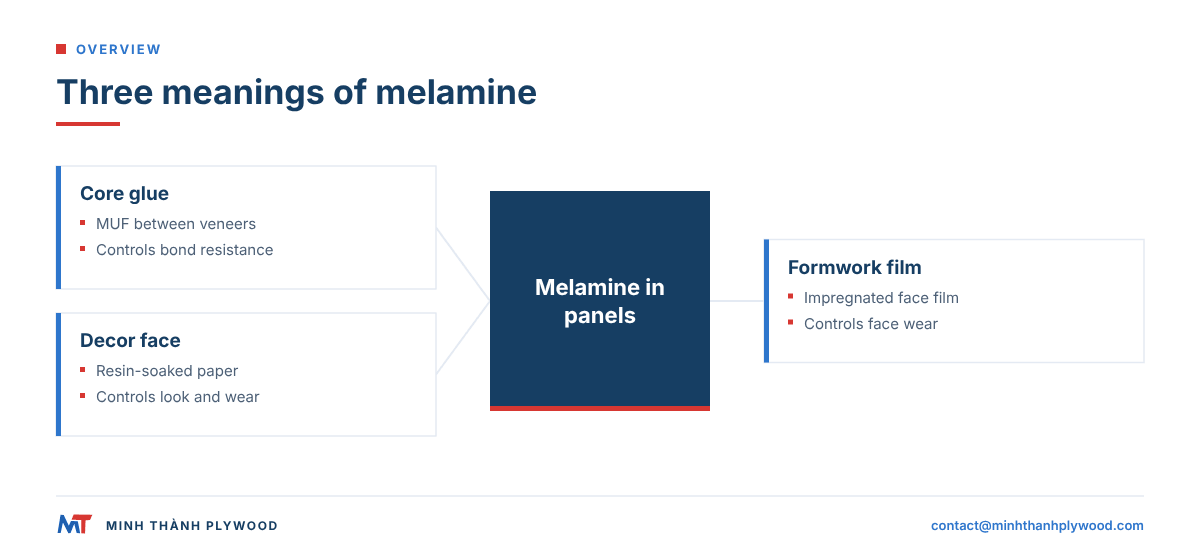
In plywood trade, melamine can mean the glue between the plies, the paper on the face or the film on a formwork panel. They are different specifications, and mixing them up is the most common source of wrong orders.
| What the word refers to | What it is | Where it sits | What it decides |
|---|---|---|---|
| Melamine glue (MUF) | Melamine-urea-formaldehyde resin | Between every veneer | Water resistance of the bond |
| Melamine-faced board | Decor paper impregnated with melamine resin | On the face of particleboard, MDF or plywood | Surface look and wear |
| Melamine film on formwork | Film impregnated with melamine or a melamine-phenolic mix | On the face of film-faced plywood | Concrete finish and face wear |
A film-faced formwork panel can combine all three words in one sentence: a phenolic or melamine film on the face, and an MUF or phenolic glue in the core. Ask for the face film and the core glue as two separate lines.
What is MUF glue, the melamine resin used in plywood?
MUF glue is melamine-urea-formaldehyde, a urea-formaldehyde glue fortified with melamine to make the bond more water resistant. It keeps the pale glue line of urea glue and adds resistance to humidity and short wetting.
How MUF behaves in plywood:
- Glue line: pale, close to the colour of the wood, invisible under light faces.
- Pressing: cures at the lower temperatures of the melamine and MR family, about 110–120 °C in Minh Thanh’s presses.
- Water resistance: suitable for humid interiors and covered exterior uses; stronger fortification gives longer boil resistance.
- Emission: depends on the formulation; resin type and emission class are separate specifications.
- Cost: lower than phenolic.
MUF is the glue of choice for kitchen and bathroom furniture panels, interior joinery in humid rooms, sheltered exterior uses and economy formwork.
What is phenolic (PF) glue?
Phenolic glue, phenol-formaldehyde or PF, is a dark, heat-curing resin that forms a bond resistant to boiling water, weather and repeated wetting. It is the glue behind WBP, weather and boil proof, in its strict sense.
How phenolic glue behaves in plywood:
- Glue line: dark red-brown, visible at every edge.
- Pressing: needs higher temperatures and longer pressing, about 130–145 °C in Minh Thanh’s presses.
- Water resistance: the highest of the common plywood glues; the standard choice for exterior and marine-type builds.
- Emission: phenolic bonds emit very little formaldehyde once cured.
- Cost: higher than MUF, in resin and in press time.
Phenolic glue is the choice for exterior plywood, formwork that is reused many times and any panel that will be wetted and dried repeatedly.
Phenolic bonds also need tighter process control. Veneers must be dried evenly before gluing, because wet spots under a phenolic glue line turn into blisters in the hot press. Spread, open time and press time are set for each thickness, and the core must be closed, since a phenolic bond cannot bridge a gap between core veneers. A mill that runs phenolic panels every week has these settings fixed; a mill that runs them rarely does not.
MUF vs phenolic glue: the comparison
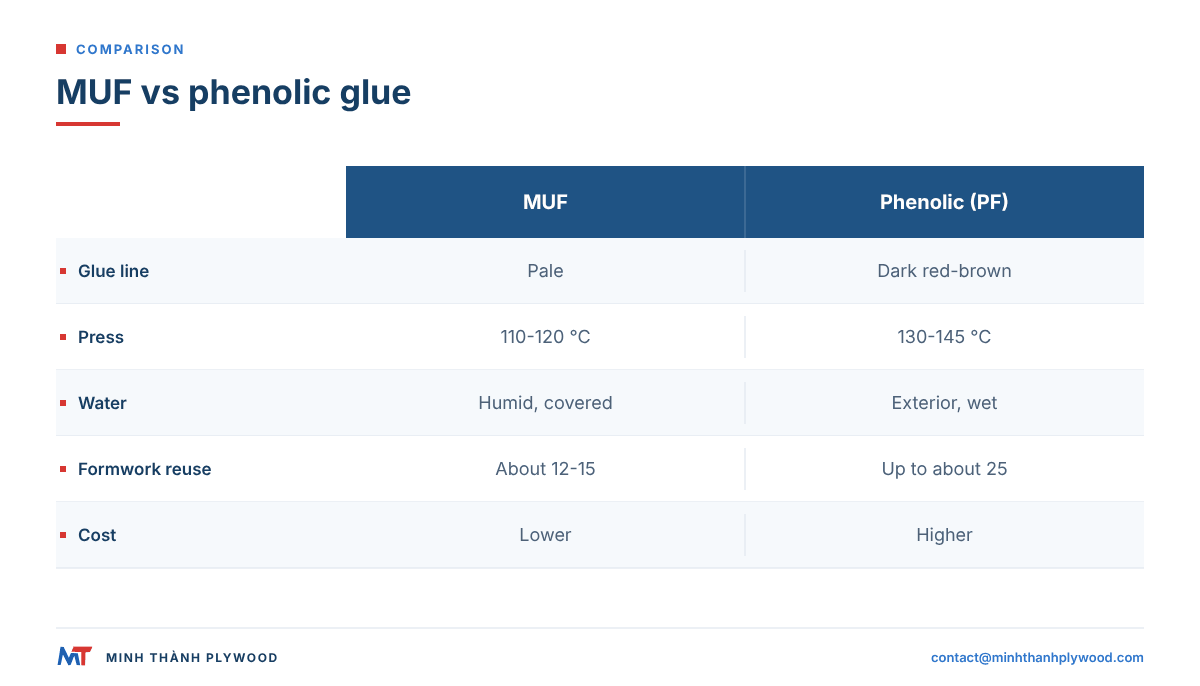
MUF gives a pale, cost-effective bond for humid and covered uses; phenolic gives a dark, more expensive bond for exterior use and long formwork life. The table compares them one metric per row.
| Metric | MUF (melamine-urea-formaldehyde) | Phenolic (PF) |
|---|---|---|
| Glue line colour | Pale | Dark red-brown |
| Pressing temperature at Minh Thanh | 110–120 °C | 130–145 °C |
| Water resistance | Humid and covered exterior | Exterior and repeated wetting |
| Typical bond class to EN 314-2 | Class 2; Class 3 in strongly fortified grades | Class 3 |
| Emission | Depends on fortification; E0 to E1 | Very low once cured |
| Film-faced reuse, with proper handling, release agent and edge sealing | About 12–15 pours | Up to about 25 pours |
| Cost index | Lower | Higher |
| Best uses | Kitchen and bathroom furniture, interior joinery, economy formwork | Exterior plywood, formwork for many pours, wet areas |
The bond classes come from EN 314-2, the European standard for plywood bond quality. Its service classes for dry, humid and exterior conditions are set in EN 636.
Glue-by-use matrix: which glue for which plywood?
Choose the glue by where the panel will live and how often it will get wet. The matrix shows the usual choice for each common use.
| Use | UF glue at E0 emission | MUF | Phenolic (PF) |
|---|---|---|---|
| Living-room and bedroom furniture | Standard | Possible | Rarely |
| Kitchen and bathroom cabinets | Possible | Standard | Rarely |
| Interior doors and joinery | Standard | Possible | Rarely |
| Covered exterior: soffits, wall linings | No | Standard | Possible |
| Exterior sheathing and stair treads | No | Possible, fortified | Standard |
| Film-faced formwork, few pours | No | Standard | Possible |
| Film-faced formwork, many pours | No | Possible | Standard |
| Packing and crates, dry | Standard | Possible | No |
Minh Thanh’s furniture and interior panels use UF glue at E0 emission as standard; MR, melamine-fortified and phenolic (WBP) bonds are made to the buyer’s specification. Exterior and CDX-type panels use melamine-fortified or phenolic glue.
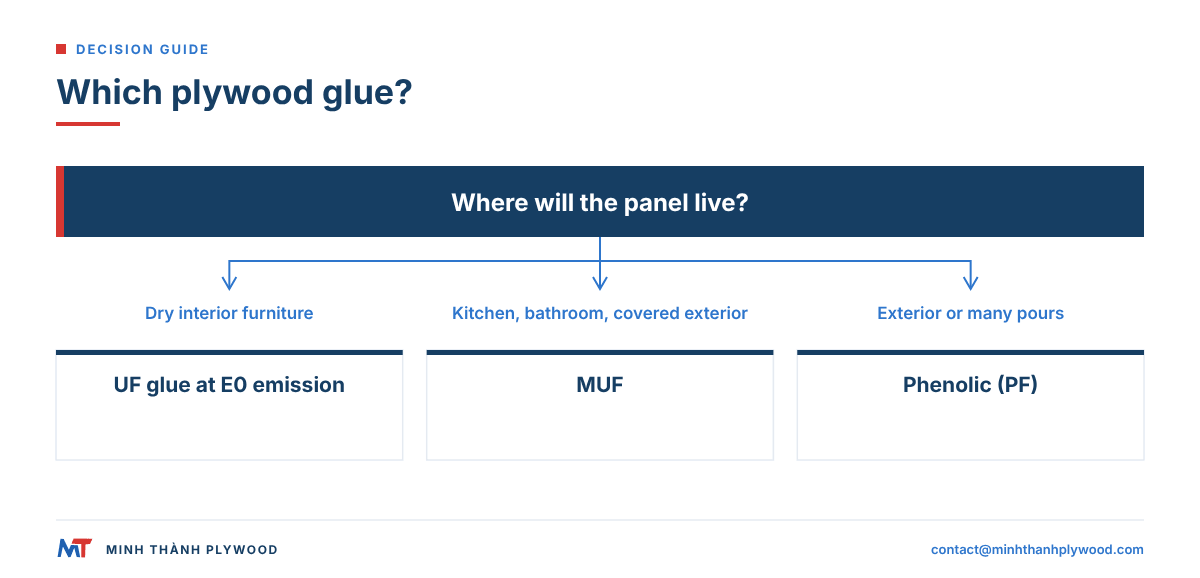
Is melamine or phenolic glue better for furniture plywood?
For most furniture plywood, neither: the standard is UF glue at E0 emission, which gives the palest glue line and the lowest emission. MUF is the step up for kitchens, bathrooms and humid rooms; phenolic is rarely used for furniture because its dark glue line shows at every edge.
What a European furniture plant usually orders:
- Dry rooms: UF glue at E0 emission on a white Styrax or Eucalyptus core.
- Kitchens and bathrooms: MUF bond for more humidity resistance, with the emission class written as its own line.
- Exposed edges: UF or MUF, so the edge stays pale.
Emission evidence for Minh Thanh’s furniture panels: CARB P2 / TSCA Title VI certification as ICTT mill no. 23024, and six ASTM D6007 chamber tests between April 2025 and June 2026 on 9, 15 and 18 mm panels averaging 0.014–0.032 ppm. See furniture plywood from Vietnam.
The US TSCA Title VI limit for veneer-core hardwood plywood is 0.05 ppm, as listed in EPA’s formaldehyde emission limits.
California regulates formaldehyde emissions from hardwood plywood under CARB’s composite wood products programme.
Melamine or phenolic glue for film-faced formwork plywood?
Melamine-bonded film-faced plywood suits jobs with a moderate number of pours and a tight budget; phenolic-bonded panels suit jobs that reuse the same panels many times. With proper handling, release agent and edge sealing, melamine bonds reach about 12–15 pours and phenolic bonds up to about 25.
Reuse is a target for a given build and site practice, not a fixed property of the sheet. What decides it:
- Core grade: a closed, dense core resists water entry at the edges.
- Glue: MUF or phenolic, as above.
- Film: weight and quality of the face film; standard films run about 120–135 g/m², premium from 135 g/m².
- Site practice: release agent on every pour, sealed cut edges, careful stripping and flat, covered storage.
A contractor who strips with crowbars and stores panels in the rain will see fewer pours from either glue. See film-faced plywood for the builds Minh Thanh offers.
Does phenolic glue make plywood darker? How to tell the glue lines apart
Yes. Phenolic glue cures to a dark red-brown line between the plies, while MUF and UF glue lines stay pale. On delivery, the edge tells the two apart in seconds.
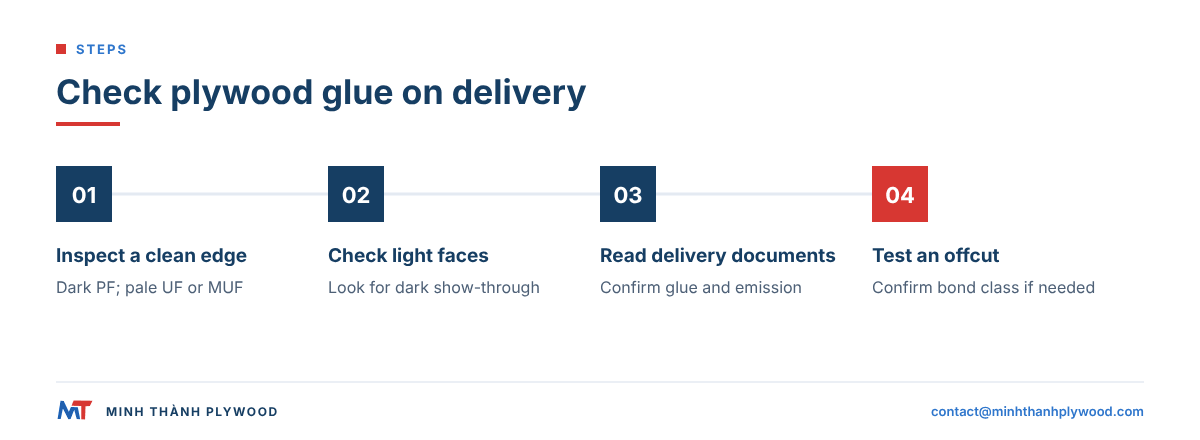
How to check the glue on arrival:
- Look at a clean cut edge: dark lines between the plies mean phenolic; pale or invisible lines mean UF or MUF.
- Look at thin light faces: on some thin faces, phenolic glue shows through as darker patches; UF and MUF do not.
- Check the documents: the glue type and the emission class should both appear on the packing list or test report.
- Test an offcut: a boil test by the mill or a laboratory confirms the bond class when it matters.
Film-faced plywood hides the face, so the edge is the only place to see the glue. Ask for edge photos at loading; Minh Thanh photographs and films every container before loading and sends the photos and video to the buyer.
Can melamine glue plywood achieve E0 emission?
Glue type and emission class are two separate specifications, so the answer depends on the formulation and the test. Lightly fortified melamine bonds can be made at E0; strongly fortified exterior bonds usually test at E1.
The reason is the trade-off inside the resin. More melamine raises the boil resistance of the bond, and the formulations that reach the longest boils carry more formaldehyde. That is why a spec sheet should carry two lines:
- Glue: for example, MUF, melamine-fortified for humid use.
- Emission class and method: for example, E0, tested to a named method.
At Minh Thanh, UF glue at E0 emission is the furniture standard and E0 emission is tested every three months. Third-party testing to the buyer’s method, for example EN 717-1, is arranged through SGS on request. The E0 and E1 emission page explains the classes.
Why is phenolic glue plywood more expensive than melamine?
Phenolic glue plywood costs more because the resin costs more, the press runs hotter and longer, and the bond is usually put into better cores. Each of these adds to the price per cubic metre.
- Resin: phenolic resin is dearer than urea and melamine-urea resins.
- Press time and energy: higher temperatures and longer cycles mean fewer press loads per shift.
- Core quality: a premium phenolic bond is pointless over a loose core, so mills pair it with better veneers.
- Drying: veneers for phenolic bonds are dried tightly to avoid blisters.
The extra cost pays back where panels are reused or exposed. For formwork, compare cost per pour, not price per sheet.
Boil tests and bond classes: what the numbers mean
A boil test checks the bond, not the emission: a sample is boiled for a set time, then the plies are tested for separation. The longer the boil a bond survives, the more water resistant it is.
Common reference points:
- About six hours: the boil a standard UF glue at E0 emission typically survives in a mill bond test.
- About twelve hours: needs a melamine-fortified bond, the usual level for covered exterior uses.
- 72 hours: the traditional WBP boil of older standards such as BS WBP and IS 710; on its own it does not prove marine quality or EN 314-2 Class 3.
EN 314-2 sets three bond classes: Class 1 for dry interior use, Class 2 for humid and covered exterior use, and Class 3 for exterior use. When a quotation names a boil time, ask which method and which class it refers to.
How to specify the glue on your purchase order
Write the glue, the emission class and the face film as separate lines, with the use they serve. Four lines are enough for the mill to quote the right build.
- Use: for example, kitchen cabinets, humid; or wall formwork, many pours.
- Core glue: UF glue at E0 emission, MUF, or phenolic (WBP).
- Emission class and method: for example, E0, or CARB P2 / TSCA Title VI.
- Face: veneer species and grade, or film type and weight for formwork.
Add the core, thickness, size, packing and quantity. Minh Thanh’s minimum order is one 40HC with mixed specifications by agreement, production takes 15–45 days after the 30% deposit, and free samples come with the quotation. Send your glue and face lines to [email protected], or read the cores and glue guides and the planned guide to WBP plywood.
Buyer questions, answered
What is melamine formaldehyde used for?
Melamine formaldehyde resin is used to impregnate decor papers for laminate flooring and melamine-faced boards, to make high-pressure laminates, tableware, coatings and melamine foam, and to fortify wood glues such as MUF for plywood.
Is melamine formaldehyde safe?
Cured melamine formaldehyde is safe for its normal uses. Tableware is limited by EU Regulation 10/2011 migration caps of 2.5 mg/kg for melamine and 15 mg/kg for formaldehyde and should stay out of microwaves, hot oil and acidic food. For wood panels, specify the emission class separately, for example E0 or CARB P2.
Is melamine or phenolic glue better for furniture plywood?
Neither as a rule: most furniture plywood uses UF glue at E0 emission, which gives a pale glue line and low emission. MUF suits humid interiors such as kitchens and bathrooms; phenolic glue is rarely used for furniture because its dark glue line shows.
Does phenolic glue make plywood darker?
Yes. Phenolic glue cures to a dark red-brown line between the plies, visible at the edge and sometimes through very thin light faces. MUF and UF glue lines are pale.
Can melamine glue plywood achieve E0 emission?
Glue type and emission class are separate specifications. Lightly fortified bonds can be made at E0; strongly fortified exterior MUF bonds usually test at E1, so specify and test both lines.
Why is phenolic glue plywood more expensive than melamine?
Phenolic resin costs more, it needs higher pressing temperatures and longer pressing, and it goes into better cores. The result is a bond that withstands exterior exposure and more formwork reuses.
What is MUF glue?
MUF is melamine-urea-formaldehyde, a urea glue fortified with melamine to raise its water resistance. It gives a pale glue line and suits humid and covered exterior uses.
Is MUF glue waterproof?
No glue makes plywood waterproof. MUF is water resistant for humid conditions and covered exterior use; phenolic glue is the choice for exterior exposure and repeated wetting.
How many times can film-faced plywood be reused with each glue?
With proper handling, release agent and edge sealing, melamine-bonded film-faced plywood reaches about 12–15 pours and phenolic-bonded panels up to about 25. Site practice changes the result more than any other factor.
How can I tell MUF and phenolic plywood apart on delivery?
Look at the edge: phenolic glue lines are dark red-brown, MUF and UF lines are pale. A boil test on an offcut, run by the mill or a laboratory, settles the bond class.
Is melamine the same as phenolic?
No. Melamine and phenol are different resins. In formwork plywood they can appear together: a phenolic film on the face and an MUF glue in the core.
Is melamine board the same as melamine glue plywood?
No. Melamine board usually means particleboard or MDF faced with melamine-impregnated decor paper. Melamine glue plywood is veneer plywood bonded with MUF glue between the plies.