
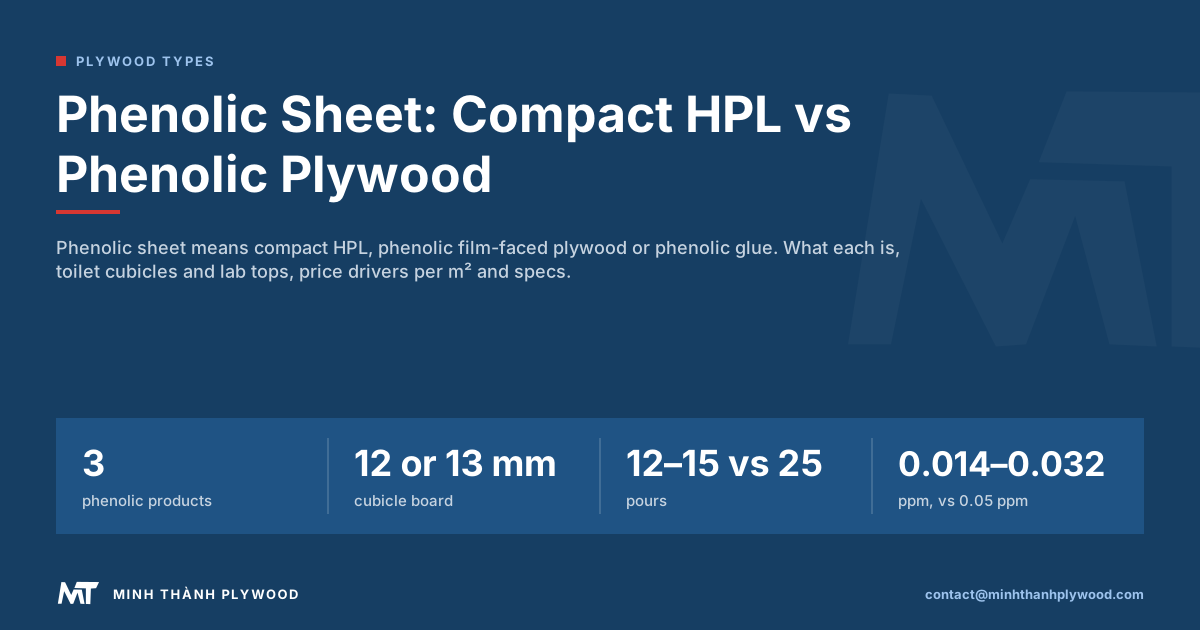
A phenolic sheet is any panel built with phenolic resin, and buyers use the name for three different products: solid compact HPL board, phenolic film-faced plywood and plywood bonded with phenolic (WBP) glue. Minh Thanh Plywood makes the plywood side of that family in Ha Hoa, Phu Tho. This guide explains what each product is, where compact board beats plywood and where plywood costs less, and what drives the price per square metre.
Phenolic sheet sizes and UK prices
UK shops sell phenolic sheet in 6, 9, 12 and 18 mm, mostly as 2440 × 1220 mm (8 × 4 ft) plywood with an anti-slip or smooth face, from about £33 ex VAT for an 8 × 4 eucalyptus-core sheet to about £86 ex VAT for a 9 mm birch 8 × 4 (small 1220 × 610 mm sheets from about £13). These are shelf prices of October 2026, set beside our mill terms for a container buyer.
| Sheet | Core and face | Size | UK price per sheet |
|---|---|---|---|
| 6.5 mm | Eucalyptus core, black hexagon anti-slip | 2440 × 1220 mm | £33.19 ex VAT, £39.83 inc VAT (Sheet Materials Wholesale) |
| 9 mm | Birch core, brown mesh (Buffalo) | 2440 × 1220 mm | £85.94 ex VAT, £103.13 inc VAT (same shop) |
| 9 mm | Eucalyptus core, dark brown mesh, pack of 100 | 2440 × 1220 mm | £33.42 ex VAT per sheet, £40.10 inc VAT |
| 9 mm | Birch core, brown mesh (Buffalo) | 3050 × 1525 mm (10 × 5 ft) | Priced separately by the same shop |
| 6, 12 and 18 mm | Black hexagon or black square anti-slip | 2440 × 1220 mm and 1220 × 610 mm | The Good Sheet lists these, with 2% off over £300 and 5% off over £1,000 |
The shops are Sheet Materials Wholesale and The Good Sheet; both list phenolic plywood by thickness and face.
The gap between the £33 and £86 rows is the core, the film and the quantity: eucalyptus cores cost less than birch, and the pack of 100 prices every sheet lower than a single one. Minh Thanh quotes phenolic plywood per cubic metre against the face, core, film and glue; our commercial plywood starts from US$250/m³ (October 2026) and film-faced board is quoted above that base, so an importer can set it against the shelf rows above and see the margin.
Four proof lines UK buyers ask for:
- Film weight. Brown film of 120 g/m² is the standard weight and 220 g/m² the heavy option on both faces; the heavier film is chosen for more reuses.
- Bond. Phenolic glue passes the boil test for the exterior bond class that EN 314-2 calls Class 3.
- CE route. Plywood sold in the UK carries its performance declared to EN 13986 for the CE or UKCA mark.
- Chain of custody. UK merchants label some sheets FSC; if your project needs it, put it on the enquiry.
What is a phenolic sheet?
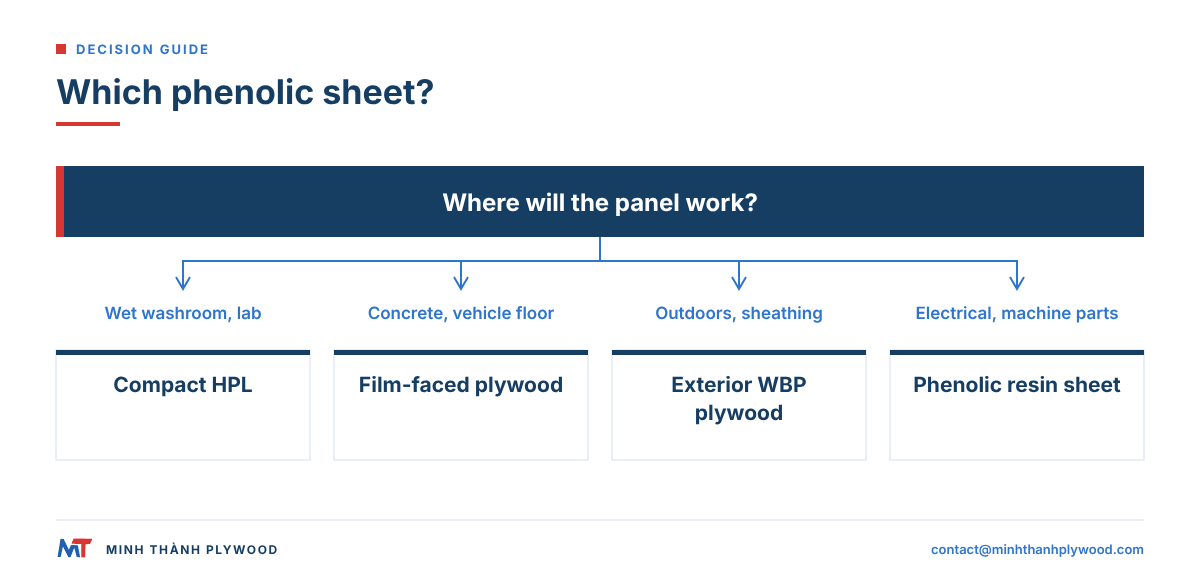
A phenolic sheet is a panel made with phenolic resin, and the name covers three products: compact HPL board, phenolic film-faced plywood and industrial phenolic resin sheet. All three use the same family of resin, phenol-formaldehyde, which cures hard, dark and highly water resistant. What sits under the resin decides the product.
- Compact HPL (compact laminate, compact phenolic board): layers of kraft paper soaked in phenolic resin and pressed into a solid board, with a decorative paper on each face. No wood core.
- Phenolic plywood: plywood bonded with phenolic (WBP) glue, usually with a phenolic-resin paper film pressed on both faces, sold as film-faced or anti-slip plywood.
- Phenolic resin sheet: a technical laminate of paper or cotton cloth and phenolic resin, used for electrical insulation, jigs and machine parts.
When a buyer in Spain asks for tablero compacto fenólico or a contractor in the Gulf asks for phenolic board, ask which of the three they mean before quoting.
What is compact HPL board?
Compact HPL is a solid board of phenolic-resin kraft paper, pressed under heat and high pressure, with a decorative melamine paper on both faces. It is the same material as the thin laminate glued on worktops, built up to full thickness so it stands on its own without a wood core.
The core is usually black or brown, the colour of cured phenolic resin; some makers dye it to match the decor. Because there is no wood inside, the board does not swell when wet, cut edges can be left exposed and polished, and the faces resist scratches, stains and cleaning chemicals.
Compact board is dense and heavy: at about 1.4 g/cm³ it is more than twice the density of a Styrax-core plywood panel at 500 kg/m³. It is made in thicknesses from a few millimetres up to about 25 mm. Cubicle panels are usually 12 mm or 13 mm, lockers and benches 10–13 mm, and laboratory worktops 16–20 mm. Compact laminates are covered by EN 438-4.
Phenolic compact board vs phenolic plywood: the build
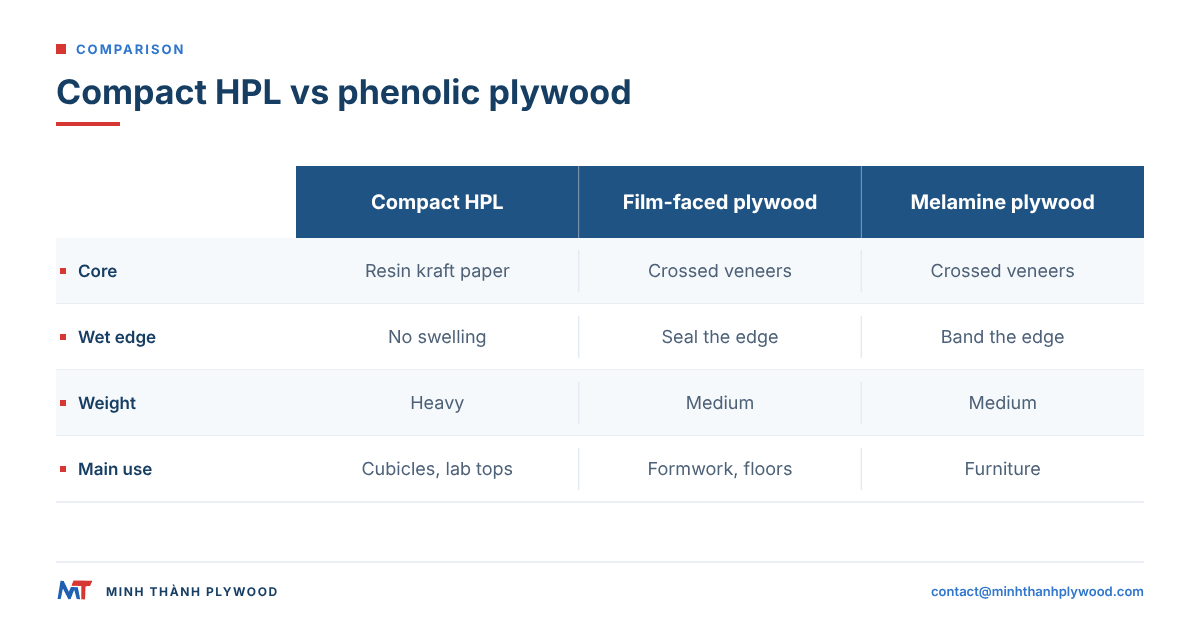
Phenolic compact board is paper and resin all the way through; phenolic plywood is wood veneer with resin on the outside and in the glue lines. That one difference explains weight, price, edge treatment and where each is used.
| Property | Compact HPL board | Phenolic film-faced plywood | Melamine-faced plywood |
|---|---|---|---|
| Core | Phenolic-resin kraft paper, solid | Crossed hardwood veneers | Crossed hardwood veneers |
| Face | Decorative melamine paper | Phenolic resin film, brown or black | Melamine decor paper |
| Glue line | None, one solid board | Phenolic (WBP) or melamine | UF or melamine |
| Water at the edge | No swelling | Edge must be sealed | Edge must be banded |
| Weight, 18 mm class | Heavy | Medium | Medium |
| Machining | Carbide tools, slow feed | Carbide tools | Normal tools |
| Typical use | Washroom cubicles, lockers, lab tops, cladding | Concrete formwork, van and trailer floors | Furniture, shopfitting, dry partitions |
Phenolic plywood also comes without film: exterior plywood bonded with phenolic or melamine-fortified glue and low-grade faces, used for stair treads and wall sheathing. Minh Thanh makes this panel as its exterior plywood.
What is a phenolic resin sheet?
A phenolic resin sheet is a technical laminate of paper or cotton fabric impregnated with phenolic resin and pressed into a hard, brown board. It is sold in electrical and engineering grades, often still called Bakelite or by trade names such as paper phenolic and cotton phenolic, and it is machined into insulators, terminal boards, washers, jigs and gears.
It is not a building panel. It has no decorative face, comes in smaller sheets, and is priced per kilogram or per sheet by plastics distributors. If a search for phenolic resin sheet leads to washroom panels or formwork plywood, those are the other two products, and their specifications are different.
Where compact HPL beats plywood
Compact HPL wins wherever water, cleaning chemicals or knocks reach the edge of the panel. With no wood inside, nothing swells, rots or delaminates, and the edge can be left visible.
- Washroom cubicles and shower partitions. Floors are mopped every day and partitions stand in splash zones; compact board has no edge to fail.
- Changing-room lockers and benches in gyms, pools and schools.
- Laboratory and hospital worktops, where the surface must resist chemicals and frequent disinfection.
- Exterior cladding in exterior-grade compact laminate with UV-resistant faces.
- Kitchen worktops in thin compact, with a dark edge as a design line.
In these uses the higher price per m² buys a longer service life and no edge maintenance.
Where plywood is cheaper and better
Plywood wins wherever the panel is dry, must be light, must hold screws close to its edge, or will be covered by another finish. It costs less per square metre, it is easier to cut and fix, and it carries a decorative face of real wood, melamine or HPL glued on top.
- Furniture and cabinets: veneer or melamine-faced plywood, at a fraction of the weight of compact board.
- Dry partitions and wall panelling: laminated plywood with edge banding.
- Substrate for thin HPL: a plywood core with a 0.6–1.0 mm laminate face gives the HPL surface at a lower panel weight.
- Formwork: phenolic film-faced plywood is made for concrete; compact board is not.
- Vehicle floors: anti-slip phenolic plywood in vans, trailers and trucks, where weight counts.
Indicative starting prices at Minh Thanh, October 2026, are from US$250/m³ for commercial plywood and from US$350/m³ for furniture and interior plywood; the final price depends on face, core, glue, thickness, size, quantity and delivery term.
Compact board toilet partition vs plywood cubicles
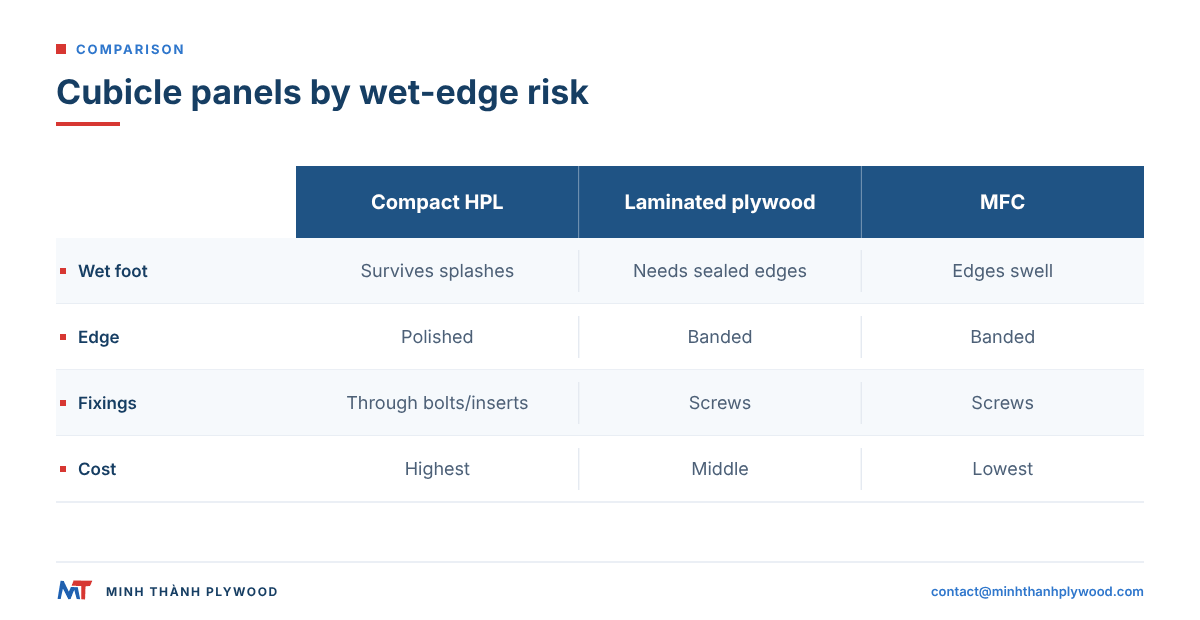
For a compact board toilet partition the choice is between three panels: compact HPL, laminated plywood and melamine-faced particleboard (MFC). Compact HPL is the default for public and wet washrooms; plywood and MFC are used in dry, low-traffic rooms where cost leads.
| Question | Compact HPL | Laminated plywood | MFC particleboard |
|---|---|---|---|
| Survives mopping and splashes at the foot | Yes | With sealed edges | Edges swell when wet |
| Edge finish | Polished, no banding | Banding or solid edge | Banding |
| Impact and vandal resistance | High | Good | Low |
| Fixing hardware | Through bolts or special inserts | Screws | Screws |
| Weight per panel | Highest | Medium | Medium |
| Cost per finished panel | Highest | Middle | Lowest |
Compact cubicle systems use 12 mm or 13 mm board on stainless steel or aluminium feet and hinges made for compact laminate. A plywood cubicle in 18 mm or 25 mm laminated plywood suits offices and staff washrooms that stay dry.
What drives the price of compact phenolic board per m²
The price of compact phenolic board per m² is set by its thickness, its decor and core colour, its fire rating and its sheet format, and a partition quote adds cutting, hardware and fitting on top. Two quotes for “compact board” can differ widely because they are for different boards.
| Price driver | What raises the price |
|---|---|
| Thickness | More paper and resin per m²: 13 mm costs more than 10 mm, worktop grades more again |
| Decor | Woodgrains, stone looks and special colours over plain white or grey |
| Core colour | Coloured-through cores over standard black or brown |
| Fire rating | Fire-retardant (FR) grades over standard grades |
| Exterior grade | UV-resistant faces for cladding |
| Sheet format | Large formats and small orders cut from stock |
| Processing | CNC cutting, drilling, polished edges, hardware |
| Delivery term | Ex-works vs delivered on site, and the freight of a dense board |
For a price per m² that compares, ask each supplier for the same thickness, decor family and fire class, priced per m² of finished panel and per cubicle, and add freight per m³: compact board fills a container’s weight limit long before its volume.
What is phenolic plywood used for?
Phenolic plywood is used where a hard, water-shedding face and a boil-resistant glue line are needed at a plywood price. The film is a paper impregnated with phenolic resin, pressed onto both faces.
- Concrete formwork: the smooth film releases from the concrete and gives a fair-faced finish, pour after pour.
- Van, trailer and truck floors: anti-slip phenolic plywood, with a hexagonal or wire-mesh pattern pressed into the film.
- Stage floors, ramps and walkways in anti-slip versions.
- Boxes, cases and pallet tops that must resist rain in transit.
- Agricultural and industrial linings that are washed down.
Reuse in formwork depends on handling and cleaning. In normal site practice a melamine-bonded film panel gives about 12–15 pours and a phenolic-bonded panel up to about 25. Minh Thanh makes film-faced plywood and anti-slip plywood on order in Ha Hoa, Phu Tho, northern Vietnam, alongside its main furniture and interior range.
Is phenolic plywood waterproof?
Phenolic plywood is water resistant in its glue and its faces, but the cut edges let water in if they are not sealed. Phenolic glue passes boil tests for exterior bonds, the class EN 314-2 calls Class 3, and the film sheds water from the face.
Treat the edges as the weak point. Factory edges are sealed with an acrylic edge paint; every cut made on site should be painted the same day. Store the panels flat, off the ground and under cover until use.
“Waterproof” in the sense of a boat hull is a different requirement. For a panel that stays under water or carries structural loads in a marine setting, specify marine plywood with the veneer quality that standard calls for.
Melamine vs phenolic glue in plywood
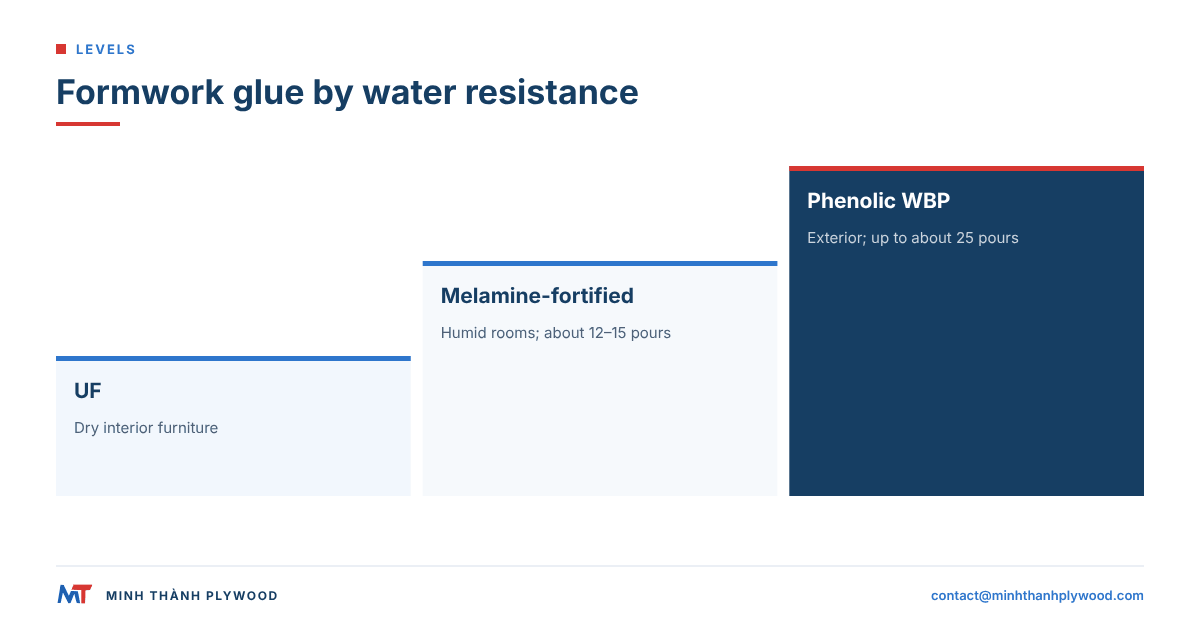
Melamine glue and phenolic glue are the two water-resistant bonds in plywood; urea-formaldehyde (UF) is the interior bond. The choice changes water resistance, glue-line colour, press temperature and price.
| Point | UF glue | Melamine-fortified (MR, MUF) | Phenolic (WBP, PF) |
|---|---|---|---|
| Water resistance | Interior, dry | Humid interiors, some exterior | Exterior and boiling water |
| Glue-line colour | Pale | Pale | Dark red-brown |
| Hot-press temperature | Low | 110–120 °C | 130–145 °C |
| Formwork reuse | Not used | About 12–15 pours | Up to about 25 pours |
| Cost | Lowest | Middle | Highest |
| Typical panel | Furniture and interior | Humid rooms, budget formwork | Exterior, formwork, vehicle floors |
Phenolic glue costs more for three reasons: the resin itself is dearer, it cures at a higher press temperature, and it needs a longer press cycle per load. Its dark glue line is why it is rarely chosen for furniture with visible edges.
Which glue for which furniture use?
For furniture the answer is usually neither melamine nor phenolic, but UF glue at a low emission class. Furniture panels stay indoors, their edges are banded or lacquered, and buyers in Europe and the US ask first about formaldehyde emission.
- Bedroom, living-room and office furniture: UF glue at E0. Minh Thanh makes its furniture and interior panels this way as standard.
- Kitchen and bathroom cabinets: melamine-fortified (MR) glue for humid rooms, still at a low emission class.
- Outdoor furniture and garden structures: phenolic (WBP) glue with exterior-grade faces and a weather finish.
- Boat interiors and caravans: phenolic or melamine-fortified glue, with the face chosen for the look.
Resin and emission class are two separate lines on a specification. “E1 glue” and “E0 glue” are shorthand; an order should say the resin (UF, MR, phenolic) and the emission class or test method.
Phenolic glue, formaldehyde and emission standards
Cured phenolic glue releases very little formaldehyde, which is one reason it is used for exterior and structural plywood. UF glue releases more, so interior panels made with it are tested and certified against emission limits.
In the US, the CARB Phase 2 and TSCA Title VI limit for hardwood plywood with a veneer core is 0.05 ppm (see 40 CFR 770.10). Minh Thanh holds CARB P2 / TSCA Title VI certification as ICTT mill no. 23024. Six ASTM D6007 chamber tests between April 2025 and June 2026 on 9, 15 and 18 mm panels averaged 0.014–0.032 ppm against that limit, three by Shanghai Hongjun and three by ICTT Vietnam.
European buyers accept the CARB P2 / TSCA Title VI certificate and the chamber reports as proof, and third-party testing to the buyer’s method, such as EN 717-1, is arranged through SGS on request. Read more on the formaldehyde emission classes page.
Can you paint or cut phenolic plywood?
You can cut phenolic plywood with normal workshop tools and a carbide-tipped blade, but you cannot paint over the film without preparation. The phenolic film is hard and non-porous, which is what makes it shed concrete and water.
To cut it: use a carbide-tipped (TCT) blade with many teeth, cut with the film face up on a table saw and face down with a hand-held circular saw, support both sides of the cut, and seal the edge the same day. Drill with sharp bits and back the exit hole to stop the film chipping.
To paint it: sand the film with a medium grit until the gloss is gone, clean the dust, apply a primer made for plastics or laminates, then paint. If the panel will be painted anyway, a sanded paint-grade face is cheaper and gives a better finish than a film.
Compact HPL needs carbide tools too, with a slower feed, and its fixings need inserts or through bolts made for compact laminate.
Phenolic board vs marine plywood
Phenolic board and marine plywood solve different problems. Marine plywood to BS 1088 is defined by its veneers, durable species and cores without gaps, bonded with WBP glue; phenolic film-faced plywood is defined by its surface. One is for boats and structures in water, the other for formwork, floors and wash-down linings.
Choose marine plywood for hulls, decks and docks. Choose phenolic film-faced plywood for concrete, trailers and vans. Choose compact HPL when the panel must have no wood at all, as in a washroom.
How to specify a phenolic sheet on your order
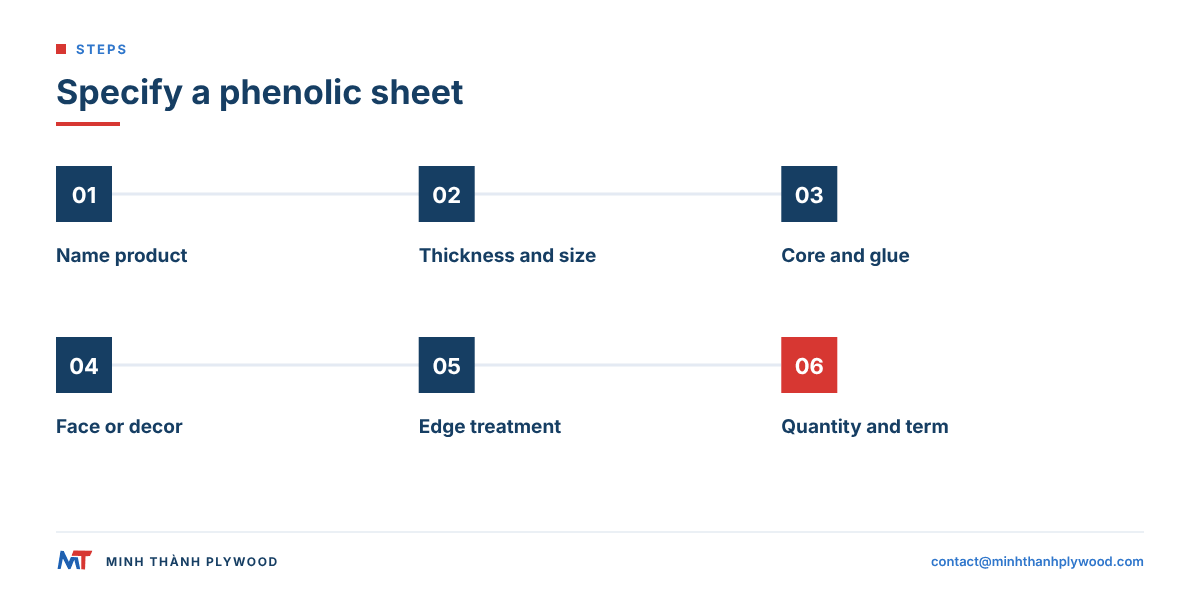
Write one specification line per product, because the three phenolic sheets share a name and nothing else.
- Product: compact HPL, phenolic film-faced plywood, anti-slip plywood or exterior plywood with WBP glue.
- Thickness and tolerance: for example 18 mm ±0.5 mm for film-faced plywood.
- Size: 1220 × 2440 mm or 1250 × 2500 mm for plywood.
- Core: Eucalyptus or Acacia for film-faced and anti-slip plywood.
- Glue: phenolic (WBP) or melamine-fortified, and the emission class for interior use.
- Face: film colour and pattern (plain or anti-slip) for plywood; decor, core colour and fire class for compact HPL.
- Edges: sealed edge paint for plywood; polished or machined edges for compact board.
- Quantity and term: sheets or m³, FOB Hai Phong, CFR or CIF.
A plywood line reads: 18 mm film-faced plywood, Eucalyptus core, phenolic (WBP) glue, brown film both faces, 1220 × 2440 mm, edges sealed, 1×40HC, CIF. MOQ is one 40HC container with mixed specifications by agreement, and production takes 15–45 days after the 30% deposit. Send the line to contact@minhthanhplywood.com or request a quotation; free samples go out before an order.
Buyer questions, answered
What is a phenolic sheet?
A phenolic sheet is a panel made with phenolic resin. The name covers compact HPL board, which is solid layers of resin-soaked kraft paper, phenolic film-faced plywood, and industrial phenolic resin sheet used for electrical insulation.
What is phenolic plywood?
Phenolic plywood is plywood bonded with phenol-formaldehyde (WBP) glue, often with a phenolic resin film pressed on both faces. The glue resists boiling water and the film gives a hard, smooth, water-resistant surface.
Is phenolic plywood waterproof?
Its glue and its film are water resistant, so the panel survives wet use and repeated concrete pours. The cut edges are the weak point: seal them with edge paint, and do not use it under constant water like a marine hull.
Is phenolic board better than plywood for toilet cubicles?
For wet washrooms, yes: compact HPL has no wood core to swell, needs no edge banding and takes knocks. Laminated plywood costs less and weighs less, and it suits dry partitions and furniture behind the cubicle line.
How much does compact phenolic board cost per m²?
The price per m² rises with thickness, decor, core colour, fire rating and sheet format, and a cubicle quote also includes cutting, hardware and fitting. Compare quotes for the same thickness and fire class, per m² of finished panel.
Can you paint phenolic plywood?
The phenolic film is non-porous, so normal paint does not stick well. Sand the film to key it and use a primer for plastics, or order plywood with a paint-grade face instead of a film.
Is melamine or phenolic glue better for furniture plywood?
Neither: interior furniture plywood is usually made with UF glue at E0 emission. Melamine-fortified glue is chosen for humid rooms and phenolic glue for exterior or wet use, where its dark glue line does not matter.
Does phenolic glue make plywood darker?
Yes. Phenolic glue cures to a dark red-brown, so the glue lines show as dark lines on the panel edge. Melamine and UF glue lines stay pale.
What glue is used in Vietnamese plywood?
Vietnamese furniture plywood is made with UF glue, at E0 emission at Minh Thanh. MR or melamine-fortified and phenolic (WBP) bonds are made to the buyer's specification, for humid, exterior and formwork uses.
Which is better, phenolic board or marine plywood?
They solve different problems. Marine plywood to BS 1088 is about veneer quality and void-free cores with WBP glue; phenolic film-faced plywood is about a hard, water-shedding surface. A boat hull needs marine plywood; formwork or a van floor needs a phenolic face.
How do you cut phenolic plywood?
Use a carbide-tipped saw blade, support the sheet on both sides of the cut and cut with the film face up on a table saw. Seal every cut edge with edge paint the same day.