
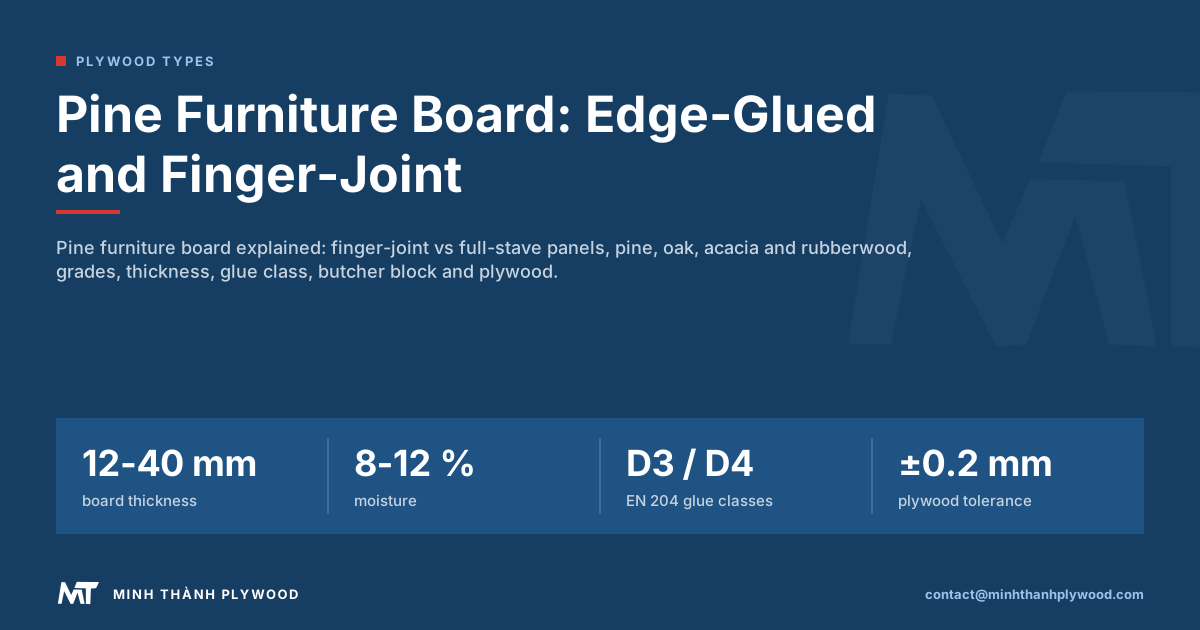
A pine furniture board is a solid wood panel made by gluing narrow pine strips edge to edge, either full-length staves or short pieces finger-jointed end to end. Oak, acacia and rubberwood boards are made the same way. They suit shelves, tops and visible solid-wood parts; plywood suits large, flat, stable panels. Minh Thanh Plywood makes pine-faced plywood for that second job.
What is a pine furniture board?
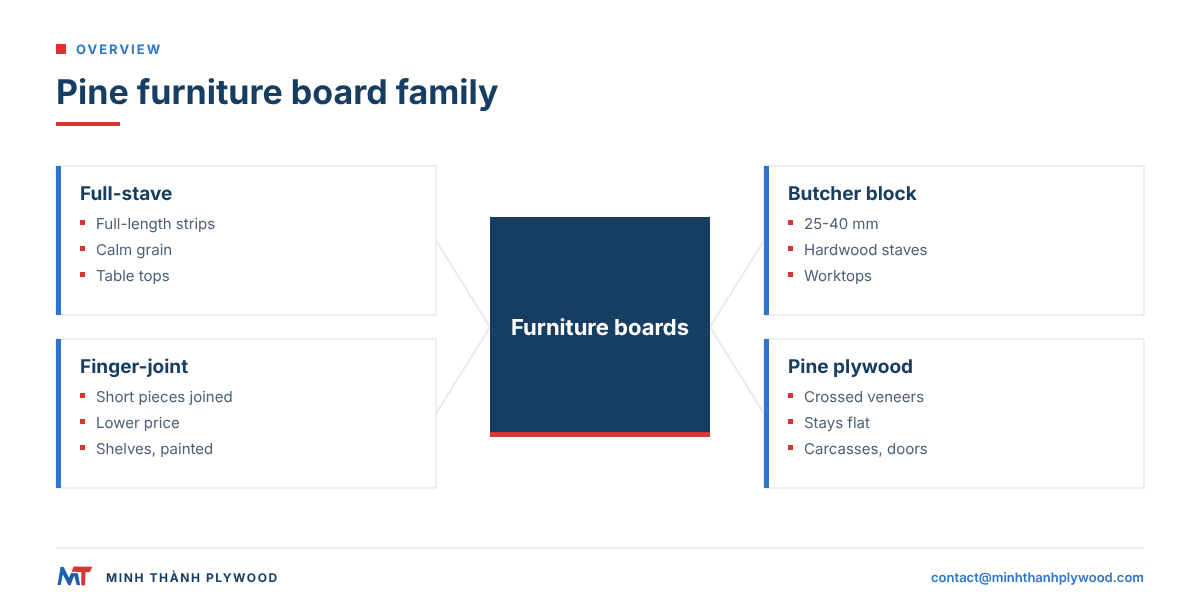
A pine furniture board is a solid wood panel made by gluing narrow pine strips edge to edge into one wide, flat board, sanded on both faces and ready to cut into furniture parts. It is also sold as an edge-glued panel, laminated pine board, solid wood panel or, in the United Kingdom, simply as a furniture board.
The same process makes oak furniture boards, acacia and rubberwood panels and thick butcher block tops. Only the species and the strip layout change. What all of them share: solid wood all through, grain running in one direction, and the look of real timber at the face and edge.
That one-direction grain is the key fact for a buyer. A solid board moves with humidity across its width, while plywood, with its cross-laminated veneers, barely moves. Both have a place in furniture; this guide shows which part suits which.
What is an edge-glued board, and how is it made?
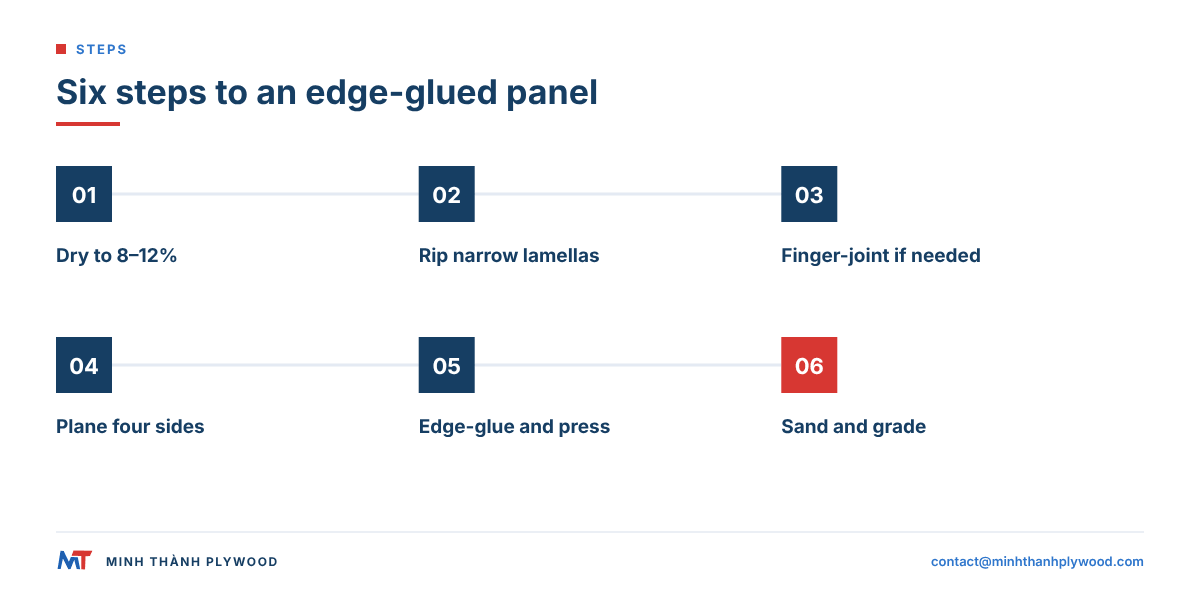
An edge-glued board is a solid-wood panel made by gluing narrow kiln-dried strips (lamellas) edge to edge under pressure, then planing and sanding it to thickness. A finger-joint board adds one step: short pieces are glued end to end into long strips first. Six steps take sawn timber to a graded panel:
- Drying. Boards are kiln-dried to a furniture moisture content, the 8–12 % band used for furniture panels.
- Ripping. Boards are sawn into narrow strips (lamellas) and knots or defects are cut out for the higher grades.
- Finger jointing (finger-joint boards only). Short pieces are milled with interlocking fingers and glued end to end into long strips.
- Planing. Strips are planed on all four sides so the glue faces meet exactly.
- Edge gluing and pressing. Glue goes on the edges, the strips are clamped side by side in a press, and the glue cures.
- Sanding and grading. The panel is sanded to thickness, cut to size and graded by the look of its faces.
Every glue line is a joint the buyer can see. A good panel shows tight, straight glue lines, matched colour between strips and no gaps when the board is held to the light.
Finger joint vs edge glued: what is the difference?
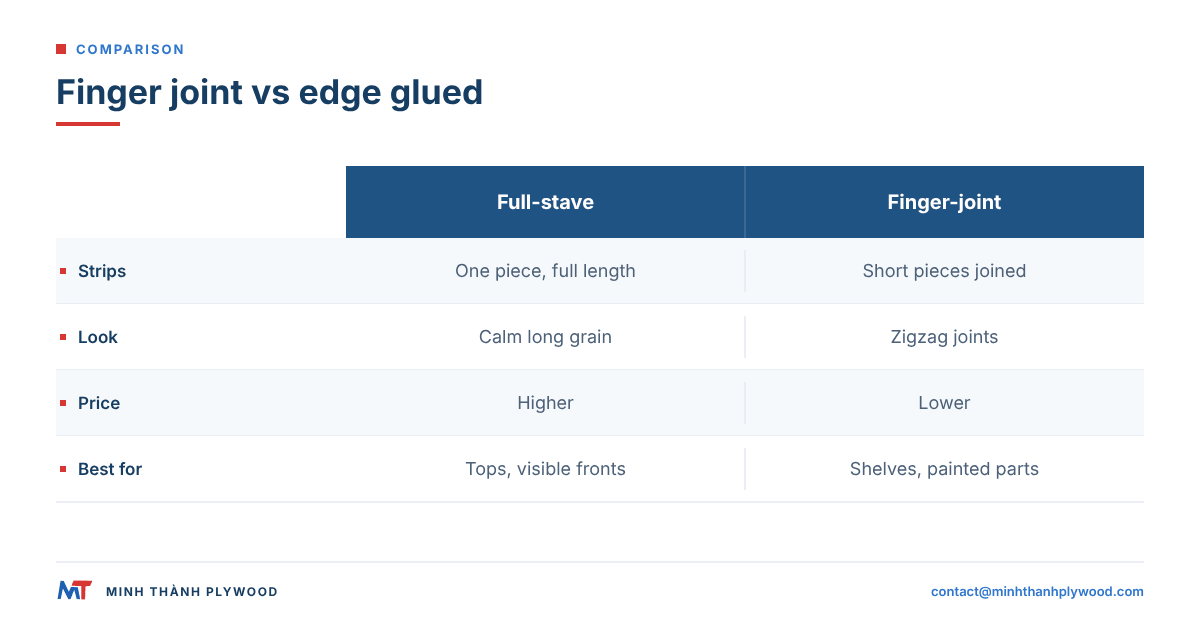
Both are edge-glued panels; the difference is in the strips. A full-stave (full-length lamella) board uses strips that run the whole length of the panel, while a finger-joint board builds each strip from short pieces joined end to end with a zigzag finger joint.
| Metric | Full-stave edge-glued board | Finger-joint edge-glued board |
|---|---|---|
| Strip construction | One piece per strip, full length | Short pieces joined end to end |
| Look | Calm, long grain, like a solid plank | Visible zigzag joints every short length |
| Timber yield | Lower: needs long clear pieces | Higher: uses short clear pieces |
| Price | Higher | Lower |
| Stability | Good | Good; joints cut out defects that cause twist |
| Best for | Table tops, visible fronts, premium butcher block | Shelving, carcasses, painted parts, hidden parts |
A finger-joint board is not weaker when it is well made: the joint is glued over a large surface. The choice is mostly about looks and price. Buyers who want a plank look pay for full staves; buyers who paint or hide the face save with finger joints.
Which species are used: pine, oak, acacia, rubberwood?
Pine, oak, acacia and rubberwood make most furniture boards in international trade; beech, birch, ash and walnut follow. The species sets colour, hardness and price.
| Species | Look | Hardness | Typical furniture use |
|---|---|---|---|
| Pine | Pale yellow, visible knots in lower grades | Soft | Shelves, children’s furniture, painted and country-style furniture |
| Oak | Light to mid brown, strong grain | Hard | Table tops, worktops, premium shelves and fronts |
| Acacia | Golden to dark brown, lively colour change | Hard | Butcher block, table tops, outdoor-style furniture |
| Rubberwood | Pale, even, fine grain | Medium hard | Worktops, painted furniture, kitchen parts |
Solid oak furniture boards cost the most, because oak is slow-grown and the yield of clear strips is low. Solid wood furniture boards in pine are the volume product for shelving and flat-pack furniture. Rubberwood and acacia boards come mostly from South-East Asian plantations.
How are edge-glued panels graded: AA, AB, BC?
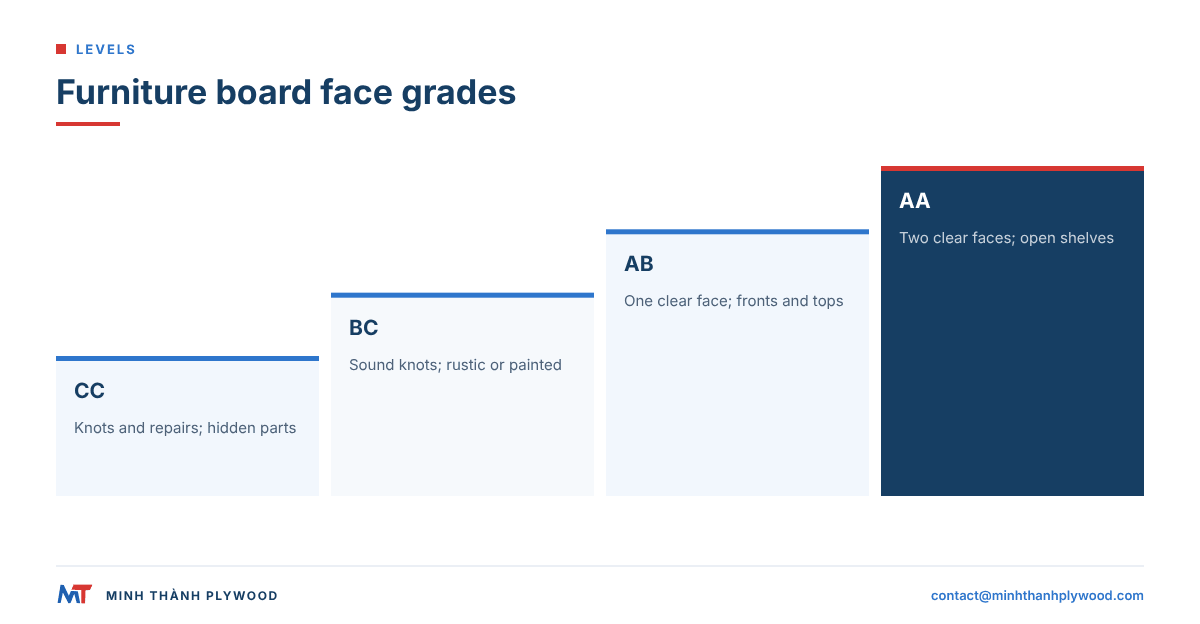
Edge-glued panels are graded face by face with letter pairs: AA, AB, BC and CC are the common steps, the first letter for the better face and the second for the back. The fewer the knots and colour changes, the higher the grade.
| Grade | Face appearance | Use |
|---|---|---|
| AA | Clear, no knots, colour matched, both faces | Visible on both sides: table tops, open shelves |
| AB | One clear face, one face with small sound knots | One visible face: fronts, tops, cabinet sides |
| BC | Sound knots and colour variation on both faces | Rustic furniture, painted parts |
| CC | Knots, small repairs | Hidden parts and carcasses |
Grade names vary by mill and by species, so the final reference is a signed sample. The same rule applies to plywood: Minh Thanh quotes pine-faced plywood as face/back pairs A/A, A/B and B/B (B/C for utility parts), matched to the buyer’s approved sample; the ladder is comparable to the European softwood face classes I to IV and the US A to D grades.
What thicknesses and sizes do furniture boards come in?
Edge-glued furniture boards are made from about 6–40 mm thick, most often 18–40 mm. Common steps are 18 mm for shelves and carcasses, 20 mm and 26 mm for tops, and 27–40 mm for worktops and butcher block.
- Thin cut-to-size boards: UK cutters such as CNC Creations stock pine furniture board in 6, 9, 12, 15 and 18 mm and cut it to any size, delivered in 1–7 working days.
- Sheet panels: 1220 × 2440 mm and other wide panels, cut to furniture parts.
- Shelf boards: narrow widths in many lengths, sold by the piece in retail.
- Worktop and table blanks: thick, wide panels in kitchen lengths.
What does a pine furniture board cost in the UK?
UK merchants sell pine furniture board by the piece, in the sizes below (retail prices read 21 October 2026, VAT included where the shop shows it):
| Board | Size (length × width, mm) | UK retail price | Per m² of board |
|---|---|---|---|
| 27 mm solid pine, Atlantic Timber | 1200 × 300 | £20.86 | about £58 |
| 27 mm solid pine, Atlantic Timber | 1200 × 600 | £41.75 | about £58 |
| 27 mm solid pine, Atlantic Timber | 2400 × 300 | £41.75 | about £58 |
| 27 mm solid pine, Atlantic Timber | 2400 × 600 | £83.51 | about £58 |
| 18 mm pine timberboard, Wickes | 1150 × 300 | £19 | about £55 |
| 18 mm solid pine panel, Harlow Bros | 1200 × 500 | £36.74 | about £61 |
| 18 mm furniture plywood, factory direct (1220 × 2440 sheet) | 2440 × 1220 | about US$19 raw FOB per sheet at US$350/m³ | about US$6.3 raw FOB |
Atlantic Timber adds £2 per cutting instruction. The plywood row is a raw FOB example of the cubic-metre price, not a delivered price: freight, duty and margin come on top.
Even so, the gap per square metre is why joinery shops and furniture makers that need sheets rather than shelf boards buy pine-faced plywood by the container. A solid board is the right buy for a shelf, a table top or a butcher block; a calibrated plywood sheet is the right buy for the carcass and the large flat panels, and it holds the sanded tolerance of ±0.2–0.3 mm that cut-to-size solid boards do not.
Plywood covers the same range: Minh Thanh’s pine plywood is made 3–40 mm thick, in 1220 × 2440 mm and 1250 × 2500 mm sheets and custom sizes such as 1220 × 2500 mm and 1220 × 2280 mm, with sanded furniture panels held to ±0.2–0.3 mm, down to ±0.2 mm. A solid board needs more allowance for thickness and flatness than a calibrated plywood sheet.
Which glue and moisture content should you specify?
Specify the glue by its durability class under EN 204 and the moisture content at dispatch. Those two lines decide whether the glue lines stay closed after the board reaches a heated room.
Glue class (EN 204)
- D2: dry interior use, low humidity.
- D3: interior furniture with short exposure to water or high humidity, such as kitchen fronts. The normal class for furniture boards.
- D4: frequent exposure to water and sheltered outdoor use, such as worktops near sinks and bathroom furniture.
Moisture content. The board should leave the mill near the moisture it will live at. The 8–12 % band used for furniture panels suits most heated interiors. A board shipped wetter shrinks after delivery; the strips pull apart at the glue lines or the panel cups.
What backs the plywood side of the order: the mill holds CARB P2 / TSCA Title VI certification (ICTT mill no. 23024), furniture panels use UF glue at E0 emission, and we supply the EUDR compliance dossier (origin records and geolocation files) with orders. European buyers, with repeat orders into Italy, receive the same file with each container.
Emission is a separate line. For EU furniture, the REACH limit of 0.062 mg/m³ under Regulation (EU) 2023/1464 applies from 6 August 2026 to furniture and wood-based articles, so it covers furniture built from either a solid board or plywood. For plywood sold into the US, the TSCA Title VI limit for hardwood plywood with a veneer core is 0.05 ppm of formaldehyde under 40 CFR 770.10. Under the EU Deforestation Regulation, the application date is 30 December 2026 for large and medium operators.
What is butcher block?
Butcher block is a thick edge-glued hardwood panel, usually 25–40 mm, used as a worktop, table top, island top or chopping surface. Traditional butcher block is end-grain blocks; most butcher block sold today is edge-grain or face-grain staves glued side by side.
What a buyer specifies for butcher block tops:
- Species: oak, beech, walnut, acacia and rubberwood are the usual choices.
- Stave layout: full-stave for a calm top, finger-joint for a lower price.
- Glue: D4 near water, D3 elsewhere.
- Finish: unfinished for oiling on site, or factory-oiled.
Butcher block is a solid-wood product: it is sanded and re-oiled in use, and its edges are the design. Plywood does not replace it on a worktop; plywood replaces it in the carcass beneath.
Solid oak furniture board vs oak-faced plywood
Use a solid oak furniture board where the edge is seen, sanded or oiled, and oak-faced plywood where the face is the design and the panel is large. The two often sit in the same piece of furniture.
| Metric | Solid oak furniture board | Oak-faced plywood |
|---|---|---|
| Edge | Solid oak, can be profiled | Ply edge, needs banding or lipping |
| Movement with humidity | Moves across the width | Very little: cross-laminated |
| Flatness of large panels | Can cup | Stays flat |
| Oak used | Oak all through | A thin oak face and back |
| Weight | Heavy | Lighter on a light core |
| Typical parts | Tops, solid fronts, shelves, frames | Doors, side panels, backs, carcasses |
Oak-faced plywood is the usual answer for large doors and side panels in oak furniture, with solid oak for tops and frames.
Pine furniture board vs pine plywood: which is better for furniture?
Pine plywood is better for large, flat, stable parts; a pine furniture board is better where solid-wood looks, thick edges and sanding matter. The build explains the difference: plywood crosses its veneers, a board keeps all its strips parallel.
| Metric | Pine furniture board (edge-glued) | Pine-faced plywood |
|---|---|---|
| Build | Solid pine strips, grain one way | Cross-laminated veneers, pine face and back |
| Movement with humidity | Moves across the width | Very little |
| Flatness of large panels | Can cup and twist | Stays flat |
| Screw holding in the face | Good | Good; edge needs care |
| Edge | Solid pine | Ply stripes; banded or left visible |
| Sheet tolerance | Sanded board | ±0.2–0.3 mm on sanded furniture panels |
| Typical parts | Tops, shelves, solid fronts, children’s furniture | Carcasses, doors, backs, drawer bottoms, large panels |
Pine plywood from Minh Thanh is built on a stitched Styrax or Eucalyptus core as standard, with Pine cores made on order, pressed twice, sanded, and finished with UF glue at E0 emission. For a carcass or a large door, that build stays flat where a solid board can move. Details are on pine plywood from Minh Thanh; for a species comparison, see birch plywood vs pine plywood.
Fir vs pine plywood for furniture: what are the key differences?
Fir plywood has a wild, high-contrast grain and is sold mostly as construction plywood; pine-faced plywood has a softer, more even grain and is graded for furniture faces. For furniture that shows its face, pine-faced plywood is the usual choice.
- Grain: fir’s rotary-cut face shows strong flame figure; pine is calmer and takes stain more evenly.
- Grading: construction fir plywood is graded for structure; furniture pine plywood is graded for face appearance, such as A/A, A/B and B/B.
- Core: construction plywood often uses the same softwood throughout; furniture pine plywood uses a light, even core, such as Styrax.
- Tolerance and finish: furniture panels are sanded to tight tolerances; construction panels are not.
Pine core plywood, sold in India and other markets as a furniture panel, is a third route: a light softwood core with a decorative face. Minh Thanh makes Pine cores on order for buyers who want an all-softwood panel.
Which board should you choose for each furniture part?
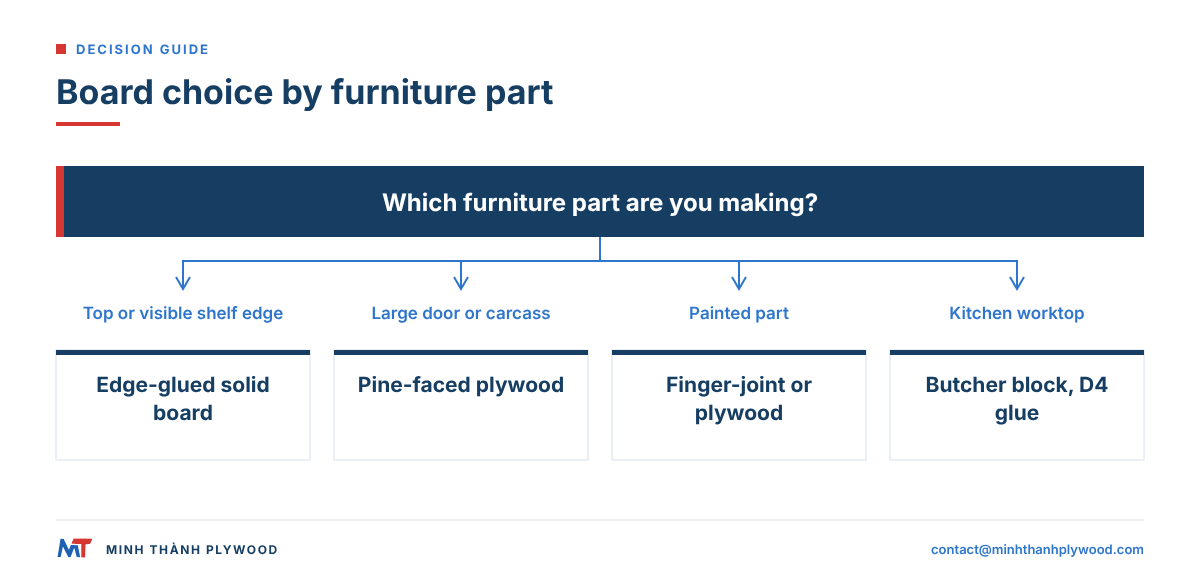
Choose solid boards for the parts people touch and see at the edge, and plywood for the parts that must stay flat over a large area. The table gives a verdict by part.
| Furniture part | Best choice | Why |
|---|---|---|
| Table and desk tops | Edge-glued board (full-stave) | Solid edge, can be sanded and oiled |
| Kitchen worktops | Butcher block, D4 glue | Thick, repairable surface |
| Open shelves, visible edge | Edge-glued board | Solid edge look |
| Cabinet carcasses | Plywood | Flat, stable, lighter |
| Large doors and side panels | Plywood with a matching face | Stays flat over large areas |
| Drawer bottoms and backs | Thin plywood | Thin, stable, low cost |
| Painted furniture | Finger-joint board or plywood | The face is covered |
| Children’s furniture | Pine board or pine plywood | Light, easy to finish |
Many furniture makers buy both: an edge-glued board for the top and frame, and plywood with a matching pine, oak or other face for the panels.
How do you specify the order?
Write an edge-glued panel order in seven lines, and a plywood order in the same way, so every container can be checked against the sample.
- Product: full-stave or finger-joint edge-glued board, or pine-faced plywood.
- Species and grade: for example pine AB, or pine-faced plywood A/B.
- Thickness and size: for example 18 mm, 1220 × 2440 mm, with tolerance.
- Glue and emission: EN 204 class for boards; for plywood, glue type and emission class on separate lines.
- Moisture content at dispatch: for example 8–12 %.
- Finish: sanded, or factory-oiled for butcher block.
- Packing and quantity: pieces per pack, protection, destination port.
For the plywood side of a furniture programme, Minh Thanh supplies pine-faced plywood in full container loads: MOQ one 40HC with mixed specifications by agreement, 15–45 days after the 30% deposit, FOB Hai Phong, CFR or CIF, and free samples. Send the specification to [email protected], or compare the wider panel family in types of wood boards.
Buyer questions, answered
What is an edge glued board?
A solid wood panel made by gluing narrow strips of timber side by side, edge to edge, into one wide board. The strips are planed, glued and pressed, then the panel is sanded to thickness.
What is the difference between finger joint and edge glued boards?
Both are edge-glued. In a full-stave board each strip runs the full length; in a finger-joint board each strip is made of short pieces joined end to end with interlocking fingers. Full-stave looks calmer, finger-joint costs less.
What is butcher block?
A thick edge-glued hardwood panel, usually 25–40 mm, used as a worktop, table top or chopping surface. Classic butcher block uses oak, beech, walnut, acacia or rubberwood staves, often oiled rather than lacquered.
Is a pine furniture board solid wood?
Yes. Every layer is solid pine; only the glue lines between the strips are not wood. That is the difference from pine plywood, which is cross-laminated veneers with a pine face.
What is a laminated pine board?
Another name for an edge-glued pine panel: pine strips laminated side by side. In some markets it also means a pine board with a melamine or paper surface, so ask which one a quotation means.
Which glue is used in edge-glued panels?
Usually a PVAc or EPI adhesive to the EN 204 durability class the use needs: D3 for interior furniture with occasional moisture, D4 for kitchens, bathrooms and sheltered outdoor use.
Is a solid oak furniture board better than oak-faced plywood?
For worktops, table tops and edges you sand, oil and see, solid oak is better. For large doors, panels and carcasses, oak-faced plywood is flatter, lighter and more stable, and it uses far less oak.
Which is better for furniture, pine board or pine plywood?
Pine board for solid-wood looks and thick shelves; pine plywood for large flat panels, carcasses and parts that must stay flat. Cross-laminated plywood moves far less with humidity than a solid board.
What are the main differences between fir and pine plywood for furniture?
Fir plywood has a wild, strongly contrasting grain and is mostly sold as construction plywood; pine-faced plywood has a softer grain and is graded for furniture faces. For visible furniture panels, pine-faced plywood is the usual choice.
What moisture content should an edge-glued panel have?
Close to the moisture it will live at indoors, normally in the 8–12 % band used for furniture panels. A board shipped wetter shrinks and opens its glue lines in a heated room.