
Since 6 August 2026, plywood in furniture and wood-based articles may not be placed on the EU market if it releases more than 0.062 mg/m³ of formaldehyde in the chamber test of REACH Annex XVII, Entry 77. This guide covers the limit, the test, how it compares with E1, CE and CARB, and the documents to request from a mill. Minh Thanh Plywood makes furniture plywood for European buyers.
What is the EU REACH formaldehyde limit for plywood?
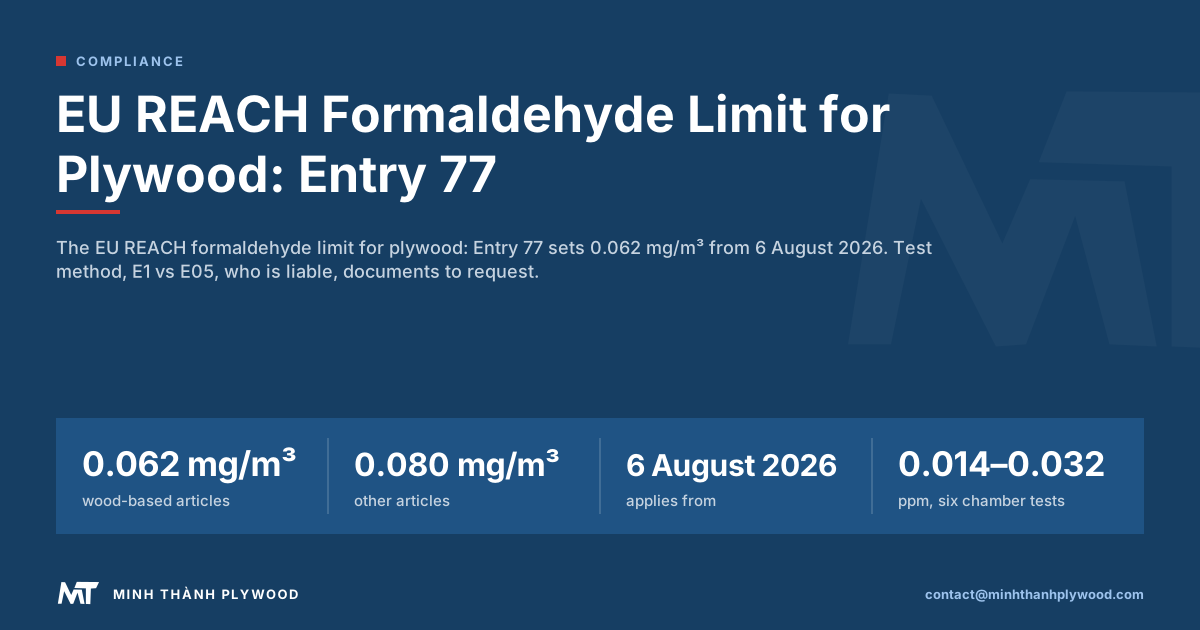
The EU REACH formaldehyde limit for plywood is 0.062 mg/m³: from 6 August 2026, furniture and wood-based articles may not be placed on the EU market if the formaldehyde they release into a test chamber exceeds that concentration. The rule is Entry 77 of Annex XVII to REACH, added by Commission Regulation (EU) 2023/1464 of 14 July 2023 (EUR-Lex, read 20 October 2026).
The text of paragraph 1 is short. Formaldehyde “shall not be placed on the market in articles, after 6 August 2026, if, under the test conditions specified in Appendix 14, the concentration of formaldehyde released from those articles exceeds: 0,062 mg/m3 for furniture and wood-based articles; 0,080 mg/m3 for articles other than furniture and wood-based articles.”
Three points matter for a plywood buyer:
- Plywood is a wood-based article, so the lower 0.062 mg/m³ value applies, whether you sell the panels as sheets or build them into cabinets.
- The limit is on release, not content. Formaldehyde-based glues stay legal; the finished article must stay below the limit in the chamber.
- The limit applies to the whole article placed on the market. A cabinet maker who builds with plywood answers for the cabinet; the panel supplier’s report is the evidence that the panel will not push it over.
Is REACH Entry 77 in force for plywood now?
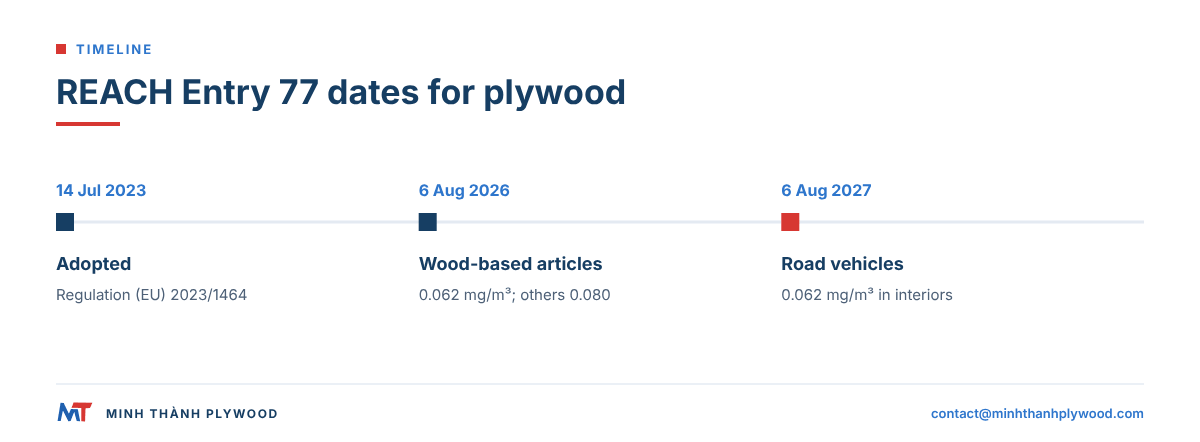
Yes. Entry 77 has applied to plywood, furniture and other articles since 6 August 2026, three years after the regulation entered into force (6 August 2023). It limits formaldehyde release to 0.062 mg/m³ in the Appendix 14 test chamber, and road vehicles follow one year later, on 6 August 2027.
| Date | What happens |
|---|---|
| 14 July 2023 | Regulation (EU) 2023/1464 adopted |
| 6 August 2026 | 0.062 mg/m³ for furniture and wood-based articles; 0.080 mg/m³ for other articles |
| 6 August 2027 | 0.062 mg/m³ in the interior of road vehicles |
The Commission chose a 36-month deferral for all sectors, and 48 months for road vehicles, “to provide sufficient time for stakeholders to implement the restriction” (recital of 2023/1464). Goods already in an EU warehouse are not grandfathered by their purchase date: the test is whether the article is placed on the market after 6 August 2026.
Does the REACH formaldehyde limit apply in the UK and Northern Ireland?
It applies in Northern Ireland and not automatically in Great Britain. EU REACH is listed in Annex 2 of the Windsor Framework, so Northern Ireland follows it and its updates, and the 0.062 mg/m³ ceiling binds anyone placing plywood furniture or panels on the market there (House of Commons European Scrutiny Committee report, checked on 21 October 2026). Great Britain runs UK REACH, regulated by the Health and Safety Executive, which has its own restriction track and has consulted on formaldehyde releasers (HSE consultation page, checked on 21 October 2026).
For a buyer in England, Scotland or Wales, the safe route is the same as for Dublin or Hamburg: write the Appendix 14 chamber result into the contract. A British importer who also ships to Northern Ireland or the Republic of Ireland needs it anyway, and a panel that passes at 0.062 mg/m³ is ready for any later GB rule. Panel makers serving the Irish and British trade moved early: MEDITE SMARTPLY said its MDF range would be E05 compliant by April 2026, four months before the EU date. A buyer who sees E05 on an MDF quote should expect the same level on a plywood quote.
What does Annex XVII Entry 77 cover, and what is excluded?
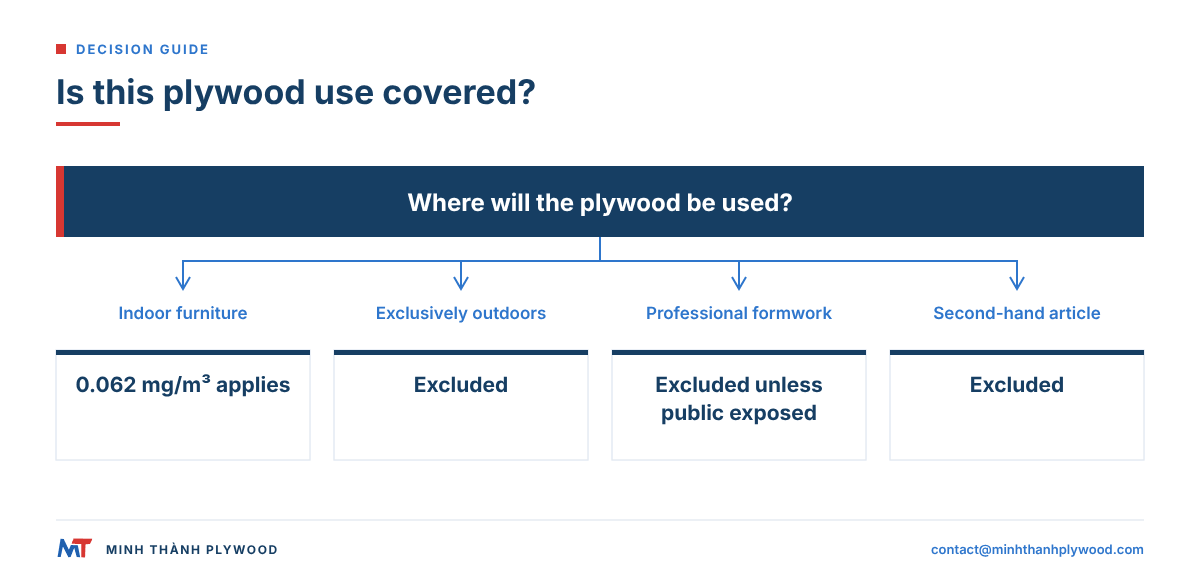
Entry 77 covers every article that releases formaldehyde into indoor air, with ten exclusions listed in paragraph 1. The ones that touch plywood are below; the rest concern biocides, medical devices, protective equipment, food-contact articles and articles already under Entry 72.
| Case in Entry 77 | Covered? | What it means for plywood |
|---|---|---|
| Furniture and wood-based articles | Yes, 0.062 mg/m³ | Furniture plywood, cabinet carcasses, shelving, interior panels |
| Other articles | Yes, 0.080 mg/m³ | Textiles, foams and other non-wood articles |
| Formaldehyde only naturally present in the materials | Excluded | Solid wood with no added resin; not glued plywood |
| Articles exclusively for outdoor use | Excluded | Garden furniture, outdoor stair treads |
| Articles outside the building shell and vapour barrier | Excluded | External sheathing that does not emit into indoor air |
| Articles exclusively for industrial or professional use | Excluded, unless the public is exposed | Concrete formwork on building sites |
| Second-hand articles | Excluded | Reused panels and furniture |
The outdoor and professional exclusions are narrow. Plywood sold through a builders’ merchant to the public is not “exclusively for professional use”, and a panel that may end up indoors is not “exclusively for outdoor use”. When the end use is open, plan on the 0.062 mg/m³ value.
Which film-faced plywood falls under the 0.062 mg/m³ limit?
Film-faced plywood used only as concrete formwork by contractors is professional use and sits outside Entry 77 unless the public is exposed; film-faced panels used indoors, in vehicles or sold to consumers fall under the 0.062 mg/m³ limit like any other wood-based article.
In practice the grade does not decide the answer; the use does. A typical film-faced panel carries a phenolic film on both faces, which seals the surface, and its edges are painted. The core glue line still matters: a film-faced panel with a melamine-fortified (MR) core used for a van floor or a shop fit-out is a wood-based article in indoor air. Ask the mill for a chamber result on the actual build if the panel leaves the building site. See our waterproof plywood guide for how WBP and MR glue lines differ.
How is plywood tested under Entry 77: EN 717-1 or EN 16516?
Entry 77 does not name EN 717-1 or EN 16516 as the method. Its Appendix 14 fixes the reference conditions of the chamber test, and any test that meets them, or a different test with “a scientifically valid correlation” to them, can show compliance (recital of 2023/1464).
The Appendix 14 conditions, word for word in the numbers:
| Condition | Appendix 14 value |
|---|---|
| Chamber temperature | 23 ± 0.5 °C |
| Relative humidity | 45 ± 3 % |
| Loading factor | 1 ± 0.02 m² of test piece per m³ of chamber |
| Air exchange rate | 1 ± 0.05 per hour |
| Sampling | At least twice a day, at least 3 hours apart |
| Test duration | Until steady state, at most 28 days |
| Result | Steady-state concentration in mg/m³ |
The loading factor of 1 m² per m³ “corresponds to the testing of wood-based panels”. For other products, Appendix 14 allows the loading factors of Section 4.2.2 of EN 16516, the European method for construction products. EN 717-1 is the long-standing chamber method for wood-based panels and runs at the same temperature, humidity, loading and air exchange; its steady-state result in mg/m³ is the number a buyer compares with 0.062.
Why a CARB or TSCA result in ppm is not converted
A CARB Phase 2 or TSCA Title VI result is measured with ASTM D6007 (small chamber) or ASTM E1333 (large chamber) under US conditions and reported in ppm. Do not convert those figures into mg/m³ and compare them with 0.062. Use them as supporting evidence of a low-emission glue line, and order a test to the EU conditions when your customer, or a market surveillance authority, needs the EU number.
How do E1, E05, CARB and the new limit compare?
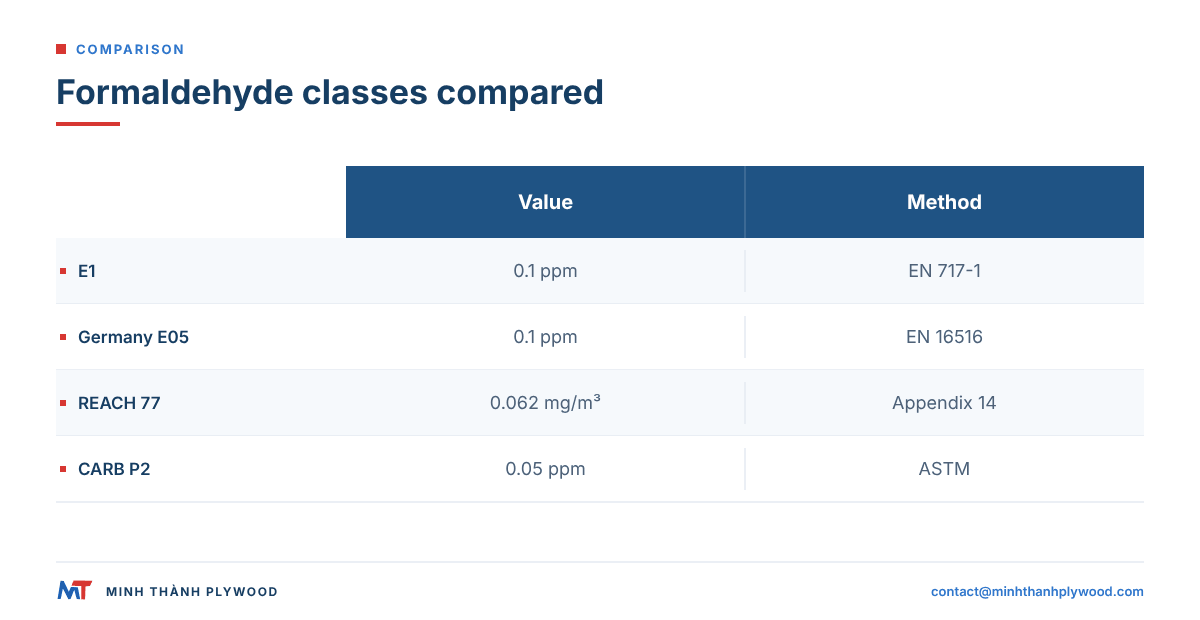
E1 is the old European ceiling, about twice the new REACH value; E05 is the trade name for panels tested to roughly half of E1; CARB Phase 2 and TSCA Title VI are the US limits in ppm. Each class comes from its own method, so compare like with like.
| Class or limit | Value | Method | Where it applies |
|---|---|---|---|
| E1 (EN 13986, Annex B) | 0.1 ppm, about 0.124 mg/m³ | EN 717-1 chamber | CE marking of wood-based panels for construction |
| Germany since 2020, “E05” in the trade | 0.1 ppm measured to EN 16516; an EN 717-1 result is doubled | EN 16516 or EN 717-1 | Wood-based panels and furniture sold in Germany |
| Finnish M1 (RTS building-material classification) | Voluntary emission class that also covers TVOC and ammonia; no single mg/m³ figure comparable with Entry 77 | RTS classification test | Indoor panels sold in Finland and the Nordic market, ordered on top of the legal limit |
| REACH Entry 77 | 0.062 mg/m³ | Appendix 14 chamber conditions | All furniture and wood-based articles in the EU from 6 August 2026 |
| CARB Phase 2 / TSCA Title VI, hardwood plywood, veneer core | 0.05 ppm | ASTM E1333 or ASTM D6007 | California and the United States |
| Japan F☆☆☆☆ | 0.3 mg/L average, 0.4 mg/L maximum | Desiccator method (JAS) | Japan; see our JAS plywood guide |
Sources: the REACH values are in Regulation (EU) 2023/1464. The German rule is summarised by SGS SafeGuardS; the US limit is in EPA’s formaldehyde standards for composite wood products (all read 20 October 2026).
“E0” is not a class in EN 13986. Mills in Asia use E0 for a UF resin grade that gives emissions well below E1; the panel’s measured result, not the label, is what Entry 77 asks about.
Does CE marking under EN 13986 satisfy REACH Annex XVII?
No. CE marking under EN 13986 and the Construction Products Regulation declares a panel’s performance, including its formaldehyde class (E1 or E2), for use in construction works. REACH Entry 77 is a separate restriction on placing articles on the market, and an E1 class on a declaration of performance does not show a result at or below 0.062 mg/m³.
Furniture plywood bought for cabinets and interiors usually needs no CE marking at all, yet it falls under Entry 77. Flooring, structural and formwork panels may need both. Read more in our CE marking guide for EN 13986.
Who is liable when plywood exceeds the REACH limit?
The person who places the article on the EU market is liable. For plywood shipped from Vietnam, that is first the EU importer; a distributor or furniture maker who then supplies the panel or the finished furniture also places an article on the market and answers for it.
REACH restrictions are enforced by the market surveillance authorities of each member state, which can sample articles from shops and warehouses. Non-compliant articles can be withdrawn, and penalties are set in national law. The mill outside the EU is not the addressee of the restriction, which is exactly why the importer needs the mill’s evidence in hand before the container is sold on.
What this means for your order: put the emission requirement in the purchase contract, name the test method and conditions, and agree who pays for a confirmation test.
What documents should an EU importer request from a Vietnam mill?
Ask for five documents before the first shipment and the lot link on every later one. Together they let you show a market surveillance authority, or your own customer, why the panels meet Entry 77.
| Document | What it must show | Why it matters |
|---|---|---|
| Chamber test report | Lab, date, method, chamber conditions, panel thickness, core, glue, steady-state result in mg/m³ | The direct evidence against 0.062 mg/m³ |
| Glue and emission line on the quote | Resin type (UF, MR or phenolic) and emission grade | Ties the report to what you buy |
| CARB P2 / TSCA Title VI certificate and recent ASTM D6007 results | Certifier, mill number, product scope | Supporting proof of a controlled low-emission glue line |
| Factory testing frequency | How often the mill tests and which lab | Shows the result is not a one-off |
| Lot marking on packs and invoice | Production lot, thickness, glue | Links your container to the tested production |
Keep the EUDR origin dossier separate: it answers a different law. See our guide to EUTR vs EUDR for that file.
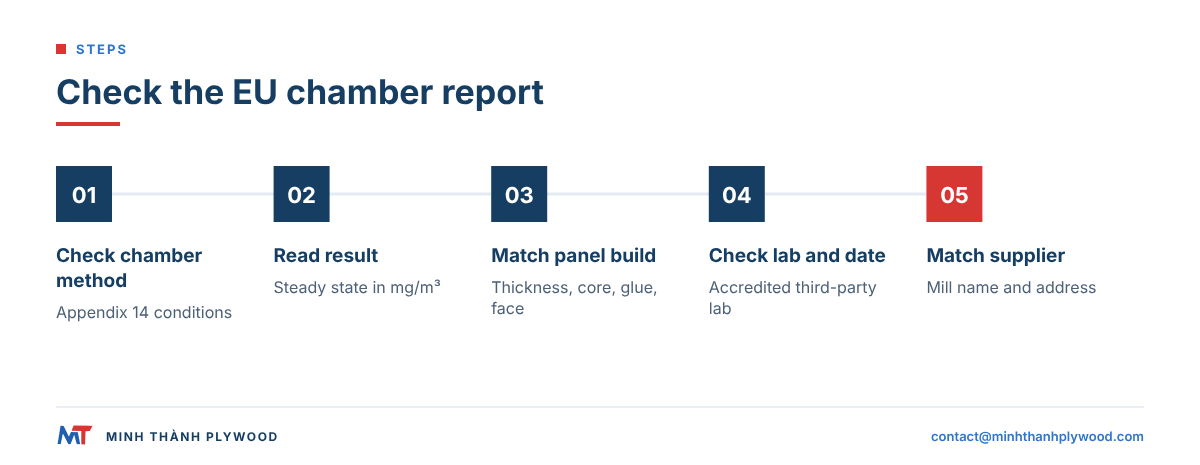
Five checks on a test report
- The method and the four chamber conditions are printed, not only “EN 717-1”.
- The result is the steady-state value, in mg/m³.
- The panel tested matches your build: thickness, core species, glue and face.
- The report is recent and from an accredited third-party lab.
- The mill’s name and address match the company on your contract.
Which glues and panels meet the 0.062 mg/m³ limit most easily?
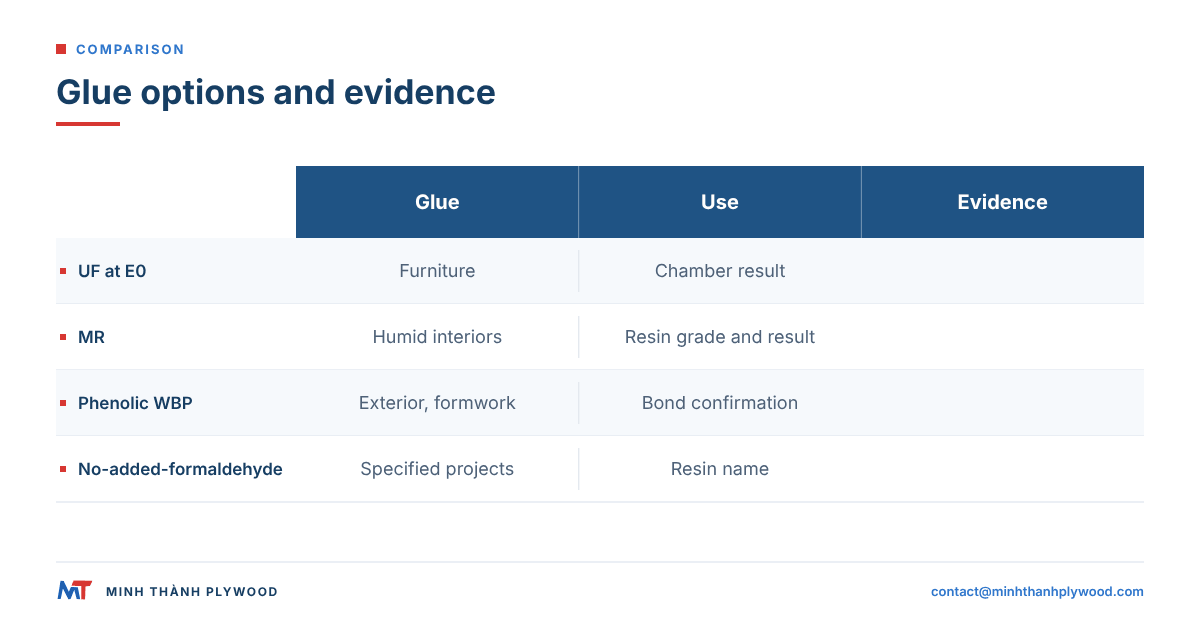
Panels bonded with low-emission UF resin at E0 grade, with melamine-fortified (MR) resin at a low-emission grade, or with phenolic (WBP) resin meet the limit most easily, provided the result is measured on the finished build. Phenolic resin releases very little formaldehyde once cured; UF resin is the furniture standard and depends on its grade and press control.
| Glue line | Typical use | What to ask for |
|---|---|---|
| UF resin at E0 grade | Furniture and interior plywood | A chamber result on the same thickness and core |
| MR (melamine-fortified UF) | Kitchen carcasses, humid interiors, film-faced cores | The resin grade and a chamber result |
| Phenolic (WBP) | Exterior, formwork, marine-type uses | Confirmation of a phenolic bond on all glue lines |
| No-added-formaldehyde resins | Specified projects | The resin name; read our formaldehyde-free plywood guide |
Thicker panels and denser cores carry more glue per sheet, so the thickness you test should be the one you sell in volume. Coatings and laminates applied later can lower the release from faces, but edges stay open; test the panel as it will be used.
What does Entry 77 change for a furniture plywood order?
For most furniture plywood orders, Entry 77 changes the paperwork more than the panel: E0-grade UF panels from a controlled mill already sit well below the US limits, and the order now needs a stated EU emission requirement and evidence that matches the build.
- Write the requirement into the specification: “formaldehyde release not more than 0.062 mg/m³ under REACH Annex XVII Appendix 14 conditions”.
- Fix the glue line: UF at E0 grade for interiors, MR or phenolic where the use is humid or exterior.
- Agree the evidence: the existing CARB P2 / TSCA certificate and chamber results, plus an EU-conditions test arranged through a third-party lab where your customer asks for it.
- Mark the lots: production lot on the pack label and the invoice.
- Keep the file: test reports, certificates and lot records with the import file.
How does Minh Thanh Plywood supply plywood for the REACH limit?
Minh Thanh makes furniture and interior plywood with Europe as its main market, and the panels meet the emission requirements European furniture buyers ask for. UF glue at E0 emission is standard for furniture and interior panels; MR (melamine-fortified) and phenolic (WBP) bonds are made to the customer’s specification.
The proof on file:
- CARB P2 / TSCA Title VI certification, ICTT mill no. 23024, for hardwood plywood with a veneer core, 3–50 mm.
- Six third-party chamber tests, ASTM D6007, between April 2025 and June 2026 on 9, 15 and 18 mm panels, averaging 0.014–0.032 ppm against the 0.05 ppm CARB Phase 2 / TSCA Title VI limit; three by Shanghai Hongjun and three by ICTT Vietnam.
- E0 emission testing every three months.
- Third-party testing to the buyer’s method, for example EN 717-1, arranged through SGS on request.
European buyers accept the CARB P2 / TSCA Title VI certificate and the chamber tests as proof. We do not convert the ppm results into mg/m³; when your customer needs the EU number, we arrange the test on your build. Details are on our formaldehyde emission page and the CARB P2 / TSCA certificate page.
The specification line to send
“Furniture plywood, 18 mm, 1220 × 2440 mm, Styrax core, poplar face B/BB, UF glue at E0, formaldehyde release not more than 0.062 mg/m³ under REACH Annex XVII Appendix 14; CARB P2 / TSCA certificate and recent chamber results with the quote; quantity one 40HC, CIF your port.”
Send it with your drawings to contact@minhthanhplywood.com, or ask for free samples of the build you plan to test. See the furniture plywood range for faces, cores and sizes.
Buyer questions, answered
Is REACH Annex XVII Entry 77 in force for plywood now?
Yes. Entry 77 applies from 6 August 2026 to furniture and wood-based articles, including plywood, placed on the EU market. Road vehicles follow on 6 August 2027.
What is the REACH formaldehyde limit for plywood in the EU?
0.062 mg/m³ of formaldehyde in the air of a test chamber at steady state, under the conditions of Appendix 14. Articles that are not furniture or wood-based have a 0.080 mg/m³ limit.
Is the test method for plywood under REACH EN 717-1 or EN 16516?
The regulation sets reference conditions, not a named standard: 23 °C, 45 % relative humidity, a loading factor of 1 m² per m³ and one air change per hour. EN 717-1 runs a wood-based panel chamber test under those conditions, and EN 16516 is cited for loading factors of other products.
Does REACH ban formaldehyde in plywood?
No. Entry 77 limits how much formaldehyde an article releases into indoor air. Formaldehyde-based glues remain allowed as long as the finished article stays below the limit.
Is an E1 rating enough to meet the REACH limit?
Not by itself. E1 under EN 13986 means up to 0.1 ppm in the EN 717-1 chamber, about 0.124 mg/m³, which is twice the 0.062 mg/m³ that now applies to wood-based articles. Ask for the measured value.
Does CE marking under EN 13986 satisfy REACH Annex XVII?
No. CE marking declares the performance of a construction product, including its formaldehyde class. Entry 77 is a separate restriction that applies to the article whatever its CE class.
Who is liable if imported plywood exceeds the limit?
The restriction binds whoever places the article on the EU market. For plywood bought from Vietnam, that is first the EU importer, who should hold the test evidence before the goods are sold.
Can a CARB P2 or TSCA result in ppm be converted to mg/m³ for REACH?
Do not convert it. ASTM D6007 and ASTM E1333 results in ppm come from different chamber conditions; use them as supporting evidence and test to the EU conditions when your customer needs the mg/m³ value.
Which film-faced plywood is covered by Entry 77?
Film-faced plywood used only as concrete formwork on building sites is for professional use and is excluded unless the public is exposed. Film-faced panels used indoors or sold to consumers are in scope.
What documents should I ask a Vietnamese mill for under Entry 77?
A dated chamber test report naming the lab, method, conditions, thickness and glue; the glue and emission specification on the quote; the CARB P2 or TSCA certificate as supporting proof; and lot marking that ties the report to your shipment.