
Eucalyptus plywood is good quality for stiff, load-bearing furniture parts and hard-wearing panels: the dense core holds screws well and the face has a warm, flowing figure. Its costs are weight and tool wear, and quality depends on where the eucalyptus sits: face, core or both. This review comes from Minh Thanh Plywood, which makes eucalyptus-faced panels and uses Eucalyptus as one of its two standard cores.
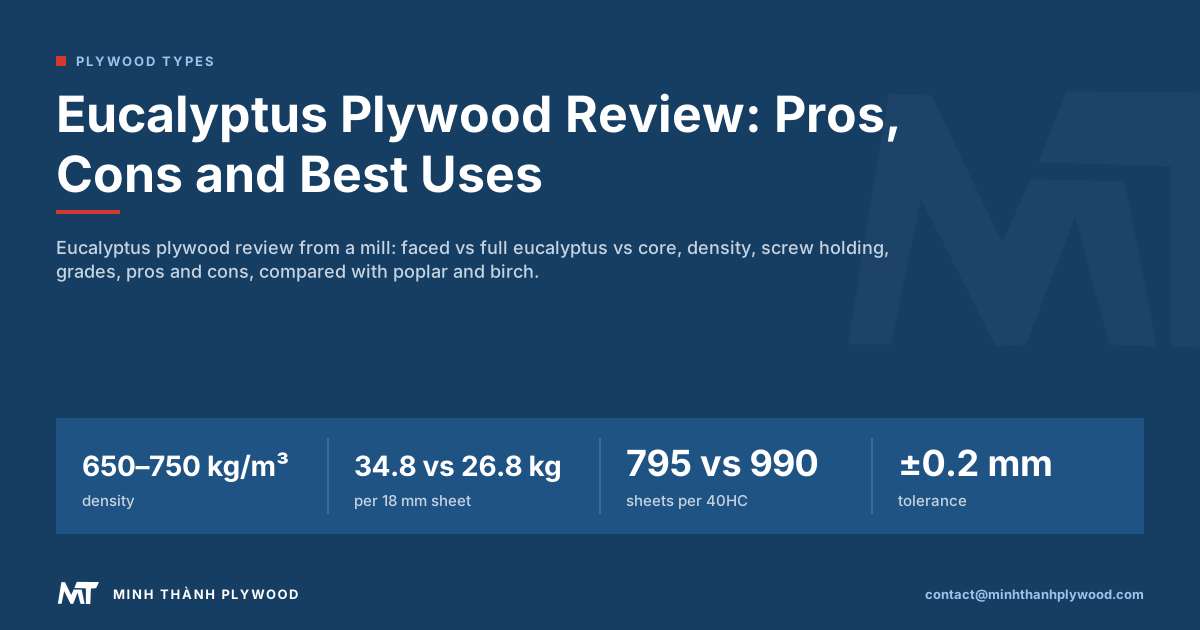
Eucalyptus plywood review: is eucalyptus plywood any good?
Our verdict on eucalyptus plywood: a strong choice for stiff, hard-wearing furniture parts and heavy-duty panels, and a weaker choice where sheet weight or a pale, plain face matters most. The answer changes with where the eucalyptus sits, so the review splits it three ways.
| Version | Verdict | Best for | Watch |
|---|---|---|---|
| Eucalyptus-faced on a white Styrax core | Strong for furniture | Visible furniture with a warm face and a light panel | Face grade against the sample |
| Eucalyptus-faced on a Eucalyptus core (full eucalyptus) | Strong for load | Shelves, tops, frames, heavy-duty parts | Sheet weight, tool wear |
| Other face on a Eucalyptus core | Strong for stiffness | Birch- or poplar-faced panels that must carry load | Name the core on the order |
| Eucalyptus core under film | Strong for construction | Film-faced formwork and anti-slip floors | Glue and film weight |
In short: eucalyptus plywood is any good when the build matches the job. The rest of this review explains the density, the face, the grades and the comparisons with poplar and birch, from a mill that presses eucalyptus every week.
UK buyers: standards, grades and prices for eucalyptus plywood
UK merchants sell eucalyptus plywood by three labels: the EN 636 use class, the EN 314-2 bond class and the face grade (B/BB or BB/CC). The same labels belong on a quote from Vietnam.
| Version | EN 636 use class | EN 314-2 bond class | Glue at Minh Thanh |
|---|---|---|---|
| Furniture and interior panel | EN 636-1, dry | Class 1 | UF glue at E0 emission |
| Kitchen, bathroom, humid interior | EN 636-2, humid | Class 2 | Melamine-fortified (MR) |
| Film-faced and anti-slip panel | EN 636-3, exterior | Class 3 | Phenolic WBP |
A UK listing for an 18 mm eucalyptus-core anti-slip phenolic panel gives exactly this set: about 34 kg per sheet, EN 314-2 Class 3, EN 636-3 and E1 (Southern Sheeting, checked on 21 October 2026). That weight matches the 34.8 kg we calculate for a 650 kg/m³ core. The BSI catalogue lists BS EN 636:2012+A1:2015 for plywood in dry, humid or exterior conditions (BSI, checked on 20 October 2026).
Formaldehyde. UK merchants state E1, the lower of the two EN 13986 formaldehyde classes. Our furniture panels are built at E0 emission, a mill grade below E1, and the six ASTM D6007 chamber results above (0.014–0.032 ppm) show a controlled glue line; we do not convert ppm to the European mg/m³ scale, and arrange an EN 717-1 test through SGS when a buyer wants the figure in the European method.
Marks and certificates. FSC and CE marking are available on request, supplied directly or through qualified partner mills. For construction use in the UK, panels follow EN 13986 with a declaration of performance; furniture plywood needs none.
Grades. UK listings use B/BB and BB/CC. Our A/B pair is the nearest match to B/BB, and B/B to BB/CC for painted or covered parts. The approved sample settles the colour and repair range.
Prices. A UK merchant listed 3.6 mm eucalyptus plywood, 1220 × 2440 mm, at £7.99 ex VAT per sheet and 18 mm B/BB at £29.85 ex VAT (Sheet Materials Wholesale, checked on 21 October 2026). Against that shelf, a raw FOB example: furniture plywood from US$350/m³ is about US$18.8 for the cubic content of one 18 mm sheet (0.0536 m³ × US$350), before freight, duty, VAT and the importer’s margin.
That is a raw FOB example, not a sheet price; the gap to the shelf price pays for freight, duty, handling and the merchant’s stock, which is why UK merchants promise delivery in 1 to 3 working days. A full 40HC of 18 mm Eucalyptus-core panels is 795 sheets.
Chinese or Vietnamese eucalyptus plywood? Many UK listings are Chinese eucalyptus, often with a poplar or mixed core under the face. The Vietnamese mill’s edge is in the build: stitched core veneers, a double press on a calibrated core board and thickness down to ±0.2 mm. Ask for the core species in writing and check the weight per sheet, as in our guide to checking whether Vietnamese plywood is made in China.
What is eucalyptus plywood?
Eucalyptus plywood is plywood with eucalyptus veneer in the face, the core or both. The name alone does not tell you which, and that is the first thing a buyer should settle.
In Vietnam eucalyptus is a plantation hardwood grown close to the mills, peeled into veneers for both faces and cores. It is one of the two standard cores for furniture plywood, with white Styrax, and the usual core for film-faced and anti-slip panels, with Acacia. As a face, eucalyptus veneer gives a warm, reddish-brown tone with a flowing figure.
Minh Thanh makes eucalyptus plywood as a furniture panel: eucalyptus face and back over a white Styrax or Eucalyptus core, stitched, pressed twice and sanded. The same Eucalyptus core sits under birch, poplar and film faces on order.
Eucalyptus-faced vs full eucalyptus vs eucalyptus core: what is the difference?
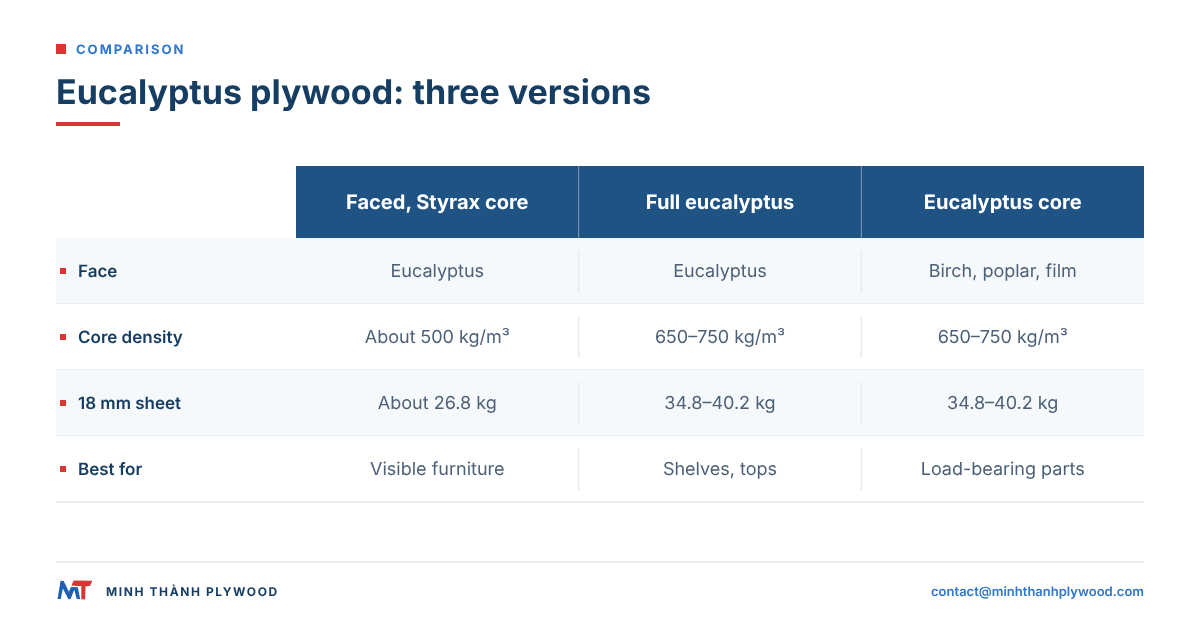
Eucalyptus-faced plywood has eucalyptus only on the face and back, full eucalyptus has it in every ply, and eucalyptus-core plywood has it only inside, under another face. Each behaves differently in weight, stiffness and appearance, so ask which of the three a quotation describes before comparing prices.
| Point | Eucalyptus-faced (Styrax core) | Full eucalyptus | Eucalyptus core, other face |
|---|---|---|---|
| Face | Eucalyptus | Eucalyptus | Birch, poplar, film or other |
| Core | White Styrax, about 500 kg/m³ | Eucalyptus, 650–750 kg/m³ | Eucalyptus, 650–750 kg/m³ |
| 18 mm sheet, 1220 × 2440 mm | About 26.8 kg | About 34.8–40.2 kg | About 34.8–40.2 kg |
| Stiffness and screw hold | Good | High | High |
| Edge | Pale core between warm faces | Even warm-toned plies | Eucalyptus core between other faces |
| Typical use | Visible furniture, wall panels | Shelves, tops, frames | Load-bearing birch or poplar parts; formwork |
Write each position on the order: face, back and core species. “Eucalyptus plywood, 18 mm” can arrive as any of the three, and the sheet weight alone differs by about a third.
How dense is eucalyptus plywood, and why does density matter?
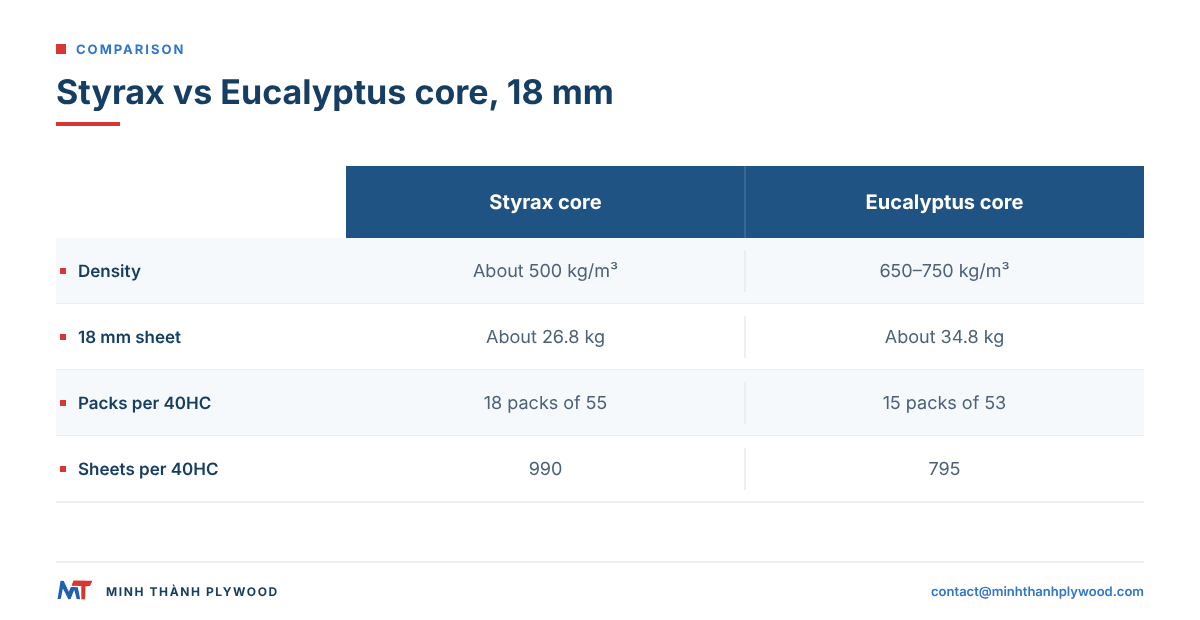
A eucalyptus-core panel is about 650–750 kg/m³, against about 500 kg/m³ for white Styrax and about 580 kg/m³ for Acacia. Density drives three things a buyer pays for: stiffness, screw holding and freight.
| Core | Density | 18 mm sheet, 1220 × 2440 mm | Sheets per 40HC at 18 mm |
|---|---|---|---|
| White Styrax | About 500 kg/m³ | About 26.8 kg | 990 (18 packs of 55) |
| Acacia | About 580 kg/m³ | About 31.1 kg | 880 (16 packs of 55) |
| Eucalyptus | 650–750 kg/m³ | About 34.8 kg at 650 kg/m³ | 795 (15 packs of 53) |
The sheet weight is density times volume: 1.22 × 2.44 × 0.018 m is about 0.0536 m³, so 650 kg/m³ gives about 34.8 kg. The heavier core reaches the container’s weight limit first, which is why a 40HC carries 795 eucalyptus-core sheets against 990 on Styrax. Planning payload is 28,000 kg unless the booking is lower.
Screw holding, stiffness and strength
A dense eucalyptus core holds screws better and deflects less than a light core, because there is more wood fibre around each fastener and in each ply. That is the main reason buyers choose it.
Where it shows in use:
- Shelves and tops sag less under the same load and span.
- Hinges, runners and knock-down fittings hold better in the core, especially near edges.
- Bed and seating frames keep their joints tight for longer.
- Floors and decks under film or anti-slip faces stay stiffer between supports.
Density alone does not give a structural rating. Where a code or drawing calls for a rated panel, the specification must name the standard and its test. For furniture, test the actual joint and load on the panel you order: a sample costs nothing and settles the question. For more on load, see eucalyptus vs poplar plywood.
Pros of eucalyptus plywood
The pros of eucalyptus plywood are stiffness, screw holding, a hard face, a warm figured look and a plantation timber supply close to the mill. Each one has a use where it pays.
- Stiff panels. The dense core carries more load per thickness.
- Strong fastener hold. Screws and fittings bite into more fibre.
- Hard-wearing face. A dense face resists dents and wear better than soft faces.
- Warm, figured face. Reddish-brown tone with a flowing grain, distinct from pale birch and poplar.
- Calibrated and flat. On a furniture build, pressed twice and sanded to ±0.2 mm, it takes HPL, melamine paper and coatings.
- Local plantation supply. Eucalyptus grows close to Vietnamese mills, which keeps supply steady.
- One species, many lines. The same core serves furniture, film-faced and anti-slip panels.
The pro buyers notice first is the shelf that does not sag. The pro they notice later is the hinge that does not pull out after a year.
Cons of eucalyptus plywood
The cons of eucalyptus plywood are sheet weight, faster tool wear, a face colour that varies more than birch or poplar, and quality that depends heavily on the mill. A good order plans around each one.
- Weight. About 34.8–40.2 kg per 18 mm sheet on a eucalyptus core, against about 26.8 kg on Styrax. Handling and freight cost more.
- Fewer sheets per container. 795 sheets of 18 mm per 40HC on Eucalyptus cores, against 990 on Styrax.
- Tool wear. Dense fibre dulls saw blades and router bits faster.
- Colour range. Eucalyptus faces vary in tone more than birch; set the range with an approved sample.
- Splitting near edges when screws go in without pilot holes.
- Mill-dependent quality. Loose cores, poor drying or a single pressing show up fast on a heavy, dense panel.
The fix for weight is the core: a eucalyptus face on a white Styrax core gives the look at about 26.8 kg. The fix for colour is the sample. The fix for mill quality is the build specification below.
Is eucalyptus plywood good quality? What separates a good panel
Eucalyptus plywood is good quality when the core is stitched and calibrated, the panel is pressed twice, the veneers are dried properly and the faces are graded to a sample. These are the build points that separate a furniture panel from a commercial one.
| Build point | Furniture-grade eucalyptus panel | What goes wrong without it |
|---|---|---|
| Core veneers | Stitched horizontally and vertically | Gaps and overlaps that show under the face |
| Pressing | Twice: core board, then faces | Waviness telegraphs through thin faces |
| Calibration | Core sanded to thickness before facing | Thickness varies across the sheet |
| Drying | Veneers and panels at 8–12 % moisture | Warping and checking after delivery |
| Tolerance | Down to ±0.2 mm on sanded panels | Fittings and edges do not line up |
| Faces | Graded A/A, A/B or B/B to the approved sample | Colour and repair surprises |
| Emission | UF glue at E0 emission, chamber-tested | No proof for EU or US furniture buyers |
Minh Thanh’s eucalyptus-faced furniture panels are built this way as standard. The E0 furniture range has six ASTM D6007 chamber tests, April 2025 to June 2026, on 9, 15 and 18 mm panels, averaging 0.014–0.032 ppm against the 0.05 ppm limit. The panels are certified to CARB P2 / TSCA Title VI (ICTT mill no. 23024). The limit for veneer-core hardwood plywood is 0.05 ppm under 40 CFR 770.10.
Eucalyptus plywood grades: A/A, A/B and B/B
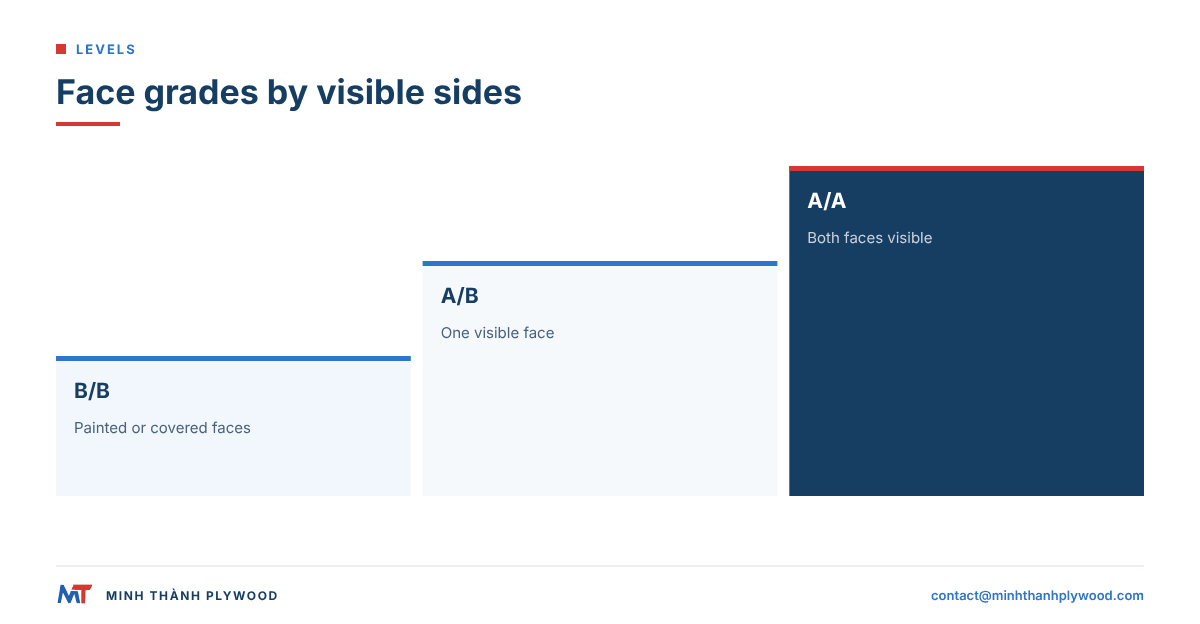
Eucalyptus-faced plywood is quoted as face/back grade pairs A/A, A/B and B/B, matched to a sample the buyer approves. The pair you choose depends on how many faces stay visible.
| Grade pair | When to choose it | Typical parts |
|---|---|---|
| A/A | Both faces stay visible under clear coating | Open shelving, room dividers, doors |
| A/B | One show face, the back hidden | Cabinet sides, tops, wall panels |
| B/B | Both faces painted, laminated or covered | Carcass backs, painted parts, HPL substrates |
Grade names describe a range, so the sample fixes the look: colour band, figure, the size and number of repairs. Approve a coated sample when the finish is clear, because coating deepens the eucalyptus tone. Every production sheet is then graded against that sample before packing.
Eucalyptus plywood uses
Eucalyptus plywood is used for furniture, cabinets, shelving, tops, frames and wall panels, and as the core of film-faced formwork and anti-slip floor panels. The version you choose follows the use.
| Use | Version | Thickness | Glue |
|---|---|---|---|
| Visible furniture and doors | Eucalyptus-faced, A/A or A/B | 15–18 mm | UF glue at E0 emission |
| Kitchen and bathroom cabinets | Eucalyptus-faced, A/B | 15–18 mm | Melamine-fortified |
| Shelves, tops, bed and seating frames | Full eucalyptus | 18 mm and up | UF glue at E0 emission |
| HPL and melamine substrates | Eucalyptus-faced or full, B/B | 12–18 mm | UF glue at E0 emission |
| Concrete formwork | Eucalyptus core, film face | 12–21 mm | Melamine-fortified or phenolic WBP |
| Vehicle and stage floors | Eucalyptus core, anti-slip face | 12–21 mm | Phenolic WBP |
For formwork the eucalyptus core is the stiffer choice of the two usual cores; see film-faced plywood for that line.
Eucalyptus plywood for furniture and cabinets
Eucalyptus plywood for furniture works best where a part must stay flat and carry load, and where the warm face is part of the design. Cabinets, shelving and tops are its strongest uses.
What a furniture plant should specify:
- Face and back: A/A for two visible sides, A/B for one, B/B for laminated or painted parts.
- Core: white Styrax for a lighter panel, Eucalyptus for the stiffest panel.
- Build: stitched core, pressed twice, sanded and polished, UV-ready faces for your own coating.
- Glue: UF glue at E0 emission for dry rooms; melamine-fortified for kitchens and bathrooms.
- Sizes: 1220 × 2440 mm or 1250 × 2500 mm, or cut parts: one sheet into 4, 6 or 8 pieces.
Clear coatings deepen the eucalyptus colour, so approve a coated sample. For banded parts, the edge band hides the core; for exposed edges, full eucalyptus gives an even, warm-toned edge.
Is eucalyptus plywood good for CNC and laser cutting?
Yes for CNC routing: a calibrated eucalyptus panel cuts cleanly, holds crisp edges and keeps nested parts flat. Laser cutting works on thin panels, more slowly than on lighter species because of the density.
Practical points for the machine shop:
- Flatness first. A panel pressed twice on a calibrated core lies flat on the vacuum bed, so depths stay even.
- Thickness tolerance. Down to ±0.2 mm keeps pocket depths and slot fits consistent.
- Tooling. Dense fibre wears cutters faster; keep spare bits and check edge quality across a shift.
- Thin panels. 3–5 mm panels are always 5-ply at Minh Thanh, which keeps thin laser and CNC parts flat.
Run a test nest on a sample sheet with your own feeds and speeds before the first production order.
For laser work, thin eucalyptus panels give a darker cut edge than pale birch or poplar, which suits engraved and contrast designs. Keep the glue in mind too: UF glue at E0 emission is the usual build for indoor laser-cut parts, and the free sample lets you set power and speed on the exact panel before you order a container.
How does eucalyptus plywood compare to poplar and birch plywood?
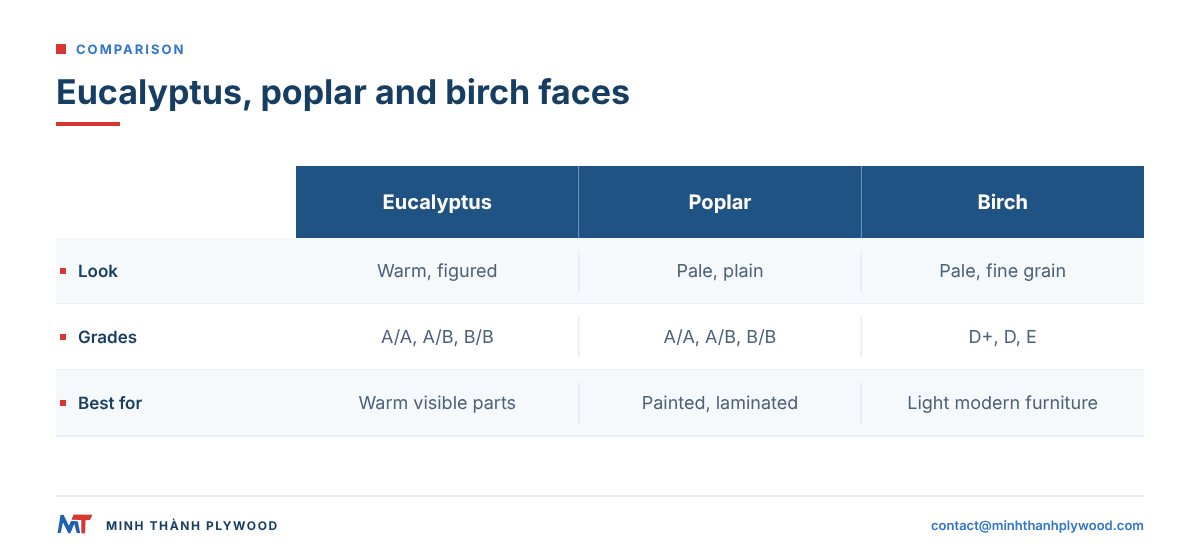
Eucalyptus plywood is denser and stiffer than poplar on a light core, and warmer in tone than birch; poplar is lighter and plainer, birch paler and finer-grained. The table compares the three faces on the same rows.
| Metric | Eucalyptus-faced | Poplar-faced | Birch-faced |
|---|---|---|---|
| Face look | Warm, reddish-brown, flowing figure | Pale, plain, even | Pale, fine grain |
| Grades quoted | A/A, A/B, B/B | A/A, A/B, B/B; also B/BB, BB/CC, CP | D+, D, E pairs, D+ about B |
| Usual cores in Vietnam | Styrax or Eucalyptus | Styrax or Eucalyptus | Styrax or Eucalyptus |
| Stiffness on a Eucalyptus core | High | High | High |
| Best for | Visible warm furniture, load-bearing parts | Painted, laminated and budget furniture | Light, modern furniture and cabinets |
The core decides the load, not the face. A poplar-faced or birch-faced panel on a Eucalyptus core is as stiff as a eucalyptus-faced one; the face decides the look and the price. Poplar-core plywood is a different panel: lighter and softer, with less screw hold than a Eucalyptus core. See eucalyptus vs birch plywood for the birch comparison in detail.
Is eucalyptus plywood good for outdoor use?
Eucalyptus plywood suits outdoor use only when it is built for it: phenolic WBP glue, a coated or film face and sealed edges. The species does not make a panel waterproof; the glue and the finish do.
| Exposure | Glue | Face | Edges |
|---|---|---|---|
| Dry indoor | UF glue at E0 emission | Sanded, coated | Banded |
| Humid indoor: kitchens, bathrooms | Melamine-fortified | Sanded, coated | Sealed or banded |
| Covered outdoor | Phenolic WBP | Coated or film | Sealed |
| Exposed outdoor | Phenolic WBP | Film or exterior coating | Sealed, recoated |
E0 is an emission class, not a water rating, so an E0 furniture panel is an indoor panel. For outdoor work, order the exterior or film-faced build on a Eucalyptus core.
How is eucalyptus plywood made at the mill?
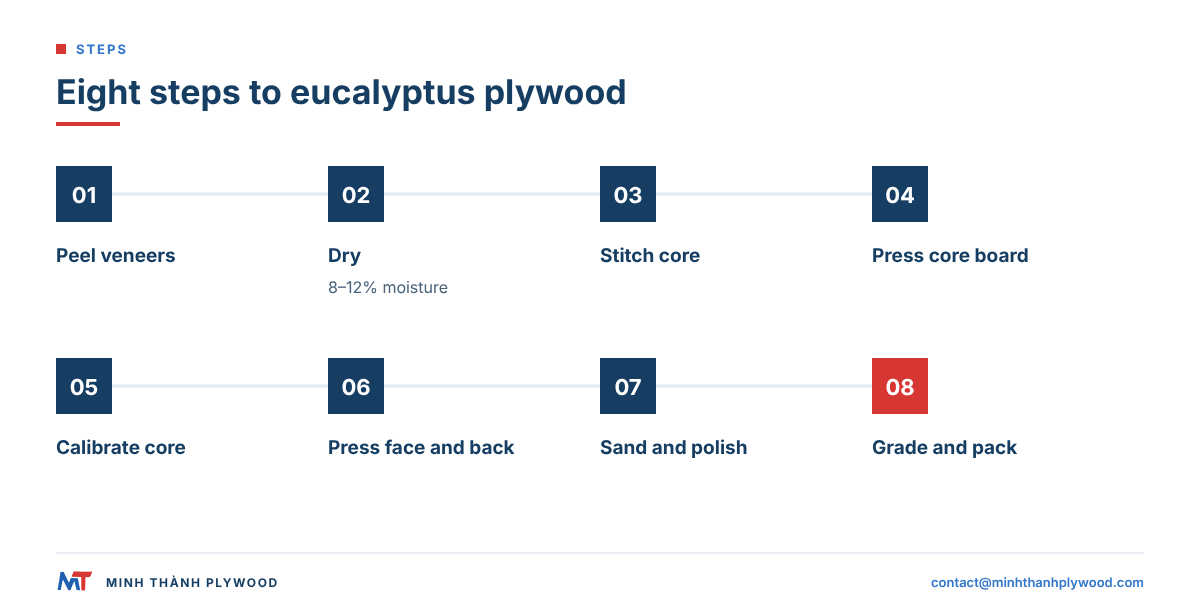
Eucalyptus plywood is made at Minh Thanh in two pressings: first a stitched, calibrated core board, then the eucalyptus face and back. The steps are the same for a Styrax or a Eucalyptus core.
- Peel plantation logs into veneers; Eucalyptus and white Styrax grow around the factory in Ha Hoa, Phu Tho.
- Dry the veneers to 8–12 % moisture, the normal range for furniture plywood.
- Stitch the core veneers both horizontally and vertically so they cannot open or overlap.
- Lay up and press the core veneers crosswise into a core board.
- Sand the core board to a calibrated thickness.
- Press the eucalyptus face and back onto the calibrated board in a second pressing.
- Sand and polish both faces, leaving them UV-ready for the customer’s own coating.
- Grade and caliper each sheet against the approved sample and the tolerance, then pack.
The second pressing is the step a dense, figured face needs most. A thin eucalyptus veneer shows any bump in the core under clear lacquer; on a calibrated board it lies flat.
Which thickness and size of eucalyptus plywood should you order?
Order eucalyptus plywood by the part: 15–18 mm for carcasses, doors and shelves, 18 mm and up for tops and frames, 12–18 mm for laminated substrates and 3–6 mm for backs and liners. Minh Thanh makes it from 3 to 40 mm.
| Format | Sizes | When to choose it |
|---|---|---|
| Standard | 1220 × 2440 mm | Most furniture and cabinet cutting lists |
| European | 1250 × 2500 mm | European cutting lists and machinery |
| Custom | 1220 × 2500 mm, 1220 × 2280 mm | Parts that nest better on a longer or shorter sheet |
| Cut parts | One sheet cut into 4, 6 or 8 pieces | Ready-sized parts for assembly lines |
Thin panels of 3–5 mm are always 5-ply at Minh Thanh, and the tolerance on sanded furniture panels goes down to ±0.2 mm. Send the cutting list with the grain direction, and the mill plans the sheet size that wastes least.
What decides the price of eucalyptus plywood?
The price of eucalyptus plywood follows the build: face grade, core species, glue and emission, thickness, size, quantity and delivery term. Two quotes for “18 mm eucalyptus plywood” can be two different panels.
- Face grade: A/A costs more than A/B, and A/B more than B/B.
- Core: a Eucalyptus core adds wood and freight weight; a white Styrax core gives a lighter, more cost-effective load per container.
- Glue: UF glue at E0 emission, melamine-fortified and phenolic WBP glue are separate steps.
- Finish: sanded and polished, UV-ready faces are part of the furniture build.
- Freight: 795 sheets of 18 mm Eucalyptus-core per 40HC against 990 on Styrax changes the landed cost per sheet.
In October 2026 furniture and interior plywood at Minh Thanh started from US$350/m³ and commercial plywood from US$250/m³. Ask every supplier for the same build in writing, then compare the delivered cost per usable part.
What documents come with eucalyptus plywood?
Eucalyptus furniture plywood from Minh Thanh ships with the shipping documents and the compliance files European and US buyers ask for. Each one answers a buyer question before it is asked.
- Shipping set: commercial invoice, packing list, bill of lading, certificate of origin (EUR.1 for the EU), phytosanitary and fumigation certificates, and insurance with CIF.
- Emission proof: CARB P2 / TSCA Title VI certification and the ASTM D6007 chamber reports.
- EU origin file: the EUDR compliance dossier with origin records and geolocation files. The Commission’s EUDR page gives 30 December 2026 as the start date for large and medium operators (European Commission, checked on 8 October 2026).
- Quality system: ISO 9001:2015, certificate KAC25/0185.
- Loading record: photos and video of every container before loading.
Third-party testing to your own method, for example EN 717-1, is arranged through SGS on request.
How do you check eucalyptus plywood on arrival?
Check eucalyptus plywood on arrival for thickness, flatness, faces and moisture, against the approved sample and the order. Five checks catch almost every problem.
- Count packs and sheets against the packing list.
- Caliper sheets from several packs at the corners and centre against the agreed tolerance.
- Lay a sheet flat on a table to check for bow and twist.
- Compare faces with the approved sample for grade, colour band and repairs.
- Measure moisture: panels leave the mill at 8–12 %.
Minh Thanh photographs and films every container before loading and sends the photos and video, so most of these checks can happen before the ship sails.
What this means for your order
For your order, decide where you want the eucalyptus: on the face for the look, in the core for stiffness, or both for the stiffest, heaviest panel. Then the grade, glue and size follow the part.
A spec line for furniture shelving reads: Eucalyptus plywood, eucalyptus A/B face/back, Eucalyptus core stitched, pressed twice, UF glue at E0 emission, sanded and polished, 18 mm, 1220 × 2440 mm, ±0.2 mm. Change the core to white Styrax for a lighter panel at about 26.8 kg per sheet, or the glue to melamine-fortified for kitchens.
Minh Thanh Plywood makes eucalyptus-faced plywood in Ha Hoa, Phu Tho, where the eucalyptus for its cores is grown. The minimum order is one 40HC with mixed specifications by agreement; a full load of 18 mm Eucalyptus-core sheets is 795 sheets. Production runs 15–45 days after the 30% deposit, and free samples go out with the quotation. Send your spec line to contact@minhthanhplywood.com.
Buyer questions, answered
Is eucalyptus plywood any good?
Yes, for stiff, load-bearing and hard-wearing parts. Eucalyptus is dense, 650–750 kg/m³, so it holds screws well and gives stiff shelves and tops; the trade-off is a heavier sheet.
Is eucalyptus plywood good quality?
From a furniture mill with a stitched, calibrated core and sanded faces, yes. Ask for the core species, face grade, tolerance and emission proof, and approve a sample.
What is the difference between eucalyptus faced and full eucalyptus plywood?
Eucalyptus-faced plywood has eucalyptus only on the face and back; its core can be another species, such as white Styrax. Full eucalyptus has eucalyptus in the face, back and core.
How does eucalyptus plywood compare to poplar plywood?
On a eucalyptus core it is denser, stiffer and holds screws better than a lightweight poplar core, at a higher sheet weight. Faces differ in look: eucalyptus warm and figured, poplar pale and plain.
Is eucalyptus plywood good for cabinets?
Yes. A sanded eucalyptus-faced panel on a Styrax or Eucalyptus core suits carcasses, doors and shelves. Use melamine-fortified glue for kitchens and bathrooms.
Is eucalyptus plywood good for furniture?
Yes, especially for parts that carry load: shelves, tops, bed and seating frames. Choose A/A faces for two visible sides and A/B when one side is hidden.
Is eucalyptus plywood good for CNC cutting?
Yes. A calibrated, double-pressed panel cuts cleanly and holds sharp machined edges. The dense core wears cutters faster than Styrax or poplar, so keep tools sharp.
Is eucalyptus plywood good for outdoor use?
Only with phenolic WBP glue, a coated face and sealed edges. Eucalyptus veneer alone does not make plywood waterproof; the glue sets water resistance.
How much does an 18 mm eucalyptus plywood sheet weigh?
A 1220 × 2440 × 18 mm sheet on a Eucalyptus core calculates to about 34.8–40.2 kg at 650–750 kg/m³. On a white Styrax core the same sheet is about 26.8 kg.
What grades does eucalyptus plywood come in?
Eucalyptus-faced panels are quoted as face/back grade pairs A/A, A/B and B/B, matched to an approved sample. A/A suits two visible faces, B/B painted or covered parts.
How many eucalyptus plywood sheets fit in a 40HC?
About 795 sheets of 18 mm, 1220 × 2440 mm, on Eucalyptus cores: 15 packs of 53, about 43 m³. The heavy core reaches the weight limit before the container is full.
Is eucalyptus plywood better than birch?
Neither wins everywhere. Birch gives a pale, fine-grained face; eucalyptus a warmer, figured face and, on a eucalyptus core, a stiffer panel. Choose by look and load.