
Eucalyptus vs poplar plywood is a choice between a dense, hard sheet and a light, soft one. Eucalyptus holds screws harder and resists dents; poplar is lighter, paler and easier to handle. As faces, both press onto the same Styrax or Eucalyptus core, so you can take the poplar look with a denser build. Minh Thanh Plywood makes both in Vietnam.
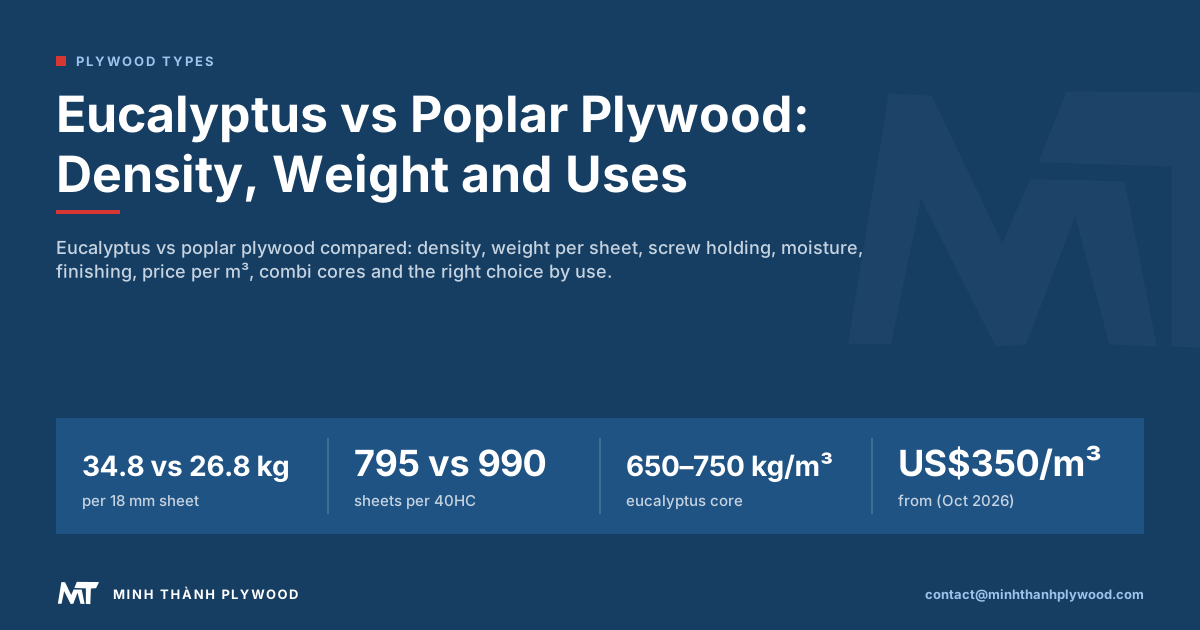
Eucalyptus vs poplar plywood: the short answer
Eucalyptus plywood is the dense, hard, screw-holding sheet; poplar plywood is the light, pale, soft sheet. Pick eucalyptus for load, fixings and wear, and poplar for low weight, clean painted faces and easy handling.
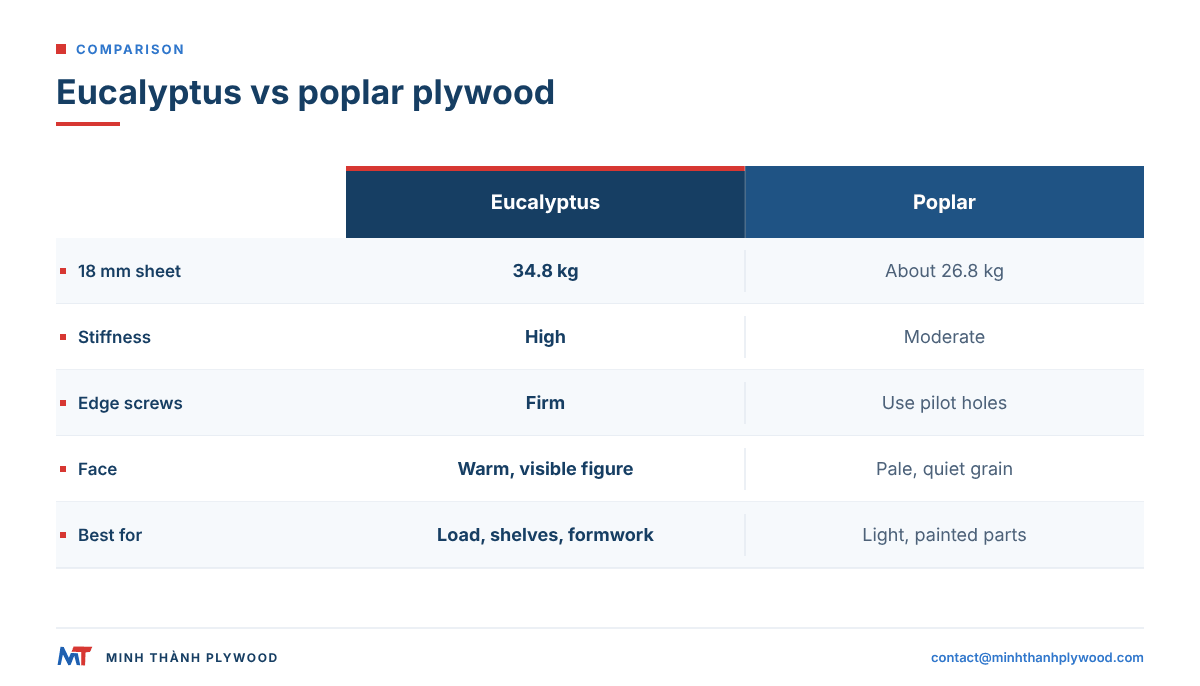
| Metric | Eucalyptus plywood | Poplar plywood |
|---|---|---|
| Wood | Plantation hardwood, dense | Fast-growing hardwood, light and soft |
| Core weight class | Dense: 650–750 kg/m³ reference | Light, close to white Styrax at about 500 kg/m³ |
| Weight, 1220 × 2440 × 18 mm | 34.8 kg on a Eucalyptus core | About 26.8 kg on a light core |
| Stiffness and dent resistance | High | Moderate |
| Screw holding in the edge | Firm | Needs pilot holes and furniture fittings |
| Face colour | Light pinkish to light brown, visible figure | Creamy white to pale yellow, quiet grain |
| Paint and laminate base | Good | Very good |
| Machining | Clean, wears cutters faster | Easy, fast cutting |
| Face grades | A/A, A/B, B/B | A/A, A/B, B/B, or B/BB, BB/CC, CP |
| Best for | Load-bearing furniture, shelves, formwork, floors | Light furniture, displays, painted and laminated parts, packing |
Verdict by use: eucalyptus for anything that carries load, takes edge screws or meets concrete; poplar for light, pale, painted or laminated parts where weight matters.
How does eucalyptus plywood compare to poplar plywood?
Eucalyptus plywood compares to poplar plywood as the heavier, harder and stiffer panel, while poplar is lighter, paler and easier to work. The difference comes from wood density, and it shows in weight, strength, screw holding, surface, container load and price per cubic metre.
- Weight: an 18 mm eucalyptus-core sheet weighs about 8 kg more than the same sheet on a light core.
- Strength: eucalyptus bends less under load and resists edge crushing.
- Fixings: eucalyptus holds edge screws firmly; poplar needs fittings made for soft cores.
- Surface: poplar is paler and more even for paint and laminate; eucalyptus is warmer under a clear coat.
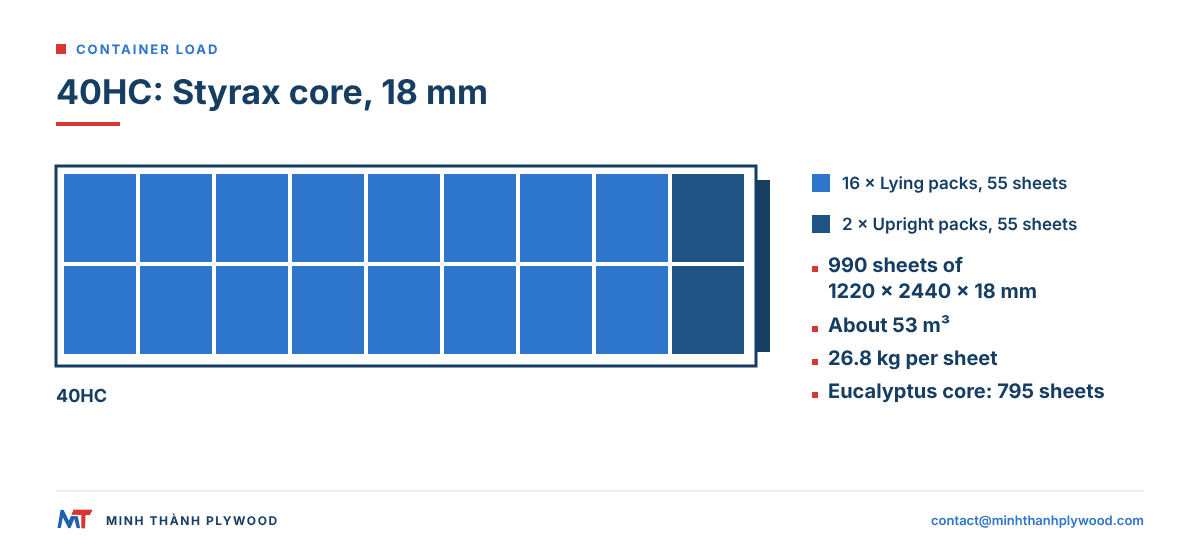
- Containers: light cores fit 990 sheets of 18 mm in a 40HC; eucalyptus cores 795.
- Where they are made: eucalyptus plywood is a Vietnamese plantation product; most full poplar-core plywood comes from China.
What is eucalyptus plywood?
Eucalyptus plywood is plywood with eucalyptus veneer in the face, the core or both. In Vietnam, eucalyptus is a plantation hardwood that peels into even veneer, and it is one of the two standard furniture cores at Minh Thanh Plywood, with white Styrax.
- Eucalyptus-faced: natural rotary-cut eucalyptus face and back over a Styrax or Eucalyptus core.
- Eucalyptus-core: any face, such as poplar, birch, EV or film, pressed on a eucalyptus core.
- Full eucalyptus: eucalyptus in every ply, the build for formwork and hard-wearing panels.
Our eucalyptus panels are stitched horizontally and vertically in the core and pressed twice: the core is pressed and calibrated, then the face and back are pressed on. The sanded panels hold thickness tolerance down to ±0.2 mm. The eucalyptus plywood review compares faced and full eucalyptus panels.
What is poplar plywood?
Poplar plywood is plywood with poplar veneer in the face, the core or both. Full poplar-core plywood is made mainly in China, where poplar is the main plantation species for plywood; Vietnamese mills use poplar as a face over their own plantation cores.
- Poplar-core plywood: poplar in every core ply, very light, made mainly in China.
- Poplar-faced plywood: a poplar face and back over a white Styrax or Eucalyptus core; this is what Minh Thanh makes.
- Bleached or white poplar: a whiter poplar face for painted and light furniture.
Poplar faces are quoted as A/A, A/B and B/B, matched to the buyer’s approved sample. Buyers also order them by the Chinese codes B/BB, BB/CC and CP, which map onto the same ladder. Our poplar-faced plywood page lists the build.
A poplar-faced panel on a Vietnamese core keeps the look that buyers know from Chinese poplar plywood while the core sets the weight. On white Styrax it stays in the light class; on Eucalyptus it becomes a denser sheet that still shows a pale, quiet face. Write face species, core species and grade pair as separate lines, so two quotations for “poplar plywood” describe the same panel.
Density and structural strength: eucalyptus vs poplar
Eucalyptus is the denser wood, so a eucalyptus panel is stiffer and stronger than a poplar panel of the same thickness and build. Density drives bending stiffness, dent resistance and edge strength.
| Property | Eucalyptus core | Light core (poplar class, white Styrax) |
|---|---|---|
| Reference density | 650–750 kg/m³ | About 500 kg/m³ for Styrax |
| Bending stiffness | Higher | Lower |
| Dent resistance | Higher | Lower; soft faces mark under point loads |
| Edge crushing | Resists | Edges crush under clamps or impact |
| Long shelf spans | Sags less | Needs thicker sheets or supports |
For furniture, both carry normal domestic loads at 15–18 mm. The difference shows on long shelves, bed slats, table tops and anything that takes knocks. For load-rated floors or structures, order a panel made and tested for that job; a furniture panel’s density is not a structural rating.
Screw holding and fastener performance
Eucalyptus holds screws, cam fittings and dowels more firmly than poplar, because there is more wood fibre around each thread. Poplar holds well in the face but strips faster in the edge.
- Face screws: both hold for normal furniture; eucalyptus resists pull-out better.
- Edge screws: eucalyptus is the safer core for carcass joints fixed into the panel edge.
- Cam and dowel fittings: both work with correct drilling; eucalyptus resists wear when parts are assembled more than once.
- Hinges: a eucalyptus core keeps hinge screws tight on heavy doors.
- Pilot holes: drill pilot holes in both; in eucalyptus they stop splitting near edges, in poplar they stop stripping.
A buyer who wants a poplar face with firm fixing can order poplar-faced plywood on a Eucalyptus core: the face looks the same, and the core holds the screws.
Weight and handling: a practical difference
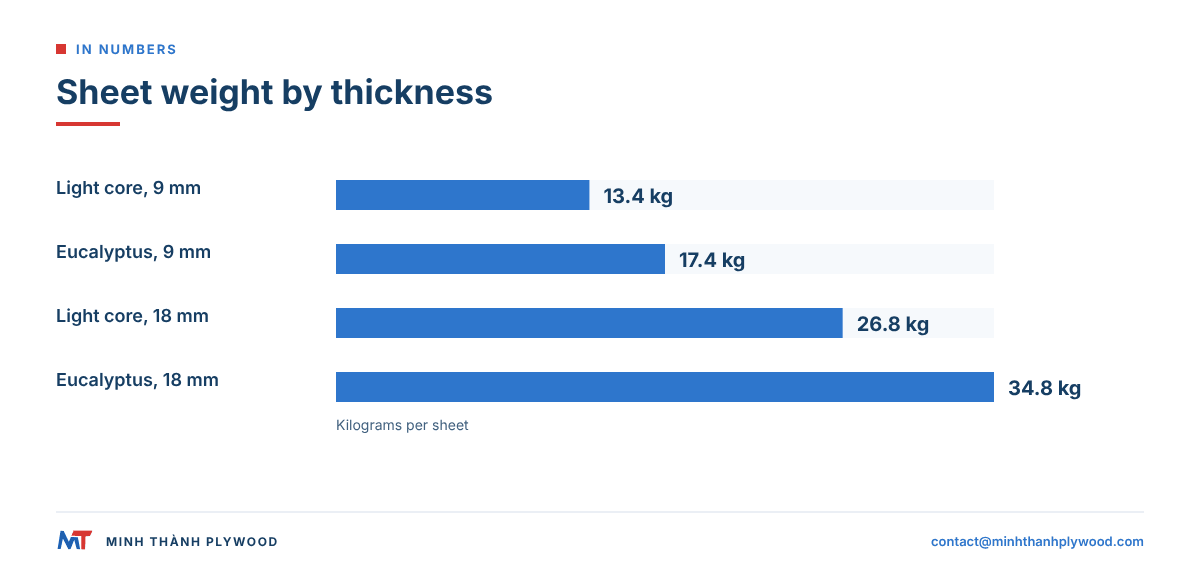
An 18 mm sheet of 1220 × 2440 mm weighs about 34.8 kg on a Eucalyptus core and about 26.8 kg on a white Styrax core, which sits in the light class of poplar-core plywood. That 8 kg per sheet changes handling, freight and the weight of the finished furniture.
| Thickness, 1220 × 2440 mm | Light core, about 500 kg/m³ | Eucalyptus core, 650 kg/m³ |
|---|---|---|
| 9 mm | 13.4 kg | 17.4 kg |
| 12 mm | 17.9 kg | 23.2 kg |
| 15 mm | 22.3 kg | 29.0 kg |
| 18 mm | 26.8 kg | 34.8 kg |
Weight is volume times density; eucalyptus cores run 650–750 kg/m³, so weigh real sheets before planning a container. Light sheets suit flat-pack furniture sold by parcel, wall-hung cabinets and displays; heavy sheets suit fixed furniture, shelving and site use.
Moisture resistance and stability
The glue line sets how either panel behaves in damp conditions; the species changes how fast a cut edge takes up water. Dense eucalyptus soaks up water more slowly at the edge than soft poplar, but neither is waterproof without the right glue.
| Exposure | Glue | Eucalyptus | Poplar |
|---|---|---|---|
| Dry interiors | UF glue at E0 emission | Stable | Stable |
| Kitchens, bathrooms | Melamine-fortified MR | Good with sealed edges | Seal edges carefully |
| Exterior, site use | Phenolic WBP | Preferred core | Soft core swells faster |
Both are dried to 8–12 % moisture content at dispatch, the normal range for furniture plywood, so sheets stay flat in a heated workshop. Seal every cut edge and drilled hole on parts that will see humidity. Store packs flat, off the floor and under cover on arrival, and let them settle in the workshop before machining, so both species keep their size through cutting and assembly.
Workability and machining
Poplar cuts, routes and sands faster and wears tools less; eucalyptus machines cleanly with sharp tooling and gives crisper edges in profiles and joints. On a stitched, calibrated core, both behave predictably on panel saws and CNC routers.
- Sawing: poplar cuts fast; eucalyptus needs sharp blades for clean exits.
- CNC routing: eucalyptus holds sharp profiles; poplar can fuzz on deep grooves.
- Drilling: eucalyptus gives clean holes; poplar can tear out at the back face without a backing board.
- Sanding: poplar sands quickly, so take care not to cut through thin faces.
- Tool wear: eucalyptus wears cutters faster; plan blade changes on long runs.
Sanded furniture panels are held to ±0.2–0.3 mm, so joints and hinge cups line up on either species. On a nesting CNC line, the lighter sheet is easier to load by hand or vacuum lifter, while the denser sheet holds small parts more firmly on the bed during routing. Run a short trial on the buyer’s own tooling with sample sheets of both species before fixing feeds and speeds for a long run.
Appearance and finishing
Poplar gives a pale, creamy, even face that is the cleanest base for paint, laminate and light stain; eucalyptus gives a warmer face with visible figure for clear-finished furniture.
- Paint: poplar takes paint smoothly with little filling; B/B poplar faces are the usual painted-furniture choice.
- Laminate and veneer: both make good bases; poplar’s pale tone does not show through thin papers.
- Clear coat: eucalyptus shows a warm figure; poplar looks plain and light.
- Stain: eucalyptus stains with depth; poplar takes light stains and can blotch under dark ones without a conditioner.
- UV coating: both faces of Minh Thanh panels arrive sanded and polished, UV-ready for the buyer’s own coating line.
Approve a coated sample sheet for the face and grade before the order. The approved sheet sets the colour range for every pack, and Minh Thanh grades each order against it before loading, with photos and video of the buyer’s own sheets sent before the container doors close. Third-party inspectors are welcome at the mill.
Cost comparison: eucalyptus vs poplar plywood price per m³
Per cubic metre, eucalyptus and poplar furniture panels sit close together; face grade, glue, tolerance and build move the price more than the species. Per sheet, weight and container count change the landed cost.
- Indicative starting price: Minh Thanh’s furniture and interior plywood from US$350/m³; commercial plywood from US$250/m³ (October 2026).
- Per container: a 40HC carries about 53 m³ of light-core 18 mm sheets but about 43 m³ of eucalyptus-core sheets, because eucalyptus reaches the payload limit first.
- Freight per sheet: with 795 sheets instead of 990, freight per eucalyptus sheet is higher.
- Face grade: A/A faces cost more than B/B on either species.
Compare quotations line by line: face and back grade, core, glue and emission class, tolerance, size, sheets per container and the delivery term (FOB Hai Phong, CFR or CIF).
A cheap sheet can cost more once it is in use. A soft core that strips screws, or a face that needs filling before paint, adds labour on the furniture line; a dense core that pushes a container to its payload adds freight per sheet. Price the finished part, not only the sheet: cutting yield, rejects, fittings and freight all belong in the comparison.
Combi core and mixed builds: the hybrid alternative
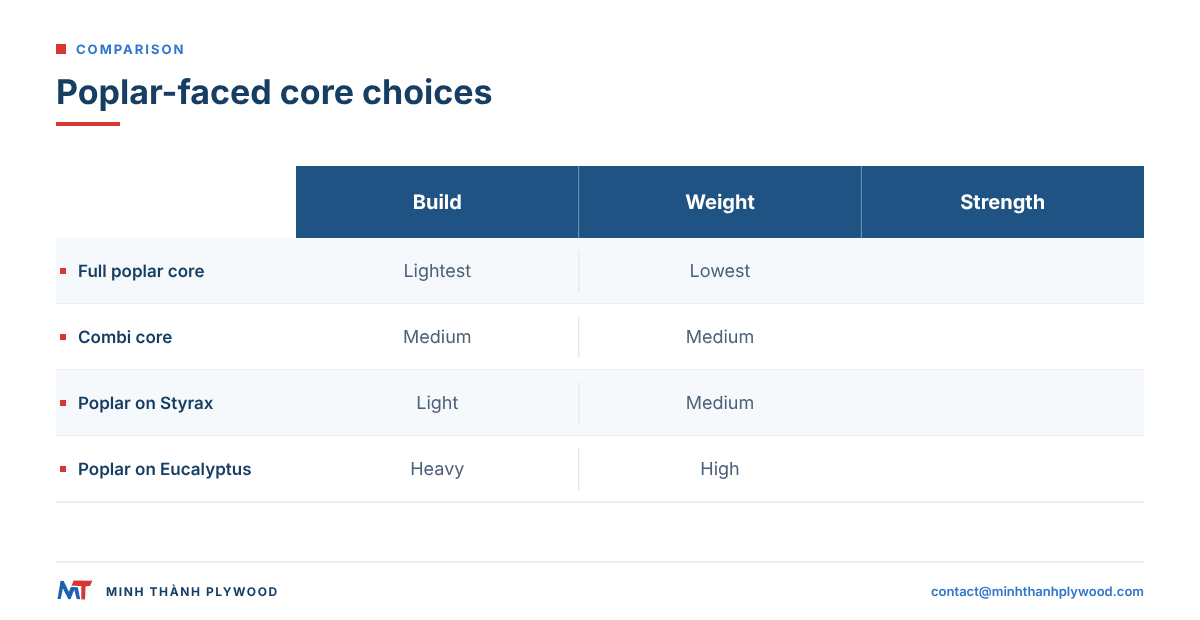
A combi core mixes species in one panel, usually poplar plies with harder plies near the faces, to balance weight and strength. It is a common Chinese build; the Vietnamese route to the same balance is to choose the core and the face separately.
| Build | Weight | Strength | Typical use |
|---|---|---|---|
| Full poplar core | Lightest | Lowest | Light furniture, displays, packing |
| Combi core (poplar with hardwood plies) | Medium | Medium | Commercial furniture, general panels |
| Poplar face on white Styrax core | Light | Medium | Painted and laminated furniture |
| Poplar face on Eucalyptus core | Heavy | High | Pale-faced parts that carry load |
| Full eucalyptus | Heaviest | Highest | Formwork, floors, hard-wearing panels |
Ask any combi-core supplier which plies are which species, and how many, so two quotations describe the same panel.
What is the main advantage of poplar plywood over eucalyptus or acacia?
The main advantage of poplar plywood over eucalyptus or acacia is low weight with a pale, smooth face. Poplar sheets are easier to lift, faster to cut, cheaper to ship per sheet and cleaner under paint.
Acacia sits between the two: about 580 kg/m³, a medium-weight core used for commercial plywood and made on order at Minh Thanh, with 880 sheets of 18 mm in a 40HC. The acacia plywood guide covers it.
Poplar’s weak points are the other side of the same coin: lower screw holding, softer faces and faster water uptake at the edge. For a buyer who wants the poplar look with more strength, a poplar face on a Eucalyptus core gives both.
Which is better for packing, furniture and formwork?
Poplar or light cores win for light furniture and display work, eucalyptus wins for load-bearing furniture and formwork, and packing plywood follows cost and weight.
| Use | Better choice | Why |
|---|---|---|
| Flat-pack and wall-hung furniture | Poplar face on white Styrax | Light, pale, paints well |
| Kitchen and wardrobe carcasses | Either face on Styrax or Eucalyptus | Styrax for weight, Eucalyptus for edge screws |
| Shelves, beds, table tops | Eucalyptus core | Stiffer, less sag |
| Painted doors and fronts | Poplar face | Smooth, even base |
| Concrete formwork | Eucalyptus, film-faced, phenolic glue | Hard core survives repeated pours |
| Truck and trailer floors | Dense hardwood with phenolic glue | Wear and load |
| Crates and packing | Commercial plywood, lowest cost core | Packing tolerance ±0.5–1.0 mm |
For formwork, see our film-faced plywood, pressed on hard cores with phenolic glue. In the US, formwork for cast-in-place concrete falls under OSHA standard 1926.703.
What are the disadvantages of eucalyptus and poplar plywood?
Eucalyptus plywood’s disadvantages are weight, faster tool wear and fewer sheets per container; poplar plywood’s disadvantages are softness, weaker edge screw holding and faster water uptake at bare edges. Each weakness has a fix in the order.
| Weak point | Eucalyptus plywood | Poplar plywood | Fix in the order |
|---|---|---|---|
| Weight | 34.8 kg per 18 mm sheet | Light | Choose a white Styrax core when weight matters |
| Sheets per 40HC | 795 at 18 mm | 990 at 18 mm on a light core | Mix specifications in one container by agreement |
| Tool wear | Faster on cutters | Low | Keep tooling sharp; plan blade changes |
| Face colour | Warm, varies across the sheet | Pale, can show green or grey streaks in lower grades | Approve a full-size sample sheet |
| Dents | Resists | Marks under point loads | Use a harder face or a coated surface |
| Edge screws | Firm | Strips faster | Poplar face on a Eucalyptus core |
| Wet edges | Slower uptake | Faster uptake | Melamine-fortified or phenolic glue, sealed edges |
None of these is a reason to rule a species out; each one points to a different core, face, glue or grade on the quotation.
Can poplar plywood be used for kitchen cabinets?
Yes, poplar-faced plywood works well for kitchen cabinets when the glue suits the room and the core suits the fixings. Its pale, smooth face is a good base for painted, laminated and veneered kitchen fronts.
- Carcasses: 15–18 mm, melamine-fortified MR glue for kitchens, poplar face on white Styrax for light wall units.
- Sink bases and tall units: a Eucalyptus core under the poplar face holds hinge and runner screws harder and copes better with knocks.
- Painted doors: B/B poplar faces, sanded and polished, UV-ready for the buyer’s coating line.
- Clear-finished doors: consider a eucalyptus or birch face if the buyer wants visible wood figure.
- Edges: seal cut edges and drilled holes near sinks and dishwashers.
- Backs and drawer bottoms: thin 3–5 mm plywood, always 5-ply at Minh Thanh.
Sanded panels are held to ±0.2–0.3 mm, so hinge cups and drawer runners line up across a whole kitchen run. Emission evidence for kitchens sold in Europe and the US is CARB P2 / TSCA Title VI certification and six ASTM D6007 chamber tests averaging 0.014–0.032 ppm against the 0.05 ppm limit.
Which core is best for furniture plywood among eucalyptus, acacia, poplar and birch?
For most furniture plywood the best core is a light, pale one; Eucalyptus is best where the part carries load. In Vietnam the light core is white Styrax, in China it is poplar, and in northern Europe the panel is birch throughout.
- Light and pale: white Styrax (Vietnam) or poplar (China), for carcasses, doors and painted parts.
- Dense and firm: Eucalyptus, for shelves, beds and heavy doors.
- Medium, cost-led: Acacia, for commercial panels.
- Even dense plies: birch, when the exposed edge is part of the design.
Many European furniture buyers choose a Styrax core, then pick the face for the look. The eucalyptus vs birch plywood comparison covers the birch side.
How many sheets fit in a 40HC?
A 40HC carries 990 light Styrax-core sheets or 795 eucalyptus-core sheets of 1220 × 2440 × 18 mm. Packs are about one metre high, so sheets per pack are 1,000 divided by the thickness, rounded down, then capped by weight.
- White Styrax core: 18 packs (16 lying, 2 upright) of 55 sheets, 990 sheets, about 53 m³, about 26,532 kg.
- Eucalyptus core: 15 packs of 53 sheets, 795 sheets, about 43 m³, about 27,666 kg.
- Planning payload: 28,000 kg unless the booking is lower.
If a booking caps cargo lower, the count is cut to fit and confirmed in the packing list. Every shipment is photographed and filmed before loading, and the buyer gets the photos and video.
When to choose eucalyptus vs poplar plywood
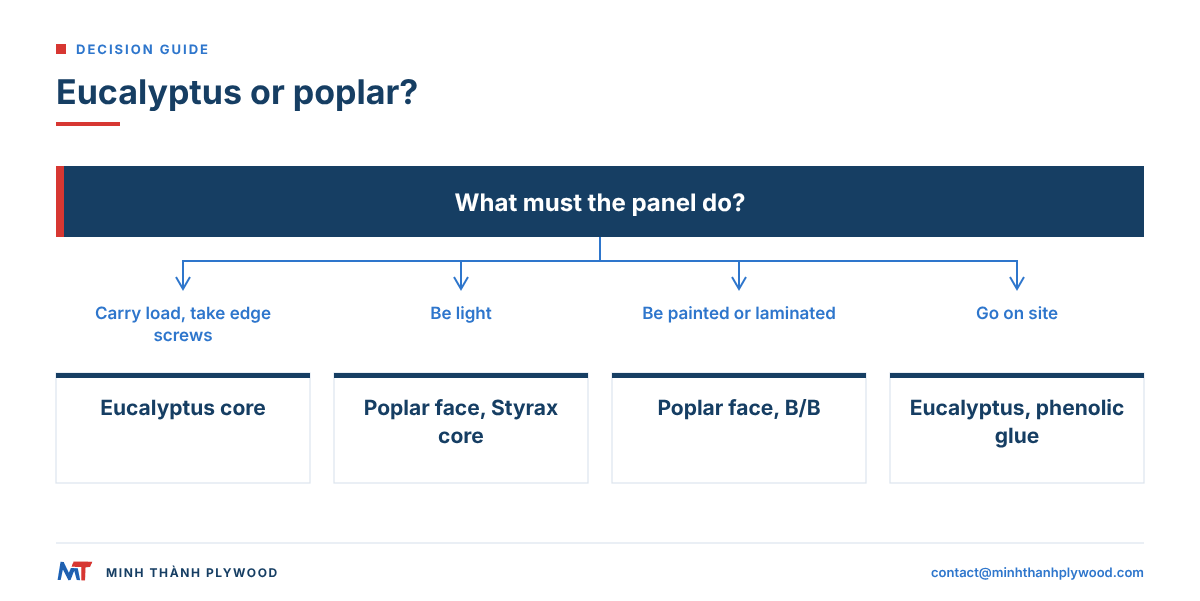
Choose by the job the panel does, then by the look. One question settles most orders: does the part carry load or take edge screws?
- Yes, it carries load or takes edge screws: eucalyptus core, with a eucalyptus face for a warm look or a poplar face for a pale one.
- No, but it must be light: poplar face on white Styrax core.
- It will be painted or laminated: poplar face, B/B grade, on the core the weight calls for.
- It goes on a building site: eucalyptus with phenolic glue, film-faced for formwork.
How to order eucalyptus or poplar plywood
Send six lines, and Minh Thanh Plywood replies within hours with a quotation and a free sample offer.
- Application: furniture part, painted doors, shelving, formwork or packing.
- Core: white Styrax for light panels, Eucalyptus for dense ones.
- Glue and emission: UF glue at E0 emission, melamine-fortified MR or phenolic WBP.
- Face and back: eucalyptus or poplar, with the grade pair, such as A/B or B/B.
- Size and thickness: 1220 × 2440 mm or 1250 × 2500 mm, 3–40 mm, custom sizes or cut-to-size.
- Packing and quantity: sheets per pack, total sheets or m³, and the destination port.
The minimum order is one 40HC with mixed specifications by agreement; production takes 15–45 days after the 30% deposit. The US limit for veneer-core hardwood plywood is 0.05 ppm under EPA’s formaldehyde emission limits. For EU deliveries, plywood is a relevant product under the EU Deforestation Regulation, Regulation (EU) 2023/1115. Emission proof is CARB P2 / TSCA Title VI certification, ICTT mill number 23024. Send the lines to contact@minhthanhplywood.com or see eucalyptus plywood from Minh Thanh.
Buyer questions, answered
Which is better, poplar or eucalyptus plywood?
Eucalyptus is better where the panel carries load, takes edge screws or must resist dents. Poplar is better where weight, a pale face and easy machining matter more than strength, such as light furniture, displays and painted parts.
Is eucalyptus plywood stronger than poplar plywood?
Yes. A eucalyptus core is denser and harder than a poplar core, so the sheet is stiffer, holds screws better and resists denting and edge crushing.
Is eucalyptus wood good for plywood?
Yes. Plantation eucalyptus peels into even veneer and gives a dense core with firm screw holding. It is one of the two standard cores at Minh Thanh, next to white Styrax.
What is the main advantage of poplar plywood over eucalyptus or acacia?
Lower weight and a pale, smooth face. Poplar sheets are easier to lift, cut and ship, and the creamy face takes paint, laminate and light stain cleanly.
How much does an 18 mm eucalyptus plywood sheet weigh?
About 34.8 kg for 1220 × 2440 × 18 mm at the reference density of 650 kg/m³. The same sheet on a white Styrax core weighs about 26.8 kg.
Is poplar plywood good for outdoor use?
Only with phenolic WBP glue, a sealed finish and sealed edges, and even then a denser hardwood core is the safer choice outdoors. Poplar is soft and soaks up water faster at cut edges.
Which is better for formwork, eucalyptus or poplar?
Eucalyptus. Film-faced formwork panels need a dense, hard core that survives repeated pours and handling; a soft poplar core dents and swells faster on site.
Is eucalyptus plywood heavier than poplar?
Yes, by a clear margin. That is why light furniture and display work favours poplar or white Styrax cores, and load-bearing parts favour eucalyptus.
Does Minh Thanh make poplar-core plywood?
No. Minh Thanh presses poplar faces on white Styrax or Eucalyptus cores. Styrax gives the same light, pale build that buyers look for in a poplar core.
Which is cheaper, poplar or eucalyptus plywood?
Per cubic metre the two are close, and face grade, glue and tolerance move the price more than the species. Minh Thanh's furniture plywood starts from US$350/m³ (October 2026).