
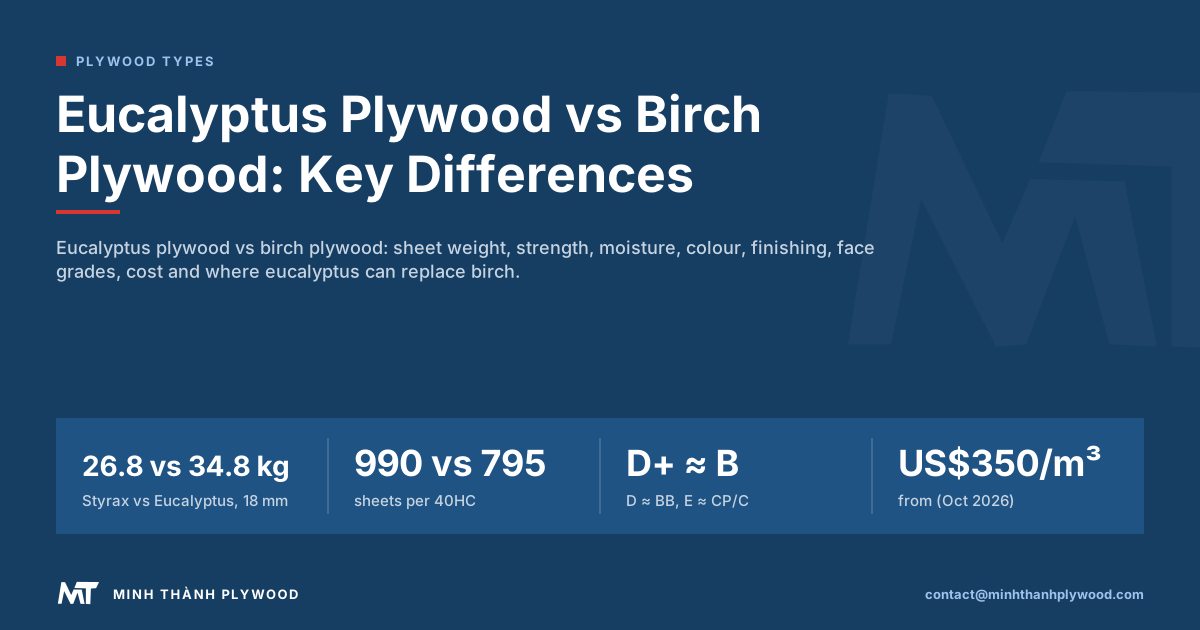
Eucalyptus plywood vs birch plywood comes down to the face and the core. On a Vietnamese panel both faces can sit on the same white Styrax or Eucalyptus core, so the difference is colour, grain, finishing and grade. Against all-birch panels from northern Europe, a full-eucalyptus sheet weighs about the same, 35–38 kg at 18 mm, and costs a fraction in UK shops. Minh Thanh Plywood presses both faces in Phu Tho.
Eucalyptus plywood vs birch plywood: the short answer
Eucalyptus plywood is the warmer, cost-effective face and the denser core; birch plywood is the paler, finer face that furniture buyers know from Baltic panels. On a Vietnamese furniture panel both faces can be pressed on the same core, so the choice is mostly about the look and the price of the face.
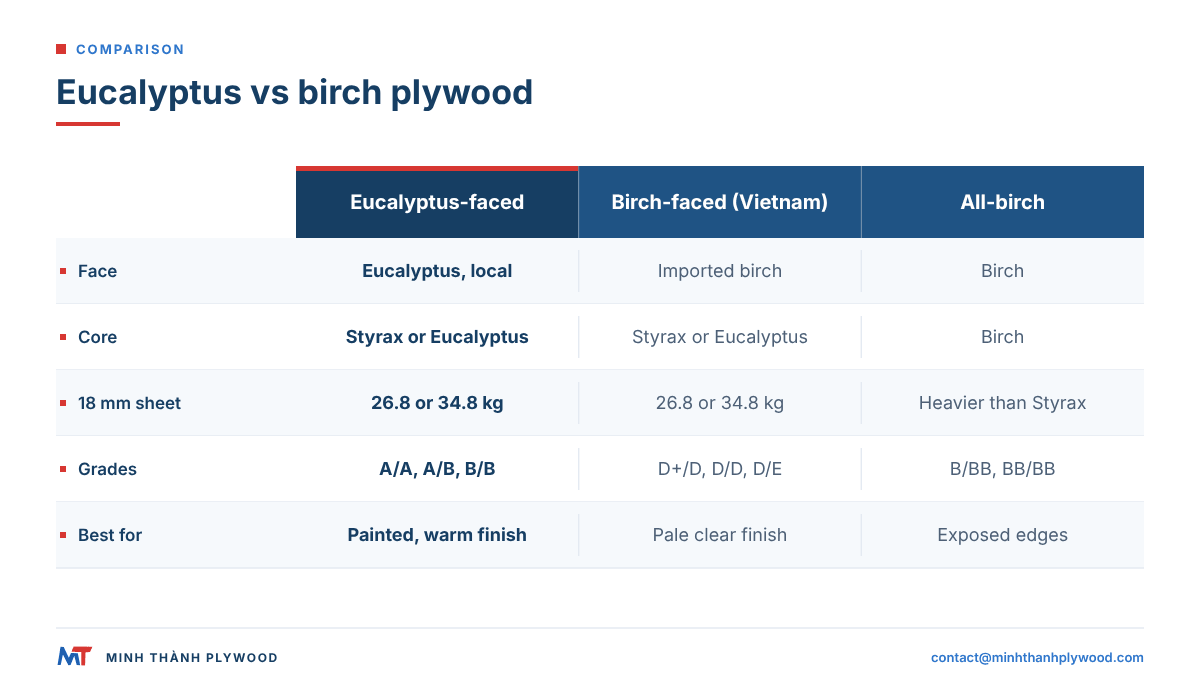
| Metric | Eucalyptus-faced plywood | Birch-faced plywood (Vietnam) | All-birch plywood (northern Europe) |
|---|---|---|---|
| Face veneer | Eucalyptus, grown and peeled in Vietnam | Imported birch | Birch |
| Core | White Styrax or Eucalyptus | White Styrax or Eucalyptus | Birch in every ply |
| Colour | Light pinkish to light brown, flowing figure | Pale cream to light yellow, fine grain | Pale cream, fine grain |
| Weight, 18 mm sheet | 26.8 kg (Styrax) or 34.8 kg (Eucalyptus) | 26.8 kg (Styrax) or 34.8 kg (Eucalyptus) | About 35–38 kg |
| Face grades | A/A, A/B, B/B | D+/D, D/D, D/E | B/BB, BB/BB, BB/CP |
| Edge look | Styrax or Eucalyptus plies | Styrax or Eucalyptus plies | Even birch plies |
| Glue | UF at E0 emission, MR or phenolic WBP | UF at E0 emission, MR or phenolic WBP | Usually phenolic or UF |
| Relative price | Lower | Higher | Highest |
| Best for | Painted, laminated or warm clear-finished furniture | Pale clear-finished furniture, Scandinavian looks | Exposed-edge furniture, CNC parts with visible plies |
Verdict by use: choose eucalyptus for painted, laminated, veneered and warm-toned furniture where cost per container matters; choose birch-faced plywood for pale, clear-finished show faces; choose all-birch only when the layered edge itself is part of the design.
What are the key differences between birch and eucalyptus plywood?
The key differences between birch and eucalyptus plywood are the face colour, the grain, how each takes a finish, the face grade names and the price of the face veneer. On a Vietnamese panel the core, the glue and the tolerance can be identical.
- Colour: eucalyptus is warmer, from light pink to light brown; birch is pale cream to light yellow.
- Grain: eucalyptus has a flowing, more visible rotary-cut figure; birch has a fine, quiet grain.
- Finish: eucalyptus takes stain with a warm, even depth; birch gives the cleanest pale clear coat but can blotch under dark stain.
- Grades: eucalyptus is quoted A/A, A/B, B/B; birch D+/D, D/D, D/E.
- Price: the eucalyptus face is local; the birch face is imported, so it adds cost.
- Weight: the core decides it, 26.8 kg on Styrax or 34.8 kg on Eucalyptus for an 18 mm sheet.
- Edge: an all-birch panel shows even birch plies; a faced panel shows its plantation core.
What is eucalyptus plywood?
Eucalyptus plywood is a panel with eucalyptus veneer on its face, in its core, or throughout the sheet. Eucalyptus-faced plywood names only the outer veneer; full eucalyptus means eucalyptus in the face, the back and every core ply.
Eucalyptus is a plantation hardwood in northern and central Vietnam, and it is one of the two standard cores at Minh Thanh Plywood alongside white Styrax. Our eucalyptus-faced furniture panels put natural rotary-cut eucalyptus face and back veneers over a stitched Styrax or Eucalyptus core, pressed twice: the core board is pressed and calibrated first, then face and back are pressed on.
The face shows natural figure, with gentle changes of grain and colour across the sheet. That makes it a good base for paint, laminate and decorative veneer, and a warm clear-finished face when the buyer wants visible wood. The eucalyptus plywood review covers faced and full eucalyptus panels in more depth.
What is birch plywood, and what does “birch” mean on a Vietnamese panel?
Birch plywood is plywood with birch veneer on the face and back; in all-birch plywood, every ply is birch. All-birch panels come mainly from Finland, the Baltic states and China, and they are known for even, pale plies at the edge.
Vietnam has no birch forest, so a Vietnamese birch panel is birch-faced: imported birch face and back veneers pressed on a white Styrax or Eucalyptus core. It is sold as birch-faced plywood, never as an all-birch panel. For a cabinet, carcass or door with banded or covered edges it looks and works like birch, because only the faces are seen.
The face is the costly part of a birch panel, and Vietnamese mills order it to the look the buyer approves. Minh Thanh Plywood presses birch faces alongside eucalyptus, poplar, EV, okoume and pine on the same cores. Our birch-faced plywood from Vietnam page lists the build.
Density and weight: how heavy is each sheet?
On a Vietnamese panel the core sets the weight, not the face. Face and back veneers are a small part of an 18 mm sheet, so a eucalyptus face and a birch face on the same core weigh almost the same.
| 1220 × 2440 × 18 mm sheet | Reference density | Weight per sheet | Sheets per 40HC |
|---|---|---|---|
| Eucalyptus or birch face, white Styrax core | 500 kg/m³ | 26.8 kg | 990 |
| Eucalyptus or birch face, Eucalyptus core | 650 kg/m³ | 34.8 kg | 795 |
| Eucalyptus core, upper reference | 750 kg/m³ | 40.2 kg | Capped by payload |
The weight is volume times density: 1.22 × 2.44 × 0.018 m is about 0.0536 m³, times 650 kg/m³ gives 34.8 kg. Eucalyptus cores run 650–750 kg/m³, so weigh real sheets before a container plan is closed.
An all-birch panel is dense through every ply: at 650–700 kg/m³ an 18 mm sheet weighs about 35–38 kg, level with the Eucalyptus-core row above and 8–11 kg more than a Styrax-core sheet. A buyer who wants a pale birch face with a light sheet should order birch-faced plywood on white Styrax; a buyer who wants a dense sheet with firmer fixing can take either face on a Eucalyptus core.
Strength, hardness and screw holding: which panel is stronger?
Panel strength follows the core and the build more than the face species. A dense Eucalyptus core gives more material for screws to bite, and an all-birch panel is strong through every ply; a white Styrax core is lighter and holds screws well in normal furniture use.
- Bending stiffness: more plies of a dense species give a stiffer sheet. All-birch and Eucalyptus-core panels are the stiffer choices for long shelves.
- Screw holding: Eucalyptus cores grip edge and face screws firmly; Styrax cores need standard furniture fittings and pilot holes.
- Surface hardness: the face takes dents first. Eucalyptus and birch are both hardwood faces and resist marking well under a coating.
- Core quality: stitched cores, laid horizontally and vertically, close gaps between core veneers, which keeps strength even across the sheet.
- Double pressing: pressing and calibrating the core before the faces go on gives a flat, even panel that keeps its strength after sanding.
For structural floors, formwork or load-rated uses, order a panel made and tested for that job; a furniture panel is chosen for flatness and finish, and density alone is not a structural rating.
Is eucalyptus plywood more water resistant than birch?
No plywood is water resistant because of its face species; the glue line decides how a panel behaves in damp rooms. A eucalyptus or birch face on the same glue behaves the same way when it gets wet.
| Exposure | Glue to order | Notes |
|---|---|---|
| Dry rooms, furniture, cabinets | UF glue at E0 emission | Standard for furniture and interior panels |
| Kitchens, bathrooms, humid rooms | Melamine-fortified MR glue | Pressed at 110–120 °C |
| Exterior exposure | Phenolic WBP glue | Pressed at 130–145 °C, edges sealed |
Panels leave the mill at 8–12 % moisture content, the normal range for furniture plywood, so they reach the buyer’s line ready to machine. Seal cut edges and drilled holes on any panel that will see humidity. Neither eucalyptus nor birch is termite-proof, and neither face species is insect-resistant by itself; for termite-prone regions, raise borer and termite treatment with the mill before ordering. The guide on whether plywood is waterproof explains the glue classes.
Appearance, colour and grain: how do the faces look?
Birch gives a pale, fine and quiet face, and eucalyptus gives a warmer face with more visible figure. Both are rotary-cut, so the grain runs in broad, flowing patterns across the sheet.
- Birch: pale cream to light yellow, fine grain, small pin knots in lower grades. It reads almost neutral under clear lacquer and suits Scandinavian, children’s and retail furniture.
- Eucalyptus: light pinkish to light brown, with stronger figure and gentle colour changes across the sheet. It reads as warm, natural wood under oil or lacquer.
- Edges: a faced panel shows its core plies at the edge; banding in the face colour hides them. All-birch edges are even and pale and are often left exposed.
Approve a full-size sample sheet for each face and grade. The approved sheet then sets the colour range and the repairs allowed for the whole order.
Staining, painting and UV coating: which face finishes better?
Birch gives the cleanest pale clear finish and a smooth painted surface; eucalyptus takes stain with a warmer, deeper tone and hides small marks under its figure. Both arrive sanded and polished, with both faces UV-ready for the buyer’s own coating line.
- Clear lacquer or oil: birch for a pale look, eucalyptus for a warm look.
- Stain: eucalyptus stains evenly; birch can blotch under dark stain, so use a pre-stain conditioner or wash coat.
- Paint: both faces paint well; B/B eucalyptus or D/E birch faces save cost under opaque paint.
- UV coating: both faces are sanded to the standard UV lines need; Minh Thanh panels are UV-ready, not UV-coated.
- Laminate or veneer: the face is hidden, so choose the cheaper face on the core your line needs.
Test the full coating system on an offcut from the sample sheet before the order is confirmed.
Machining, CNC and edges: which panel works better in the line?
Both panels machine cleanly when the core is stitched, double-pressed and calibrated; the face species changes little on a saw or CNC router. What matters is flatness, tolerance and a core without gaps.
- Thickness tolerance: sanded furniture panels are held to ±0.2–0.3 mm, down to ±0.2 mm, so routed joints and hinge cups stay in line.
- Length and width: ±2 mm, square sheets for panel saws.
- Edge banding: both faces band well; a pale Styrax edge takes banding in birch or eucalyptus colour.
- Exposed edges: if the design leaves plies visible, an all-birch panel gives an even birch edge; a faced panel shows Styrax or Eucalyptus plies.
- Tools: the denser Eucalyptus core wears cutters a little faster than Styrax; keep tooling sharp for clean exits.
Face grades and yield: A/B eucalyptus vs D+/D/E birch
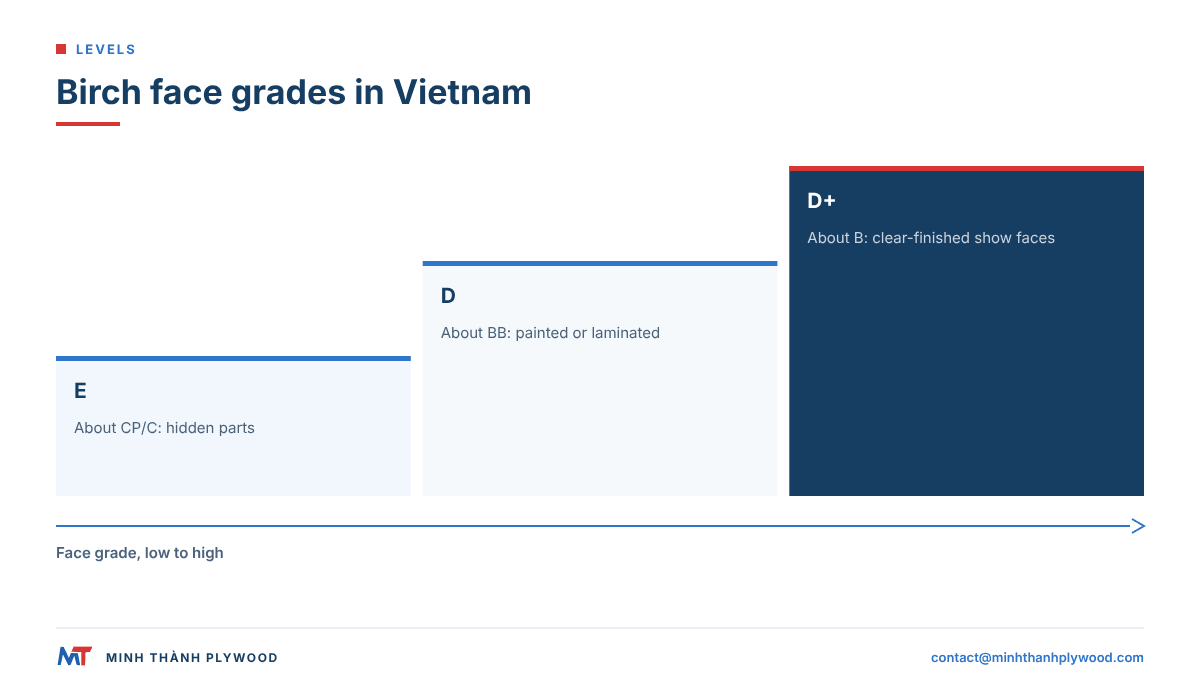
Eucalyptus faces are graded A/A, A/B and B/B; birch faces are graded D+, D and E in Vietnam and quoted as pairs such as D+/D or D/E. Each order is matched to the sample sheet the buyer approves.
| Eucalyptus pair | Use | Birch pair | European birch equivalent |
|---|---|---|---|
| A/A | Two clear-finished show faces | D+/D+ | B/B |
| A/B | One show face, utility back | D+/D | B/BB |
| B/B | Painted or laminated parts | D/D | BB/BB |
| B/B | Hidden parts | D/E | BB/CP |
Birch individual grades map onto the European ladder as D+ ≈ B, D ≈ BB and E ≈ CP/C. Grade choice drives price on both faces: buy the top grade only for faces that stay visible under a clear coat, and use B/B eucalyptus or D/E birch under paint, laminate or veneer.
Is eucalyptus plywood cheaper than birch?
Yes. Eucalyptus face veneer is grown and peeled in Vietnam, while birch face veneer is imported, so a eucalyptus-faced sheet usually costs less than a birch-faced sheet on the same core and thickness. An all-birch panel from northern Europe costs more than either.
UK shelf prices (October 2026). At Sheet Materials Wholesale, an 18 mm eucalyptus-throughout B/BB sheet, 2440 × 1220 mm, lists at £30.91 ex VAT, and a 3.6 mm sheet at £7.99 ex VAT. The 18 mm birch-throughout BB/BB sheet in the same size lists at £83.95 ex VAT, about 2.7 times the eucalyptus price. Other UK merchants list the birch sheet from £67.50 to £119.95, so the gap holds across the trade.
| 18 mm sheet, 2440 × 1220 mm | UK price per sheet (ex VAT) |
|---|---|
| Eucalyptus throughout, B/BB | £30.91 |
| Birch throughout, BB/BB | £83.95 |
| Minh Thanh furniture plywood, raw FOB example at US$350/m³ | about US$18.8 (0.0536 m³ × US$350) |
The FOB line is a raw example from the starting price, not a sheet quote: it leaves out freight, duty, VAT, the importer’s margin and the face and glue you choose. It shows the room an importer has between the factory price and a UK shelf price that already sits at £30.91 for eucalyptus.
Minh Thanh’s indicative starting price for furniture and interior plywood is from US$350/m³ (October 2026). The final price depends on face, core, glue, thickness, size, quantity and delivery term, so compare quotations line by line:
- Face species and grade pair on both sides.
- Core species: Styrax or Eucalyptus, and whether it is stitched.
- Glue and emission class as two separate lines.
- Thickness tolerance and sanding.
- Sheets per container and the delivery term (FOB Hai Phong, CFR or CIF).
A cheaper face on the same core cuts cost without changing strength or weight.
Proof lines a UK buyer asks for. Ask each supplier to name the EN 636 service class that matches the glue (EN 636-1 dry, EN 636-2 humid, EN 636-3 exterior), the EN 314-2 bond class, the formaldehyde class (E1 under EN 13986, E0 for the lower-emission panels Minh Thanh presses with UF glue at E0 emission) and the UKCA or CE declaration of performance when the panel is used structurally. FSC chain-of-custody and other certificates are quoted per order; send the requirement with the enquiry.
Supply, lead time and traceability
Eucalyptus-faced plywood has a short supply chain in Vietnam: the face and core grow near the mills. Birch-faced panels depend on imported face veneer, and all-birch supply in Europe changed when the EU banned imports of wood products from Russia under Regulation (EU) 2022/576, effective 9 April 2022.
On 14 May 2024 the European Commission extended its anti-dumping duties on birch plywood from Russia to imports from Kazakhstan and Türkiye, after finding that the duties were being evaded.
- Production: 15–45 days after the 30% deposit for either face.
- Sea transit: Hai Phong to the Mediterranean takes 25–35 days and to Northern Europe 30–40 days, by carrier and route.
- Traceability: we supply the EUDR compliance dossier (origin records and geolocation files) with orders.
- Emission: CARB P2 / TSCA Title VI certification, ICTT mill no. 23024, and six ASTM D6007 chamber tests averaging 0.014–0.032 ppm. The US limit for veneer-core hardwood plywood is 0.05 ppm under 40 CFR 770.10.
Both faces go out with the same documents: invoice, packing list, B/L, certificate of origin, phytosanitary and fumigation certificates.
Is eucalyptus plywood as good as birch? Where it replaces birch and where it does not
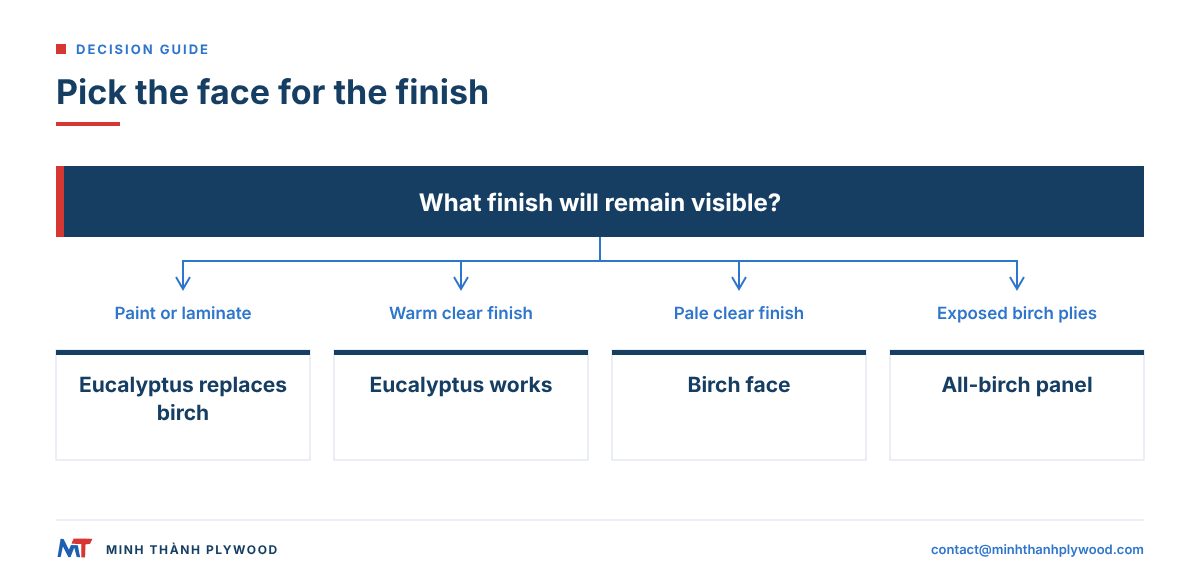
Eucalyptus plywood is as good as birch-faced plywood for painted, laminated, veneered and warm clear-finished furniture, because the core, glue and tolerance can be the same. It is not a replacement where the pale birch look or an exposed all-birch edge is the design.
| Job | Eucalyptus replaces birch? | Why |
|---|---|---|
| Kitchen and wardrobe carcasses under laminate | Yes | Face hidden, same core |
| Painted doors and fronts | Yes | Paint covers the face colour |
| Veneered or wrapped furniture parts | Yes | Decorative layer hides the face |
| Warm clear-finished tables and shelving | Yes | Eucalyptus figure is the look |
| Pale Scandinavian clear-finished furniture | No | Birch colour is the design |
| Exposed layered edges | No | Only all-birch gives birch plies |
| Children’s and retail furniture in pale wood | Usually no | Buyers expect the birch tone |
For a mixed range, many furniture plants buy both: birch-faced plywood for pale show parts and eucalyptus for hidden or covered parts, on the same core and tolerance.
Which core is best for furniture plywood: eucalyptus, acacia, poplar or birch?
White Styrax is the usual core for light, pale furniture panels, and Eucalyptus is the core for denser sheets with firmer screw holding. Acacia, poplar and birch cores each have their own market.
| Core | Character | Typical panel |
|---|---|---|
| White Styrax | Light, about 500 kg/m³, pale edge | Furniture and interior plywood; most sheets per container |
| Eucalyptus | Dense, 650–750 kg/m³ | Furniture parts that carry load; stiffer shelves |
| Acacia | Medium, about 580 kg/m³ | Commercial plywood; made on order |
| Poplar | Light, soft | Chinese commercial and furniture plywood |
| Birch | Dense, even plies | All-birch panels from northern Europe and China |
Many European furniture buyers choose a Styrax core for its weight and pale edge, then pick the face for the look. The best plywood for furniture guide and the eucalyptus vs poplar plywood comparison go further on core choice.
Eucalyptus or birch plywood for kitchen cabinets, wardrobes and doors?
For kitchen cabinets, eucalyptus plywood under laminate or paint gives the same carcass as birch at a lower face cost; birch is worth paying for on pale clear-finished fronts. The glue matters more than the face in a kitchen.
- Kitchen carcasses and sink bases: 18 mm, melamine-fortified MR glue, B/B eucalyptus or D/E birch under laminate.
- Clear-finished kitchen fronts: A/B eucalyptus for a warm look, D+/D birch for a pale look.
- Wardrobe carcasses: 15–18 mm on white Styrax core to keep tall units light.
- Shelves: 18 mm on Eucalyptus core when spans are long and loads are heavy.
- Interior doors: 18–40 mm, faces matched to one approved sample so a run of doors reads as one set.
- Backs and drawer bottoms: thin 3–5 mm plywood, always 5-ply at Minh Thanh, with the face that matches the carcass.
Buyers who run both faces in one kitchen range keep the same core and tolerance on every part, so hinge positions and joints do not change between face species.
How do you check eucalyptus and birch panels on arrival?
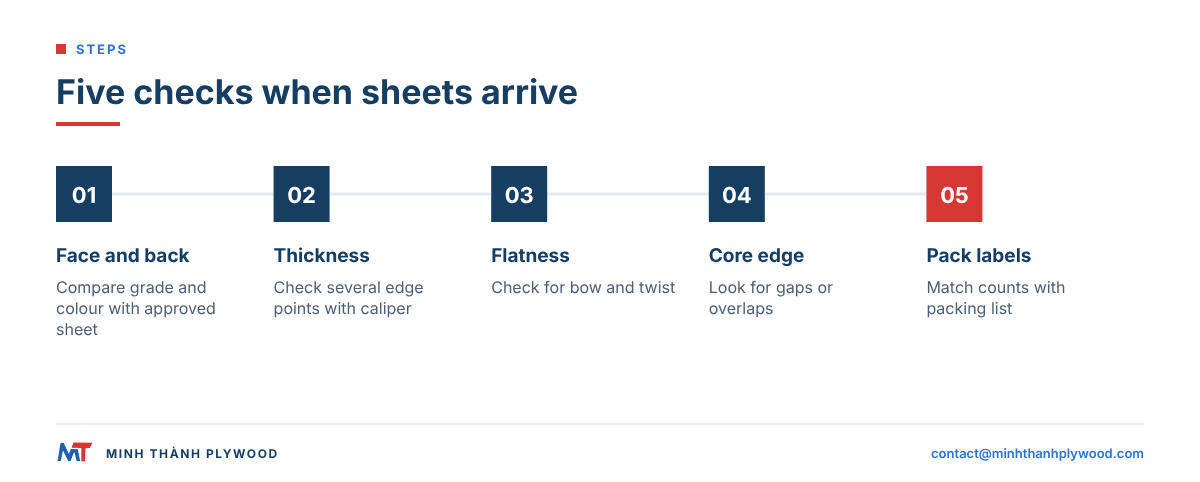
Check the same five points on both faces, against the sample sheet signed off before production. A quick check on the first packs catches problems before panels reach the line.
- Face and back: grade pair, colour range and repairs, compared with the approved sheet in daylight.
- Thickness: digital caliper at several points on the edge; furniture panels are held down to ±0.2 mm.
- Flatness: lay a sheet on a flat bench and look for bow or twist.
- Edge and core: stitched core plies with no open gaps or overlaps at the cut edge.
- Packs: pack count and sheets per pack against the packing list, and labels against the order.
Minh Thanh grades every order against the approved sample and sends photos and video of the buyer’s own sheets before the container doors close. Third-party inspectors are welcome at the mill.
How many sheets fit in a container?
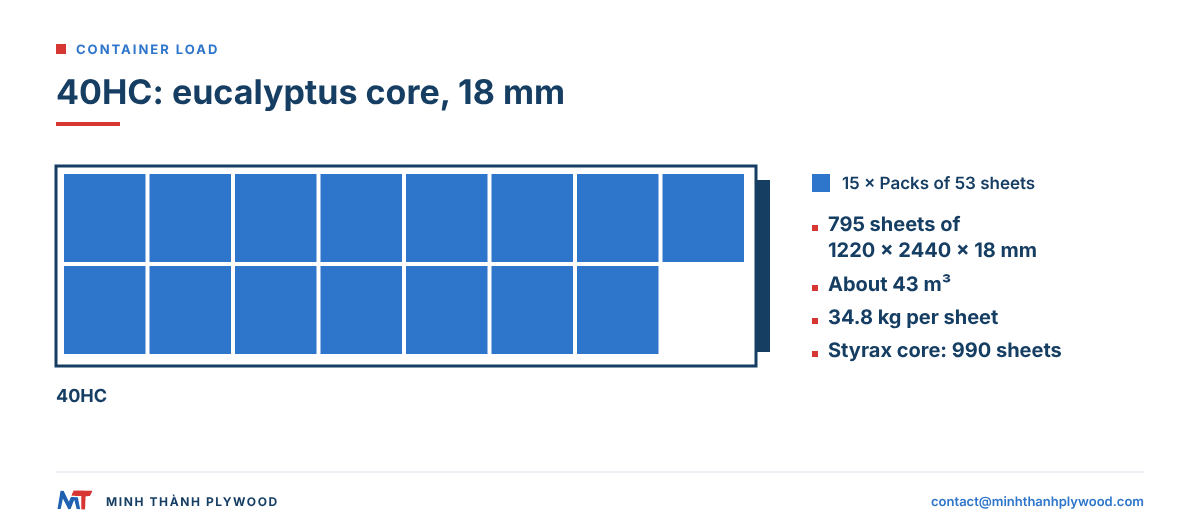
A 40HC carries 795 eucalyptus-core sheets or 990 Styrax-core sheets of 1220 × 2440 × 18 mm, whatever the face. Packs stand about one metre high, so sheets per pack are 1,000 divided by the thickness, rounded down, and then capped by weight.
- Styrax core: 18 packs of 55 sheets, 990 sheets, about 53 m³, 26.8 kg per sheet, about 26,532 kg.
- Eucalyptus core: 15 packs of 53 sheets, 795 sheets, about 43 m³, 34.8 kg per sheet, about 27,666 kg.
- Planning payload: 28,000 kg unless the booking is lower.
If the buyer’s booking caps cargo lower, the sheet count is cut to fit and confirmed in the packing list. Every shipment is photographed and filmed before loading, and the buyer gets the photos and video.
How to specify eucalyptus or birch plywood for a quotation
Send six lines and every mill will quote the same panel. Minh Thanh Plywood replies within hours with a price and a free sample offer.
- Application: carcasses, doors, shelving, wall panels or CNC parts.
- Core: white Styrax for a light panel, Eucalyptus for a dense one.
- Glue and emission: UF glue at E0 emission, melamine-fortified MR, or phenolic WBP.
- Face and back: eucalyptus A/A, A/B or B/B, or birch D+/D, D/D or D/E.
- Size and thickness: 1220 × 2440 mm or 1250 × 2500 mm, 3–40 mm, with custom sizes or cut-to-size into 4, 6 or 8 pieces.
- Packing and quantity: sheets per pack, total sheets or m³, and the destination port.
Example line: “18 mm eucalyptus-faced plywood, A/B, white Styrax core, UF glue at E0 emission, 1220 × 2440 mm, 990 sheets, CIF to your port.” The minimum order is one 40HC, with mixed specifications by agreement. Send it to contact@minhthanhplywood.com or see eucalyptus plywood from Minh Thanh.
Buyer questions, answered
Is eucalyptus plywood as good as birch plywood?
For painted, laminated and veneered furniture, a well-built eucalyptus panel does the same job as birch-faced plywood on the same core. Birch stays the better choice for pale clear-finished faces and for exposed layered edges that must be birch throughout.
Is eucalyptus plywood cheaper than birch?
Yes. In UK shops an 18 mm eucalyptus-throughout B/BB sheet lists at £30.91 ex VAT and an 18 mm birch-throughout BB/BB sheet at £83.95 ex VAT, about 2.7 times more (October 2026). Eucalyptus face veneer is grown and peeled in Vietnam, while birch face veneer is imported.
Which is heavier, eucalyptus or birch plywood?
On a Vietnamese panel the core decides the weight, not the face. A 1220 × 2440 × 18 mm sheet weighs about 26.8 kg on a white Styrax core and about 34.8 kg on a Eucalyptus core at 650 kg/m³, whichever face it carries.
Is eucalyptus plywood more water resistant than birch?
Not in any way that matters for the order. Water resistance comes from the glue line: UF glue for dry rooms, melamine-fortified MR glue for humid rooms and phenolic WBP glue for exterior exposure, with cut edges sealed.
Can eucalyptus plywood be stained like birch?
Yes. Eucalyptus takes stain with a warmer tone and more visible figure. Birch is paler and can blotch under dark stain, so use a pre-stain conditioner or a wash coat on birch and test both on offcuts.
Which is better for CNC furniture parts?
Both machine cleanly on a stitched, double-pressed core. Choose the face for the look and the core for weight and screw holding; the ±0.2 mm thickness tolerance keeps routed joints and hinge holes in line.
What face grades do eucalyptus and birch plywood come in?
Eucalyptus faces are quoted as A/A, A/B or B/B. Birch faces are graded D+, D and E in Vietnam and quoted as pairs such as D+/D or D/E, comparable to the European B, BB and CP/C ladder.
Is Vietnamese birch plywood all birch?
No. Vietnamese birch plywood is birch-faced: imported birch face and back veneers pressed on a white Styrax or Eucalyptus core. All-birch panels come from northern Europe and China.
Which core is best for furniture plywood: eucalyptus, acacia, poplar or birch?
White Styrax is the usual furniture core for light, pale panels; Eucalyptus gives a denser sheet with firmer screw holding. Acacia is a common commercial core, poplar cores come mainly from China, and full birch from northern Europe.
How many eucalyptus-core sheets fit in a 40HC?
At 1220 × 2440 × 18 mm, 795 sheets: 15 packs of 53, about 43 m³ and about 27,666 kg at 650 kg/m³. On a Styrax core the same container carries 990 sheets.