
CDX plywood is commonly C-D Exposure 1 sheathing for concealed construction; ACX plywood offers an A face, while BCX plywood offers a B face for utility finishing. Choose the face for appearance, then select the required bond classification and structural rating. Minh Thanh Plywood supplies CDX-type panels against an agreed construction and sample; specify the required product mark separately.
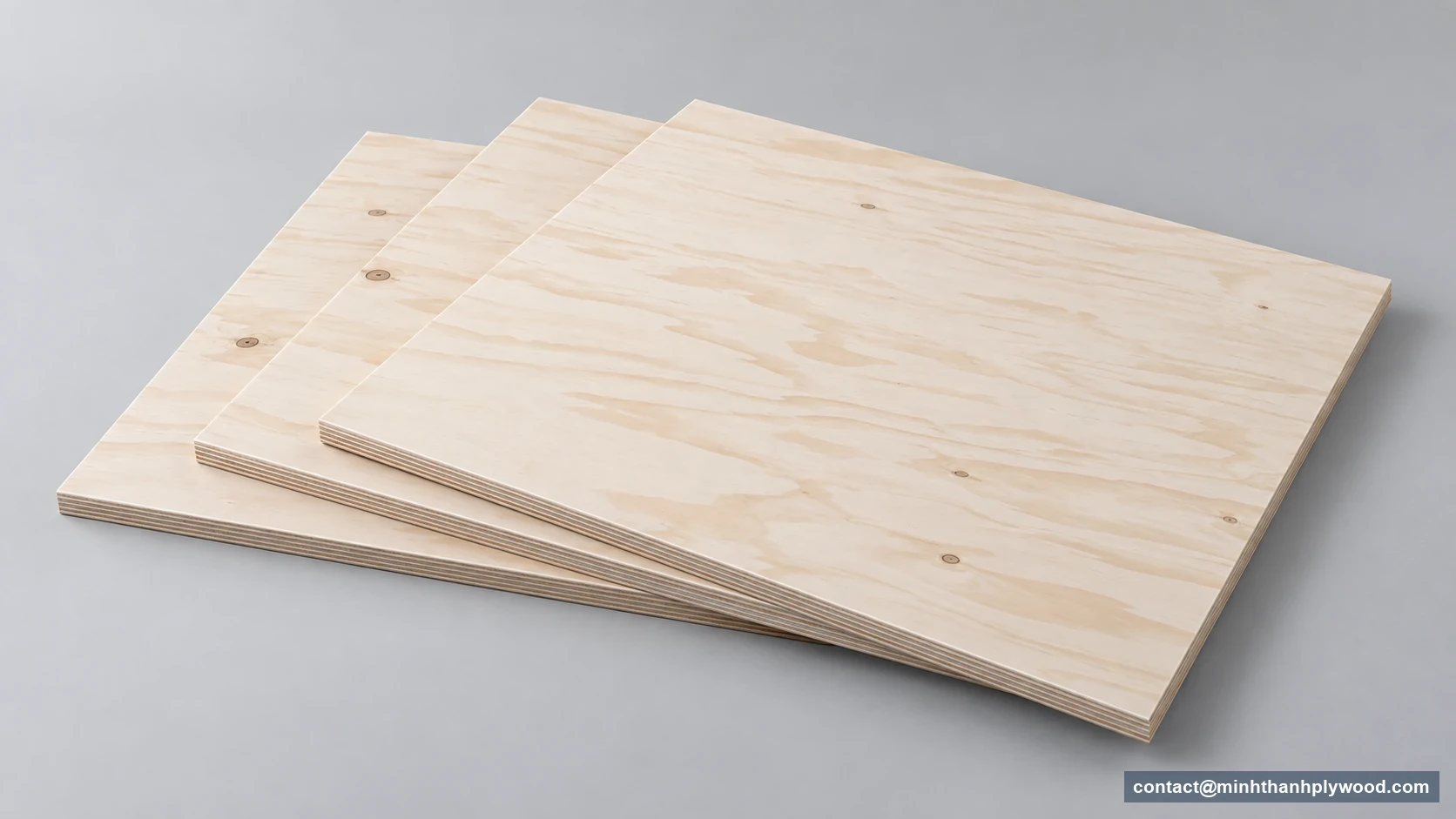
What is CDX plywood, and where does it belong?
CDX plywood is a common trade description for a C face and D back, usually associated with Exposure 1 sheathing used in concealed construction. The letters help describe the surfaces. The panel’s structural grade and exposure marking determine whether it satisfies the building specification.
Choose a utility face when the completed assembly hides it and the relevant performance requirements are met. A roof deck underneath its weather protection does not need the decorative surface of a cabinet door. A garage cabinet door does need an appearance instruction, even if the buyer is comfortable with visible patches. Both jobs require a more complete description than one trade name.
The first purchase decision is therefore the role of the panel: structural sheathing, decorative lining, utility furniture or packing. For structural sheathing, start with the specified rating and construction requirements. For a visible panel, start with the face/back sample and finish. For a crate, start with the load, fixing arrangement and exposure during its journey.
Minh Thanh’s exterior/CDX-type plywood range uses utility C/D appearance with water-resistant melamine-fortified or phenolic bonds specified for the order. The term CDX-type gives buyers a starting description for that range. For structural orders, identify the standard, rating and permitted mark.
This guide compares the grades as buying descriptions. It then explains the documents and physical checks that turn those descriptions into an order. The types of plywood guide covers the wider product families; this page concentrates on the choice among CDX, ACX and BCX and the mistakes that arise when one substitutes for another.
ACX plywood vs BCX plywood vs CDX plywood: what changes?
The immediate difference is the face/back appearance pair: ACX has an A face and C back, BCX has a B face and C back, and CDX has a C face and D back. An A or B face is selected for a more controlled visible finish. A utility C/D surface suits work where surface appearance has less value.
| Buying decision | ACX plywood | BCX plywood | CDX plywood |
|---|---|---|---|
| Face/back description | A face, C back | B face, C back | C face, D back |
| Face preparation | Smooth sanded appearance face | Sanded face with permitted sound knots and repairs | Utility face; specify sanding if required |
| Repairs to assess | Permitted repairs against the grade and finish sample | Sound knots, plugs and repairs against the sample | Permitted knots, openings and repairs against the utility specification |
| Where the face earns its cost | Visible painted panels and appearance-sensitive utility work | Painted utility cabinets and semi-visible parts | Concealed rated sheathing and agreed utility uses |
| Reverse side | C back; specify if visible | C back; specify if visible | D back; inspect permissible defects |
| Continuing weather exposure | Require the actual Exterior classification | Require the actual Exterior classification | Common Exposure 1 CDX belongs in protected service |
| Load-bearing selection | Standard, rating and construction for the design | Standard, rating and construction for the design | Standard, rating and construction for the design |
| Reason to select it | Better appearance on the useful face | Balance appearance work with utility cost | Avoid paying for a decorative face that is hidden |
A higher face letter has value when it reduces surface preparation or rejects on the parts being made. It does not automatically make the panel stiffer, waterproof or suitable for a longer unsupported span. Match quotations on construction and performance before attributing a price difference to the face grade.
For a two-sided part, ACX and BCX leave the reverse at C appearance. That can be acceptable for a hidden back but unattractive inside an open cabinet. Specify both visible faces. At Minh Thanh, pine-faced plywood is quoted in appearance pairs such as A/A, A/B and B/B against a sample; the offered appearance pair stays tied to the approved sample.
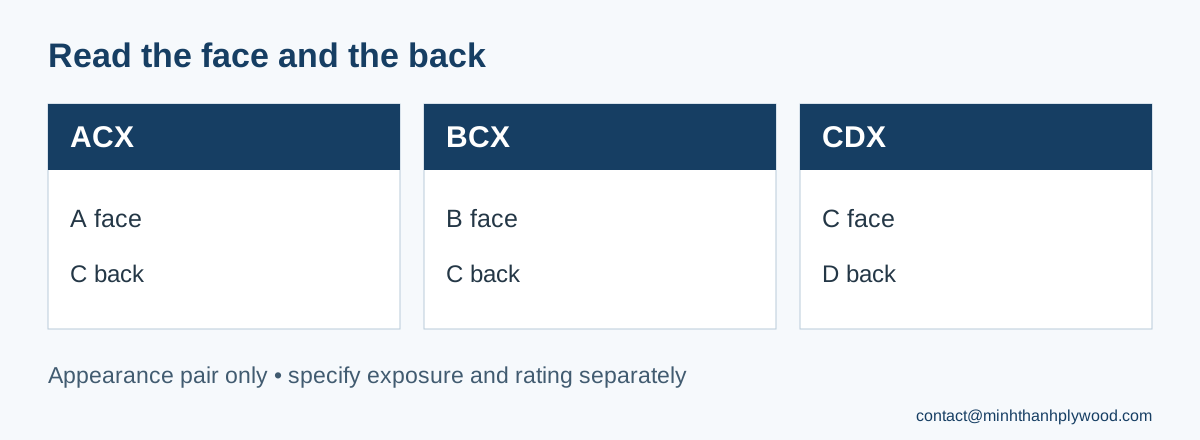
What do A, B, C and D allow on the veneer?
A through D describe progressively less restrictive veneer appearance, with allowable repairs governed by the named grading system. A smooth A face can contain permitted repairs. It should not be sold to a buyer as an unconditional promise of an untouched, perfectly clear sheet.
For quotation purposes, describe the features the finished part exposes. A sound knot is attached wood; a knothole is an opening. A filled defect, a veneer plug and an open split create different finishing work. A B face can be a sensible utility paint surface, but a repaired area may show through a demanding coating unless the finishing process is qualified.
The order sample should include representative repairs, not only the cleanest piece of the sheet. Mark whether patches must be flush, whether contrasting repair colour is acceptable and which face receives the finish. A part with a narrow visible edge needs a different useful area from a wide door that shows the entire face.
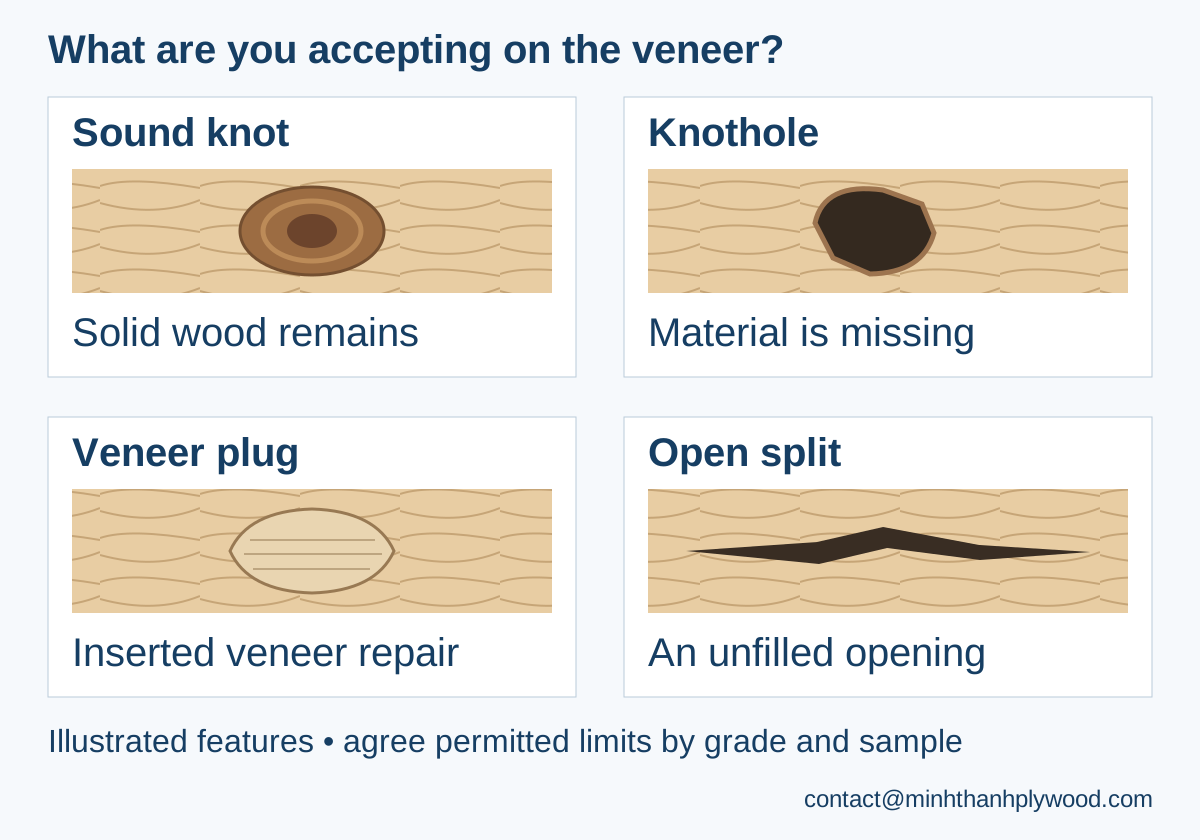
The diagram separates attached wood, missing material, a veneer repair and an unfilled split. Use these feature names when marking the acceptance sample; permitted sizes and frequencies come from the specified grade.
C and D descriptions allow utility defects that an appearance buyer would reject. The permitted size, frequency and repair rules come from the specified standard. Avoid buying from a generic internet knot-size table when the quotation uses a different grading system. Inspect the actual panel grade, its standard and the sample that belongs to the offered construction.
Minh Thanh selects face/back appearance against the approved sample. Its furniture-grade production presses and calibrates the core before the separate face press. That preparation gives the buyer a controlled substrate for a thin decorative veneer; it is a different buying proposition from rough sheathing purchased only for concealed use.
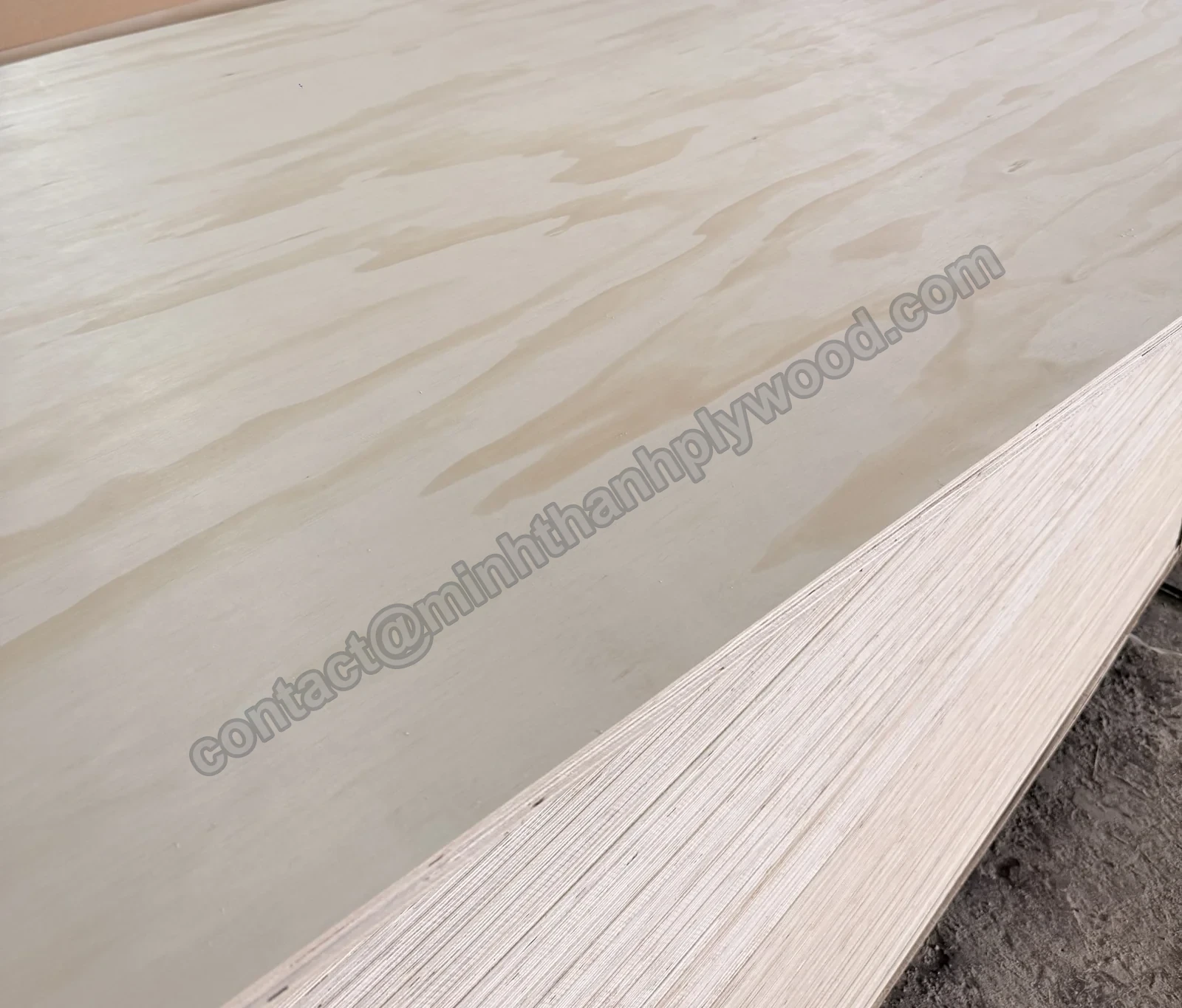
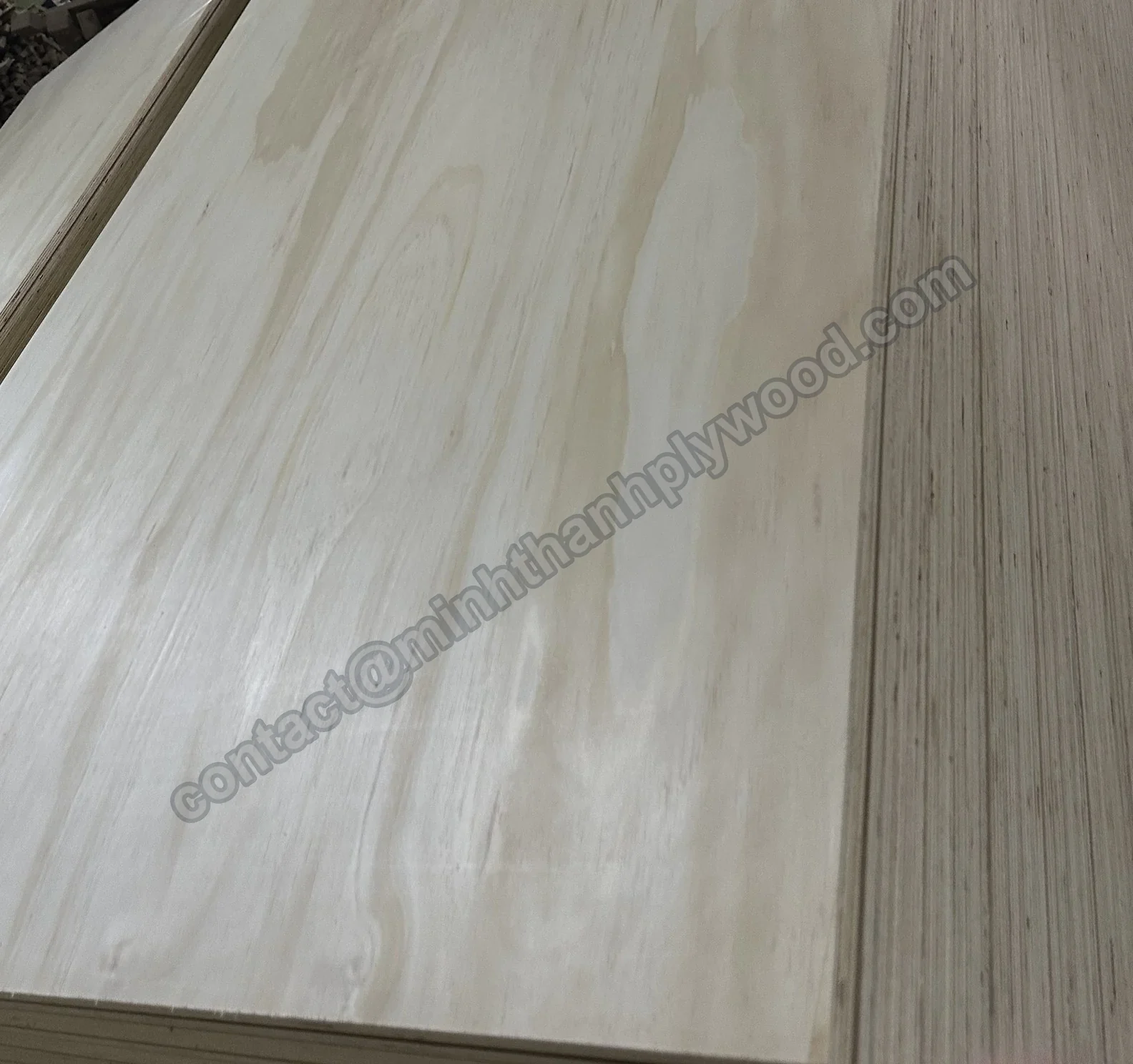
The photographed pine face provides a surface reference. Use the approved physical sample to set the appearance of the ordered panels.
Does X mean Exterior, Exposure 1 or waterproof?
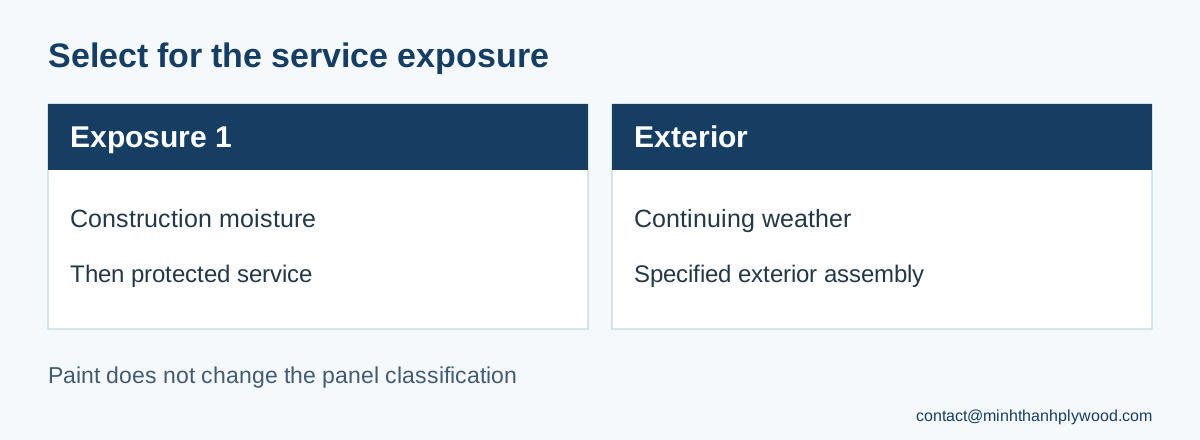
X is trade shorthand associated with exterior-type bonding; the panel’s actual exposure classification is the useful selection criterion. Exposure 1 suits construction moisture followed by protected service. Exterior suits continuing weather exposure under its intended design conditions.
The APA Help Desk guidance on Exposure 1 and Exterior, consulted on 7 October 2026, explicitly distinguishes commonly sold CDX from an Exterior panel. Use that distinction when choosing between a covered roof deck and a continuously weather-exposed part. Buying a lower appearance grade can be economical; buying the wrong exposure classification creates a different service condition from the one specified.
Water resistance also belongs to the finished assembly. Cut edges, penetrations, joints and trapped water remain important with an Exterior panel. A coating protects surfaces but does not convert the product mark. Record the coating system, exposed-edge treatment and drainage design alongside the panel requirement.
At Minh Thanh, exterior/CDX-type orders specify melamine-fortified or phenolic bonding. Interior furniture orders use their own bond and emission requirements. A buyer should not transfer the familiar furniture specification onto a moisture-exposed construction order simply because both panels come from the same manufacturer.
Is ACX or BCX stronger than CDX?
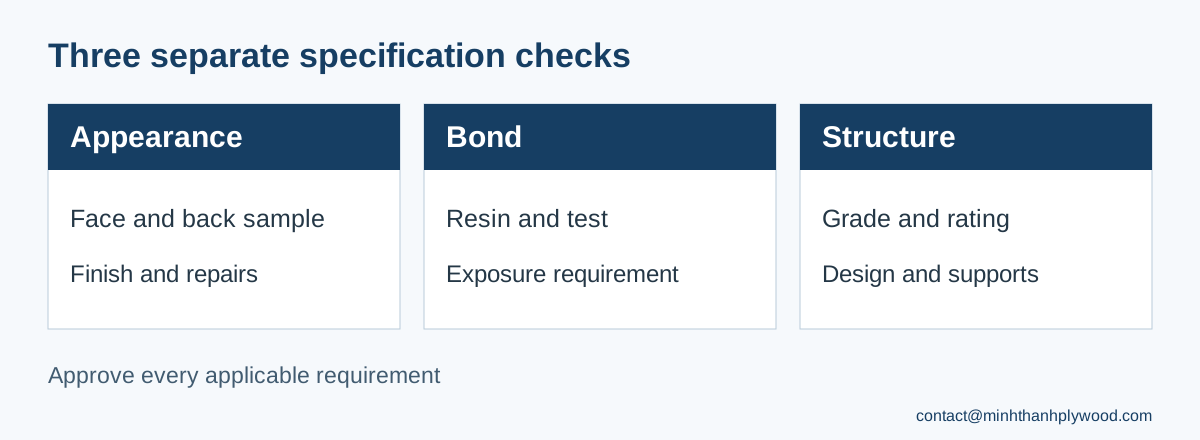
A cleaner face does not establish a higher structural load capacity. Strength and stiffness belong to the specific panel construction, rating and direction of loading. Compare those values with the same thickness, support arrangement and intended service before deciding whether one grade can replace another.
A structural panel order should identify the product standard, performance category where applicable, required rating and panel identification. The designer selects for the load and support spacing. Procurement then buys that identified product. A substitution that retains “plywood” and a nominal thickness while changing its rating is a change to the design specification.
Species and layup matter. The number and orientation of veneers, their thicknesses and the rated construction affect performance. Counting layers on a sawn edge is useful for checking the ordered layup; it does not produce a structural rating. Likewise, a heavier sheet provides information about mass, not a complete bending or shear comparison.
Keep strength and stiffness separate in supplier data. A panel can resist failure while deflecting more than the application permits. Point loads, distributed loads and long-term loads also impose different requirements. The load case should travel with the drawing, rather than being reduced to an unexplained maximum weight in a quotation.
Minh Thanh’s Styrax and Eucalyptus cores offer different planning densities. That helps estimate component and shipment mass. It does not allow a purchasing team to calculate a span rating from density. For a structural requirement, retain the applicable product evidence; for furniture, qualify the actual assembly and hardware.
How do you read the plywood grade mark before buying?
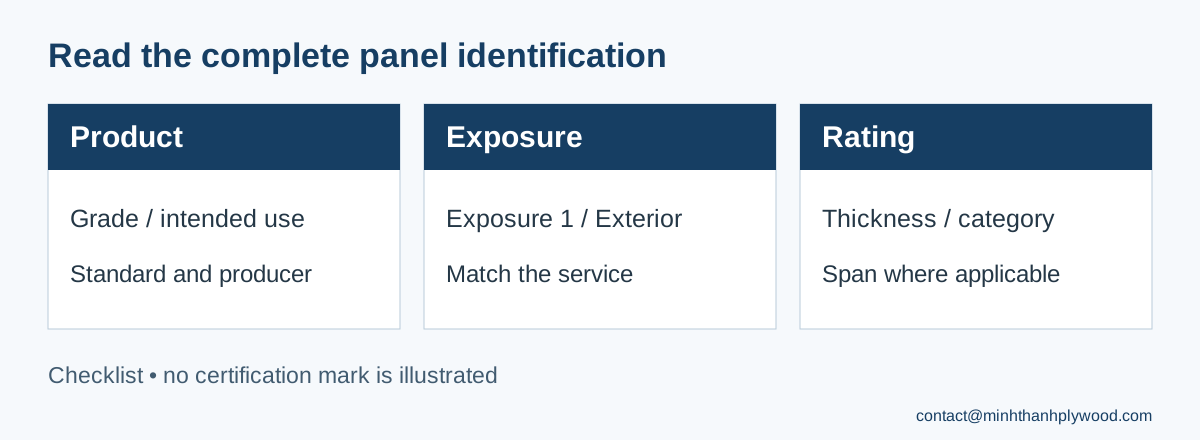
Read the complete mark for the panel grade, exposure classification, thickness or performance category, applicable standard and traceable producer identification. Match the mark to the specification and supplier documents. A photograph of a trade name on a bundle is insufficient when the project requires a particular third-party product mark.
Use this sequence when qualifying a structural panel:
- Find the product grade or intended-use designation. Rated Sheathing and a sanded appearance grade describe different purchase attributes.
- Read Exposure 1 or Exterior. Match it to temporary construction moisture or continuing exposure in the design.
- Read the performance category and stated thickness. Keep the label and measured dimensions together.
- Read the span rating where the grade uses one. Apply it to the correct roof or floor role and installation conditions.
- Identify the standard and the third-party quality mark required by the project.
- Retain the mill/product identification with the lot documents and receiving record.
A dual roof/floor span rating contains role-specific values, not a universally permitted span for every application. The panel orientation, supports, edge support and fastening still belong to the design. If a supplier proposes a different rated product, compare it against the relevant design line before accepting the substitute.
The APA panel trademark examples, consulted on 7 October 2026, help buyers distinguish appearance grade, intended-use designation and rating information. Copy the required fields into the RFQ. Do not reproduce an association logo on an unrelated sample or create an assumed mark in the order artwork.
For a Vietnam sourcing enquiry, attach the project specification and an example of the required marking. Minh Thanh can quote the panel construction and appearance against those purchase requirements. The quote should state exactly which product evidence accompanies the offered panel so approval covers the same product that ships.
Which grade belongs in roofs, walls and subfloors?
Choose a rated panel that satisfies the structural design for roofs, structural walls and subfloors; choose its face grade according to whether it will be seen. Concealed construction is often served economically by utility-faced sheathing. Paying for an A face does not remove the need to match the rating and installation.
For a roof deck, the order needs the required panel rating, actual thickness or category, support spacing and edge arrangement. The construction programme also determines how long the panel encounters moisture before the covering protects it. A panel intended for protected service should be handled and enclosed as that specification requires.
For a structural wall, distinguish sheathing behind cladding from visible wall lining. A shear-wall panel must satisfy the design’s structural requirements and fixing schedule. Decorative lining needs a selected face, planned joints and coating. One panel can serve multiple roles only when its specification meets each role; appearance alone does not establish the structural one.
For a floor, distinguish the load-carrying subfloor from the underlayment immediately beneath the finish. A rated sheathing subfloor and a smooth underlayment have different jobs. Roughness, voids, repair profiles and fastening can affect the finished floor even when the underlying structure carries its design load.
The floor-covering manufacturer’s substrate instructions govern the finishing interface. Select an underlayment grade and surface that those instructions accept. “BCX under all flooring” is too broad: a tile assembly, sheet floor and carpet system have different substrate and installation requirements. The sample should represent the part of the panel that actually contacts the finish system.
Minh Thanh’s construction plywood range is the starting catalogue for a construction enquiry. Send the rating and installation specification with the schedule. Related guides on roof sheathing and subfloor selection develop those application choices; the grade comparison here identifies the purchase fields that must remain consistent across them.
When should a visible panel use ACX or BCX?
Use ACX when the A face’s appearance and preparation matter to the finished part; use BCX when permitted B-face knots and repairs fit the intended utility finish. Choose a two-sided appearance pair when both surfaces remain visible. The C back on ACX or BCX should be part of the sample approval.
A painted garage cabinet is a useful example. Its door face may accept a B face under an opaque coating, while a more demanding finish calls for a tighter face selection. The cabinet interior can still expose the reverse of that same door. Give purchasing a front-and-back acceptance sample instead of approving only the outside.
Fine furniture also asks more of the core and thickness control than a face letter alone describes. A narrow groove, exposed ply edge, hinge recess or connector hole cuts into the internal construction. Inspect those machined features on the offered panel. A face repair that disappears under paint does not settle an internal void exposed in a critical joint.
At Minh Thanh, furniture panels have two-way stitched cores and double pressing, with sanded thickness tolerance of ±0.2–0.3 mm, down to ±0.2 mm. Buyers choose white Styrax or Eucalyptus as standard cores and specify the face veneer independently. This gives the order a defined construction rather than a generic upgrade from C to A.
For a natural clear finish, choose the veneer and repair appearance deliberately. A general A-grade description does not promise matched colour or figure across an entire run of doors. Grain direction, permitted repair contrast and useful part layout should be recorded on the sample sheet. For painted work, retain the primer and topcoat trial with that same approval.
How do you specify sanding, patches and the finished surface?
Specify surface preparation and repair acceptance in terms of the finished component. “Sanded” describes preparation, while the appearance grade controls permitted veneer features. A touch-sanded utility panel and a fully sanded appearance panel should not be treated as identical substrates.
Check patches across their full perimeter under side lighting. A repair can be present and structurally sound while leaving a local edge that shows through a coating. Look for flushness, sanding scratches, torn grain and the remaining face veneer at the machining area. Take the sample through the buyer’s normal coating process before judging the result.
Do not solve a thin face problem by sanding an uncertain amount away on site. The ordered face thickness and factory preparation need to suit the intended finish. Aggressive extra sanding can expose the substrate or change local thickness, particularly where a repair already needs work. Put the finishing requirement into the factory order so production prepares the surface for that job.
On an opaque painted panel, repair colour may have little value after the coating trial. Under a clear finish, the same repair can be the dominant visual feature. This is why one photograph labelled B grade cannot settle every finishing order. The coating, light and visible area should be consistent when comparing samples.
Minh Thanh prepares sanded and polished faces for the specified use. In a furniture order, UV-ready preparation is a substrate instruction for the customer’s coating process. It should be written separately from a supplied cured coating, and separately from the bond that joins the veneers inside the panel.
How do nominal inches compare with actual millimetres?
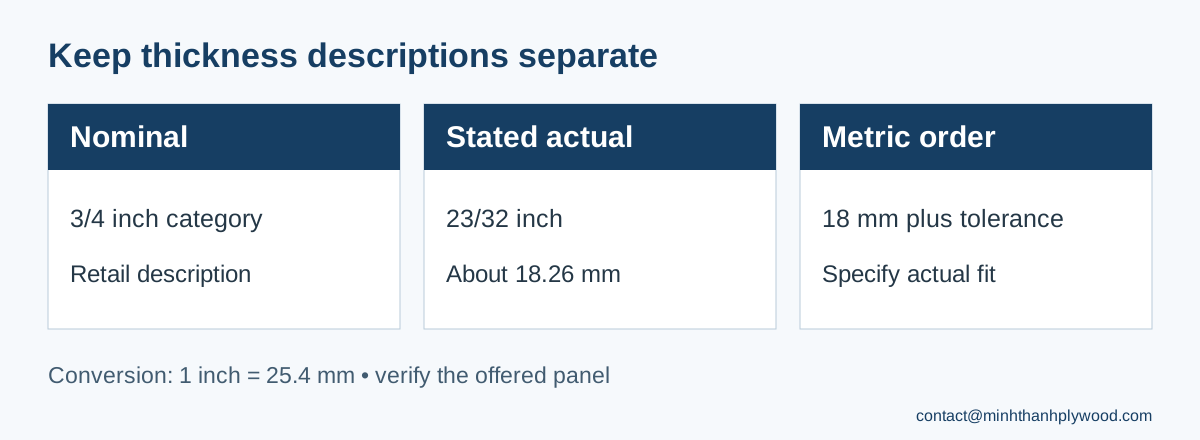
Specify actual thickness and its tolerance alongside any required nominal category. A nominal inch description can refer to a panel with a smaller stated actual thickness. Replacing that description with the closest whole millimetre number can change a groove fit, panel category or finished assembly.
For example, nominal three-quarter-inch plywood is commonly offered at an actual 23/32 inch, approximately 18.26 mm. Nominal half-inch plywood can be offered at 15/32 inch, approximately 11.91 mm. These are conversions of stated fractions, not guaranteed dimensions for all plywood sold under those names. The supplier’s panel identification and measured thickness remain decisive.
The conversion uses 25.4 mm per inch. It does not assign a performance category or certify a panel. An order for 18 mm metric plywood therefore needs its own tolerance and any category or rating requirement. A drawing for a tight slot should state the permitted actual dimension rather than leaving purchasing to infer it from a shelf label.
Minh Thanh’s standard sheet formats include 1220 × 2440 mm and 1250 × 2500 mm. The first is a metric commercial format often compared with the familiar four-by-eight-foot sheet. Write the millimetre dimensions on the export order. That avoids uncertainty when cutting yield depends on a component fitting across the sheet.
Measure thickness at agreed positions with a suitable calibrated tool, record readings rather than only a rounded average, and match the report to the lot. Commercial plywood tolerance is ±0.5 mm; sanded furniture plywood uses the tighter range described earlier. Select the tolerance for the actual panel line and part fit.
The plywood thickness guide covers broader thickness selection, while the sheet sizes guide connects panel format to cutting layouts. Use both when the same quote mixes construction sheets and appearance-sensitive furniture components.
Can Vietnam plywood replace a specified ACX, BCX or CDX panel?
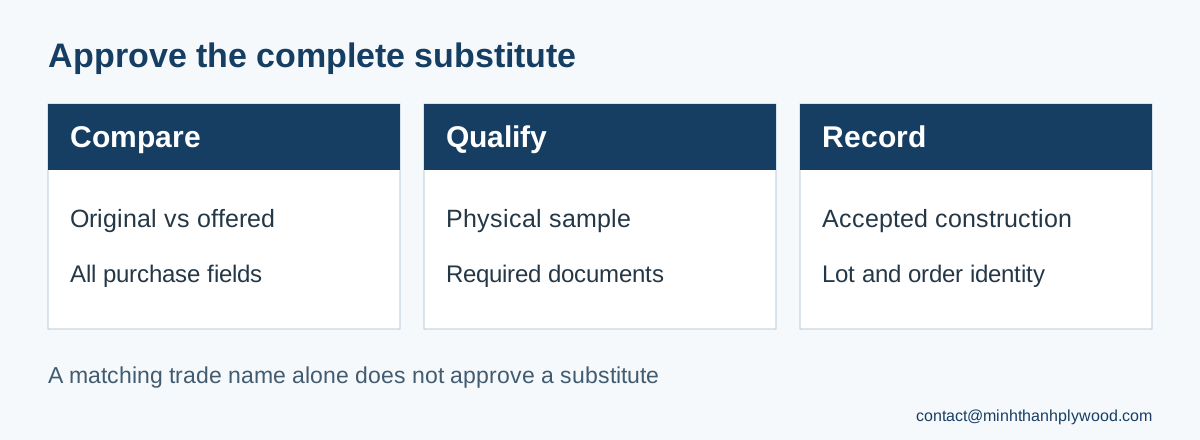
A Vietnam panel can be considered for substitution when the offered construction, appearance, dimensions and required product evidence satisfy the original specification. Approve the complete panel. Do not approve a substitution solely because the supplier uses the same three-letter trade name.
Create a comparison schedule with an original requirement and an offered value for every purchase attribute. Include the face/back sample, core species and layup, actual thickness, tolerance, bond requirement, exposure condition, relevant structural standard and rating, surface preparation and required identification. The schedule makes differences visible before the first production order.
A utility C/D sample does not demonstrate an A face. A melamine-fortified bond does not silently become an unspecified phenolic bond. A metric thickness is not automatically the same category as the specified inch-labelled product. Resolve those differences as part of product approval and record the accepted construction on the purchase order.
For visible parts, machine and finish a representative sample. For structural roles, approval uses the required product mark and design evidence. For packing, qualify the crate or pallet component in the intended load and fixing arrangement. The supplier should be comparing like-for-like purchase requirements, even when the local grade names differ.
Minh Thanh quotes exterior/CDX-type utility panels and furniture-grade panels as separate constructions. A buyer ordering fine furniture gains more useful control by specifying the face veneer and paired appearance sample than by asking for ACX without explaining the finished part. A buyer ordering structural sheathing gains more control by attaching the exact product and rating requirement.
Which documents belong to bond, emissions and structural approval?
Use separate records for bond performance, emissions and structural product approval. Each record answers a different question. A formaldehyde chamber report supports the tested emission result; a bond test supports the specified moisture requirement; a structural product mark and rating support the corresponding construction application.
“WBP” is often used in export conversations for a water-resistant bonding requirement. Write the intended resin, named test and acceptance criteria in the order. A trade abbreviation gives the purchasing team less control than a defined bond specification. The same approach applies to “MR”: identify the intended service and requirement rather than allowing an abbreviation to carry the whole decision.
Minh Thanh holds CARB Phase 2 / TSCA Title VI certification, ICTT mill no. 23024, for its veneer-core hardwood plywood range. Six ASTM D6007 chamber tests on 9, 15 and 18 mm panels, from April 2025 to June 2026, averaged 0.014–0.032 ppm against the 0.05 ppm limit. Shanghai Hongjun issued HJ-QAT-250597, HJ-QAT-251303 and HJ-QAT-261036; ICTT Vietnam issued ICTTVN-QAT-250841, ICTTVN-QAT-251173 and ICTTVN-QAT-260272.
View the factory records in the quality hub and the emission documents page. The US composite-wood emission guidance, consulted on 7 October 2026, explains the product programme. Keep the report code and tested construction with the relevant order.
For a structural enquiry, list the required product standard, third-party mark and rating explicitly. For an appearance-panel enquiry, list the face/back approval and machining requirements. The documentation schedule then matches the actual buying intent so approval covers the offered product.
Minh Thanh supplies the EUDR compliance dossier with origin records and geolocation files. The European Commission implementation guidance, consulted on 7 October 2026, explains the sourcing information non-EU suppliers provide to buyers. Include these records in the shipment documentation schedule.
Is CDX the same as marine, treated or film-faced plywood?
CDX, marine, preservative-treated and film-faced describe different product attributes. CDX is a trade grade description. Marine relates to a named marine-panel specification; treatment addresses a specified preservative requirement; a film describes an overlay. Choose the attribute the application needs rather than using the terms interchangeably.
For boat construction or a marine specification, order the named standard and the corresponding construction evidence. A water-resistant adhesive alone does not define a marine panel. A C/D appearance panel also does not acquire a marine grade by coating its edges. Face quality, internal veneer requirements and the named standard remain part of that product decision.
For decay or insect exposure, identify whether treatment is required by the design and where the panel is used. Bond classification addresses adhesive durability, not a complete preservative treatment. The treatment process, intended use and finishing compatibility belong on their own order lines. Painting alone does not substitute for a required treatment classification.
For concrete forms, the face in contact with concrete needs its own specification. A phenolic film, an overlay and a bare veneer give different finish and handling requirements. Minh Thanh offers film-faced plywood for forming enquiries. An attractive film face should be evaluated together with its core, bond and edge sealing rather than being treated as a substitute for the required structural rating.
If a buyer proposes Exterior plywood for an exposed part, qualify the entire assembly’s coating, drainage, fixing and maintenance. If the design requires marine or treated plywood, keep that requirement. The water resistance guide explains the difference between a moisture-resistant panel bond and a waterproof assembly.
How do you compare cost and inspect the shipment?
Compare the cost of the accepted usable part, then inspect the shipment against the same specification and sample. A less expensive C/D face is economical when the job hides it. It becomes expensive if extra preparation, rejected parts or the wrong product evidence prevent the panel being used.
Ask suppliers to quote the same face/back selection, core, bond, actual thickness, format, preparation and delivery term. Keep product standard and marking requirements in that same enquiry. A price comparison that changes several of those fields measures different products; it does not establish a fixed ACX premium or CDX saving.
For appearance work, include cutting yield and finishing effort. Mark whether repairs can fall in hidden components or whether the useful face area must meet a tighter appearance sample. A cutting layout can separate visible and concealed parts, giving purchasing a more useful grade plan than paying for the best face on every sheet.
For shipment planning, calculate mass from the offered dimensions and density and include packing within the booking allowance. Minh Thanh’s planning reference densities are 500 kg/m³ for Styrax and 650–750 kg/m³ for Eucalyptus. The packing calculator helps build the load plan for the selected panel; a core change affects shipment mass as well as component handling.
At receiving, check labels and documents first, then the selected sheets. Inspect both faces and representative edges, measure dimensions and thickness, and compare repairs with the accepted sample. Record any wet packing or sheet damage on arrival with photographs. Keep a distinguishable sample and lot record so the supplier can investigate the actual panel involved.
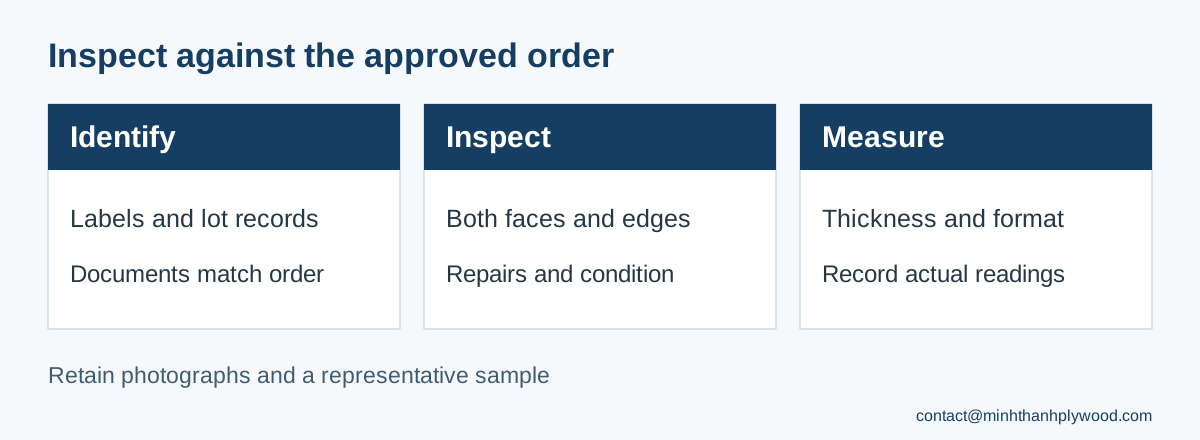
For factory orders, retain the pre-loading photographs alongside the packing list. Minh Thanh photographs and films every shipment before loading and sends the records to buyers. Those records help connect the shipped bundles to the order; the receiving inspection checks the condition and specification at destination.
What should your ACX, BCX or CDX quotation request contain?
Send a complete panel schedule with the application, face/back acceptance sample, core, bond, dimensions, required product evidence and shipment quantity. That lets Minh Thanh quote the construction the buyer can approve, with the documentation and marking that belong to it.
Use this order outline for a first enquiry:
- Application: concealed roof or wall sheathing, subfloor, visible lining, utility cabinet or packing component; attach the drawing and required rating for structural work.
- Appearance: the intended AC, BC or CD comparison, the actual local face/back pair offered, acceptable repairs, visible sides, grain and finish sample.
- Construction: core species, agreed layup and any machined-edge or hardware requirements.
- Bond and service: resin system, named test and acceptance criteria, Exposure 1 or Exterior where applicable, coating and treatment requirements.
- Dimensions: actual thickness and tolerance, required performance category, sheet format and edge profile.
- Evidence: specified product standard and mark, lot identification, applicable emission records and sourcing documentation.
- Shipment: sheet or volume quantity, bundle protection, destination port and FOB, CFR or CIF quotation basis.
A practical sample request includes a representative repaired area and the reverse side. For a painted component, ask for the preparation that will be supplied in production and apply the intended finish. For structural work, include the exact approval evidence required by the project before evaluating a substitute.
Minh Thanh offers free samples. The standard factory order starts at one 40HC, with mixed specifications by agreement. Production takes 15–45 days after the deposit; that is production time rather than the sea journey. Standard terms are 30% deposit and 70% against the scanned bill of lading, or irrevocable letter of credit at sight, with FOB Hai Phong, CFR or CIF quotations.
Send the schedule through the quotation contact page or email [email protected]. Lisa handles international sales on WhatsApp, ref MT-cdx-acx-bcx. We reply within hours. Include the original grade and marking requirement so the offered Vietnam construction can be reviewed against the same purchase decision.
Buyer questions, answered
What does CDX plywood mean?
CDX is a common trade name for plywood with a C-grade face and D-grade back, often sold as C-D Exposure 1 sheathing. The panel mark identifies its actual grade, bond classification and structural rating. Use those markings to select the panel for the job.
What is the difference between ACX, BCX and CDX plywood?
ACX describes an A face with a C back; BCX describes a B face with a C back; CDX describes a C face with a D back. A and B faces give progressively more controlled appearance for visible work. Bond classification, thickness and structural capacity need their own specification.
Does the X in CDX mean exterior plywood?
X is trade shorthand associated with exterior-type adhesive; it is not the panel's complete exposure classification. APA identifies commonly sold CDX as Exposure 1, intended for construction moisture rather than permanent weather exposure. Read Exterior or Exposure 1 on the actual panel mark.
Is CDX plywood waterproof?
CDX plywood does not make a waterproof finished assembly. Exposure 1 panels tolerate construction moisture and then need protection from long-term weather. Water management, membranes, edge treatment and ventilation belong to the assembly design.
Is ACX plywood stronger than CDX plywood?
An A face provides a better appearance surface, not an automatic increase in structural capacity. Compare the panel's actual rating, thickness, species group or layup, load direction and support conditions. A substitution must satisfy the same design requirements as the specified panel.
Can I use BCX plywood for painted cabinets?
A B face can suit painted utility cabinets when its sound knots and repairs are acceptable after the intended primer and topcoat. For fine furniture, specify the actual face veneer, back appearance, core, thickness tolerance and emission requirement. Qualify the finished sample and hardware before ordering.
Can CDX plywood be used for a subfloor?
Rated sheathing can serve as a structural subfloor when its rating and installation match the floor design. The underlayment directly beneath the finished floor is a separate selection. A CDX label alone does not establish suitability beneath vinyl, tile or another finish.
Can I leave CDX plywood outside if I paint it?
Painting an Exposure 1 panel does not change its classification to Exterior. For continuing weather exposure, select an Exterior-classified panel and the coating and edge details for that assembly. Marine and treated panels address other requirements and are not synonyms for CDX.
Is 18 mm plywood the same as three-quarter-inch plywood?
Nominal inch categories and measured millimetre thickness are different order descriptions. A three-quarter-inch label can identify a panel whose stated actual thickness is 23/32 inch, approximately 18.26 mm. Write the required performance category where applicable, actual thickness and tolerance on the order.
Does CDX-type plywood from Vietnam have an APA stamp?
CDX-type describes an offered appearance and construction; an APA trademark requires the corresponding certified product and mill. Order the required standard, third-party mark and traceable panel identification explicitly. Minh Thanh quotes its exterior/CDX-type range against the agreed face/back sample and bond specification.
Does WBP glue prove a panel is structural?
WBP is trade terminology for a water-resistant bond requirement; it supplies no span rating by itself. Specify the resin system, required bond test and acceptance criteria separately from the structural product standard and panel rating. Face grade and emission class are also separate purchase lines.
What should I send for a CDX-type plywood quotation?
Send the application, face/back acceptance sample, core and layup, bond and exposure requirement, applicable product standard, actual thickness and sheet size. Add coating or treatment requirements, emission evidence, quantity, packing and destination port. Include the required panel marking so the quote covers the complete specification.