
A project panel, Far Eastern plywood, general purpose plywood, utility plywood and ordinary plywood are local names for the same product family: hardwood-faced commercial plywood with an interior glue for non-structural work. Minh Thanh Plywood maps each market's name to one specification and shows what to ask a Vietnamese mill for.
What is a project panel in Australia?
In Australian shops, a project panel is a ready-sized flat panel for shelves, desks, wardrobes and craft jobs, and the name covers two products: laminated (edge-glued or finger-jointed) pine and hardwood panels, and sanded plywood panels. Shoppers mostly meet the first kind; an importer of Vietnamese plywood supplies the second.
| Laminated timber project panel | Plywood project panel | |
|---|---|---|
| Made from | Pine or hardwood strips, edge-glued or finger-jointed | Veneers pressed in cross layers, sanded faces |
| Typical retail form | 1200 × 405 mm or 1200 × 600 mm, 18 mm | Quarter and half sheets, 6 to 18 mm |
| Stability | Can cup and move with humidity | Flat, stable in both directions |
| Best for | Painted or stained shelves | Cabinet sides, backs, drawers, wardrobes |
The edge-glued kind is covered in edge-glued and finger-joint panels. This guide is about the plywood kind, which an importer can undercut: Bunnings lists a Specrite 1200 × 405 × 18 mm laminated pine panel at A$29 and the 1200 × 600 × 18 mm panel at A$39 (October 2026), that is roughly A$54 to A$60 per m² for glued pine. Plywood cut from a full sheet competes on stability and on price per m².
Australian sizes, price and proof
Retail project panels run 900, 1200, 1800 and 2400 mm long and 300, 400, 450 and 600 mm wide, in 12, 16 and 18 mm. The mill side matches them by cutting: a 1220 × 2440 mm sheet cuts to 1220 × 610 mm quarters or 610 × 610 mm eighths, and a 1200 × 600 mm quarter sheet suits the Australian shelf.
| Australian retail project panel | Price (Oct 2026) | Per m² | Plywood alternative |
|---|---|---|---|
| Specrite pine 1200 × 405 × 18 mm | A$29 | A$59.67 | Quarter-sheet cut, 18 mm, FOB per m³ |
| Specrite pine 1200 × 600 × 18 mm | A$39 | A$54.17 | Same cut, 1200 × 600 mm |
| Specrite pine 1800 × 600 × 18 mm | not listed | – | Same cut, 1800 mm length |
Australian buyers look for three proofs on interior plywood. AS/NZS 2270 is the standard for plywood for interior use; formaldehyde emission is graded E0 and E1 and tested by AS/NZS 2098.11; and FSC or PEFC chain of custody is asked for on larger orders. Minh Thanh’s furniture plywood uses UF glue at E0 emission as standard, and six ASTM D6007 chamber tests on 9, 15 and 18 mm panels averaged 0.014–0.032 ppm against the 0.05 ppm CARB Phase 2 limit (ICTT mill no. 23024). FOB prices start from US$250/m³ for commercial plywood (October 2026) and US$350/m³ for furniture and interior plywood.
Project panel plywood from the mill side
A project panel is a ready-sized panel for DIY and furniture projects, an Australian retail term. It is mostly edge-glued pine or hardwood, and also a sanded plywood panel with interior glue, cut from full sheets into handy sizes.
Project panels are bought by the piece, not the crate. Retailers stock them so a home or trade buyer can make a shelf, a cabinet side or a toy box without cutting a full sheet. The plywood kind is ordinary commercial or furniture plywood; what makes it a project panel is the size and the clean faces.
For an importer supplying that channel, the opportunity is cut-to-size production at the mill. Minh Thanh cuts a full panel into 4, 6 or 8 pieces before packing. From a 1220 × 2440 mm sheet, four pieces gives 1220 × 610 mm and eight gives 610 × 610 mm. The cut-to-size plywood page covers that service.
Plywood shipped to Australia clears biosecurity under the import conditions listed in BICON. Duty follows the Australian Border Force tariff, chapter 44, which lists plywood with a tropical or eucalyptus outer ply (4412.31, 4412.33).
Australian project panels also come in pine and poplar faces for painted work and in hardwood faces for stained work. A retailer that stocks both covers most DIY jobs. For an importer, the same container can carry both faces in separate packs, cut and labelled for the shelf.
Plywood project panels: sizes, faces and thicknesses that sell
Plywood project panels sell in small sizes, sanded faces and a few common thicknesses. Retail buyers pick them by look and handling, so a clean face and square edges matter more than structural rating.
What to plan for a project panel range:
- Sizes: quarter and eighth sheets cut from 1220 × 2440 mm, or custom cuts to the retailer’s shelf.
- Thicknesses: 3–6 mm for backs and crafts, 9–12 mm for small furniture, 15–18 mm for shelves and sides.
- Faces: pale, even faces sell best: poplar, birch, okoume or pine. Darker bintangor suits stained work.
- Edges: square, clean cuts with no breakout on the face.
- Packing: small packs or shrink-wrapped bundles that a retailer can split.
Thin panels at Minh Thanh are always 5-ply. A 3 mm panel has one core veneer, two cross-band veneers and two faces; 4 and 5 mm panels have three core veneers and two faces.
What do project panel, Far Eastern, utility and ordinary plywood mean?
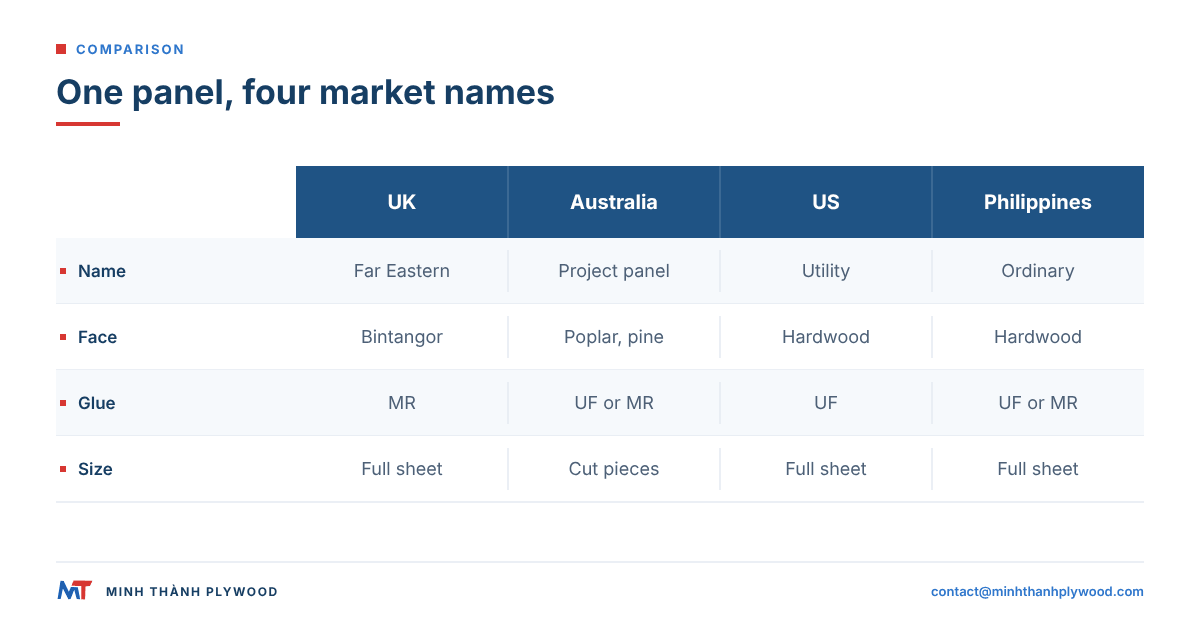
They are market names for one family of panels: commercial plywood with a hardwood face, a plantation hardwood core and interior or moisture-resistant glue, sold for non-structural work. The name changes by country and sales channel; the build underneath is close to the same.
| Market | Local name | Usual sheet | Main use |
|---|---|---|---|
| United Kingdom | Far Eastern plywood, general purpose plywood, hardwood ply | 2440 × 1220 mm | Shelving, linings, hoardings, joinery |
| Australia | Project panel | Small ready-cut panels | DIY, crafts, furniture projects |
| United States | Utility plywood, utility panel | 4 × 8 ft | Backs, shelves, crafts, underlayment |
| Philippines | Ordinary plywood | 4 × 8 ft | Cabinets, ceilings, partitions |
| Vietnam and export trade | Commercial plywood | 1220 × 2440 mm | Furniture parts, packing, interior fit-out |
For an importer, these names hide the specification. Two “Far Eastern” quotes can differ in core species, face grade, glue and tolerance by a wide margin. The rest of this guide turns the names into one specification you can send to a mill, with the commercial plywood range as the reference.
The names also carry expectations about price. In each market these are the cost-effective panels on the rack, below furniture-grade birch or decorative veneer plywood. A mill quoting them must hit a price, so the specification decides where it saves: core grade, sanding, glue or tolerance. Knowing which of those your customers notice tells you which lines to fix on the order.
General purpose plywood in the UK: Far Eastern plywood explained
General purpose plywood in the UK is mainly Far Eastern plywood: hardwood-faced panels from Asia with interior or moisture-resistant glue, for non-structural jobs. Merchants sell it in 2440 × 1220 mm sheets as the everyday board for shelving, linings and site hoardings.
Typical build of Far Eastern general purpose plywood:
- Faces: red or pink tropical hardwood types, such as bintangor or okoume, sometimes called “hardwood faced”.
- Core: mixed plantation hardwoods.
- Glue: interior or moisture-resistant (MR).
- Face preparation: lightly sanded or unsanded.
- Use class: non-structural.
UK buyers judge Far Eastern plywood mostly on face colour, flatness, core voids and edge breakout when cutting. A Vietnamese mill can match the look with bintangor or okoume faces on an Acacia or Eucalyptus core. The bintangor plywood page shows that face.
18mm Far Eastern plywood: plies, weight and tolerance
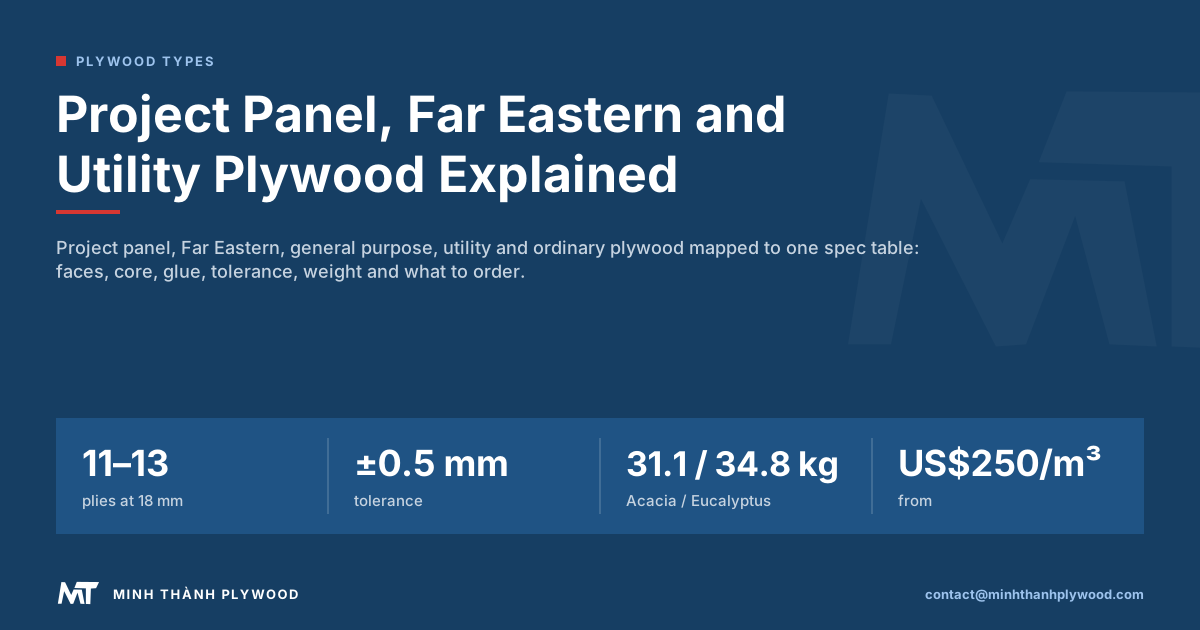
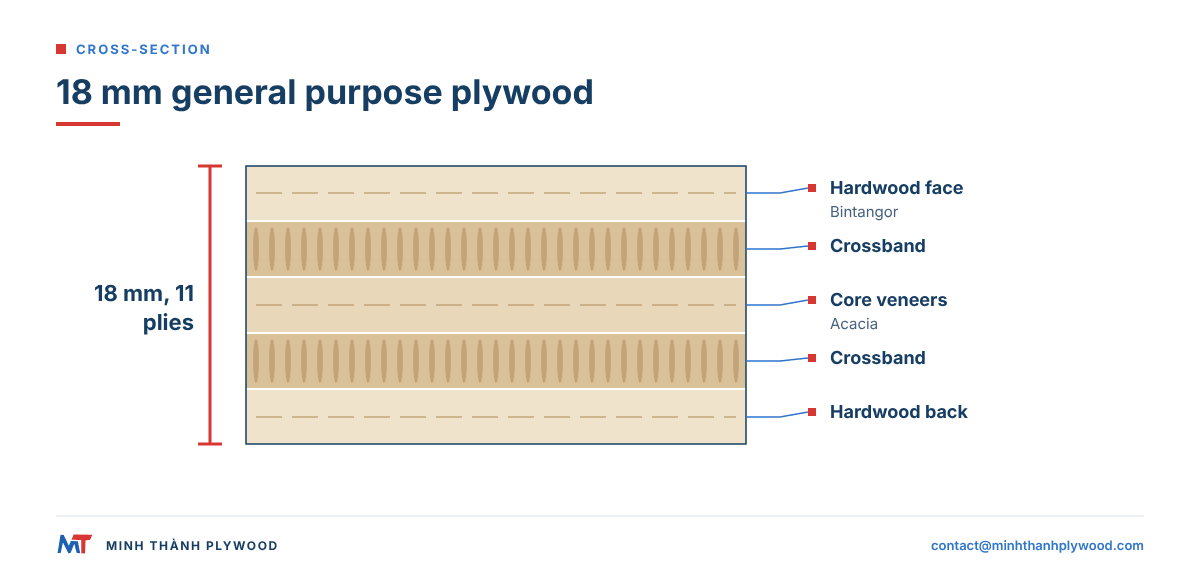
An 18 mm Far Eastern plywood sheet has 11–13 plies, most often 11, and weighs about 31.1 kg on an Acacia core or 34.8 kg on a Eucalyptus core at 1220 × 2440 mm. Commercial plywood is held to ±0.5 mm thickness tolerance.
| Point | 18 mm commercial / Far Eastern | 18 mm furniture plywood |
|---|---|---|
| Plies | 11–13 | 11–13 |
| Core | Acacia or Eucalyptus, AB grade, loose-laid or jointed | Styrax or Eucalyptus, A grade, stitched |
| Pressing | Once | Twice: core calibrated, then faces |
| Thickness tolerance | ±0.5 mm | ±0.2–0.3 mm, down to ±0.2 mm |
| Faces | Unsanded or lightly sanded | Sanded, polished, UV-ready |
| Weight per sheet | About 31.1 kg (Acacia), 34.8 kg (Eucalyptus) | About 26.8 kg (Styrax) |
| Length and width | ±2 mm | ±2 mm |
The weights use reference core densities of 580 kg/m³ for Acacia and 650 kg/m³ for Eucalyptus; real Eucalyptus panels run 650–750 kg/m³, so sheets are weighed before a load plan is fixed.
Utility plywood in the US and ordinary plywood in the Philippines
Utility plywood in the US and ordinary plywood in the Philippines are the same interior commercial panel under local names. Both are chosen for price and general use, with appearance and water resistance secondary.
US utility plywood is the low-cost hardwood-faced panel on store racks, used for shelving, cabinet backs, crafts and underlayment. US buyers also need the panels to meet TSCA Title VI formaldehyde limits for composite wood products, which applies to hardwood plywood sold in the US. Minh Thanh holds CARB P2 / TSCA Title VI certification (ICTT mill no. 23024), and US orders carry the TSCA Title VI label.
Philippine ordinary plywood is the interior grade, sold as the alternative to marine plywood for cabinets, ceilings and partitions in dry rooms. Buyers there compare it on face, thickness accuracy and price; for wet areas they move to marine or exterior plywood.
The TSCA Title VI limit for hardwood plywood with a veneer core is 0.05 ppm of formaldehyde under 40 CFR 770.10.
Both markets compare offers mainly on face appearance and price, then on thickness accuracy. A panel a millimetre thinner than its nominal size causes problems in shelving rebates and cabinet joints, so tolerance is worth writing on the order even for low-cost panels.
One specification behind all the names
Behind every market name is one short specification: face species and grade, core, glue, emission class, thickness tolerance and size. Send those six lines and any mill can quote the panel your market calls Far Eastern, utility, project panel or ordinary.
| Spec line | UK Far Eastern / general purpose | AU project panel | US utility | PH ordinary |
|---|---|---|---|---|
| Face | Bintangor or okoume | Poplar, birch, pine or hardwood | Hardwood or poplar | Hardwood |
| Face preparation | Lightly sanded | Sanded | Sanded one side | Lightly sanded |
| Core | Acacia or Eucalyptus | Acacia, Eucalyptus or Styrax | Acacia or Eucalyptus | Acacia or Eucalyptus |
| Glue | MR | Interior UF or MR | Interior UF | Interior UF or MR |
| Emission proof | Buyer’s class | E0 or E1 | CARB P2 / TSCA Title VI | Buyer’s class |
| Tolerance | ±0.5 mm | ±0.5 mm or tighter | ±0.5 mm | ±0.5 mm |
| Size | 1220 × 2440 mm | Cut-to-size pieces | 1220 × 2440 mm | 1220 × 2440 mm |
The table is a starting point. A buyer who wants a cleaner face or a tighter tolerance on a general purpose panel writes that line in: sanded faces, ±0.2–0.3 mm, or E0 emission. Write the line your customers need, not the name.
Which face veneer for commercial plywood?
Bintangor, okoume and gurjan are the classic hardwood faces for commercial plywood; poplar, eucalyptus and pine give paler or cheaper alternatives. The face sets the colour your customers recognise as “Far Eastern” or “hardwood ply”.
| Face | Colour | Market fit |
|---|---|---|
| Bintangor | Red-brown | UK Far Eastern look, Middle East, Asia |
| Okoume | Pink to light brown | Europe, interior panels |
| Gurjan | Red-brown | India and South Asia |
| Poplar | Pale cream | Project panels, painted parts |
| Eucalyptus | Pale to light brown | Cost-effective general use |
| Pine | Yellow with knots | Rustic projects, Australia |
Minh Thanh produces 10+ faces; Okoume, Poplar and Pine are among the most produced, and Bintangor, Eucalyptus and Gurjan are pressed on request. Face grades follow the approved sample: pine and eucalyptus as A/A, A/B or B/B pairs, poplar also by the codes B/BB, BB/CC and CP.
What type of plywood is best for DIY projects?
For indoor DIY, the best plywood is a sanded hardwood-, poplar- or birch-faced panel in 12–18 mm with interior glue and a void-free core. For outdoor DIY, use exterior plywood with phenolic WBP glue.
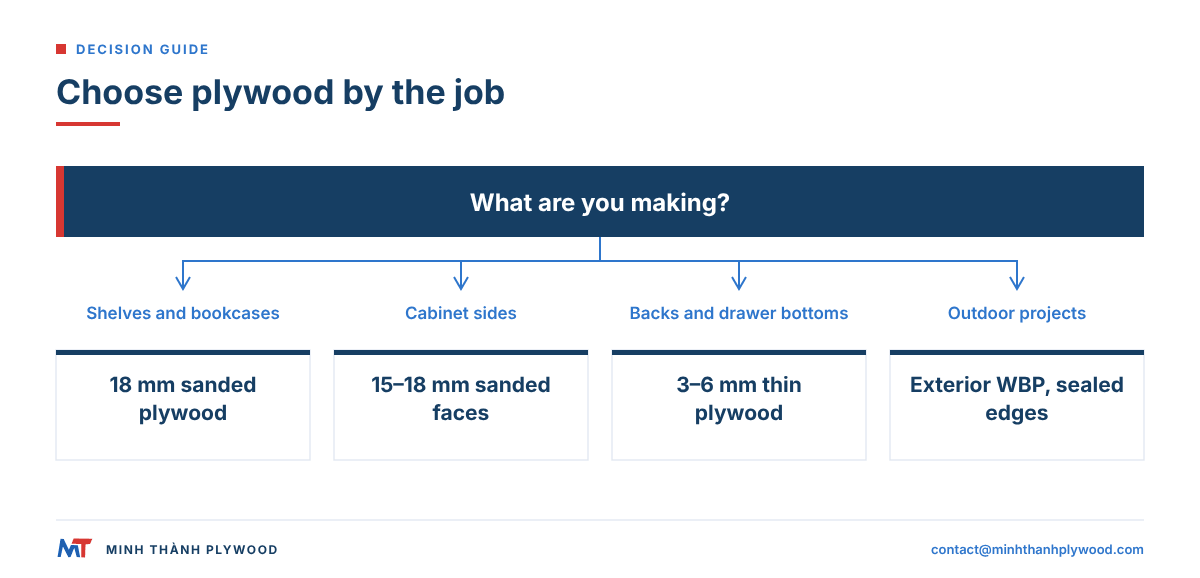
Pick the panel by the job:
- Shelves and bookcases: 18 mm, for stiffness over the span.
- Cabinet and box sides: 15–18 mm, sanded faces for paint or oil.
- Backs and drawer bottoms: 3–6 mm thin plywood.
- Painted furniture: poplar or birch faces, which take paint evenly.
- Stained furniture: okoume or bintangor faces, or a furniture-grade face such as EV.
- Outdoor planters and sheds: exterior plywood with WBP glue, edges sealed.
Retail project panels make DIY easier because they come cut and sanded. For a workshop or retailer buying by the container, cut-to-size panels from the mill save the cutting and the waste.
A void-free core matters in DIY more than most people expect. Screws driven into a cabinet edge find a gap and lose grip, and an exposed edge shows holes after cutting. Ask for jointed or stitched cores on any panel that will show its edges or take screws in them.
Glue and water: where general purpose plywood stops
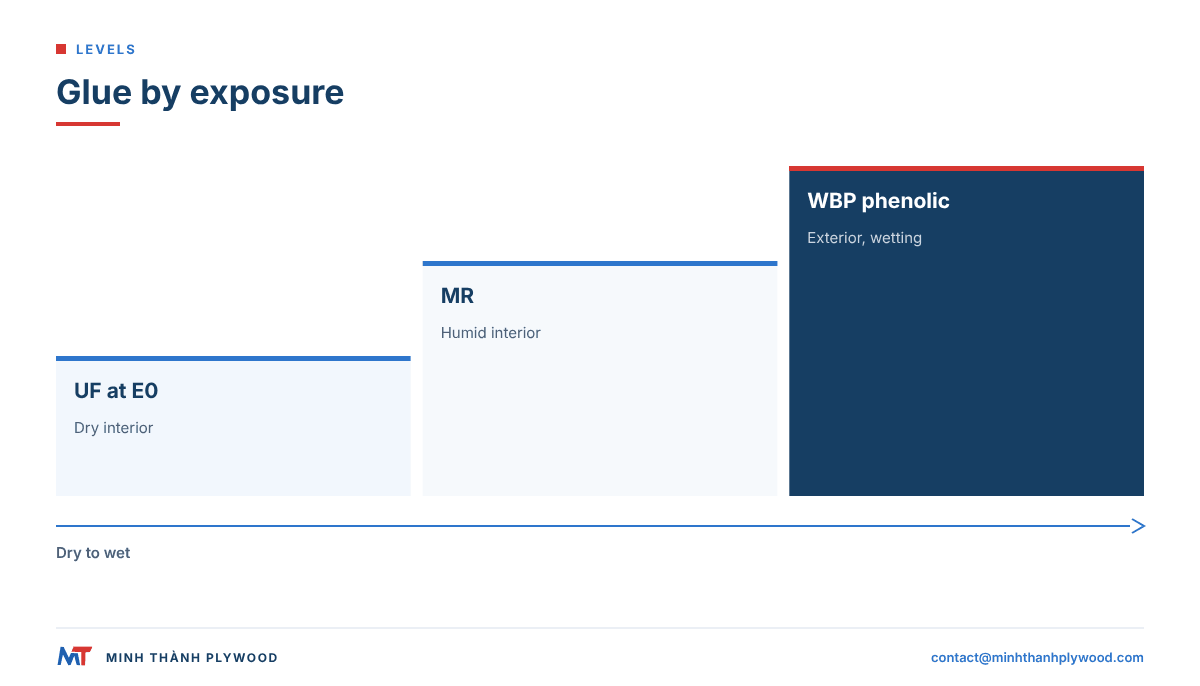
General purpose plywood is made with interior or moisture-resistant glue, so it suits dry rooms and brief damp, not outdoor exposure. Where water stays on the panel, change the glue, not just the name.
| Glue | Typical use | Water resistance |
|---|---|---|
| UF glue at E0 emission | Furniture, interior panels | Dry interior |
| MR (melamine-fortified UF) | General purpose, kitchens, humid rooms | Humid interior, short wetting |
| WBP (phenolic) | Exterior, sheathing, formwork | Exterior, repeated wetting |
Glue type and emission class are two separate specification lines. An E0 interior panel and a WBP exterior panel are different products, and each needs its own line on the order. Minh Thanh makes MR and WBP bonds to the customer’s specification, and its exterior plywood uses phenolic WBP or melamine-fortified glue with C/D utility faces for outdoor jobs.
The comparison with marine panels is in commercial vs marine plywood.
Is general purpose plywood structural?
No. General purpose, Far Eastern, utility and project panel plywood are sold for non-structural work. Load-bearing floors, roofs and walls need structural plywood specified and marked for that use in the country of installation.
Non-structural uses where these panels fit well:
- Shelving, cabinets and furniture carcasses.
- Wall linings, ceilings and partitions in dry rooms.
- Site hoardings and temporary works not carrying load.
- Packing cases, crates and pallet tops.
- Crafts, models and display stands.
For heavier loads in furniture and fit-out, such as workbenches or stage tops, choose thicker panels with denser cores. The guide to heavy-duty plywood covers that choice.
Commercial plywood from Vietnam: price and container
Minh Thanh’s commercial plywood starts from US$250/m³ (October 2026). The face, core, glue, thickness, size and quantity set the final price; furniture and interior plywood starts from US$350/m³.
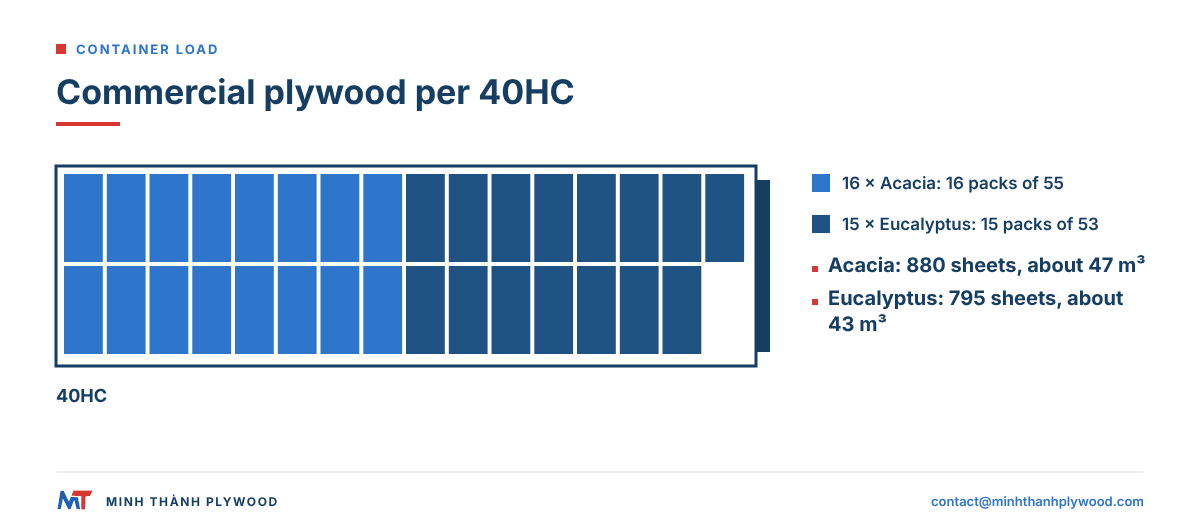
Container planning on 1220 × 2440 mm panels at 18 mm, packs about one metre high, against a 28,000 kg planning payload:
| Core | Packs × sheets | Sheets per 40HC | Volume |
|---|---|---|---|
| Acacia | 16 × 55 sheets | 880 sheets | about 47 m³ |
| Eucalyptus | 15 × 53 sheets | 795 sheets | about 43 m³ |
The numbers are capped by weight; a lower booking payload reduces them, and the plan is worked out on the real booking. The MOQ is one 40HC with mixed specifications by agreement, so a UK merchant can mix 9, 12 and 18 mm in one container.
Terms: production 15–45 days after the 30% deposit, balance 70% against the scanned B/L or by irrevocable L/C at sight, FOB Hai Phong, CFR or CIF.
What to write when ordering Far Eastern or project panel plywood
Send the six-line specification, not the market name. A mill that receives “Far Eastern plywood” alone will quote its own idea of it.
- Application: shelving, linings, furniture parts, project panels for retail.
- Core: Acacia or Eucalyptus; jointed or stitched.
- Glue and emission: interior UF, MR or WBP; E0, E1 or CARB P2 / TSCA Title VI.
- Face: bintangor, okoume, poplar or pine; face/back grade; sanded or not.
- Panel: thickness, size or cut-to-size pieces, tolerance.
- Packing and quantity: pack size, labels, quantity per thickness, destination port.
A filled line reads: “18 mm commercial plywood, Eucalyptus core, MR glue, E1, bintangor face and back, lightly sanded, 1220 × 2440 mm, ±0.5 mm, export packs, mixed with 9 and 12 mm, one 40HC, CIF Felixstowe.”
Send it through the quote form or to contact@minhthanhplywood.com. We reply within hours and send free samples of the faces you are considering.
Buyer questions, answered
What is project panel plywood?
Project panel is an Australian retail name for ready-sized panels for DIY and furniture jobs: mostly edge-glued pine or hardwood, and also sanded plywood panels cut to handy sizes.
What is Far Eastern plywood?
Far Eastern plywood is the UK trade name for hardwood-faced plywood made in Asia, with interior or moisture-resistant glue, for general non-structural use. It is sold in 2440 × 1220 mm sheets.
What is general purpose plywood?
General purpose plywood is plywood for non-structural interior jobs: shelving, furniture carcasses, linings, hoardings and DIY. In the UK it is mostly Far Eastern hardwood-faced plywood.
What type of plywood is best for DIY projects?
For indoor DIY furniture and shelving, a sanded hardwood-faced or birch-faced plywood in 12–18 mm with interior glue. For anything outdoors, choose exterior plywood with WBP phenolic glue.
Is Far Eastern plywood waterproof?
No. Far Eastern and general purpose plywood use interior or moisture-resistant glue and suit dry or briefly damp places. For wet and outdoor use, order exterior plywood with phenolic WBP glue.
How heavy is an 18 mm sheet of Far Eastern plywood?
It depends on the core. An 18 mm sheet of 1220 × 2440 mm weighs about 31.1 kg on an Acacia core and about 34.8 kg on a Eucalyptus core, using reference densities of 580 and 650 kg/m³.
What is ordinary plywood in the Philippines?
Ordinary plywood is the Philippine name for interior-grade plywood, as opposed to marine plywood. It suits cabinets, ceilings and partitions in dry areas.
What is utility plywood in the US?
Utility plywood is a US retail name for low-cost hardwood-faced panels with interior glue, used for shelving, crafts, backs and underlayment where appearance matters less.
Is general purpose plywood structural?
No. General purpose and project panel plywood are made for non-structural work. Floors, roofs and load-bearing parts need structural plywood specified for that use.
How much does commercial plywood cost from Vietnam?
Minh Thanh's commercial plywood starts from US$250/m³ (October 2026). Face species, core, glue, thickness, size and quantity set the final price.