
Commercial plywood is general-use plywood with interior or moisture-resistant glue and an ordinary core; marine plywood is made to a boat-building standard, with waterproof phenolic glue, durable veneers and a core free of gaps. Minh Thanh Plywood, which makes commercial and exterior plywood, compares glue, grade and price and shows which jobs need which.
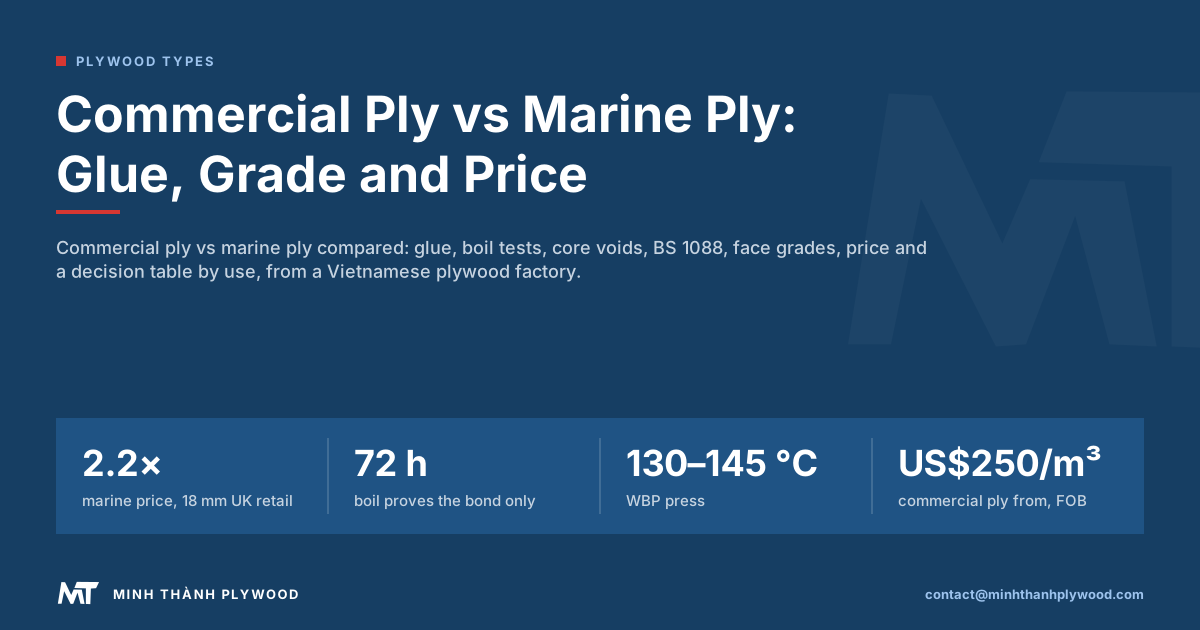
Commercial ply vs marine ply: the short answer
Commercial ply is everyday plywood for indoor work, with interior or moisture-resistant glue; marine ply is a boat-building panel with waterproof phenolic glue, durable veneers and a core with no gaps. Use commercial ply for furniture, shelving and fit-out, and marine ply only where the panel stays wet or carries a boat.
Between the two sits exterior plywood: phenolic or melamine-fortified glue like marine ply, with ordinary core species and utility faces. It covers most outdoor and wet jobs at a lower price than marine ply. The comparison below includes it, because most buyers who ask about marine ply need exterior ply.
| Metric | Commercial plywood | Exterior plywood | Marine plywood |
|---|---|---|---|
| Glue | UF or MR (melamine-fortified UF) | WBP phenolic or melamine-fortified | WBP phenolic |
| Bond | Interior or humid interior | Exterior, boil-resistant | Boil-proof |
| Core species | Plantation hardwoods, mixed | Plantation hardwoods | Durable species to the standard |
| Core gaps and overlaps | Some allowed | Some allowed | Not allowed |
| Faces | Hardwood, sanded or not | Utility C/D | Durable hardwood, high grade |
| Standard | Buyer’s specification, IS 303 in India; interior bond (Type C) to AS/NZS 2270 in Australia | Buyer’s specification; AS/NZS 2269 with Type A bond in Australia | BS 1088, IS 710 in India, AS/NZS 2272 in Australia |
| Thickness tolerance | ±0.5 mm | ±0.5 mm | Per standard |
| Relative price | Lowest | Medium | Highest |
| Typical use | Furniture, shelving, linings | Sheathing, stair treads, sheds | Boat hulls, decks, docks |
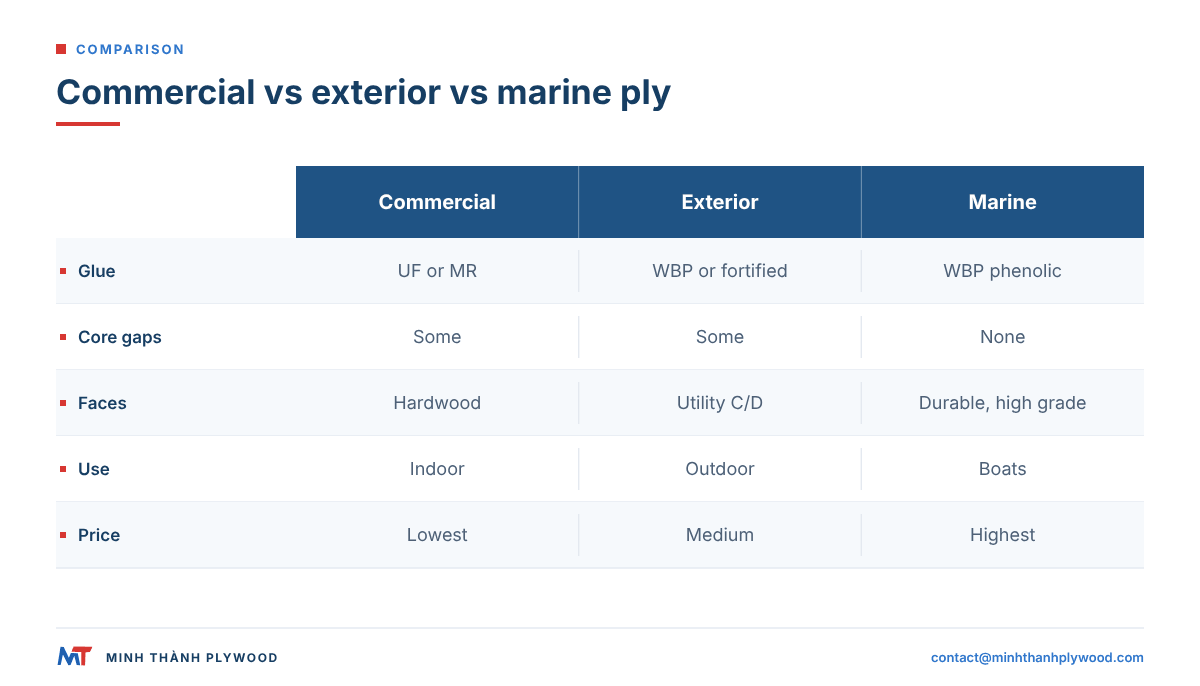
What is the difference between marine plywood and commercial plywood?
The difference between commercial plywood and marine plywood comes down to four things: glue, veneer species, core gaps and face quality. Glue is the one buyers hear about most; core gaps are the one that ruins a boat.
- Glue. Commercial plywood uses urea-formaldehyde (UF) or melamine-fortified MR glue. Marine plywood uses phenol-formaldehyde, the dark WBP glue that survives boiling water.
- Veneer species. Commercial plywood uses plantation hardwood cores such as Acacia or Eucalyptus. Marine plywood uses veneers of species with natural durability, such as okoume or meranti, through the whole panel.
- Core gaps. Commercial plywood allows small gaps and overlaps between core veneers. Marine plywood allows none, because water collects in a gap and rots the panel from inside.
- Face quality. Marine faces are graded to the standard, with limits on knots, splits and patches. Commercial faces follow the buyer’s sample.
A panel that has phenolic glue but an ordinary core with gaps is exterior plywood, not marine plywood, whatever its label says.
What is commercial plywood?
Commercial plywood is general-use plywood: a plantation hardwood core under hardwood or other faces, bonded with interior UF or moisture-resistant MR glue, for furniture, fit-out, shelving, packing and other non-structural work. It is the largest volume of plywood traded from Vietnam.
Its default build at a Vietnamese mill:
- Core: Acacia or Eucalyptus, AB grade, loose-laid or jointed.
- Faces: bintangor, okoume, gurjan, poplar or eucalyptus, unsanded or lightly sanded.
- Glue: UF or MR; WBP on order.
- Thickness tolerance: ±0.5 mm.
- Pressing: once.
Commercial plywood is sold under many market names: Far Eastern or general purpose plywood in the UK, utility plywood in the US, project panels in Australia and ordinary plywood in the Philippines. The guide to Far Eastern, utility and project panel plywood maps them to one specification.
Commercial plywood is also the base for many finished products. Furniture plants veneer or laminate it, packing plants cut it into cases, and fit-out contractors paint it. Its value is that it does the general job at the lowest cost per square metre, as long as the panel stays dry or only briefly damp.
What is marine plywood?
Marine plywood is plywood made for boat building and permanently wet use: every veneer is a durable species, the bond is waterproof phenolic, and the core has no gaps or overlaps. In Europe it is made to BS 1088. In India it is made to IS 710.
What the marine standard controls:
- Species with natural resistance to decay, in faces and core.
- Bond that survives boiling and long wetting.
- Core with no gaps, overlaps or voids, so water has no pocket to sit in.
- Face quality with limits on defects and patches.
- Marking of each panel with the standard.
Marine plywood is a high-cost, small-volume product. Buyers outside boat building usually need exterior plywood instead. The marine plywood buying guide covers the boat-building side in depth.
Marine plywood is not the only waterproof plywood. Exterior plywood and film-faced plywood both use phenolic or melamine-fortified bonds; they differ from marine plywood in species, core and faces, not in having a waterproof glue. That is why the label “marine” alone is a weak specification: ask for the standard, the species and the core rule.
What are the downsides of marine plywood?
The downsides of marine plywood are price, the need to seal it, and the risk of paying for a label: it costs about twice as much as ordinary hardwood plywood, the wood still takes up water at unsealed edges, and some panels sold as marine are exterior plywood with a phenolic bond and an ordinary core.
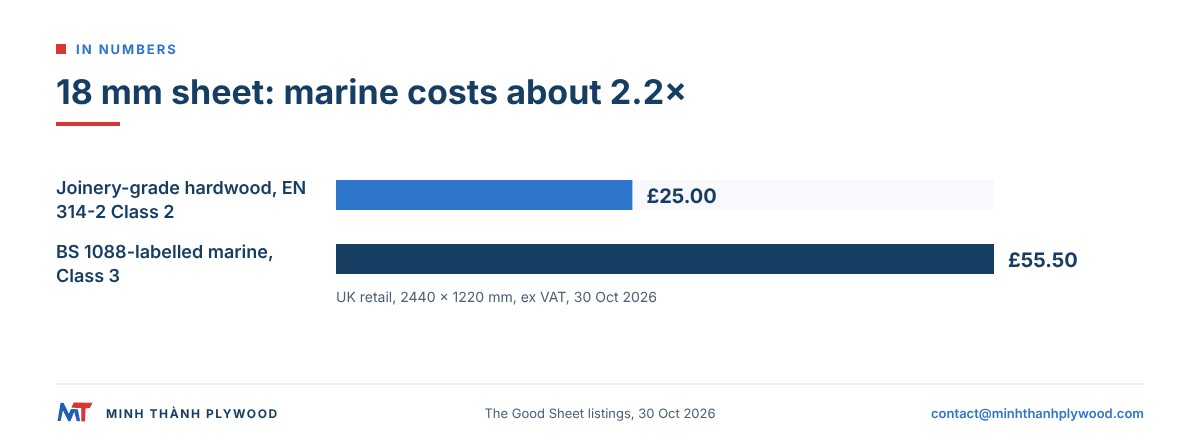
- Cost. In the UK retail prices read on 30 October 2026, an 18 mm marine sheet cost about 2.2 times a joinery-grade hardwood sheet with an EN 314-2 Class 2 bond.
- Not maintenance-free. The bond is waterproof; the veneers are not. Edges and faces need sealing or paint outdoors.
- Over-specified indoors. Cabinets, wardrobes and interior doors gain nothing from a boat-building standard.
- Wrong for formwork. Without a film, its faces take up cement water and wear quickly; film-faced plywood is the panel for concrete.
- Labels are unreliable. Ask for the standard, the species and an EN 314-2 Class 3 bond report from a third-party laboratory.
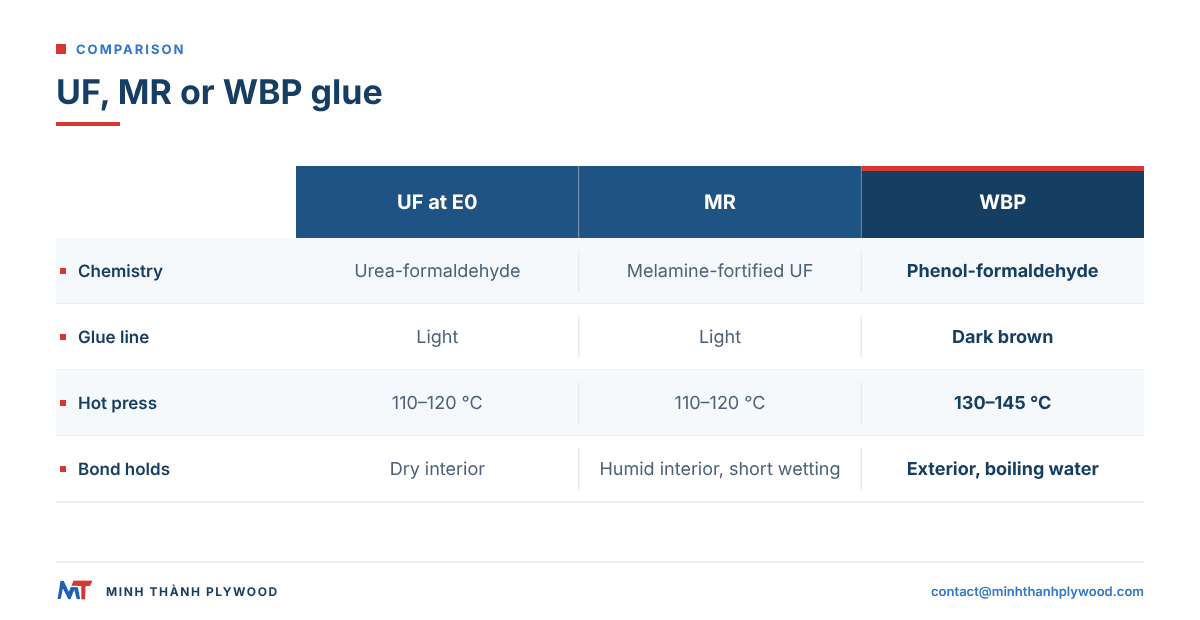
The glue is the first difference: MR vs WBP
MR glue resists humidity and short wetting; WBP phenolic glue resists boiling water and long exposure. That single change decides whether a panel survives outdoors more than any face or label.
| Glue | Chemistry | Colour of glue line | Hot press temperature | Bond holds |
|---|---|---|---|---|
| UF at E0 emission | Urea-formaldehyde | Light | 110–120 °C | Dry interior |
| MR | Melamine-fortified UF | Light | 110–120 °C | Humid interior, short wetting |
| WBP | Phenol-formaldehyde | Dark brown | 130–145 °C | Exterior, boiling water |
A quick check at the edge: a dark glue line between plies points to phenolic glue; a pale line points to UF or MR. It is a first sign only; a bond test settles it.
Glue type and emission class are separate lines on a specification. A UF glue at E0 emission is the low-emission choice for furniture; WBP phenolic is the waterproof choice for exterior. Minh Thanh makes MR and WBP bonds to the customer’s specification.
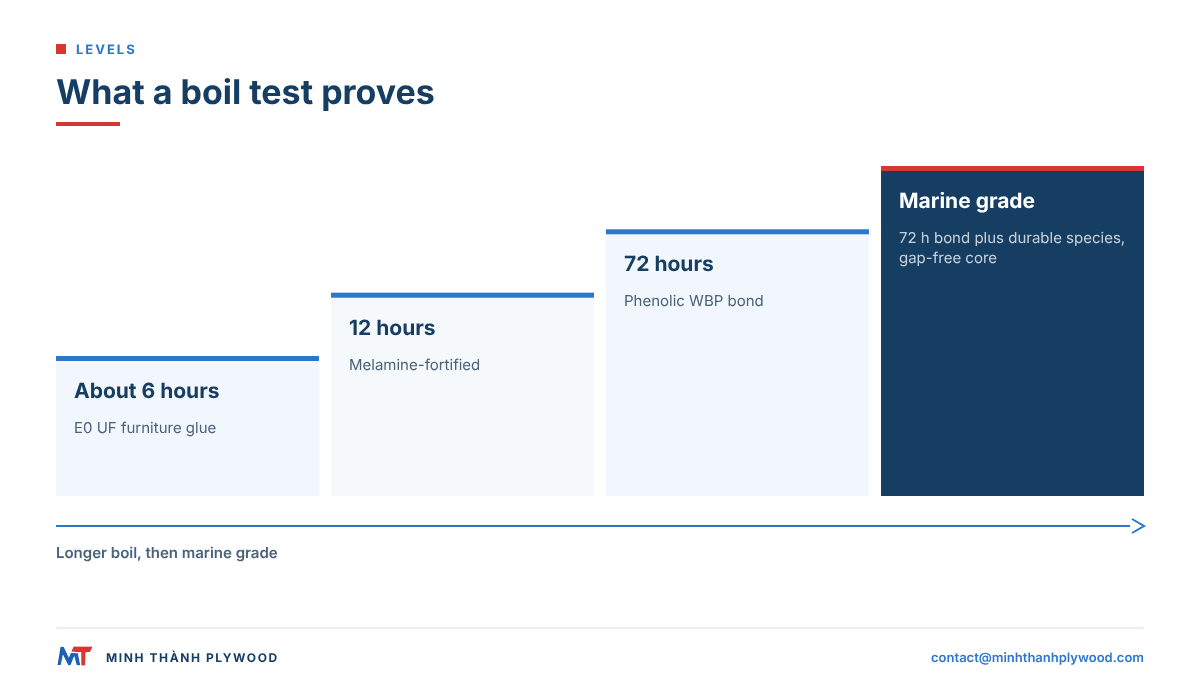
Boil tests: 6 hours, 12 hours, 72 hours, and what they prove
A boil test checks the glue bond on a sample, not the emission or the core. Longer boils prove stronger bonds, but no boil test on its own makes a panel marine grade.
How the common figures read at a Vietnamese mill:
- About 6 hours: the E0 UF glue standard for furniture panels holds a boil of about six hours.
- 12 hours: an exterior-use bond for humid and outdoor jobs needs melamine-fortified glue; emission at that level is usually E1.
- 72 hours: the traditional long boil test (IS 710 and the old BS WBP test) for phenolic bonds.
The bonding-quality requirements for plywood in Europe are set in BS EN 314-2:1993, as the BSI record describes it.
A panel that passes 72 hours of boiling has a waterproof bond. It still may have a core with gaps or non-durable veneers. That is why a buyer for boats asks for the marine standard, not only a boil result, and a buyer for sheds or stair treads is well served by exterior plywood with a WBP bond.
EN 314-2 sets three bond classes: Class 1 for dry interior use, Class 2 for humid conditions and Class 3 for exterior use. A test report that states the class is a stronger proof than a boil time quoted on its own.
Which plywood is most waterproof?
No plywood is fully waterproof, because wood takes up water; what can be waterproof is the glue bond. Plywood with a phenolic WBP bond, tested to EN 314-2 Class 3, is the most water-resistant type, and marine plywood adds durable veneers and a gap-free core so the panel survives permanent wetting.
| Panel | Bond | What else resists water | Best for |
|---|---|---|---|
| Commercial plywood, MR | Melamine-fortified UF | Nothing beyond the glue | Humid interiors |
| Exterior plywood | WBP phenolic or melamine-fortified | Sealed edges and paint on site | Rain and weather |
| Film-faced plywood | Phenolic or melamine-fortified | Phenolic film on both faces, painted edges | Concrete formwork |
| Marine plywood | WBP phenolic, Class 3 | Durable species, gap-free core | Boats, docks, permanent wetting |
Core voids: why marine plywood allows none
Marine plywood allows no gaps or overlaps between core veneers, because a void collects water, weakens the panel at that point and starts rot inside a hull. Commercial plywood allows small gaps, which do not matter in a dry cabinet.
Where core quality shows in use:
- Screws and fasteners that hit a void lose grip.
- Edges cut through a void show a hole that needs filling.
- Thin faces dip over a void and telegraph under gloss.
- Wet panels take water into the void and swell or rot.
Furniture plywood closes most of that gap without being marine. Minh Thanh stitches furniture cores horizontally and vertically so core veneers stay closed in the press, then presses and calibrates the core before the faces go on. The result is a near void-free furniture core, bonded with interior glue for interior use.
A buyer can see core quality in a few seconds. Cut a strip from the panel edge, or look at the sheet edge in good light, and count the plies. Dark holes or thin wedges between plies are gaps; ridges where two veneers overlap show as uneven lines. A marine panel shows none along its whole edge.
Commercial ply vs marine ply price: why marine costs more
Marine ply costs well above commercial ply because every layer is selected durable veneer, the phenolic glue and hotter pressing cost more, and the gap-free core rejects more veneer. Commercial ply is the cost-effective panel wherever the panel stays dry.
Cost drivers, marine against commercial:
| Driver | Commercial plywood | Marine plywood |
|---|---|---|
| Veneer species | Plantation Acacia, Eucalyptus | Durable species, imported |
| Veneer grading | Normal | Strict, more rejected |
| Glue | UF or MR | Phenolic |
| Press temperature | 110–120 °C | 130–145 °C |
| Core laying | Loose-laid or jointed | Gap-free, slower |
| Testing and marking | On request | To the standard |
The main reason is mill yield: the marine standard rejects veneer with voids, splits and open defects, so less of each log ends up in a sold panel. BS 1088 also sets face veneers of 1.3–3.8 mm on multi-ply boards, a maximum core veneer thickness and a thickness tolerance for each nominal thickness, and a buyer should ask for an accredited third-party EN 314-2 Class 3 test report rather than the factory’s own QC sheet.
Commercial ply vs marine ply price by grade
At retail, an 18 mm BS 1088-labelled marine sheet costs about 2.2 times a joinery-grade hardwood sheet of the same size; at the mill, commercial plywood starts from US$250/m³ FOB. The figures below are dated references, not a price list.
| Panel, 18 mm | Grade and bond | Price | Basis |
|---|---|---|---|
| Commercial plywood, Acacia or Eucalyptus core | AB core, faces to the buyer’s sample, UF or MR | From US$250/m³, about US$13.40 per 1220 × 2440 mm sheet | FOB Hai Phong, Minh Thanh, October 2026 |
| Furniture plywood, stitched Styrax or Eucalyptus core | Sanded faces, UF glue at E0 emission | From US$350/m³, about US$18.75 per sheet | FOB Hai Phong, Minh Thanh, October 2026 |
| Exterior plywood | C/D faces, WBP phenolic or melamine-fortified | Quoted on the specification | FOB Hai Phong |
| Joinery-grade hardwood plywood, poplar core, eucalyptus faces, 2440 × 1220 mm | EN 636-2, EN 314-2 Class 2 bond | £25.00 ex VAT per sheet | UK retail, one sheet, read 30 October 2026 |
| Marine plywood, 2440 × 1220 mm | BS 1088-labelled, EN 314-2 Class 3 bond | £55.50 ex VAT per sheet | UK retail, one sheet, read 30 October 2026 |
The two UK retail prices are from one merchant’s listings, The Good Sheet joinery-grade hardwood sheet and its BS 1088 marine sheet, read on 30 October 2026. The marine listing itself says the panel is not recommended for boat-building, which shows why a label is not a specification.
Mill prices move with grade, not only with the panel name. A better face grade, a stitched or gap-free core, WBP glue instead of MR, a tighter tolerance and a thinner panel (more veneer and glue per m³) each raise the price per m³; a full container of one specification lowers it. At US$250/m³, 18 mm commercial plywood works out at about US$0.42 per square foot FOB, before freight, duty and the importer’s margin.
A 40HC holds about 47 m³ (880 sheets) of 18 mm Acacia-core plywood or about 43 m³ (795 sheets) of Eucalyptus-core plywood, so the price per m³ is the figure to compare between quotes, not the price per sheet alone.
The money saved by matching the panel to the job is real. A furniture plant that orders marine ply for kitchen carcasses pays for a boat-building standard the cabinets never use. A contractor who orders commercial ply for an outdoor stair pays twice, once for the panel and again to replace it. The decision table below avoids both mistakes.
The grey zone: jobs where buyers pick the wrong panel
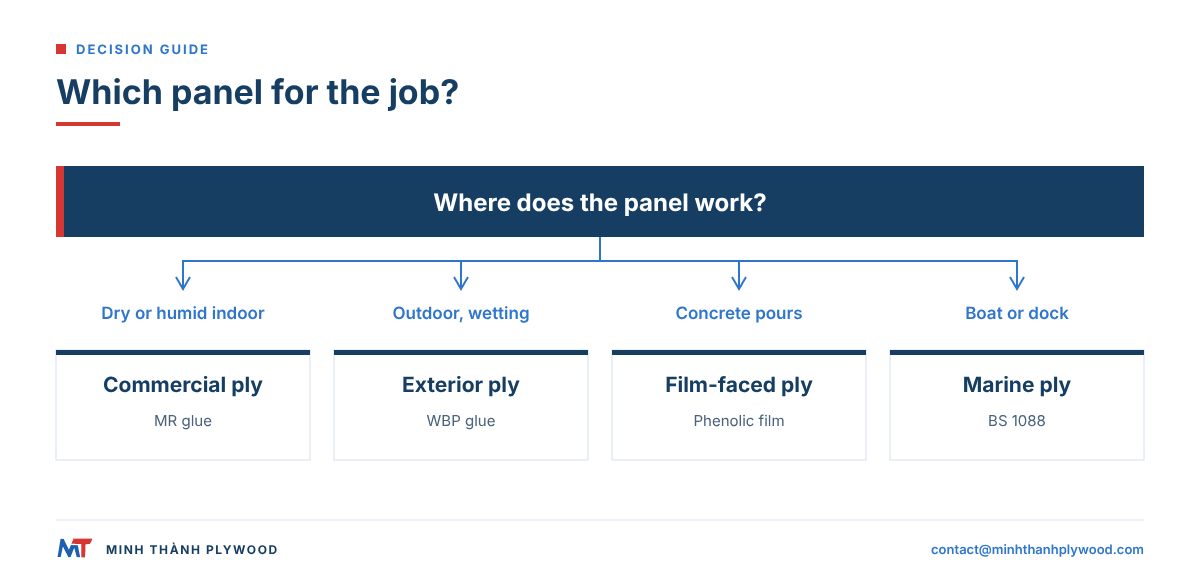
Most wrong choices go two ways: paying for marine ply in a job that needs only exterior ply, or using commercial ply where water stays on the panel. The table puts common jobs in the right column.
| Job | Panel to order | Why |
|---|---|---|
| Kitchen and bathroom cabinets | Commercial or furniture plywood, MR glue | Humid, not wet; seal edges near sinks |
| Shelving, wardrobes, furniture | Commercial or furniture plywood | Dry interior |
| Interior doors | Commercial or furniture plywood | Dry interior |
| Exterior doors | Plywood with WBP glue, sealed | Rain and sun |
| Wall sheathing, stair treads, roofs under cover | Exterior plywood, WBP or melamine-fortified | Weather, not immersion |
| Sheds, planters, outdoor furniture | Exterior plywood, painted | Wetting and drying |
| Concrete formwork | Film-faced plywood | Release and reuse |
| Boat hulls, decks, docks | Marine plywood to BS 1088 | Permanent wetting |
| Packing cases and crates | Packing plywood | One-way use |
For formwork, film-faced plywood is the right panel: its phenolic film and glue release concrete cleanly and survive repeated pours. See film-faced plywood.
Marine plywood vs commercial plywood for doors in India
In India, commercial plywood to IS 303 (MR grade) is used for interior doors and furniture, and marine plywood to IS 710 for kitchens, bathrooms and exterior doors. Many Indian buyers also use BWR-grade IS 303 plywood as the middle option.
Buyers who compare BWP vs BWR vs HDHMR should note that HDHMR is a high-density fibre board, not a veneer plywood, so it is compared on its own board standard rather than on IS 303 or IS 710.
| Indian grade | Standard | Bond | Typical use |
|---|---|---|---|
| MR | IS 303 | Moisture resistant | Interior furniture, wardrobes, interior doors |
| BWR | IS 303 | Boiling water resistant | Kitchens, bathroom cabinets |
| BWP / marine | IS 710 | Boiling water proof | Exterior doors, wet areas, boats |
For export orders to India, faces such as gurjan are the familiar look. Minh Thanh presses gurjan faces on request; the gurjan plywood page shows the face. Specify the bond you need on the order line rather than the grade name alone.
Commercial or marine plywood for Australian buyers
Australian buyers choose by standard: marine plywood to AS/NZS 2272, structural and exterior plywood to AS/NZS 2269 with a Type A (phenolic) bond, and interior or project panels with a Type C urea bond to AS/NZS 2270. Marine ply to AS/NZS 2272 uses listed durable species such as hoop pine, one species per ply, AA or OO faces and tight limits on core gaps; structural plywood has the same phenolic bond but allows ordinary veneer grades.
| Australian use | Standard | Bond | Panel |
|---|---|---|---|
| Boats, wet marine work | AS/NZS 2272 | Type A phenolic | Marine plywood |
| Decks, bracing, structural, exterior | AS/NZS 2269 | Type A phenolic | Structural or exterior plywood |
| Furniture, joinery, linings, project panels | AS/NZS 2270 | Type C interior | Commercial plywood |
Look for the EWPAA brand, certified under JAS-ANZ, on structural plywood; the EWPAA design guide says the mark certifies compliance with AS/NZS 2269. Imported marine ply is often described as AA or BB, a face grade and not a standard, so ask for the standard and the third-party report in writing. Australian sheets are commonly 2400 × 1200 mm, so a Vietnamese mill can cut to that size; import quotes are given in AUD per m³ or per sheet landed. Most Australian jobs that ask for marine ply are served by exterior plywood with a phenolic bond, which costs less.
Commercial or marine plywood for UAE and Gulf buyers
Gulf buyers use commercial plywood for joinery, furniture and fit-out in air-conditioned interiors, and exterior or marine plywood for outdoor and coastal work. Heat and humidity outdoors make the glue line the deciding point.
Practical guidance for UAE, Kuwait and other Gulf importers:
- Fit-out and furniture: commercial plywood with bintangor or okoume faces, MR glue.
- Outdoor joinery and coastal sites: exterior plywood with WBP phenolic glue, sealed and painted.
- Formwork on construction sites: film-faced plywood, not marine.
- Boats and marinas: marine plywood to BS 1088.
Shipping time from Hai Phong to the Middle East is typically 15–25 days at sea, by carrier and route. Production takes 15–45 days after the 30% deposit.
How to check what you received: commercial or marine?
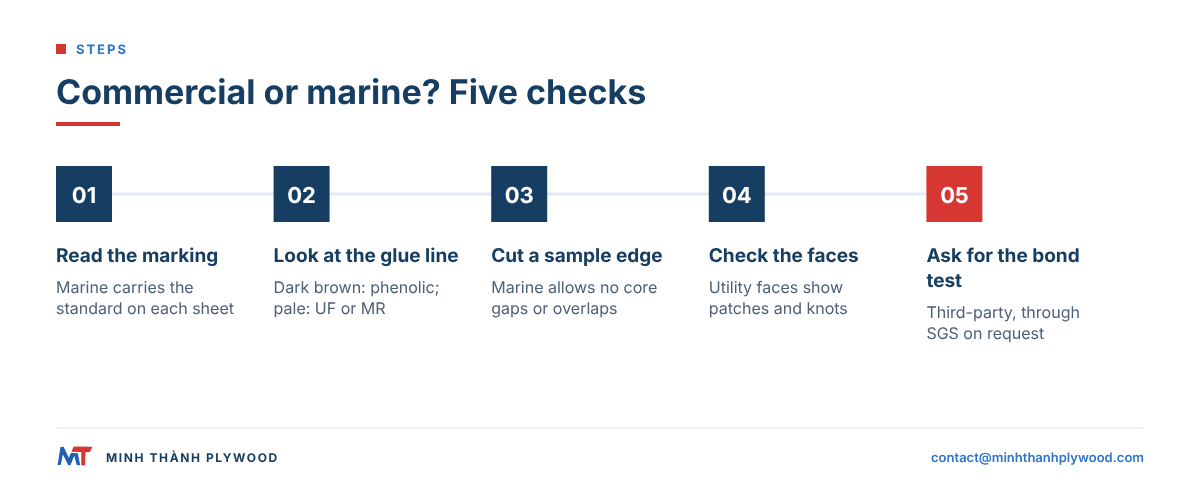
Five checks on arrival tell commercial, exterior and marine plywood apart before the panels go into a job.
- Read the marking. Marine panels carry the standard on each sheet; commercial panels carry the buyer’s label.
- Look at the glue line. A dark brown line between plies points to phenolic; a pale line to UF or MR.
- Cut a sample edge. Count the plies and look for gaps or overlaps in the core; marine allows none.
- Check the faces. Marine faces are clean and durable; utility faces show patches and knots.
- Ask for the bond test. A third-party boil test on a sample settles the glue; Minh Thanh arranges third-party testing through SGS on request.
Measure thickness at several points too. Commercial plywood at ±0.5 mm and sanded furniture plywood at ±0.2–0.3 mm are normal; wider spreads point to a poorly calibrated panel.
What Minh Thanh supplies: commercial and exterior plywood
Minh Thanh makes commercial plywood for dry and humid interiors and exterior plywood for wet and outdoor jobs. For work that needs a waterproof bond without the boat standard, our exterior plywood uses phenolic WBP or melamine-fortified glue with C/D utility faces.
- Commercial plywood: Acacia or Eucalyptus cores, bintangor, okoume, gurjan, poplar or eucalyptus faces, UF, MR or WBP glue to order, ±0.5 mm, from US$250/m³ (October 2026).
- Exterior plywood: WBP phenolic or melamine-fortified glue, C/D faces, for stair treads, sheathing and roofs.
- Furniture plywood: Styrax or Eucalyptus cores, stitched, double-pressed, UF glue at E0 emission, ±0.2–0.3 mm.
- Proof: CARB P2 / TSCA Title VI (ICTT mill no. 23024) and six ASTM D6007 chamber tests that averaged 0.014–0.032 ppm against the 0.05 ppm limit.
- Sizes: 1220 × 2440 and 1250 × 2500 mm, 3–40 mm thick.
The limit for veneer-core hardwood plywood is 0.05 ppm under 40 CFR 770.10, checked on 27 October 2026. The commercial plywood range and exterior plywood page list the full specifications.
What to write on your order
Write the job and the glue first, then the panel. “Marine plywood” on an order for kitchen cabinets wastes money; “plywood” on an order for outdoor stairs gets the wrong glue.
- Application: furniture, kitchens, interior doors, exterior joinery, sheathing or boats; indoor or outdoor.
- Core: Acacia, Eucalyptus or Styrax; stitched or jointed; gap-free if required.
- Glue and emission: UF at E0, MR or WBP phenolic; emission class or CARB P2 / TSCA Title VI.
- Face: species and face/back grade; sanded or not.
- Panel: thickness, size, tolerance.
- Packing and quantity: packs, quantity per thickness, destination port.
A filled line reads: “18 mm exterior plywood, Eucalyptus core, WBP phenolic glue, C/D faces, 1220 × 2440 mm, ±0.5 mm, export packs, one 40HC, CFR Jebel Ali.”
Order terms in short:
| Term | Minh Thanh standard |
|---|---|
| Minimum order | One 40HC; mixed specifications by agreement |
| Production | 15–45 days after the 30% deposit |
| Balance | 70% against the scanned B/L, or irrevocable L/C at sight |
| Delivery | FOB Hai Phong, CFR or CIF |
| Before loading | Every shipment photographed and filmed |
Send it through the quote form or to contact@minhthanhplywood.com. We reply within hours and send free samples so you can check the glue line yourself.
Two more lines help when the panels go outdoors: ask for edges sealed at the mill where the use is exterior, and state whether the panels will be painted on site. A sealed, painted exterior panel with a WBP bond lasts far longer than the same panel left bare.
Buyer questions, answered
What is the difference between commercial plywood and marine plywood?
Commercial plywood uses interior or moisture-resistant glue and an ordinary core for dry and humid indoor work. Marine plywood uses waterproof phenolic glue, durable face and core veneers and a gap-free core, made for boats and permanently wet places.
Is marine plywood waterproof?
Its glue bond is waterproof, and the bond survives boiling. The wood itself still absorbs water, so marine plywood needs sealing or paint to last outdoors or in a hull.
Can commercial plywood be used in a kitchen or bathroom?
Yes, for cabinets and furniture away from standing water, commercial plywood with MR glue works well. Under sinks and in wet zones, choose exterior plywood with WBP glue or seal every edge.
Why is marine plywood more expensive than commercial plywood?
Marine plywood uses selected durable veneers, phenolic glue pressed at a higher temperature, and a core with no gaps, so more veneer is graded out. The extra material, rejected veneer and testing raise the cost.
What is BS 1088 marine plywood?
BS 1088 is the British standard for marine plywood, covering durable species, veneer quality, gap-free cores and a boil-proof phenolic bond. Panels sold for boats should be marked and certified to it.
Does a 72-hour boil test prove plywood is marine grade?
No. A long boil test checks that the glue bond holds, which exterior and marine plywood both need. Marine grade also requires durable veneers, a gap-free core and face quality to the marine standard.
Which plywood is better for doors, commercial or marine?
For interior doors, commercial or furniture plywood is enough and cheaper. For exterior doors and doors in permanently wet areas, use plywood with phenolic WBP glue.
Is exterior plywood the same as marine plywood?
No. Both use waterproof phenolic or melamine-fortified glue, but exterior plywood allows ordinary core species and some core gaps, with utility faces. Marine plywood adds durable veneers and a gap-free core.
How much does commercial plywood cost?
Minh Thanh's commercial plywood starts from US$250/m³ FOB (October 2026), about US$13.40 for an 18 mm 1220 × 2440 mm sheet or US$0.42 per square foot, and furniture or interior plywood from US$350/m³. Face grade, core, glue, thickness and quantity set the final price.
What are the downsides of marine plywood?
Marine plywood costs about twice as much as ordinary hardwood plywood, still needs sealing because the wood absorbs water, and is wasted money in dry or humid indoor jobs. The word marine on a label proves nothing without the standard and a test report.
Which plywood is most waterproof?
No plywood is fully waterproof; the glue bond is. Phenolic WBP bonds (EN 314-2 Class 3) resist boiling water; marine plywood adds durable veneers and a gap-free core for permanent wetting, and film-faced plywood adds a phenolic film for concrete work.
Is commercial plywood good for furniture?
Yes. Commercial plywood with MR glue suits cabinets, shelving and fit-out that stays dry or humid. For visible faces, tight tolerance and low emission, furniture plywood with a stitched core and UF glue at E0 emission is the better panel.
Should I use marine plywood for concrete formwork?
No. Formwork needs film-faced plywood, whose phenolic film and glue release concrete cleanly and survive repeated pours. Marine plywood without a film costs more and wears faster in that job.
What do IS 303 and IS 710 mean in India?
IS 303 is the Indian standard for general-purpose plywood, with MR and BWR grades. IS 710 is the Indian standard for marine plywood with boiling-water-proof bonds.