
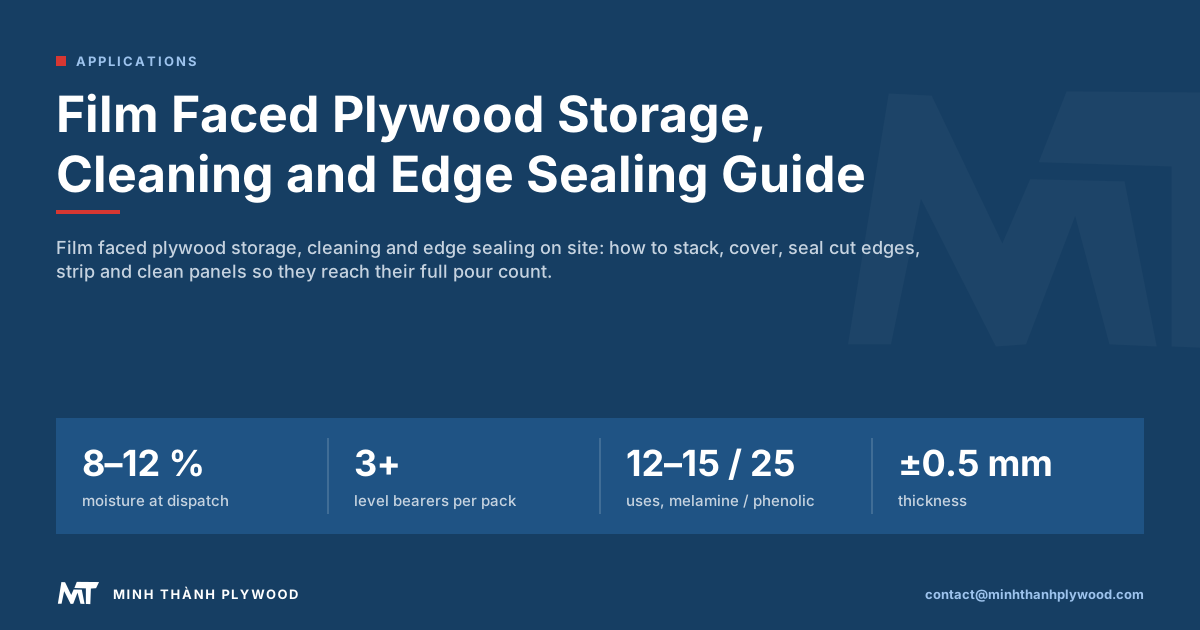
Film faced plywood storage decides how many pours a panel gives: keep packs flat, covered and off the ground, seal every cut edge the same shift, apply release agent before each pour and clean the face as soon as it is stripped. Minh Thanh Plywood makes film-faced formwork panels with factory-sealed edges, and this guide sets out the site routine that protects them.
Film faced plywood storage: the short answer
Film faced plywood storage comes down to five habits: flat, dry, covered, sealed and clean. A panel that sits flat on level bearers, under a ventilated cover, with every cut edge sealed and its face cleaned after each pour keeps its film and core in shape; the same panel left wet on uneven ground can fail in a few pours.
- Flat: three or more level bearers under every pack, aligned top to bottom.
- Dry: clear of the ground, out of puddles, edges never standing in water.
- Covered: a sheet that sheds rain and sun but lets air move under it.
- Sealed: every cut, hole and chipped corner painted before the next pour.
- Clean: residue removed right after stripping, release agent before every pour.
The rest of this guide turns those habits into a site routine, step by step.
Australian film faced plywood sizes, grades and prices
Australian shops sell film faced plywood as 2400 × 1200 mm sheets in 9, 12 and 17 mm, and 17 mm is the usual formwork board. Two products share the black film: non-structural film faced plywood for lighter shuttering, and F17 formply, which carries a structural stress grade for load-bearing forms and is made to AS 6669.
| Product | Sheet and thickness | Structural grade | Indicative price per 17 mm sheet (A$) |
|---|---|---|---|
| Non-structural film faced plywood | 2400 × 1200 mm in 9, 12 and 17 mm (Bunker) | None; lighter-duty shuttering, trays, shelving | 60.00 (Just Plywood); 84 (Bunnings) |
| F17 formply | 2400 × 1200 × 17 mm | F17, AS 6669 | 81.50 (ausf); 90.00 (Blacktown Building Supplies) |
| Minh Thanh film faced plywood | 1220 × 2440 mm, 12–21 mm including 17 mm | Sold as film faced plywood to the buyer’s specification | CIF quote per container |
Prices were checked on 21 October 2026 and move by state and supplier. The same storage rules apply to both products. An Australian importer who buys film faced plywood by the container sells the non-structural line and leaves the F17 stamp to the mills that hold the AS 6669 certification.
What moisture content and storage conditions does film-faced plywood need?
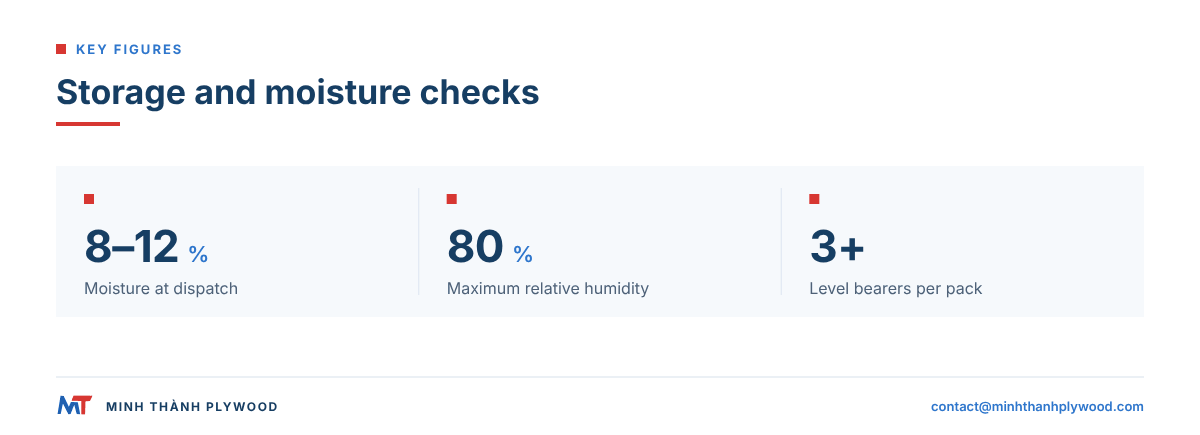
European plywood for dry, humid or exterior use is specified in BS EN 636. Film-faced plywood needs storage that keeps its core near the moisture it left the factory with; ours is dispatched at 8–12 % moisture content, the normal range for plywood, with the film on both faces and the four edges painted. Water does not get through the film; it gets in through edges, holes and damaged corners.
| Condition | What to aim for | Why it matters |
|---|---|---|
| Moisture at delivery | 8–12 % at dispatch | Stable core, flat sheets |
| Ground contact | None: packs on bearers | Ground moisture wicks into the bottom sheets |
| Rain and sun | Covered, ventilated | Wet edges swell; hot sun dries the top sheet unevenly |
| Storage temperature | –40 °C to +50 °C | The range plywood makers publish for film-faced packs |
| Relative humidity | 80% at most | Above this the core takes water through the edges |
| Bearers | At least 50 mm thick and as long as the pack is wide | No sag, no overhang at the pack ends |
| Strapping in long storage | Cut and remove the tapes | Stops strap marks on the top and bottom sheets |
| Air movement | Gap between cover and pack | Stops condensation under plastic |
| Edges | Sealed at all times | The core takes water only through bare wood |
Concrete sites are wet places, so the aim is not a dry warehouse but a routine that keeps water away from the edges and lets the panels dry evenly after rain.
How to receive and unload a film-faced container
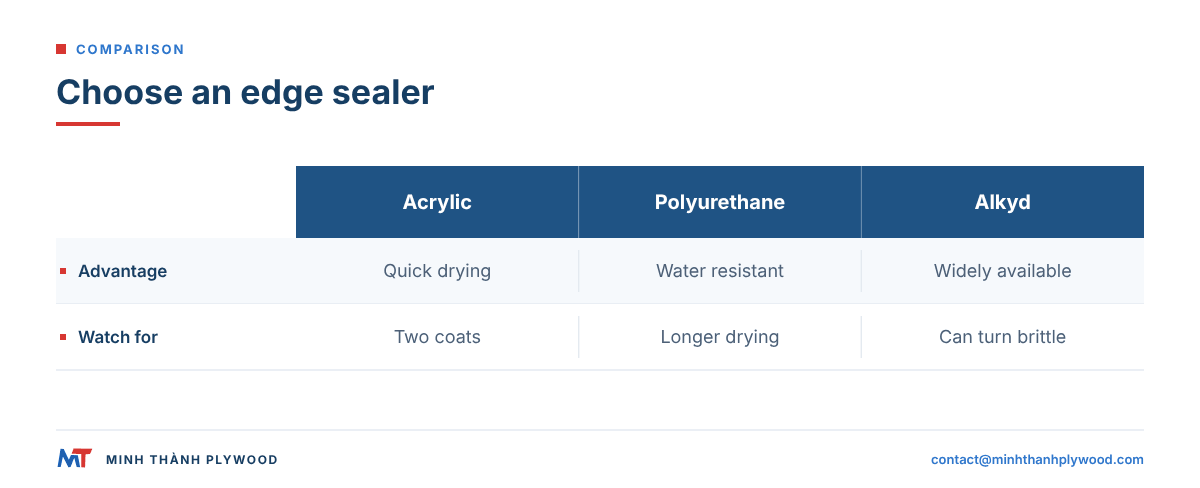
Receiving decides whether a later problem can be traced. Record the delivery before the first pack moves, then unload so the packs stay flat and the edges are not crushed.
- Photograph the container as it opens: seal, door view and the first row of packs.
- Check pack labels against the packing list: thickness, size, film and glue per pack.
- Lift with wide forks or slings and edge protectors; never drag a pack off the floor.
- Set packs straight onto level bearers, not onto the ground or a single timber.
- Keep the straps and wrap on until the pack is needed on the deck or wall.
- Note any damage with a photo and the pack number on the day it is found.
Every shipment we load is photographed and filmed before the doors close, and buyers receive those photos and the video; your arrival photos close the loop. An 18 mm sheet of 1220 × 2440 mm weighs about 34.8 kg on a Eucalyptus core and 31.1 kg on Acacia, so a full pack needs a forklift, not hand unloading.
How to stack film-faced plywood on site
Stack film-faced plywood flat, on three or more level bearers that line up vertically through every layer of packs, so no sheet bends between supports. A sheet that dries while bent keeps the bend, and a bowed panel leaves a step at every joint of the form.
| Do | Do not |
|---|---|
| Three or more bearers per pack: near each end and in the middle | One bearer in the middle, or sheets resting on rubble |
| Bearers aligned top to bottom when packs are stacked | Bearers offset between layers |
| Same size and thickness in one stack | Short sheets on top of long ones |
| Opened packs restrapped or weighted with a flat sheet | Loose sheets left to curl in the sun |
| Stacks on firm, drained, level ground | Stacks on mud, slopes or in hollows |
| Face-to-face storage of used panels | Stacking with concrete crumbs between faces |
Used panels go back on the stack face to face after cleaning and oiling, so any grit left on one face does not press into the other. Keep the stack low enough for safe lifting, and stack packs of the same size together so their bearers align.
Storage in hot, humid and rainy sites
In hot and humid climates the risk is uneven drying and trapped condensation, not just rain. A black film panel in full sun can get hot on top while its underside stays damp, and that difference is what bows sheets and opens hairline checks at the edges.
- Shade first: an opaque or reflective cover, or a roof, over every pack.
- Ventilate: tie the cover so air moves under it; never wrap packs airtight in clear plastic.
- Drain: keep the ground under the stack dry; raise the bearers if water pools after rain.
- Rotate stock: use the oldest packs first so no pack sits outside for a full season.
- Dry before stacking: let wet used panels drain on edge or on spacers before they go back on the stack.
- Check edge paint monthly: hot sun and rain together crack edge paint faster.
For projects in the Gulf and Africa, our guide to film-faced plywood for hot climates covers panel choice as well as storage.
How to seal film faced plywood edges after every cut
Seal film faced plywood edges in the same shift as the cut: bare end grain draws water far faster than the face, and a cut edge left open through one pour can swell the outer plies and lift the film along it. Our panels leave the factory with all four edges painted; every new cut, hole or chip needs the same protection on site.
- Cut clean: a sharp fine-tooth blade, film face up on a table saw or down on a track saw, so the film does not chip. A blade of about 350 mm diameter and 3.5 mm thickness with more than 100 teeth, at 3,000 to 3,600 rpm, is the setup makers recommend for standard woodworking tools.
- Check the edge: it must be dry and free of dust; brush or blow off the sawdust.
- Apply the first coat of edge sealer across the whole edge and onto the film by a few millimetres.
- Apply a second coat once the first is touch-dry; end grain soaks up the first coat.
- Seal drilled holes for ties and bolts by working sealer into the bore with a small brush.
- Touch up chipped corners and screw holes from the last pour before oiling the face.
- Let it dry before release agent goes on, or the oil stops the paint from bonding.
A panel that arrives with a damaged edge gets the same treatment before it goes into the form.
Choosing an edge sealer and a plywood end grain sealer
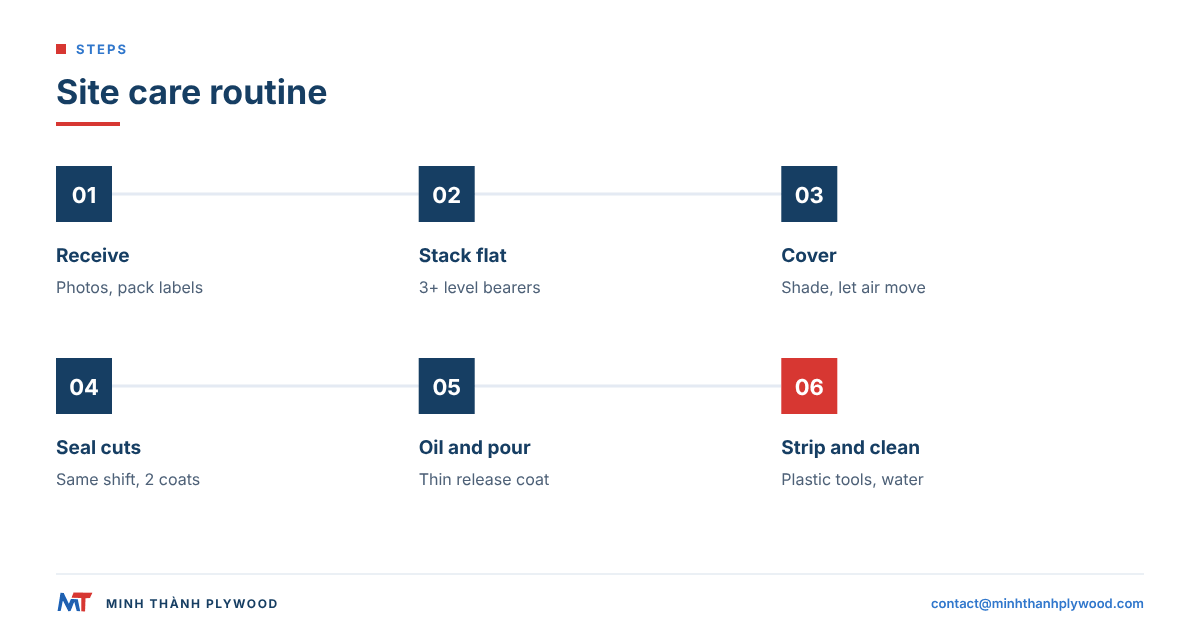
The right plywood end grain sealer for formwork is a water-resistant edge paint that stays flexible and bonds to both wood and film; acrylic and polyurethane formwork edge paints are the common choices on site. What matters more than the brand is that it is on every exposed edge before the panel meets concrete.
| Sealer type | Strengths | Watch for |
|---|---|---|
| Acrylic formwork edge paint | Water-based, quick to dry, easy on site | Needs two coats on end grain |
| Polyurethane edge sealer | Tough, highly water-resistant | Longer drying, solvent handling |
| Alkyd or solvent paint | Widely available | Slower drying, can become brittle |
| Release oil alone | None as a sealer | Does not seal end grain |
| Wax end sealers | Good for stored timber | Can block later paint coats |
Match the colour of the edge paint to the panel if you want to see later chips at a glance, and keep a tin with each crew that cuts panels.
Release agent before every pour
Apply a thin, even coat of release agent to the film before every pour; it stops concrete from bonding to the face, makes stripping easier and cuts the cleaning that wears the film. A heavy coat does not help: excess oil pools, stains the concrete and attracts dust.
- Choose a release agent made for film-faced formwork, chemical-release or mineral oil based, and check it with the finish your project needs.
- Spray or wipe a thin film onto a clean, dry face; wipe off runs and puddles.
- Oil the edges and holes after the sealer has dried, never instead of sealing.
- Keep oiled panels out of rain and dust until the pour.
- Record the product used on each batch of panels, so a stain or sticking problem can be traced.
Release agents and form oils deserve their own guide: see concrete form release agents for plywood formwork for products and dosing.
Stripping without damaging the face
Most damage to film-faced panels happens at stripping, not in the pour. Prying a sheet off with a steel bar against the film tears it, and dropping a panel on its corner crushes the edge and opens the core.
- Strip at the time the engineer sets, not early, so the concrete does not tear the face.
- Loosen ties and fixings first, then free the panel with wedges or plastic stripping tools at the frame, not on the film.
- Lower panels by hand or crane; never let a sheet fall flat or on a corner.
- Set stripped panels on edge or on spacers, not face down on rubble.
- Mark damaged panels with a crayon on the back for repair before they are cleaned and stacked.
Crews that strip with care often see more uses from a standard panel than careless crews get from a premium one. On US sites, OSHA standard 1926.703 (checked on 20 October 2026) also requires that forms are not removed until the concrete can carry its load.
How to clean film faced plywood after each pour
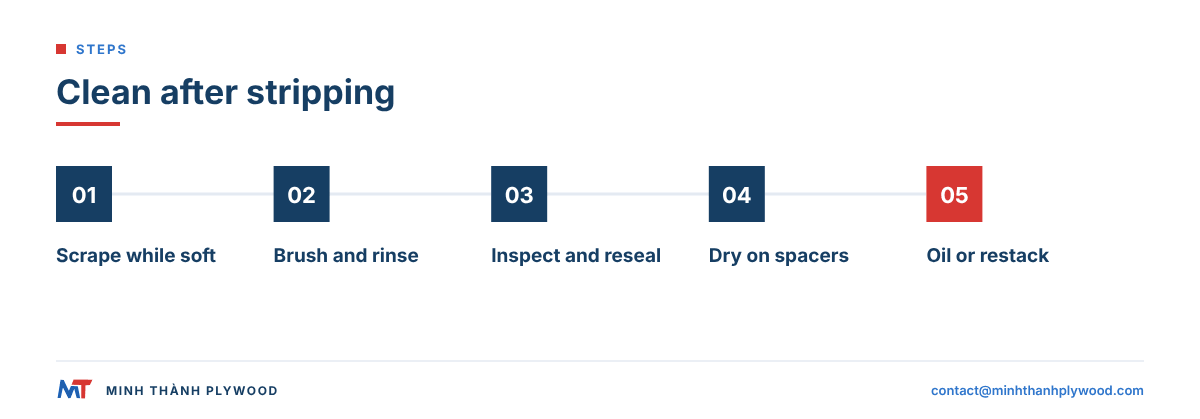
Clean film faced plywood right after stripping, while the concrete residue is still soft, with a plastic or hardwood scraper held flat, a stiff nylon brush and water. Cleaning the same day is the cheapest way to protect the film: hardened residue needs force, and force wears the face.
- Scrape loose concrete with the scraper held flat to the face, working along the sheet.
- Brush and rinse with clean water; a low-pressure hose is enough.
- Check edges and holes while the panel is clean and repaint any bare wood.
- Let the panel dry on edge or on spacers before oiling.
- Apply release agent if the panel goes straight back into the form, or stack it face to face.
Avoid steel scrapers, wire brushes, angle grinders and acid cleaners on the face: they cut through the film to the veneer. A pressure washer held close to the surface can lift a film already weakened at its edges.
Residue by type: what to use
Different residues need different tools, but none of them needs metal on the film. The table matches the residue to the method.
| Residue | Method | Avoid |
|---|---|---|
| Fresh grout and laitance | Rinse and soft brush the same day | Leaving it overnight |
| Hardened concrete splashes | Plastic or hardwood scraper held flat | Steel scraper or chisel |
| Release oil build-up | Wipe with a cloth and mild detergent, rinse | Solvents that soften the film |
| Rust stains from ties | Brush and rinse; seal the hole | Acid cleaners |
| Tape and marker | Peel tape slowly; clean with a cloth | Scraping with a knife |
| Mud and dust | Rinse and dry before oiling | Oiling over dirt |
A clean face also shows damage clearly, which makes the next inspection quicker.
Inspection, repair and retiring a panel
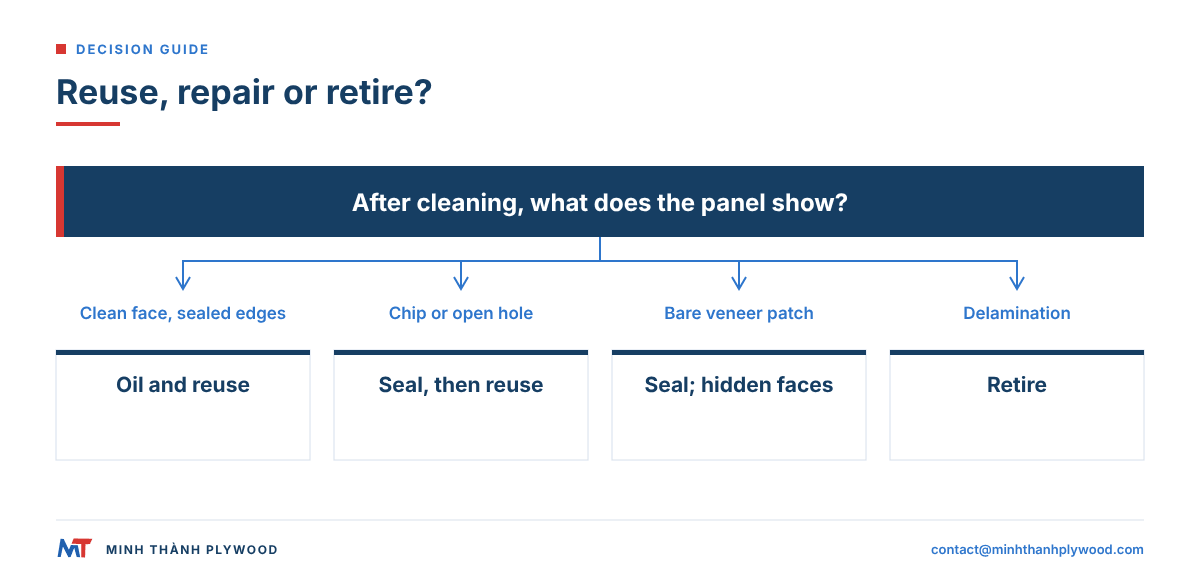
Inspect every panel after cleaning and sort it into one of three piles: back into service, repair first, or retire. A quick check costs minutes; a damaged panel left in the form costs a patched concrete face.
| Finding | Action | Panel status |
|---|---|---|
| Clean face, sealed edges | Oil and reuse | In service |
| Small film scratch, no bare wood | Reuse; watch it | In service |
| Chipped corner or open screw hole | Seal with edge paint, then reuse | Repair first |
| Bare veneer patch on the face | Seal; use for hidden faces only | Repair, then downgrade |
| Edge swelling or film lifting at an edge | Cut back the swollen strip and reseal if the size allows | Repair or retire |
| Delamination, soft or broken core | Remove from formwork use | Retire |
Panels too worn for fair-faced concrete can still serve hidden faces, footings and site protection before they are scrapped.
Grades of used film faced plywood
When panels are resold or moved between sites, the market sorts them into three types by uses and surface:
| Type | Uses so far | Surface | Suitable for |
|---|---|---|---|
| Type 1 | 1 to 2 | Film in good condition | Fair-faced concrete, walls and columns |
| Type 2 | 3 to 5 | Light scratches | Slabs, footings, hidden faces |
| Type 3 | Heavily worn | Film worn through, poor reuse | Site protection, hoarding, scrap |
The bands follow a Longdat guide to used film-faced plywood (checked on 21 October 2026). For concrete formwork, buy Type 1 to keep a smooth finish and easy stripping, and check thickness and core on every lot.
Maintenance routine and the pour log
Reuse is a target that depends on the panel and the site together: as an industry guide, melamine-fortified film-faced plywood gives about 12–15 uses and phenolic (WBP) panels up to about 25, with proper handling, release agent and edge sealing. A pour log shows whether a site is reaching that range.
- Number the panels or batches on the back when they arrive.
- Log each pour: date, element, panels used, release agent, any damage found.
- Log repairs and retirements with the reason: stripping damage, edge swelling, film wear.
- Compare batches: if one batch retires early, check its storage and handling first, then its build.
Our standard film is about 120–135 g/m² and premium film starts from about 135 g/m²; the heavier film and the phenolic glue line give the most pours when storage and cleaning are right. The log also gives the next order its real numbers: cost per pour, not cost per sheet.
What a supplier can check, and what site handling decides
A supplier can check how a panel was made; it cannot see how it was stored. A manufacturing question is easiest to answer on sheets that were stored flat, kept sealed and recorded on arrival, with their pack labels kept. The bonding-quality classes for plywood are set out in BS EN 314-2.
| Issue | Usually points to | Evidence that helps |
|---|---|---|
| Thickness outside ±0.5 mm on new sheets | Manufacture | Calliper readings at several points, pack label |
| Delamination on an uncut, unused sheet | Manufacture | Photo, sheet and pack number |
| Edge swelling after cutting | Unsealed cut edges | Photo of the cut, sealer record |
| Film torn in patches | Stripping or cleaning tools | Pour log, crew notes |
| Bowed sheets from one stack | Storage on uneven bearers | Stack photo |
| Wet core on the bottom sheets | Ground contact or standing water | Stack photo, weather record |
Keep the arrival photos, pack labels and pour log together. With them, any question about a batch can be answered quickly, and the next order can be adjusted to the site.
What this means for your film-faced order
A film-faced order that suits your site names the build and the care conditions together. Send these lines with your request:
- Application and pours: walls, slabs, columns or footings, and the planned number of pours.
- Core: Eucalyptus or Acacia.
- Glue: melamine-fortified for medium reuse, phenolic (WBP) for the most pours.
- Film: about 120–135 g/m² standard or from 135 g/m² premium; brown or black.
- Size and thickness: 1220 × 2440 mm or 1250 × 2500 mm; 12–21 mm, ±0.5 mm.
- Packing and quantity: from one 40HC, mixed specifications by agreement; destination port and any storage time before use.
Production is 15–45 days after the deposit, FOB Hai Phong, CFR or CIF, with free samples. See our film-faced plywood specification, the concrete form plywood buying guide and our comparison of HDO plywood vs MDO plywood for overlay choices.
Buyer questions, answered
How should film faced plywood be stored?
Store film-faced plywood flat on three or more level bearers, clear of the ground, under a cover that sheds rain but lets air move. Keep packs strapped until use and out of direct sun and standing water.
When should film faced plywood be cleaned?
Clean film-faced plywood right after stripping, while concrete residue is still soft. Residue left to harden overnight needs harder scraping, which wears the film faster.
How do you clean film faced plywood without damaging the film?
Use a plastic or hardwood scraper held flat, a stiff nylon brush and clean water. Avoid steel scrapers, wire brushes, grinders and acid cleaners on the face.
Do you need to seal the edges of film faced plywood after cutting?
Yes. Every cut edge, drilled hole and damaged corner exposes bare veneer and must be sealed with a water-resistant edge paint before the panel's first pour, ideally in the same shift as the cut.
What is the best sealer for plywood end grain on formwork?
A water-resistant acrylic or polyurethane edge paint made for formwork panels is the usual choice. Apply two coats on cut edges and work it into drilled holes; it must be dry before the panel is oiled.
What moisture content should film faced plywood have?
Our panels are dispatched at 8–12 % moisture content. Good storage keeps them close to that range: sealed edges, flat stacking and a ventilated cover stop the core from taking on water.
How many times can film faced plywood be reused?
As an industry guide, melamine-fortified film-faced plywood gives about 12–15 uses and phenolic (WBP) panels up to about 25, with proper handling, release agent and edge sealing. Poor storage cuts that number quickly.
Can film faced plywood be stored outdoors?
For short periods, yes, if packs sit on level bearers clear of the ground and under a ventilated cover. For longer storage, move them under a roof; repeated wetting and drying swells the core from the edges.
Is brown or black film faced plywood more expensive?
The colour alone does not set the grade. Quotations follow the film mass, glue and core, so compare those lines when you compare brown and black offers.
What is the minimum order for film faced plywood from Vietnam?
Our minimum order is one 40HC, with mixed specifications by agreement. Production takes 15–45 days after the 30% deposit.