
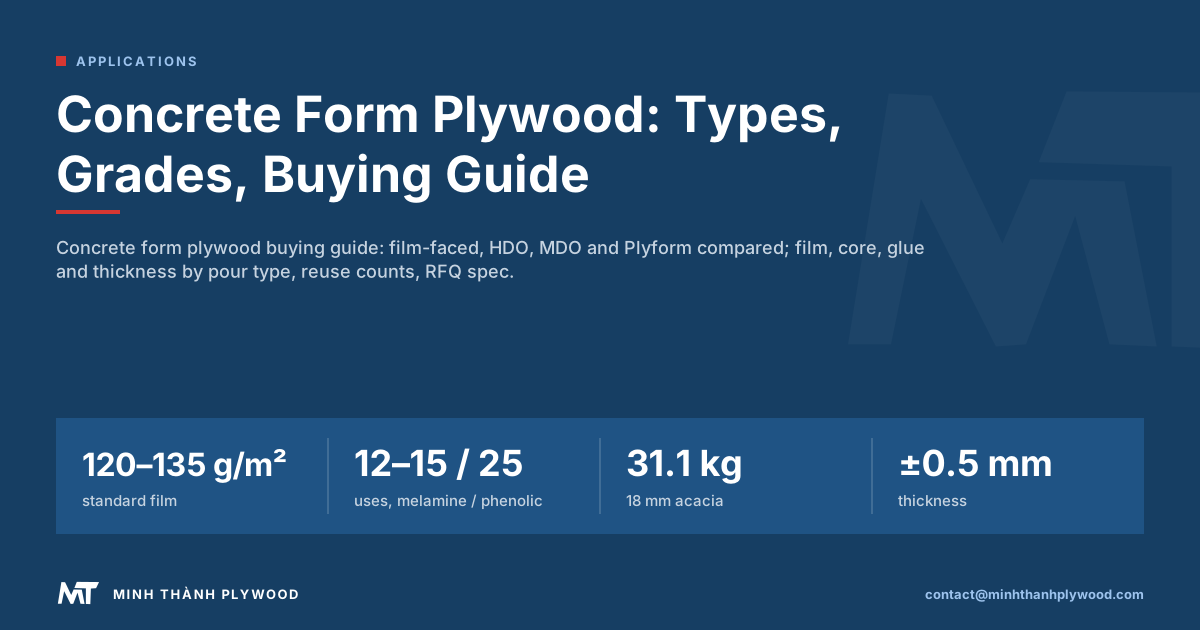
Concrete form plywood is a cross-laminated panel with a water-resistant bond and a sealed face, used as the skin that moulds fresh concrete. Buy it by four lines: face film mass, core species, glue class and thickness, matched to the pour. Minh Thanh Plywood makes 12–21 mm film-faced panels with 120–135 g/m² or premium film and melamine-fortified or phenolic WBP glue.
What is concrete form plywood?
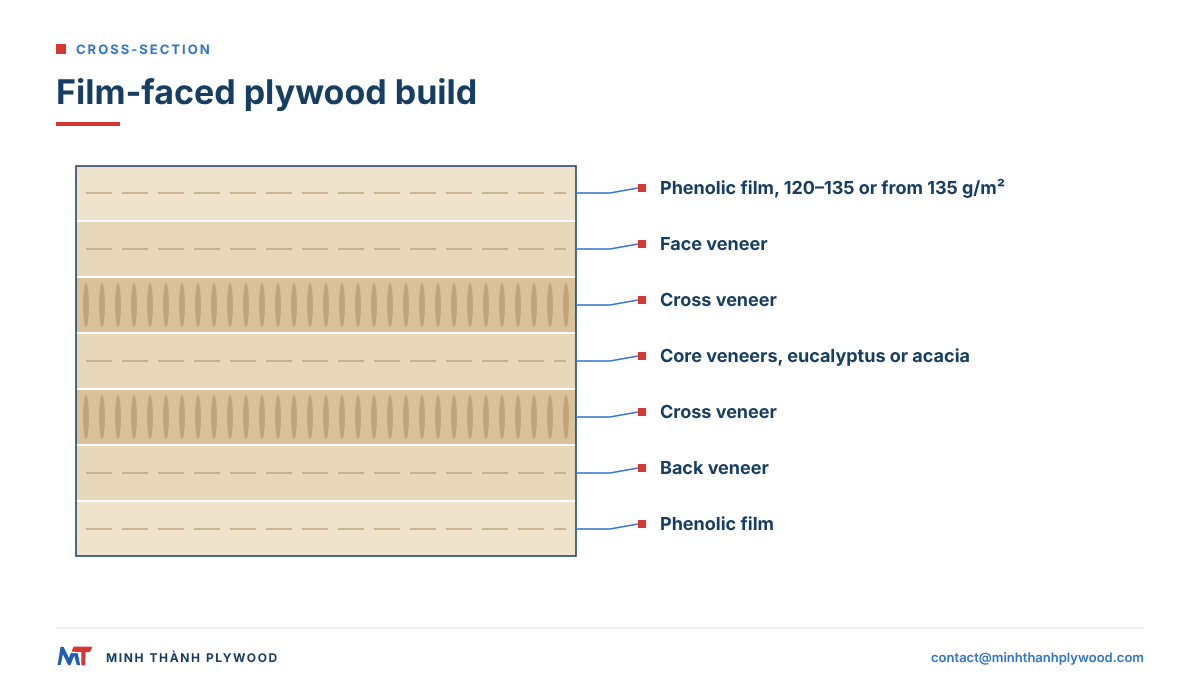
Concrete form plywood is plywood made to act as the contact skin of a concrete form: cross-laminated veneers, a glue that resists water and boiling, and a sealed face that releases cleanly from cured concrete. It is the part of the formwork the concrete touches; joists, bearers, props and ties carry the load behind it.
Three things separate it from ordinary plywood:
- A water-resistant bond. Melamine-fortified or phenolic (WBP) glue, so the veneers stay bonded through repeated wetting.
- A sealed face. A phenolic-impregnated film, a resin overlay or a heavy coat of sealer, so cement paste does not soak in and the panel strips clean.
- Sealed edges. Paint or sealer on all four edges, because water enters plywood fastest through the end grain.
Forming plywood is sold under many names and in several builds. This guide sorts them, then shows which build to buy for each pour and what to write on the order. If you are new to the whole system, start with what formwork is and how its parts work.
Formply, shuttering ply, Plyform, phenolic board: are they the same panel?
They are regional names for plywood used in concrete forms; the build behind each name differs, so compare specifications, not labels.
| Name | Where it is used | What it usually means |
|---|---|---|
| Concrete form plywood, form plywood | United States, Canada | Any plywood sold for forms; often with an overlay |
| Plyform | United States | APA-trademarked form panel graded under US Product Standard PS 1, Class I or Class II, sanded or with HDO/MDO overlays |
| Formply | Australia, New Zealand | Film-faced form panel, often graded to AS 6669 with a stress grade such as F17 |
| Shuttering plywood, shuttering ply | United Kingdom, Ireland, India, Africa | Plywood for concrete shuttering, film-faced or plain WBP |
| Film-faced plywood, film faced ply | Europe, Asia, Middle East | Plywood with a phenolic film pressed on both faces |
| Phenolic board, phenolic plywood | Middle East, Asia | Film-faced plywood, usually with phenolic glue |
| Marine form ply | Some import markets | A trade name for film-faced or WBP form panels; not marine plywood to BS 1088 |
When a drawing names a structural grade such as F17 or Plyform Class I, put it in the enquiry together with the test evidence the project needs. When it only says “shuttering ply 18 mm”, the rest of this guide gives the lines to add. APA, the Engineered Wood Association, publishes the US Plyform classes.
What plywood is used for shuttering and concrete forms?
Five builds cover almost every concrete forming job. The face decides the concrete finish and most of the reuse count; the glue and core decide whether the panel survives the wet cycles.
| Type | Face | Typical glue | Concrete finish | Reuse |
|---|---|---|---|---|
| Film-faced plywood, standard | Phenolic film 120–135 g/m² | Melamine-fortified | Smooth, even | About 12–15 uses* |
| Film-faced plywood, premium | Phenolic film from 135 g/m² | Phenolic WBP | Smooth, even | Up to about 25 uses* |
| HDO plywood | Hard, glossy resin-fibre overlay | Phenolic | Very smooth, high gloss | High, by overlay weight |
| MDO plywood | Matte resin-fibre overlay | Phenolic | Smooth matte, paintable | Medium to high |
| Sanded or B-B Plyform | Sanded veneer, oiled | Exterior phenolic | Grain may print | Low |
*With proper handling, release agent and edge sealing.
Film-faced plywood is the most traded type worldwide: it gives a smooth face at a lower cost per pour than HDO and ships in the same sheet sizes. HDO and MDO are covered in detail in our HDO vs MDO plywood guide. Plastic-faced and all-plastic panels exist as well; they are a different product with different fixing and repair.
What is the best plywood for shuttering?
The best plywood for shuttering, and the best formwork plywood in general, is the build that gives the lowest cost per usable pour for your job. For repeated wet formwork that is phenolic WBP plywood with premium film from 135 g/m² and a dense hardwood core; for a short programme, a melamine-fortified panel with standard film is cheaper per pour.
Three questions decide it:
- How many times will each panel be used? Ten pours on one building, or thirty across several sites.
- What finish does the concrete need? Fair-faced concrete that stays visible, or structural concrete that is buried, rendered or tiled.
- What does the formwork design say? Support spacing, the panel thickness and any grade the engineer names.
A panel that costs more per sheet and gives twice the uses is the cheaper form. The calculation is simple: delivered price per sheet, plus handling and repair, divided by the pours you actually get. Our guide to formwork plywood price and cost per pour works it through.
Questions about which brand to buy have the same answer. Ask any manufacturer for the film mass, glue, core species and thickness tolerance of the panel quoted, and compare those lines side by side.
Which build for which pour: slab, wall, column or fair-faced?
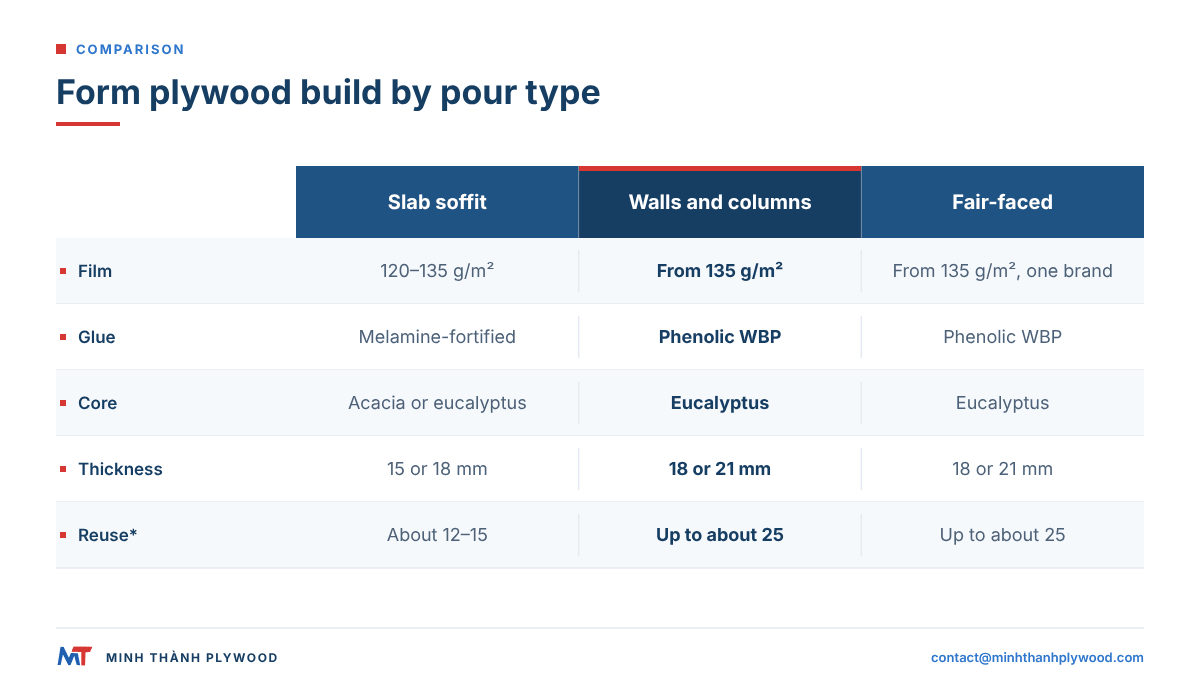
Each pour type loads the panel and uses its face differently, so each has a build that fits it. The table is a starting point for the enquiry; the formwork design always sets the final thickness and supports.
| Pour type | Film mass | Core | Glue | Thickness | Expected reuse* |
|---|---|---|---|---|---|
| Slab soffit, closely supported | 120–135 g/m² | Acacia or eucalyptus | Melamine-fortified | 15 mm or 18 mm | About 12–15 uses |
| Slab soffit, repeated floors | From 135 g/m² | Eucalyptus | Phenolic WBP | 18 mm | Up to about 25 uses |
| Walls | From 135 g/m² | Eucalyptus | Phenolic WBP | 18 mm | Up to about 25 uses |
| Columns and beams | From 135 g/m² | Eucalyptus | Phenolic WBP | 18 mm or 21 mm | Up to about 25 uses |
| Fair-faced concrete | From 135 g/m², one film brand and colour for the job | Eucalyptus | Phenolic WBP | 18 mm or 21 mm | Up to about 25 uses; replace panels by finish, not by count |
| Footings, blinding, one-off forms | 120–135 g/m² | Acacia | Melamine-fortified | 12 mm or 15 mm | About 12–15 uses |
*With proper handling, release agent and edge sealing.
Slabs load the panel mainly with the weight of wet concrete, reinforcement and workers, spread over closely spaced joists. Walls and columns load it sideways with the pressure of fluid concrete, which rises with pour height and pour rate; the panels also take more knocks at stripping. That is why vertical forms usually get the phenolic build.
For fair-faced work, keep one film brand, colour and production batch across the whole job, so the concrete colour does not change between bays. Our guide to fair-faced concrete and the plywood finish goes further.
How thick should plywood be for concrete forms?
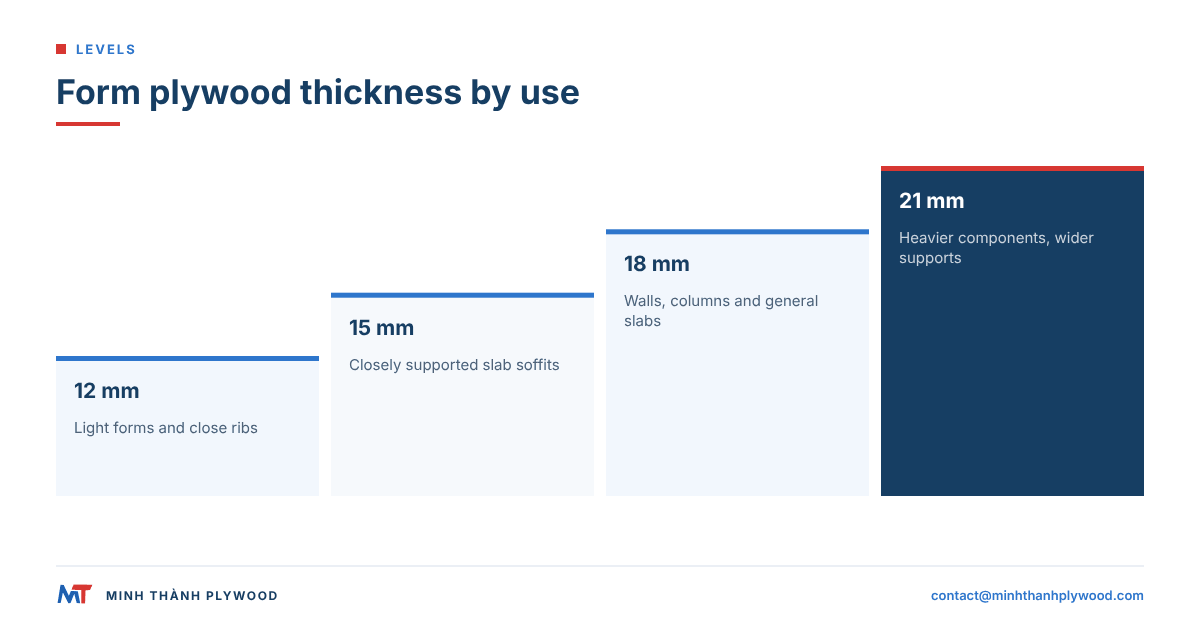
The common thicknesses are 12, 15, 18 and 21 mm, and 18 mm is the default for walls and columns. Thickness follows the support spacing in the formwork design: closer joists allow a thinner panel, wider joists need a thicker one.
| Thickness | Typical use in formwork |
|---|---|
| 12 mm | Supported light forms, liners, curved forms on close ribs |
| 15 mm | Closely supported slab soffits |
| 18 mm | Walls, columns, general slab work; the most traded form thickness |
| 21 mm | Heavier formwork components, wide support spacing in the design |
In North America the matching thicknesses are written in inches; 3/4 in form plywood is the counterpart of 18 mm. Our film-faced panels are made to ±0.5 mm on thickness and ±2 mm on length and width, so panels from different packs sit flush in the same form.
Strength runs along the face grain. Lay panels with the face grain across the joists unless the design says otherwise, and keep that direction the same in every bay. For span and load reasoning, see how much weight plywood can hold and our plywood thickness guide.
Core species: eucalyptus or acacia?
The core carries the load and decides the sheet weight. Eucalyptus cores are denser at 650–750 kg/m³ and suit heavier-duty panels; acacia, at about 580 kg/m³, gives a lighter sheet that is quicker to handle on site.
| Thickness, 1220 × 2440 mm | Eucalyptus core, 650–750 kg/m³ | Acacia core, about 580 kg/m³ |
|---|---|---|
| 12 mm | 23.2–26.8 kg | 20.7 kg |
| 15 mm | 29.0–33.5 kg | 25.9 kg |
| 18 mm | 34.8–40.2 kg | 31.1 kg |
| 21 mm | 40.6–46.9 kg | 36.3 kg |
Weights are sheet volume times core density. Crews feel the difference: on a wall gang moved by hand all day, a few kilograms per sheet add up. The weight also sets how much fits in a container: a 40HC of premium film-faced plywood carries about 43 m³ on a eucalyptus core and about 47 m³ on acacia before the weight limit is reached.
A good form core has no open gaps and no overlaps. Gaps under the film show as dents in the concrete and let water in when the panel is cut. Ask for an edge photo of the core on the sample, and check the cut edges on arrival.
Glue: melamine-fortified or phenolic WBP?
Choose phenolic WBP glue for repeated wet formwork and melamine-fortified glue for shorter programmes. The glue holds the veneers together through every wet cycle; the film only protects the face.
| Glue | Hot-press temperature | Wet behaviour | Reuse with standard care* | Use |
|---|---|---|---|---|
| Melamine-fortified (MR/MUF) | About 110–120 °C | Resists humid and wet use with an agreed bond test | About 12–15 uses | Slabs, footings, short programmes |
| Phenolic (WBP) | About 130–145 °C | Weather and boil resistant | Up to about 25 uses | Walls, columns, repeated floors, fair-faced work |
*With film of the matching grade, proper handling, release agent and edge sealing.
WBP stands for weather and boil proof in plywood trading. A boil test checks the bond on a sample cut from the panel; it says nothing about formaldehyde emission, which is a separate line on the specification. In Europe the bond is often written as Class 3 or EN 636-3 for exterior conditions. Bonding quality is set in EN 314-2, and the panel standard, EN 636, covers plywood for dry, humid or exterior conditions. If the project names one, quote against it.
The order line reads the glue and the film as two items, for example “phenolic WBP glue, phenolic film 135 g/m² both sides”. A quotation that says only “WBP film-faced” leaves the glue open.
Film mass, colour and face: what to specify
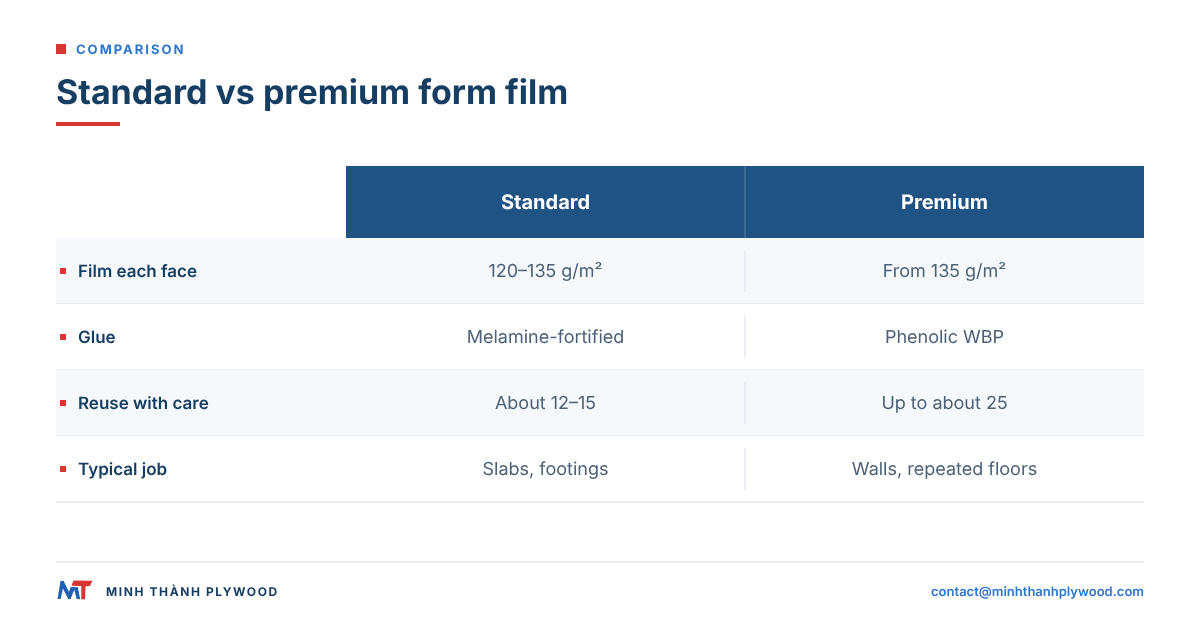
Specify the film by its mass in grams per square metre, both sides, and by colour. Our standard film is 120–135 g/m²; premium film starts from 135 g/m² and pairs with phenolic glue for the longest reuse.
- Film mass. Heavier film resists abrasion from vibrators, rebar chairs and cleaning, and keeps the face smooth for more pours.
- Colour. Black and brown are the common colours. Colour does not change strength.
- Film supplier. Name it on the sample approval when the job is fair-faced, so the face stays the same across repeat containers.
- Surface. Smooth film for concrete contact; textured anti-slip film, about 220 g/m², is for floors and decks people walk on, and it prints its pattern into concrete.
| Film line on the order | Standard | Premium |
|---|---|---|
| Mass, each side | 120–135 g/m² | From 135 g/m² |
| Paired glue | Melamine-fortified | Phenolic WBP |
| Reuse with standard care* | About 12–15 uses | Up to about 25 uses |
| Typical pours | Slabs, footings, short runs | Walls, columns, repeated floors, fair-faced |
*With proper handling, release agent and edge sealing.
Can you use regular plywood for concrete forms?
Regular interior plywood makes a poor concrete form. Its UF glue is made for dry indoor use, its sanded face soaks up cement paste, and its edges take in water, so it swells, sticks and delaminates within a few pours.
Plain exterior plywood with phenolic glue works for one-off forms, footings and hidden concrete if the face is oiled before every pour and the edges are painted. Expect grain to print into the concrete and the face to roughen quickly.
For anything that repeats or stays visible, a film or overlay face pays for itself. A sheet that strips clean also saves the cleaning and patching time that a bare face costs after every pour.
Plywood forms or steel, aluminium and plastic systems?
Plywood is the most flexible form face: it cuts to any shape on site, takes nails and screws, and costs far less per square metre than steel, aluminium or plastic panels. Metal and plastic systems win on very high repetition of one identical shape.
| Form face | Strengths | Limits | Fits |
|---|---|---|---|
| Film-faced plywood | Cut and fixed on site, light, low cost per sheet, smooth finish | Reuse counted in tens of pours | Most buildings, varied shapes, slabs, walls, columns |
| Steel panels | Hundreds of uses, rigid | Heavy, costly, needs a crane, rusts | Repeated identical elements, precast yards |
| Aluminium panels | Many uses, lighter than steel | High purchase cost, fixed module sizes | High-rise floors repeated many times |
| Plastic panels | Light, washable, many uses | Fixed modules, limited spans, cold-weather brittleness | Small repetitive walls and columns |
Most modular steel and aluminium systems still use plywood: as the infill between frames, as the slab deck on table forms, and for every odd shape the modules do not cover. That is why film-faced plywood stays the base material of concrete forming worldwide.
Common defects in formwork plywood and how to spot them
The defects that shorten form life are visible before the first pour if you know where to look. Check a few sheets from each pack when the container is opened.
- Core gaps and overlaps. Look at the cut edge: open voids or doubled veneer show as dents or bumps in the concrete and weak spots under load.
- Thin or uneven film. Raking light along the face shows bare patches, wrinkles and a dull, papery look where the film is light.
- Blisters. Small raised bubbles in the film mean the film did not bond fully in the press; they burst and peel after a few pours.
- Unsealed or thinly sealed edges. Bare veneer on an edge drinks water from the first pour.
- Thickness out of tolerance. Readings outside ±0.5 mm leave steps at the panel joints, which print into the concrete.
- Warped sheets. A pack that does not lie flat usually left the press with uneven moisture or was stored badly.
Photograph each defect with the pack label in view and raise it with the supplier before the panels go to site. The approved sample is the reference for what the face should look like.
How many times can form plywood be reused?
Melamine-fortified film-faced plywood gives about 12–15 uses and phenolic WBP film-faced plywood up to about 25, with proper handling, release agent and edge sealing. Reuse is a target for a given build and site practice; the same panel gives fewer pours when it is dropped, pried off with a bar or left wet.
What spends a form panel fastest:
- Damage at stripping. Steel bars levered against the face tear the film. Use wedges and timber or plastic tools.
- Unsealed cuts and holes. Every site cut and tie hole opens the core to water. Seal them the same day.
- Wrong release agent. Diesel and heavy oils soften phenolic film. Use a purpose-made agent; see our guide to release agent for concrete formwork.
- Dirty faces. Cement residue left on the film builds up and prints into the next pour.
- Bad storage. Panels stacked wet, on uneven ground or in the sun bow and swell.
Count reuse on site by panel, not by the whole set. Sort panels after each strip into reuse, repair and retire, and move worn panels from fair-faced work to hidden pours before they are scrapped.
Plywood formwork loads: what the designer needs for slabs, walls and columns
In plywood formwork, the designer sets the panel thickness and support spacing from the loads, so the buyer’s job is to supply the inputs and buy the panel the design names. Slabs load the panel downwards with the weight of concrete, steel and workers; walls and columns load it sideways with the pressure of fluid concrete.
Send the designer:
- Pour type and geometry: slab thickness, wall or column height and section.
- Pour rate and method: metres per hour of rise, pump or skip, and how the concrete is vibrated.
- Concrete conditions: mix, admixtures, temperature on the day, and any self-compacting concrete, which pushes harder on vertical forms.
- Finish class: hidden, rendered, or fair-faced.
- Panel data: thickness, face grain direction, core species and glue of the panel you plan to buy.
The system has four layers: the sheathing (the plywood), the joists or studs behind it, the bearers or walers that carry the joists, and the props, ties or braces that take the load to the ground or across the wall. The plywood decides the finish and the reuse; the layers behind it decide whether the form holds.
In the United States, OSHA’s construction rule 1926.703(a)(1) requires formwork that is “capable of supporting without failure all vertical and lateral loads that may reasonably be anticipated” (OSHA standard 1926.703). The panel is one part of that; the designed support layout is the other.
Cut edges, tie holes and site care
Seal every cut edge and drilled hole before the panel sees concrete. Factory edges arrive sealed; site cuts expose bare veneer that drinks water, swells and starts delamination at the edge.
- Cut with a fine-tooth blade and support the sheet on both sides, so the film does not chip.
- Seal cuts the same day with an edge sealer or exterior paint, two coats on the end grain.
- Drill tie holes from the face side with a sharp bit, then seal the bore.
- Support every panel joint on a joist or batten, so edges do not step under load.
- Clean after each strip with a plastic scraper and water; no wire brushes on the film.
- Store flat and covered on level bearers, face to face, out of sun and standing water.
Our guide to cutting, drilling and painting film-faced plywood has the tool settings.
Trial pour and arrival check: approve the panel before the programme
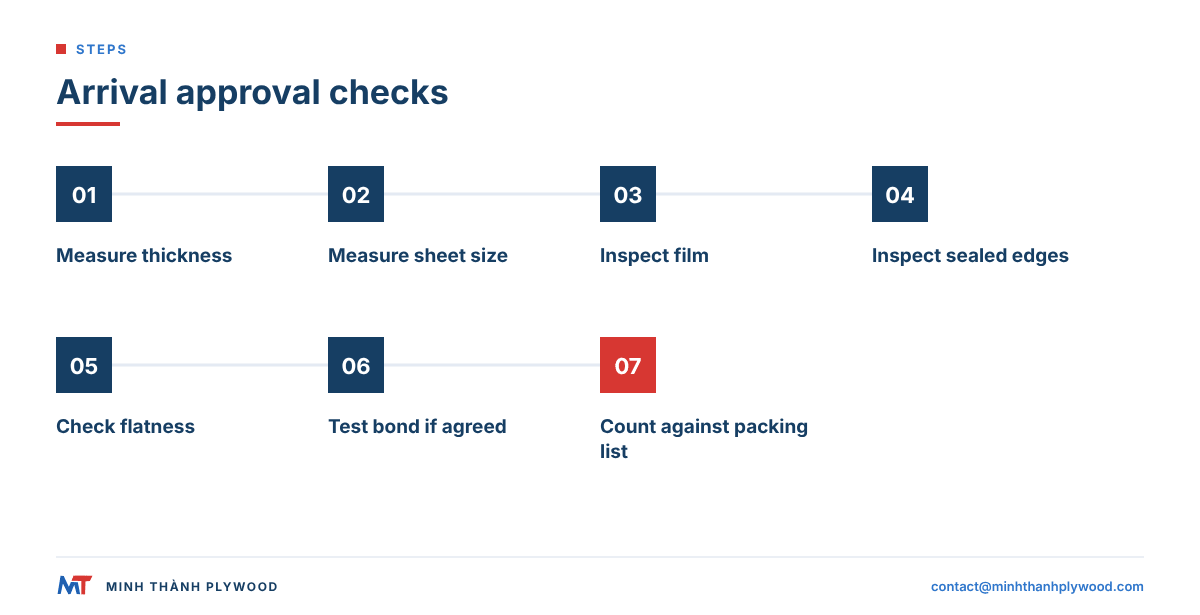
Approve the panel on a trial pour before the programme starts, and check every container against that approved sample. A trial bay with the release agent, concrete and crew of the real job shows the finish, the strip and the first signs of wear.
On arrival, check and record:
| Check | How | Accept when |
|---|---|---|
| Thickness | Caliper at several points on sampled sheets | Within ±0.5 mm of nominal |
| Length and width | Tape on sampled sheets | Within ±2 mm |
| Film | Look along the face in raking light | Even colour, no bubbles, tears or bare spots |
| Edges | Look at all four edges | Sealed, no open core gaps |
| Flatness | Sheets lying on the pack | Flat, no twist across the pack |
| Bond | Boil or soak test on an offcut, if the order states one | Passes the agreed test |
| Count | Sheets per pack against the packing list | Matches |
Record the pack labels with the photos. If a problem appears months later, the record shows which batch it came from.
RFQ checklist: what to write on a concrete form plywood order
A complete enquiry fixes the build line by line, so every quotation you receive prices the same panel. Copy this list and fill it in:
- Use and pour type: slab, wall, column, fair-faced; expected reuse per panel.
- Thickness and tolerance: for example 18 mm ±0.5 mm.
- Sheet size: 1220 × 2440 mm or 1250 × 2500 mm.
- Film: mass each side in g/m², colour, smooth or anti-slip.
- Glue: melamine-fortified or phenolic WBP, and any bond test the project requires.
- Core: eucalyptus or acacia.
- Edges: sealed, and the sealer colour if it matters.
- Grade or standard named in the design, if any, with the evidence needed.
- Packing: sheets per pack, pallet and covers, pack labels.
- Quantity and delivery: sheets or containers, destination port, FOB, CFR or CIF.
A spec line ready to send: “Film-faced plywood 18 mm ±0.5 mm, 1220 × 2440 mm, phenolic film from 135 g/m² both sides, brown, phenolic WBP glue, eucalyptus core, sealed edges, 1×40HC CIF [your port].”
How Minh Thanh Plywood supplies concrete form plywood
We make film-faced plywood in Ha Hoa, Phu Tho, alongside our main furniture and commercial plywood lines, and supply it by the container. Each order is built to the lines above and checked against your approved sample before loading.
| Line | What we offer |
|---|---|
| Thickness | 12–21 mm, ±0.5 mm |
| Sheet size | 1220 × 2440 mm, 1250 × 2500 mm |
| Film | 120–135 g/m² standard; premium from 135 g/m²; black or brown, smooth |
| Core | Eucalyptus 650–750 kg/m³ or acacia about 580 kg/m³ |
| Glue | Melamine-fortified or phenolic WBP |
| Edges | Sealed on all four sides |
| Container | About 43 m³ per 40HC on eucalyptus, about 47 m³ on acacia; 1,200 sheets of 12 mm on eucalyptus |
| Terms | MOQ 1×40HC, mixed specifications by agreement; 15–45 days after the 30% deposit; balance against the scanned B/L or L/C at sight; FOB Hai Phong, CFR or CIF |
Every shipment is photographed and filmed before loading, and you receive the photos and video. Our certificates and test reports are on the quality page. Free samples go out before the first order, so the trial pour uses the panel you will buy. Send your specification through the film-faced plywood page, or read what sets the number in our guide to film-faced plywood price.
Buyer questions, answered
What plywood is best for concrete forms?
For repeated pours, phenolic WBP plywood with premium film from 135 g/m² on a hardwood core gives the most uses, up to about 25 with proper handling, release agent and edge sealing. For a few pours, melamine-fortified film-faced panels with 120–135 g/m² film give about 12–15 uses at a lower price.
Can you use regular plywood for concrete forms?
Regular interior plywood with UF glue and an open face is a poor form: water reaches the glue lines, the face absorbs paste and the panel delaminates within a few pours. Use plywood with a water-resistant bond, and a film or overlay face where the concrete finish or reuse count matters.
How thick should plywood be for concrete forms?
Common choices are 12 mm for supported light forms and liners, 15 mm for closely supported slab soffits, 18 mm for walls and columns and 21 mm for heavier formwork components. The formwork design fixes the support spacing; the panel thickness follows it.
How many times can form plywood be reused?
Melamine-fortified film-faced plywood gives about 12–15 uses and phenolic WBP film-faced plywood up to about 25, with proper handling, release agent and edge sealing. Damaged corners, unsealed cuts and diesel on the film shorten that life.
What is the difference between film-faced, formwork plywood and MDO?
Formwork plywood is the use; film-faced plywood is a type of it with a phenolic-impregnated paper film pressed on both faces. MDO carries a thicker resin-treated fibre overlay with a matte surface, used where a smoother, paintable or textured finish is wanted.
Is shuttering plywood the same as concrete form plywood?
Yes. Shuttering plywood is the British and Indian name for the same product; Australians say formply and Americans say form plywood or Plyform for the APA-graded version. Compare the film, core, glue and thickness, not the name.
Black or brown film: which is better for formwork?
Neither colour is stronger. Colour follows the film supplier and the buyer's market; compare film mass in g/m², the glue and the core instead, and approve the colour on the sample.
What size is concrete form plywood?
The standard sheet is 1220 × 2440 mm, the metric counterpart of 4 × 8 ft; 1250 × 2500 mm is common in Europe. Both sizes are standard in our film-faced range.
Which core is better for formwork plywood: eucalyptus or acacia?
Eucalyptus is denser at 650–750 kg/m³ and suits heavier-duty panels; acacia, at about 580 kg/m³, gives a lighter sheet that is easier to carry and loads more volume within a container's weight limit.
What should I send to get a quote for form plywood?
Send the thickness, sheet size, film mass and colour, glue class, core species, edge sealing, quantity in sheets or containers, and the destination port. Add the pour type and the reuse count you expect so the build can be matched to the duty.