
Good one side plywood (G1S) is plywood with one sanded, high-grade face for show or paint and a lower-grade back that stays hidden. It costs less than good two sides (G2S) because only one face is selected. Minh Thanh Plywood, a Vietnamese manufacturer, explains how G1S is graded, which face pairs meet it and what to write on the order.
Good one side plywood: definition and when to use it
Good one side plywood is a panel with one high-grade, sanded face and a lower-grade back. It is written G1S, “good one side” or “good 1 side”, and it is the standard choice when only one side of the panel will be seen.
You use G1S when:
- One side faces a wall or another panel. Cabinet sides, wall panelling, built-ins and fixture backs.
- The face will be painted or clear-finished. The good face takes finish evenly; the back does not need to.
- The budget matters. Selecting one good face instead of two lowers the panel cost.
You avoid G1S when both sides show: open shelves, doors, room dividers and drawer fronts need good two sides (G2S) or a matched face and back.
G1S plywood: how the grade is written in each system
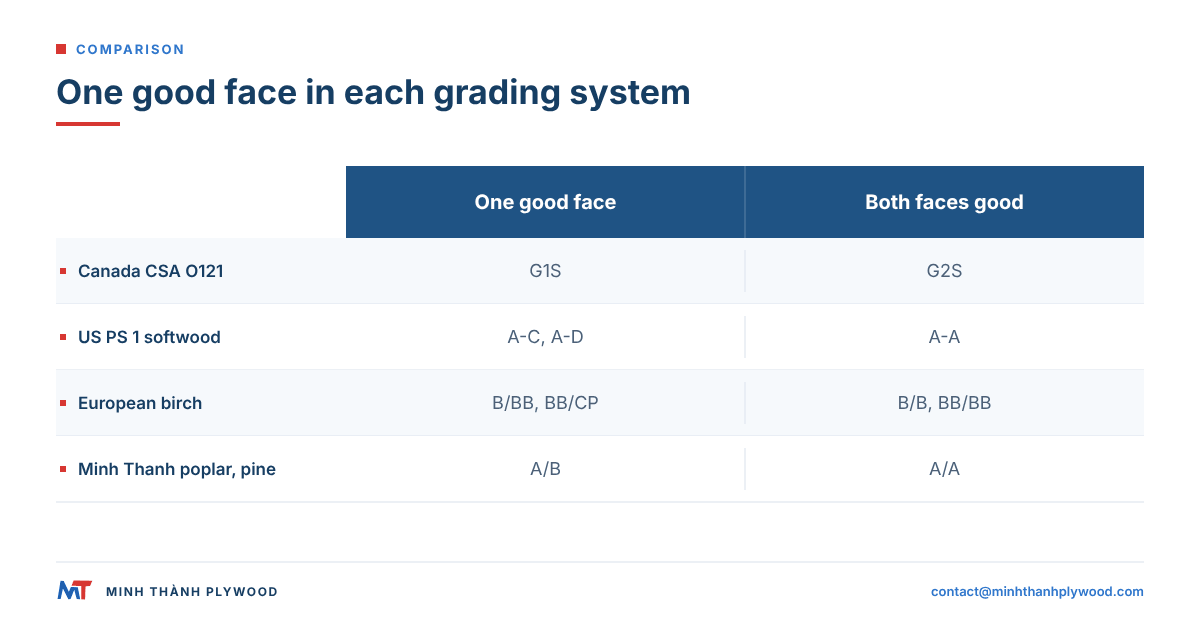
G1S plywood is a grade name, not a single standard: each grading system has its own way of describing one good face and one plain back. The table shows how the same idea is written in the main systems.
| System | One good face, one plain back | Both faces good |
|---|---|---|
| Canada, CSA O121 Douglas fir plywood | Good one side (G1S) | Good two sides (G2S) |
| US softwood, PS 1 | A-C (exterior) or A-D (interior) | A-A |
| US hardwood, ANSI/HPVA HP-1 | A-3 or B-3 and similar | A-1, B-1, A-2 |
| European birch | B/BB, BB/CP | B/B, BB/BB |
| Face/back pairs (Asian mills) | A/B, A/C | A/A |
| Minh Thanh birch faces | D+/D or D/E (≈ B/BB, BB/CP) | D+/D+ or D/D (≈ B/B, BB/BB) |
| Minh Thanh poplar, pine, eucalyptus | A/B | A/A |
The same buyer question, “one good face, please”, gets a different code from each mill. Convert by approved sample, not by letter. Our guide to hardwood plywood grades explains the HP-1 letters and numbers in more detail.
What makes a face “good”?
A good face is sound, smooth, sanded and even in colour, with any repairs neatly made and few natural marks. It is the face a painter, a finisher or a customer sees.
| Feature | Good face (G1S face) | Back of a G1S panel |
|---|---|---|
| Open defects (holes, splits) | None | Small, within the grade limits |
| Repairs | Few, neat, colour-matched | More, any neat repair |
| Knots | Pin knots, few | Sound and small knots allowed |
| Colour | Even or compatible | Can vary |
| Sanding | Sanded smooth | Sanded or not, by system |
| Finish it takes | Paint, stain or clear coat | Not meant to be finished |
On fir G1S, the face is often an A-grade veneer with neat boat-shaped patches; on hardwood-faced panels, the face is a selected veneer of birch, poplar, pine or another species. Either way, approve the face on a sample, because “good” depends on the finish you plan.
3/4 plywood good one side: the most ordered size
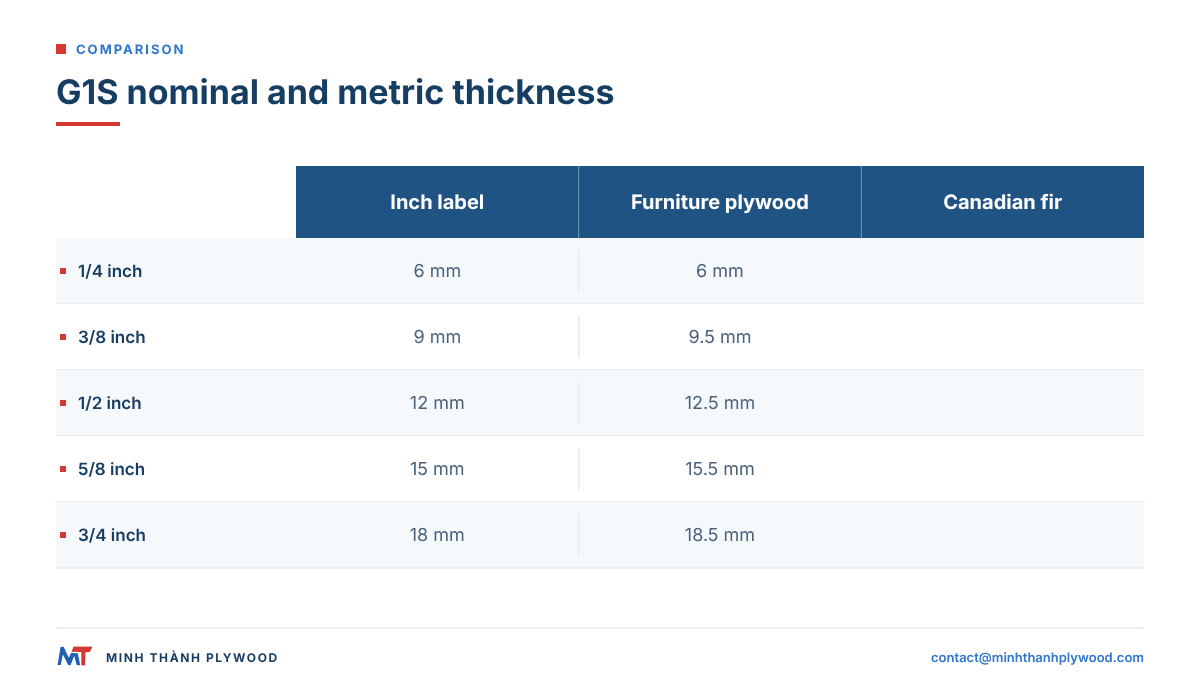
3/4 plywood good one side is the most ordered G1S panel, used for cabinet carcasses, built-ins, shop fixtures and wall panelling. A 3/4 4x8 plywood good one side sheet is 48 × 96 inches, made as 1220 × 2440 mm outside North America.
| Label | Metric furniture plywood | Canadian fir plywood | Typical uses |
|---|---|---|---|
| 1/4 inch | 6 mm | 6 mm | Cabinet backs, drawer bottoms |
| 3/8 inch | 9 mm | 9.5 mm | Backs, light panelling, jigs |
| 1/2 inch | 12 mm | 12.5 mm | Drawer sides, light shelving |
| 5/8 inch | 15 mm | 15.5 mm | Cabinet sides, shelving |
| 3/4 inch | 18 mm | 18.5 mm | Carcasses, built-ins, fixtures |
Always order in millimetres with a tolerance, because the inch label hides the real thickness. Our furniture panels are made to ±0.2–0.3 mm on thickness, down to ±0.2 mm; commercial panels to ±0.5 mm. An 18 mm furniture panel has 11–13 plies.
3/8 plywood good one side: where the thin panels go
3/8 plywood good one side, about 9 mm, is used where the panel is thin, light and seen from one side only: cabinet backs, drawer bottoms, wall panelling, display backs and templates.
Three things matter more in a thin G1S panel than in a thick one:
- Flatness. A thin panel bends with any imbalance between face and back, so the build must be balanced and the panel pressed flat.
- Face thickness. A thin face can sand through at the edges; ask for the face veneer thickness and sanding allowance.
- Core gaps. A gap under a thin face shows as a dip after finishing.
For panels from 3 to 5 mm, we always build 5-ply: 3 mm uses one core veneer, two cross-band veneers and two face veneers, and 4 to 5 mm use three core veneers and two faces. Our thin plywood page lists the builds.
Good one side vs good two sides vs select
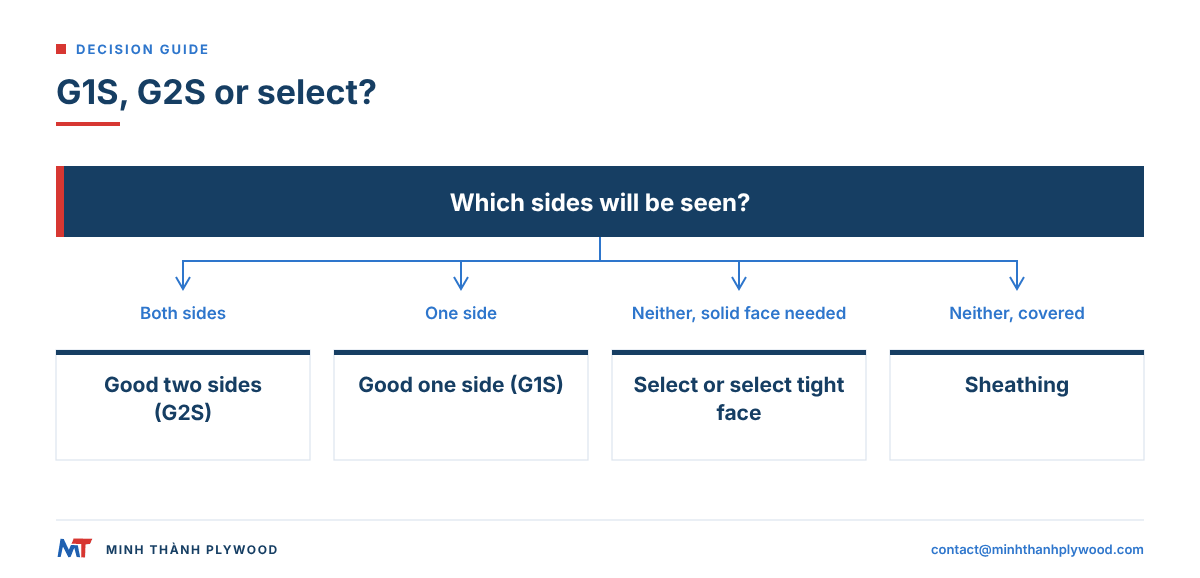
Choose good one side when one side shows, good two sides when both show, and select when you need a solid, repaired face but no sanded finish. The three answer different jobs.
| Grade | Face | Back | Sanded | Typical use | Relative cost |
|---|---|---|---|---|---|
| Good two sides (G2S) | Good | Good | Yes | Shelves, doors, open cabinets | Highest |
| Good one side (G1S) | Good | Plain | Yes | Cabinet sides, built-ins, panelling | Medium |
| Select tight face | Repaired, all openings filled | Plain | No | Underlayment-type uses, painted utility | Lower |
| Select | Repaired, some openings filled | Plain | No | Floors under finish, utility | Lower |
| Sheathing | Unselected | Unselected | No | Walls and roofs under cladding | Lowest |
In the CSA O121 system, the reference G1S build is the Canadian Douglas fir panel: an A-face with a C-back and inner plies, surface blemishes repaired with wooden plugs and putty patches, then sanded smooth. Richmond Plywood (Richply) describes its G1S as select, plug and touch sanded, made to CSA O121 in 1220 × 2440 mm sheets, with a 19 mm (3/4 inch) panel typically weighing less than 31 kg. Hardwood G1S from Asian mills follows the same idea with a selected veneer face.
What is select plywood?
In the CSA O121 system for Douglas fir plywood, select plywood is an unsanded grade with its open defects repaired or filled, sold where a solid face matters more than a smooth one. Select tight face fills every opening. Neither is a finishing face.
What does good one side plywood cost in the US?
Good one side plywood is priced by the face grade, species and thickness, and a G1S panel sits below the same panel in G2S because only one face is selected. US retail prices for a 4 × 8 foot sheet run from about US$10 for OSB to about US$135 for marine plywood. These are shelf prices at Lenco Supplies, checked on 21 October 2026:
| 4 × 8 ft sheet (US retail, one supplier) | Retail price (US$) | Raw FOB example from US$350/m³ for the same thickness |
|---|---|---|
| OSB, 7/16 inch, grade 2 | about 10 to 12 | not our product |
| Birch plywood, 1/2 inch, good both sides (G2S) | about 50 | about 12.5 for 12 mm |
| Red oak plywood, 3/4 inch, G2S | about 85 | about 18.8 for 18 mm |
| Marine plywood AB, 3/4 inch | about 135 | marine grade is a separate specification |
The right-hand column is a raw example only: furniture plywood from US$350/m³ times the volume of a 1220 × 2440 mm sheet (0.0357 m³ at 12 mm, 0.0536 m³ at 18 mm). It is not a sheet price and leaves out freight, duty and handling. It shows why an importer who buys a container of G1S furniture plywood sees a wide gap against shelf prices, and a container of mixed specifications is quoted by agreement.
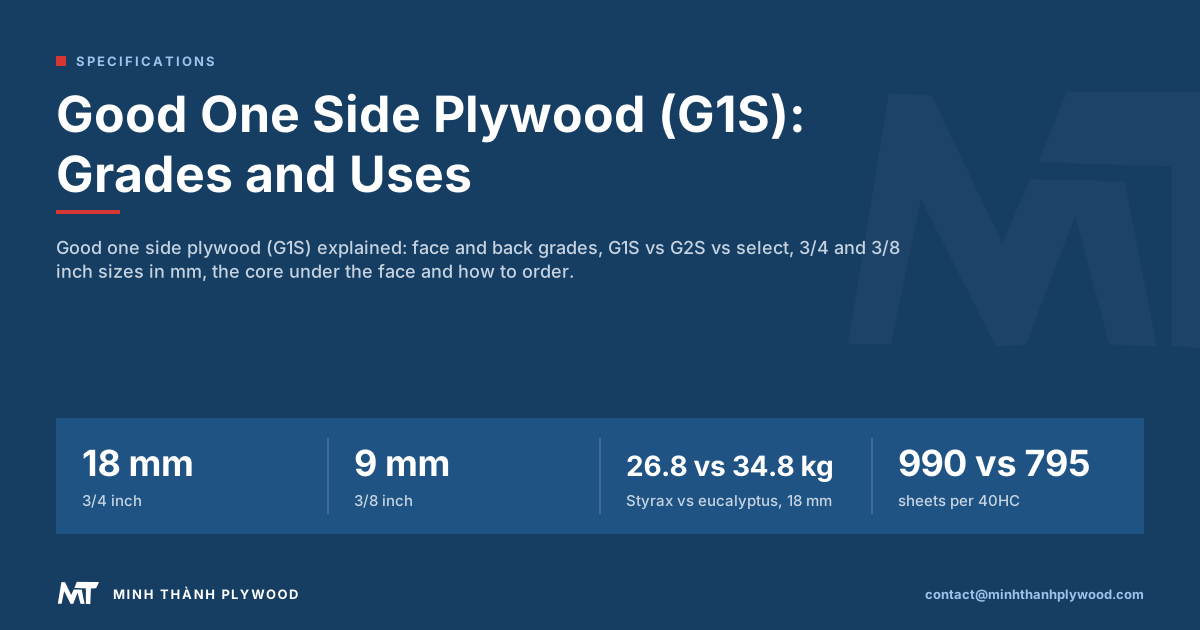
Weight is the second number on a US quote. A 19 mm Douglas fir G1S panel typically weighs less than 31 kg (Richply); our 18 mm Styrax-core panel weighs about 26.8 kg, and a lighter sheet is cheaper to ship and easier for one installer to carry.
Which core goes under a good face?
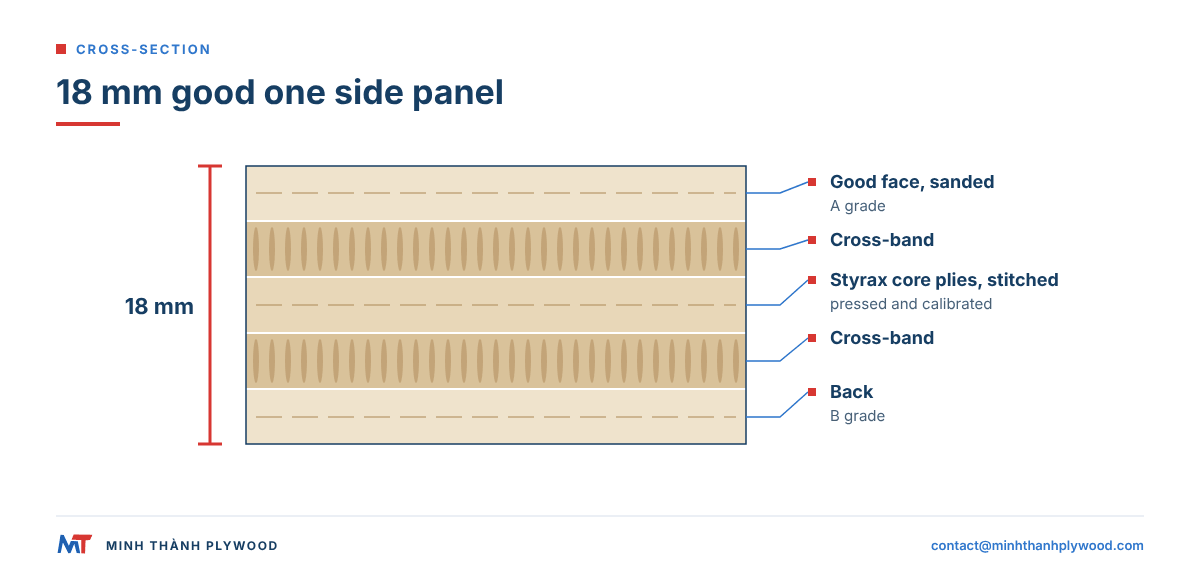
The core under a good face decides whether that face stays good after cutting, screwing and finishing. A gappy or uneven core shows through the face as dips, ridges or soft spots, whatever the face grade.
| Core feature | What it does to the good face | What to ask for |
|---|---|---|
| Gaps and overlaps | Dips and ridges after sanding or painting | Gap-free core, stitched |
| Uneven core thickness | Waves visible under raking light | Core pressed and calibrated before facing |
| Mixed species | Uneven density, uneven screw holding | One core species |
| High moisture | Warping after delivery | Moisture at dispatch stated |
| Loose-laid core | Movement and gaps | Core stitched both ways |
Our furniture panels use white Styrax or eucalyptus cores, stitched both horizontally and vertically, and are pressed twice as standard: the core board is pressed and calibrated, then face and back are pressed on. Veneers and finished panels are dried to 8–12% moisture at dispatch. That build keeps a G1S face flat and smooth.
Which Vietnamese core species is best for good one side plywood?
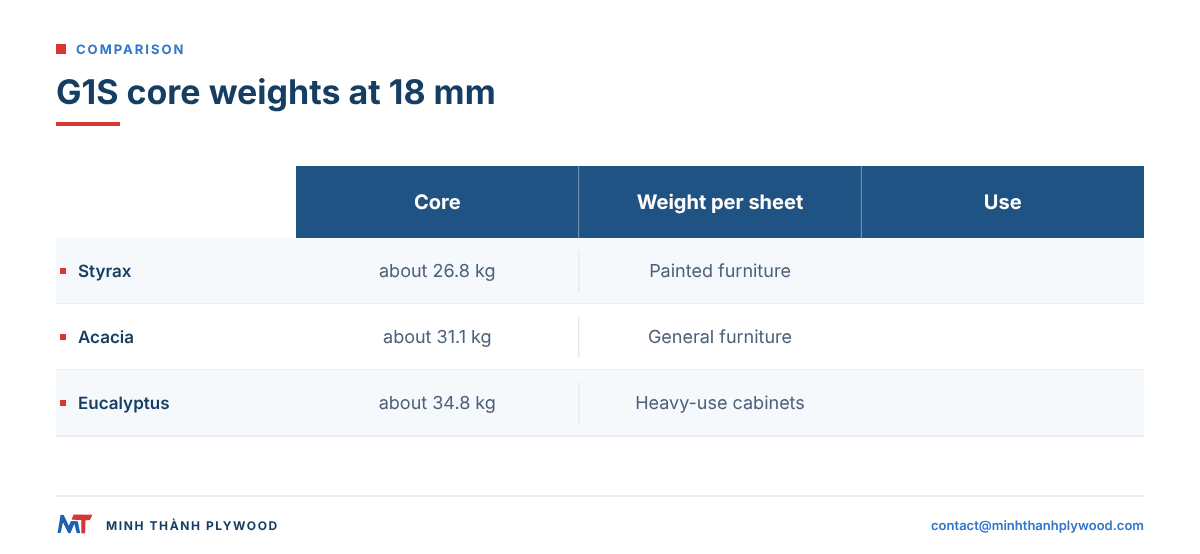
For good one side furniture plywood, white Styrax is the best core when weight and a smooth face matter, and eucalyptus is the best when hardness and screw holding matter. Acacia and pine cores are made on order.
| Core (18 mm, 1220 × 2440 mm) | Weight per sheet | Character | Best for |
|---|---|---|---|
| Styrax | About 26.8 kg | Light, even, pale | Painted furniture, panelling, large cabinets |
| Acacia | About 31.1 kg | Medium weight, firm | General furniture |
| Eucalyptus | About 34.8 kg | Dense, hard | Fixtures, heavy-use cabinets, screw-heavy work |
A light core also changes freight: one 40HC holds 990 sheets of 18 mm Styrax-core panels against 795 sheets on a eucalyptus core, by our 40HC plan. Many European furniture buyers choose Styrax for its light weight and clean face.
Which faces can be ordered good one side?
Most face species can be ordered good one side; the grade pair changes, not the idea. We offer 10+ face veneers, most often EV (engineered veneer), poplar, birch, okoume and pine.
| Face | Good one side pair | Good two sides pair | Look |
|---|---|---|---|
| Birch | D+/D or D/E | D+/D+ or D/D | Pale, fine grain |
| Poplar | A/B | A/A | Pale, plain grain |
| Pine | A/B | A/A | Warm, knotty character |
| Eucalyptus | A/B | A/A | Reddish to pale, firm |
| EV (engineered veneer) | Selected face, plain back | Selected both sides | Uniform colour and grain |
| Okoume | Selected face, plain back | Selected both sides | Pinkish, smooth |
Our eucalyptus faces follow the same rule: A/A for two visible faces, A/B for one visible face, and B/B for painted or overlaid panels. Birch faces are named D+, D and E in Vietnam, comparable to European B, BB and CP/C. Every pair is fixed by the approved sample.
Smooth one side, textured one side and one side laminated: not the same as G1S
Good one side describes the grade of a natural wood face; smooth one side, textured one side and one side laminated describe a surface added or machined on the panel. Buyers sometimes search for one and mean the other.
- Smooth one side: a panel sanded or overlaid on one side only; often a sheathing or utility panel.
- Textured, grooved or embossed one side: a machined or pressed pattern on the face, for decorative panelling or siding.
- One side laminated or melamine-faced: a decorative paper or HPL on one face over a plywood core.
- Film-faced one side: a phenolic or melamine film on one face, for formwork or floors.
A G1S panel is often the base for these: its good face takes a laminate, film or paint cleanly. When ordering, name the surface you want and the grade of the face underneath it.
Glue and emission: the lines a grade does not cover
The G1S grade describes the faces only; glue and formaldehyde emission are separate lines. A good face over the wrong glue fails in a bathroom; a good face without an emission certificate cannot enter some markets.
- Interior furniture: UF glue at E0 emission, our standard for furniture and interior panels.
- Humid rooms: melamine-fortified (MR or WBP melamine) glue.
- Exterior or wet use: phenolic (WBP) glue, with edges and faces sealed.
For the US market, hardwood plywood must meet the US EPA formaldehyde standards for composite wood products (TSCA Title VI), aligned with the California Air Resources Board composite wood products programme. The limit for hardwood plywood with a veneer core is 0.05 ppm under 40 CFR 770.10. We hold CARB P2 / TSCA Title VI certification (ICTT mill no. 23024), and six third-party chamber tests from April 2025 to June 2026 averaged 0.014–0.032 ppm against that limit.
How to inspect good one side plywood on delivery
Inspect good one side plywood by checking the good face against the approved sample, then the thickness, the back and the edges. Pull sheets from several packs, not only the top of one.
- Face against sample. Lay the sample on the sheet in daylight: colour, grain, repairs and knots should match the approved look.
- Thickness. Measure with a caliper at corners and mid-edges against the stated tolerance.
- Back. Check that the back meets its grade: no open defects beyond it, no delamination.
- Edges. Look for core gaps and overlaps on all four edges.
- Flatness. Lay a sheet on a flat floor and check the corners.
- Moisture. Check with a moisture meter against the moisture stated on the order.
Every Minh Thanh shipment is photographed and filmed before loading, and buyers receive the photos and video.
How to order good one side plywood: the specification line
Order good one side plywood with the face and back grade pair and every line under it, so the mill cannot fill a blank with its own choice.
| Line | Example: painted kitchen cabinets |
|---|---|
| Use | Kitchen cabinet carcasses, painted inside and out on one side |
| Face and back | Poplar A/B (good one side), sanded both sides |
| Thickness and tolerance | 18 mm, ±0.3 mm |
| Core | Styrax, stitched, pressed twice |
| Glue and emission | UF glue at E0 emission, CARB P2 / TSCA Title VI |
| Size | 1220 × 2440 mm |
| Packing | Export pallet, plywood covers, steel straps, corner guards |
| Quantity and term | One 40HC, CIF your port |
| Sample | Approved sample reference ___ |
Our minimum is one 40HC, with mixed specifications by agreement; production runs 15–45 days after the 30% deposit, with the 70% balance against the scanned B/L or an irrevocable L/C at sight. We ship FOB Hai Phong, CFR or CIF, and samples are free.
What this means for a Minh Thanh Plywood order
We make good one side plywood in the faces we offer, as a face/back grade pair fixed by your approved sample. You can write the grade the way your market writes it, G1S, A/B or B/BB, and we confirm the pair on the proforma invoice.
- Thickness: 3–40 mm, inch equivalents such as 18 mm for 3/4 inch and 9 mm for 3/8 inch.
- Sizes: 1220 × 2440 mm and 1250 × 2500 mm, plus custom sizes and cut-to-size panels.
- Build: stitched Styrax or eucalyptus cores, pressed twice, sanded and polished faces, both faces UV-ready.
- Capacity: 50,000+ m³ a year from our mill in Ha Hoa, Phu Tho.
Send your specification through the furniture plywood page or the poplar plywood page, and our team replies within hours. Related guides: hardwood plywood grades and the plywood thickness guide.
Buyer questions, answered
What does good one side plywood mean?
It means one face is a high, sanded appearance grade fit for paint or a clear finish, and the back is a lower grade that may carry knots, patches and colour variation. The panel is made for work where only one side is seen.
What is the difference between G1S and G2S plywood?
G1S has one good face and a lower-grade back; G2S has good faces on both sides. G2S costs more and is used where both sides show, such as shelves, doors and open cabinets.
Is good one side plywood sanded?
Yes, the good face is sanded smooth, and in most grade systems the whole panel is sanded. The back is sanded too but may show repairs, knots and colour changes.
What is select plywood?
In the Canadian CSA O121 system, select is an unsanded grade whose face has its open defects repaired or filled, used where a solid face is needed but sanding is not. Select tight face has every face opening filled.
What size is 3/4 good one side plywood in mm?
A 3/4 inch good one side panel is about 18 mm in metric furniture plywood and often labelled 18.5 mm in Canadian Douglas fir plywood. The sheet is 4 × 8 feet, made outside North America as 1220 × 2440 mm.
What size is 3/8 good one side plywood?
3/8 inch good one side plywood is about 9 mm in metric panels and often 9.5 mm in Canadian fir plywood. It is used for cabinet backs, drawer bottoms and light panelling.
Can good one side plywood be used outdoors?
Only if its glue is exterior-rated, such as phenolic (WBP), and its edges and faces are sealed. Many G1S fir panels carry exterior glue; hardwood-faced G1S is usually interior grade.
Is G1S plywood good for cabinets?
Yes, for cabinet sides, backs and boxes where one side faces a wall or another panel. For doors and open shelves, where both sides show, order G2S or a matched face and back.
What face species are sold as good one side plywood?
Douglas fir and other softwoods in Canada and the US, and birch, poplar, pine, eucalyptus and other hardwood faces from Asian and European mills. The grade name is the same; the look depends on the species.
How do I order good one side plywood from a mill?
Write the face and back grade pair, the species, thickness in mm with tolerance, core, glue and emission class, sheet size and sanding. Approve a sample of the good face before production.