
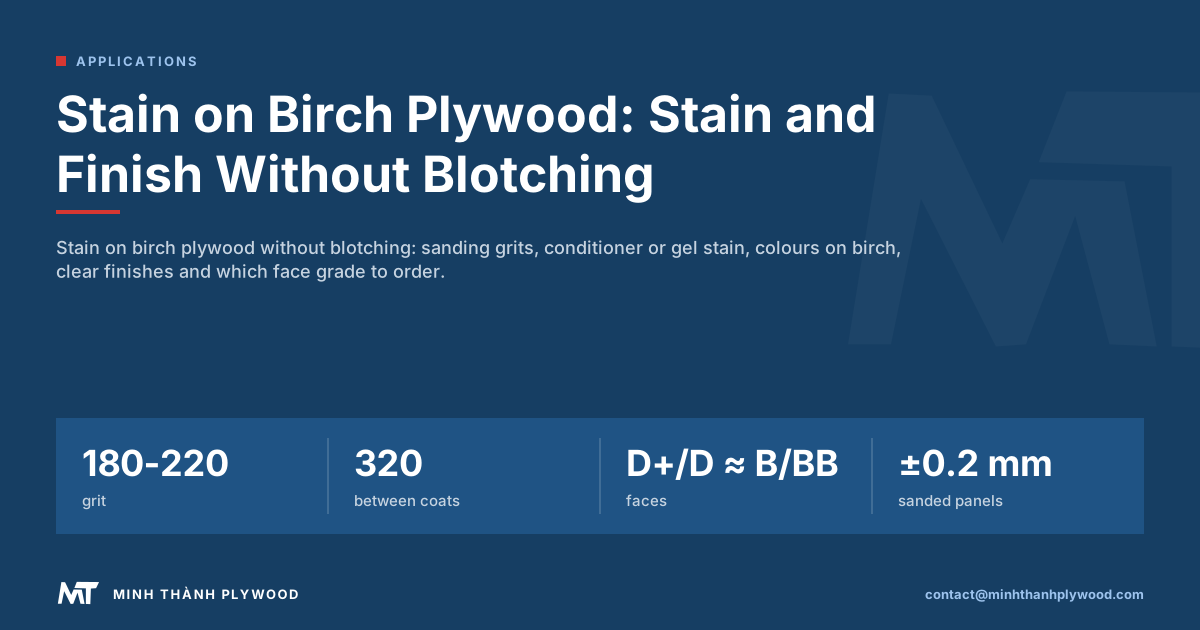
Yes, birch plywood takes stain, but its tight, uneven grain absorbs pigment in patches. The fix is preparation: sand to 180-220 grit, seal the face with a pre-stain conditioner or a thin wash coat, then use a gel stain or a dye, and finish with a clear coat. Order a stain-grade face such as D+/D. Minh Thanh Plywood sets out the steps, colours and finishes from the panel side.
Can you put stain on birch plywood?
Yes, birch plywood can be stained in any colour, from a pale white wash to a deep walnut. The difference between a good result and a blotchy one is preparation: birch absorbs stain unevenly, so the face has to be sanded fine and partly sealed before the colour goes on.
Stained birch plywood is used for kitchen and wardrobe fronts, shelving, wall panels, shop fittings and furniture where a darker wood tone is wanted on a pale, stable panel. The same steps work on Baltic birch and on birch-faced plywood with a lighter hardwood core.
Why does birch plywood blotch when you stain it?
Birch blotches because its grain is dense and irregular: some areas soak up stain quickly, others hardly at all. On a solid birch board the effect is mild; on plywood it is stronger, because the face is rotary-cut. A rotary-cut veneer is peeled off the log like paper off a roll, which opens the grain across the whole face in wide, wavy figure.
Thin, pigmented wiping stains show this most. The pigment lodges in the open areas and leaves dark clouds, while the tighter areas stay pale. Three things reduce it:
- A pre-stain conditioner or wash coat, which partly seals the face so it absorbs evenly.
- Gel stain, which sits on the surface instead of soaking in.
- Dye stain or toner, which colours the wood fibres evenly or tints the finish itself.
How do you go about staining birch plywood, step by step?
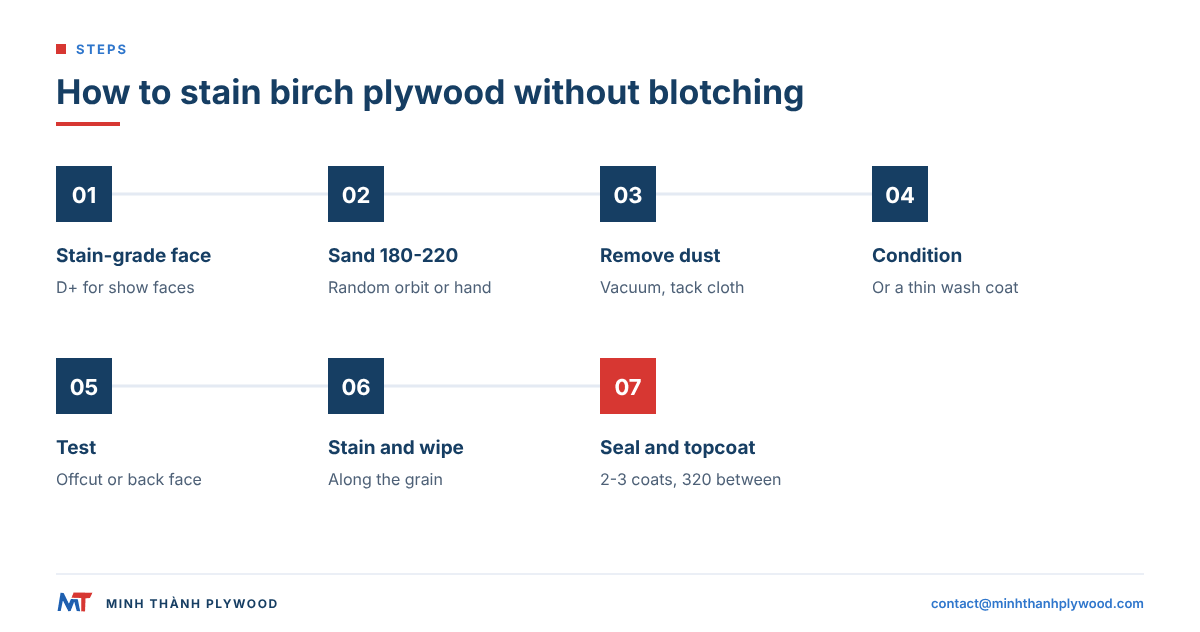
Follow this sequence when staining birch plywood for an even, durable colour:
- Choose a stain-grade face. A D+ face has few patches and an even tone; colour streaks and patches show through stain.
- Acclimatise the panels for two days in the room where they will be finished, flat on bearers.
- Sand by hand or with a random orbit sander at 180, then 220 grit. Factory-sanded faces need only a light pass to remove handling marks.
- Remove all dust with a vacuum and a tack cloth; dust under stain leaves specks.
- Raise the grain if you use a water-based stain: wipe with a damp cloth, let it dry, and sand lightly at 220.
- Apply a pre-stain conditioner or a wash coat (one part finish to about four to six parts thinner), and stain within the window the maker gives.
- Test on an offcut or the back face, in the same order, to check the colour.
- Apply the stain with a cloth or brush, working one panel at a time, and wipe off the excess along the grain before it dries.
- Let the stain dry fully, as long as the label says, longer in cold or humid rooms.
- Seal and topcoat with two or three coats of clear finish, sanding lightly at 320 grit between coats.
Gel stain changes steps 6 and 8: it can go on without conditioner, in thin coats wiped off evenly, and a second coat deepens the colour.
Timings that keep the sequence on track:
- Conditioner: wipe on with a lint-free rag, leave 5–10 minutes, then stain once it has dried for 5–15 minutes, inside the window on the can.
- Stain: wipe off the excess within the label’s time; a second coat goes on only after the first is dry to the touch and the label’s recoat time has passed.
- Wash coat method: brush on a thin coat of dewaxed shellac such as SealCoat, let it dry, then sand lightly with 120 and 220 grit before the stain.
- Grit ladder for raw panels: 80 grit only to remove damage, then 120–150, then 220; a factory-sanded face starts at 180.
- Protection: gloves, a respirator rated for solvent vapour when using oil-based stain, and ventilation; oily rags are laid flat to dry or soaked in water before disposal.
Why the sanding is light: the face of Baltic birch is only 1–1.5 mm thick, and furniture-grade birch-faced panels carry a face of the same order or thinner, so heavy sanding cuts through to the glue line. Hold to 180–220 grit with light pressure and no belt sander.
How do you cut birch plywood without splintering the face?
Cut with a sharp, fine-tooth blade and support the face fibres at the cut line. Birch face veneer is thin and splinters where the saw teeth exit.
- Table saw or panel saw: good face up, with a scoring blade or a zero-clearance insert.
- Circular saw or plunge saw: good face down, on a guide rail with a splinter guard.
- Score the line with a knife first, or run masking tape along it, for hand-held saws.
- Use 60-80 tooth blades for 2,440 mm long rip and cross cuts in birch plywood.
Cut before you sand and finish. Panels cut to size at the mill arrive with clean edges and need only sanding: Minh Thanh cuts one panel into 4, 6 or 8 pieces before packing.
What colours suit stained birch plywood?
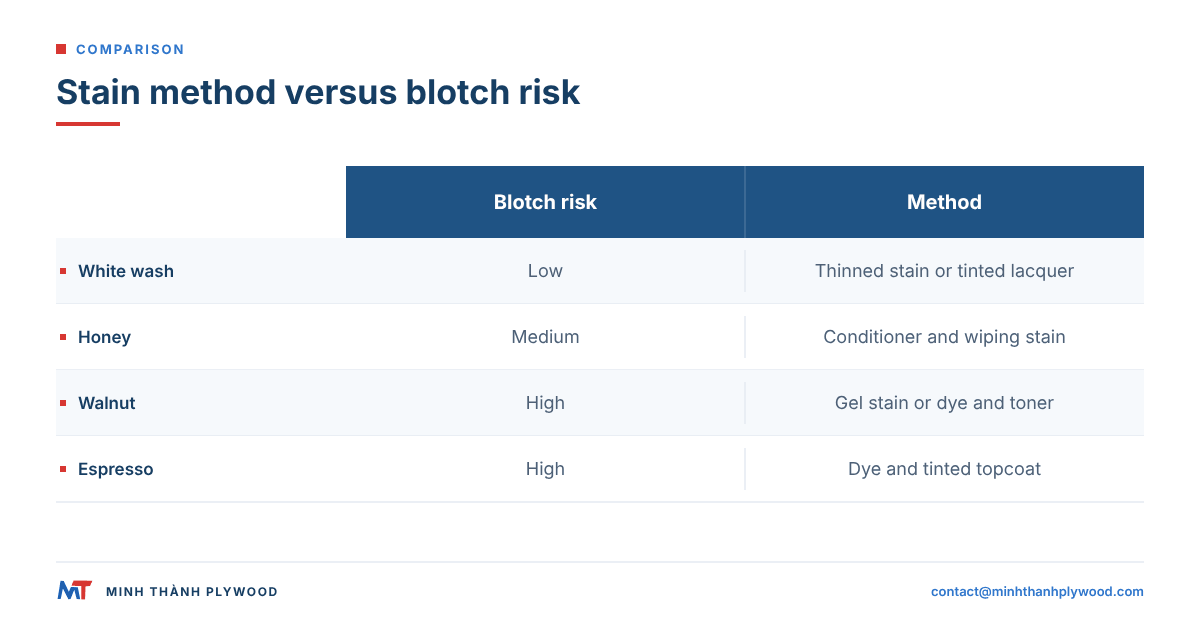
Birch is a pale, neutral wood, so it takes almost any colour; the lighter the stain, the less blotch shows. How the common stain families look on birch:
| Stain colour | Result on birch | Blotch risk | Best method |
|---|---|---|---|
| Natural or clear | Pale cream, slight warmth | None | Water-based clear finish only |
| White wash or pickled | Soft Scandinavian white | Low | Thinned white stain or tinted lacquer |
| Honey or golden oak | Warm mid-tone | Medium | Conditioner, then wiping stain |
| Grey or weathered | Cool, modern | Medium | Dye or gel stain |
| Walnut | Deep brown, imitates walnut | High | Gel stain or dye plus toner |
| Espresso or black | Very dark, grain shows faintly | High | Dye stain, then tinted topcoat |
| Cherry or red tones | Warm red-brown | Medium to high | Conditioner plus gel stain |
Popular named stains to sample on birch plywood
Stain names help only if the colour is proven on your own panel. These widely sold US stains cover the families in the table; test each on an offcut of the same face grade, once with conditioner and once without, before committing a whole job.
| Family | Named stain to sample | What to expect on birch |
|---|---|---|
| Light | Varathane Sunbleached | Pale, nearly natural; lowest blotch risk |
| Golden | Minwax Golden Oak | Warm honey; conditioner needed |
| Weathered | Minwax Weathered Oak | Muted grey-brown; test for streaks |
| Grey | Minwax Classic Gray | Cool grey; shows any uneven absorption |
| Walnut | Minwax Special Walnut, Dark Walnut | Brown; high blotch risk, so use conditioner or gel |
| Black | Minwax Ebony | Near black; grain shows faintly; dye or gel is safer |
| Gel | General Finishes Java gel stain | Deep brown that sits on the surface; the lowest blotch route for dark colours |
Sample a D+ face and a D face side by side: colour streaks and patches on the lower face show through the stain.
Birch plywood stained walnut is one of the most asked-for looks. For a walnut tone that looks even, use a gel stain or a water-based dye, then a coat of tinted finish (toner) to adjust the depth; a thin oil-based wiping stain in a dark walnut is the combination most likely to blotch.
For a true walnut grain rather than a walnut colour, a walnut-pattern EV (engineered veneer) face is the more reliable route; see our EV plywood.
Which clear finishes work on birch plywood?
The clear finish decides the final colour and how the surface wears. The main options on birch:
| Finish | Colour on birch | Durability | Application | Use |
|---|---|---|---|---|
| Water-based polyurethane | Stays pale, no yellowing | High | Brush, roller or spray; fast drying | Light birch furniture, kids’ rooms |
| Oil-based polyurethane | Warm amber, deepens over time | Very high | Brush; slower drying | Table tops, floors, stained pieces |
| Acrylic or nitro lacquer | Clear (acrylic) or slightly warm (nitro) | High | Spray | Production furniture, cabinet doors |
| Hardwax oil | Natural, matt, slightly warm | Medium to high; easy spot repair | Wipe on, buff off | Shelving, wall panels, natural look |
| Danish or tung oil | Amber, low sheen | Low to medium | Wipe on, several coats | Decorative pieces |
| UV-cured coating | Clear, hard | Very high | Factory UV line | Large furniture runs |
For production runs, many furniture plants apply UV-cured coatings on their own lines. Both faces of Minh Thanh’s furniture panels are sanded and polished UV-ready, to the standard customers need to apply their own UV coating. Our clear finishes for plywood guide compares these finishes on other faces too.
How do you seal birch plywood?
Seal birch plywood with a thin first coat of the same clear finish you will use on top, or with a dewaxed shellac sealer, which works under almost any topcoat. The seal coat locks in the stain, stops the next coats from lifting it and fills the grain.
Seal every face and edge, including the back of panels fixed to walls. An unsealed back takes up moisture differently from the sealed front, and the panel can cup. Plywood edges are end grain at every second ply, so they soak up more finish; give them an extra coat. Our guide on how to seal plywood edges covers edge sealing for wet areas.
How do you paint birch plywood?
Paint birch plywood after sanding to 180-220 grit and priming. A water-based or shellac-based primer seals the face and stops the grain from telegraphing through the paint; sand the primer lightly at 220-320 grit before two topcoats.
Painted panels do not need a stain-grade face. A D/D or D/E birch panel, or a poplar or Eucalyptus face, gives the same painted result at a lower price. The how to paint plywood guide covers primers and paint systems.
Baltic birch or birch-faced plywood: does it finish differently?
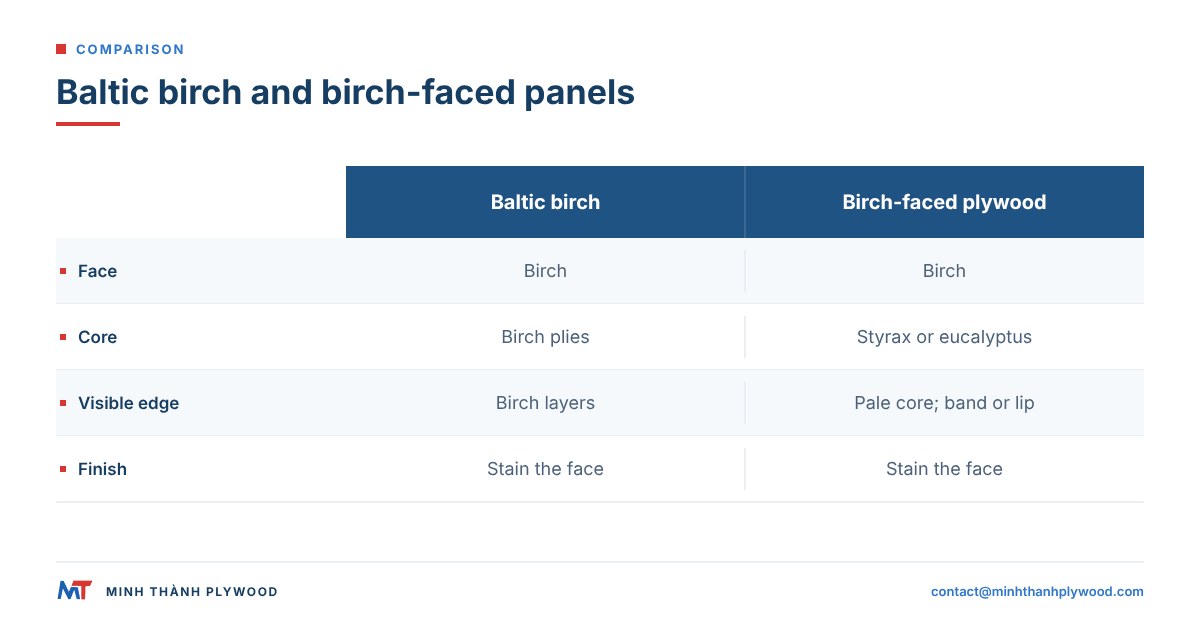
The faces finish the same way; the edges and the price differ. Baltic birch has birch in every ply, so a sanded edge shows even, pale birch layers that stain like the face. Birch-faced plywood has a birch face and back on a lighter hardwood core.
At Minh Thanh the core is white Styrax or Eucalyptus, and the panel is built for the face: core layers stitched both horizontally and vertically, core board pressed and calibrated, then face and back pressed on. The face takes stain exactly like Baltic birch; the edge shows pale core plies, which most furniture covers with edge banding or solid lipping.
| Point | Baltic birch | Birch-faced plywood (Minh Thanh) |
|---|---|---|
| Face | Birch | Birch, graded D+, D or E |
| Core | Birch plies | White Styrax or Eucalyptus |
| Exposed edge | Birch plies, stains like the face | Pale core plies; band or lip for a stained look |
| Face flatness | Even | Even, from a calibrated core and double pressing |
| Thickness tolerance | Standard | ±0.2-0.3 mm, down to ±0.2 mm, on sanded furniture panels |
| Sheet size | Often 1525 x 1525 mm | 1220 x 2440 and 1250 x 2500 mm, plus custom sizes |
Our comparison of Chinese, Baltic and Vietnamese birch plywood goes deeper on grades and price.
Which birch face grade should you order for staining?
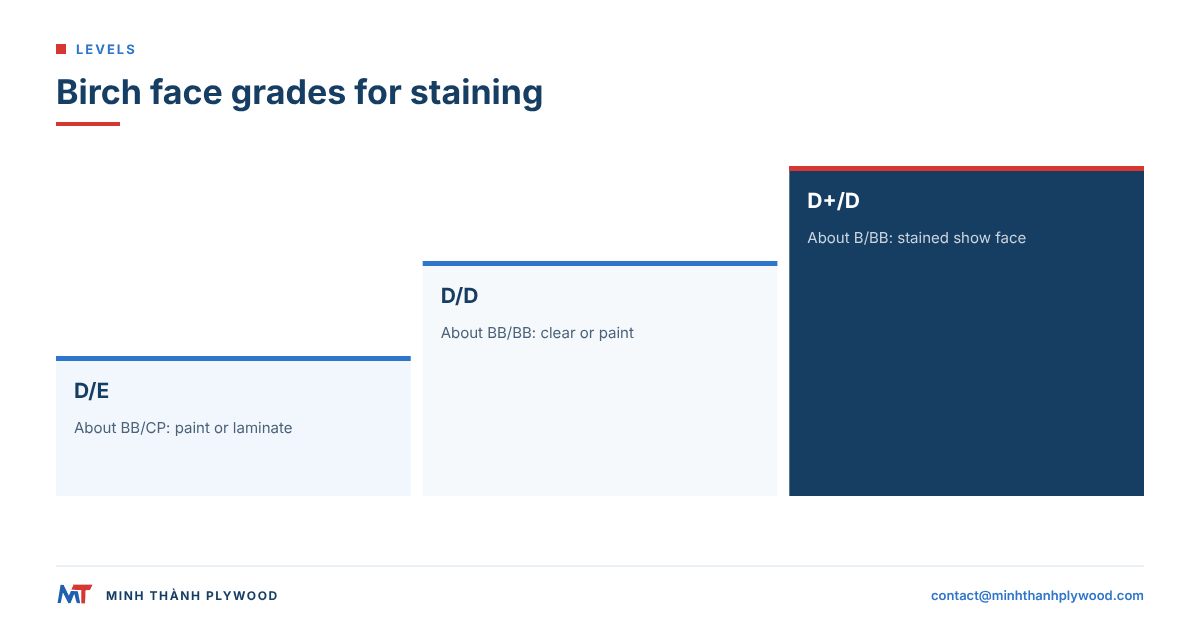
Order D+ faces for stained show surfaces. Birch faces in Vietnam are graded E, D and D+ from low to high and quoted as face/back pairs:
| Vietnamese grade | Comparable European grade | Finish it suits |
|---|---|---|
| D+/D | B/BB | One stained or clear show face, back for hidden side |
| D/D | BB/BB | Clear finishes on both faces where small patches are acceptable; painted work |
| D/E | BB/CP | Painted or laminated panels, hidden parts |
A stain darkens the wood and makes every colour difference sharper, so a patch or mineral streak that disappears under a clear coat stands out under walnut. The grade of each order is fixed to the buyer’s approved sample, so a stained test on a free sample panel shows exactly what the run will look like.
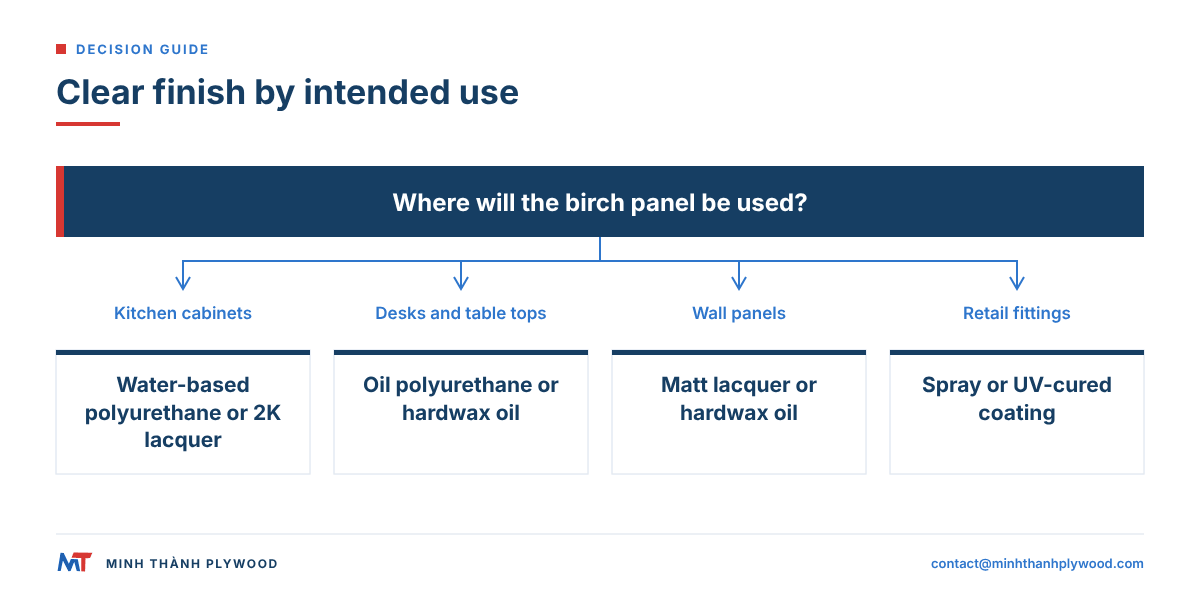
Which finish works best for each use of birch plywood?
Pick the finish by what the surface has to survive. A kitchen door and a decorative wall panel need different protection, even when the stain colour is the same.
| Use | Recommended finish | Why |
|---|---|---|
| Kitchen and bathroom cabinets | Water-based polyurethane or 2K lacquer, three coats | Resists water, grease and frequent cleaning |
| Table tops and desks | Oil-based polyurethane or hardwax oil | Hard-wearing; hardwax oil repairs locally |
| Children’s furniture and toys | Water-based finish rated for toys | Low odour, stays pale |
| Shelving and wardrobes | Water-based polyurethane or hardwax oil | Even sheen, easy upkeep |
| Wall and ceiling panels | Matt lacquer or hardwax oil | Low sheen hides small marks |
| Retail and shopfitting | Factory spray or UV-cured coating | Consistent across many panels |
Should you buy prefinished birch plywood or finish it yourself?
Finish it yourself, or on your own line, when the colour must match a design or other materials; buy prefinished panels only when a standard clear coat is all you need. A prefinished panel saves spraying, but every cut edge, hole and joint still needs finishing on site, and the factory colour cannot be changed afterwards.
Most furniture plants take the middle route: they buy sanded panels with faces ready for their coating line and apply their own stain, sealer and UV or spray topcoat in one controlled process. Minh Thanh supplies birch panels in that state, sanded and polished, UV-ready on both faces.
What finishing problems happen on birch plywood, and how do you fix them?
Most problems are preventable at the sanding and sealing stage:
| Problem | Cause | Fix |
|---|---|---|
| Dark blotches | Uneven absorption of thin pigment stain | Conditioner or wash coat; gel stain; dye and toner |
| Sanded through the face | Coarse grit or a belt sander on a thin face veneer | Start at 150-180 grit; random orbit or hand sanding only |
| Raised, rough grain | Water-based stain or finish lifting fibres | Pre-raise the grain and sand at 220 before staining |
| Stain lifts or smears | Topcoat brushed over wet stain | Let stain dry fully; spray or wipe the first coat |
| Cloudy or milky finish | Humidity or thick coats | Thin coats in a warm, dry room |
| Panel cups after finishing | Back face left unsealed | Finish both faces and the edges |
| Cross-grain scratches | Skipped grits or sanding across the grain | Sand with the grain through every grit |
What does this mean for your birch plywood order?
A furniture maker who stains birch should order the panel for the finish, not just the size:
- Face grade: D+/D for one stained show face, D/D where both faces show under clear or paint.
- Thickness: for example 18 mm carcasses and 12 mm backs and drawers, held to ±0.2 mm on sanded panels.
- Core and glue: white Styrax or Eucalyptus core, UF glue at E0 emission. Six ASTM D6007 chamber tests on our 9, 15 and 18 mm panels averaged 0.014-0.032 ppm against the 0.05 ppm CARB Phase 2 / TSCA Title VI limit. The legal limit for veneer-core hardwood plywood is set in EPA’s TSCA Title VI requirements. For the bond, ask for the class under EN 314-2, and for the panel type under EN 636.
- Surface: sanded and polished, UV-ready on both faces.
- Size: 1220 x 2440 or 1250 x 2500 mm, custom sizes, or cut-to-size parts.
- Quantity: from one 40HC container, with mixed thicknesses by agreement.
Our birch plywood page lists the build and grades, and the how to finish plywood guide covers the other faces. Furniture plywood starts from US$350/m³ (October 2026). Ask for free samples to test your stain, and send the specification to [email protected] for a quote within hours.
Buyer questions, answered
Can you stain birch plywood?
Yes. Birch plywood stains well once the face is sanded to 180-220 grit and sealed with a pre-stain conditioner or wash coat. Gel stains and dyes give the most even colour; thin pigment stains on bare birch tend to blotch.
Why does birch plywood blotch when stained?
Birch has a dense, irregular grain, so some areas absorb stain much faster than others. Rotary-cut birch face veneer exposes that grain in wide figure patterns, which shows up as dark patches under thin stains.
What is the best finish for birch plywood?
Water-based polyurethane or acrylic lacquer keeps birch pale and clear. Oil-based polyurethane and oils warm it to an amber tone. Hardwax oil gives a natural, matt surface that is easy to repair.
Is water-based or oil-based stain better on birch?
Oil-based gel stain is the easiest for an even colour on birch. Water-based stain dries fast and stays clear but raises the grain, so wet the face first, let it dry and sand lightly before staining.
Can you stain birch plywood multiple times?
Yes. Each coat darkens the colour, but wiping stains stop absorbing once the wood is full. Build depth with a gel stain or a tinted topcoat instead of many thin coats.
What grit sandpaper should I use on birch plywood?
Start at 150 or 180 grit and finish at 220 by hand or with a random orbit sander. Do not use coarse grits: the face veneer is thin and sands through quickly. Use 320 between topcoats.
Can you stain Baltic birch plywood?
Yes, with the same preparation. Baltic birch has birch plies throughout, so its edges also stain as birch, while birch-faced plywood with a Styrax or Eucalyptus core shows pale core plies at the edge.
How long does a finish on birch plywood last?
Indoors, a polyurethane or lacquer finish lasts many years with normal care. Oiled surfaces need a fresh coat when they look dry. Outdoor finishes need renewing every few seasons.
Does stained birch plywood need a topcoat?
Yes. Stain only colours the wood; it does not protect it. A clear topcoat of polyurethane, lacquer or hardwax oil seals the colour and protects against water, scratches and wear.
Which birch plywood grade is best for staining?
D+ faces, the top of the Vietnamese birch ladder, which compares with European B grade. D+/D panels suit furniture with one stained show face; D/D panels compare with BB/BB and suit painted or opaque finishes.