
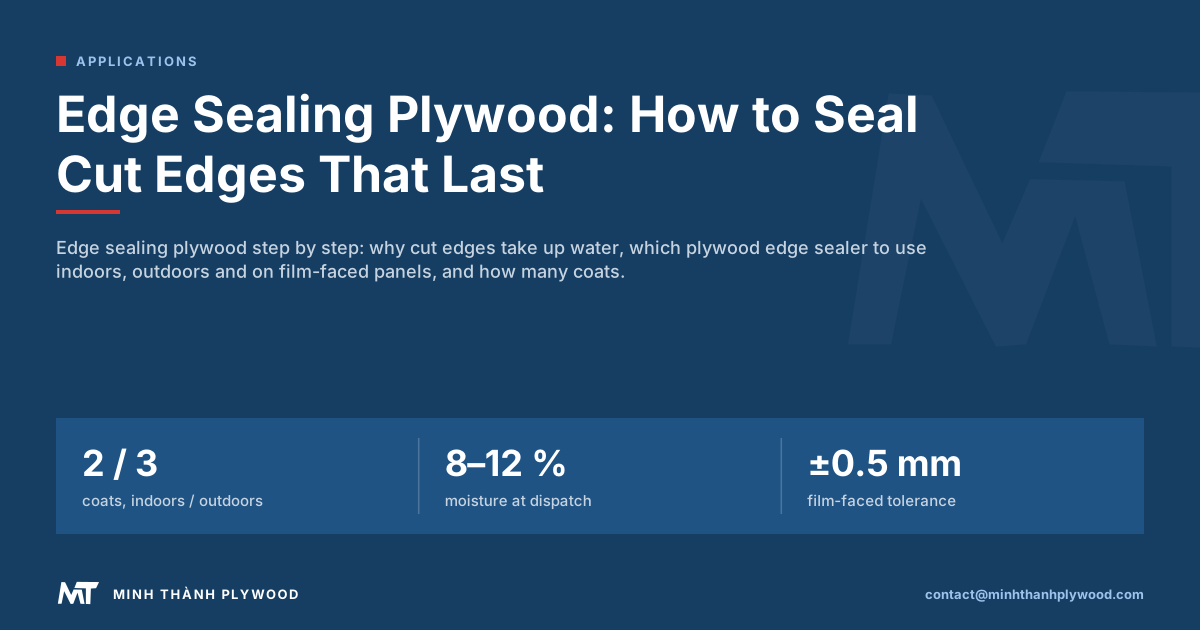
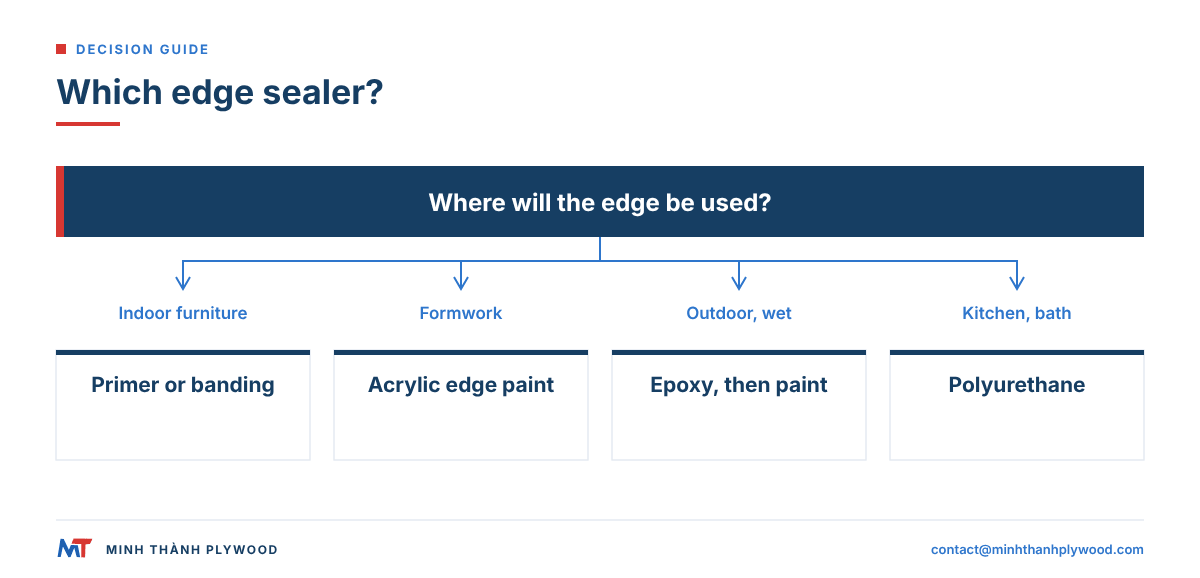
Seal every cut plywood edge the same day you cut it: sand it, prime the end grain, then apply two or three coats of a sealer suited to the exposure. Acrylic edge paint suits film-faced and formwork panels, polyurethane or epoxy suits wet exterior parts, and primer or banding suits furniture. Minh Thanh Plywood ships panels dry, so a sealed edge keeps them that way.
Why does edge sealing plywood matter?
Plywood edges need sealing because they expose end grain on every cross layer, and end grain draws water in far faster than a face. Water enters at the edge, swells the core veneers, and over time weakens the glue lines from the outside in.
A face veneer is long grain: water moves into it slowly and evenly. The edge is a stack of veneers, and half of them run across the sheet, so their open cell ends face outward like bundles of straws. That is why plywood that is wet on site swells at the edge first, why paint soaks into edges and stays rough, and why exterior parts fail at the edges and screw holes long before the faces.
| Where water gets in | How fast | What happens |
|---|---|---|
| Face, long grain | Slow | Surface swelling, raised grain |
| Edge, end grain | Fast | Core swelling, edge lift, staining |
| Screw and dowel holes | Fast | Swelling around fixings, split edges |
| Damaged film or coating | Medium | Local swelling under the coating |
Sealing slows water uptake at the edge to something close to the face, so the panel moves evenly. It does not turn an interior panel into an exterior one: that is decided by the glue. Read is plywood waterproof for the glue classes.
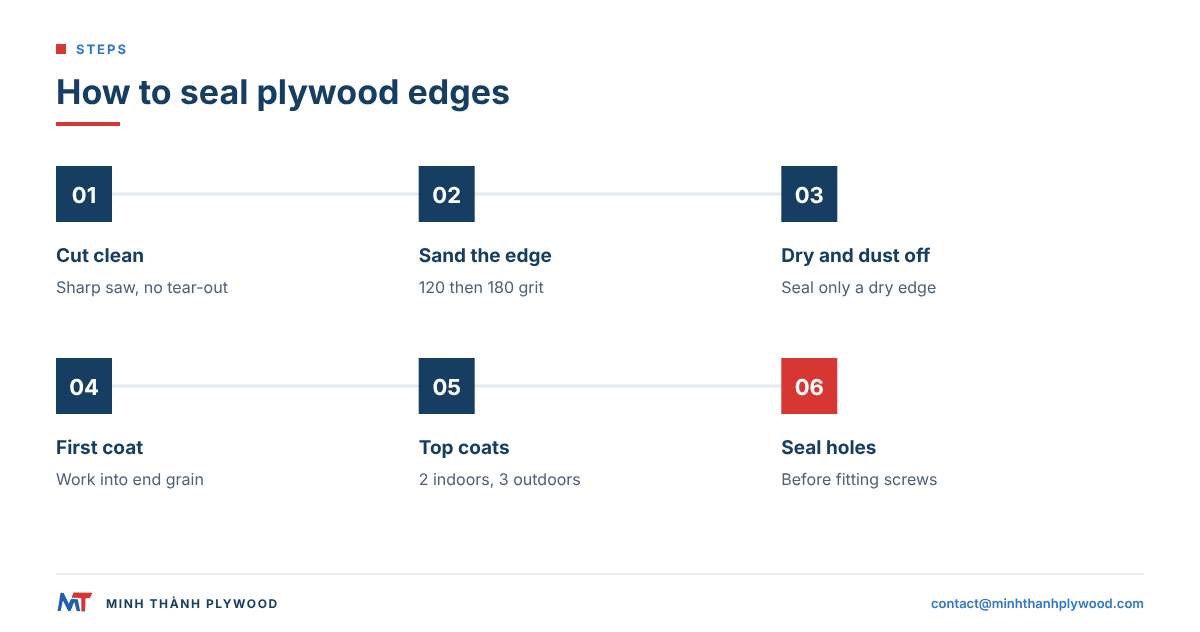
How to seal the edge of plywood: the steps
To seal the edge of plywood, cut it clean, sand it, prime the end grain and build up two or three coats of a sealer chosen for the exposure. Seal on the day you cut, before the edge picks up moisture.
- Cut clean. A sharp saw or router leaves an edge with closed fibres and no tear-out. Ragged edges take more sealer and hold water in the gaps.
- Sand the edge. Hand-sand at 120 then 180 grit on a block, and break the sharp corners with a few strokes so the coating can wrap round them.
- Remove dust. Brush and vacuum the edge; dust in the end grain stops the first coat soaking in.
- Check dryness. Seal only a dry edge. Panels that have been rained on need to dry back first, or the sealer traps water.
- Apply a penetrating first coat. Thin it as the maker allows, or use a dedicated primer, and brush it into the end grain until it stops soaking in.
- Let it dry, then sand lightly at 180–220 grit to knock down raised fibres.
- Build up the top coats. Two more coats outdoors, one more indoors, each brushed along the edge and slightly onto the face.
- Seal holes and notches. Every drilled hole and cut-out is an edge too. Brush or dab sealer into the hole before fitting the screw.
- Inspect. Look for pinholes and bare spots in the end grain under a light, and touch them up.
Two coats indoors and three outdoors is the working rule. On thick panels, a small brush or foam roller lets you lay sealer only on the edge.
Which plywood edge sealer should you use?
The right plywood edge sealer depends on exposure: acrylic edge paint for film-faced and formwork panels, polyurethane or epoxy for wet exterior parts, primer or banding for furniture. This table compares the main types.
| Plywood edge sealer | Best for | Strength | Limitation |
|---|---|---|---|
| Acrylic edge paint (water-based) | Film-faced and formwork panels, site cuts | Fast drying, easy to brush, cheap | Wears on panels that are handled hard |
| Polyurethane varnish or edge sealer | Exterior parts, kitchens, bathrooms | Hard, water-resistant film | Needs dry wood and several coats |
| Two-part epoxy (penetrating) | Boats, outdoor furniture, wet zones | Soaks in and bonds the end grain | Must be covered from sunlight with paint or varnish |
| Oil-based or shellac primer | Furniture edges before paint | Blocks absorption, sands well | Not a top coat outdoors |
| Diluted PVA glue | Indoor pre-seal before paint | Very cheap, quick | Not water-resistant |
| Wax emulsion end sealer | Edges in storage and transit | Fast, slows drying and moisture uptake | Must be removed before finishing |
| Edge banding or lipping | Furniture and shelving | Hides and protects the edge | Glued edge is not waterproof by itself |
Edge paint and polyurethane are what most contractors keep on site. Epoxy gives the best seal on exposed exterior parts, then needs a UV-resistant top coat because sunlight breaks it down.
What is the best way to seal plywood edges for outdoor use?
The best way to seal plywood edges for outdoor use is a penetrating epoxy or exterior primer on the end grain, followed by two or three coats of exterior paint or marine-grade varnish, on a panel with an exterior glue. The glue decides whether the panel survives; the sealer decides how long the edge stays sound.
Outdoor sealing in practice:
- Choose the panel first. Exterior work needs plywood bonded with a phenolic (WBP) or melamine-fortified glue. Minh Thanh’s exterior plywood uses these bonds for uses such as stair treads and wall sheathing.
- Shape the edge. Round or chamfer exposed edges slightly so the coating does not thin out on a sharp corner.
- Seal end grain hardest. Bottom edges and any edge that sits on a wet surface get an extra coat.
- Keep water off. Detail parts so edges drain and do not stand in water; leave a gap at the bottom of cladding.
- Inspect each year. Re-coat edges where the coating is cracked or worn, before the wood greys.
On a deck, balcony or planter, the edge that touches wet ground fails first. A sealed edge plus a gap keeps the panel out of standing water.
How to seal film-faced plywood edges after cutting
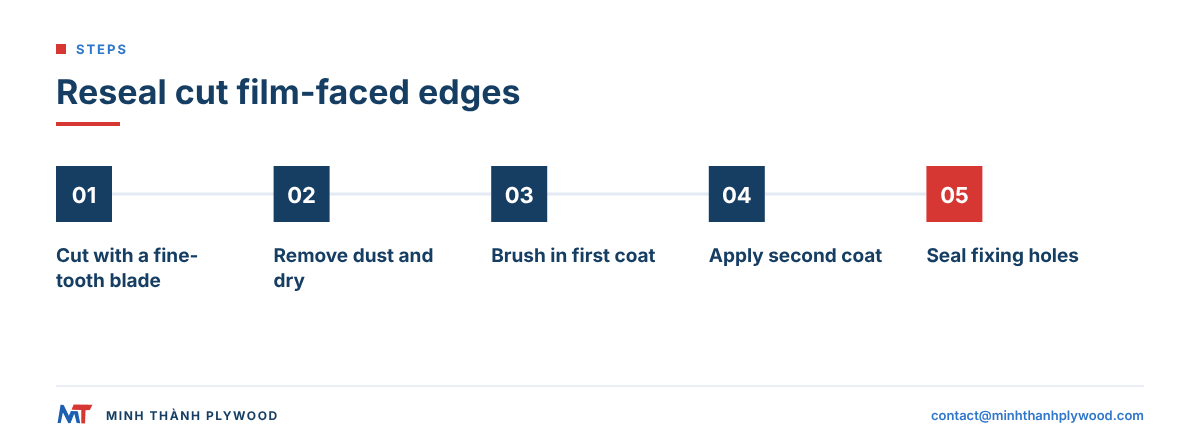
Seal film-faced plywood edges after cutting with two coats of acrylic edge paint or a polyurethane edge sealer, brushed on the same day. The film protects the faces; every cut opens a raw edge that drinks concrete water and swells.
Film-faced plywood is normally supplied with its edges sealed with paint at the mill. On site, the sequence is short:
- Cut with a fine-tooth blade so the film does not chip at the edge.
- Brush off sawdust and let a damp edge dry.
- Apply the first coat and work it into the core layers.
- Apply a second coat once dry, slightly overlapping the film on both faces.
- Seal tie-rod and fixing holes the same way.
Sealed edges, a release agent and careful handling decide how many times a formwork panel can be reused. A panel whose cut edges stay raw swells, chips at the film edge and leaves marks on the concrete. Our film-faced plywood page lists the glue options for repeated pours.
Sealing edges on furniture and interior plywood
On furniture and interior plywood, edge sealing is mainly for looks and paint quality: prime or band the edge, sand smooth and finish it with the faces. Indoor edges see little water, except in kitchens and bathrooms.
- Painted parts: skim the edge with primer or filler, sand at 180 grit, prime again and paint with the faces.
- Clear or stained parts: apply veneer edge banding or solid lipping, then finish with the faces. See plywood edge banding.
- Exposed edges as a design feature: sand the edge to 220 grit and apply the same clear finish as the faces, with one extra coat on the edge.
- Kitchen and bathroom parts: seal every edge, including the hidden back and bottom edges, and the holes for hinges and handles.
Furniture plywood from Minh Thanh uses UF glue at E0 emission as standard, a glue for interior use. Seal and band edges in wet rooms, or order a melamine-fortified (MR) bond for parts near water.
Which edge sealer works for plywood and OSB?
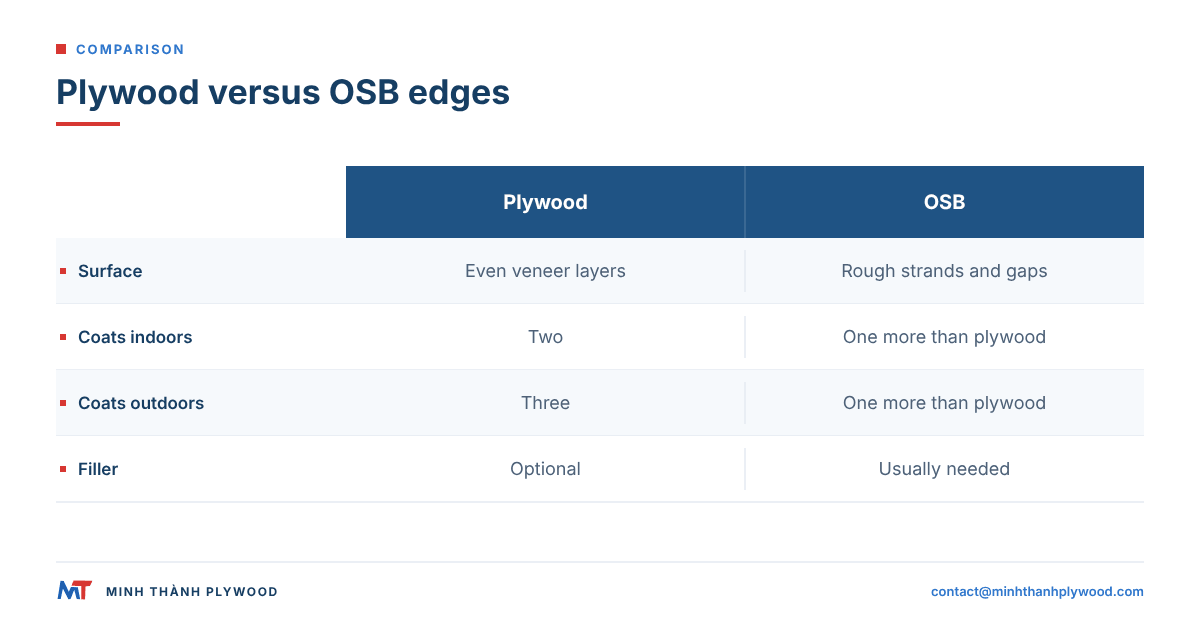
The same edge sealers work on plywood and OSB, but OSB edges are rougher and more absorbent, so they need an extra coat and sometimes a filler first. OSB is made of pressed strands, and its edge swells more visibly than plywood when wet.
| Point | Plywood edge | OSB edge |
|---|---|---|
| Surface | Even veneer layers | Rough strands, gaps |
| Absorption | High on cross layers | High everywhere |
| Coats of sealer | Two indoors, three outdoors | One more than plywood |
| Filler before paint | Optional | Usually needed |
| Swelling when wet | At the core layers | Across the whole edge |
For construction sheathing, panel makers often supply edge-sealed sheets. Every site cut still needs sealing. See plywood vs OSB for how the two panels compare.
How to seal MDF edges
To seal MDF edges, skim them with thinned PVA, a shellac-based primer or a fine filler, sand smooth at 180–220 grit and paint. MDF edges are fibre, not veneers, and soak up paint until sealed.
MDF is often in the same cabinet as plywood, so the same workshop seals both. The difference is that a sealed MDF edge is for paint quality only: MDF is not for wet exposure, while exterior plywood with a phenolic glue is. Compare the two panels in plywood vs MDF.
Factory edge sealing vs re-sealing cut edges on site
Factory edge sealing protects the panel as it leaves the mill; once you cut it, the new edges are yours to seal. A full sheet with sealed edges can still swell along every site cut that is left raw.
| Stage | Who seals | Purpose |
|---|---|---|
| At the mill (film-faced, some exterior panels) | Manufacturer | Protect the full sheet in storage and transit |
| Cut-to-size parts from the mill | Agreed on the order | Parts arrive ready to fit |
| Site cuts and holes | Contractor or fabricator | Close each new edge before use |
| Repairs after damage | User | Stop water entering at chips and dents |
Cut-to-size orders move part of the work to the mill. Minh Thanh cuts one panel into 4, 6 or 8 pieces for buyers who want parts, not sheets, and ships them regularly to Italy and other European markets. Write on the order whether cut edges should be sealed, so the parts arrive the way your line uses them. See cut-to-size plywood.
How many coats, and how to check the seal
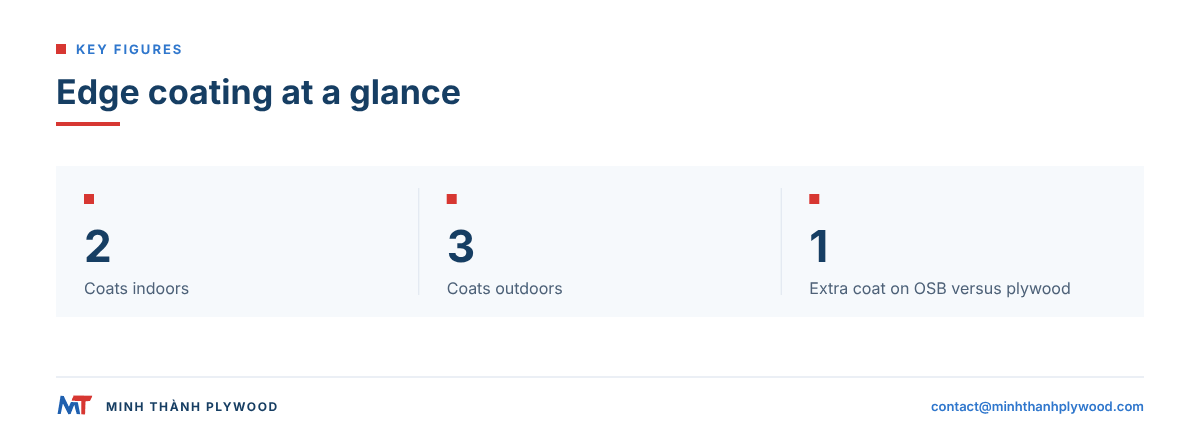
Plywood edges need two coats of sealer indoors and three outdoors, with the first coat worked into the end grain. A good seal looks evenly glossy along the whole edge with no dry, dull spots.
Simple checks:
- The look: dull patches on the edge are where the end grain drank the coat; add another.
- The water drop: a drop of water on the edge should bead and not darken the wood.
- The fingernail: the coating should not flake from the corner.
- The holes: shine a torch into fixing holes; the wood inside should be coated.
Recoat interior edges when you refinish the faces. Recoat exterior edges once a year, or as soon as the coating cracks.
How long does an edge seal last, and what does it cost to skip it?
Sealing pays back in service life and in measured water uptake. UK retailer guidance puts a number on both:
| Question | Figure | Source |
|---|---|---|
| Unsealed plywood outdoors | A few years | Toolstation guide |
| Sealed and maintained plywood outdoors | 10–20 years or more | Toolstation guide |
| Primer or edge paint as the only seal | Reapply every 1–2 years | Toolstation guide |
| Exterior paint or polyurethane varnish | 2–3 coats, with drying time between | Toolstation guide |
| Epoxy-sealed boat finishes with varnish on top | Up to 20 years | MakeWoodGood |
A published soak test shows why coats matter. The WEST SYSTEM moisture-exclusion test soaked epoxy-coated plywood blanks in 100 % humidity for 8 weeks: uncoated blanks gained about 23 % in weight, two coats of epoxy still gained 18 %, and three coats held the gain to 8 %. The lesson for edges is the same as for the table above: one thin coat is not a seal, so work three into end grain that will see weather.
What UK buyers pay. Plain far-eastern WBP plywood in 2440 × 1220 × 18 mm sells for roughly £36–£43 a sheet at UK timber merchants, a BB/BB birch sheet of the same size lists around £120 ex VAT, and phenolic-faced birch runs £97–£150. A tin of edge sealer or exterior primer from a merchant such as Toolstation or Travis Perkins costs far less than the panel it protects, so sealing a cut edge is the cheapest repair on the job.
Edge sealing for export: moisture in packing and containers
For export, the panel’s own moisture and the packing matter more than edge paint on furniture plywood. Furniture panels leave Minh Thanh dried to 8–12 % moisture content, the normal range for furniture plywood, and are packed so the edges are covered in transit.
What protects edges between the mill and your warehouse:
- Dry panels at loading. Panels at 8–12 % are less likely to swell or grow mould in a closed container.
- Covered packs. Packs are wrapped in film, protected with cardboard and strapped on plywood pallet blocks, so they stay off the container floor.
- Tested packaging. The four packaging materials, cardboard, plywood and pallet blocks, strapping band and wrapping film, were tested by SGS in September 2026 under the EU Packaging and Packaging Waste Regulation, Regulation (EU) 2025/40: lead, cadmium, mercury and hexavalent chromium not detected.
- Evidence. Every shipment is photographed and filmed before loading, and the buyer gets the photos and video.
Plywood is processed wood, so it sits outside ISPM 15, the international standard for wood packaging; solid sawn-wood bearers under the packs are inside it and carry the ISPM 15 mark. UK import rules likewise say they do not apply to processed, non solid WPM like plywood.
On arrival, store packs flat and dry, off the floor, and open the wrapping only when you cut. See export packing for how packs are built.
Common edge-sealing mistakes
Most edge failures come from sealing too late, too thinly or not at all on hidden edges. These are the mistakes that show up first.
| Mistake | Result | Do this instead |
|---|---|---|
| Sealing days after the cut | Swollen or stained edge | Seal the same day |
| One thin coat | End grain dries dull, water gets in | Two coats indoors, three outdoors |
| Sealing a wet edge | Trapped water, coating peels | Let the edge dry first |
| Forgetting holes and notches | Swelling around fixings | Seal every hole before the screw |
| Skipping hidden edges | Bottom edges rot first | Seal all edges, seen or not |
| Interior panel outdoors | Glue lines fail behind the sealer | Use exterior glue |
| Sharp corners | Coating thins and cracks at the arris | Break the corner before sealing |
What this means for your order
Edge sealing starts with the right panel and the right glue, then a sealer matched to exposure. Put these lines on your order so the panel and your sealing method fit together:
- Use: furniture, kitchen and bathroom, formwork, or exterior.
- Glue: UF at E0 emission for interior furniture; MR (melamine-fortified) or phenolic WBP for damp and exterior use.
- Face: sanded veneer for furniture, film for formwork.
- Thickness tolerance: ±0.2–0.3 mm on sanded furniture panels, ±0.5 mm on film-faced.
- Edges: sealed at the mill or left raw for your own process; cut-to-size if you want parts.
- Packing: wrapped and strapped packs, moisture 8–12 % at dispatch.
Minh Thanh sends free samples of the build you specify, so you can test your edge sealer on the real panel. Send your specification to [email protected], or read how to finish plywood and how to sand plywood for the steps before sealing.
Buyer questions, answered
What is the best way to seal plywood edges for outdoor use?
Sand the edge, apply a penetrating epoxy or an exterior primer to the end grain, then two or three coats of exterior paint or polyurethane. Use exterior plywood with a phenolic (WBP) or melamine-fortified glue; a sealer cannot fix an interior glue line.
How do you seal film-faced plywood edges after cutting?
Clean and lightly sand the cut, then brush on two coats of acrylic edge paint or a polyurethane edge sealer the same day, letting the first coat soak in. Re-seal any drilled holes the same way.
What can I use to seal the edge of plywood?
Acrylic edge paint, polyurethane varnish, two-part epoxy, an oil-based or shellac primer, or diluted PVA glue as a cheap indoor pre-seal. The right one depends on exposure: indoor, covered outdoor or wet.
Which edge sealer works for both plywood and OSB?
Acrylic or polyurethane edge sealers made for wood panels work on both. OSB edges are rougher and more absorbent, so they take an extra coat.
How do you seal MDF edges?
MDF edges soak up paint, so skim them with thinned PVA, a shellac-based primer or a filler, sand smooth at 180–220 grit and then paint. MDF is not for wet exposure even when sealed.
Does PVA glue seal plywood edges?
Diluted PVA works as a cheap first coat to stop paint soaking into indoor edges. It is not water-resistant enough on its own for outdoor or wet use.
How many coats of sealer do plywood edges need?
Two coats indoors and three outdoors, with the first coat thinned or worked into the end grain. Edges absorb more than faces, so they always need at least one more coat than the face.
Should I seal plywood edges before painting?
Yes. Prime or seal edges first, sand at 180 grit and then paint. Unsealed end grain soaks up paint and stays rough.
Why do plywood edges swell?
The edge shows end grain on every cross layer, and end grain draws water in much faster than the face. Swelling starts at the edge and spreads along the glue lines.
Do film-faced plywood panels come with sealed edges?
Yes, film-faced panels are normally supplied with their edges sealed with paint at the mill. Every cut you make on site opens a new raw edge that you must seal yourself.