
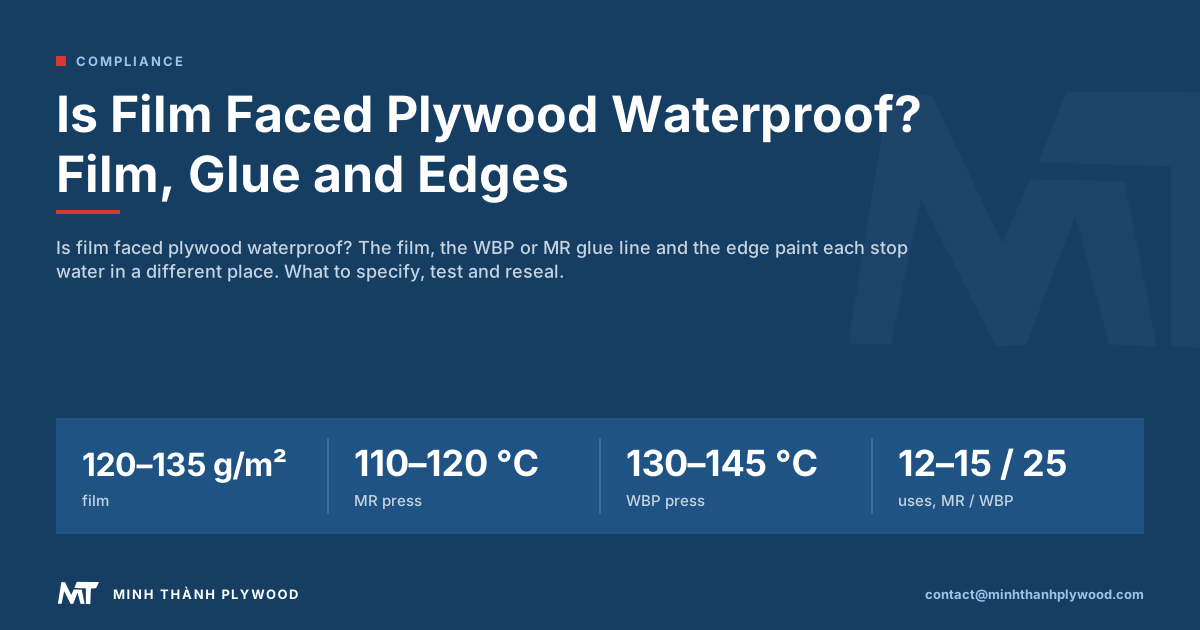
Is film faced plywood waterproof? Its film slows moisture uptake; the whole panel is water-resistant, with performance shaped by the glue line and sealed edges. A phenolic (WBP) bond survives long boiling, a melamine-fortified (MR) bond survives less, and every saw cut opens a path for water. Minh Thanh Plywood makes film-faced panels in both bonds and explains here what to order for wet sites.
Is film faced plywood waterproof? The short answer
Film faced plywood is water-resistant, including on its film face. The resin film on both faces slows moisture uptake and helps concrete release; the glue line, edge paint and care on site determine how the panel performs in wet work. Intact film still allows moisture penetration, so protect edges and maintain the surface.
- Film: phenolic resin film, about 120–135 g/m² standard, from about 135 g/m² premium; it seals the faces.
- Glue line: phenolic (WBP) for long wet service, melamine-fortified (MR) for shorter jobs.
- Edges: factory edge paint slows water into the end grain; site cuts must be repainted.
- Use: water enters where film or paint is broken, so reuse falls fastest at damaged edges.
The rest of this guide takes each barrier in turn, then the site rules and the order lines that follow from them.
Film faced plywood or formply in Australia: F14, F17, 2400 × 1200 mm and shelf prices
In Australia, non-structural film faced plywood and structural formply are both water-resistant, and the difference is the stress grade, not the water rating. Structural formply is made to AS 6669 with an F14 or F17 stress grade for load-bearing formwork; non-structural film faced plywood has no stress grade and is sold for linings, shelving, trays and lighter shuttering.
| Line | Non-structural film faced plywood | Structural formply (F14, F17) |
|---|---|---|
| Standard | Order specification | AS 6669, stress grade from AS/NZS 2269 |
| Use | Linings, light shuttering, general use | Load-bearing formwork, slabs, tilt-up panels |
| Water | Film and panel water-resistant | Film and panel water-resistant |
| Usual thickness | 9 mm and 12 mm linings, 17 mm formwork | 17 mm for most formwork |
Australian shelf prices in October 2026 for non-structural film faced plywood in the local sheet size, 2400 × 1200 mm, were A$55 for 9 mm, A$60 for 12 mm and A$69 for 17 mm, with a pack of 42 sheets of 17 mm at A$2,520 and delivery from A$89, at Just Plywood in Melbourne. Bunker Building Supplies stocks the same three thicknesses and points load-bearing formwork to F17 formply.
The 17 mm sheet at A$69 is 0.049 m³, about A$1,409 per m³ including 10% GST, so a buyer comparing an import offer should compare per cubic metre first. Importing from Vietnam adds sea freight and, for goods that do not qualify for preference, duty:
- Transit: about 16–18 days direct from Hai Phong to Sydney or Melbourne, 22–28 days with transhipment (ATL, 2026).
- Freight: indicative US$1,400–1,900 for a 40-foot container from Hai Phong to Sydney or Melbourne, which spread over a full 40HC is a small cost per sheet.
- Duty: the Australian Border Force tariff lists plywood with a tropical or eucalyptus outer ply (4412.31, 4412.33) at a general rate of 5%; goods that meet the AANZFTA rules of origin with a Form AANZ certificate enter at the preferential rate (ABF tariff, chapter 44).
- GST: 10% on the import value, recoverable for a GST-registered business.
- Biosecurity: timber products are inspected, so packing and documents matter.
Our film faced plywood ships as 1220 × 2440 mm or 1250 × 2500 mm sheets, from one 40HC, with the glue line, film mass and edge sealing written on the quote; commercial plywood starts from US$250/m³ (October 2026), a raw FOB basis per m³ before film, bond and core set the specification price. Ask for a quote for 17 mm formwork panels and compare it per m³ with the shelf price above.
Waterproof or water-resistant: what the word means on a quote
Water-resistant describes both the phenolic film face and the complete panel. A quote that says “waterproof film faced plywood” tells you nothing about the bond, which is the line that decides whether the sheet survives months of rain and pours.
| Word on the quote | What it can honestly mean | What to ask for |
|---|---|---|
| Waterproof | Water resistance under stated exposure conditions | Glue type and boil-test basis |
| Water-resistant | Panel resists wetting in normal site use | Exposure and planned pours |
| WBP | Weather and boil proof bond, usually phenolic | Bond test method and hours |
| Marine | A named marine standard such as BS 1088 | The standard and its proof |
Replace the single word with three lines on the order: glue type, film mass and edge sealing. Those lines make two offers comparable and keep “waterproof” from hiding a short-life bond.
The four water barriers: film, glue line, edge paint and core
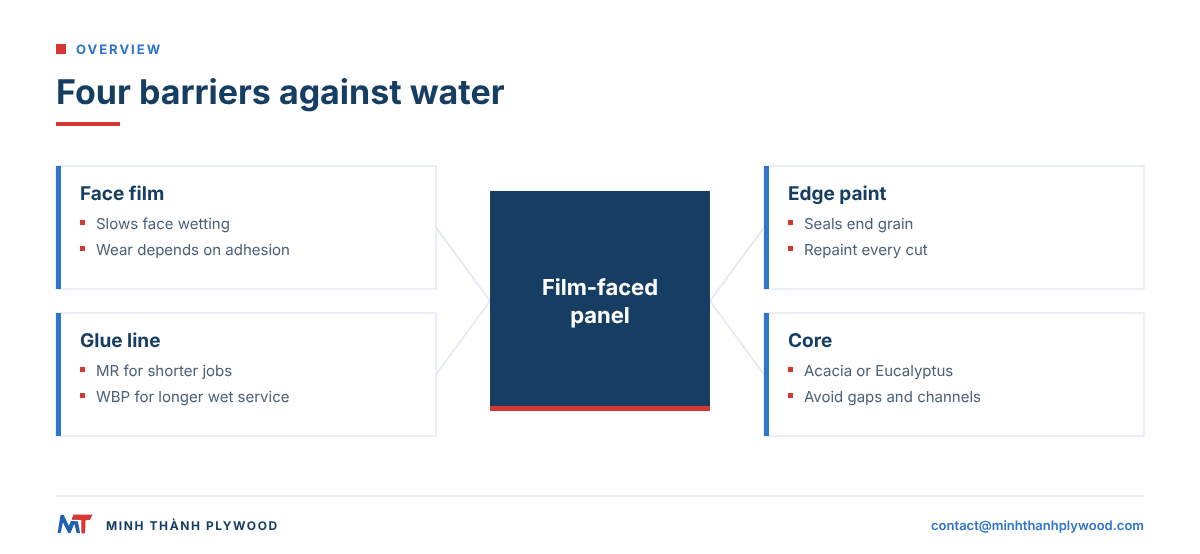
A film-faced panel resists water through four barriers that fail in different places: the film on the faces, the glue line between veneers, the paint on the edges and the core veneers themselves. A strong film on a weak bond fails at the glue line; a good bond with unpainted cuts fails at the edge.
- The film. Resin-impregnated paper cured onto both faces under heat and pressure. Film mass, curing and adhesion decide how long it resists abrasion and water. Heavier film gives more wear allowance; on its own it is not a quality grade.
- The glue line. Phenolic (WBP) or melamine-fortified (MR) resin bonding each veneer to the next. This is the barrier that holds the sheet together once water gets inside.
- The edge paint. Applied after trimming to seal the end grain of every veneer. End grain takes in water many times faster than an intact face.
- The core. Our film-faced panels use Acacia or Eucalyptus hardwood veneers. A tight, gap-free core leaves no channels for water to run along inside the panel.
Our film-faced plywood page lists the build, film options and sizes for each grade.
Is phenolic plywood waterproof? Film versus phenolic glue
Phenolic film slows moisture uptake at the faces, while a phenolic glue line maintains the bond when wet; these are different specifications. “Phenolic” can describe the resin in the film, the resin in the glue, or both; most film-faced plywood carries a phenolic film, while the glue inside may be phenolic or melamine-fortified.
| Part | Phenolic version | What it protects |
|---|---|---|
| Face film | Phenolic resin film, brown or black | The two faces |
| Glue line | Phenolic (WBP) resin | Bond between veneers when wet |
| Both | Phenolic film on a phenolic bond | Faces and bond: the longest wet life |
| Film only | Phenolic film on a melamine-fortified bond | Faces; the bond is the shorter-lived part |
The film colour does not show the glue. Ask for the glue line in writing, and treat “phenolic board” or “phenolic plywood” on a quote as a name, not a bond class.
MR vs WBP glue line: what the boil test shows
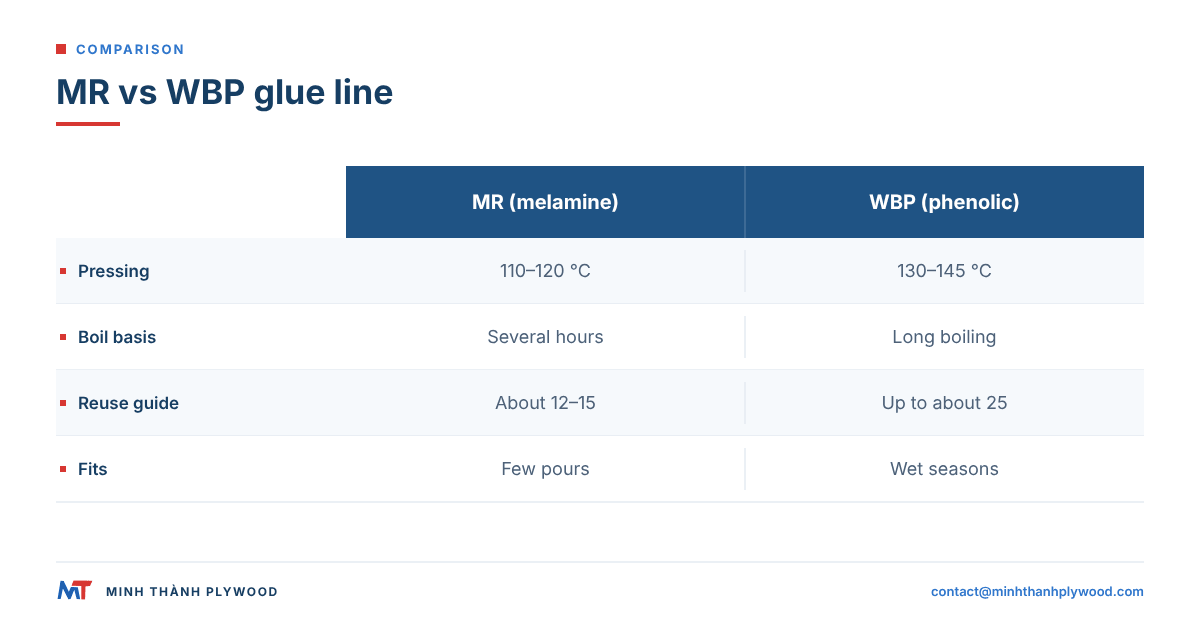
The boil test shows how long a glue line holds in boiling water, and it is the clearest way to tell a WBP bond from an MR bond. A phenolic (WBP) bond is pressed at 130–145 °C and is built for long boiling; a melamine-fortified (MR) bond is pressed at 110–120 °C and holds for fewer hours.
| Line | Melamine-fortified (MR) | Phenolic (WBP) |
|---|---|---|
| Pressing temperature | 110–120 °C | 130–145 °C |
| Glue line colour | Light | Dark brown |
| Typical boil basis | Several hours, by order | Long boiling, such as 72 hours |
| Reuse guide | About 12–15 uses | Up to about 25 uses |
| Fits | Short projects, few pours | Repeated pours, long wet seasons |
Reuse figures are industry guides with proper handling, release agent and edge sealing. A boil test is a bond test on samples, not an emission test and not a strength test. A 72-hour boil is the traditional WBP test (IS 710, the old BS WBP basis); on its own it does not prove a marine grade or an EN 314-2 Class 3 bond.
European bond classes come from EN 314-2, the bonding-quality standard. Class 1 for dry use, Class 2 for humid use, Class 3 for exterior use, each after its own soak or boil pre-treatment. Panels marketed for construction in the EU sit under the Construction Products Regulation (EU) No 305/2011 (read 20 October 2026). For a project that names a class, put the class and the test method on the order; we arrange third-party testing to the buyer’s method through SGS on request. Our guide to plywood boiling and bond tests explains each method.
Is formply or shuttering plywood waterproof?
Formply is water-resistant, not waterproof, because it is film-faced plywood under its Australian and New Zealand name. Formply, form ply, shutterply, shuttering ply, phenolic board and betonplex all describe the same build, so the waterproof question has the same answer for each: the film slows moisture uptake, while wet performance also depends on the bond and edges.
Is formply waterproof in each regional name?
| Name | Where | Is it waterproof? |
|---|---|---|
| Film-faced plywood | Export, Europe, Middle East, Asia | Water-resistant film and panel |
| Formply, form ply | Australia, New Zealand | Water-resistant; phenolic bond for wet use |
| Shuttering ply | UK, India | Water-resistant when bonded WBP |
| Shutterply | South Africa | Water-resistant; ask for the bond |
| Phenolic board | Philippines | Water-resistant film; glue may be MR or WBP |
| Betonplex | Netherlands, Belgium | Waterbestendig (water-resistant), not waterdicht |
Translate the name into the same three lines before you compare prices: glue type, film mass, edge sealing. Our concrete form plywood buying guide covers the full formwork specification under every regional name.
How film-faced plywood behaves in each water exposure
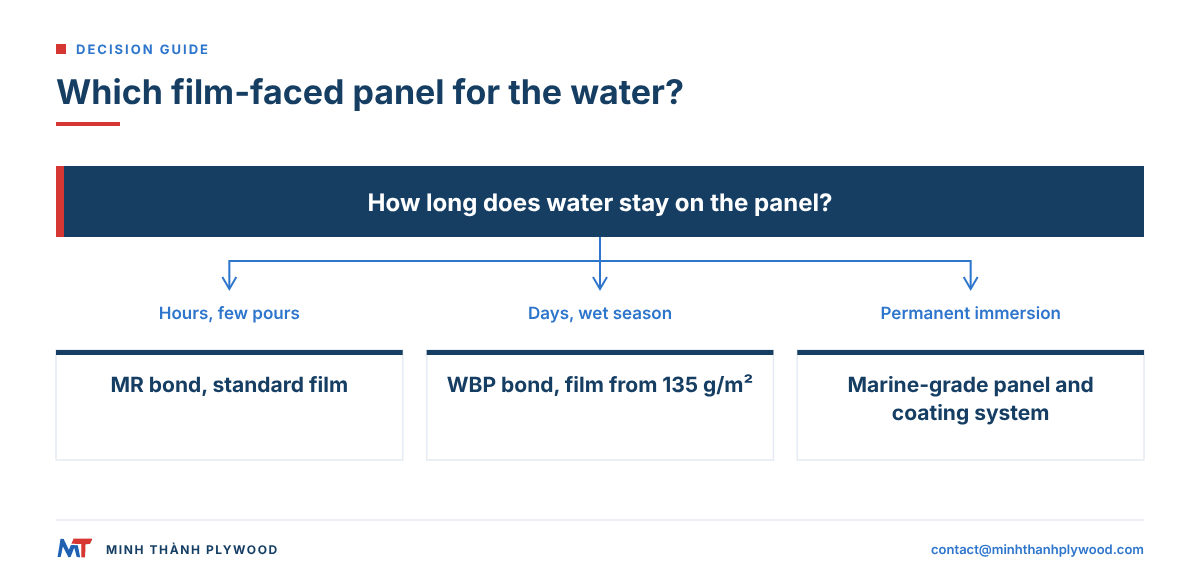
Film-faced plywood handles short, repeated wetting well and continuous water badly. The table matches each exposure to the expected behaviour and the control that keeps the panel in service.
| Exposure | Expected behaviour | Control |
|---|---|---|
| Fresh concrete during a pour | The intended use | Release agent, intact film, sealed edges |
| Rain during a pour cycle | Tolerated by a sound panel | Drain, dry with airflow, inspect edges |
| Repeated wet-dry cycles | Gradual stress on film, edges and bond | Clean, dry and reseal after each use |
| Water ponding on a deck | Higher risk at joints and holes | Slope or drain the deck, seal holes |
| Uncovered storage | Edge swelling, warping, film ageing | Raised, flat, covered and ventilated stacks |
| Continuous immersion | Not a formwork design condition | Marine-grade panel and coating system |
The exposure decides the bond: phenolic (WBP) where water stays on the panel for days, melamine-fortified (MR) where pours are few and drying is quick.
Where water gets into a film-faced panel
Water enters fastest where film or edge paint is damaged; intact phenolic film slows moisture uptake but does not stop it completely, as explained in ForestOne’s plywood FAQ. Five entry points account for most swelling and delamination on site.
- Saw cuts. A cut removes the factory edge paint and exposes the end grain of every veneer.
- Tie holes and fixings. Small in area, but they lead straight into the core, often with concrete residue that keeps them wet.
- Scratches and impacts. Metal scrapers, dragged rebar and rough stripping cut through the film to the face veneer.
- Open glue lines or core gaps. A gap at the edge collects water and opens further with each wet-dry cycle.
- Storage on wet ground. A stack on bare ground wicks water from below while rain wets the top sheet.
Edge paint should never hide an open glue line or a core gap. Look along the edges of a few sheets from each pack in the receiving inspection, before the first cut, and set aside any sheet with an open line.
How water exposure limits reuse
Water exposure limits reuse because swelling at the edges and holes, not wear on the film, is what usually retires a formwork panel. With proper handling, release agent and edge sealing, the industry guide is about 12–15 uses on a melamine-fortified bond and up to about 25 on a phenolic bond.
| Condition on site | Effect on reuse |
|---|---|
| Edges resealed after every cut | Panel reaches its bond’s reuse range |
| Cuts left unpainted | Edges swell first; reuse falls well short |
| Stacks stored wet and covered tight | Trapped moisture swells the core |
| Film scraped with metal tools | Water reaches the face veneer |
| Phenolic bond in a long wet season | Holds where MR bonds start to open |
Reuse is a target set by the build and the site, not a fixed property of the sheet. A buyer who plans many pours in a wet season gets more uses per sheet from a phenolic bond than from extra film mass alone.
Can film-faced plywood be left in the rain or submerged?
Film-faced plywood can take rain during a pour cycle, but it should not be stored in the rain or left submerged. Rain on a sound, installed panel runs off the film; rain on an uncovered stack soaks the edges, and standing water reaches the core through every cut and hole.
- Installed forms: rain between pours is a normal formwork condition; drain decks and let panels dry before the next pour.
- Stacks: lift them on level bearers, cover them against rain and sun, and leave space for air.
- Wet sheets: dry them standing or spaced before restacking; a tight wrap over a wet stack traps moisture.
- Immersion: water tanks, marine works and permanent wet assemblies need a panel and coating made for immersion.
For warehouse and container storage, see our guide on how to store plywood.
Should cut edges be sealed? Steps on site
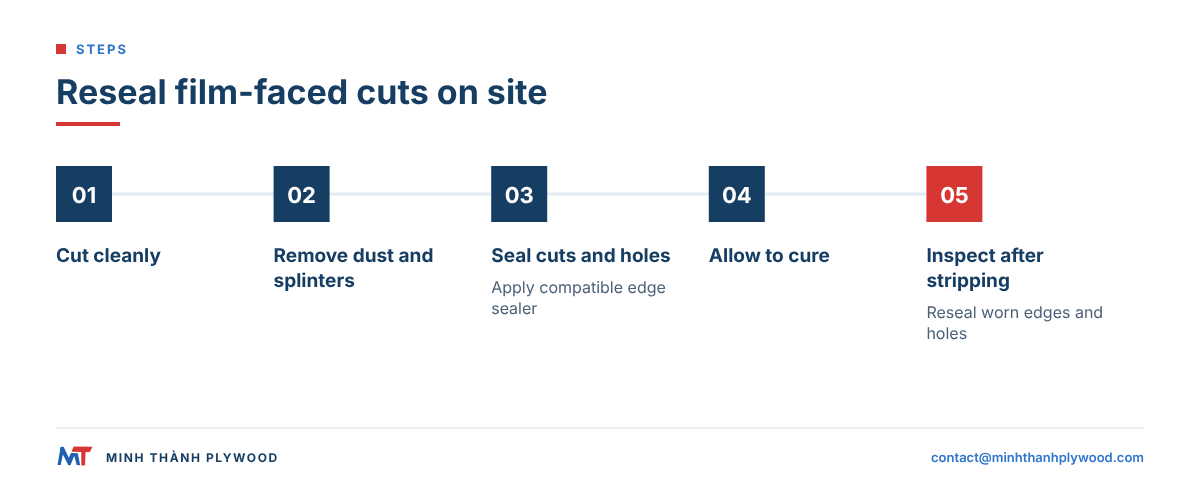
Yes: every saw cut and drilled hole should be sealed before the panel meets concrete or rain. Factory edge paint protects the edges as delivered; site cuts start with bare end grain, which takes in water faster than any other part of the sheet.
- Cut cleanly. Use a sharp blade and support the sheet to avoid lifting the film at the cut.
- Clean the edge. Remove dust and splinters so the sealer bonds to the veneer.
- Seal the same day. Apply edge paint or a compatible sealer to the cut and inside drilled holes.
- Let it cure. Keep the sealed panel out of rain and away from concrete until the sealer has dried.
- Recheck after stripping. Clean residue with non-metal tools, inspect edges and holes, and reseal where paint has worn.
Our guide on how to waterproof plywood compares edge sealers, paint and epoxy for longer protection.
When should a wet panel be removed from service?
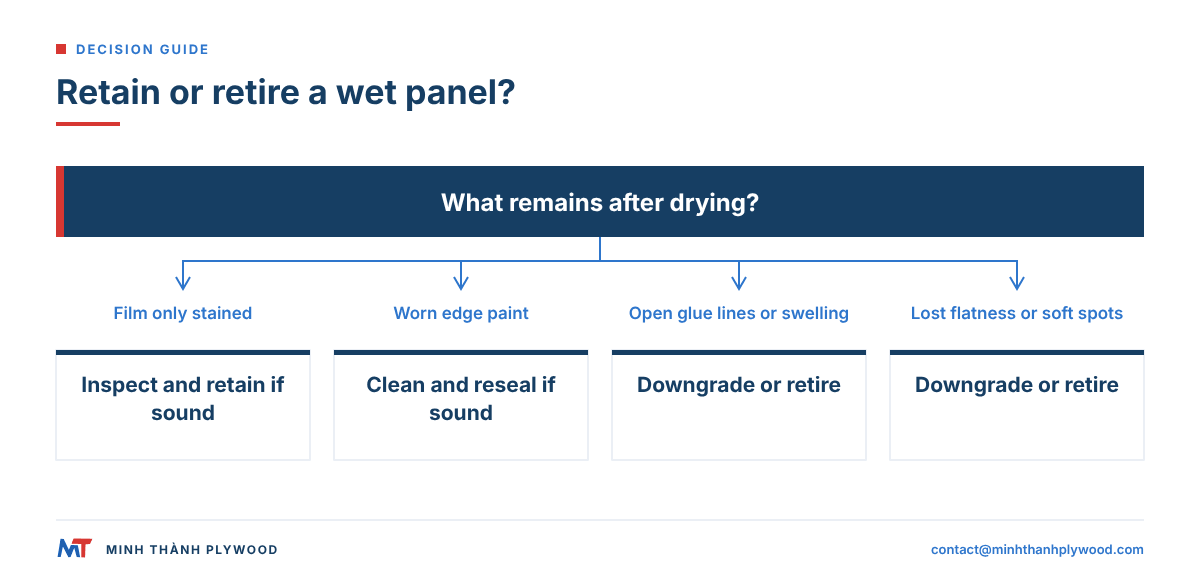
A wet panel should be removed from service when water has damaged the bond or the shape, not when the film is merely stained. Downgrade or retire a sheet that shows any of these after cleaning and drying:
- open glue lines or delamination at an edge or a hole;
- edge swelling that stops panels from butting tightly;
- loss of flatness that will show in the concrete face;
- film worn through to the veneer across a large area;
- crushed corners or soft spots near fixings;
- mould or decay that cleaning does not remove.
A downgraded sheet can still serve on footings and hidden concrete. Painting over a swollen edge does not repair it; the swelling marks a bond that has already let water in.
Film-faced vs marine plywood in wet conditions
Film-faced plywood is built for repeated short wetting and easy concrete release; marine plywood is built for long wet service under a named marine standard. Neither is chosen by the word “waterproof”; each is chosen by the exposure.
| Line | Film-faced plywood | Marine plywood |
|---|---|---|
| Purpose | Concrete formwork, temporary works | Boats, permanent wet assemblies |
| Face | Phenolic film on both faces | Durable face veneers, no film |
| Bond | MR or phenolic (WBP) by order | Phenolic to the marine standard |
| Standard | Order specification | A named standard such as BS 1088 |
| Edges | Painted at the factory, resealed on site | Sealed by the boatbuilder’s coating |
| Wet life | Many pours with care | Years with a coating system |
The pillar guide is plywood waterproof? compares every bond and panel type for wet and humid use.
Buying waterproof film-faced plywood for wet seasons in Cambodia and South-East Asia
For a long wet season in Cambodia and the rest of South-East Asia, order film-faced plywood with a phenolic (WBP) bond, a premium film from about 135 g/m² and painted edges. Projects in Phnom Penh, Siem Reap or Battambang that pour through the monsoon put more water on the panels than any other season, and the bond is the line that keeps reuse up.
- Transit: about 5–12 days at sea from Hai Phong to South-East Asian ports, by carrier and route.
- Terms: FOB Hai Phong, CFR or CIF; from one 40HC, mixed specifications by agreement.
- Production: 15–45 days after the 30% deposit.
- Price basis: quoted per specification; commercial plywood starts from US$250/m³ (October 2026), and the film, bond and core set the final price.
Ask any supplier, local or importing, for the glue type, film mass and edge sealing in writing. Those three lines decide whether a cheaper sheet costs more per pour.
What this means for your film-faced order
A film-faced order for wet work names the bond, the film and the edges, not the word waterproof. Send these lines with your request:
- Application and exposure: walls, slabs or decks; planned pours; rainy season or covered site.
- Glue line: phenolic (WBP) or melamine-fortified (MR), and the boil-test basis if the project names one.
- Film: mass (about 120–135 g/m² standard, from 135 premium, about 220 anti-slip) and colour.
- Core: Eucalyptus or Acacia.
- Size and thickness: 1220 × 2440 mm or 1250 × 2500 mm; ±0.5 mm thickness tolerance.
- Packing and quantity: from one 40HC; destination port.
We reply within hours with a matched specification and free samples. Every shipment is photographed and filmed before loading, and the photos and video go to the buyer.
Buyer questions, answered
Is film faced ply waterproof?
The film face sheds water and concrete, but the panel as a whole is water-resistant rather than waterproof. Water still enters at cut edges, tie holes and scratches, so the glue line and edge sealing decide how long the sheet lasts.
Is shuttering plywood waterproof?
Shuttering plywood with a phenolic (WBP) glue line and a film face resists water through repeated pours. It is not waterproof at unsealed cuts and holes, which need edge paint before the next pour.
Does phenolic film make plywood completely waterproof?
No. The phenolic film protects the two faces only. The edges, the holes and the glue line inside the panel are protected by edge paint and by the bond, not by the film.
Is phenolic board waterproof?
Phenolic board is the Philippine and Asian name for film-faced plywood. Its film slows moisture uptake, and the panel is water-resistant overall; ask whether the glue inside is phenolic (WBP) or melamine-fortified.
Is formply water resistant?
Yes. Formply is film-faced plywood for Australian and New Zealand formwork, made with a phenolic bond for wet use, so it resists water well while the film and edge paint stay intact.
What is the difference between film faced plywood and F17 formply in Australia?
Both have a film face. F17 formply carries a structural stress grade under AS 6669 for load-bearing formwork; non-structural film faced plywood has no stress grade and suits lighter shuttering and general use at a lower cost. Both are water-resistant, and the glue line decides how long they last wet.
Can film faced plywood be left in the rain?
A sound panel tolerates rain during a pour cycle, but stacks should not stay uncovered. Lift them off the ground, cover them with ventilation, and let wet sheets dry before restacking.
Can film faced plywood be submerged?
Continuous immersion is not a design condition for formwork plywood. Water enters at the edges and holes over time; choose a marine-grade panel and a coating system for permanent wet service.
Should cut edges be sealed?
Yes. Seal every saw cut and drilled hole with edge paint or a compatible sealer the same day, before the panel meets concrete or rain.
Is betonplex waterbestendig?
Betonplex is the Dutch and Belgian name for film-faced plywood, and it is waterbestendig (water-resistant) rather than waterdicht (waterproof). The film slows moisture uptake; exterior use also needs a suitable bond and sealed cut edges.
How many times can wet film-faced plywood be reused?
As an industry guide, about 12–15 uses on a melamine-fortified bond and up to about 25 on a phenolic bond, with proper handling, release agent and edge sealing. Water at open edges lowers that number fastest.