
Waterproofing for plywood works in two layers: a panel whose glue survives water, then a coating that keeps water out of the wood. Start from a WBP (phenolic) panel, seal every edge and hole first, then choose oil, water-based sealer, epoxy, paint, liquid rubber or bitumen by where the panel lives. Minh Thanh Plywood, a plywood manufacturer in Vietnam, sets out the steps and the method table below.
Waterproofing for plywood: the short answer
Waterproofing for plywood means keeping liquid water out of the wood and its glue lines. No coating does that on its own if the panel underneath falls apart when wet, so the job has two layers:
- A panel with a waterproof bond. Exterior plywood with phenolic WBP glue, marine plywood or film faced plywood. The glue holds the plies together when they get wet.
- A coating over every surface. A sealer, paint system, epoxy, liquid rubber or bitumen, on the faces, the edges and every hole.
Get the panel right, seal the edges first, and the coating has a chance to last. Use an interior panel, skip the edges, and the best coating fails within months.
Is plywood a waterproof wood on its own?
Plywood is not a waterproof wood on its own. Even a marine panel is wood, and wood takes in water through its face and, much faster, through its edges. What differs between panels is the glue: an exterior or marine bond keeps the plies together after soaking; an interior bond does not.
Water does three kinds of damage to uncoated plywood:
- Swelling and checking. The face veneer swells and shrinks with each wet and dry cycle and develops fine cracks.
- Delamination. Interior glue softens in water and the plies separate, starting at the edges.
- Rot and mould. Wood that stays wet for long periods decays.
A coating stops the first and third; only the right glue stops the second. Our guide Is plywood waterproof? explains each panel type in detail.
Water proofing plywood starts with the glue class
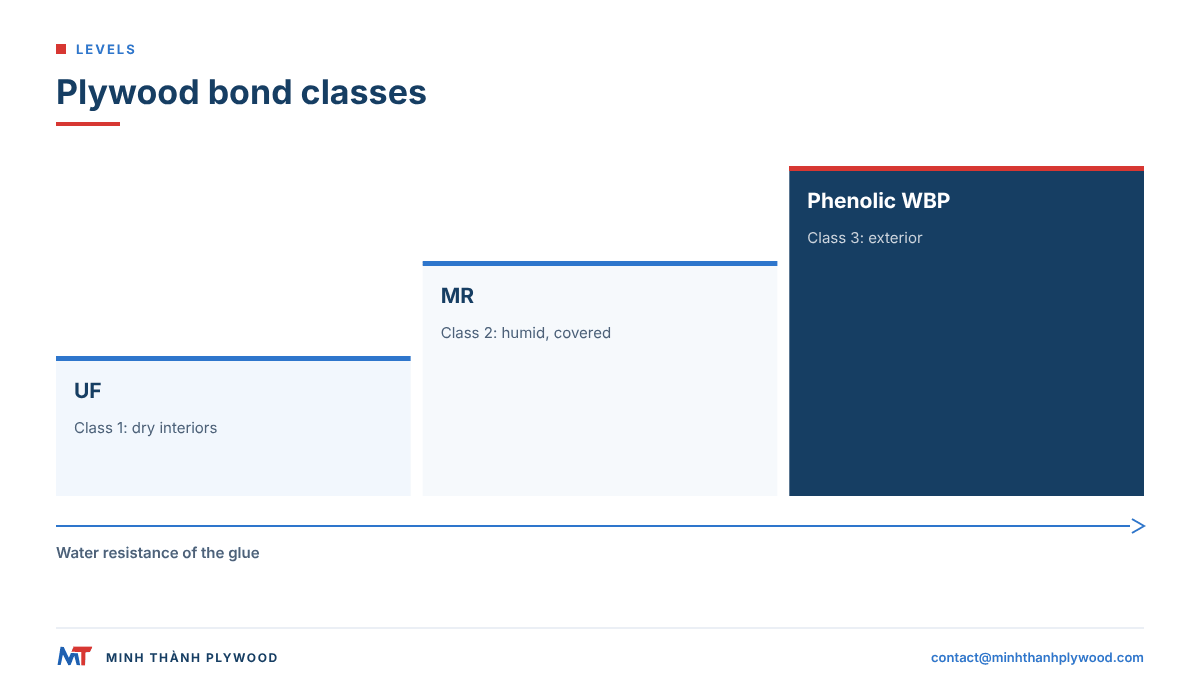
Water proofing plywood starts with the panel’s glue class, which decides how much water it can take; choose it before you choose a coating. In Europe the bond is classed under EN 314-2; in trade terms the classes map like this:
| Bond on the order | EN 314-2 class | Where it works | Coat it? |
|---|---|---|---|
| UF glue (interior) | Class 1, dry | Furniture, dry interiors | Only for looks; not for wet use |
| MR / melamine-fortified | Class 2, humid | Covered, humid areas, kitchens, under roofs | Yes, for any splash or damp |
| Phenolic WBP | Class 3, exterior | Outdoors, wet areas, roofs, boats | Yes, for long life |
| Phenolic WBP + film faces | Class 3, exterior | Formwork, floors, trailer decks | Seal cut edges and holes |
UF glue is for interior use: furniture plywood uses UF glue at E0 emission, and no coating turns it into an outdoor panel. Resin and emission class are separate specifications, so an E0 panel is low-emission, not waterproof.
For anything outdoors or wet, start from a WBP panel, such as our exterior plywood, or a marine panel, specified in BS 1088:2018, where the use calls for one (see the marine plywood buying guide).
How to waterproof plywood: 8 steps
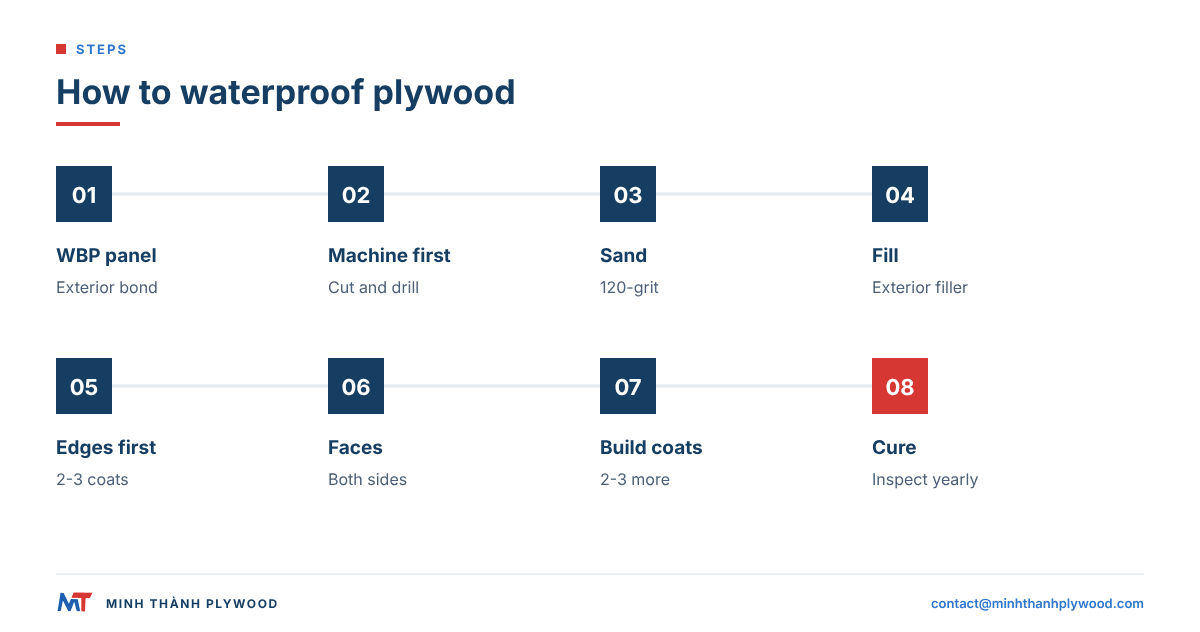
These steps work for any coating. The coating changes only steps 5 to 7.
- Choose a WBP panel for any outdoor or wet use, and keep it dry and flat until you work on it.
- Cut, drill and shape first. Every cut after coating opens new end grain, so finish all machining before the first coat.
- Sand the faces with 120-grit paper, round sharp edges slightly, and remove the dust with a dry cloth.
- Fill voids and splits in the face and edge with an exterior wood filler; sand flush once dry.
- Seal the edges and holes first. Brush two or three coats of sealer, thinned epoxy or primer into every edge, cut-out and fixing hole, letting each soak in.
- Apply the first coat to the faces with brush or roller, thin and even, working in the direction of the grain. Coat both faces, even the hidden one, so the panel takes and loses moisture evenly.
- Add two or three more coats after the recoat time on the can, sanding lightly between coats if the product calls for it.
- Let it cure fully before it meets water, load or traffic, and inspect it every year.
Coating both faces matters as much as the edge. A panel sealed on one face only takes up water through the other and cups.
Which waterproofing method is best? Method comparison table
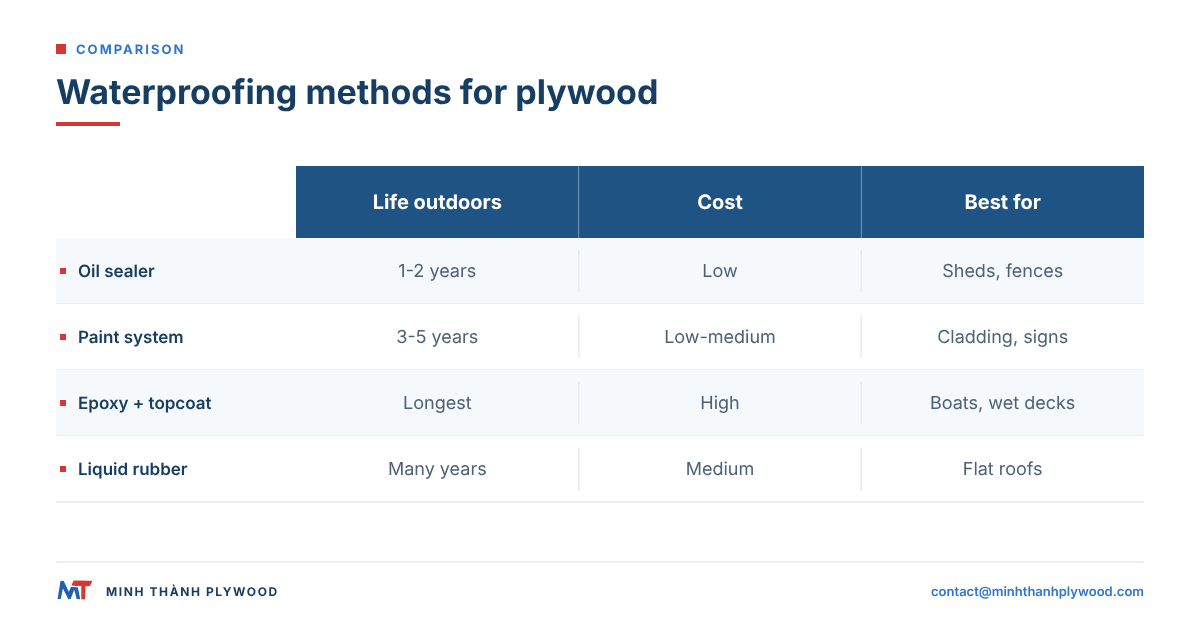
The best waterproofing for plywood depends on exposure, wear and whether the surface is seen. Paint suits sheds and sheathing, epoxy suits boats and wet floors, and a membrane suits flat roofs; each works only over a WBP panel with sealed edges. The table compares the six common methods.
| Method | What it does | Life outdoors | Cost | Best for | When glue class still matters |
|---|---|---|---|---|---|
| Penetrating oil sealer | Soaks in, repels water, keeps wood look | About 1–2 years | Low | Sheds, fences, garden furniture | Always: oil does not seal an interior bond |
| Water-based sealer or varnish | Thin film, clear | About 1–2 years | Low | Covered outdoor areas, interiors near water | Always |
| Exterior paint system (primer + 2 coats) | Opaque film, blocks sun and water | About 3–5 years | Low to medium | Sheds, sheathing, signs, soffits, playhouses | Use WBP; paint only slows water |
| Epoxy (2–3 coats) + UV topcoat | Hard, near-complete seal | Longest, with topcoat upkeep | High | Boats, wet decks, showers, planters | WBP or marine panel under it |
| Liquid rubber membrane | Thick flexible skin | Many years if covered or walked on lightly | Medium | Flat roofs, balconies, under tiles | WBP panel under it |
| Bitumen coating | Thick black seal | Many years, hidden | Low | Below ground, roof decks under felt, planter backs | WBP panel under it |
Verdict by use:
- Garden structures and sheds: paint system over sealed edges.
- Boats, wet floors, showers: epoxy, with a UV-resistant paint or varnish on top where sun reaches it.
- Flat roofs and balconies: liquid rubber or a roofing membrane over a WBP deck.
- Hidden surfaces against soil or masonry: bitumen.
Seal the edges first: why end grain fails first
The edges are where plywood takes in most of its water, so seal them before anything else. A cut edge shows the end grain of every cross-ply; end grain draws water up like a bundle of straws, many times faster than the face.
How to seal plywood edges:
- Sand the edge smooth and round the arris slightly, so the coating does not thin out over a sharp corner.
- Apply the first coat thinned, so it soaks into the end grain, then two or more full coats.
- Seal holes the same way. Drill every hole first, push sealer into it with a small brush or pipe cleaner, and set fixings in sealant.
- Keep edges off the ground. A sealed edge standing in water still fails; leave a gap at the bottom of cladding and fences.
Film faced plywood has its faces sealed in the press and its edges sealed at the mill; once you cut it, the new edge is bare wood and needs the same treatment.
Exterior waterproofing for plywood: outdoors and on roofs
Exterior waterproofing for plywood must handle sun as well as rain. Ultraviolet light breaks down most clear coatings and the wood surface under them, which is why opaque paint lasts longer outdoors than clear sealers.
- Walls, sheds and soffits: WBP panel, edges sealed, exterior primer and two coats of exterior paint. Fit cladding with a drip edge and a gap above ground.
- Roof decks: WBP plywood under a roofing membrane, felt or liquid rubber, never bare. Lay sheets with a small gap for movement, supported on joists.
- Signs and boards: WBP or MDO panels, edges sealed, painted both faces.
- Planters: epoxy or bitumen inside, paint outside; drill drainage holes and seal them.
On a horizontal surface outdoors, slope it slightly so water runs off. Standing water finds any weak point in a coating.
Waterproofing plywood for floors, showers and boats
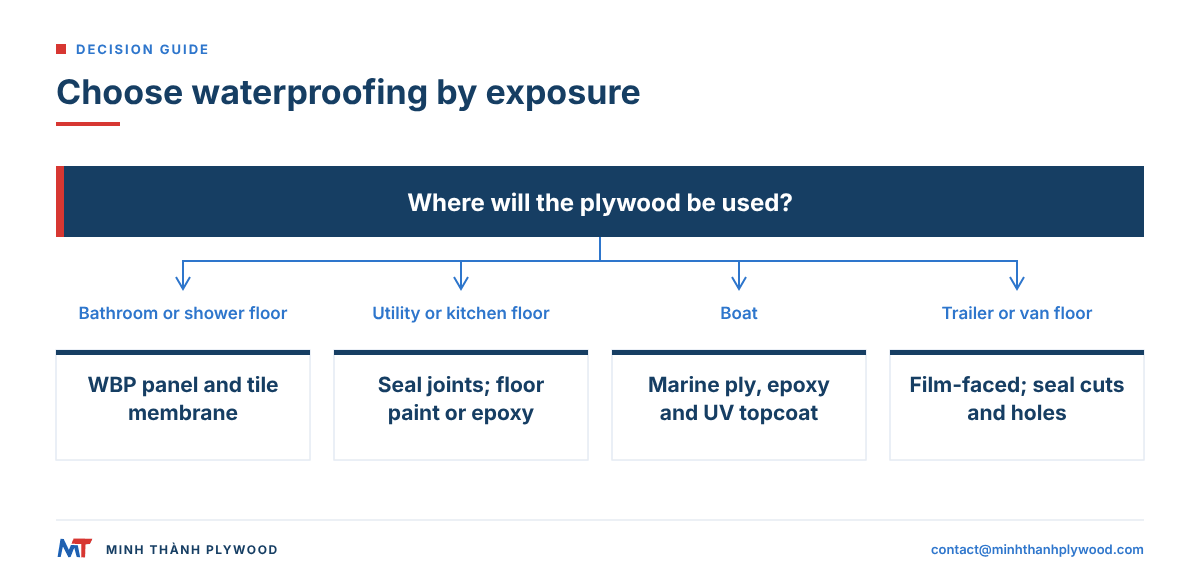
Wet floors, showers and boats need the most complete seal: epoxy or a membrane over a WBP or marine panel.
- Bathroom and shower floors: WBP plywood screwed to joists, edges and joints sealed, then a liquid waterproofing membrane under the tile. Water must never stand on bare plywood.
- Utility room and kitchen floors: seal edges and joints, then a floor paint or epoxy floor coating.
- Boats: marine plywood encapsulated in two or three coats of epoxy on every face and edge, then a UV-resistant paint or varnish.
- Trailer and van floors: film faced or anti-slip film plywood is already sealed on both faces; seal the cut edges and bolt holes.
For a floor that is walked on, add a grit or anti-slip additive to the last coat.
Can you fully waterproof plywood?
You can make plywood close to fully waterproof with epoxy encapsulation, but not permanently. Two or three coats of epoxy on every face, edge and hole leave almost no path for water, which is why boatbuilders use it.
Three limits remain:
- Sunlight degrades epoxy, so it needs a UV-resistant topcoat.
- Any later cut, screw or impact opens the wood again; each needs sealing.
- Every coating wears. Inspect it each year and recoat before wood shows through.
For most buyers, a WBP panel with sealed edges and a good paint system is the practical waterproof plywood; epoxy is for the places that stay wet.
What is the most cost-effective way to waterproof plywood?
The most cost-effective way is a WBP panel plus an exterior paint system. Paint costs less than epoxy, goes on with a roller, blocks sunlight, and lasts several years outdoors before a recoat.
Where the money goes:
| Option | Up-front cost | Upkeep | Total over the life of a shed or sign |
|---|---|---|---|
| Interior plywood + sealer | Lowest | Fails early | Highest: the panel is replaced |
| WBP plywood + paint system | Low | Recoat every few years | Lowest |
| WBP plywood + epoxy + topcoat | High | Topcoat upkeep | Worth it only for constant wet |
| Film faced plywood, edges sealed | Medium | Reseal cut edges | Low, where a dark face is acceptable |
Spending on the panel saves more than spending on the coating: a cheap interior sheet under an expensive coating still delaminates once water reaches the glue.
How do you maintain waterproofed plywood?
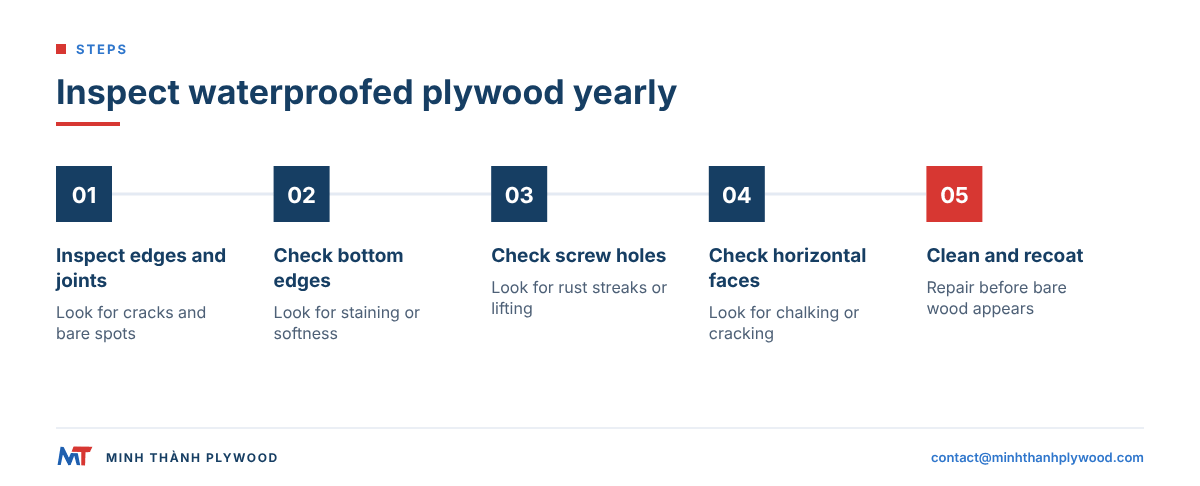
Maintain waterproofed plywood by inspecting it once a year and recoating before the wood shows. Look first where water collects.
- Edges and joints: cracks or bare spots in the sealer; sand and reseal.
- Bottom edges near the ground: dark staining or softness means water is in; dry and reseal, or replace the panel.
- Fixings: rust streaks or lifted coating round a screw; reseal the hole.
- Horizontal faces: chalking or cracking paint; wash, sand lightly and recoat.
Clean coated plywood with water and a soft brush; strong solvents and pressure washers at close range can lift coatings.
Common mistakes when waterproofing plywood
Most failures come from the same six mistakes:
- Coating interior plywood for outdoor use. The glue gives way under the coating.
- Skipping the edges, or sealing them once and the faces three times.
- Coating one face only, so the panel cups.
- Cutting after coating, which opens fresh end grain.
- Coating wet wood. A sheet left out in rain traps moisture under the film, which then blisters.
- Leaving it on the ground. The bottom edge stands in water whatever the coating.
The USDA Forest Products Laboratory Wood Handbook, chapter 16 on finishing wood, explains why sun, end grain and moisture cycles break down finishes; it remains the standard reference.
Is Vietnamese plywood waterproof?
Vietnamese mills make interior and waterproof-bonded plywood; the bond written on the order decides which you get. Furniture and interior panels use UF glue for dry use; MR (melamine-fortified) bonds suit humid interiors; phenolic WBP bonds are for outdoor and wet use.
For any outdoor, roof, bathroom or wet-area panel, ask for phenolic WBP glue in writing, and order film faced plywood when the faces must already be sealed. In hot, sunny markets such as the Gulf, order WBP panels for exterior work and still coat them on site, because the sun breaks down bare wood fast.
What this means for your plywood order
Coating starts at the mill: a buyer who orders the right bond and dry panels has half the waterproofing done before the container ships. When you order from us:
- Exterior / CDX-type plywood with water-resistant melamine-fortified or phenolic WBP glue, utility C/D faces, for stair treads, sheathing and other outdoor work.
- Film faced plywood with phenolic film on both faces and sealed edges, for formwork and floors.
- Panels dried to 8–12 % moisture content at dispatch, ready to seal once acclimatised on site.
- Sizes 1220 × 2440 and 1250 × 2500 mm, thickness 3–40 mm.
- MOQ one 40HC, production 15–45 days after deposit, free samples.
Send the line in this form: Exterior plywood, 18 mm, 1220 × 2440 mm, phenolic WBP glue, C/D faces, eucalyptus core, for painted outdoor cladding, one 40HC, CIF your port. We reply within hours with the build and price; the exterior plywood product page lists the range.
Buyer questions, answered
How do I waterproof plywood?
Start with an exterior (WBP) panel, sand it, seal every edge and drilled hole first, then apply two or three coats of a sealer, epoxy, paint system, liquid rubber or bitumen chosen for the use. Let each coat cure and recoat before the surface wears through.
Can you fully waterproof plywood?
Close to it, for a time. Two or three coats of epoxy over every face and edge seal plywood almost completely, but sunlight breaks epoxy down, so it needs a UV-resistant topcoat. Every coating needs inspection and recoating over the years.
What is the best waterproofing for plywood outdoors?
For exposed outdoor plywood, a primer and two coats of exterior paint over sealed edges gives the longest life for the cost. Epoxy with a UV topcoat is best for boats and wet decks; liquid rubber or bitumen suits flat roofs and hidden surfaces.
What is the most cost-effective way to make plywood water-resistant?
Buy a WBP panel and paint it. An exterior primer plus two coats of exterior paint, with the edges sealed first, costs less than epoxy and lasts several years outdoors before a recoat.
Is plywood waterproof on its own?
No. Exterior and marine plywood use a waterproof glue, so the plies do not separate when wet, but the wood itself still absorbs water. Uncoated, it swells, checks and eventually rots.
Which plywood is most water-resistant?
Panels bonded with phenolic WBP glue: marine plywood, exterior plywood and film faced plywood. Film faced plywood also has a phenolic film sealing both faces, so it resists water best before any coating.
Does sealing the edges of plywood matter?
Yes, more than any other step. Cut edges and holes expose end grain, which takes in water many times faster than the face. Seal them first, with extra coats, before you coat the faces.
Can I use a deck sealer on plywood?
A water-repellent deck sealer slows water on a horizontal plywood surface for a season or two. It needs frequent recoating and does not seal edges well; for longer life use a primer and paint, or epoxy.
How long does waterproofing on plywood last?
Oil and water-based sealers last about one to two years outdoors, paint systems about three to five years, epoxy with a UV topcoat longer, and bitumen or liquid rubber under cover many years. Inspect each spring and recoat worn areas.
Is Vietnamese plywood waterproof?
Vietnamese mills make both interior and waterproof-bonded plywood. Ask for phenolic WBP glue for outdoor or wet use; MR and UF bonds are for interior use. The bond is written on the order and the test report.
Can you waterproof plywood for a shower or bathroom?
Yes. Use WBP or marine plywood, seal all edges, and cover it with a liquid waterproofing membrane under tiles, or with epoxy where it stays exposed. Water must never stand on bare plywood.