
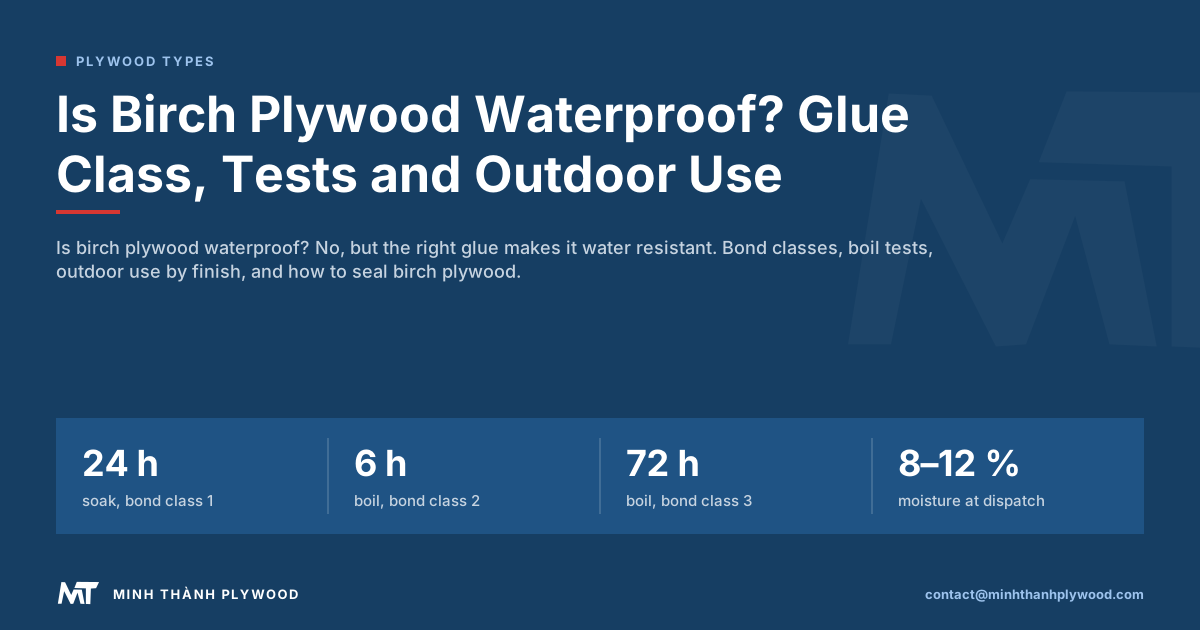
No: birch plywood is not waterproof. Birch wood rots outdoors, and the glue line decides how much water the panel survives. With a phenolic (WBP) bond, birch plywood resists boiling and works outdoors once its faces and edges are sealed; with interior UF glue it is for dry rooms only. Minh Thanh Plywood makes birch-faced panels with UF, MR or phenolic bonds to order.
Is birch plywood waterproof? The short answer
No: birch plywood is not waterproof. Birch wood soaks up water and rots outdoors, so the panel’s water resistance comes from its glue line and its finish, not from the birch. The right bond makes it water resistant; a sealed finish keeps water out of the wood.
- Phenolic (WBP) bond: survives boiling water; suitable outdoors when every face and edge is sealed.
- MR (melamine-fortified) bond: resists humidity and splashes; for kitchens, bathrooms and covered areas.
- UF bond (interior): for dry rooms; soaking will separate the plies.
- Finish: paint, varnish or a film keeps water out of the face; edges matter most.
So the useful question is not “is birch plywood waterproof?” but “which bond and which finish does this job need?”. The sections below answer that, with test methods, an outdoor use matrix and sealing steps.
What is birch plywood?
Birch plywood is plywood with a birch face veneer, either over a core of other hardwood (birch-faced plywood) or with birch in every ply (all-birch, often called Baltic birch). For water resistance the build matters less than the glue: both kinds come with interior, moisture-resistant or exterior bonds.
- Birch-faced plywood: birch face and back over a hardwood core. Our panels use white Styrax or Eucalyptus cores as standard.
- All-birch plywood: birch in every ply; dense and stiff, with an even edge.
- Faces: graded on our panels with the Vietnamese names D+, D and E, quoted as face/back pairs such as D+/D.
- Bonds: UF glue at E0 emission as standard for furniture; MR or phenolic (WBP) to order.
A birch-faced panel with a phenolic bond resists water as well as an all-birch panel with the same bond. Read the glue line on the specification before the species.
Is birch water-resistant? The wood itself
Birch wood is not water-resistant. It is classed as perishable: it readily rots and decays when exposed to the elements and is susceptible to insect attack (The Wood Database, yellow birch, read 20 October 2026). Birch has no natural oils or extractives that keep fungi out, unlike teak or cedar.
What this means for birch plywood:
- The face needs protection outdoors: bare birch greys, checks and grows mould when it stays damp.
- End grain and edges absorb water fastest: every cut edge is an open door for water.
- Rot needs moisture over time: a dry birch panel does not rot; a panel that stays wet does.
- A good bond does not stop rot: the glue holds the plies together, but the wood still needs a finish.
This is why exterior birch panels are always paired with a coating, a film or paint. The glue keeps the panel in one piece; the finish keeps the wood dry.
The glue decides: UF, MR and phenolic (WBP) bonds
The glue line is what makes one birch panel water resistant and another not. Three bond types cover almost all birch plywood, and they differ in how much water and heat they survive before the plies separate.
| Bond | Resin | Water resistance | Typical use |
|---|---|---|---|
| UF | Urea-formaldehyde | Dry conditions; soaking separates plies | Furniture, cabinets, interior panelling |
| MR | Melamine-fortified UF | Humidity and occasional wetting | Kitchens, bathrooms, covered areas |
| WBP | Phenolic (phenol-formaldehyde) | Survives boiling; long wet exposure | Exterior panels, formwork, vehicles |
WBP stands for “weather and boil proof”. The name describes the glue line, not the panel: a WBP-bonded panel will not delaminate in boiling water, but its wood still swells, stains and decays if left wet.
Furniture plywood uses UF glue at E0 emission as standard. Resin and emission class are separate specifications: “E0” describes formaldehyde emission, not water resistance, so an E0 panel can be UF, MR or phenolic.
How to tell which glue a panel has, before any test:
- Glue line colour: a phenolic glue line is dark brown to black at the edge; UF and MR glue lines are pale and hard to see.
- The stamp or label: exterior panels are marked with their bond class or “WBP”; read the panel and the invoice.
- The paperwork: the order confirmation and the test report should name the resin, not only the emission class.
- The price: a phenolic-bonded panel costs more than the same panel in UF glue; a very low price for “waterproof” plywood is a warning sign.
Bond classes and use classes: what the standards say
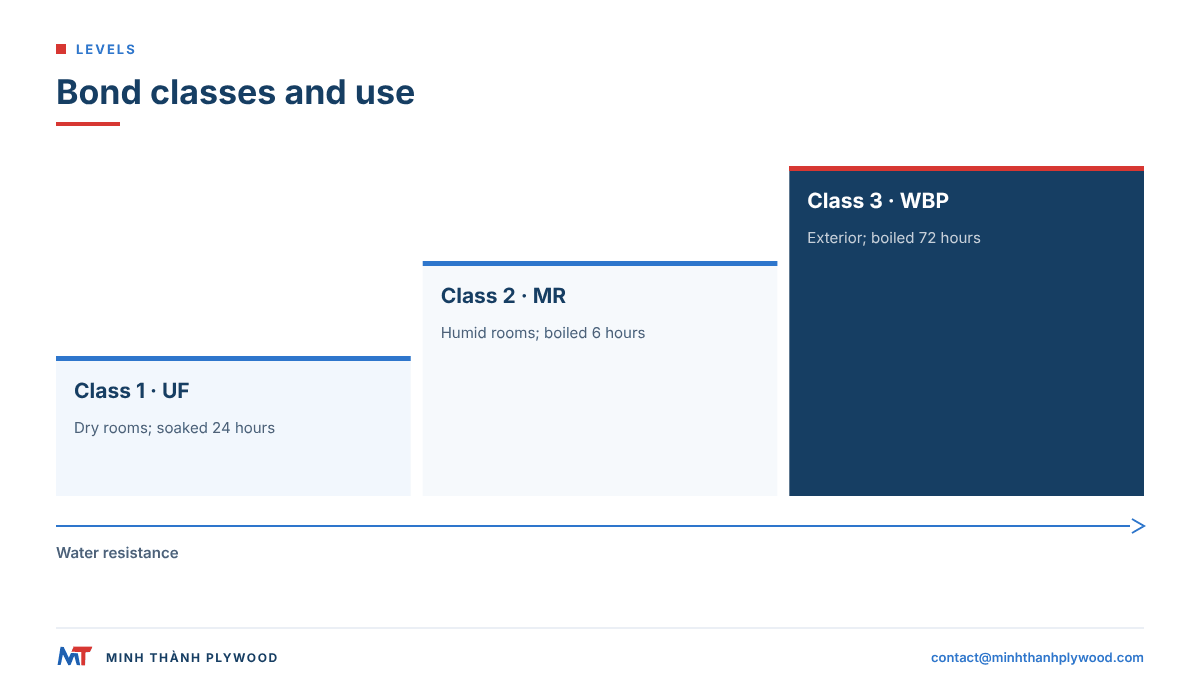
In Europe, plywood bonds are tested to EN 314-1 and classed under EN 314-2 into three bond classes, and panels are specified for use under EN 636 as dry, humid or exterior. The bond class tells you which water and boiling pre-treatment the glue line has passed.
| Bond class (EN 314-2) | Pre-treatment before the shear test | Panel use (EN 636) |
|---|---|---|
| Class 1 | Soaked 24 hours in cold water | EN 636-1: dry conditions |
| Class 2 | Boiled 6 hours, then cooled 1 hour in cold water | EN 636-2: humid conditions |
| Class 3 | Boiled 72 hours, or repeated boil-and-dry cycles | EN 636-3: exterior conditions |
CE marking of construction plywood in the EU falls under the Construction Products Regulation (EU) No 305/2011. The BSI description of BS EN 636:2012+A1:2015, consulted on 27 October 2026, covers plywood for structural and general-purpose use in dry, humid or exterior conditions. The harmonised product standard for construction plywood is EN 13986. For a buyer, the short version is: order class 3 bond and EN 636-3 use for outdoor work, class 2 for humid interiors, class 1 for dry furniture.
In North America the same split appears as interior, Exposure 1 and Exterior glue. The meaning is the same: the bond class sets where the panel can go.
Is birch plywood water resistant? It depends on the bond
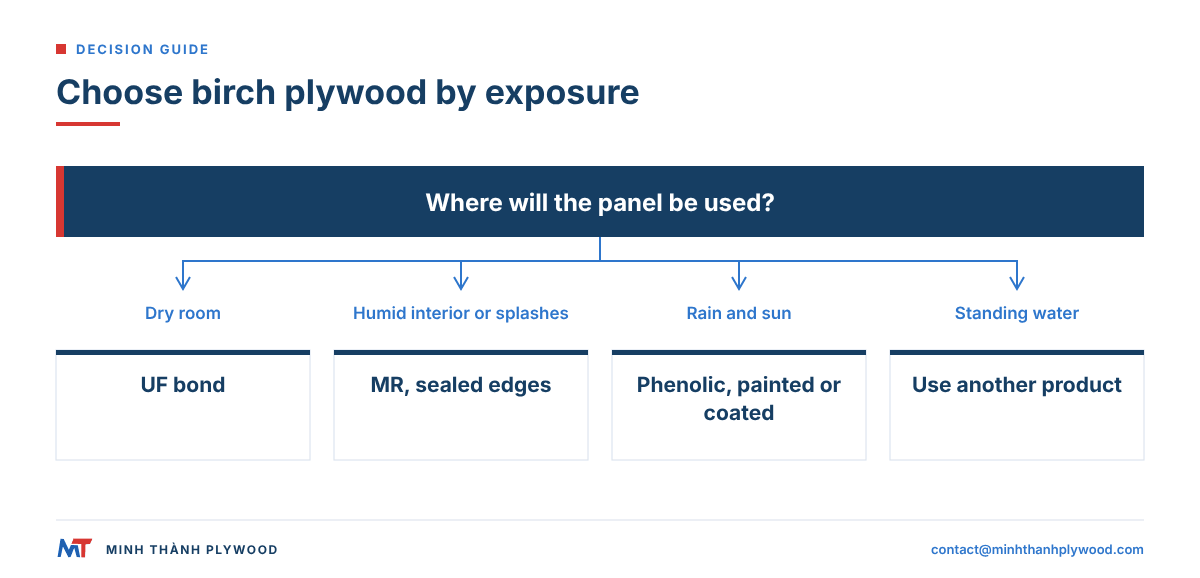
Birch plywood is water resistant when it has an MR or phenolic bond, and is not when it has an interior UF bond. With a phenolic (WBP) glue it survives boiling without separating; with an MR glue it survives humidity and splashes; with UF glue it is for dry rooms.
| Exposure | UF bond | MR bond | Phenolic (WBP) bond |
|---|---|---|---|
| Dry room | Yes | Yes | Yes |
| Humid room, no direct water | Not advised | Yes, sealed | Yes, sealed |
| Splashes, kitchen sink area | No | Yes, sealed edges | Yes, sealed edges |
| Covered outdoor area | No | Short term, sealed | Yes, sealed |
| Rain and sun | No | No | Yes, painted or coated |
| Ground contact or standing water | No | No | No, use a treated or other product |
Water resistance is never a single yes or no. It is the bond, the finish and the exposure together, so every order for damp or outdoor use should name all three.
Birch-faced on hardwood core vs Baltic birch: does the core change it?
The core species changes weight, stiffness and the look of the edge, but not the water resistance of the glue line: a birch-faced panel on a hardwood core and an all-birch Baltic panel with the same bond pass the same boil test. What the core does change is how fast water travels in from an unsealed edge.
- Glue line: same bond, same bond class, whatever the core species.
- Core gaps: a core with gaps or overlaps lets water pool inside; our core layers are stitched horizontally and vertically to avoid them.
- Pressing: furniture-grade panels are pressed twice as standard (calibrated core board, then face and back), which keeps the face bonded evenly.
- Edge density: a denser core such as Eucalyptus (650–750 kg/m³) takes up edge water more slowly than a light one.
We do not sell birch-faced panels as full birch. The order should state the build and the bond, and the bond decides the water resistance.
In practice, buyers who need water resistance and a birch look are usually served by a birch-faced panel with a phenolic bond on a dense core, sealed and finished. An all-birch panel adds weight and cost for an edge that will be sealed and painted anyway.
Can birch plywood get wet, and for how long?
Birch plywood can get wet occasionally without harm when it is sealed; it fails when water reaches the wood or the glue line repeatedly or for long periods. How long a panel survives depends on the bond and the finish more than on any fixed number of hours.
- A splash or spill on a sealed face: wipe it off; no harm to any bond.
- Repeated splashes at an unsealed edge: the edge swells and the face can lift, first on UF-bonded panels.
- Soaking for a day: a UF-bonded panel may start to separate; MR and phenolic bonds hold, but the wood swells.
- Days of wetting and drying outdoors: only a phenolic bond holds, and only with a sound finish.
- Months of damp: mould, staining and rot in the wood, whatever the glue.
Dry a wet panel slowly, flat and with air on both faces. A panel dried fast on one side will cup.
What to do when a birch panel has been soaked:
- Lay it flat on level bearers with spacers, off the floor.
- Let air reach both faces; do not stand it against a wall to dry.
- Dry at room temperature; avoid heaters or direct sun on one face.
- Check the edges once dry: lifted face veneer or open plies mean the bond has failed.
- Re-seal the edges before the panel goes back into use.
Boil and soak tests you can run on a sample
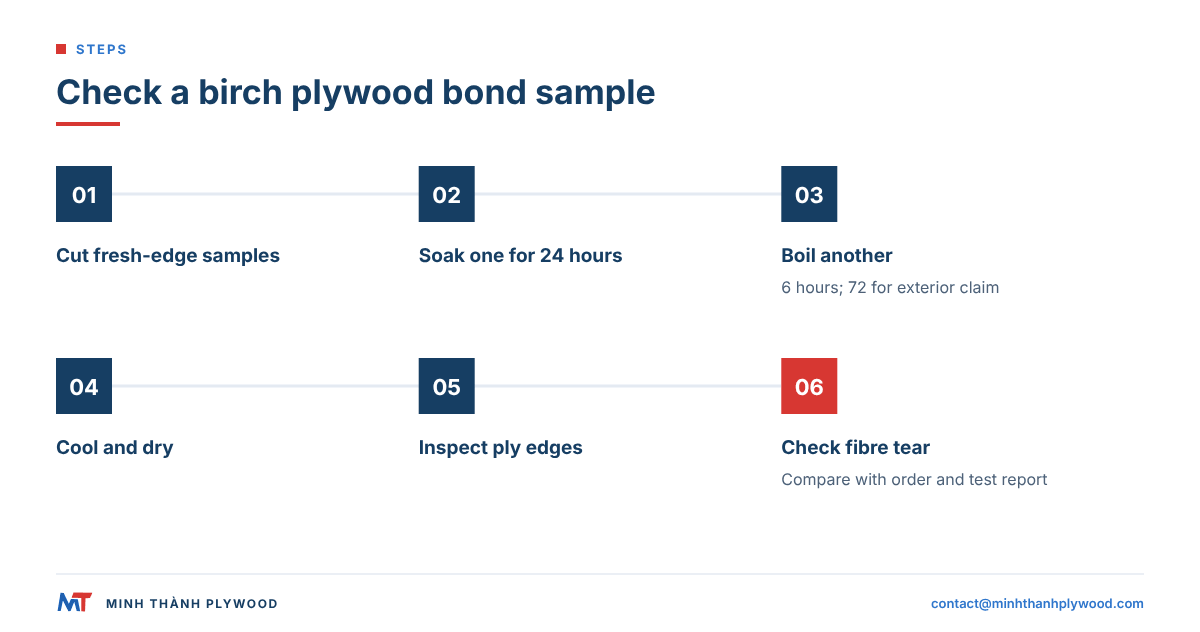
You can check the bond of a birch plywood sample with a simple soak or boil test before ordering, and repeat it on arrival. These are field checks, not the laboratory test, but they separate interior from exterior bonds clearly.
- Cut test pieces about the size of a hand from the panel, with fresh-cut edges.
- Soak test: leave one piece in cold water for 24 hours, then dry it at room temperature for a day.
- Boil test: boil another piece for 6 hours (or 72 hours for an exterior bond claim), then let it cool and dry.
- Look at the edges: any visible gap between plies is a failed bond.
- Try to split the glue line with a chisel at the edge: a good bond tears wood fibres; a weak bond splits cleanly along the glue.
- Compare with the order: UF pieces may fail the boil test; MR and phenolic pieces should pass the soak; phenolic pieces should pass the boil.
For a formal result, ask for a laboratory test to EN 314. Third-party testing to the buyer’s method is arranged through SGS on request.
Is birch plywood good for outdoors? Outdoor use by finish
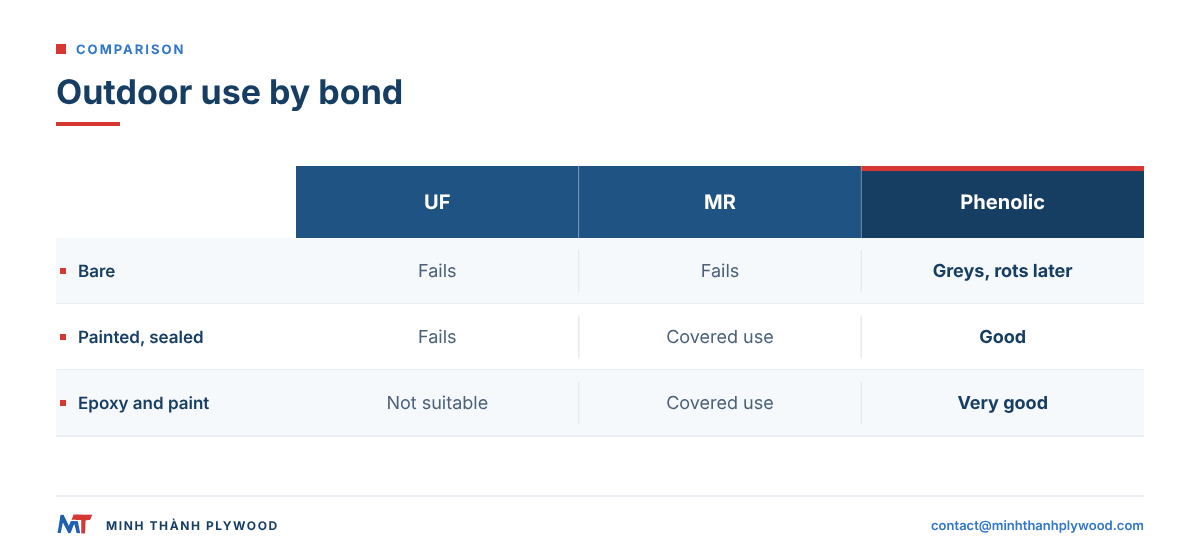
Birch plywood is good for outdoors only with a phenolic (WBP) bond and a full protective finish. This matrix shows what to expect from each combination of bond and finish under rain and sun.
| Finish | UF bond | MR bond | Phenolic (WBP) bond |
|---|---|---|---|
| Bare, no finish | Fails | Fails within a season | Greys and checks; rots over time |
| Sealed edges, clear varnish | Fails | Short-term covered use | Good with regular re-coating |
| Primed and painted, all faces and edges | Fails | Covered use only | Good; repaint as needed |
| Epoxy-sealed, then painted | Not suitable | Covered use only | Very good |
| Film-faced (phenolic film) | Not made | Not usual | Very good for formwork and vehicles |
The best outdoor result is a phenolic-bonded birch panel with epoxy-sealed edges and a paint system on both faces. Clear finishes look better but need re-coating more often, because sunlight breaks them down and greys the wood beneath.
Birch plywood exterior use: where it works and where it does not
Birch plywood exterior use works for protected and maintained jobs: signs, garden furniture, playground and stage builds, vehicle floors and trailer panels, shuttering and sheds, all with a phenolic bond and a full finish. It does not work for ground contact, standing water or permanent immersion.
- Good: painted signs, garden furniture, covered outdoor cabinets, vehicle and trailer floors (film-faced), formwork, sheds and kennels.
- Possible with care: exterior cladding behind a ventilated gap, decks under a roof, with regular repainting.
- Not suitable: ground contact, raised beds holding wet soil, boat hulls (use marine plywood), flat roofs without a membrane.
| Outdoor job | Bond | Finish |
|---|---|---|
| Signs and display boards | Phenolic (WBP) | Primer and exterior paint, sealed edges |
| Garden and patio furniture | Phenolic (WBP) | Epoxy-sealed edges, paint or UV-absorbing varnish |
| Trailer and vehicle floors | Phenolic (WBP) | Film-faced or anti-slip face |
| Concrete formwork | Phenolic (WBP) | Film-faced, edges sealed |
| Sheds and kennels | Phenolic (WBP) | Paint on all faces, gap at ground level |
| Covered porch cabinets | MR or phenolic | Sealed edges, paint or varnish |
For birch plywood outdoor use, plan maintenance as part of the job: inspect edges and screw holes each season and repaint where the finish is worn. Our guide to how to waterproof plywood compares sealers, epoxy and paint in detail.
How to waterproof birch plywood: sealing steps
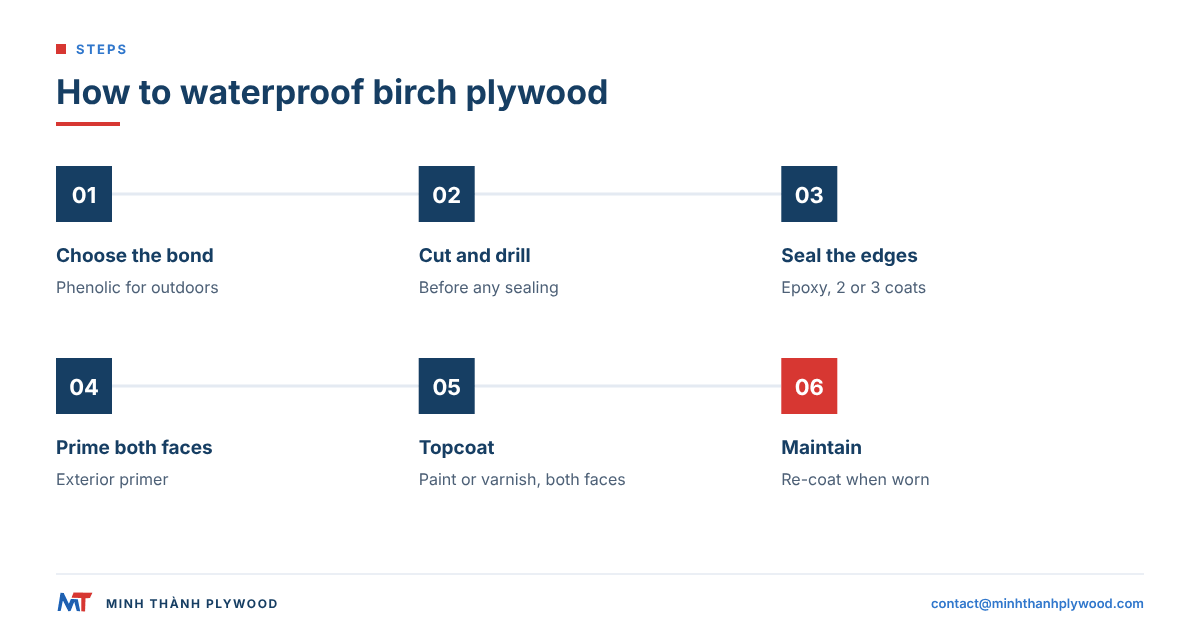
To waterproof birch plywood, start with a phenolic or MR bond, then seal every edge and face before installing. The steps below work for outdoor and wet-room panels.
- Choose the bond: phenolic (WBP) for outdoors, MR or phenolic for wet rooms.
- Cut and drill first: every cut and hole must be sealed, so finish machining before sealing.
- Seal the edges: two or three coats of epoxy or a dedicated edge sealer on every edge and in every hole.
- Sand lightly: fine paper on the faces to remove raised fibres.
- Prime both faces: an exterior primer, or a thin first coat of the varnish.
- Apply the topcoat: two or three coats of exterior paint or varnish on both faces, back included.
- Install with a gap: leave space for air and water to drain; do not trap water against the panel.
- Maintain: inspect each season and re-coat where the finish wears through.
Coating only one face makes the panel cup as it takes up moisture on the other. Treat both faces the same way.
Edges, screw holes and cut ends: where water gets in
Water gets into birch plywood through its edges, screw holes and cut ends far faster than through a finished face, because end grain draws water along the wood fibres. A panel with a perfect face finish and bare edges will still swell and delaminate from the edge in.
- Edges: seal with epoxy or edge sealer before paint; on floors, bevel slightly so water runs off.
- Screw holes: pre-drill, fill with sealant, then fix; seal the screw head.
- Cut-outs: sinks, hatches and vents need the same edge sealing as the panel edge.
- Joints: leave a small gap and seal it with flexible sealant; do not butt bare edges together.
- Bottom edges: keep them off the ground and off wet surfaces.
Most outdoor birch plywood failures start at an unsealed edge or hole. Spending ten minutes on the edges saves the panel.
Is Baltic birch plywood waterproof, and can it be used outside?
Baltic birch plywood is not waterproof either. Most Baltic birch sold for furniture, drawers and laser cutting has an interior or moisture-resistant glue and should stay indoors; exterior Baltic birch with a phenolic (WBP) bond can be used outside once it is sealed and finished.
| Baltic birch type | Glue | Outdoors? |
|---|---|---|
| Furniture and craft grade | Interior or MR | No |
| Exterior grade | Phenolic (WBP) | Yes, sealed and finished |
| Film-faced birch | Phenolic, with a phenolic film | Yes, for formwork, vehicles and floors |
The all-birch core gives Baltic birch a dense edge that takes up water slowly, but it does not change the rule: read the glue class, then plan the finish. Our Baltic birch plywood guide explains the panel in full.
Birch plywood for marine use
Birch plywood with a phenolic bond is water resistant, but it is not marine plywood unless it is made and tested to a marine standard such as BS 1088. Marine plywood sets limits on veneer species, core gaps and defects as well as the glue, because a hull cannot tolerate a hidden void that holds water.
- Marine plywood: BS 1088 construction, boil-proof glue, no core gaps, defined species.
- Exterior birch plywood: phenolic bond, suitable for many wet jobs above the waterline with a finish.
- Boat interiors: phenolic-bonded birch, sealed, is widely used for bulkheads and furniture.
- Hulls and decks: specify marine plywood to the standard.
Our guide to marine plywood explains how to buy it. We do not sell our birch-faced furniture panels as marine plywood.
For a boat builder, the useful split is above and below the waterline. Below it, and anywhere a void could hold water against the hull, only marine plywood to the standard will do. Above it, in cabins, lockers and furniture, a sealed phenolic-bonded birch panel is a common and economical choice.
UV light and birch plywood
Sunlight greys bare birch and breaks down clear finishes, so birch plywood outdoors needs a pigmented paint or a finish with UV absorbers, re-coated as it wears. Clear varnish on birch in full sun lasts far less than paint.
Note a common mix-up: in furniture making, “UV coating” means a lacquer cured by ultraviolet lamps on the production line, not protection from the sun. Our birch faces are delivered UV-ready on both sides, sanded and polished to the standard customers need to apply their own UV-cured coating. That makes them ideal for furniture lines that UV-coat their panels; it does not make them weatherproof.
- For sun exposure: exterior paint, or a varnish with UV absorbers, re-coated regularly.
- For indoor furniture: UV-cured lacquer on our UV-ready faces gives a hard, fast-curing finish.
- For a natural look outdoors: accept greying, or re-oil each season.
Birch plywood thickness and water resistance
Thickness does not change the bond class of birch plywood, but it changes how the panel behaves when it gets wet. A thick panel takes longer to soak through and stays flatter; a thin panel cups and twists faster when one face gets wetter than the other.
| Thickness | Behaviour when damp | Advice |
|---|---|---|
| 3–6 mm | Cups quickly; thin plies | Bond both faces to a frame; seal both faces |
| 9–12 mm | Moderate | Seal edges and both faces; support on short spans |
| 15–18 mm | Stable; slow to soak | Standard choice for outdoor furniture and floors |
| 21 mm and over | Very stable | Floors, heavy-duty and vehicle use |
Our thin 3–5 mm panels are always 5-ply. For damp or outdoor work in thin sheets, order a phenolic bond and seal before fixing.
Birch plywood in kitchens and bathrooms
Birch plywood works well in kitchens and bathrooms when it has an MR or phenolic bond and every face and edge is sealed. It should stay out of direct, standing water, such as inside a shower tray.
- Sink-base cabinets: MR or phenolic bond; seal the base, the cut-outs and the back.
- Vanities: same as sink bases, with a sealed worktop edge.
- Wall panels in bathrooms: phenolic bond, sealed and painted, away from the shower.
- Kitchen carcasses away from water: standard UF glue at E0 emission is enough.
Our guide to birch plywood for kitchen cabinets covers carcass specifications.
Is birch plywood toxic? Emissions and glue
Birch plywood for interiors is safe when its formaldehyde emission meets the buyer’s limit; the face species has nothing to do with it, the glue and its emission class do. Our panels hold CARB P2 / TSCA Title VI certification (ICTT mill no. 23024).
Six ASTM D6007 chamber tests between April 2025 and June 2026 on 9, 15 and 18 mm panels averaged 0.014–0.032 ppm, against the 0.05 ppm limit. The limit for veneer-core hardwood plywood is 0.05 ppm under 40 CFR 770.10. Three tests were run by Shanghai Hongjun and three by ICTT Vietnam. Third-party testing to the buyer’s method, such as EN 717-1, is arranged through SGS on request.
Our birch-faced plywood: glue options for damp and outdoor work
We make birch-faced plywood with the bond the job needs: UF glue at E0 emission as standard for furniture and interiors, and MR (melamine-fortified) or phenolic (WBP) bonds to the customer’s specification for damp and outdoor work.
| Specification | Our birch-faced plywood |
|---|---|
| Face grades | D+, D and E, quoted as face/back pairs such as D+/D or D/E |
| Core | White Styrax or Eucalyptus; Acacia and Pine on order |
| Core build | Stitched horizontally and vertically |
| Pressing | Twice: calibrated core board, then face and back |
| Bonds | UF glue at E0 emission; MR or phenolic (WBP) to order |
| Thickness | 3–40 mm; sanded tolerance down to ±0.2 mm |
| Sizes | 1220 × 2440 and 1250 × 2500 mm; custom sizes on order |
| Moisture | 8–12 % at dispatch |
Our exterior and CDX-type line uses utility faces with melamine-fortified or phenolic (WBP) glue for outdoor jobs such as stair treads and wall sheathing. See the birch plywood page for the full range, and our pillar guide is plywood waterproof for other panel types.
What to write on an order for damp or outdoor birch plywood
An order for birch plywood that will meet water names the bond, the use, the finish and the size. Send these lines:
- Application and exposure: dry, humid, covered outdoor or full weather.
- Bond: MR (melamine-fortified) or phenolic (WBP); bond class 2 or 3 if you work to EN 314-2.
- Face: birch grade pair, for example D/E for painted outdoor work.
- Core: white Styrax or Eucalyptus.
- Size and thickness: for example 1220 × 2440 × 18 mm.
- Finish: sanded, UV-ready, or film-faced for formwork and vehicles.
- Packing and quantity: from one 40HC, mixed specifications by agreement; destination port.
Production is 15–45 days after the 30% deposit, FOB Hai Phong, CFR or CIF, with free samples. Read how to store plywood to keep panels dry before use, and is film faced plywood waterproof for formwork panels.
Buyer questions, answered
Is birch plywood waterproof?
No. Birch plywood is not waterproof: birch wood absorbs water and rots outdoors. With a phenolic (WBP) glue and sealed faces and edges it becomes water resistant enough for outdoor use.
Is birch plywood water resistant?
It depends on the glue. Birch plywood with a phenolic (WBP) bond resists boiling water without delaminating; with an MR bond it resists humidity and splashes; with interior UF glue it is for dry use only.
Is birch plywood good for outdoors?
Only with an exterior glue and a protective finish. A phenolic-bonded birch panel, painted or coated on every face and edge, performs well outdoors; bare or UF-bonded birch does not.
Can birch plywood get wet?
Occasional splashes do no harm to any sealed birch panel. Repeated wetting or standing water swells the face, stains it and, with interior glue, separates the plies.
Is Baltic birch plywood waterproof?
No. Most Baltic birch for furniture uses an interior or moisture-resistant glue. Exterior Baltic birch with a phenolic bond resists water, but still needs sealing for permanent outdoor use.
Can Baltic birch plywood be used outside?
Only the exterior grade with a phenolic (WBP) bond, sealed on all faces and edges. Furniture-grade Baltic birch with interior glue will delaminate outdoors.
How do you waterproof birch plywood?
Seal the edges first with epoxy or edge sealer, then prime and paint, or apply several coats of exterior varnish, on both faces. Re-coat whenever the finish wears through.
Is birch water-resistant as a wood?
No. Birch is classed as perishable: it readily rots and decays when exposed to the elements, and it is susceptible to insect attack.
Is birch plywood marine plywood?
No. Marine plywood is made to the BS 1088 standard with defined veneers and a boil-proof glue. A phenolic-bonded birch panel is water resistant, but it is marine plywood only if made and tested to that standard.
Is birch plywood toxic?
Birch plywood for interiors is safe when it meets formaldehyde limits. Ours carries CARB P2 / TSCA Title VI certification, and six chamber tests averaged 0.014–0.032 ppm against the 0.05 ppm limit.
What glue makes birch plywood water resistant?
Phenolic resin, sold as WBP (weather and boil proof), gives the highest water resistance. Melamine-fortified (MR) glue resists humidity; urea-formaldehyde (UF) is for dry interiors.
Can I use birch plywood in a bathroom?
Yes, with an MR or phenolic bond and every face and edge sealed. Keep it out of direct water, such as inside a shower.