
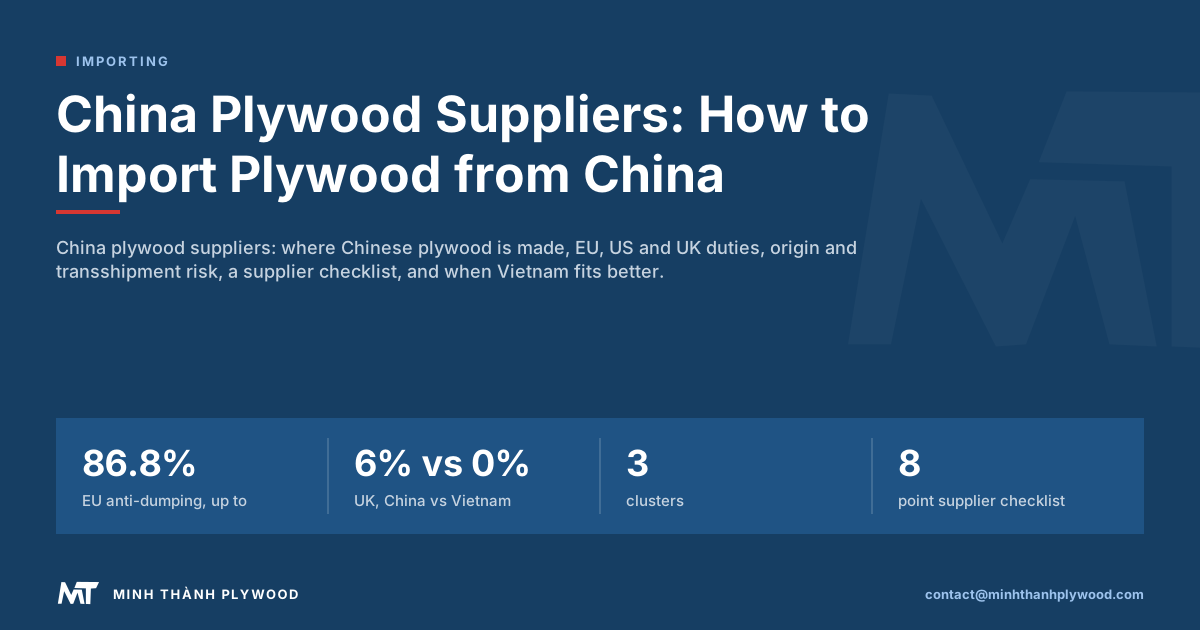
China plywood suppliers are clustered in Shandong, Jiangsu and Guangxi, and you can import plywood from China into most markets. What changes the deal is the destination: the EU charges anti-dumping duty of up to 86.8% on Chinese hardwood plywood, and the US has its own orders. This guide from Minh Thanh Plywood, a Vietnamese manufacturer, covers how to vet a mill, which duties apply, and when Vietnam is the better fit.
Can I import plywood from China?
Yes, you can import plywood from China into the EU, the UK, the US and most other markets. China produces and exports every grade, from packing board to birch-faced furniture panels, and what you pay in duty depends on the destination and on the faces of the panel.
What decides whether it is a good buy is the destination and the product line:
| Destination | What applies to Chinese plywood | Effect on the buyer |
|---|---|---|
| European Union | Anti-dumping duty on hardwood plywood, up to 86.8% | Landed cost rises sharply on hardwood-faced panels |
| United States | Anti-dumping and countervailing duty orders on hardwood and decorative plywood | Duty deposit on entry; structural and some other lines outside the scope |
| United Kingdom | UK Global Tariff, 6% on most plywood lines, 10% on some | Normal duty; no preference for China |
| UAE and the other GCC states | GCC common external tariff, generally 5% on the CIF value | One duty at first entry into the union; confirm the 12-digit tariff line with your broker |
| Other markets | National tariff and any trade remedies | Check with your customs broker before ordering |
So the first question is not “which supplier” but “which product, to which market”. A packing board for an Asian buyer and a birch-faced furniture panel for Germany are two different decisions.
Where are plywood manufacturers in China located?
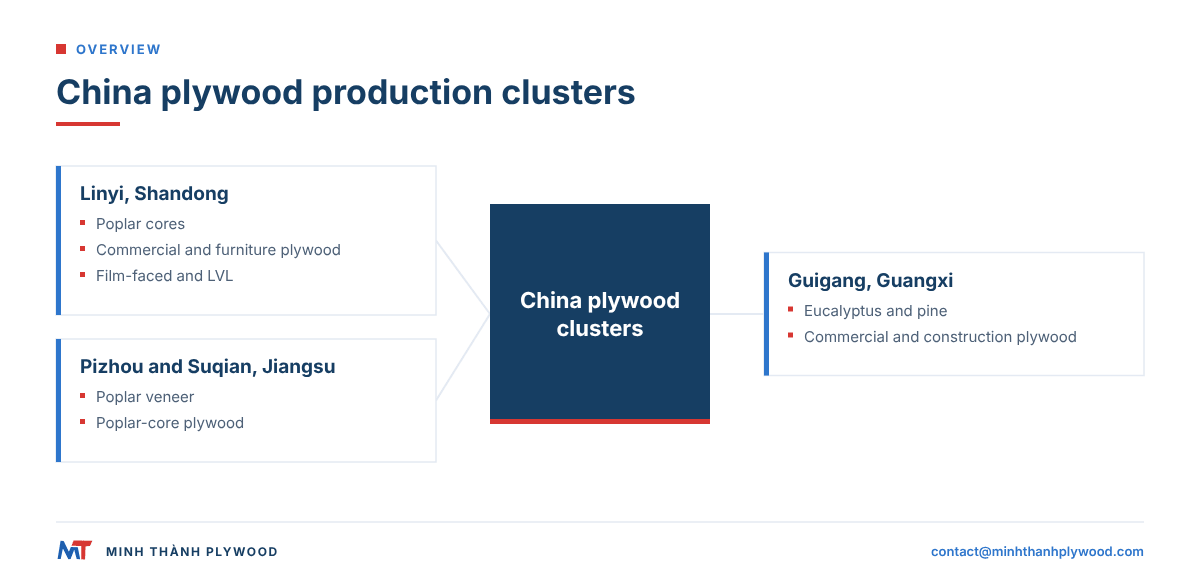
Plywood manufacturers in China sit in three main clusters, each tied to its timber supply:
- Linyi, Shandong: the largest cluster, with thousands of mills and veneer workshops; poplar cores, commercial, film-faced and furniture plywood, plus LVL.
- Pizhou and Suqian, northern Jiangsu: poplar veneer and poplar-core plywood, from small workshops to large export mills.
- Guigang and wider Guangxi: eucalyptus and pine from southern plantations; cores, commercial and construction plywood.
Smaller centres sit in Hebei, Zhejiang and Fujian; public supplier directories also list Xuzhou in Jiangsu for melamine-faced board, Langfang in Hebei and Huzhou in Zhejiang for furniture panels. A supplier’s cluster tells you a lot about its core: northern mills mostly use poplar, southern mills eucalyptus. Ask the supplier where the core veneer comes from, and check that the answer matches its address.
Which China plywood suppliers export the most?
Nine China plywood suppliers appear in the best-known export directories, and the table below lists what each says it makes and where it sells. It is a starting list for your own checks, not an endorsement, and every claim is the supplier’s own.
| Supplier | Province | Makes | Export markets it names |
|---|---|---|---|
| Luju Leader Wood | Shandong (Linyi) | Plywood, OSB, formply, LVL, MDF; plywood capacity of 70,000 m³ | South America, North America, Africa, Middle East, Europe |
| Luli Group | Shandong | Plywood, particle board | USA, Canada, Asia |
| Pioneer | Shandong | Fancy plywood, laminated boards | USA, Canada |
| Jinchao Timber | Shandong | Plywood, HDF, MDF | Global |
| Yunfeng Wood | Shandong | Film-faced plywood, coreboard | South Asia, Africa |
| Shouguang Fushi | Shandong | Furniture boards, OSB, blockboard | Africa, Southeast Asia |
| Jiu Li Wood Industry | Jiangsu | Multi-layer plywood | Global |
| Yalong Wood | Guangxi | Commercial and film-faced plywood | Middle East, Africa |
| Guangxi Xiangsheng | Guangxi | Eucalyptus plywood, LVL | Middle East, South America |
Source: Linyi Luju’s supplier list, checked on 21 October 2026. Shandong holds six of the nine, which fits the Linyi cluster above.
Yalong gives the clearest published terms. Its range runs from 2 mm to 18 mm in ordinary plywood and 12 mm to 18 mm in film-faced, production takes 15–25 days after the order, and shipping to the buyer takes another 10–50 days (Yalong Wood, read 21 October 2026). Put the same three figures in front of every supplier on your shortlist, ours included: thickness range, production days and transit days.
What do China plywood suppliers make well?
China plywood suppliers are strongest where volume and range matter. Typical strengths are:
- Poplar-core plywood in large volumes for commercial and packaging use.
- Film-faced plywood for concrete formwork, in many film weights and grades.
- Faced panels with birch, okoume, bintangor or engineered veneer on a poplar or combi core.
- Laminated and melamine-faced boards for interior fit-out.
- LVL for packaging and some structural uses.
The range is wide, and so is the spread of quality inside each product. A Linyi mill can make a good poplar-core board or a gappy one at the same thickness. The supplier’s country tells you little; the specification and the checks you write into the order tell you everything.
How do you tell a China plywood factory from a trading company?
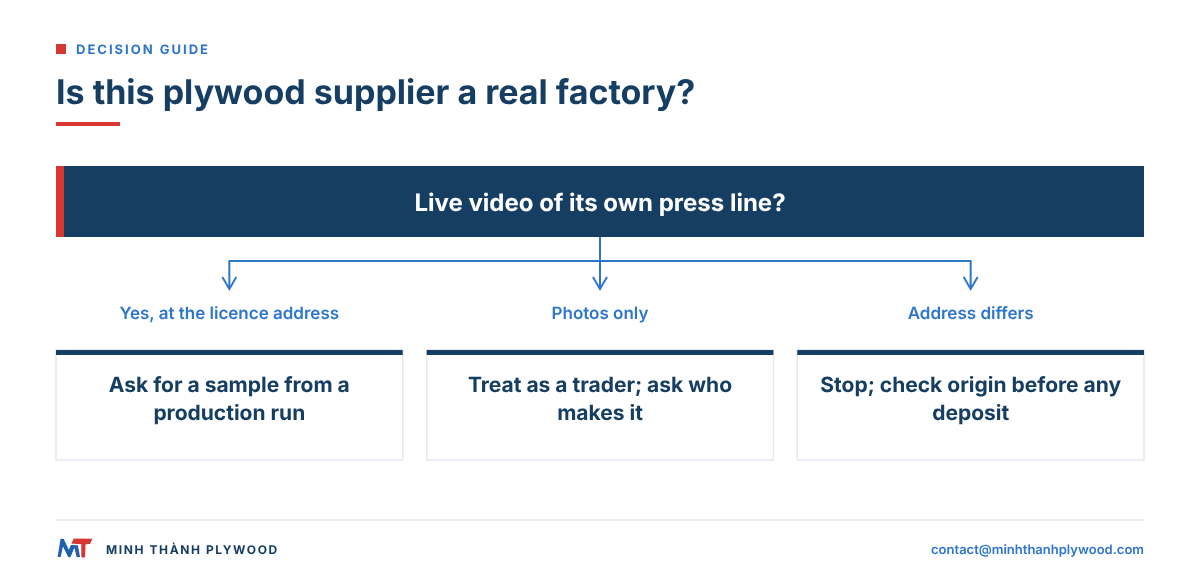
A China plywood factory can show its own press line, its veneer yard and its staff on demand; a trading company sends photos. Many buyers work happily with traders, but you should know which one you are paying.
Five checks separate them:
- Live video walk: veneer yard, lay-up line, hot press and sanding line, on a call you schedule.
- Business licence and certificates: the production address on both must match the address on the video.
- Sample from production: a sample cut from a real press run, not a polished showroom sheet.
- Cross-section photo: one sheet cut across, to show the core layers and joints.
- Named contacts at the mill: a production or QC manager who can answer technical questions.
Run these checks before the sample order, not after the first container. A supplier that agrees to a live call within a day or two, and shows the same press line on a second call, is usually what it says it is. One that sends only edited photos, or moves the call from week to week, is telling you something too. Keep notes of each call with the date, so the record is ready if you later need to show customs or your own customers how the supplier was chosen.
The same checks work for any country. At our plant in Ha Hoa, Vietnam, your inspector or any agency you appoint is welcome, and every shipment is photographed and filmed before loading.
Which import duties apply to plywood from China?
Duty on Chinese plywood depends on your market and the panel’s faces and plies. These are the trade remedies in force at the time of writing, checked 20 October 2026:
European Union. Regulation (EU) 2025/2333, Article 1 imposes a definitive anti-dumping duty on hardwood plywood from China: 86.8% for all companies not named, and 43.3% for one named exporter with a valid invoice declaration. The duty is charged on the net, free-at-Union-frontier price before duty. Bamboo plywood and okoume-faced plywood fall outside the scope.
United States. Anti-dumping and countervailing duty orders cover hardwood and decorative plywood from China. A 2023 circumvention ruling extends them to plywood finished in Vietnam with Chinese core components (core platforms or core veneers, with or without Chinese faces); other Vietnamese plywood needs importer and exporter certifications that no such Chinese inputs were used.
United Kingdom. No preference for China: the UK Trade Tariff lists the rates by commodity code. The rate is 6% for most hardwood-faced plywood lines and 10% for some tropical-faced lines.
Duty is the importer’s cost and the importer’s risk. Have your customs broker confirm the code, the scope and the rate for your exact panel before you sign.
What are transshipment and origin fraud, and how do you avoid them?
Transshipment is routing goods through a third country, or finishing them there, to show a different origin and pay less duty. When customs finds it, the importer pays the duty, interest and penalties, often years later.
Plywood is exposed because veneers travel. A panel pressed in one country from another country’s veneer may take the second country’s origin, depending on the rules of the market. Watch for these signs:
- A price well below the market for the same specification.
- A supplier that cannot show its own press line in the origin country.
- Certificates of origin from a trading address, not a mill.
- Face or core species that do not grow near the claimed mill and are not declared as imported.
- Shipping routes that call at a second port where the containers are changed.
Ask for production records, the veneer source and the mill address before the first order. Our cores come from plantation timber grown around Ha Hoa, and imported faces such as birch or okoume are declared with their own country of harvest.
How do you check a plywood supplier before the first order?
Check the mill, the sample and the paperwork before you pay a deposit. This checklist works for China plywood suppliers and any other export mill:
| Check | What to ask for | What a good answer looks like |
|---|---|---|
| Real production | Live video of the line; licence address | Press, sanding line and stock at the licensed address |
| Specification | Written spec sheet per item | Face, core, glue, emission, thickness tolerance, size, packing |
| Sample | Sample from a production run | Same core, glue and face grade as the order |
| Core | Cross-section of one sheet | No open gaps or overlaps; ply count fits the thickness |
| Tolerance | Caliper readings on finished stock | Within the agreed limit, measured on several sheets |
| Emission | Certificate and chamber test reports | Lab, method, date and result on each report |
| Origin | Veneer and core source | Species and harvest country for each layer |
| Loading record | Photos and video of a past loading | Pack labels, straps and the full container before sealing |
A supplier that answers all eight in writing, quickly, is worth a sample order. One that avoids the core and origin questions is not.
Which documents does a plywood import from China need?
Every plywood container needs four core documents: commercial invoice, packing list, bill of lading and certificate of origin. Your market then adds its own files.
- Furniture plywood: formaldehyde emission certificates and labels for the US (TSCA Title VI), and the emission proof your EU or UK customers ask for.
- EU imports: the origin and geolocation data for your EUDR due diligence statement.
- US imports: species and harvest country for every layer, for the Lacey Act declaration.
- Packaging: ISPM 15 marks on solid wood bearers; plywood itself is exempt.
The four core papers must match line by line. The plywood import documents guide walks through each one.
Which glue and emission specification should you ask for?
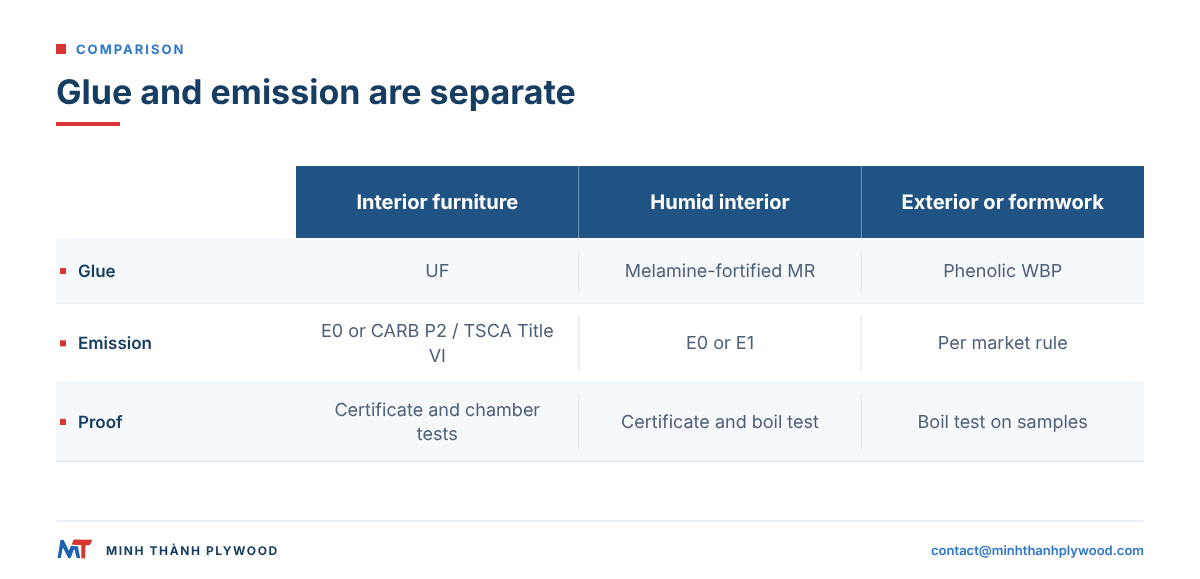
Name the glue and the emission class as two separate fields; they are different specifications. The glue sets water resistance, and the emission class sets how much formaldehyde the panel releases.
| Field | Interior furniture | Humid interior | Exterior or formwork |
|---|---|---|---|
| Glue | UF | Melamine-fortified (MR) | Phenolic (WBP) |
| Emission | E0 or CARB P2 / TSCA Title VI | E0 or E1 | Per market rule |
| Proof | Certificate and chamber tests | Certificate and boil test | Boil test on samples |
Ask for the test report behind any emission claim: laboratory, method, date and result. Our furniture panels use UF glue at E0 emission as standard; we hold CARB P2 / TSCA Title VI certification (ICTT mill no. 23024), and six ASTM D6007 chamber tests between April 2025 and June 2026 averaged 0.014–0.032 ppm. The limit for veneer-core hardwood plywood is 0.05 ppm under 40 CFR 770.10.
What payment terms and lead times are normal?
Most export plywood mills, in China and Vietnam, work on a deposit and a balance against shipping documents. A common pattern is 30% with the order and 70% against the bill of lading, or a letter of credit at sight.
Minh Thanh’s standard terms, for comparison:
- Minimum order: one 40HC, with mixed specifications by agreement.
- Deposit: 30%, which starts production.
- Production: 15–45 days after the deposit.
- Balance: 70% against the scanned B/L, or an irrevocable L/C at sight.
- Delivery terms: FOB Hai Phong, CFR or CIF.
- Samples: free.
Avoid paying the full value before loading on a first order. Paying the balance against documents gives you time to act if the loading photos show a problem.
How do you inspect a plywood container before it leaves China?
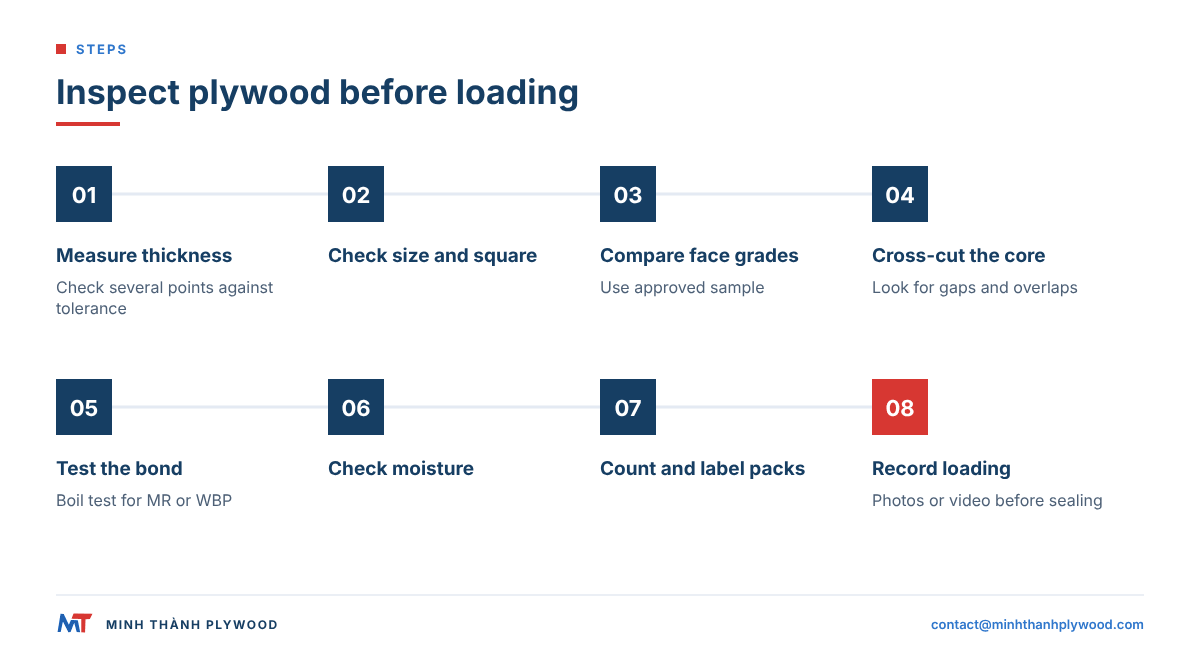
Book an inspection while the packs are finished but not yet loaded, so a failed pack can still be replaced. A pre-shipment inspection checks, on a random sample of sheets:
- Thickness at several points, against the agreed tolerance.
- Length, width and squareness.
- Face and back grade against the approved sample.
- Core: a cross-cut for gaps and overlaps.
- Bond: a boil test on cut samples for MR or WBP glue.
- Moisture content.
- Pack count, labels, straps and wrapping.
Then watch the loading, or ask for photos and video of every pack going in. Our guide on how to check plywood quality before shipment sets out the limits and the sampling plan.
When does Vietnam fit better than China for plywood?
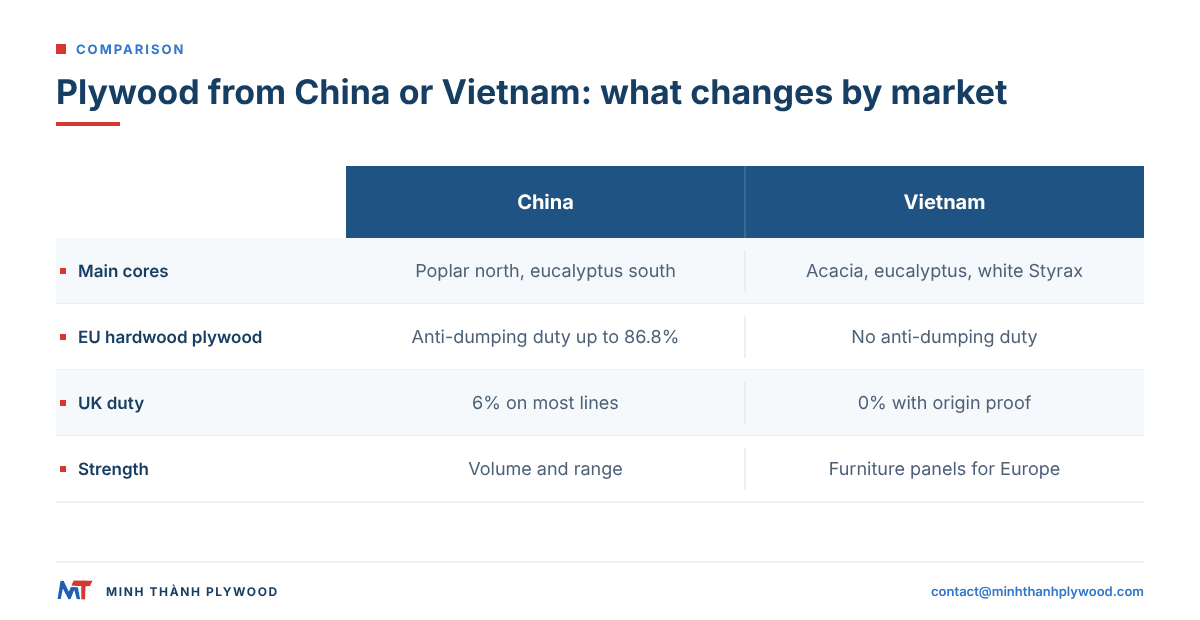
Vietnam usually fits better for hardwood furniture and interior plywood going to the EU, and China for very large volumes of poplar-core commercial board. Both countries have good mills; the choice follows the product and the market.
| Factor | China | Vietnam |
|---|---|---|
| Main cores | Poplar in the north, eucalyptus in the south | Plantation acacia, eucalyptus and white Styrax |
| EU duty on hardwood plywood | Anti-dumping duty, up to 86.8% | No anti-dumping duty; preferential rate with origin proof |
| UK duty | 6% on most lines | 0% with origin proof under the UK-Vietnam agreement |
| US trade remedies | Orders on hardwood and decorative plywood | 2026 final determinations on hardwood and decorative plywood |
| Scale | Largest producer, widest range | Smaller, focused mills |
For the US, both origins now face trade-remedy cases on hardwood plywood; structural PS 1 / PS 2 panels, phenolic film-faced formwork, flooring and ready-to-assemble furniture fall outside the 2026 Vietnam scope. The Vietnam vs China plywood comparison goes line by line.
Why do European furniture buyers source from Minh Thanh in Vietnam?
Our factory in Ha Hoa, Vietnam, is built for top-grade furniture and interior plywood, with Europe as its main market. What a European buyer gets:
- Panels pressed twice: the core board is pressed and calibrated, then the face and back are pressed on.
- Stitched cores: outer two to four core layers stitched horizontally and vertically.
- Thickness tolerance down to ±0.2 mm on sanded furniture panels.
- 10+ face veneers, including EV, poplar, birch, okoume and pine, in 3–40 mm.
- Documents: CARB P2 / TSCA Title VI, ISO 9001:2015 and TCVN 11902:2017 held; the EUDR compliance dossier with every order; FSC and CE available*.
- Capacity: 50,000+ m³ per year.
*Supplied directly or through qualified partner mills.
What should you send a plywood supplier for a quotation?
Send one specification line per item, the quantity and the destination port; a clear request gets a comparable quote from every supplier you ask. For example:
18 mm furniture plywood, 1220 × 2440 mm, birch face D+/D, white Styrax core, UF glue at E0 emission, sanded ±0.2 mm, export packing, one 40HC, CIF Hamburg.
Add the end use, the emission proof your customers need and any second specification for a mixed load. Send it to [email protected] or through the quotation form, and ask for free samples with the quote. Faces, cores and grades to choose from are on the furniture plywood from Vietnam page.
Buyer questions, answered
Can I import plywood from China?
Yes. Plywood from China can be imported into the EU, the UK, the US and most other markets, but the duty differs: the EU applies anti-dumping duty of up to 86.8% on Chinese hardwood plywood, and the US applies anti-dumping and countervailing duty orders to Chinese hardwood and decorative plywood.
Where are most plywood manufacturers in China?
Most Chinese plywood is made in three clusters: Linyi in Shandong, the Pizhou and Suqian area of northern Jiangsu, and Guigang and the wider Guangxi region in the south, where eucalyptus plantations supply the cores.
What is the EU anti-dumping duty on Chinese plywood?
Regulation (EU) 2025/2333 sets 86.8% for most Chinese exporters of hardwood plywood and 43.3% for one named company with a valid invoice declaration. Bamboo and okoume plywood fall outside its scope.
How do I know a China plywood supplier is a real factory?
Ask for a live video walk from veneer yard to press to sanding line, a cross-section of a sheet from your sample run, and the production address on the business licence and certificates. A trading company cannot show its own press line on demand.
What is plywood transshipment?
Transshipment is routing goods through a third country, or finishing them there, to claim a different origin and avoid duty. Customs authorities in the EU and the US investigate it, and duty, penalties and seizure fall on the importer.
Does Vietnamese plywood made with Chinese veneer count as Chinese?
For the US, yes in many cases: a 2023 circumvention ruling applies the China orders to plywood finished in Vietnam with Chinese core components (core platforms or core veneers, with or without Chinese faces), and other Vietnamese plywood needs importer and exporter certifications that no such Chinese inputs were used.
Which documents should a Chinese plywood supplier send?
Commercial invoice, packing list, bill of lading and certificate of origin for every container, plus emission certificates for furniture plywood, origin and species data for EUDR or the Lacey Act, and ISPM 15 marks on solid wood bearers.
Is Chinese plywood good quality?
China makes every grade, from packing plywood to high-grade birch-faced panels. Quality depends on the mill and the specification you set, so judge a supplier by its core, tolerance, glue and test reports rather than by country.
When is Vietnam a better choice than China for plywood?
For hardwood furniture and interior plywood sold into the EU, where Chinese hardwood plywood pays anti-dumping duty and EUDR origin data is needed, Vietnam usually fits better. For very large orders of poplar-core commercial plywood, China's volume is hard to match.
What is the minimum order from a plywood mill?
Most export mills, in China and Vietnam, sell by the container. Minh Thanh's minimum is one 40HC, with mixed specifications by agreement.