
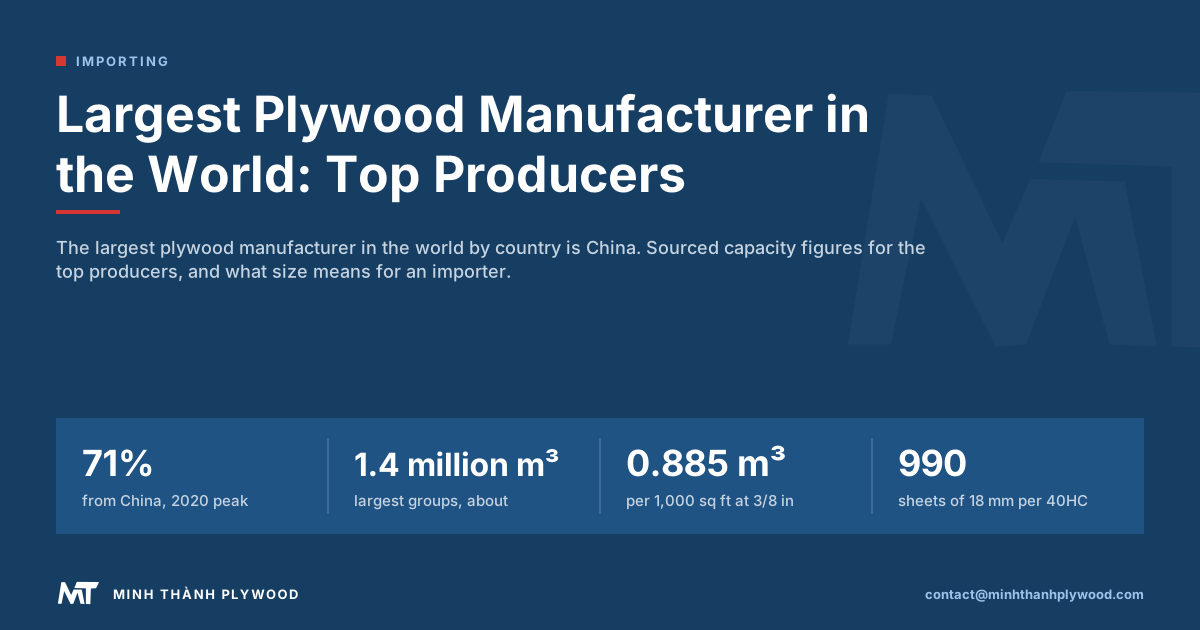
By country, the largest plywood manufacturer in the world is China, which supplied about 71% of global plywood at its 2020 peak. By company, no single mill comes close: the biggest groups publish capacities between a few hundred thousand and about 1.4 million m³ a year. Minh Thanh Plywood, a furniture plywood factory in Vietnam, sets out the sourced figures and what size changes for an importer.
Who is the largest plywood manufacturer in the world?
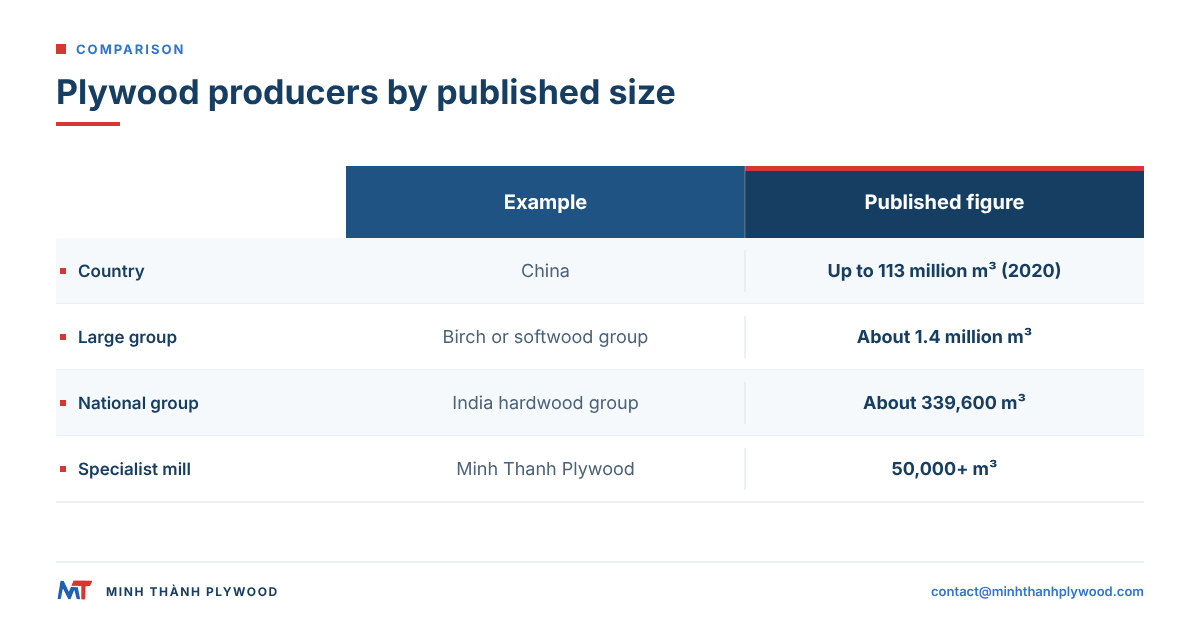
By country, China is the largest plywood manufacturer in the world. Wood Central reported in October 2023 that China supplied about 71% of global plywood at its 2020 peak, up to 113 million m³ a year, from more than 9,800 manufacturers spread across 28 provinces (Wood Central, October 2023).
By company, the answer is less clear. No plywood group controls more than a small slice of world output. The largest published figures sit around 1.4 million m³ a year, and they usually cover a whole group of mills and several wood products, not one plywood factory.
That is why the honest answer has two parts:
- The largest producing country is China, by a margin no other country approaches.
- The companies with the most capacity are multi-mill groups in Russia, North America, Northern Europe and India, each strong in one panel family: birch, softwood or tropical-faced hardwood plywood.
For an importer, the second answer matters more than the first. You buy from a mill, not from a country, and the mill’s size only helps if it makes your product.
Who are the top 10 plywood manufacturers in the world?
The table lists producers that publish a capacity or volume figure, with the source and date beside each number. We left out every figure we could not trace to the company or to a trade publication.
| Producer and country | Main plywood family | Published figure | Source and date |
|---|---|---|---|
| Plywood industry of China | Poplar, eucalyptus and mixed-core hardwood plywood | Up to 113 million m³ a year at the 2020 peak; more than 9,800 manufacturers | Wood Central, October 2023 |
| Sveza (Russia) | Birch plywood | About 1.4 million m³ of wood products a year from its plants | Sveza company brochure |
| Boise Cascade (USA) | Softwood plywood | 1.599 billion sq ft (3/8 inch basis) sold in 2023, about 1.4 million m³ | EUWID, April 2024 |
| Century Plyboards (India) | Hardwood plywood for furniture and interiors | About 339,600 m³ of plywood capacity a year | Timber Industry News, September 2024 |
| UPM Plywood (Finland, Estonia) | Birch and spruce plywood | 110,000 m³ delivered in the second quarter of 2024; Otepää mill expanded to 90,000 m³ a year | Timber Industry News, 2024; Pulp & Paper News, 2019 |
| Russian birch plywood industry | Birch plywood | About 3.2 million m³ of capacity a year, by merchant estimates | EUWID |
Capacity figures exist for only a few groups, so the table above is short on purpose. The companies below appear on most lists of the top plywood manufacturers in the world and in the US, European and Indian trade directories. Each is named with what it sells; none is ranked by size, because the sources do not publish a comparable plywood-only number.
| Company | HQ | Founded | What it sells |
|---|---|---|---|
| Georgia-Pacific | Atlanta, Georgia, USA | 1927 | Structural plywood, sheathing, subflooring and industrial panels |
| Weyerhaeuser | Seattle, Washington, USA | 1900 | Structural plywood, LVL, OSB and lumber |
| Boise Cascade | Boise, Idaho, USA | 1957 | Softwood plywood, OSB, I-joists and LVL |
| Columbia Forest Products | Greensboro, North Carolina, USA | 1957 | Hardwood plywood and decorative veneer |
| PotlatchDeltic | Spokane, Washington, USA | n/a | Industrial plywood, lumber and panels |
| Timber Products Company | Springfield, Oregon, USA | 1918 | Hardwood and softwood plywood, veneer and overlaid panels |
| Roseburg Forest Products | Springfield, Oregon, USA | n/a | Structural and hardwood plywood, LVL |
| Murphy Company | Eugene, Oregon, USA | n/a | Softwood and hardwood plywood, value-added panels |
| West Fraser | Vancouver, Canada | 1955 | Plywood, lumber, OSB and other wood products |
| Garnica | Logroño, Spain | 1941 | Poplar and mixed plywood for Europe |
| Sveza | Russia | n/a | Birch plywood |
| UPM Plywood | Finland, Estonia | n/a | Birch and spruce plywood |
| Century Plyboards | India | n/a | Hardwood plywood for furniture and interiors |
| Minh Thanh Plywood | Phu Tho, Vietnam | n/a | Furniture-grade and interior plywood on plantation cores |
Sources: Metoree, October 2026 for HQ and founding years, WeiYe, 2026 for US product lines and the Timber Products founding year, and Wikipedia for Columbia. “n/a” means the source gives no year.
The US names matter if you buy house-building panels. If you buy sanded furniture panels, the useful names are the mid-sized specialists, which is the group we belong to.
Three rules help you read any such list:
- Check the unit. Cubic metres, square feet on a 3/8 inch basis and “wood products” are not the same measure.
- Check the scope. A group figure may include LVL, MDF, particleboard or sawn wood.
- Check the date. Mills open, close and change owners; a 2018 figure says little about 2026.
Biggest plywood manufacturer in the world by country
China leads by country because it built a plywood industry around fast-growing poplar and eucalyptus, cheap veneer peeling and thousands of small and medium mills. Its 2020 output of up to 113 million m³ is more than all other producing countries combined.
The other large producing regions each have their own wood:
- North America makes softwood plywood from Douglas fir and southern yellow pine, mostly for house building, reported in square feet.
- Russia and Finland make birch plywood, prized for its many thin, even plies. Russian output for January to October 2023 was 2.711 million m³, down 4.3% on the year before (WhatWood, citing Rosstat).
- Indonesia and Malaysia make tropical hardwood plywood, with Japan as a long-standing main market (ITTO Biennial Review).
- India makes hardwood plywood mainly for its own furniture and interiors market.
- Vietnam makes plantation-core plywood from acacia, eucalyptus and Styrax, for furniture, packing and formwork.
Country size tells you where the volume is. It does not tell you which country suits your product: our pillar guide on which country makes the best plywood compares them by use.
How to compare plywood capacity in square feet and cubic metres
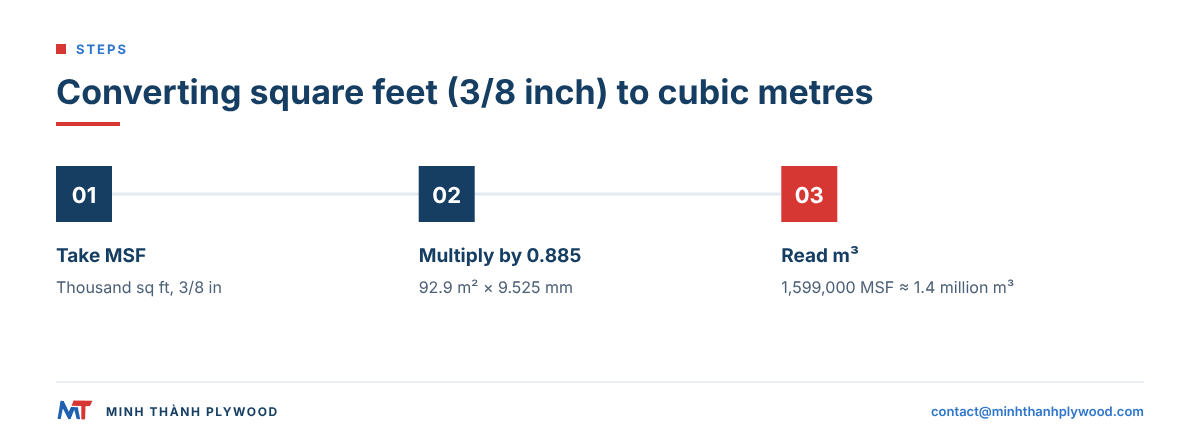
North American producers report plywood in square feet on a 3/8 inch basis; most other producers report cubic metres. To compare them, convert to cubic metres.
One thousand square feet is 92.9 m² of panel. At 3/8 inch, which is 9.525 mm, that area is about 0.885 m³ of plywood. So:
- Take the figure in thousands of square feet (MSF, 3/8 inch basis).
- Multiply by 0.885.
- The result is cubic metres.
Boise Cascade’s 1.599 billion sq ft sold in 2023 is 1,599,000 MSF; multiplied by 0.885 it gives about 1.4 million m³. On that basis, the largest North American and Russian groups are of a similar order of size.
A second trap is “capacity” against “output”. Capacity is what the presses can make; output is what they made. In 2023 a Sveza sales director said its facilities were not yet fully utilized (WhatWood interview). Compare like with like before you rank anyone.
Which is the biggest plywood factory in Asia?
There is no checkable answer for a single factory in Asia, because Asian mills rarely publish audited capacity per site. Lists that crown one factory as “Asia’s largest” are usually written by that factory or by a reseller.
What can be checked is the size of groups and countries:
- China holds most of Asia’s plywood capacity, spread over thousands of mills rather than one giant site.
- India’s largest plywood group publishes about 339,600 m³ a year of plywood capacity across its units (Timber Industry News, September 2024).
- Indonesia and Malaysia export tropical plywood from many mills; Malaysian exports fell to a historic low in 2024 on log shortages and weak Japanese demand (ITTO).
- Vietnam has many mid-sized mills grouped near their plantations, in the northern midlands, the central coast and the south.
If a supplier tells you its factory is the size leader in Asia, ask for the number of presses, the cubic metres shipped last year and a live video of the press hall. Those three answers tell you more than the title.
Biggest plywood exporters in Asia and what each ships
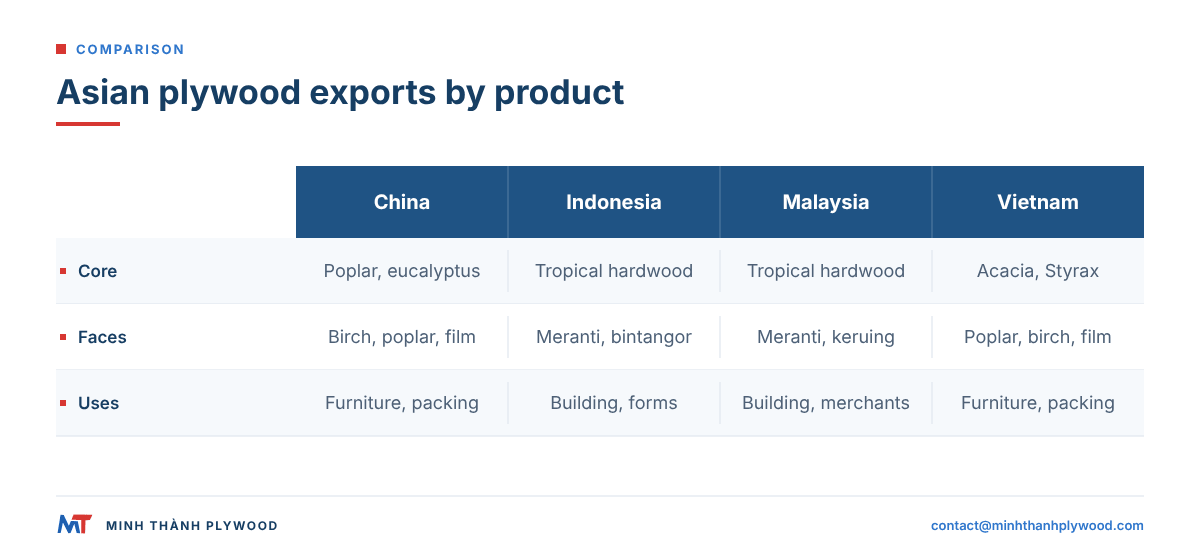
The biggest plywood exporters in Asia are China, Indonesia, Malaysia and Vietnam, and each ships a different product.
| Exporting country | Typical core | Typical faces | Main uses abroad |
|---|---|---|---|
| China | Poplar, eucalyptus, mixed hardwood | Birch, poplar, okoume, bintangor, film | Furniture, packing, formwork, flooring |
| Indonesia | Tropical mixed hardwood, falcata | Meranti, bintangor, film | Building, Japanese concrete forms, furniture |
| Malaysia | Tropical mixed hardwood | Meranti, keruing, film | Japanese and Middle East building, UK and EU builders’ merchants |
| Vietnam | Acacia, eucalyptus, Styrax | Poplar, birch, okoume, pine, engineered veneer, film | Furniture and interiors, packing, formwork |
For buyers in Europe, the country also sets the paperwork. Under the EU Deforestation Regulation, Vietnam is classed as low risk by Implementing Regulation (EU) 2025/1093, while Indonesia and Malaysia are standard risk. For Vietnamese plywood we supply the EUDR compliance dossier (origin records and geolocation files) with orders.
Our comparisons of Malaysian plywood and Vietnam vs Indonesia plywood go into each origin in detail.
Why is Asia the hub for plywood production?
Asia leads plywood production because it combines fast-growing plantation wood, veneer peeling at low cost and a large furniture industry close to the mills.
- Short-rotation plantations. Poplar in China, and acacia, eucalyptus and Styrax in Vietnam, are planted, harvested and replanted on short cycles, so mills peel small-diameter logs grown nearby.
- Peeling technology for small logs. Spindleless lathes peel logs down to a small core, which makes plantation wood economic for veneer.
- Labour for grading and lay-up. Sorting veneer, patching and laying up a core are still partly manual, and skilled workers hold the quality.
- Buyers next door. Asian furniture factories consume a large share of the panels, which keeps mills busy all year.
Vietnam adds a growing export base: its forestry exports reached a record US$17.3 billion in 2024, of which wood and wood products were about US$16.3 billion (Vietnam News, December 2024).
Which company manufactures the best plywood in the world?
The manufacturer with the highest output makes the most plywood, not necessarily the best plywood for your order. Size and fit are separate questions.
| What you need | Large multi-mill group | Specialist mid-sized mill |
|---|---|---|
| Very high volume of one standard grade | Strong fit | Possible over several containers |
| Custom size, face or core | Often a minimum per run | Normal practice |
| Tight thickness tolerance | Depends on the mill in the group | Usually the reason the mill exists |
| Fast written answers | Through a sales office | Often from the factory itself |
| Documents | Wide certificate set | Certificates for its own market focus |
“Best” depends on the use. For birch plywood with many plies, Baltic and Finnish mills set the benchmark. For North American house sheathing, local softwood mills lead. For sanded furniture panels with plantation cores, specialist Vietnamese mills compete on quality and price.
At Minh Thanh Plywood, furniture-grade panels are pressed twice as standard: the core board is pressed and calibrated, then face and back are pressed on. That step, rather than the size of the factory, is what gives a flat panel within ±0.2–0.3 mm.
What size means for an importer’s order
Size matters to an importer in three ways: how many containers a mill can ship each month, how long it can hold a specification, and how much attention your order gets.
A worked example puts the numbers in proportion. One 40HC of 18 mm furniture panels at 1220 × 2440 mm on a Styrax core holds 990 sheets, about 53 m³. A mill making 50,000+ m³ a year, like ours, therefore ships the equivalent of more than 900 such containers a year.
For most importers that is more than enough:
- A first order is one 40HC, with mixed specifications by agreement.
- A regular programme of one to four containers a month fits a mid-sized mill easily.
- A very large tender of dozens of containers a month is where a multi-mill group or two suppliers in parallel make sense.
A very large group may treat one container as a small order. A mid-sized specialist treats it as a customer it wants to keep.
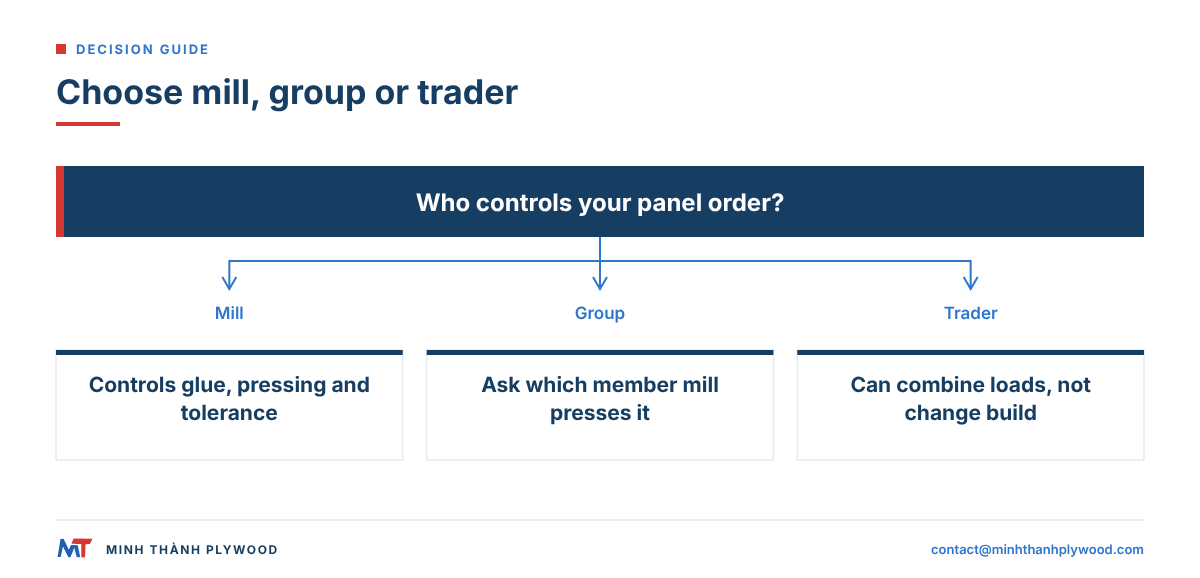
Mill, group or trader: who stands behind the list?
Many lists of top manufacturers mix three kinds of company: mills that press their own panels, groups that own several mills, and traders that buy finished packs.
- A mill peels or buys veneer, lays up the core, presses, sands and grades. It controls glue, pressing and tolerance on the day your order runs.
- A group owns several mills, sometimes in different countries. Ask which mill will make your order.
- A trader buys from mills and resells. It can help with mixed loads, but it cannot change the build.
A quick test separates them: ask for a live video of the press hall with today’s date visible, and the certificate holder’s name and number. A mill answers both in a day. Our guide to plywood manufacturers in Vietnam gives a fuller scorecard.
How should importers vet a large plywood supplier worldwide?
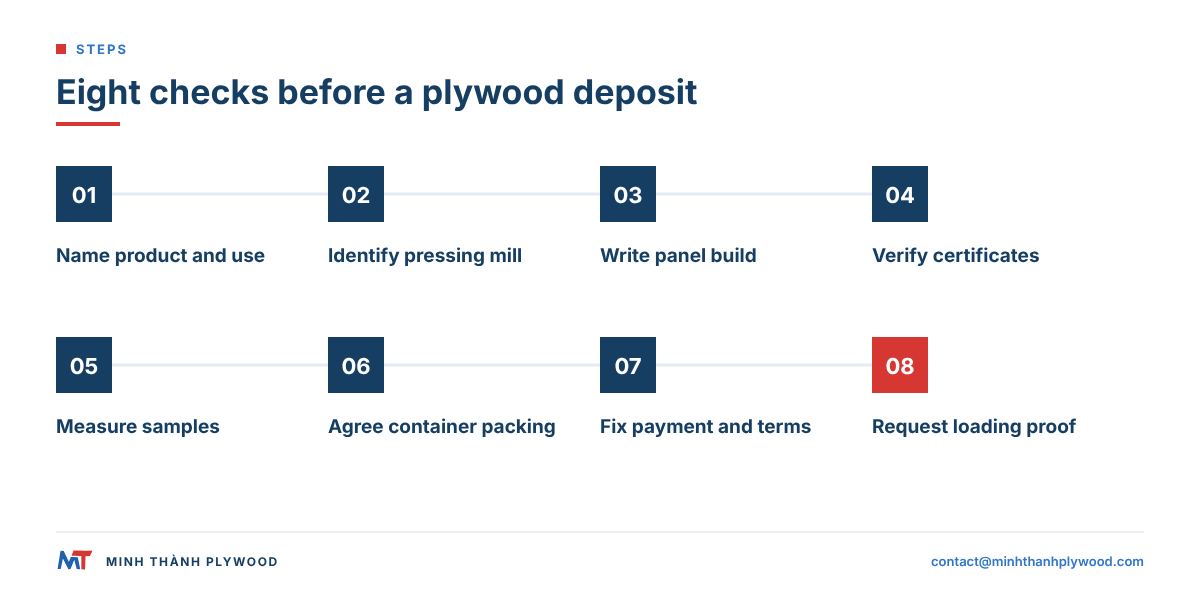
Vet a large supplier the way you vet a small one: on proof, not on reputation. Follow these steps before the deposit.
- Name the product and use: furniture, packing, formwork, structural.
- Ask which mill will press your order, and where.
- Get the build in writing: core species, number of plies, glue, emission class, face grade, tolerance.
- Check certificates against the issuer’s public register: CARB P2 / TSCA Title VI, ISO 9001, FSC, CE where relevant.
- Order samples and measure them: thickness at several points, weight, flatness.
- Agree the packing plan: packs per container, sheets per pack, weight against your booking.
- Fix payment and terms: deposit, balance trigger, Incoterm and port.
- Ask for pre-loading photos and video of your packs.
For Minh Thanh Plywood the answers are short: our own factory in Ha Hoa, Phu Tho; CARB P2 / TSCA Title VI with ICTT mill no. 23024; ISO 9001:2015; free samples; one 40HC minimum; 30% deposit and 70% against the scanned B/L.
Is a top-15 plywood manufacturer list useful?
A top-15 list is useful as a map of who exists, not as a buying decision. It tells you which countries and groups make plywood at scale; it does not tell you who makes your panel well.
Most lists share three weaknesses:
- They rank by fame, which follows marketing, not tolerance or bond quality.
- They mix units and scopes, so a sawmill group with a small plywood line can appear above a plywood specialist.
- They are often written by a mill on the list, which places itself near the top.
Use a list to collect names. Then shortlist three to five mills that make your product and score each one on proof.
Largest plywood glue manufacturers and why glue matters more than size
Plywood glue comes from chemical producers, not from plywood mills, and the glue a mill uses shapes the panel more than the mill’s size.
For importers, three glue families matter:
| Glue family | Typical use | What to write on the order |
|---|---|---|
| Urea-formaldehyde (UF) | Furniture and interior panels | UF glue at E0 emission, or the emission class your market needs |
| Melamine-fortified (MR/MUF) | Humid interiors, some formwork | MR or melamine-fortified bond, with the boil test you need |
| Phenolic (WBP/PF) | Exterior, formwork | Phenolic (WBP) bond |
Glue type and emission class are two separate lines on a specification. Our furniture panels use UF glue at E0 emission; six ASTM D6007 chamber tests between April 2025 and June 2026 on 9, 15 and 18 mm panels averaged 0.014–0.032 ppm. Three were by Shanghai Hongjun and three by ICTT Vietnam. The TSCA Title VI limit for veneer-core hardwood plywood is 0.05 ppm under 40 CFR 770.10.
Can you still buy Russian birch plywood in Europe?
No. Council Regulation (EU) 2022/576 of 8 April 2022 banned imports of Russian wood products, including plywood, into the EU from 9 April 2022; contracts concluded before that date could be executed until 10 July 2022 (EUR-Lex).
Russia is still home to some of the largest birch plywood capacity, but European buyers now source birch-faced and other panels elsewhere. Two common routes:
- All-birch plywood from Baltic and Finnish mills, for uses that need birch through the whole panel.
- Birch-faced plywood with imported birch face and back veneers on a plantation core, for furniture and interiors where the face is what shows.
We make birch-faced plywood on a Styrax or eucalyptus core, with faces graded D+, D and E and quoted as pairs such as D+/D, comparable to the European birch grade ladder. It is birch-faced plywood, not all-birch plywood.
Where Minh Thanh Plywood fits among the world’s producers
Minh Thanh Plywood is a specialist furniture plywood factory, not a giant group. We make 50,000+ m³ a year in Ha Hoa, Phu Tho, built for top-grade furniture and interior plywood with Europe as our main market.
| What you need | What we offer |
|---|---|
| Panels | Furniture and interior plywood; also commercial, packing and film-faced |
| Cores | White Styrax or eucalyptus as standard; acacia and pine on order |
| Faces | Poplar, birch, okoume, pine, engineered veneer and more, graded to the approved sample |
| Build | Cores stitched both ways; double pressing; tolerance down to ±0.2 mm |
| Sizes | 1220 × 2440 mm and 1250 × 2500 mm; 3–40 mm thick |
| Proof | CARB P2 / TSCA Title VI (ICTT mill no. 23024); ISO 9001:2015; EUDR dossier with orders |
| Terms | One 40HC minimum; 15–45 days after the 30% deposit; FOB Hai Phong, CFR or CIF |
If a large group fits your volume, use it. If you need sanded furniture panels built to your specification, send us the spec through the furniture plywood page: application, core, glue and emission class, face, size, packing and quantity. We reply within hours, with free samples.
Buyer questions, answered
Which country produces the most plywood?
China produces the most plywood by a wide margin. At its 2020 peak it supplied about 71% of world plywood, up to 113 million m³ a year, from more than 9,800 manufacturers in 28 provinces.
Who is the largest plywood manufacturer in the world by company?
No single company dominates world plywood the way China dominates by country. The largest groups publish capacity in the range of a few hundred thousand to about 1.4 million m³ of panels a year, spread over several mills and often mixed with other wood products.
Which is the biggest plywood factory in Asia?
Single factories in Asia rarely publish audited capacity, so a ranking of factories cannot be checked. The Asian producers with the most capacity are groups with several mills, mostly in China and India, while Indonesia, Malaysia and Vietnam export from many mid-sized mills.
Who are the biggest plywood exporters in Asia?
China ships more plywood than any other Asian exporter. Indonesia and Malaysia have long been the main suppliers of tropical hardwood plywood to Japan, and Vietnam exports plantation-core plywood for furniture, packing and formwork.
Is the largest plywood manufacturer the best supplier for an importer?
Not necessarily. A large group suits buyers of standard grades in high volume; a specialist mill often holds tighter tolerances, answers faster and builds to a custom specification. Match the mill to your product, then check its proof.
How big is a mid-sized plywood factory?
A mid-sized export mill produces tens of thousands of cubic metres a year. Minh Thanh Plywood makes 50,000+ m³ a year, which is more than 900 containers of 18 mm panels at about 53 m³ each.
How do I compare plywood capacity figures in square feet and cubic metres?
North American producers report plywood in square feet on a 3/8 inch basis. One thousand square feet at 3/8 inch is about 0.885 m³, so multiply thousands of square feet by 0.885 to get cubic metres.
Can I still import birch plywood from Russia into the EU?
No. Council Regulation (EU) 2022/576 banned imports of Russian wood products, including plywood, into the EU from 9 April 2022; contracts concluded before that date could be executed until 10 July 2022.
What should I ask a large plywood manufacturer before ordering?
Ask which of its mills will make your order, the core species, glue and emission class, thickness tolerance, the certificate number and holder, the packing plan per container, and the payment terms. A large name does not replace these answers.
Which companies are the biggest plywood manufacturers in the USA?
The names that appear on most US lists are Georgia-Pacific, Weyerhaeuser, Boise Cascade, Columbia Forest Products (a hardwood plywood and veneer maker), PotlatchDeltic, Timber Products, Roseburg and Murphy Company. They are mostly softwood structural producers; furniture panels come from hardwood specialists.
Where does Vietnam rank among plywood producers?
Vietnam is a smaller producer than China but a fast-growing exporter, with plantation acacia, eucalyptus and Styrax cores. Its wood and wood products exports reached about US$16.3 billion in 2024, across furniture, chips, pellets and panels.