
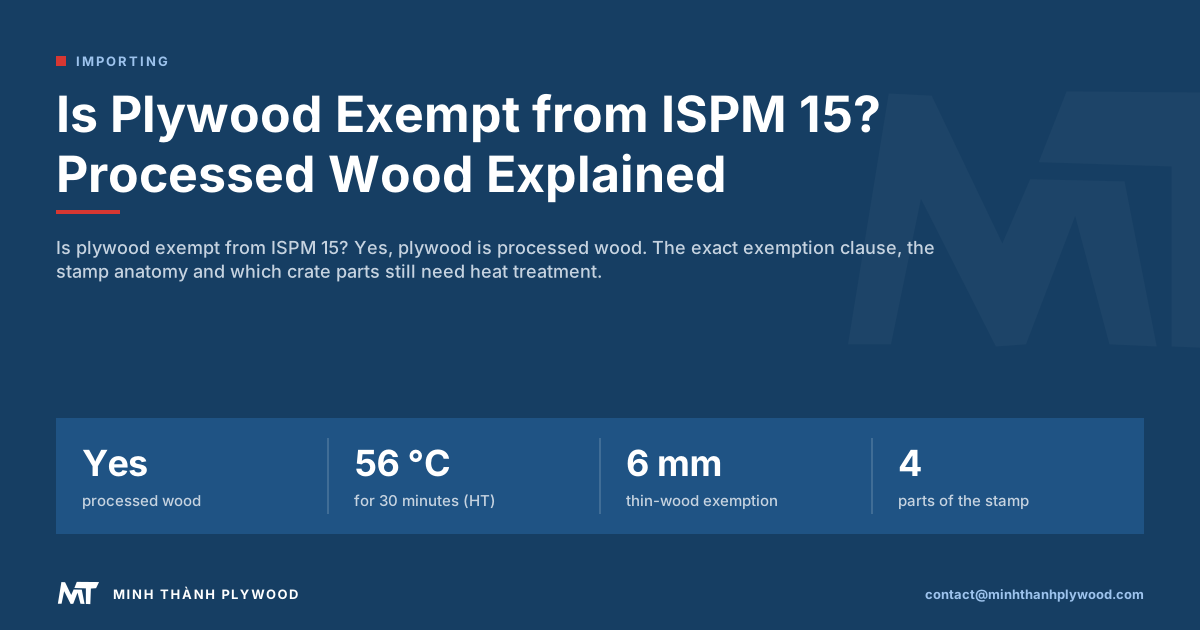
Yes. Plywood is exempt from ISPM 15 because it is processed wood made with glue, heat and pressure, so plywood sheets, plywood boxes and plywood pallet decks need no heat treatment or stamp. The rule still applies to any solid sawn wood in the same load: bearers, skids, battens and dunnage. Minh Thanh Plywood ships its packs on that basis.
Is plywood exempt from ISPM 15?
Yes, plywood is exempt from ISPM 15. Section 2.1 of the standard exempts “wood packaging made wholly of processed wood material, such as plywood, particle board, oriented strand board or veneer that has been created using glue, heat or pressure, or a combination thereof.”
The scope paragraph repeats the point, excluding packaging “made from wood processed in such a way that it is free from pests (e.g. plywood).”
ISPM 15 is the International Standard for Phytosanitary Measures No. 15, Regulation of wood packaging material in international trade, published by the International Plant Protection Convention (IPPC), the plant-health body under the UN Food and Agriculture Organization. The current text was last revised in April 2018 and published in 2019 (ISPM 15, IPPC/FAO, read 20 October 2026).
The exemption has one condition built in: the packaging must be made wholly of processed wood. A crate with plywood walls and solid pine runners is not wholly processed wood. The runners fall back under the standard.
Does plywood need heat treatment for export?
Plywood counts as processed wood because the way it is made kills the pests ISPM 15 targets. Logs are peeled into thin veneers, the veneers are dried, glue is spread, and the stack is pressed under heat until the glue cures. Bark is gone at the first step, and insects and nematodes that live in raw wood do not survive drying and hot pressing.
At Minh Thanh, furniture-grade panels go through that heat twice. The core board is pressed and calibrated first, then the face and back veneers are pressed on in a second cycle. Veneers and finished panels leave the factory dried to 8–12 % moisture content, the normal range for furniture plywood.
That is why the standard places plywood beside particle board, oriented strand board (OSB) and veneer. All four are made with glue, heat, pressure or a mix of them, and none of them carries the raw-wood pest risk that sawn timber does.
Is plywood ISPM 15 compliant without a stamp?
Yes, plywood is ISPM 15 compliant without a stamp, because exempt material sits outside the standard. There is nothing to certify, so there is no mark to apply. An all-plywood crate or a plywood pallet with plywood blocks falls within this processed-wood exemption.
Buyers sometimes ask a supplier for “ISPM 15 plywood” or “heat-treated plywood” for packaging. What they need is a plain statement on the packing list or a packaging declaration that the packaging is made of plywood, a processed wood product. That statement answers the question faster than a stamp would.
Some importers still prefer to see a mark on every pallet for their own warehouse rules. In that case, use solid wood parts that are properly treated and marked, and leave the plywood parts as they are.
Which wood packaging still needs treatment in a plywood shipment?
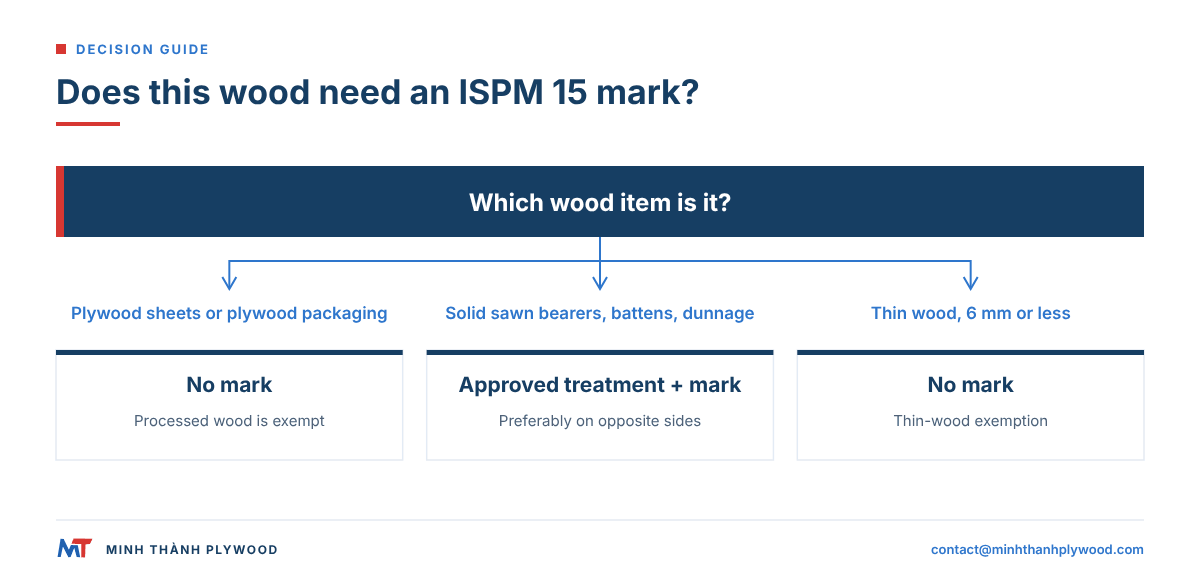
Solid sawn wood thicker than 6 mm used as packaging still needs an approved ISPM 15 treatment and compliant marking. In a plywood export container that usually means three things: the bearers or skids under each pack, the battens or blocks inside a mixed crate, and the loose dunnage used to brace packs against the container walls.
| Part of the shipment | Material | Needs ISPM 15? | What to check |
|---|---|---|---|
| Plywood sheets traded as goods | Plywood | No, they are cargo, not packaging | Destination rules for wood products |
| Plywood cover boards on top of a pack | Plywood | No, processed wood | Clean, no bark or soil |
| Pallet deck and blocks made of plywood | Plywood | No, processed wood | Made wholly of plywood |
| Bearers or skids under a pack | Solid sawn wood | Yes | Visible mark, preferably on two opposite sides |
| Battens inside a crate | Solid sawn wood | Yes | Treat the solid wood; mark the completed crate |
| Loose dunnage and bracing | Solid sawn wood | Yes | Marked along its length |
| Thin slats, 6 mm or less | Thin solid wood | No, thin-wood exemption | Thickness measured |
The table is the simplest way to brief a forwarder. Each solid wood part is checked on its own; the plywood around it does not make it exempt.
What does the ISPM 15 stamp show?
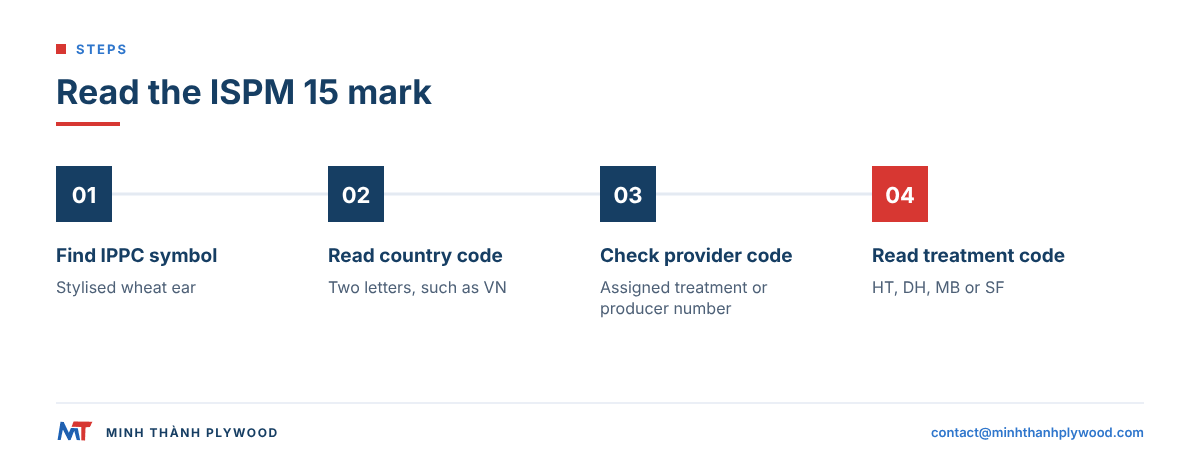
The ISPM 15 stamp shows four required parts inside a rectangular border, set out in Annex 2 of the standard. A vertical line separates the symbol on the left from the codes on the right.
- The IPPC symbol, a stylised wheat ear, always on the left.
- The country code, the ISO two-letter code of the country where the wood was treated, such as VN for Vietnam.
- The producer or treatment provider code, a unique number the national plant protection organisation assigns to the company that treated the wood or made the packaging. It follows the country code after a hyphen.
- The treatment code: HT for heat treatment, DH for dielectric heating, MB for methyl bromide or SF for sulphuryl fluoride.
The standard adds rules for how the mark is applied. It must be legible, durable and not transferable, never hand drawn, and placed where it stays visible, preferably on at least two opposite sides of the unit. Red and orange are to be avoided because those colours mark dangerous goods. No other information may sit inside the border; a company logo goes outside it.
How is solid wood heat treated under ISPM 15?
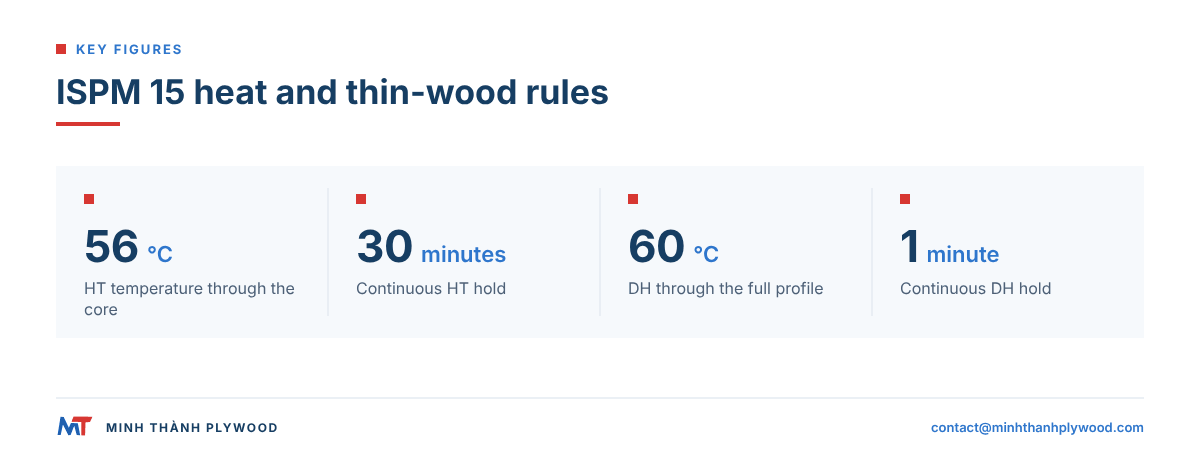
Heat treatment (HT) under ISPM 15 means the whole profile of the wood, including its core, reaches at least 56 °C for at least 30 continuous minutes in a kiln or heat chamber. Dielectric heating (DH), by microwave or radio waves, needs at least 60 °C for 1 continuous minute through the whole profile, surface included.
The wood must also be debarked. Small pieces of bark may remain only if each is under 3 cm wide, or, if wider, under 50 square centimetres in area. For heat treatment, debarking can happen before or after the kiln.
Methyl bromide (MB) and sulphuryl fluoride (SF) are fumigation treatments in Annex 1. Methyl bromide depletes the ozone layer, and the IPPC recommends replacing it where alternatives exist, so heat treatment is the route most packaging makers take.
Which other wood packaging is exempt from ISPM 15?
Besides plywood and other processed wood, ISPM 15 exempts five more groups of low-risk articles:
- wood packaging made entirely of thin wood, 6 mm or less in thickness;
- barrels for wine and spirit that were heated during manufacture;
- gift boxes for wine, cigars and other goods made from wood processed so it is free of pests;
- sawdust, wood shavings and wood wool;
- wood components permanently attached to freight vehicles and containers, such as a container’s own floor.
A footnote adds that not every gift box or barrel is built in a pest-free way. Where doubt exists, the importing and exporting plant protection organisations can agree specific arrangements. Plywood has no such caveat in the text.
Can plywood be used to repair ISPM 15 pallets?
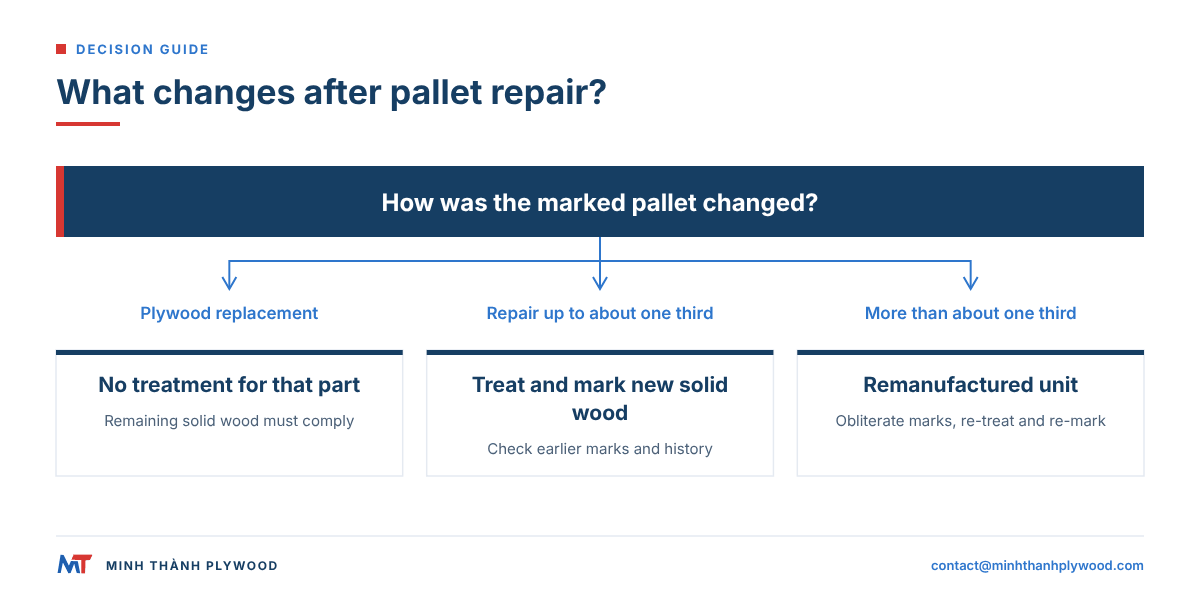
Yes. Section 4.3.2 of ISPM 15 allows a marked pallet or crate to be repaired with wood treated under the standard, or with wood made from processed wood material. A broken deck board can therefore be replaced with a plywood board without new treatment of that part.
Under section 4.3.2, replacing up to approximately one third of components counts as a repair; replacing more makes the unit remanufactured. Each newly added solid-wood component must be treated and individually marked; a plywood replacement component needs no treatment. A remanufactured unit must have earlier marks obliterated, then be re-treated and re-marked.
A plywood repair board does not make an otherwise valid pallet non-compliant. However, the remaining solid wood must still meet the standard, its marks and repair history must be valid, and the national plant protection organisation may require re-treatment or removal from international trade if a component’s origin or treatment cannot be established. An old stamp alone does not prove a repaired pallet compliant.
Where does the mark go on a mixed plywood and solid wood crate?
On a single composite unit that mixes treated solid wood and plywood, ISPM 15 allows the mark to be placed on the plywood part. Annex 2 gives the reason: the plywood panel is often the only surface large and visible enough for a legible mark.
The mark on the plywood still certifies the treated solid components. It says nothing new about the plywood, which needed no treatment. This option applies only to a composite unit built as one piece, not to loose wood stacked together for one trip.
Do plywood sheets shipped as cargo fall under ISPM 15?
No. ISPM 15 regulates wood packaging, meaning crates, boxes, pallets, cable drums and dunnage that carry or protect goods. Plywood sheets bought and sold as a product are the goods, not the packaging, so the standard does not apply to them at all.
What applies to plywood as cargo is each importing country’s own rule for wood products. Australia, for example, lists plywood, laminated veneer lumber (LVL) and veneer sheets in its table of wooden products that need minimal biosecurity intervention. Some countries ask for a phytosanitary certificate for wood products, and our guide to the plywood phytosanitary certificate covers when that happens and how the certificate is issued in Vietnam.
How do Minh Thanh export packs handle ISPM 15?
Minh Thanh export packs are built so that ISPM 15 is never the reason a container waits. The packaging materials are cardboard, plywood and pallet blocks, strapping band and wrapping film; SGS tested all four in September 2026 for lead, cadmium, mercury and hexavalent chromium under the EU packaging regulation, Regulation (EU) 2025/40: none was detected, a pass against the 100 mg/kg limit (Regulation (EU) 2025/40 on EUR-Lex).
When a buyer orders export pallets with solid wood bearers, the bearers are heat treated and carry the ISPM 15 mark. Every shipment is photographed and filmed before loading, and the buyer receives the photos and video, so the packaging can be checked before the vessel sails.
The factory’s reference 40HC packing plan for 1220 × 2440 mm panels uses 18 Styrax-core packs, 16 Acacia-core packs (on-order core) or 15 Eucalyptus-core packs, each about one metre high. These are planning layouts, not guaranteed load counts: verify the booking’s permitted mass, pack weights, stacking and the approved loading plan before shipping. Solid-wood bearers in the selected layout must still have valid ISPM 15 treatment and marks.
Is plywood exempt from ISPM 15 in Great Britain and the UK?
Yes. The UK government guidance says the rules “do not apply to processed, non solid WPM like plywood”, and also exempts raw wood that is 6 mm thick or less, barrels for wines and spirits, gift boxes made from processed wood, sawdust, shavings and cardboard (GOV.UK, Wood packaging material for import and export, updated 22 April 2026). Solid wood packaging must meet ISPM 15 when it comes into Great Britain from any country, whether it moves goods or is supplied to businesses.
What a UK importer should know about the solid wood in a plywood load:
- The mark is the proof. GB does not ask for a separate treatment or phytosanitary certificate for the packaging, because the certification is the ISPM 15 mark itself. A certificate cannot stand in for a missing mark.
- Checks can happen at the port or inland. Solid wood packaging may be checked at the border or at inland premises, and non-compliant packaging could be rejected or destroyed, which leaves you to arrange other transport for the goods.
- Northern Ireland. Movements from Northern Ireland to Great Britain and to the EU continue as before 1 January 2021. Solid wood packaging moving from Great Britain to Northern Ireland must be treated and marked to ISPM 15, and checks on those movements are risk-targeted.
- UK-made pallets. A UK producer that applies the mark must be a member of the UK Wood Packaging Material Marking Programme (UKWPMMP), with an assessment of its facility every 6 months, and registered with the Forestry Commission as a professional operator.
- Dunnage under timber. Bearers and spacers of the same type as a sawn timber consignment listed in the regulations, banded with it, need not be ISPM 15 compliant. Dunnage under any other consignment, including plywood, must comply. A plywood load is not in that exception, so its solid wood bearers need the mark.
- Who to ask. The Forestry Commission plant health service answers queries on 0300 067 5155.
For a UK buyer the practical line is the same as everywhere else: plywood packs and plywood decks need no mark, solid sawn bearers do.
Can an ISPM 15 stamp be faked, and how do you spot one?
Yes, fake stamps exist. Manufacturers have been fined for branding pallets that did not meet the standard, and buyers who bought them believed they were compliant (Pallite Group, ISPM 15 exempt shipping crates). Three checks catch most problems before loading:
- Read the code. A valid mark has the IPPC wheat-ear symbol, the two-letter country code, a producer or treatment provider number and an approved treatment code (HT, DH, MB or SF), inside a border. A missing producer code or a hand-painted mark is a warning sign.
- Ask for the treatment provider’s records. The provider that applied the mark keeps the records for the treatment used.
- Avoid the stamp question altogether where you can. Plywood bearers, plywood decks and all-plywood packs carry no mark because none is needed, so there is nothing to forge. Minh Thanh export packs use plywood and pallet blocks, and any solid wood bearers are heat treated and marked.
Can an ISPM 15 pallet or crate be reused?
Yes. A unit that has been treated and marked in line with ISPM 15 and has not been repaired, remanufactured or otherwise altered does not need re-treatment or a new mark for the whole of its service life (ISPM15.com, FAQ). Undamaged compliant packaging can go to any country that accepts the standard.
Repair changes that, within limits: repairs with treated or processed-wood parts keep the unit compliant, but a unit that is remanufactured must be re-treated and re-marked, as the repair section above explains. A plywood part that has never been solid wood needs none of this, which is one reason all-plywood decks suit returnable packaging.
How do you check the ISPM 15 status of a plywood shipment?
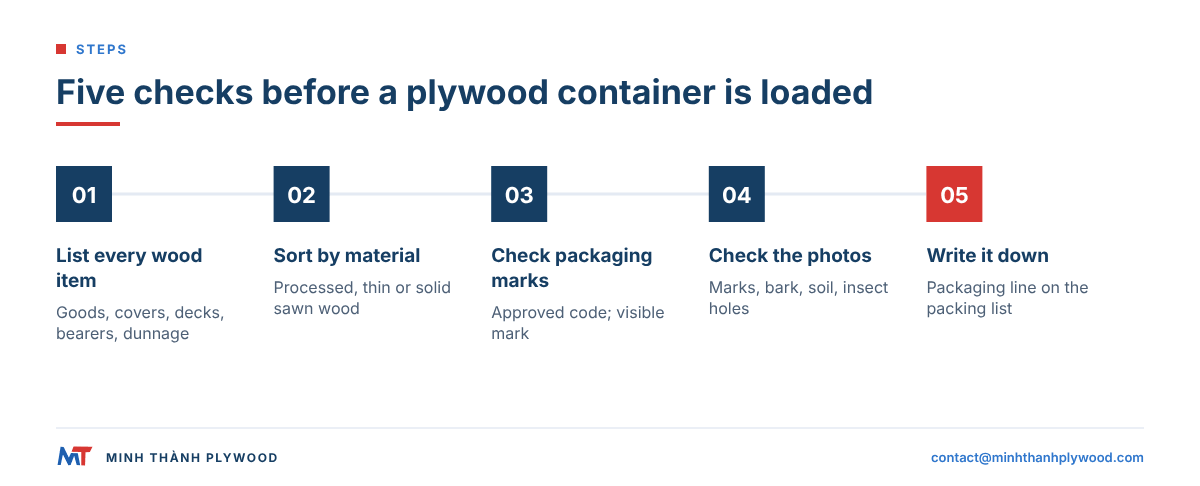
Check the ISPM 15 status of a plywood shipment in five steps, before the container is loaded:
- List every wood item in the load: the plywood goods, pack covers, pallet decks, bearers, crate battens and dunnage.
- Sort each item into processed wood (plywood, OSB, particle board), thin wood of 6 mm or less, or solid sawn wood.
- Check the mark on each regulated packaging unit and each loose dunnage piece. It must be visible and carry the approved treatment code (HT, DH, MB or SF); placement on at least two opposite sides is preferred.
- Look at the loading photos for each mark and for bark, soil or insect holes on the solid parts.
- Write the packaging description on the packing list, for example “plywood packs on ISPM 15 HT-marked solid wood bearers”, so the importer’s broker can answer any packaging declaration.
Australia’s packing declaration for sea containers asks exactly this: whether timber or bamboo dunnage was used and, if so, whether it is ISPM 15 treated and marked.
What happens when solid wood packaging is not compliant?
When solid wood packaging arrives without a valid ISPM 15 mark, the importing country’s plant inspectors decide the outcome. The usual options are treatment at the port, removal and destruction of the packaging, or re-export of the packaging or the whole consignment. Each one adds days at the terminal and storage charges.
Plywood buyers rarely face this with all-plywood packs. The risk sits in the loose dunnage a loading crew cuts on the day, and in bearers made from untreated offcuts. ISPM 15 Annex 2 warns that small pieces of dunnage cut without the full mark should not be used. A pre-loading check of every solid wood piece prevents both problems.
Does ISPM 15 mean plywood needs fumigation?
No. ISPM 15 lists fumigation with methyl bromide or sulphuryl fluoride only as a treatment option for solid wood packaging. Plywood, being exempt, needs neither fumigation nor heat treatment under the standard.
Some destinations or buyers still ask for a fumigation certificate for the whole container for their own reasons. Minh Thanh’s shipping documents can include phytosanitary and fumigation certificates when the order calls for them; whether your port needs one is covered in does plywood need fumigation for export.
What should you write in your order about packaging?
Write the packaging into the order so the mill, the forwarder and your broker read the same thing. A short packaging line for a plywood order to any destination looks like this:
“Packs of about one metre high, plywood cover boards, cardboard edge protection, strapping band and wrapping film; solid wood bearers ISPM 15 HT marked on two sides; no loose untreated dunnage; loading photos and video before sealing.”
Add the panel specification beside it: application, core, glue and emission class, face grade, size and thickness, quantity and destination port. Send it to Minh Thanh for a quote on packing plywood or on any furniture panel; samples are free, and replies come within hours.
Buyer questions, answered
Is plywood exempt from ISPM 15?
Yes. ISPM 15 exempts wood packaging made wholly of processed wood material such as plywood, particle board, OSB and veneer created with glue, heat or pressure. Plywood crates, boxes and pallet decks therefore need no ISPM 15 treatment or mark.
Does plywood need to be heat treated for export?
Not for ISPM 15. The hot press that bonds the veneers already makes plywood pest-free, which is why the standard exempts it. Solid sawn wood used with the plywood, such as skids, bearers or dunnage, needs an approved treatment and compliant packaging marking.
Is plywood ISPM 15 compliant without a stamp?
Yes. A plywood crate or pallet made wholly of plywood complies by being exempt, so it carries no stamp. If the crate includes solid wood battens or blocks, those solid parts must receive approved treatment and the completed packaging unit must be marked.
What does the ISPM 15 stamp show?
The IPPC wheat-ear symbol, the ISO two-letter country code, a producer or treatment provider code issued by the national plant protection organisation, and a treatment code: HT, DH, MB or SF. Everything sits inside a rectangular border.
Can an ISPM 15 stamp be put on plywood?
On a composite unit that mixes treated solid wood and plywood, ISPM 15 allows the mark to sit on the plywood part so it is visible and large enough. The mark still certifies the treated solid wood, not the plywood.
Do plywood sheets shipped as cargo need ISPM 15?
No. ISPM 15 covers wood packaging, not the goods. Plywood sheets traded as a product follow the importing country's own rules for wood products, and ISPM 15 then applies only to any solid wood packaging under or around the packs.
Is OSB or MDF exempt from ISPM 15 too?
Yes. The exemption names plywood, particle board, oriented strand board and veneer made with glue, heat or pressure. MDF and other fibreboards are processed the same way and are treated as processed wood by most national plant protection organisations.
Does thin wood need ISPM 15?
No. Wood packaging made entirely of thin wood, 6 mm thick or less, is exempt. Wine and spirit barrels heated during manufacture, sawdust, shavings and wood wool are also exempt.
Do I need a phytosanitary certificate instead of the stamp?
No. ISPM 15 states that the mark makes a phytosanitary certificate unnecessary for the packaging. A certificate for the plywood itself is a separate question that depends on the destination's import conditions.
What happens if solid wood dunnage has no mark?
The importing country's plant inspectors can order the dunnage treated, removed or re-exported, and the container can be held while this happens. Mark every piece of solid wood dunnage before loading.