
A plywood phytosanitary certificate is the plant-health certificate the exporting country's plant protection authority issues for a consignment. Plywood usually does not need one, because it is processed wood, but the importing country decides, and some destinations or buyers still ask for it. Minh Thanh Plywood arranges it with the shipping documents whenever the order requires it.
Does plywood need a phytosanitary certificate?
Plywood usually does not need a phytosanitary certificate. It is processed wood: veneers are peeled, dried, glued and hot-pressed, which leaves nothing in the panel that can carry the bark beetles, wood borers and nematodes plant-health rules target. The international standards say so directly, and most importing countries follow them.
ISPM 12, the IPPC standard on phytosanitary certificates (revised 2022), states that importing countries “should not require phytosanitary certificates for plant products that have been processed to the point where they have no potential for introducing regulated pests” (ISPM 12, IPPC, read 20 October 2026). ISPM 32, on sorting commodities by pest risk, gives plywood, particle board and wafer board as its examples of multi-method processing by heat and high pressure.
The final word belongs to the importing country. A destination can list plywood among the products that need a certificate, and a buyer’s bank can write one into a letter of credit. In both cases the certificate becomes a shipping document like any other.
What is a plywood phytosanitary certificate?
A plywood phytosanitary certificate is an official document, issued by the plant protection organisation of the exporting country, stating that a consignment was inspected and meets the importing country’s plant-health requirements. It follows the model certificate annexed to the International Plant Protection Convention (IPPC), so it looks much the same from every country.
The certificate covers one consignment, not a product or a factory. A plywood mill does not “hold” a phytosanitary certificate the way it holds a quality or emission certificate. Each container, or each group of containers on one bill of lading, gets its own certificate when the destination requires it.
When do importers ask for a phytosanitary certificate for plywood?
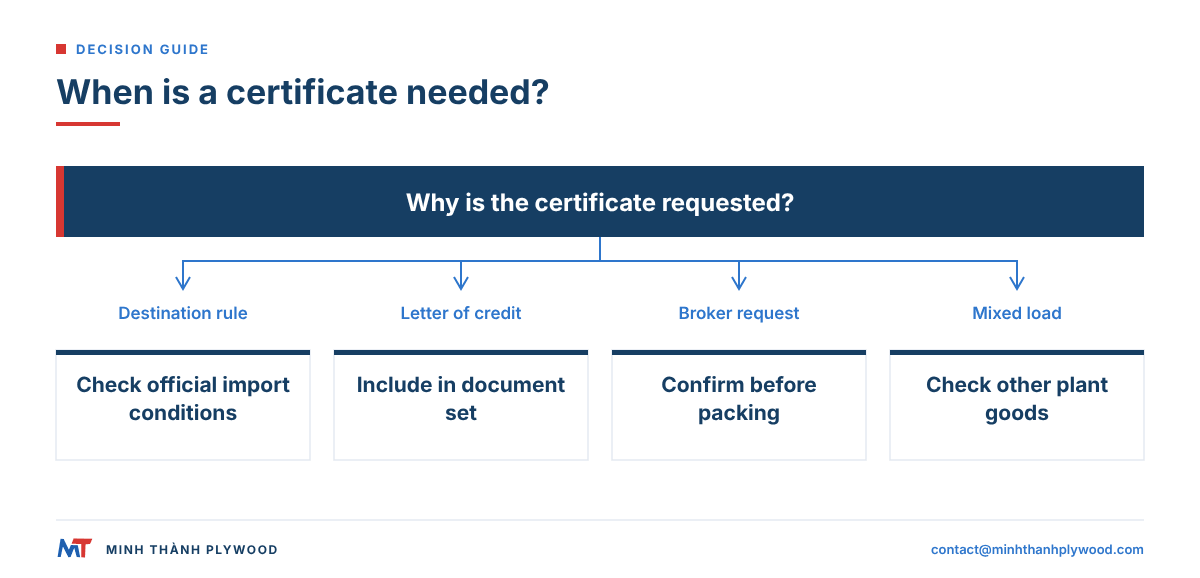
Importers ask for a phytosanitary certificate for plywood in four situations:
- The destination lists it. The importing country’s plant-health rules name plywood, HS 4412, or wood products in general as needing a certificate.
- The letter of credit lists it. The buyer’s bank wrote “phytosanitary certificate” into the documents required, and the bank will refuse a set without it, whatever the plant-health rule says.
- The customs broker asks for it. A broker who cannot confirm the rule quickly may ask for a certificate to avoid a query at the port.
- The load mixes products. A container that carries plywood together with sawn timber, logs or other plant products may need a certificate for those other goods.
The first case is a legal requirement. The other three are commercial habits, and they are easy to meet when the exporter knows about them before the goods are packed.
Which countries require a phytosanitary certificate for plywood?
No country list is fixed: each importing country publishes its own conditions and changes them over time. The table shows where an importer finds the official rule for plywood in markets buyers often ask about, and what we know of the rule.
| Destination | Official source of the rule | What it says about plywood |
|---|---|---|
| Australia | BICON, the biosecurity import conditions database of the Department of Agriculture, Fisheries and Forestry | Plywood, LVL and veneer sheets are on the table of wooden products needing minimal biosecurity intervention |
| New Zealand | Import health standards of the Ministry for Primary Industries | Check the standard for processed wood products |
| United Arab Emirates | Ministry of Climate Change and Environment | Check the current import conditions for wood products |
| Oman | Ministry of Agriculture, Fisheries and Water Resources | Check the current import conditions for wood products |
| Morocco | ONSSA, the national food safety office | Check the current import conditions for processed wood |
| Mexico | SENASICA, under the agriculture ministry | Check the phytosanitary requirements module for HS 4412 |
| United Kingdom (Great Britain) | Forestry Commission plant health service, and Annex XI Part A of Regulation 2019/2072 as it applies in Great Britain | Plywood (HS 4412) is not on the Annex XI Part A list of wood needing a certificate; veneer sheets (HS 4408) of some species are. Regulated wood follows the procedure in the next section |
| European Union | Implementing Regulation (EU) 2019/2072, Annex XI Part A, applied by each member state’s plant protection office | Plywood (HS 4412) is not among the wood listed in Annex XI Part A (logs, chips, sawn wood, veneer sheets, packing cases, casks, prefabricated buildings); check the current consolidated text on EUR-Lex. The EU Deforestation Regulation covers HS 4412 separately |
| Any destination | The letter of credit and the buyer’s purchase order | A certificate listed there is required, whatever the plant-health rule says |
The rule of thumb works in most markets: plywood traded as panels is treated as low risk. Read the official source for your country and HS code before the order, and write the answer into the purchase order so the exporter prepares the right set.
What does Great Britain require for wood that needs a certificate?
Great Britain requires a phytosanitary certificate only for the wood it regulates, and plywood is not on that list. Annex XI Part A of Regulation 2019/2072, as it applies in Great Britain, names the wood that “may not be introduced into Great Britain unless” it is accompanied by a phytosanitary certificate: logs and sawn wood (4403, 4407), veneer sheets of 6 mm or less (4408) of listed species, casks (4416) and prefabricated wooden buildings (9406), each for named origins. Plywood does not appear in that list (legislation.gov.uk, Annex XI, checked on 21 October 2026).
When a consignment does carry regulated wood, such as veneer sheets or solid timber shipped with the panels, the GOV.UK import guidance sets three steps (Import wood, wood products or bark, GOV.UK, updated 19 September 2025, checked on 21 October 2026):
- Register as a professional operator. The importer, its agent or broker first applies to the Forestry Commission.
- Give a notice of landing. At least one working day before the goods land for sea freight, and at least 4 working hours for air and roll-on roll-off freight.
- Present the original certificate. The original phytosanitary certificate goes to a Forestry Commission inspector within three days of the wood entering Great Britain.
Goods for Northern Ireland must meet both the GB rules and Northern Ireland’s own import rules. For a Minh Thanh plywood container to the UK, the usual set is the commercial invoice, packing list, bill of lading and certificate of origin, with no phytosanitary certificate unless the buyer or the bank asks for one. When one is asked for, we courier the original ahead of the vessel so the importer can show it inside that 3-day window.
How is a phytosanitary certificate issued in Vietnam?
In Vietnam, phytosanitary certificates are issued by the Plant Production and Protection Department of the Ministry of Agriculture and Environment, through its regional plant quarantine offices. For plywood leaving through Hai Phong, the exporter deals with the office that covers the northern ports. Applications go through Vietnam’s National Single Window, the online portal that links customs and the inspection agencies.
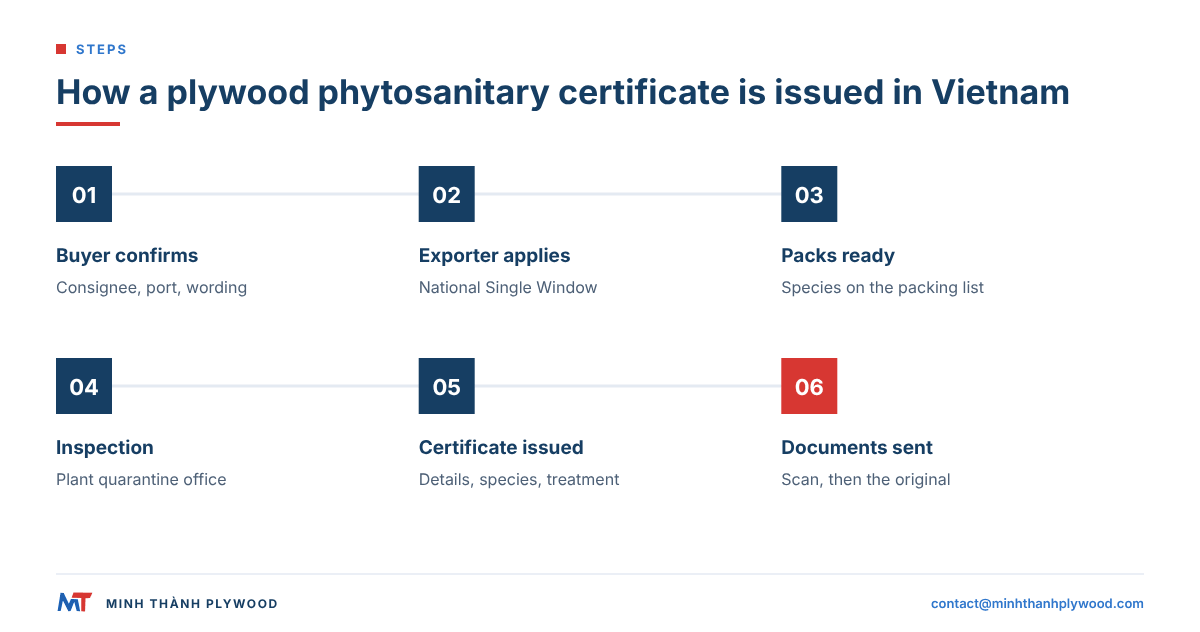
The process runs in six steps:
- The buyer confirms in the order that a certificate is required, and names the consignee and port of entry exactly as they must appear.
- The exporter applies through the National Single Window, with the commercial invoice, packing list and the booking or bill of lading details.
- The goods are made ready for inspection: packs finished, strapped and labelled, with the species of the panels stated on the packing list.
- The plant quarantine office inspects the consignment, usually at the factory or the port before or during loading.
- The certificate is issued, recording the consignment details, the botanical names and any treatment. Circular 33/2014/TT-BNNPTNT, article 10, gives the office 24 hours from the start of inspection to issue it when the goods meet the importing country’s requirements, or a written reason if testing takes longer (Circular 33/2014, checked on 21 October 2026). From application to certificate in hand, exporters usually plan 3–5 working days, depending on volume and on when the inspection can be booked.
- The exporter sends a scan with the shipping documents and the original by courier, or the electronic certificate where both countries exchange them.
Minh Thanh builds this into the order calendar. Production runs 15–45 days after the deposit; the application goes in while the last packs are finished, so the certificate follows the same timetable as the bill of lading.
What does a plywood phytosanitary certificate show?
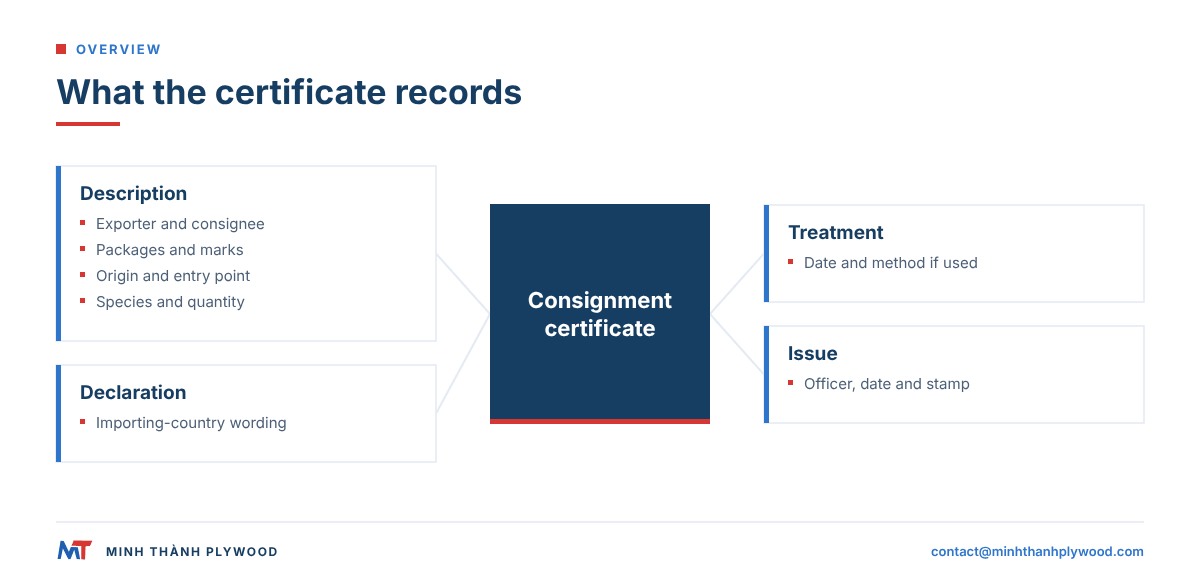
A plywood phytosanitary certificate shows three sections, in the layout of the IPPC model certificate in Annex 1 of ISPM 12.
Section I, description of consignment: name and address of the exporter; declared name and address of the consignee; number and description of packages (“18 packs of plywood”); distinguishing marks such as pack numbers; place of origin (Vietnam); declared means of conveyance (vessel and voyage); declared point of entry; name of produce and quantity declared (sheets and cubic metres); botanical name of plants. A certification statement follows, saying the goods were inspected and conform to the importing country’s requirements.
Section II, additional declaration: extra statements the importing country asks for, worded as its rules require.
Section III, disinfestation and disinfection treatment: date, treatment, chemical, duration and temperature, concentration. For plywood this section is often empty, because the panels need no treatment.
The certificate closes with the place of issue, the name of the authorised officer, the date and the stamp of the plant protection organisation.
Which botanical names go on the certificate?
The botanical names on a plywood phytosanitary certificate are the wood species in the panel, both face and core. A plywood panel is rarely one species, and the certificate should describe what is really in it.
For Minh Thanh furniture plywood the core is white Styrax or Eucalyptus as standard, with Acacia and Pine cores made on order. Faces include engineered veneer (EV), poplar, birch, okoume and pine, with bintangor, eucalyptus, gurjan and sapele on request. A poplar-faced panel on a Styrax core is therefore declared with both species.
The same species list feeds other documents. The certificate of origin, the importer’s own legality file and the packing list should all name the same species; a mismatch between them is one of the most common reasons a document set is queried.
How is a phytosanitary certificate different from an ISPM 15 stamp?
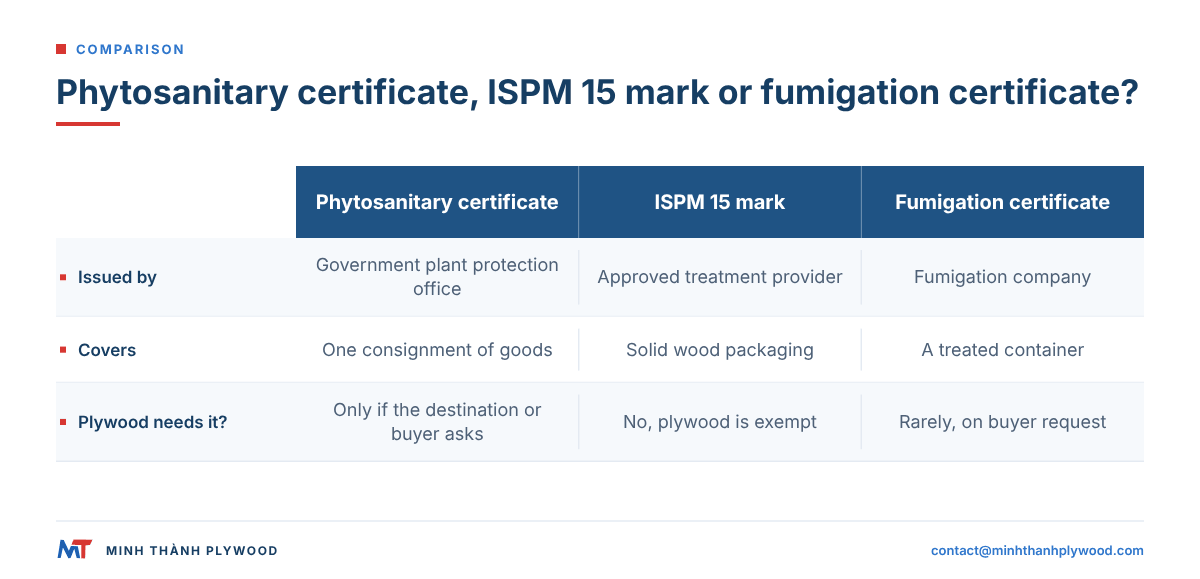
A phytosanitary certificate covers a consignment of goods; an ISPM 15 stamp covers a piece of solid wood packaging. ISPM 15 is the standard for pallets, crates and dunnage, and its own text says the mark “renders the use of a phytosanitary certificate unnecessary” for that packaging.
Plywood sits outside both in most cases. Plywood packaging is exempt from ISPM 15 because it is processed wood, and plywood goods are low-risk under ISPM 12 and ISPM 32. Only the solid wood bearers or dunnage under the packs need the stamp. The full exemption text and the stamp layout are in is plywood exempt from ISPM 15.
How is a phytosanitary certificate different from a fumigation certificate?
A fumigation certificate is a private record issued by the company that fumigated a container: the fumigant, the dose, the time and the temperature. A phytosanitary certificate is a government document issued by the plant protection office after inspection. When a consignment was fumigated, the treatment details can also be recorded in section III of the phytosanitary certificate.
Plywood seldom needs fumigation, since the hot press already did what fumigation would do. Some buyers still order it for their own reasons. Minh Thanh’s shipping documents include phytosanitary and fumigation certificates per shipment when the order calls for them; whether your port expects fumigation is covered in does plywood need fumigation.
How long is a phytosanitary certificate valid?
ISPM 12 lets the exporting country’s plant protection office set how long a phytosanitary certificate stays valid before export. The office weighs the packaging, the storage, the commodity and the season. A certificate whose validity runs out before loading cannot be used for that export.
The practical answer is timing: apply when the packs are finished and booked, not weeks ahead. A certificate issued close to loading also carries the right vessel name, which saves a replacement certificate if the booking changes.
Which documents travel with a plywood phytosanitary certificate?
A plywood phytosanitary certificate travels with the standard set of export documents, and its details must match them line by line. Minh Thanh prepares, per shipment:
- commercial invoice;
- packing list, with species, pack numbers, sheets and cubic metres;
- bill of lading;
- certificate of origin (EUR.1 for the European Union);
- phytosanitary and fumigation certificates, where the destination or buyer requires them;
- insurance certificate when the sale is CIF.
Consignee name, pack count, quantity and port must read the same on all of them. Our guide to the plywood HS code 4412 explains how the product description is chosen so that the invoice and the certificate agree.
What causes problems with a plywood phytosanitary certificate?
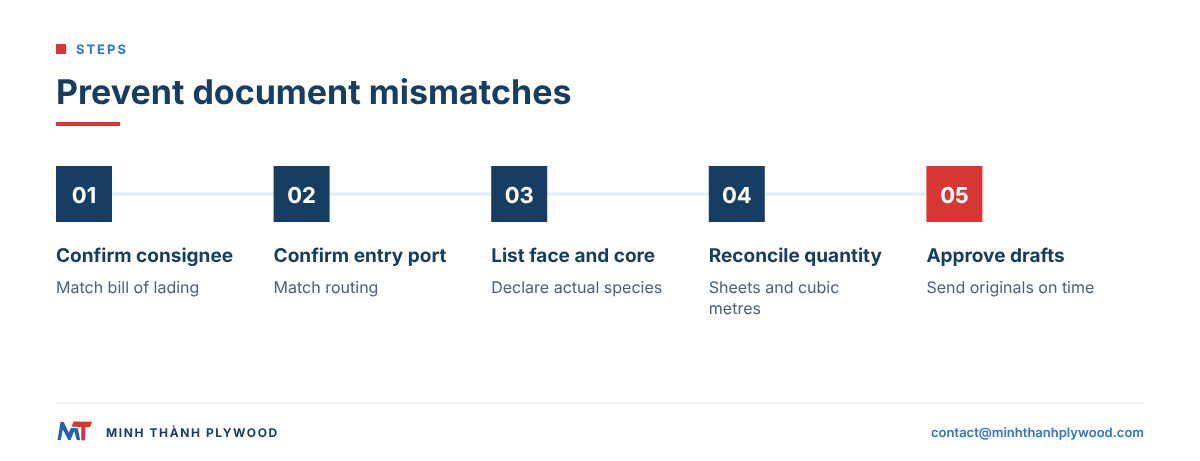
Most problems with a plywood phytosanitary certificate are mismatches, not plant-health findings. The five that come up most:
- Consignee mismatch. The certificate names the buyer, but the bill of lading names a forwarder or a bank.
- Wrong port of entry. The vessel discharges at a different port from the one declared.
- Missing species. Only the face species is declared, not the core.
- Quantity mismatch. Sheets on the certificate, cubic metres on the invoice, with no conversion.
- Late certificate. The original arrives after the vessel, and the bank or the port will not release without it.
Each one is avoided at the order stage: write the consignee, port and species into the purchase order, and ask for a draft of the document set after the goods are packed. Minh Thanh sends draft shipping documents for the buyer to approve before the originals are issued.
How does a phytosanitary certificate affect the order timeline?
A phytosanitary certificate adds no production time, and only a short inspection step before loading. The order timeline for a 40HC from Minh Thanh runs like this: deposit of 30%, production of 15–45 days, inspection and loading, then the vessel. The 70% balance is paid against the scanned bill of lading, or by an irrevocable letter of credit at sight.
From Hai Phong, typical days at sea are 15–25 to the Middle East and 25–35 to the Mediterranean; Japan and Korea take about 2–3 weeks. The original certificate goes by courier with the other originals, which arrive well before most vessels.
What should you send to get the certificate right first time?
Send four lines with your order, and the certificate is prepared without queries:
- Is a phytosanitary certificate required? Yes or no, and whether it is for the destination’s rules or for a letter of credit.
- Consignee and notify party, exactly as on the bill of lading.
- Port of discharge and final destination.
- Any additional declaration the importing country asks for, in its required wording.
Add the panel specification: application, core, glue and emission class, face and grade, size and thickness, packing and quantity. Send it to Minh Thanh for a quote on packing plywood or furniture panels; samples are free, and replies come within hours. For the duty side of the same shipment, read the guide to import duty on plywood from Vietnam.
Buyer questions, answered
Does plywood need a phytosanitary certificate?
Usually not. Plywood is processed with glue, heat and pressure, and the plant-health standards say importing countries should not require certificates for products processed to the point that they cannot carry pests. The importing country still decides, so check its import conditions.
Who issues a plywood phytosanitary certificate in Vietnam?
The Plant Production and Protection Department under Vietnam's Ministry of Agriculture and Environment, through its regional plant quarantine offices. The exporter applies through the National Single Window, the goods are inspected, and the office issues the certificate.
Which countries require a phytosanitary certificate for plywood?
Each importing country sets its own list, and most treat plywood as low risk. Some destinations, and some buyers' banks or letters of credit, still ask for a certificate. Read the importing country's official conditions for HS 4412 before the order is placed.
Is a phytosanitary certificate the same as an ISPM 15 stamp?
No. The ISPM 15 stamp is burned or printed on solid wood packaging such as pallets and dunnage. A phytosanitary certificate is a paper or electronic document for the consignment of goods. Plywood packaging needs neither.
Is a fumigation certificate the same as a phytosanitary certificate?
No. A fumigation certificate is issued by the company that fumigated the container and records the treatment. A phytosanitary certificate is issued by the government plant protection office; if a treatment was done, it can be recorded in section III of the certificate.
How long does a phytosanitary certificate stay valid?
ISPM 12 lets the exporting country's plant protection office set a period of validity before export. Apply when the goods are packed and ready, so the certificate is issued close to loading.
What does a phytosanitary certificate for plywood show?
The exporter and consignee, the number and description of packages, the marks on them, the place of origin, the vessel, the port of entry, the product and quantity, the botanical names of the wood species, any additional declaration and any treatment.
What botanical names go on a plywood phytosanitary certificate?
The species of the wood in the panel, face and core. For a poplar-faced panel on a Styrax core the certificate names both, so ask the exporter to list every species in the build.
Does Minh Thanh provide phytosanitary certificates?
Yes. Phytosanitary and fumigation certificates are part of the shipping documents we prepare when a destination or a buyer asks for them, together with the commercial invoice, packing list, bill of lading and certificate of origin.
Does plywood need a phytosanitary certificate for the UK?
Usually not. Plywood (HS 4412) is not on the Great Britain list of wood that needs a certificate. Regulated wood, such as some veneer sheets, needs a professional operator registration with the Forestry Commission, a notice of landing at least one working day before arrival by sea, and the original certificate shown to an inspector within three days.
How long does Vietnam take to issue a phytosanitary certificate?
The plant quarantine office must issue it within 24 hours of starting the inspection when the goods meet the importing country's rules. From application to certificate in hand, plan 3 to 5 working days.
Can a missing phytosanitary certificate hold a plywood container?
Yes, if the importing country or the letter of credit requires one. The container can wait at the port until a certificate arrives, so settle the question before the order is confirmed.