
Larch wood is the timber of the Larix genus: a resinous, deciduous conifer that is botanically a softwood but harder and heavier than pine or spruce. Its heartwood weathers well, so larch timber is the classic choice for cladding, decking, fencing and boat planking. Minh Thanh Plywood explains how European and Siberian larch differ and where plywood is the better buy.
What is larch wood?
Larch wood is timber from trees of the genus Larix, conifers that drop their needles every autumn. It has a pale sapwood band and a reddish-brown to orange heartwood, a resinous smell and distinct growth rings. The heartwood is the valuable part: it is dense, hard for a softwood and resists decay well enough for cladding and decking.
Larch grows across the cool northern belt:
- European larch (Larix decidua): the Alps and Central Europe, planted widely in the UK and Scandinavia.
- Siberian larch (Larix sibirica and Larix gmelinii, also called Dahurian larch): Russia and Siberia, the main source of imported larch boards in Europe.
- Japanese larch (Larix kaempferi): planted in Japan, Britain and Ireland, often crossed with European larch as hybrid or Dunkeld larch.
- Western larch (Larix occidentalis): the Pacific Northwest of North America, sold with Douglas fir as “Doug fir–larch”.
- Tamarack (Larix laricina): eastern North America.
Three things set larch timber apart from pine and spruce in the yard: a deeper colour, a higher weight per board and a natural durability that lets builders leave it untreated outside.
Is larch a hardwood or softwood?
Larch is a softwood. Botany, not hardness, sets the label: larch is a gymnosperm, a conifer with needles and cones, so it belongs with pine, spruce and fir in the softwood group. Hardwoods are broadleaved flowering trees such as oak, birch and poplar.
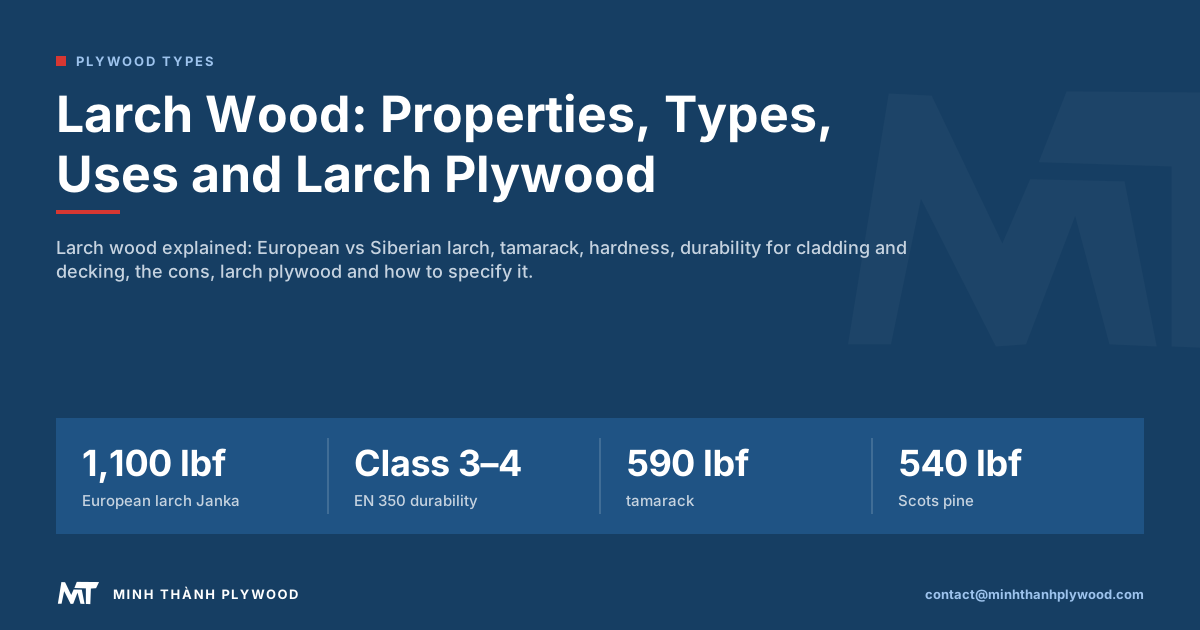
The confusion is natural, because larch behaves like a medium hardwood. European larch scores about 1,100 lbf on the Janka hardness test, close to black cherry at 950 lbf and well above yellow poplar at 540 lbf. It is also one of the few conifers that is deciduous: its needles turn gold and fall each year, which makes people think of it as a broadleaved tree.
For buying and trade, larch is sold as softwood lumber, graded under softwood rules, and imported under the softwood timber headings.
European vs Siberian larch: what is the difference?
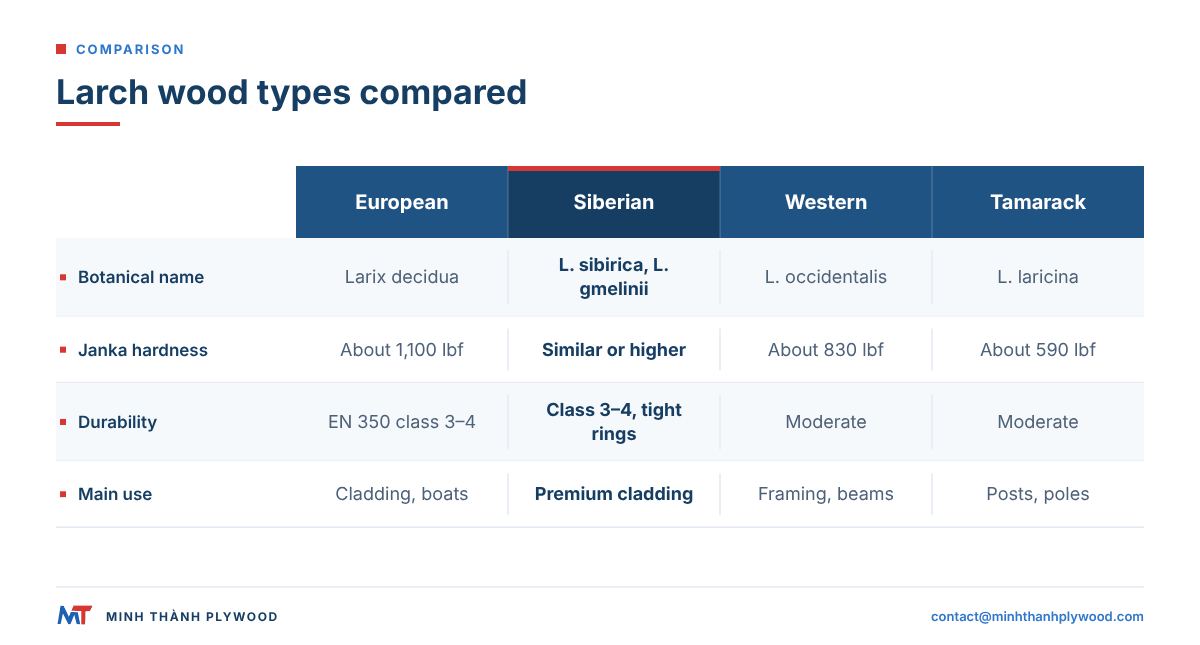
Siberian larch grows slowly in a short, cold season, so it has narrow growth rings, a higher share of heartwood and slightly higher density than European larch. European larch from plantations grows faster, with wider rings and more sapwood. For cladding, buyers pay more for Siberian larch because tight rings and more heartwood mean fewer knots, less movement and longer life.
| Larch | Botanical name | Main source | Janka hardness | Heartwood durability | Typical use |
|---|---|---|---|---|---|
| European larch | Larix decidua | Alps, Central Europe, UK plantations | About 1,100 lbf | Moderate to slight (EN 350 class 3–4) | Cladding, boats, fencing, beams |
| Siberian larch | Larix sibirica, L. gmelinii | Russia, Siberia | Similar to or above European | Moderate to slight (class 3–4), tighter rings | Premium cladding, decking, plywood |
| Japanese and hybrid larch | L. kaempferi, L. × marschlinsii | Japan, UK, Ireland | Close to European | Moderate to slight, faster grown | Fencing, construction, cladding |
| Western larch | Larix occidentalis | US and Canadian Pacific Northwest | About 830 lbf | Moderate | Framing, beams, flooring, poles |
| Tamarack | Larix laricina | Canada, northern US | About 590 lbf | Moderate | Posts, poles, pallets, pulp |
Two buying notes follow from the table. First, “Siberian larch” is a trade name for slow-grown Russian larch and may cover two species; ask for the growth-ring count and the heartwood share you need. Second, plantation larch of any species is softer and has more sapwood than old, slow-grown stock, so grade matters more than origin.
What is tamarack lumber?
Tamarack lumber is sawn timber from Larix laricina, the eastern larch of Canada and the northern United States, also called hackmatack or American larch. It is the lightest and softest of the commercial larches, at about 590 lbf Janka and a specific gravity of about 0.53 at 12 % moisture content according to the USDA Wood Handbook.
Tamarack trees grow in bogs and cold wetlands, rarely reach large diameters and carry many knots, so the lumber comes in short, narrow sizes. It is used for:
- posts, poles and fence rails, where its decay resistance helps;
- rough framing and pallets in local markets;
- pulp, and traditionally boat knees cut from the curved root flare.
Tamarack is rarely exported as finished board. A buyer who searches for tamarack lumber outside North America usually needs Siberian or European larch instead.
What are the properties of larch?
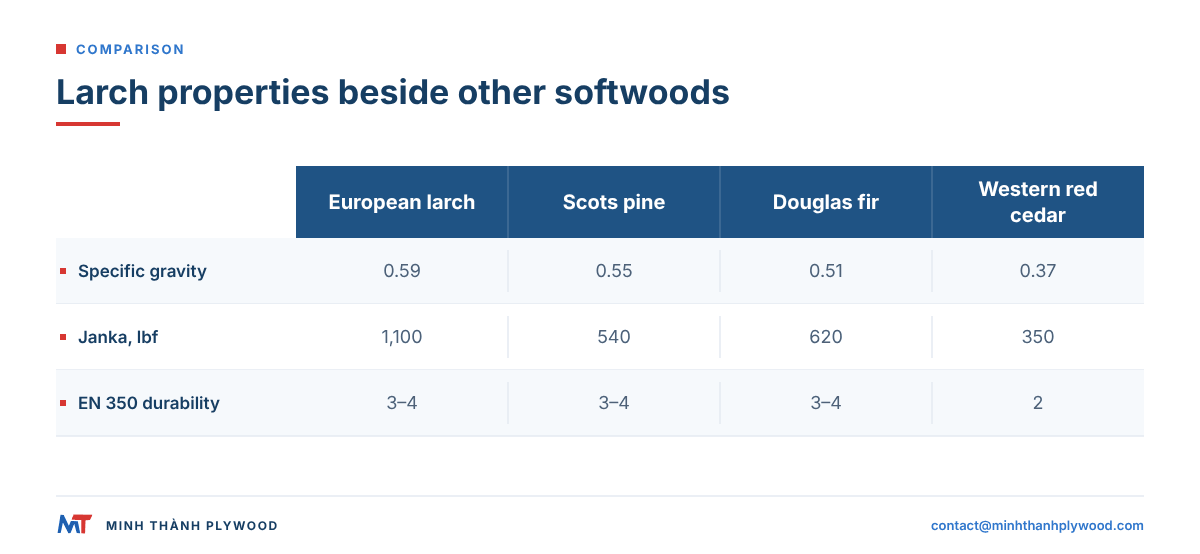
The properties of larch that matter to a buyer are high density for a softwood, good bending strength, natural decay resistance in the heartwood, a high resin content and medium movement. The figures below are for air-dried timber at about 12 % moisture content.
| Property | European larch | Scots pine | Douglas fir | Western red cedar |
|---|---|---|---|---|
| Specific gravity at 12 % MC | About 0.59 | About 0.55 | About 0.51 | About 0.37 |
| Janka hardness | About 1,100 lbf | About 540 lbf | About 620 lbf | About 350 lbf |
| Heartwood durability (EN 350) | Class 3–4 | Class 3–4 | Class 3–4 | Class 2 |
| Resin | High, with resin pockets | Medium | Medium | Low |
| Weathered colour | Silver-grey | Grey, can stain | Grey | Silver-grey |
What these numbers mean on site:
- Hardness: larch decking dents less under furniture and heels than pine or cedar decking.
- Strength: larch beams and joists carry loads comparable to Douglas fir and are graded to the same strength classes in Europe.
- Durability: heartwood larch outlasts untreated pine above ground; it does not match cedar or tropical hardwoods in ground contact.
- Gum content: larch contains arabinogalactan, a water-soluble gum that can slow the setting of cement and some glues. Plywood and wood-cement board makers adjust the glue mix and press settings for larch for this reason.
Is larch wood long lasting outdoors?
Yes, larch heartwood is long lasting above ground. European standard EN 350 rates larch heartwood as moderately to slightly durable (classes 3–4) against decay fungi. In practice, heartwood cladding fixed with a ventilated cavity, sheltered ends and stainless steel fixings commonly lasts several decades without treatment.
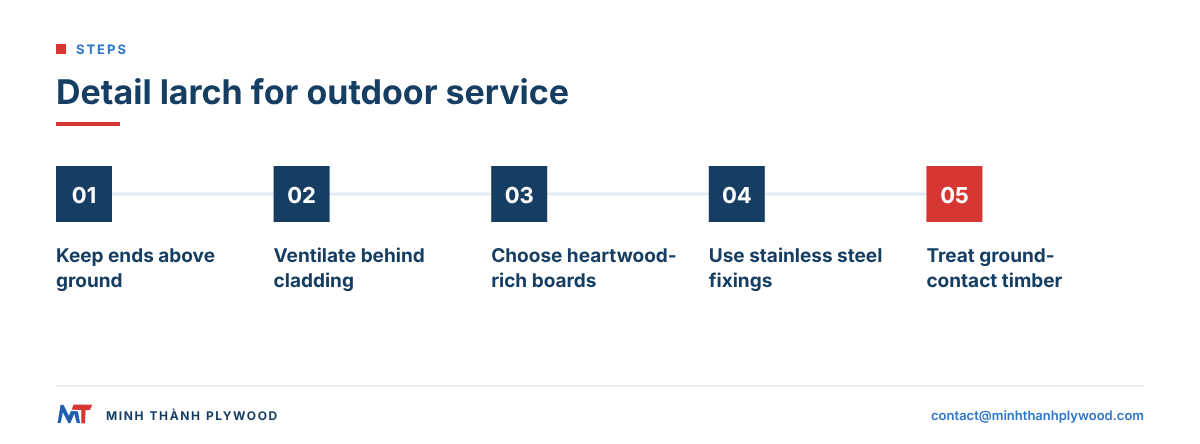
Service life depends more on detailing than on species:
- Keep end grain off the ground and away from standing water.
- Ventilate the back of cladding with a cavity so boards dry after rain.
- Use heartwood-rich boards; sapwood has no natural durability.
- Fix with stainless steel screws or nails; larch extractives darken around plain steel.
- Treat or replace where boards sit in ground contact, such as fence posts.
Left uncoated, larch turns silver-grey within a year or two in sun and rain. Owners who want to keep the orange-brown colour use a pigmented, oil-based exterior finish and recoat it every few years.
How much does larch cost, how long does it last and where do you buy it?
Larch costs more than pine and spruce but less than western red cedar, and well-detailed larch cladding commonly lasts 50 years or more. In the UK, Duffield Timber priced Siberian larch V-groove cladding at about £70 per square metre plus VAT against £80.80 plus VAT for western red cedar (Duffield Timber guide, checked on 21 October 2026). Our larch wood price guide breaks the price down by grade and origin.
- Lifespan: with the right installation, treatment and maintenance, Siberian larch can last over 50 years, with up to 100 years claimed by the same supplier.
- Sustainability: Larch, mainly Siberian and Dahurian larch, covers over a third of Russia’s forest area, and Siberian larch is rated Least Concern on the IUCN Red List, so the species itself is abundant.
- Origin papers: the EU has banned imports of goods from Russia that fall in Chapter 44 of its tariff, wood included, since April 2022 under Article 3i of Regulation (EU) No 833/2014, inserted by Regulation (EU) 2022/576, and other markets restrict Russian timber too. For any larch timber or plywood placed on the EU market, the importer also needs origin data under Regulation (EU) 2023/1115, which covers wood. A buyer should ask for origin documents and check the rules for the destination port before ordering Siberian larch.
- Where to buy in the US: western larch, sold as tamarack or Doug fir-larch, comes from regional mills in Oregon, Washington and Montana, through yards such as Blasen & Blasen Lumber in Portland and Carl Diebold Lumber in Troutdale (Oregon Forest Directory). Nova Tree Co. sells tamarack decking in 4 in and 6 in widths (Nova Tree). Siberian larch cladding comes through specialist importers, so ask for the origin papers first.
- Where to buy in the UK: Duffield Timber stocks Siberian larch sawn timber, cladding, fencing and decking.
If larch cladding is only a look, a pine-faced plywood panel can give a similar softwood face at a steadier price; the section on plywood below compares the options.
What is larch timber used for?
Larch timber is used where wood must stay outdoors or carry wear: cladding, decking, fencing, boat building and heavy construction. The main uses:
- Exterior cladding: the largest use in Europe, as shiplap, feather-edge, open-joint rainscreen and board-on-board, often untreated.
- Decking and boardwalks: harder than pine and cheaper than tropical hardwoods.
- Fencing, gates and garden buildings: posts need treatment where they enter the ground.
- Boat building: traditional planking on oak frames for fishing boats in Scotland and Scandinavia.
- Beams, joists and glulam: western larch and Siberian larch are sold as structural timber.
- Flooring and interior panelling: prized for the warm colour and visible grain.
- Poles, piles and mine timbers: historic uses that depend on strength and decay resistance.
- Larch plywood: construction sheathing, formwork and truck and trailer floors.
For furniture, solid larch appears in rustic and Alpine pieces. Most furniture plants that want a softwood look buy pine-faced plywood instead, because it stays flat and costs less per finished panel.
What are the cons of larch wood?
The cons of larch wood are splitting, resin, knots, movement and cost relative to pine. None rules it out; each needs a step in fixing or finishing.
- Splitting: larch is dense and brittle near board ends. Pre-drill nail and screw holes within about two board-widths of an end.
- Resin pockets and bleed: resin can weep from knots and pockets in hot sun, and can soften some paints.
- Knots: dead knots can loosen as the board dries; specify a clear or small-knot grade for joinery.
- Movement and distortion: larch moves more than cedar and can cup or twist if fixed wet; buy kiln-dried or well air-dried boards.
- Tool wear and gum: resin clogs saw teeth and sandpaper.
- Weight: a larch board weighs noticeably more than the same board in spruce or cedar.
- Price: larch costs more than pine and spruce, and Siberian larch costs more than European larch.
- Ground contact: natural durability is not enough for posts in soil without treatment.
How do you fix, glue and finish larch?
Larch is fixed with stainless steel, glued after wiping resin from the surface, and finished with oil-based or water-repellent stains rather than film-forming paints.
- Fixings: A2 or A4 stainless steel screws or ring-shank nails; galvanised fixings are a budget option, plain steel stains.
- Pre-drilling: near board ends and for hardwood-type screws.
- Gluing: wipe joint surfaces with a solvent to lift resin, then glue promptly with an exterior-rated adhesive.
- Finishing: penetrating oils and pigmented stains work best; film paints can blister over resin pockets.
- Indoors: larch sands to a smooth surface and takes clear oils and lacquers well once resin is controlled.
What is larch plywood?
Larch plywood is plywood with veneers peeled from larch logs, either all-larch or larch faces over a mixed softwood core, bonded with phenolic or melamine glue. It is made mainly in Russia and Siberia and sold as construction plywood, formwork and flooring for trucks and containers.
Compared with spruce or pine construction plywood, larch plywood is heavier, harder on the face and more decay resistant, and its reddish face is darker. The gum in larch slows some glue cures, so mills tune press time and glue mix.
Larch plywood or another plywood: what fits your order?
Larch plywood is a niche product with a narrow supply base. For most uses, another plywood gives the same result with steadier supply:
| Need | Larch plywood | Alternative from a Vietnamese mill |
|---|---|---|
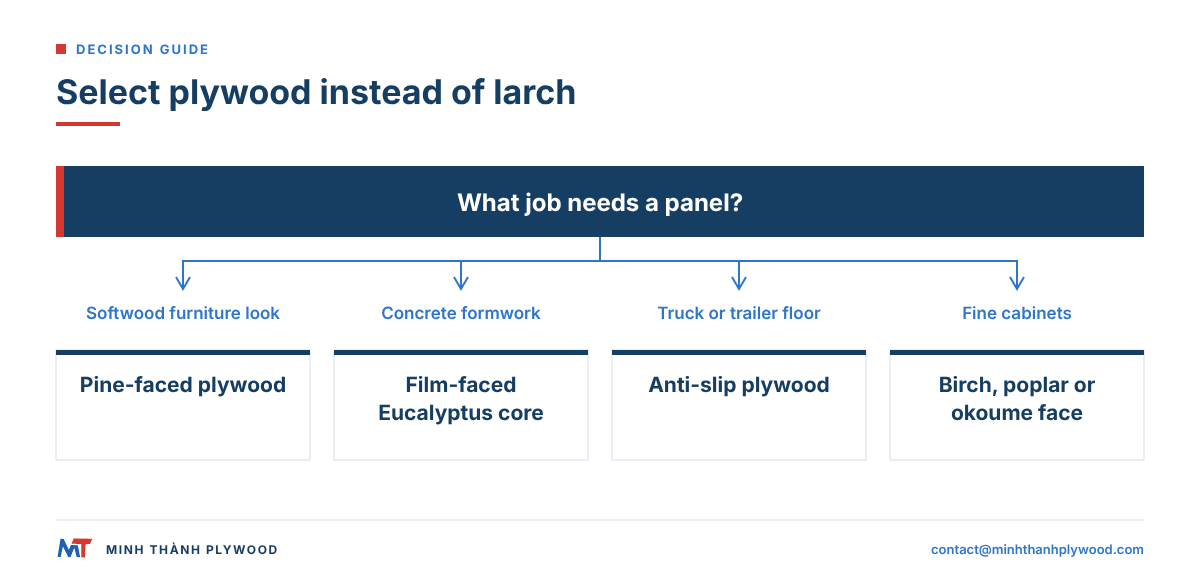
| Softwood look for furniture or interiors | Reddish, knotty face | Pine-faced plywood, A/A to B/B faces |
| Exterior sheathing and stair treads | Larch with phenolic glue | Exterior/CDX-type plywood with melamine-fortified or phenolic (WBP) glue |
| Concrete formwork | Larch formwork plywood | Film-faced plywood on a Eucalyptus core |
| Truck, trailer and container floors | Larch flooring plywood | Anti-slip plywood, accepted on order |
| Fine furniture, cabinets, UV coating | Rarely used | Birch, poplar or okoume faces on a Styrax core |
Minh Thanh does not make larch plywood. The factory makes plywood on white Styrax or Eucalyptus cores with 10+ face veneers, including pine for a softwood look. Construction panels are bonded with melamine-fortified or phenolic (WBP) glue to the customer’s specification; furniture panels use UF glue at E0 emission and are pressed twice, core first, then faces.
How do you specify plywood in place of larch?
Send the use first, then six lines, and the mill can quote the right panel instead of a larch look-alike:
- Application: cladding backing, sheathing, stair treads, formwork, furniture.
- Core: white Styrax for light, flat furniture panels; Eucalyptus for harder, heavier construction panels.
- Glue: UF at E0 emission for interiors; melamine-fortified or phenolic for damp and exterior use.
- Face and back: pine A/B for a softwood look, or film, anti-slip, birch, poplar or okoume.
- Size and thickness: 1220 × 2440 mm or 1250 × 2500 mm, 3–40 mm, sanded to ±0.2–0.3 mm on furniture panels.
- Packing and quantity: sheets per pack, total sheets or m³, destination port.
Minh Thanh Plywood ships from Ha Hoa, Phu Tho, Vietnam: MOQ one 40HC, 15–45 days after the 30% deposit, FOB Hai Phong, CFR or CIF, free samples. Commercial plywood starts from US$250/m³ and furniture plywood from US$350/m³ (October 2026). Send your specification to contact@minhthanhplywood.com or browse Minh Thanh plywood products.
Buyer questions, answered
Is larch a hardwood or softwood?
Larch is a softwood. It is a conifer with needles and cones, so it is classed with pine and spruce, even though its heartwood is harder than many hardwoods such as poplar.
What is larch wood used for?
Larch is used for exterior cladding, decking, fencing, garden structures, boat planking, flooring, beams and posts. Its plywood is used in construction, formwork and transport floors.
Is larch wood long lasting outdoors?
Larch heartwood is rated moderately to slightly durable (classes 3–4 under EN 350). Untreated cladding that sheds water and dries quickly commonly lasts decades; ground contact needs treatment or a more durable species.
Is larch better than pine?
For exterior cladding and decking, yes: larch is harder, denser and more decay resistant than Scots pine. Pine is cheaper, lighter, easier to machine and takes preservative treatment better.
What is the difference between Siberian and European larch?
Siberian larch grows slowly in a cold climate, so it has narrow growth rings, more heartwood and slightly higher density. European larch from plantations grows faster, with wider rings and more sapwood.
What is tamarack lumber?
Tamarack is the North American eastern larch, Larix laricina. Its lumber is lighter and softer than western larch and is used for posts, poles, rough framing, pallets and pulp.
Does larch need treating?
Heartwood cladding and decking are often left untreated to weather silver-grey. Sapwood-rich boards, ground contact and structural posts need preservative treatment or a more durable species.
What are the cons of larch wood?
Larch splits near ends if nailed without pre-drilling, carries resin pockets and knots, moves more than cedar as it dries, and its resin and gum can slow some coatings and glues.
What is larch plywood?
Larch plywood is cross-laminated plywood with larch veneers, mostly made in Russia and Siberia. It is heavier and harder than spruce plywood and is used for construction, formwork and floors.
Does Minh Thanh make larch plywood?
No. Minh Thanh makes plywood on white Styrax or Eucalyptus cores with 10+ face veneers, including pine for a softwood look and phenolic or melamine-fortified bonds for exterior and construction use.