
Hardwood is timber from broadleaved flowering trees. The main types of hardwood fall into five groups: temperate (oak, maple, ash, walnut, cherry, beech, birch), tropical (teak, mahogany, sapele, meranti), exotic (purpleheart, wenge, padauk), Australian (jarrah, spotted gum) and Asian plantation species (eucalyptus, acacia, rubberwood). Minh Thanh Plywood lists each with hardness, uses and the legal checks that come with it.
What is hardwood?
Hardwood is wood from angiosperms: broadleaved, flowering trees whose seeds grow inside a fruit or nut, such as oak, maple, teak and eucalyptus. Softwood comes from gymnosperms: conifers with needles and cones, such as pine, spruce, fir and larch. The split is botanical, so it says nothing certain about how hard a board is.
Under a hand lens the two look different. Hardwoods have vessels, the pores you see on an oak or ash end grain, that carry water up the tree. Softwoods have no vessels; water moves through tracheids, so their end grain looks uniform. This structure is why hardwoods show more varied figure and colour, and why the hardwood family covers species from feather-light balsa to iron-hard ipe.
There are tens of thousands of hardwood tree species, against a few hundred conifers, but only a few hundred are traded as timber. This guide covers the hardwood timbers buyers meet most in furniture, flooring, joinery and plywood.
Is hardwood always harder than softwood?
No, hardwood is not always harder than softwood. Most hardwoods are denser than most softwoods, but the ranges overlap widely. Balsa, a hardwood, scores under 100 lbf on the Janka hardness test, while yew, a softwood, scores about 1,520 lbf and larch about 1,100 lbf.
The Janka test measures the force needed to press a steel ball of 0.444 inch diameter halfway into the wood. It is the common yardstick for flooring and furniture hardness, and every hardness figure in this guide uses it. Figures come from The Wood Database and the USDA Wood Handbook (read 21 October 2026) and are rounded; the same species varies by tree and moisture.
| Wood | Group | Janka hardness |
|---|---|---|
| Balsa | Hardwood | Under 100 lbf |
| Basswood (linden) | Hardwood | About 410 lbf |
| Yellow poplar | Hardwood | About 540 lbf |
| Scots pine | Softwood | About 540 lbf |
| Larch (European) | Softwood | About 1,100 lbf |
| Red oak | Hardwood | About 1,290 lbf |
| Yew (European) | Softwood | About 1,520 lbf |
| Ipe | Hardwood | About 3,500 lbf |
How are types of hardwood grouped?
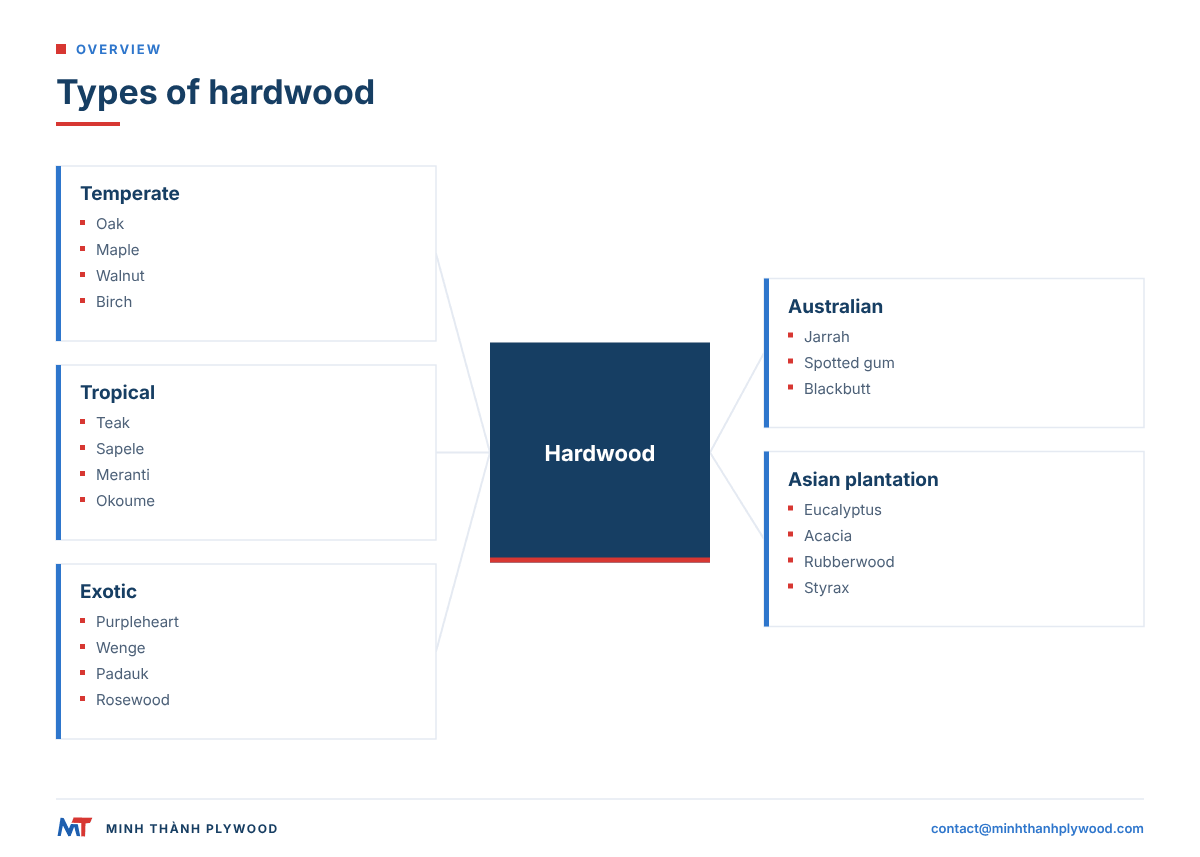
Buyers group types of hardwood by where they grow, because origin sets the supply, the price band and the legal paperwork. Five groups cover the trade:
- Temperate hardwoods from Europe, North America and North Asia: oak, maple, ash, walnut, cherry, beech, birch, poplar, alder.
- Tropical hardwoods from Africa, Southeast Asia and South America: teak, mahogany, sapele, iroko, meranti, okoume, keruing.
- Exotic woods: tropical species with striking colour, figure or density, sold in small volumes: purpleheart, wenge, padauk, zebrawood, bubinga, rosewood.
- Australian hardwoods: mostly eucalypts: jarrah, spotted gum, blackbutt, Tasmanian oak.
- Asian plantation hardwoods: fast-grown eucalyptus, acacia, rubberwood, poplar and Styrax, the base of most Asian plywood and furniture production.
A second split, by grain, matters for finishing. Ring-porous woods (oak, ash, hickory, elm) have large pores in the early wood and show strong grain. Diffuse-porous woods (maple, birch, cherry, beech, poplar) have even pores and a smooth, uniform surface that takes paint and UV coating well.
Examples of hardwood from Europe and North America
Temperate hardwoods are the examples of hardwood most furniture buyers know. They grow slowly in seasonal climates, come from managed forests and are traded under graded rules such as the NHLA grades in North America (see the grading section below).
| Hardwood | Botanical name | Janka hardness | Colour and grain | Main uses |
|---|---|---|---|---|
| White oak | Quercus alba | About 1,350 lbf | Light brown, ring-porous, rays | Flooring, barrels, outdoor joinery |
| Red oak | Quercus rubra | About 1,290 lbf | Pinkish brown, open grain | Flooring, cabinets, furniture |
| European oak | Quercus robur, Q. petraea | About 1,120 lbf | Golden brown, figured rays | Furniture, flooring, beams |
| Hard maple | Acer saccharum | About 1,450 lbf | Creamy white, fine | Butcher blocks, floors, sports |
| European beech | Fagus sylvatica | About 1,450 lbf | Pale pink, flecked | Chairs, bent parts, tool handles |
| White ash | Fraxinus americana | About 1,320 lbf | Light, bold grain | Handles, bats, furniture |
| Black walnut | Juglans nigra | About 1,010 lbf | Chocolate brown | Fine furniture, veneer |
| Black cherry | Prunus serotina | About 950 lbf | Reddish, darkens with age | Cabinets, furniture |
| Hickory | Carya spp. | About 1,880 lbf | Light to brown, tough | Tool handles, flooring |
| Birch | Betula spp. | About 1,210–1,260 lbf | Pale, even | Plywood, furniture, flooring |
| Red alder | Alnus rubra | About 590 lbf | Light tan, even | Cabinets, paint-grade parts |
| Yellow poplar | Liriodendron tulipifera | About 540 lbf | Greenish cream | Paint-grade mouldings, cores |
| Basswood | Tilia spp. | About 410 lbf | White, very even | Carving, models, cores |
Birch and poplar are the two temperate hardwoods that matter most for plywood. Birch gives a hard, pale, even face for furniture and laser cutting. Poplar gives a light, smooth face for paint and lamination, and grows fast in plantations.
How is US hardwood lumber graded and sold?
US hardwood lumber is graded under National Hardwood Lumber Association (NHLA) rules by the share of clear wood a board yields in cuttings, and it is sold by thickness in quarters of an inch and by the board foot. Grade decides price more than species does, so a quote for oak or walnut should always name the grade.
| NHLA grade | Clear-cutting yield | What it means |
|---|---|---|
| FAS (First and Seconds) | About 83% on the better face | Boards 6 in and wider, 8 ft and longer; the top grade for furniture parts |
| FAS One Face (F1F) | FAS on the better face, Number 1 Common on the reverse | Priced between FAS and Selects |
| Selects | About 83% on the better face | Boards 4 in and wider, 6 ft and longer; reverse face Number 1 Common |
| Number 1 Common | About 67% to 83% | Shorter cuttings for cabinet doors, drawer parts and flooring |
| No. 2A Common | About 50% | Small cuttings; economy parts and flooring |
Thickness is quoted in quarters: 4/4 is a rough one-inch board, 5/4 is 1.25 inches and 8/4 is two inches, and the volume is counted in board feet. The NHLA grading rules are the reference for the US trade; see the NHLA hardwood species guide and a summary of the grades (checked on 21 October 2026). Plywood uses a different language: panels are graded by face and back pair, such as A/B or D+/D.
What is the most common hardwood?
Oak is the most common hardwood in the Western furniture and flooring trade, and red oak is the largest US hardwood lumber species by volume. In Europe, oak and beech lead. In Southeast Asia, the most common hardwoods by volume are plantation eucalyptus and acacia, which feed plywood, pallet and furniture plants.
Popularity follows supply and cost as much as looks. Red oak grows across the eastern United States in large volumes, which keeps it cheaper than white oak, walnut or cherry. Plantation eucalyptus in Vietnam is harvested on short rotations, which makes it the backbone of the country’s plywood cores.
Tropical hardwood timbers from Africa, Asia and South America
Tropical hardwoods are timber hardwoods from natural forests and plantations between the tropics. Many are large, straight trees that yield wide, clear boards and big veneer leaves, which is why tropical faces dominate marine, exterior and decorative plywood.
| Hardwood | Botanical name | Origin | Janka hardness | Notable property | Main uses |
|---|---|---|---|---|---|
| Teak | Tectona grandis | India, Myanmar, plantations worldwide | About 1,070 lbf | Oily, very durable, stable | Boat decks, outdoor furniture |
| Genuine mahogany | Swietenia macrophylla | Central and South America | About 800 lbf | Stable, ribbon figure | Fine furniture, boats; CITES Appendix II |
| Sapele | Entandrophragma cylindricum | West and Central Africa | About 1,410 lbf | Ribbon stripe | Doors, joinery, veneer |
| Iroko | Milicia excelsa | Tropical Africa | About 1,260 lbf | Durable, teak substitute | Outdoor furniture, worktops |
| Okoume | Aucoumea klaineana | Gabon, Congo | About 400 lbf | Light, even | Plywood faces, boat plywood |
| Meranti | Shorea spp. | Malaysia, Indonesia | Medium | Red to pink, coarse | Joinery, plywood (lauan) |
| Keruing / gurjan | Dipterocarpus spp. | South and Southeast Asia | Medium to high | Strong, resinous | Truck floors, plywood |
| Bintangor | Calophyllum spp. | Southeast Asia | Medium | Reddish, interlocked grain | Plywood faces |
| Ipe | Handroanthus spp. | South America | About 3,500 lbf | Extremely hard and durable | Decking, boardwalks |
Three of these are everyday plywood faces in Asian mills: okoume for light, smooth panels; bintangor for a reddish commercial face; and gurjan (keruing) for hard, strong panels.
What are exotic woods?
Exotic woods are hardwoods imported from outside the buyer’s own region, nearly always tropical, and chosen for unusual colour, figure or density rather than for volume. They are sold in small boards, turning blanks and veneers.
Common exotic woods and what sets them apart:
- Purpleheart (Peltogyne spp.): turns from brown to vivid purple after cutting; about 2,520 lbf Janka.
- Wenge (Millettia laurentii): near-black with fine light stripes; about 1,930 lbf.
- African padauk (Pterocarpus soyauxii): bright orange-red that darkens to brown.
- Zebrawood (Microberlinia spp.): bold black and cream stripes.
- Bubinga (Guibourtia spp.): pinkish red with figure; three species listed in CITES Appendix II.
- Rosewoods (Dalbergia spp.): dark, oily, fragrant; Brazilian rosewood is in CITES Appendix I and most other rosewoods in Appendix II.
- Ebony (Diospyros spp.): jet black and very dense; Madagascar ebonies are CITES listed.
- Lignum vitae (Guaiacum spp.): among the hardest and heaviest woods, above 4,000 lbf; CITES listed.
For furniture panels, the exotic look is usually bought as veneer or as engineered veneer (EV), which reproduces the colour and stripe of wenge, zebrawood or rosewood from fast-grown plantation logs.
Australian hardwoods
Australian hardwoods are mostly eucalypts, many of them very hard and naturally durable. They are used for decking, flooring, bridges, poles and outdoor structures.
- Jarrah (Eucalyptus marginata): deep red, about 1,910 lbf, durable; flooring, decking, furniture.
- Spotted gum (Corymbia maculata): hard, pale to dark brown, very tough; decking, structural timber.
- Blackbutt (Eucalyptus pilularis): pale golden, hard and fire resistant; flooring, cladding.
- Tasmanian oak: a trade name for three eucalypts (E. regnans, E. obliqua, E. delegatensis), light coloured; joinery, furniture, floors.
- Ironbark (Eucalyptus spp.): among the hardest and most durable, for poles, sleepers and bridges.
Asian plantation hardwoods: eucalyptus, acacia, rubberwood and Styrax
Asian plantation hardwoods are fast-grown species harvested on short rotations. They supply most of the hardwood used in Asian plywood, furniture and pallets, and they arrive with origin records from the plantation plot.
- Eucalyptus (Eucalyptus urophylla and hybrids): dense, strong; plywood cores, film-faced formwork, pallets and outdoor furniture.
- Acacia (Acacia mangium, A. auriculiformis): golden to brown, attractive grain; outdoor furniture, flooring, edge-glued panels.
- Rubberwood (Hevea brasiliensis): pale, about 960 lbf; furniture and kitchen tops from retired latex plantations.
- Poplar (Populus spp.): light, even; plywood cores and faces, mainly in China.
- Styrax (Styrax tonkinensis): a white, light hardwood from northern Vietnam; a stable, even core veneer for furniture plywood.
Minh Thanh’s factory in Ha Hoa, Phu Tho uses locally grown plantation timber for its cores: white Styrax for light, flat furniture panels and Eucalyptus for harder, heavier panels. Both are stitched horizontally and vertically, and furniture-grade panels are pressed twice, core first, then face and back.
More commercial hardwoods from A to Z
Beyond the headline species, buyers meet another thirty or so hardwoods in price lists and drawings. The list gives each with its botanical name, a hardness class (soft under about 800 lbf, medium to about 1,200 lbf, hard to about 2,000 lbf, very hard above that) and what it is bought for. Classes follow The Wood Database and the USDA Wood Handbook (read 21 October 2026).
| Hardwood | Botanical name | Hardness | Main uses |
|---|---|---|---|
| Afrormosia | Pericopsis elata | Hard | Joinery, boat decks; CITES Appendix II |
| Afzelia (doussie) | Afzelia spp. | Hard | Joinery, flooring, outdoor |
| Andiroba (carapa) | Carapa guianensis | Medium | Furniture, mahogany substitute |
| Ayan (movingui) | Distemonanthus benthamianus | Medium | Flooring, joinery |
| Ayous (obeche) | Triplochiton scleroxylon | Soft | Plywood cores, mouldings, drawer sides |
| Balau (bangkirai) | Shorea spp. | Very hard | Decking, heavy construction |
| Black locust | Robinia pseudoacacia | Hard | Fence posts, outdoor furniture |
| Bloodwood (satiné) | Brosimum rubescens | Very hard | Inlay, turning, veneer |
| Brown mallet | Eucalyptus astringens | Very hard | Tool handles, tannin bark |
| Chestnut | Castanea sativa | Soft | Furniture, beams, fencing |
| Cumaru | Dipteryx odorata | Very hard | Decking, flooring |
| Ebony, African | Diospyros crassiflora | Very hard | Instruments, inlay |
| Elm | Ulmus spp. | Medium | Furniture, chair seats |
| Garapa | Apuleia leiocarpa | Hard | Decking, flooring |
| Greenheart | Chlorocardium rodiei | Very hard | Marine piling, lock gates |
| Hornbeam | Carpinus betulus | Hard | Tool parts, chopping blocks |
| Idigbo | Terminalia ivorensis | Medium | Joinery, interior fittings |
| Jatoba | Hymenaea courbaril | Very hard | Flooring, stairs |
| Jelutong | Dyera costulata | Soft | Carving, pattern making |
| Kapur | Dryobalanops spp. | Hard | Structural joinery, flooring |
| Khaya (African mahogany) | Khaya ivorensis | Medium | Furniture, boats, joinery |
| Limba | Terminalia superba | Soft | Veneer, plywood, furniture |
| Massaranduba | Manilkara spp. | Very hard | Decking, bridges |
| Merbau | Intsia bijuga | Hard | Flooring, decking |
| Nyatoh | Palaquium spp. | Medium | Furniture, flooring |
| Osage orange | Maclura pomifera | Very hard | Fence posts, bows |
| Paulownia | Paulownia tomentosa | Soft | Light panels, plantation timber |
| Pecan | Carya illinoinensis | Hard | Flooring, tool handles |
| Ramin | Gonystylus spp. | Hard | Mouldings, dowels; CITES Appendix II |
| Sweetgum | Liquidambar styraciflua | Medium | Plywood faces, furniture parts |
| Sycamore maple | Acer pseudoplatanus | Medium | Instruments, furniture |
| Utile | Entandrophragma utile | Medium | Joinery, furniture |
| Wandoo | Eucalyptus wandoo | Very hard | Flooring, poles, structures |
| York gum | Eucalyptus loxophleba | Very hard | Fence posts, turning |
Treat any hardness class as a first filter; ask the supplier for a test value on the lot, as density varies with the tree and the drying.
Hard wood types ranked by hardness
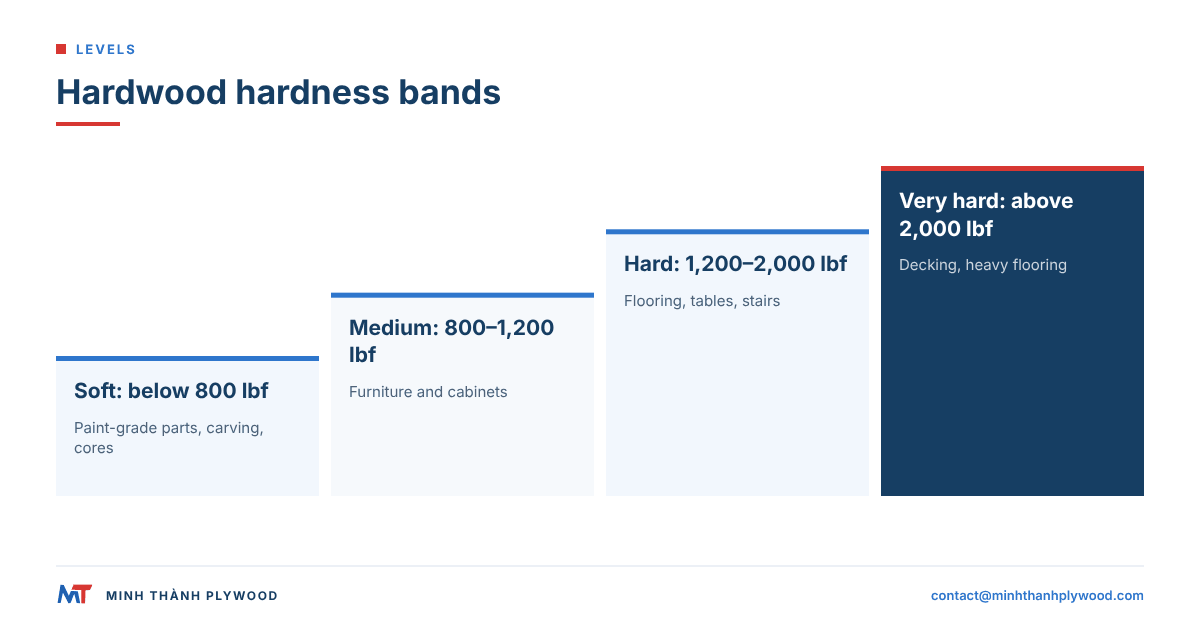
Hard wood types ranked by Janka hardness tell you how a floor or tabletop will resist dents. Above about 1,000 lbf a wood suits floors and tabletops; below about 600 lbf it suits paint-grade parts, carving and plywood cores.
| Hardness band | Janka range | Hardwoods | Typical use |
|---|---|---|---|
| Very hard | Above 2,000 lbf | Ipe, purpleheart, spotted gum, lignum vitae | Decking, heavy flooring |
| Hard | 1,200–2,000 lbf | Hickory, jarrah, wenge, maple, beech, sapele, white oak, ash, red oak, iroko | Flooring, tables, stairs |
| Medium | 800–1,200 lbf | European oak, teak, walnut, cherry, rubberwood, mahogany | Furniture, cabinets |
| Soft | Below 800 lbf | Alder, yellow poplar, basswood, okoume, balsa | Paint-grade parts, carving, plywood faces and cores |
Hardness is one input. Stability, durability, workability, colour, supply and price usually decide the purchase.
Which hardwood should you use for each job?
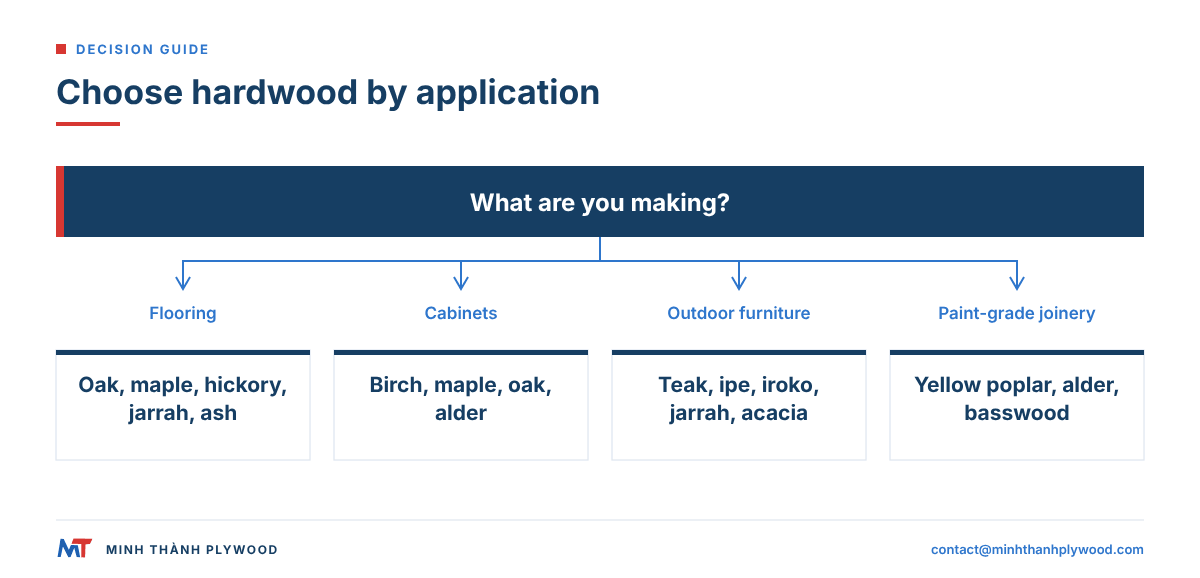
Choose the hardwood by the job, then by budget. The short list by use:
- Flooring: oak, hard maple, hickory, jarrah, ash.
- Fine furniture: walnut, cherry, oak, sapele, mahogany.
- Kitchen cabinets: birch, maple, oak, alder; plywood carcasses with hardwood faces.
- Outdoor furniture and decking: teak, ipe, iroko, jarrah, acacia, eucalyptus, white oak.
- Paint-grade joinery: yellow poplar, alder, basswood, poplar plywood.
- Bent and turned parts: beech, ash, hickory.
- Large flat panels: hardwood plywood, because solid boards wider than a log cannot stay flat.
Solid hardwood moves with humidity across the grain. For wide panels such as cabinet sides, tabletops, shelves and doors, factories use plywood faced with the chosen hardwood, which holds its size because each veneer layer runs across the one below.
Timber hardwoods and the law: EUDR, CITES and the Lacey Act
Every hardwood shipment into the EU, the UK or the US needs proof of legal origin. Four rules apply most often:
- EU Deforestation Regulation: Regulation (EU) 2023/1115 covers wood and wood products, including plywood, placed on the EU market. Operators must show the product is deforestation-free and legally harvested, with geolocation of the plots where the wood grew.
- CITES: the Convention on International Trade in Endangered Species lists timbers such as genuine mahogany, most rosewoods, three bubinga species and lignum vitae; trade needs CITES permits.
- UK Timber Regulation: importers into the UK follow the UK Timber Regulation (UKTR), in force since 1 January 2021, whose due diligence rules match the old EU Timber Regulation; the GOV.UK timber guidance sets them out.
- US Lacey Act: importers declare the genus, species and country of harvest of the wood in each product.
For Minh Thanh orders, we supply the EUDR compliance dossier (origin records and geolocation files) with orders, and face and core species with Vietnamese harvest origin for the importer’s Lacey Act declaration. Plantation species such as eucalyptus, Styrax and acacia carry plot records that make these files straightforward.
What are the types of hardwood plywood?
Hardwood plywood is plywood with a hardwood face veneer, classed by face species, core and glue. The face sets the look; the core sets weight, flatness and screw holding; the glue sets moisture resistance and emission.
| By face | By core | By glue |
|---|---|---|
| Birch: pale, hard, for furniture and laser cutting | Hardwood veneer core (Styrax, eucalyptus, poplar, birch) | UF glue at E0 emission for interior furniture |
| Poplar: light, smooth, for paint and lamination | Softwood veneer core (pine) | MR / melamine-fortified for kitchens and bathrooms |
| Okoume: light pink-brown, for decorative panels | MDF or particleboard core for flat veneered panels | Phenolic (WBP) for exterior and construction |
| Bintangor and gurjan: reddish, commercial and truck use | Blockboard core (solid strips) | |
| Eucalyptus: hard, for construction and formwork | ||
| EV (engineered veneer): oak, walnut, teak, wenge looks |
Minh Thanh makes hardwood plywood with 10+ face veneers, most produced in EV, poplar, birch, okoume and pine, plus bintangor, eucalyptus, gurjan and sapele on request, on white Styrax or Eucalyptus cores. Panels are made 3–40 mm thick in 1220 × 2440 mm and 1250 × 2500 mm, with sanded faces and thickness tolerance down to ±0.2 mm.
How do you specify hardwood plywood?
Write the order in six lines, and the price and sample will match what your plant needs:
- Application: cabinets, furniture, wall panels, flooring base, packing.
- Core: white Styrax for light, flat panels; Eucalyptus for harder, heavier panels.
- Glue and emission: UF at E0 emission for interiors; MR or phenolic for damp and exterior use. CARB P2 / TSCA Title VI certified (ICTT mill no. 23024) for US orders.
- Face and back: species and grade pair, such as birch D+/D or poplar A/B.
- Size and thickness: for example 18 mm, 1220 × 2440 mm, ±0.2–0.3 mm.
- Packing and quantity: sheets per pack, total sheets or m³, destination port.
Minh Thanh Plywood ships from Vietnam: MOQ one 40HC, 15–45 days after the 30% deposit, FOB Hai Phong, CFR or CIF, free samples. Furniture plywood starts from US$350/m³ (October 2026). Send your specification to contact@minhthanhplywood.com or browse Minh Thanh plywood products.
Buyer questions, answered
What are the main types of hardwood?
The main groups are temperate hardwoods (oak, maple, ash, walnut, cherry, beech, birch, poplar), tropical hardwoods (teak, mahogany, sapele, meranti, iroko), exotic woods (purpleheart, wenge, padauk), Australian eucalypts (jarrah, spotted gum) and Asian plantation hardwoods (eucalyptus, acacia, rubberwood).
What is the most common hardwood?
Oak is the most widely used hardwood in North American and European furniture and flooring, with red oak the largest US hardwood lumber species. In Southeast Asia, plantation eucalyptus and acacia lead by volume.
What are exotic woods?
Exotic woods are hardwoods imported from outside the buyer's region, usually tropical, and chosen for unusual colour, figure or density, such as purpleheart, wenge, padauk, zebrawood and bubinga. Many need CITES or legality papers.
What is the hardest hardwood?
Among commercial timbers, lignum vitae and quebracho are among the hardest, above 4,000 lbf on the Janka test. Ipe, at about 3,500 lbf, is the hardest common decking hardwood.
Is hardwood always harder than softwood?
No. Hardwood means a broadleaved flowering tree, not a hard timber. Balsa is a hardwood and very soft; yew and larch are softwoods and harder than poplar or basswood.
What are examples of hardwood used in furniture?
Oak, walnut, maple, cherry, ash, beech and birch in temperate markets; teak, sapele, mahogany and rubberwood in tropical and Asian production. Plywood faced with birch, oak-look EV or okoume covers most panel parts.
Which hardwood is best for outdoor use?
Teak, ipe, iroko, jarrah and white oak heartwood resist decay and weather well. Sapwood of any species, and non-durable timbers such as beech, maple and poplar, need treatment or a covered location.
What are the types of hardwood plywood?
Hardwood plywood is classed by its face veneer (birch, poplar, okoume, bintangor, eucalyptus, oak, walnut, EV), its core (hardwood veneer, softwood, MDF or particleboard) and its glue (interior UF, MR, phenolic).
Is eucalyptus a hardwood?
Yes. Eucalyptus is a broadleaved flowering tree, so its wood is a hardwood. Plantation eucalyptus from Vietnam and Brazil is used for plywood cores, faces, pallets and outdoor furniture.
Do hardwood imports need legal paperwork?
Yes. The EU requires due diligence under Regulation (EU) 2023/1115, the US Lacey Act requires a species and origin declaration, and CITES-listed species need permits for international trade.